

The AI PC as a new central hub: What will be calculated locally in the company in the future – and what makes the cloud irreplaceable
Xpert Pre-Release

Available in 27 languages 📢
Prefer Xpert.Digital on GoogleⓘPublished on: July 7, 2026 / Updated on: July 7, 2026 – Author: Konrad Wolfenstein
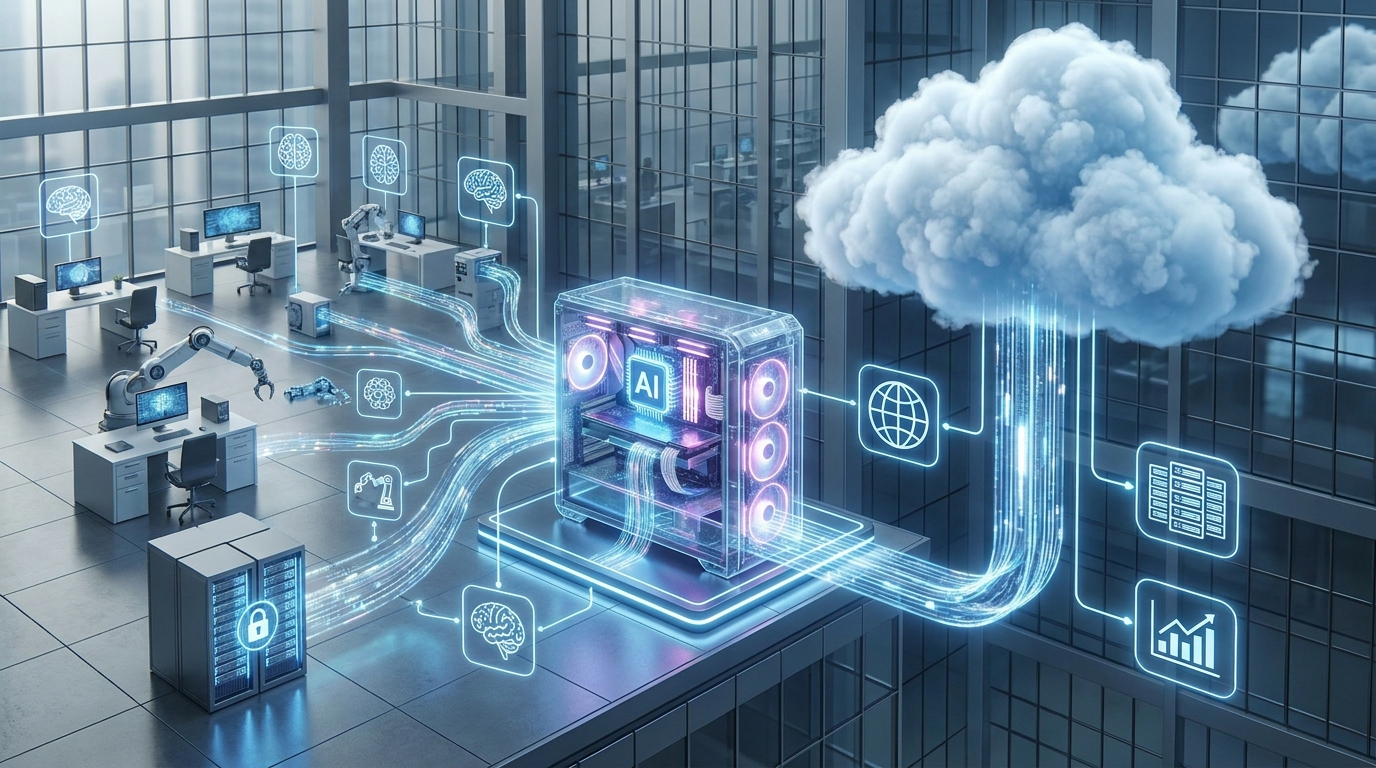
The AI PC as a new central hub: What will be calculated locally in the company in the future – and what makes the cloud irreplaceable – Image: Xpert.Digital
The end of the cloud monoculture: Which AI tasks companies will have to calculate locally in the future
Cost explosion in the cloud: Why Microsoft and Nvidia are bringing AI to your desk now
The future is hybrid: When does expensive cloud AI really still pay off for businesses?
For years, an unwritten rule prevailed in the tech world: anyone wanting to use artificial intelligence needed the cloud. But this monoculture is now facing serious challenges. Exploding costs for API calls, latency issues in everyday work, and the stringent requirements of the GDPR are increasingly forcing companies to rethink their strategies. This is precisely where a new generation of hardware comes in, one that could revolutionize the market: the AI PC. With immense local computing power and specially optimized models, Microsoft, Nvidia, and others are bringing artificial intelligence directly to the desktop – entirely without an internet connection or data leakage. But does this mean the end of data centers? Not at all. The architecture of the future is hybrid. Learn which tasks will absolutely have to run on the endpoint in the future, for which workloads the cloud will remain indispensable, and how companies can successfully navigate this strategic boundary without falling into cost and compliance traps.
The end of the cloud monoculture: Why AI is now on the table
For years, a tacit agreement prevailed in the corporate world: artificial intelligence was a matter for the data center. Those who wanted to use AI sent their data to the cloud, waited for the response, and paid per token, per API call, per second of GPU time. This was convenient, quick to deploy, and required no dedicated hardware. But it was expensive, raised data privacy concerns, and created a strategic dependency.
This model is now under pressure – from two sides simultaneously. On the one hand, cloud AI costs are exploding: According to Gartner, the average AI bill for large companies has risen from $1.2 million in 2024 to around $7 million in 2026. On the other hand, the hardware performance of local devices has increased to such an extent that true AI processing is now possible directly on the workstation. Microsoft and Nvidia recognized this opportunity and responded in the spring and summer of 2026 with a coordinated platform strategy: the AI PC as a fully-fledged processing unit in the enterprise environment.
The global market for edge AI—that is, AI that runs on the end device rather than in the cloud—is developing rapidly. While various market research firms report slightly different figures, they all point in the same direction: Fortune Business Insights estimates the edge AI market at $47.59 billion in 2026 and expects it to reach $385.89 billion by 2034. Grand View Research projects market growth from $30.0 billion in 2026 to $118.7 billion by 2033, representing a compound annual growth rate (CAGR) of 21.7 percent. While these figures are broad and encompass industrial applications far beyond the PC sector, they signal a structural shift: computing power is moving to the edge of the network, directly to the people who need it.
From marketing promise to architectural decision: The technical basis of the AI PC
What exactly is an AI PC? The answer is less clear-cut than Microsoft initially made it seem. With the introduction of the Copilot+ PC class in the summer of 2024, Microsoft defined a new device category: at least 40 TOPS (trillion operations per second) of computing power from the integrated NPU (Neural Processing Unit), at least 16 GB of RAM, and 256 GB of SSD storage. The central requirement was that certain AI functions—speech processing, image generation, summarizing—should run locally on the device without relying on the cloud.
However, just two years later, Microsoft had to relax these strict guidelines. Since June 14, 2026, computers without the Copilot+ label can run local AI workloads if they have an Nvidia GeForce RTX 30 series graphics card or newer with at least 6 GB of video memory. The reason is technically straightforward: Modern graphics cards are more powerful for many AI tasks than specialized NPUs in notebook chips. An RTX graphics card can often run local language models better and faster than the smaller neural processors found in ultrabooks.
The true centerpiece of the new strategy is the Nvidia RTX Spark – an ARM-based superchip jointly unveiled by Nvidia and Microsoft at Computex 2026. The chip combines a 20-core Grace processor with a Blackwell GPU and up to 128 GB of LPDDR5X memory, which is shared by the CPU and GPU. Its reported AI computing power is one petaflop, enabling the local execution of language models with up to 120 billion parameters and context windows of over one million tokens. This is a level of performance that, just three years ago, was only achievable in hyperscaler data centers.
The software foundation is OpenShell, an open-source runtime environment for Windows 11 on ARM developed jointly by Nvidia and Microsoft. It runs AI agents in isolated environments and prevents applications from accessing personal data without oversight. Users can define permissions with granular control, while Windows enforces the defined security policies. This is no small feat: it addresses precisely the control problem that is difficult to solve in cloud-based AI systems.
The first devices with RTX Spark – including the Surface Laptop Ultra and workstations from Asus, Dell, HP, Lenovo, and MSI – are expected to launch in fall 2026. However, pricing is clearly in the premium segment: entry-level configurations are expected to start at around €2,700, while fully equipped systems could cost well over €5,000. The Surface Laptop 8 for Business is already available for €3,299, and the RTX Spark Dev Box for local AI development starts at €4,999.
The local model in operation: Microsoft's Phi Silica and its successors
In parallel with its hardware strategy, Microsoft is expanding its model stack for local execution. The best-known local model in the Windows ecosystem is Phi Silica – a compact, NPU-optimized language model that runs directly on Copilot+ PCs. Available as part of the Windows App SDK, it provides access to local language model APIs for tasks such as chat processing, mathematical solutions, code generation, and text reasoning – all without a cloud connection.
Phi Silica has been available for Nvidia GPUs since 2026 and can be downloaded via Windows Update on systems with at least 6 GB of VRAM. Specifically, Microsoft uses this model for, among other things, directly summarizing emails on the device. This may sound like a small feature, but it's economically significant: Every summary calculated locally not only saves an API call in the cloud, but also runs without an internet connection and doesn't share email content with external services.
Phi Silica is complemented by Microsoft's new MAI model family, introduced in June 2026. MAI Thinking-1 is designed for reasoning tasks with a 128K context window, while MAI Code-1 is intended for programming tasks and aims to replace OpenAI models within GitHub Copilot. Microsoft claims to have reduced internal operating costs by up to 90 percent with these proprietary models – while the partnership with OpenAI continues in parallel. This illustrates the fundamental principle of the hybrid strategy: standard tasks are run internally and cost-effectively, while peak performance continues to come from the cloud.
For developers, Microsoft provides Windows AI Foundry – a unified platform that supports the AI developer lifecycle from model selection and fine-tuning to deployment on CPU, GPU, NPU, and cloud. This is the strategic framework: Microsoft doesn't want to force developers to choose between on-premises and cloud, but rather offer both seamlessly within a single development environment, leaving the runtime decision to the system.
What will run on the device in the future: Specific applications in everyday business life
The crucial question for companies is not what is technically possible, but what should be implemented locally in daily operations. Three criteria define this boundary: latency, data protection, and cost.
Local execution is superior wherever a fast response without network latency is needed. This applies to real-time speech recognition and dictation functions, automatic noise reduction in video conferences, camera effects and background removal, as well as live captioning of conversations. Microsoft integrates precisely these functions into Windows 11 as local features on Copilot+ PCs. They are short, repetitive tasks with high latency requirements – ideal for local execution.
Document analysis and internal knowledge management represent a particularly strong use case. Local AI systems can analyze, summarize, and search contracts, invoices, and internal documents for specific clauses without sensitive business information leaving the company network. Retrieval-Augmented Generation (RAG) allows a locally running AI model to access company manuals, process documentation, and email archives and answer natural language queries. According to Gartner, such internal knowledge assistants reduce information retrieval time in small and medium-sized enterprises (SMEs) by an average of 30 to 40 percent.
Local execution is also becoming increasingly attractive for supporting text creation and communication. Windows 11 is getting a new, locally running writing assistant that is also available offline on Copilot+ PCs. Phi Silica can be used directly within applications for text suggestions, rewording, and corrections. For companies with high communication volumes and sensitive customer data—for example, in legal consulting, finance, or medicine—this means AI support without sharing data with external providers.
In software development, local code assistants enable AI-powered programming without sharing proprietary source code. This is particularly relevant for companies that develop their own software and need to protect their competitive advantages through technological know-how. Microsoft's Intelligent Terminal, introduced in June 2026, integrates AI support directly into the command line, offering command suggestions, error explanations, and workflow support.
For SMEs with regular workloads, a clear economic logic emerges: Local AI systems for 10 to 20 users cost a one-time fee of €4,000 to €12,000 for hardware and setup, with annual follow-up costs of €500 to €1,500. This contrasts with cloud AI subscriptions for 15 users, which typically cost €3,000 to €6,000 per year. According to an analysis by Andreessen Horowitz, local AI systems pay for themselves within 12 to 18 months for companies with more than 20 daily AI users. Beyond this threshold, the investment in hardware becomes more cost-effective in the long run compared to ongoing cloud subscriptions.
Data protection as a strategic advantage: GDPR, EU AI Act and control over sensitive data
In no other area is the advantage of local AI processing as clear as in data protection. According to a Bitkom study, 53 percent of German companies cite legal hurdles and uncertainty as key obstacles to AI deployment, while 48 percent cite stringent data protection requirements. The study also found that 70 percent of German companies have already halted innovation plans due to legal uncertainties surrounding data protection. Local AI systems address this problem structurally: If data never leaves the company network, the risk of data transfer to third countries (Articles 44–49 GDPR), the risk of data reuse for provider training, and, in many cases, the need for a data processing agreement under Article 28 GDPR are eliminated.
In its guidance document on AI and data protection from May 2024, the German Data Protection Conference (DSK) explicitly designated closed, local systems as "preferable from a data protection perspective." The GDPR's fundamental obligations, such as legal basis, purpose limitation, and data protection impact assessment, still apply – but the risk assessment is structurally more favorable for local systems. For professionals bound by confidentiality, such as lawyers, doctors, and tax advisors, fully local processing is often the only legally compliant option, as cloud-based AI carries the risk of criminally relevant disclosure to the provider under Section 203 of the German Criminal Code (StGB).
The EU AI Act, which has been gradually coming into force since August 2024, reinforces this trend. According to Article 13 of the AI Act, transparency and traceability of AI decisions are mandatory for high-risk applications – a requirement that locally operated systems can structurally meet more easily than black-box cloud APIs. However, those using local agents must be aware that the regulatory burden doesn't shift away; it merely shifts into their own organization. Which data is used, how decisions remain traceable, and how updates are managed must all be integrated into internal company processes.
The greatest data privacy risks arise precisely where Microsoft has integrated its most spectacular AI features: Windows Recall. This feature continuously takes screenshots of screen activity and semantically indexes them, allowing users to search their entire computer history. Data privacy experts warn of serious risks: the AI captures sensitive data such as passwords and confidential documents, and companies face GDPR violations. It is telling that Recall is one of the few features that remains exclusive to a dedicated NPU on a Copilot+ PC and does not run on GPU systems. This technical exclusivity is less a mark of quality than a decision to limit control over a particularly sensitive function.
🎯🎯🎯 Data-driven B2B industry hub as a quasi-in-house solution

The quasi-in-house solution: How Xpert.Digital closes operational gaps in B2B marketing and sales – Smart Content-Driven Business - Image: Xpert.Digital
Xpert.Digital is a data-driven B2B industry hub led by Konrad Wolfenstein . The company acts as an external, quasi-in-house solution for industrial partners, closing operational gaps in marketing, content, and sales – without requiring additional resources on the client side.
More information here:
Local AI vs. Hyperscalers: When does in-house hardware pay off?
The cloud remains indispensable: Where local AI reaches its limits
As attractive as local processing is for many everyday tasks, the limitations of this approach are clear. Training large language models will foreseeably remain the exclusive domain of the cloud. Mid-sized IT departments are not equipped for this, and even large companies cannot provide the necessary resources with legacy systems at a reasonable cost. Even an RTX Spark system with one petaflop of AI performance and 128 GB of memory is a matchstick compared to a modern hyperscaler cluster. Training a competitive frontier model requires thousands of high-performance GPUs, months of computing time, and billions in investment – this remains the domain of OpenAI, Anthropic, Google, and Microsoft themselves.
The same applies to fine-tuning large models to proprietary data. Although parameter-efficient methods like LoRA have significantly simplified this process, and Microsoft even offers a LoRA adaptation for Phi Silica, full fine-tuning of large models remains resource-intensive. Companies that want to train a 70-billion-parameter model on their specific business data will still need to do so using cloud resources.
For irregular, sporadic AI requests with high computational demands, the cloud remains more cost-effective. According to the FinOps Foundation, inference workloads consume 80 to 90 percent of ongoing AI costs, but GPU utilization in cloud operations is often only 15 to 30 percent. Users who rarely access a large model only pay for what they use in the cloud – whereas a local workstation consumes power and ties up capital even when idle. Investing in expensive local hardware only becomes worthwhile above a certain usage volume.
Applications that rely on the latest models and are expected to benefit from short-term model improvements are still better suited to the cloud. Local models require active updates, which entails administrative overhead. Cloud providers update their models continuously without requiring any user intervention. Those who need the most powerful available model for complex tasks such as legal reasoning, medical diagnostics, or creative writing will continue to rely on cloud-based frontier models – because, according to current benchmarks, quantized local models achieve around 90 to 95 percent of the performance of GPT-40 for typical business applications, but the cloud still offers significant advantages for highly complex tasks.
Ultimately, collaborative, enterprise-wide AI workloads are better suited to the cloud. When 500 employees need to access a central AI model simultaneously, utilize a shared knowledge repository, and synchronize results in real time, the cloud is the natural platform. Microsoft positions Windows 365 and the Microsoft 365 Copilot suite precisely for this purpose: as a cloud-based collaboration infrastructure that complements, but does not replace, on-premises processing.
Hybrid architecture as a strategic blueprint for companies
The most intelligent enterprise architecture is neither purely on-premises nor purely cloud-based, but hybrid – and based on clearly defined criteria. The principle is simple: Fast, sensitive, everyday tasks move to the device. Everything that is large, expensive, and extremely computationally intensive remains in the data center. Between these extremes lies a gray area where situational decisions should be made based on latency, data sensitivity, and cost.
For a medium-sized company, this architecture could look like this: On the local PC, real-time speech recognition runs daily during customer interactions, along with the summarization of emails and meeting minutes, an internal knowledge assistant based on RAG with company documents, and text correction and formulation assistance. In the cloud, training and fine-tuning of company-specific models runs twice a quarter, along with sporadic analyses of large datasets, complex legal or strategic reasoning requiring the best available frontier models, and the provision of AI services to all employees simultaneously via Microsoft 365 Copilot.
This hybrid approach combines the best of both worlds: the data control, offline capability, and high-volume cost efficiency of an on-premises solution with the scalability, model real-time accuracy, and collaboration capabilities of the cloud. 98 percent of FinOps teams now actively manage AI spend, compared to just 31 percent two years ago. This demonstrates that companies have recognized the complexity of hybrid AI cost models as a real challenge.
A practical decision tree for companies looks like this: Is sensitive data processed regularly, for which transferring it to a third country would be problematic? Then local processing is the first choice. Are AI functions used intensively and daily by many employees? Then local hardware pays off in the medium term. Are peak performance and the latest model generations needed sporadically? Then the cloud remains the more efficient option. Do models need to be regularly trained with new company data? Then cloud infrastructure is indispensable.
Strategic risks: What companies must not overlook during the transition
The shift to local AI carries risks that are often underestimated during the planning phase. The most serious is technological fragmentation: with each hardware generation, Microsoft changes the target platform for local AI functions. Initially, the NPU was intended to be the preferred foundation, but now the GPU is once again taking center stage, with models running in parallel on CPU cores, integrated GPUs, dedicated graphics cards, and NPUs. For developers integrating AI functions into Windows applications, this means more effort, more testing, and more uncertainty. Companies investing heavily in NPU-optimized hardware today could find in two years that the market has drifted in a different direction.
The second strategic risk is the productivity illusion. Despite the global AI boom, nearly 90 percent of companies surveyed in an international poll of around 6,000 executives reported that they had not observed any significant impact of AI on productivity or employment over the past three years. On average, employees use AI tools for only about 1.5 hours per week. AI tools are often used as a supplement, without fundamentally changing workflows, and the necessary quality assurance often negates any time saved. The best hardware is useless if employees don't know how to integrate AI into their actual work processes.
Gartner predicts that more than 40 percent of AI-powered projects will be abandoned by the end of 2027, primarily due to unclear economic viability. This is a sobering forecast given the enormous investments companies are currently making in AI infrastructure. Anyone investing today in expensive AI PCs for their entire workforce without first validating the actual usage levels and specific use cases risks a costly misinvestment.
The shifting boundary: What the office routine of the future will feel like
When all the technical, economic, and regulatory developments are considered together, a clear picture of everyday office life emerges in three to five years. AI will become less visible—not because it will be less prevalent, but because it will be more deeply integrated into everyday tools. The question "Should I use AI now?" will no longer arise, because AI support will automatically appear where it is needed: when typing an email, opening a document, or starting a video conference.
Windows 11 is moving in this direction with features like "Hey Copilot" for direct voice interaction, Click to Do for context-aware AI actions on any text and images, and an improved semantic search that finds documents by content rather than filename. Microsoft is positioning Copilot as a central "super app" that is slated to combine chat, coworking, and coding capabilities by summer 2026. AI tasks can now be run locally on more than 500 million PCs via the company's own Windows ML platform—a figure that underscores the reach of this transformation.
The real shift, however, is not technical, but mental. Companies will stop viewing AI as an external service, something you book like a data center, and begin treating it as an integrated part of their own infrastructure – with all the advantages of control, but also all the responsibilities of ownership. Anyone running an AI model locally has to maintain it, update it, secure it, and ensure compliance. The convenience of the cloud comes at a price, not only in euros, but also in dependency and data sharing. Local AI comes at a price, not only in hardware investments, but also in operational overhead.
The most accurate description of this development is provided by the architecture itself: The AI PC doesn't replace the cloud – it merely shifts the boundary. Everything that is fast, sensitive, or routine moves to the device. Everything that is large, expensive, and extremely computationally intensive remains in the data center. And the companies that consciously and strategically define this boundary – instead of leaving it to chance or default settings – will reap the greatest benefits from the next generation of AI workplaces.
Your global marketing and business development partner
☑️ Our business language is English or German
☑️ NEW: Correspondence in your native language!

Konrad Wolfenstein
I and my team are happy to be available to you as your personal advisor.
You can contact me by filling out the contact form here [email protected]:or simply call me at +49 7348 4088 965. My email address is
I'm looking forward to our joint project.
☑️ SME support in strategy, consulting, planning and implementation
☑️ Creation or realignment of the digital strategy and digitization
☑️ Expansion and optimization of international sales processes
☑️ Global & Digital B2B trading platforms
☑️ Pioneer Business Development / Marketing / PR / Trade Fairs
📈🚀 From visibility to trust 👀🤝 Your scalable path with Xpert.Digital

From visibility to trust: Your scalable path with Xpert.Digital - Image: Xpert.Digital
In industrial B2B, sustainable business relationships rarely emerge overnight. They develop step by step – through visibility, professional relevance, recurring touchpoints, and growing trust. Xpert.Digital's 4-stage model addresses precisely this: It offers a structured path that begins with a manageable entry point and can evolve into deeper collaboration in business development if needed.
Instead of relying on loud marketing promises, this model puts the relationship at the forefront. Companies start with clearly defined, easily calculable measures and then decide, based on their own experience, how far they want to expand the collaboration. A key factor for this undisturbed trust-building process: The platform completely avoids annoying advertising ads, so the editorial focus remains solely on the companies' expertise.
More information here:









