
Google Cloud as a kingmaker: New business models through cloud infrastructure
Xpert Pre-Release

Available in 27 languages 📢
Prefer Xpert.Digital on GoogleⓘPublished on: August 24, 2025 / Updated on: August 24, 2025 – Author: Konrad Wolfenstein
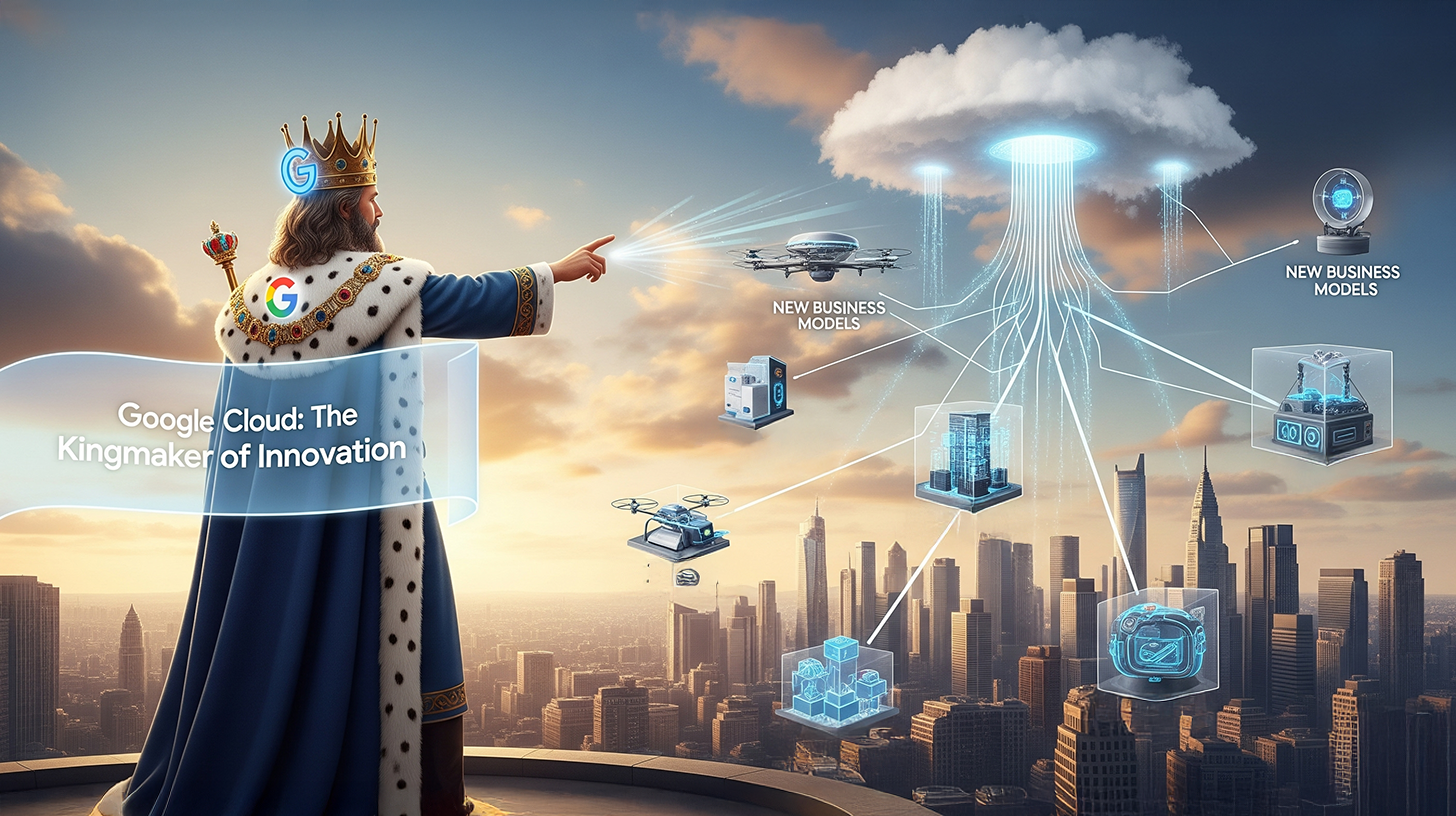
Google Cloud as a kingmaker: New business models through cloud infrastructure – Image: Xpert.Digital
Google's incredible power: This is why even rivals like Meta and OpenAI are paying billions to their competitor
### The Secret Behind ChatGPT: How OpenAI Secretly Accesses Google's Most Important Resource to Function ### Google's Secret AI Weapon: This Chip Is Competing with Nvidia and Fueling Countless New Startups ### More Than Just a Search Engine: Google's Hidden Power That Even Its Biggest Competitors Need to Use ### Meta, OpenAI, Apple: They All Depend on Google – And Here's the Amazing Reason Why ###
The kingmaker of the tech world: How Google quietly pulls the strings and creates new tech giants
While Google acts as a direct competitor to companies like Meta or OpenAI in many areas, a remarkable development is taking place behind the scenes: These tech giants are increasingly reliant on their rival's infrastructure. Google Cloud has evolved from a mere provider of server and storage space into a fundamental "kingmaker," laying the technological foundation for the business models of the future—even those of its own competitors. A ten-billion-dollar deal with Meta is just the tip of the iceberg of a strategy resting on several pillars: access to highly specialized hardware such as its own TPU chips, the indispensable quality of its search index, which is even used by AI systems like ChatGPT, and a comprehensive platform that enables smaller companies to develop complex AI solutions. This transformation positions Google not just as a service provider, but as a central ecosystem that catalyzes innovation across all industries and redefines the rules of the digital economy.
Suitable for:

What does it mean when Google Cloud becomes the kingmaker of new business models?
Google Cloud has evolved from a pure cloud provider into a crucial infrastructure enabler, allowing other companies to establish entirely new business models. This development is particularly evident in the fact that even direct competitors like Meta and OpenAI rely on Google's infrastructure. Meta, for example, has signed a six-year, $10 billion contract with Google Cloud to gain access to servers, storage, networks, and Nvidia GPUs in Google's data centers.
What makes this so remarkable is the fact that Meta and Google are direct competitors in numerous areas – from advertising to social media. Yet Meta is willing to make such a massive investment in its competitor's infrastructure. This illustrates how Google Cloud has become an indispensable foundation for the business models of other companies.
Which established business models already use Google Cloud as a foundation?
The established business models based on Google Cloud are diverse and span various industries and use cases. A prominent example is the AI lab ecosystem, where companies like OpenAI and Anthropic utilize Google Cloud for additional computing capacity. OpenAI, which previously relied exclusively on Microsoft Azure, recently began using Google Cloud to meet its growing computing needs.
Another established model is that of SaaS providers who build their services on Google Cloud Platform. These companies can focus entirely on their core competencies while Google provides the entire infrastructure. This enables startups and established companies alike to develop scalable solutions without having to make massive investments in hardware.
In the field of data analytics, business models have emerged that are based on Google's BigQuery and other data processing services. Companies can now offer data-driven services that would not be possible without the massive computing power of Google Cloud. These models range from business intelligence services to complex machine learning applications.
How does Google Cloud enable new AI labs to enter the market?
Google Cloud has proven to be a crucial catalyst for new AI labs by providing them with access to specialized hardware such as TPUs (Tensor Processing Units). These Google-developed chips are specifically optimized for machine learning and offer an alternative to the often scarce and expensive Nvidia GPUs. For AI startups, this means they can enter the market without their own data centers or massive hardware investments.
TPU technology is particularly relevant because it is optimized for specific AI workloads such as training neural networks. Google introduced the first TPU back in 2016 and has continuously developed improved versions since then. These chips are specialized in performing the mathematical operations that form the backbone of AI models and can be more efficient than conventional processors.
Additionally, Google Cloud offers a comprehensive machine learning platform through Vertex AI. This platform simplifies the entire ML workflow, from data preprocessing and model training to deployment. New AI labs can leverage these tools to rapidly prototype and scale their solutions without having to worry about the underlying infrastructure.
What role does Google play in the search infrastructure of other AI systems?
One particularly interesting development is Google's indirect role as a data provider for competing AI systems. OpenAI, for example, secretly uses Google's search results via the third-party provider SerpAPI. SerpAPI is a web scraping service that extracts search results and passes them on to clients. This data helps ChatGPT answer current questions about news or stock market information.
Other major AI providers, such as Apple, Perplexity, and Meta, also use SerpAPI to access Google's search index. The quality and depth of a search index directly impact the performance of AI responses. Anthropic uses the Brave index for Claude, but its API results have not yet reached the level of Google's.
This reliance on Google's search infrastructure demonstrates how the company has become an indispensable component of the AI ecosystem, even for direct competitors. While companies like OpenAI are working in the long term to build their own search indexes, for the time being they remain dependent on Google's data to deliver high-quality answers.
What new business models are emerging as a result of TPU technology?
Google's TPU technology enables entirely new business models centered around specialized AI acceleration. Companies can now develop AI-as-a-Service offerings based on the superior efficiency of TPUs. These chips consume less power than comparable GPU solutions and are specifically optimized for TensorFlow workloads, making them more attractive for certain use cases.
A new business model is that of TPU-optimized software solutions. Developers can create applications specifically designed to leverage the advantages of TPUs and offer them as specialized services. This could range from accelerated image processing to real-time speech translation.
Furthermore, business models are emerging around TPU cluster management and optimization. Since TPUs are particularly effective in pod configurations, services are developing to help companies optimize their TPU usage and reduce costs. These consulting and management services are becoming a market segment in their own right.
How is Google Cloud changing the traditional software development model?
Google Cloud has fundamentally transformed the traditional software development model by allowing developers to focus on business logic while completely abstracting away the infrastructure. Serverless architectures like Google Cloud Functions and Cloud Run enable developers to write code without worrying about servers, scaling, or maintenance.
This shift has led to new business models where companies can develop services that scale automatically and only incur costs when they are actually used. The traditional model of upfront investment in servers and infrastructure is being replaced by usage-based billing, which is particularly attractive for startups and smaller companies.
Cloud-native development has also led to the emergence of new professions and service companies. Specialists in container orchestration, Kubernetes management, and multi-cloud strategies have become sought-after experts. Companies like Bechtle, adesso, and Wabion have positioned themselves as Google Cloud Premier Partners and offer specialized consulting and implementation services.
EU/DE Data Security | Integration of an independent and cross-data-source AI platform for all business needs

Independent AI platforms as a strategic alternative for European companies - Image: Xpert.Digital
AI Game Changer: The most flexible AI platform - Tailor-made solutions that reduce costs, improve your decisions and increase efficiency
Independent AI platform: Integrates all relevant company data sources
- Rapid AI integration: Tailor-made AI solutions for businesses in hours or days, instead of months
- Flexible infrastructure: Cloud-based or hosting in your own data center (Germany, Europe, free choice of location)
- Maximum data security: its use in law firms is irrefutable proof
- Deployment across a wide variety of enterprise data sources
- Choice of own or different AI models (DE, EU, USA, CN)
More about it here:
Digital transformation unleashed: Strategies for future-proof companies
What impact does the multi-cloud strategy have on new business models?
The multi-cloud strategy, in which companies use several cloud providers simultaneously, has led to the emergence of entirely new business models. Meta uses Google Cloud as well as Amazon Web Services, Microsoft Azure, Oracle, and CoreWeave. This diversification reduces dependence on a single provider and allows companies to combine the best services from different providers.
This has led to the emergence of new business models for multi-cloud management tools. Companies are developing platforms that enable the automatic migration of workloads between different cloud providers, based on cost, performance, or availability. These orchestration tools are becoming a market in their own right.
Specialized consulting firms are also emerging, helping companies develop optimal multi-cloud strategies. These services encompass not only technical implementation but also cost optimization, compliance management, and risk assessment. The complexity of multi-cloud environments is creating a sustained demand for specialized service providers.
Suitable for:

How do new business models emerge through AI infrastructures?
Google Cloud's AI infrastructure empowers businesses to develop entirely new business models based on artificial intelligence. Vertex AI and AutoML enable companies without in-depth AI expertise to develop and deploy their own machine learning models. This democratizes access to AI technologies and allows smaller businesses to offer AI-powered services.
One particularly interesting business model is that of AI Model-as-a-Service providers. These companies develop specialized AI models for specific industries or use cases and make them available via APIs. From predictive maintenance in industry to personalized recommendation systems in e-commerce, specialized AI services are emerging.
Furthermore, Google Cloud infrastructure enables new business models in the area of data monetization. Companies can use their data to train AI models and market these as services without having to disclose the raw data. This creates new revenue streams from existing data assets.
What future business models are emerging?
The future business models enabled by Google Cloud are already emerging in various sectors. One promising area is autonomous AI systems that can make independent decisions and execute actions. Google Cloud's infrastructure provides the necessary computing power and reliability for such systems.
Another trend is the emergence of edge computing business models. By distributing Google Cloud services to the network edge, companies can develop low-latency applications that respond in real time. This is particularly relevant for IoT applications, autonomous vehicles, and industrial automation.
Quantum computing represents another promising field. Google is one of the pioneers in this area and already offers access to quantum computers via the cloud. As this technology matures, entirely new business models will emerge, based on the superior computing power of quantum computers – from cryptography to complex optimization problems.
How does Google Cloud affect the data processing ecosystem?
Google Cloud has fundamentally transformed the data processing ecosystem by making tools like BigQuery accessible for large-scale data analytics. Companies can now analyze petabytes of data in seconds without having to operate their own data warehouses. This has led to the emergence of new business models based on real-time data analysis.
Data-as-a-Service providers use Google Cloud infrastructure to offer prepared datasets and analytical results as a service. These companies collect, process, and refine data from various sources and make it available to other businesses. From market research data to industry analyses, they create specialized data services.
Furthermore, Google Cloud enables the creation of data marketplaces where companies can securely monetize their data without losing control. Technologies like federated learning allow models to be trained without the raw data ever leaving the company's sphere of influence. This creates new opportunities for data collaboration between companies.
What role does Google Cloud play in digital transformation?
Google Cloud acts as a catalyst for the digital transformation of businesses, enabling new business models. Traditional companies can expand their existing business models with cloud-native technologies or develop entirely new digital services. The flexibility and scalability of the cloud allow companies to react quickly to market changes.
A particularly interesting aspect is the ability to test experimental business models with low risk. Companies can develop and test new services in the cloud without having to make large upfront investments. If an experiment is successful, it can be scaled quickly; if not, the resources can simply be released.
The cloud also enables new forms of collaboration between companies. Through APIs and cloud-based integrations, companies can seamlessly connect their services and build shared value chains. This leads to ecosystem business models where value is created through the networking of different services.
How do Google Cloud partners create new value?
Google Cloud Partners play a crucial role in the emergence of new business models, acting as intermediaries between complex cloud technology and customer business needs. These partners develop industry-specific solutions based on Google Cloud, but tailored to the unique requirements of specific industries.
System integrators like T-Systems and Go Reply have developed specialized business models based on their expertise with Google Cloud Services. They not only offer implementation services but also develop their own intellectual property (IP) in the form of pre-built solutions, accelerators, and industry-specific templates.
Another important aspect is the emergence of managed service providers that use Google Cloud infrastructure as the foundation for their own services. These companies manage the cloud environment for their customers and develop value-added services based on it. Specialized service offerings are emerging, ranging from monitoring and security to compliance and optimization.
What impact does Google Cloud's sustainability strategy have on new business models?
Google's commitment to sustainability and renewable energy is creating new business models in the field of green computing. Companies can improve their own sustainability strategy by using Google Cloud, as Google is committed to powering its data centers with 100% renewable energy.
This is leading to the emergence of Sustainability-as-a-Service offerings, where consulting firms help their clients improve their carbon footprint by migrating to Google Cloud. These services include carbon footprint tracking, sustainability reporting, and the optimization of cloud workloads for maximum energy efficiency.
Furthermore, new business models are emerging around green tech solutions. Companies are developing Google Cloud-based services for smart cities, energy management, and environmental monitoring. The combination of high-performance cloud infrastructure and sustainable energy supply makes such solutions particularly attractive to environmentally conscious customers.
Google Cloud as the infrastructure ecosystem of the future
Google Cloud has successfully evolved from a pure infrastructure provider to an enabler of entirely new business models. The platform allows companies of all sizes to develop innovative services without massive upfront investments in hardware and infrastructure. From AI startups developing TPU-based solutions to established companies accelerating their digital transformation, Google Cloud acts as a catalyst for innovation.
Google Cloud's particular strength lies in the combination of highly specialized hardware components like TPUs, comprehensive AI services like Vertex AI, and the underlying search and data infrastructure. This combination creates a unique ecosystem that even direct competitors like Meta and OpenAI leverage to advance their own business models.
Looking ahead, Google Cloud is expected to further expand its role as a kingmaker. With the ongoing development of quantum computing, edge computing, and autonomous AI systems, further new business models will emerge, built on Google's infrastructure. The democratization of access to cutting-edge technologies through cloud computing will continue to foster innovation and enable new market entrants to develop disruptive business models.
We are there for you - advice - planning - implementation - project management
☑️ SME support in strategy, consulting, planning and implementation
☑️ Creation or realignment of the AI strategy
☑️ Pioneer Business Development

Konrad Wolfenstein
I would be happy to serve as your personal advisor.
You can contact me by filling out the contact form below or simply call me on +49 7348 4088 965 (Munich) .
I'm looking forward to our joint project.
Write to me

Xpert.Digital - Konrad Wolfenstein
Xpert.Digital is a hub for industry with a focus on digitalization, mechanical engineering, logistics/intralogistics and photovoltaics.
With our 360° business development solution, we support well-known companies from new business to after sales.
Market intelligence, smarketing, marketing automation, content development, PR, mail campaigns, personalized social media and lead nurturing are part of our digital tools.
You can find out more at: www.xpert.digital - www.xpert.solar - www.xpert.plus
Keep in touch









