
$141,261.82 in focus: Deutsche Bank, Trump and the Russia trail – What's behind the suspicious payments to Baku
Xpert Pre-Release

Available in 27 languages 📢
Prefer Xpert.Digital on GoogleⓘPublished on: November 17, 2026 / Updated on: November 17, 2026 – Author: Konrad Wolfenstein
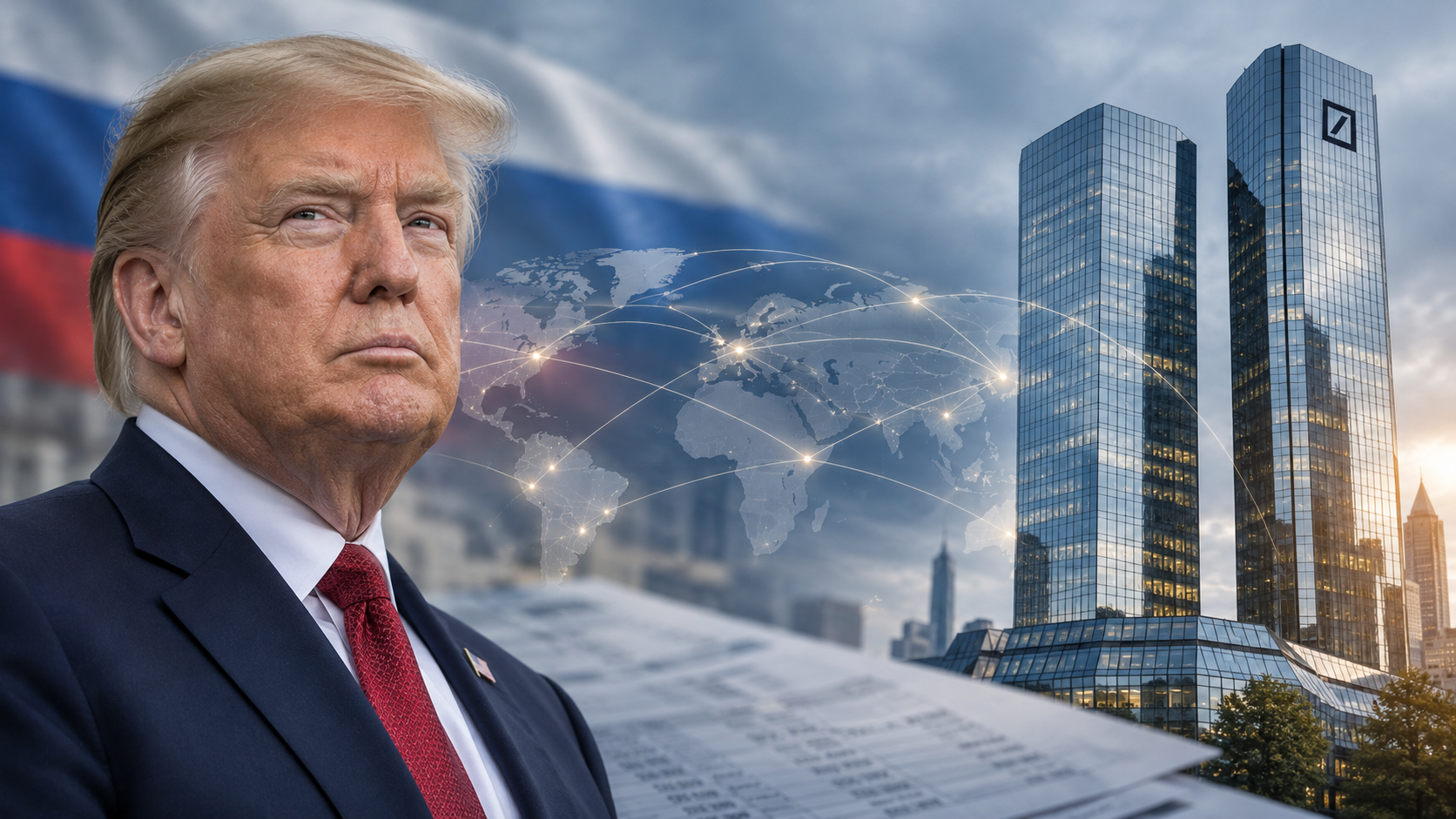
$141,261.82 in focus: Deutsche Bank, Trump and the Russia trail – What's behind the suspicious payments to Baku – Creative image on the topic, with AI: Xpert.Digital
New questions about payments to Trump companies: Russia connection, millions in flows, open questions
$141,261.82 in focus: Deutsche Bank, Trump and the Russia trail – What's behind the suspicious payments to Baku
New questions about payments to Trump companies: Russia connection, millions in flows, open questions
Deutsche Bank investigated Trump's business dealings: Why the payment methods raise questions
New research into internal Deutsche Bank documents raises questions about payments to two companies linked to Donald Trump's business circle. The focus is on THC Baku Services LLC and DT Marks Baku LLC, which appear in internal bank documents and suspicious activity reports related to unusual financial flows. A transfer of $141,261.82 to THC Baku Services LLC in April 2015 is particularly noteworthy. According to the published research, the sender, the British company Faberlex, was part of a complex network through which nearly $1 billion flowed within two years.
The documents point to possible links to money laundering networks with ties to Russia and Azerbaijan. However, they prove neither that Trump was personally involved in money laundering, nor that he knew of the illegal origin of the funds. Political interference is also not proven. There are crucial differences between a documented payment, a suspicion, and proof of a crime.
The case therefore raises questions primarily about the origin and purpose of the payments – and about how banks aggregate information on cross-border financial flows. The following analysis reveals what clues the published documents actually provide, where their limitations lie, and what answers are still missing for a final assessment.
The money arrived – but its origin, responsibility, and political significance remain unclear
New reports about suspicious payments to companies in Donald Trump's business circle raise a significant economic and political question: How reliably can international banks determine the true origin of funds when payments are routed through multiple countries, shell companies, and intermediary financial institutions? Two companies, THC Baku Services LLC and DT Marks Baku LLC, are at the center of the investigation. According to research by the international media project Inside Deutsche Bank, these companies appear in internal Deutsche Bank documents and several suspicious activity reports. Individual business partners of these companies are alleged to have had connections to money laundering networks linked to Russia and Azerbaijan. However, the published information does not prove either Trump's personal involvement in money laundering or his knowledge of the funds' illegal origin.
This distinction is crucial for a sound analysis. Different levels of evidence exist between a documented transfer, a well-founded suspicion of money laundering, proof of a crime, and political interference. Conflating these levels overstates the findings. Conversely, dismissing suspicious payment methods as insignificant underestimates the economic risks and the demands placed on banks, multinational corporations, and political officials.
The real significance, therefore, lies not solely in the size of individual payments. It lies in the combination of opaque corporate structures, cross-border payment processing, prominent recipients, and the question of how a bank consolidates its internally held knowledge. The case is thus simultaneously an investigation into potential financial crime and a lesson in the limits of institutional control.
What information research provides and where its limits lie
The BILD report by Jasper Bitter, published on November 17, 2026, draws on internal Deutsche Bank documents and cites, among others, Der Spiegel and Financial Mail. A more detailed account is provided by the investigation by Inside Deutsche Bank, published in outlets including Daraj and the Danish newspaper Berlingske. Berlingske describes a database of approximately 15 million confidential files. A key document is an internal memorandum from May 2020, allegedly compiled by Brian Hagerty, then a senior member of Deutsche Bank's US financial crime analysis team.
The detailed investigation highlights an important methodological detail: the information does not originate solely from a single suspicious activity report. Journalists combined information from internal bank documents with other documents, including a bank statement from the British company Faberlex. This allows for a more precise attribution of at least one specific payment than would be possible based on the internal memorandum alone. While this combination of documents increases the reliability of individual findings, it does not replace a complete review of all contracts, account transactions, and beneficial owners.
At the same time, there is a discrepancy regarding a key figure: While Daraj and BILD report transactions exceeding three million US dollars, Berlingske cites just under three million US dollars. Without a complete comparison of the underlying accounting records, this difference cannot be reliably resolved. Therefore, it is appropriate to classify this as a suspicious transaction volume in the range of approximately three million US dollars. It would not be reliable to derive from this a precisely determined amount of illegal proceeds or proven personal income for Trump.
Why a payment of $141,261.82 deserves special attention
The most precisely documented transaction concerns a transfer of US$141,261.82 to THC Baku Services LLC. According to research published by Daraj, a Faberlex bank statement shows that the payment was made on April 28, 2015. The same amount appears in an internal Deutsche Bank memorandum from May 2020. The bank statement thus establishes a link between a specific payment transaction and a subsequently documented anomaly within the bank.
From an economic perspective, it's not the absolute sum that's unusual. A payment of this magnitude can be perfectly plausible in an international real estate, branding, or service project. What makes it conspicuous is the identity and structure of the sender, their other financial transactions, and the lack of clarity regarding the economic context. A sum can only be meaningfully assessed if it's known what service it represents and why this particular company is settling the bill.
According to the research, the Faberlex bank statement identifies the transfer as a second invoice. Such a description provides a starting point, but not yet proof of actual service rendered. A reliable assessment would require the corresponding invoice, the contract, the service period, the identity of the client, and, if applicable, an agreement regarding payments by third parties. This complete chain of evidence is not evident from the published information.
Additionally, the journalists report that a few days earlier, the same amount had been transferred to DT Marks Baku LLC and subsequently recalled. This transaction is relevant to the analysis because recalled and redirected payments can easily be miscalculated when totaling transactions. Without a complete accounting record, the same economic transaction cannot be counted multiple times as a final cash inflow. Therefore, the publicly available information does not allow for an independent, cent-accurate reconstruction of the total net inflow.
Faberlex and the problem of economically difficult-to-explain transit companies
Faberlex's significance stems primarily from its substantial financial transactions. According to the published research, nearly one billion US dollars flowed into the company's account between May 2013 and May 2015. During the same period, precisely the same total amount was reportedly paid out. The company is linked to the so-called Azerbaijani money laundering network; Berlingske also reports on complex ownership structures and a lack of discernible evidence of legitimate business operations.
A high transaction volume with a low remaining account balance is not, in itself, proof of money laundering. Legitimate payment service providers, trading companies, or internal group accounting units also move large sums of money. The crucial factor is whether the business model, personnel, contracts, customer structure, and economic purpose are consistent with this payment volume. The less apparent operational substance, the more important a comprehensible explanation of the money movements becomes.
The economic function of a problematic conduit company can be to obscure the connection between the original lender and the final recipient. Each additional company and each change of bank account makes it more difficult to trace the transaction. The final recipient is not necessarily involved in the obfuscation. They may have provided a genuine service and still received money from a suspicious entity. Precisely for this reason, the origin of the money, the legality of the underlying transaction, and the recipient's knowledge of the transaction must be investigated separately.
For the Trump Society, this means that the documented receipt of Faberlex raises a significant need for clarification. However, it does not automatically prove that the receiving company billed for a fictitious service or that its officials were aware of the payment's criminal origin. The journalistic investigation provides a concrete suspicion, but not a legally binding judgment regarding the payment.
The Baku project explains the business context, but not yet the remittances
The two companies bear the name of the Azerbaijani capital, Baku. Trump's business group pursued a luxury real estate project there. Daraj and Berlingske describe a planned hotel and tower complex, respectively, as well as business relationships with a local partner associated with the influential Mammadov family. This background explains why such project companies existed and why payments related to Azerbaijan were, in principle, conceivable.
However, he does not answer the crucial question regarding the specific purpose of the payments. Berlingske explicitly states that the evaluated documents do not prove whether the suspicious transfers were actually related to the Baku project. Likewise, they provide no evidence that the named local business partner was connected to the specific payments, Faberlex, or any illegal activities. A sound analysis must maintain this boundary, even if a shared geographical connection seems plausible.
Economically, international brand and real estate projects require particular explanation when ownership, financing, construction, brand licensing, and management are distributed across various companies. An internationally recognized brand can generate revenue without actually owning the land or providing construction financing. This creates a control problem: The brand owner can profit financially, while the original sources of capital are located several levels away.
This is not a statement about the specific contractual arrangements in Baku, but rather the analytical standard against which such projects must be examined. The crucial question is which company was supposed to provide which service, who was obligated to pay, and why a company other than the direct contractual partner made the transfer. Only this allocation would allow a distinction to be made between an unusual but explainable payment method and an economically implausible transaction.
Project Broadway: Large test numbers are no substitute for precise evaluation
According to the BILD report, Deutsche Bank launched an internal investigation in 2017 called Project Broadway. Around 800 individuals and companies were reportedly scrutinized. The extensive international research describes the project as a response to government investigations and questions surrounding Trump's business dealings with the bank. The memorandum from May 2020 lists approximately 59 suspicious activity reports concerning 140 individuals and companies, which had been submitted by the previous month.
These figures reflect a comprehensive investigation. However, they do not allow for a direct conclusion about the number of illegal transactions or how many of the individuals investigated were actually suspects. The scope of the review, encompassing approximately 800 units, is not equivalent to the number of units mentioned in the reports. Similarly, 59 reports do not necessarily equate to 59 unrelated offenses.
A single report can involve multiple companies and numerous payments. Conversely, the same economic relationship can appear in several reports, for example, if new information comes to light. The role of a named company is also crucial: it can be the central subject of the audit, a payment partner, or merely part of a larger transaction context. International research reveals different classifications of the two Trump companies in various reports.
This leads to an important limitation of statistical interpretation. The published figures do not allow for a reliable calculation of the suspicion rate for Trump's companies, and certainly not the probability of a crime. This is due, among other things, to the lack of standardized counting rules, the complete population, and information about overlaps. The figures are primarily meaningful as an indication of the scope, duration, and organizational complexity of the bank's internal review.
Our EU and German expertise in business development, sales and marketing

Our EU and German expertise in business development, sales and marketing - Image: Xpert.Digital
Industry focus areas: B2B, digitalization (from AI to XR), mechanical engineering, logistics, renewable energies and industry
More information here:
A thematic hub offering insights and expertise:
- Knowledge platform covering global and regional economies, innovation and industry-specific trends
- A collection of analyses, insights, and background information from our key areas of focus
- A place for expertise and information on current developments in business and technology
- A hub for companies seeking information on markets, digitalization, and industry innovations
Suspicious activity reports and their significance for Deutsche Bank
Suspicious activity reports indicate a need for investigation, not a finding of guilt
Suspicious Activity Reports (SARs), as they are known in the US system, are tools for combating financial crime. The US Securities and Exchange Commission (SEC) describes the reporting obligation for supervised securities firms as including transactions where there is reason to suspect that they involve funds originating from illegal activities, have no discernible legitimate economic purpose, or are intended to facilitate criminal activity. The threshold is thus based on reasonable suspicion, not on conclusive proof of criminal activity.
In the present case, this distinction is particularly important. The bank must be able to report irregularities before it knows all the background information. If a report required full proof of a crime, the instrument would lose much of its preventive benefit. At the same time, it would be unlawful to treat the individuals concerned as convicted perpetrators simply because of such a report.
The research published by Daraj reports that DT Marks Baku LLC and THC Baku Services LLC were listed as suspect entities in a report dated January 16, 2020. At the same time, it notes that Trump personally was not named as a suspect in that report. For earlier reports, the research describes different roles for the companies. This results in no consistent, unchanging suspicion status across all years.
The correct wording is therefore: There is documented evidence of unusual payment relationships that Deutsche Bank considered reportable. Whether this resulted in criminal activity and who, if anyone, bears responsibility cannot be conclusively determined based on the published information. This reticence does not diminish the significance of the evidence, but rather describes its actual value.
How Deutsche Bank was able to see payments even though the recipients were not customers
A seemingly contradictory detail is crucial for understanding the case: According to the internal memorandum, the two Trump companies were not clients of Deutsche Bank. Nevertheless, the bank was able to identify payments involving it and file suspicious activity reports. Berlingske explains this by pointing to Deutsche Bank's role as a correspondent bank for the Estonian branch of Danske Bank, for which it processed dollar transactions.
Correspondent banking, in simple terms, means that one bank provides another bank with access to payment transactions and settlement in a specific currency. The intermediary institution can obtain information about a payment without maintaining the complete customer file of either the original originator or the final recipient. In this specific case, this structure explains why Deutsche Bank was able to view transactions even though it had no direct customer relationship with either of the recipient companies.
Economically, this creates a distributed information landscape. The account-holding bank may know the originator more precisely. The receiving bank has information about the beneficiary. The correspondent bank recognizes certain cross-border patterns or anomalies in the payment processing. None of these perspectives is automatically complete.
The central task of control therefore consists not only of technically verifying individual payments. It consists of meaningfully linking disparate pieces of information and forwarding open questions to the responsible authority. This case thus illustrates a structural risk of the international financial system: a payment route can function technically flawlessly, while its economic background remains only partially visible to several participating institutions.
Why Russian ties, Russian money origin, and state influence are not the same thing
Political attention is focused primarily on possible links to Russia. However, the published documents concern different matters. According to the international investigation, transactions with companies reportedly linked to both the Russian and Azerbaijani money laundering networks were documented. A transaction involving a company linked to the Russian network, recorded in a suspicious activity report for THC Baku Services LLC in 2018, is also mentioned.
This initially suggests a connection to a suspicious financial network. However, the questions of which country the specific money originally came from, who owned it economically, and whether a state agency authorized the payment are not automatically answered. Even if a network is historically described as Russian, a single payment cannot be attributed to the Russian state without additional evidence.
The gap is even wider when it comes to the claim of political influence. For that to be the case, it would have to be demonstrably clear that a payment was linked to expectations, quid pro quo, dependencies, or specific political decisions. The published information does not provide such conclusive evidence. Daraj explicitly states that there is no evidence that Trump was compromised by his business dealings with Russia.
The economically viable outlook is therefore neither a cause for complacency nor a prejudgment. Unresolved financial relationships can create conflicts of interest or undermine confidence in political independence. Whether they actually enabled influence must be investigated separately. This distinction is particularly important in the case of a president: The heightened public relevance of his business dealings changes the need for clarification, but not the requirements for proof.
The 2019 statement raises questions about the internal flow of knowledge
The relationship between the documented irregularities and an internal statement from April 2019 is particularly puzzling. According to research published by Daraj, a senior bank lawyer stated in a draft response to US authorities at that time that no connections between Trump and Russia were known that affected his business dealings with Deutsche Bank. The subsequent memorandum, however, documented previously recorded suspicious payments in connection with the two Trump companies.
Whether this constitutes a factual contradiction depends crucially on the precise scope of the statement. A direct loan connection to Russia is different from a payment processed via a correspondent bank to a company that was not itself a customer of Deutsche Bank. Similarly, a proven connection to Russia differs from a transaction with a company suspected of being linked to a Russian money laundering network.
These possible distinctions do not automatically solve the problem. Rather, they show which questions an audit would have to answer. What information was already available in April 2019? Which departments were aware of it? What meaning was given to the term "bank-related connection"? And was the response to the authorities formulated in such a way as to adequately reflect the actual state of knowledge?
From an economic perspective, this is a problem of corporate governance. A large organization can possess relevant individual pieces of information and still fail to create an accurate overall picture. Conversely, a precise legal formulation can create a more comprehensive impression than its narrow wording actually conveys. The published documents justify a review, but do not, in themselves, prove deliberate deception by the bank.
High-profile clients change a bank's economic incentives
Business relationships with particularly well-known or politically influential individuals can be attractive to banks. They can promise immediate returns, additional business connections, and a boost to reputation. At the same time, they increase the effort required for legal due diligence, monitoring, and internal coordination. In this case, the international investigation reports on a special internal policy for Trump and other individuals from his government circle, which was developed through a separate project.
Such a special procedure is not automatically problematic. It can be an expression of stricter controls. The crucial question is whether the additional attention actually leads to more independent audits or whether it effectively favors preferential treatment in the interest of the business relationship. These two possibilities should not be equated without further evidence.
The economic challenge lies in the temporal imbalance between benefits and risks. Business revenues are realized immediately. Potential legal costs, regulatory measures, or reputational damage may only arise years later. If internal performance evaluations primarily reward short-term revenues, while later risks affect other areas, a perverse incentive is created. This is an analytical explanatory model, not proof that appropriate action was taken in a specific case.
For a bank, therefore, the number of its auditors or the existence of specific guidelines is not the only decisive factor. What matters is whether risk-relevant findings trigger the same consequences regardless of a customer's economic value. High-profile relationships, in particular, test the resilience of a control system because professional decisions can be subject to greater business and public pressure.
Why timely reporting is just as economically important as complete reporting
According to recent reports, Deutsche Bank cites legal confidentiality obligations regarding suspicious activity reports and improvements to its controls against financial crime. Such a statement is neither proof of wrongdoing nor a complete answer to the question of whether past control processes were sufficient. It merely limits what the bank publicly discloses about specific incidents.
A separate, officially documented process demonstrates why the mere existence of a report is not enough. On December 20, 2024, the SEC announced that Deutsche Bank Securities Inc. had agreed to a $4 million civil fine for delayed suspicious activity reporting. According to the SEC's findings, certain investigations were not conducted or completed within a reasonable timeframe between April 2019 and March 2024; in at least two instances, more than two years elapsed before reporting. The company neither acknowledged nor contested these findings.
This SEC case should not be used as evidence of shortcomings in the Trump payments discussed here. It concerns a separate matter. Its significance lies in the general functioning of the reporting system: information loses practical value when it reaches investigators only after a long delay. Payment methods can change, companies can be dissolved, and assets can be transferred.
Therefore, evaluating Project Broadway requires more than just knowing which reports exist. Equally important are the times of initial detection, internal escalation, transmission, and any subsequent actions. The publicly available information is insufficient to fully assess this entire process chain.
The economic damage caused by a suspicion cannot be measured by the amount of compensation paid
A suspicious payment amount is not synonymous with financial loss. The approximately three million US dollars mentioned in the reports initially represent a transaction volume. It does not automatically correspond to a profit for the recipients, a loss for the bank, or a subsequent fine. Furthermore, simply adding up all the payments mentioned in the reports without adjusting for chargebacks and overlaps would be methodologically problematic.
For Deutsche Bank, the economically relevant factors would be different: additional auditing effort, potential legal costs, possible regulatory consequences, and a potential loss of confidence. For the companies involved, the review of business relationships and the uncertainty surrounding future banking services could be more significant than the individual historical payment received. The publications examined do not allow for a reliable total of such consequential costs to be derived.
Therefore, any direct assessment by shareholders would be speculative. The mere existence of new reports does not permit a reliable forecast of a specific penalty payment, nor a dependable statement about the company's future earnings. This would require, among other things, the status of regulatory audits, the legal classification, any risks already accounted for, and the effectiveness of current controls.
The economic significance lies, for the time being, more in the information and trust issue than in any quantifiable damage. This is a crucial distinction. A thorough analysis prevents a publicly visible transfer amount from being confused with an as-yet-unknown total risk.
Which documents would enable a reliable clarification?
The most important open question concerns the economic basis of the payments. Complete contracts, invoices, and proof of performance would be required, as well as a clear allocation of the client, the party obligated to pay, the actual sender, and the recipient. In particular, regarding the payment to Faberlex, it would need to be understood why this company settled the invoice and whether it acted in its own name or on behalf of a third party.
Equally crucial is the chain of origin of the funds. A bank statement can show the immediate sender without revealing the original beneficial owner. Berlingske notes that information about the original source of the funds and the beneficial owners of the entities involved is missing from the memorandum. This gap, in particular, prevents a conclusive assessment of the connections to Russia and Azerbaijan.
On the recipient side, it would be necessary to clarify who vetted business partners, allocated payments, and addressed any potential irregularities. Personal responsibility cannot be derived solely from ownership of a corporate group. Conversely, a division of labor within an organization does not preclude responsibility. Specific responsibilities, levels of knowledge, and decisions would be decisive.
At Deutsche Bank, the completeness and speed of internal information sharing would be crucial. From the regulatory perspective, the decisive factor would be what insights were gained from the reports and whether any further measures were derived from them. The fact that Trump and his business group did not respond to the corresponding journalistic inquiries after the reports leaves these questions unanswered; however, silence alone is not proof of a crime.
The reasoned perspective: A serious control problem, but no proven political money trading
The published research provides concrete and verifiable evidence. This includes the payment of $141,261.82, the repeated recording of transactions with two Trump companies, the connection of individual counterparties to the described money laundering networks, and the extensive internal investigation by Deutsche Bank. These findings justify a thorough investigation. However, they do not support the further claim that Trump knowingly accepted illegal Russian money or made political decisions in exchange for financial gain.
The strongest economic implication of this case therefore concerns the quality of oversight. International payment flows can only be effectively assessed if banks do not stop at the mere formal existence of a company or an invoice number. Equally important is whether they integrate disparate pieces of information into a coherent overall picture and communicate this fully and promptly to the relevant authorities.
For politically exposed businesspeople, the question of economic transparency is becoming increasingly pressing. Not every unusual payment is corrupt, and not every opaque business partner makes their customer an accomplice. Nevertheless, unclear financial relationships can undermine trust in the separation of private interests and public responsibility. This conflict of trust deserves an objective investigation, not partisan political posturing.
The appropriate conclusion is therefore: The Russia connection is a well-founded avenue for research and investigation, not a final judgment. The crucial question now is whether the origin, purpose, and responsibilities of the payments can be fully reconstructed. Only then will it become clear whether these were unusual but legitimate transactions, serious deficiencies in controls, or actual criminal acts. Until then, precision is the most important prerequisite for any credible assessment.
🎯🎯🎯 Data-driven B2B industry hub as a quasi-in-house solution

The quasi-in-house solution: How Xpert.Digital closes operational gaps in B2B marketing and sales – Smart Content-Driven Business - Image: Xpert.Digital
Xpert.Digital is a data-driven B2B industry hub led by Konrad Wolfenstein . The company acts as an external, quasi-in-house solution for industrial partners, closing operational gaps in marketing, content, and sales – without requiring additional resources on the client side.
More information here:
Your global marketing and business development partner
☑️ Our business language is English or German
☑️ NEW: Correspondence in your native language!

Konrad Wolfenstein
I and my team are happy to be available to you as your personal advisor.
You can contact me by filling out the contact form here [email protected]:or simply call me at +49 7348 4088 965. My email address is
I'm looking forward to our joint project.