

Meat trade under high pressure: How supply chains and high-bay warehouses determine margin, quality and market power
Xpert Pre-Release

Available in 27 languages 📢
Prefer Xpert.Digital on GoogleⓘPublished on: September 17, 2026 / Updated on: September 17, 2026 – Author: Konrad Wolfenstein
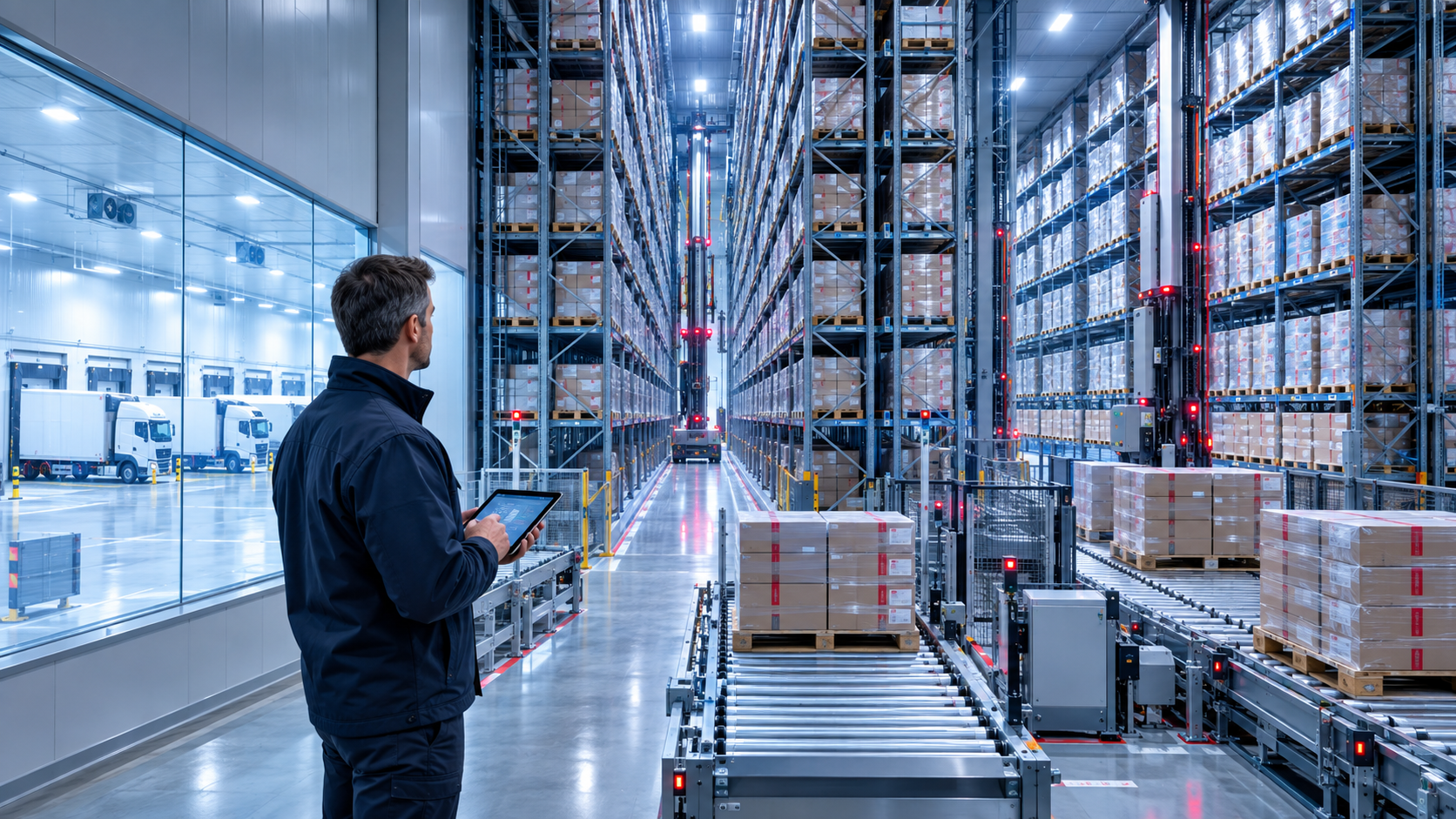
Meat trade under high pressure: How supply chains and high-bay warehouses determine margin, quality and market power – Creative image on the topic, with AI: Xpert.Digital
The Cold Storage Profit Trap: Why High-Bay Warehouses Decide the Future of the Meat Trade
The second cold chain: Why data is more valuable than steel and concrete in the meat trade today
Poultry is booming, pork is under pressure: How the meat trade now has to restructure its logistics
The meat trade is facing unprecedented structural change: Changing consumer behavior, volatile raw material prices, high energy costs, and chronic labor shortages are putting massive pressure on margins. In this demanding market environment, the supply chain is evolving from a mere cost factor to a decisive competitive advantage. At the heart of this development is the automated high-bay warehouse – a capital-intensive infrastructure that is far more than just a technologically upgraded storage facility. It is the company's economic operating system, where the flow of goods, data quality, and capital commitment inevitably intersect. But when does automation in the frozen or fresh food sector truly pay off? And why is someone who still blindly manages pallets instead of data freezing their capital? This comprehensive analysis shows how traditional meat traders are transforming into modern system integrators, what strategic role the digital "second cold chain" plays, and how flexibility, resilience, and sustainability will define the logistics of the future.
Those who are still moving pallets instead of managing data today will not only freeze goods tomorrow, but also capital
The meat trade is one of the most economically demanding sectors of the food supply chain. It combines highly perishable goods, fluctuating raw material prices, strict hygiene regulations, international procurement markets, short delivery times, and high expectations for availability. Meat traders must purchase, inspect, refrigerate, store, pick, document, and deliver products, even though demand, prices, and available quantities can change within just a few days. The supply chain is therefore not merely a logistical link between the slaughterhouse, processor, wholesaler, and customer; it is the very economic operating system of the company.
The high-bay warehouse plays a special role in this system. It is not merely a technically upgraded warehouse, but a capital-intensive infrastructure where space utilization, energy consumption, goods handling, inventory risk, and delivery capability converge. A well-planned, automated refrigerated or deep-freeze warehouse can reduce costs per pallet movement, minimize temperature deviations, alleviate staffing shortages, and improve traceability. Conversely, an incorrectly sized or poorly integrated high-bay warehouse can tie up capital, destroy flexibility, and lead to a company becoming technologically dependent.
The crucial economic question, therefore, is not whether automation is inherently modern or efficient. The decisive factor is under what conditions it creates more value than it costs. In the meat trade, this value arises primarily when high and relatively stable product flows meet expensive refrigeration space, limited labor, demanding batch management, and reliable customer demand. Where quantities fluctuate significantly, product structures change frequently, or sales channels are uncertain, a more flexible, partially automated approach can be economically superior.
From meat trader to systems integrator
The traditional image of the meat trader as a mere middleman is too simplistic. Modern companies in this sector coordinate procurement, quality control, cold chains, financing, customs and veterinary procedures, packaging, customized order fulfillment, and distribution. They compensate for temporal, spatial, and qualitative differences between supply and demand. In doing so, they fulfill a crucial economic function: transforming irregular production volumes into predictable, marketable delivery programs.
This service is gaining importance because market segments are diverging. Pork remains particularly important in Germany in terms of volume, while poultry is structurally gaining in importance. Beef is more strongly characterized by limited livestock numbers, higher prices, and a heterogeneous use of different cuts. At the same time, restaurants, catering establishments, food retailers, industry, and export customers demand different cuts, packaging, certifications, and delivery sizes. A trader, therefore, doesn't just sell kilograms. They sell availability with the right specifications, in the right place, and at the right time.
This is precisely where the connection to high-bay warehouses lies. The more diverse the product range, the more valuable a warehouse management system becomes that simultaneously maps batch, origin, best-before date, temperature status, ownership, reservations, and customer approvals. The physical warehouse and the digital inventory model must not be considered separately. A pallet that is available but cannot be sold due to incorrect master data, missing approval, or an unclear batch is almost as economically problematic as a missing pallet.
The meat trader is therefore evolving into a system integrator between the flow of goods, information, and finances. Its competitiveness increasingly depends on how well these three levels are synchronized. Those who optimize only transport but ignore inventory and payment terms shift costs. Those who focus solely on driving down purchase prices but thereby cause fluctuating quality or unreliable deliveries jeopardize customer loyalty. And those who build an automated warehouse without incorporating sales planning and assortment strategy may be automating the wrong processes.
A large market with shifting power dynamics
German meat production in 2025 amounted to approximately 6.9 million tons, almost at the same level as the previous year. However, compared to the previous record high in 2016, this volume was about 17 percent lower. This development demonstrates that short-term stabilization and long-term structural change are possible simultaneously. The market is not disappearing, but its production base, product mix, and value creation logic are changing.
Pork continued to account for the largest share of German pork production in 2025, at approximately 4.3 million tons. Production increased slightly compared to the previous year. Beef production, on the other hand, declined significantly to around 0.9 million tons, while poultry production remained stable at approximately 1.6 million tons. Within the poultry segment, production of broiler chicken increased, while turkey production decreased. This shift is relevant for storage and distribution systems because pallet profiles, packaging types, throughput times, and temperature requirements vary depending on the product group.
Consumption trends are not linear either. Theoretically, meat consumption in Germany rose to 54.9 kilograms per person in 2025. Poultry saw particularly strong growth, reaching a peak of 14.7 kilograms per capita. Pork remained the most important type of meat at 28.3 kilograms, while beef and veal accounted for 9.7 kilograms. This short-term increase does not offset the longer-term decline compared to previous consumption levels. However, it demonstrates that companies should not base their investments on a simplistic narrative of a steadily shrinking meat market.
The picture is also more nuanced at the European level. In 2024, the EU produced approximately 21.1 million tons of pork, about 14.1 million tons of poultry, and roughly 6.6 million tons of beef. Pork production remained significantly below its 2021 peak, while poultry reached a new record high. A slight decline in overall meat consumption is expected across the EU by 2035, particularly for beef and pork. Poultry, on the other hand, is likely to continue to grow due to its comparatively low price and more positive perception of its health benefits.
For the meat trade, this doesn't mean a blanket downsizing strategy, but rather a shift strategy. Warehouse locations and automation must be able to accommodate different future paths. A deep-freeze warehouse designed for a few standardized pork products can be very efficient, but it will lose value if sales shift more rapidly towards poultry, convenience products, smaller units, or more differentiated provenance programs. Future viability, therefore, doesn't mean maximum technical complexity, but rather controlled adaptability.
The profit margin is determined by the flow of goods
In the meat trade, high sales volumes can mask true profitability. The value of the goods is substantial, but the net margin is often limited. Even minor deviations in purchase price, yield, weight loss, energy consumption, complaints, or bad debts can significantly alter the bottom line. Therefore, the supply chain is not merely a supporting cost center, but a direct lever for profitability.
Purchasing initially determines the cost basis, but it is the logistical execution that ultimately decides how much of that remains. Additional holding times, repeated relocations, inaccurate inventory levels, and poorly coordinated deliveries increase costs without increasing customer value. With refrigerated goods, the risk of shortened shelf life is an additional factor. A seemingly inexpensive purchase can prove costly if the goods sit for too long, don't fit the customer profile, or are only marketable to a limited extent due to a broken cold chain.
The high-bay warehouse can reduce these losses by controlling storage, relocation, and retrieval based on predefined rules. The combination of minimum shelf-life logic, batch purity, and order prioritization is particularly valuable. Classic first-in, first-out (FIFO) management is often insufficient for meat. A more economically viable approach is to manage storage based on the earliest expiration or use-by date, supplemented by customer-specific remaining shelf-life requirements. This ensures that the oldest pallet is not necessarily delivered first, but rather the one that best suits the order in terms of quality, contract terms, and revenue.
In addition, inventory accuracy plays a role. In a manual warehouse, incorrect entries, wrong storage locations, and unrecorded damage can lead to search times or duplicate orders. In an automated system, every pallet change is digitally recorded. This improves planning but doesn't automatically eliminate all errors. If incorrect labels, weights, or batch data are already recorded upon goods receipt, the system simply processes these errors faster and more consistently. The crucial control point, therefore, lies before automated putaway.
Cold is a production factor and a cost risk
The cold chain ensures food safety, product quality, and marketability. At the same time, it makes the meat trade energy-intensive. In cold storage facilities, refrigeration can account for the majority of electricity consumption. The actual consumption per cubic meter varies considerably, depending on the building envelope, temperature zone, occupancy, system technology, door openings, defrosting methods, air circulation, and operational discipline.
This variation is more economically significant than a general industry benchmark. Two warehouses with the same capacity can have significantly different energy costs. An inefficient location therefore loses competitiveness not only when electricity prices are high. It incurs permanently higher unit costs and becomes more vulnerable to price shocks. For meat traders in Germany, this risk is exacerbated by comparatively high industrial electricity costs and grid fees.
High-bay warehouses can offer energy advantages because they reduce the footprint and building envelope per pallet space. A compact, tall design often has a smaller heat-transferring external surface area relative to the storage volume than a low-rise building. Automated conveyor technology also allows for smaller openings and shorter door opening times. Reduced pedestrian and forklift traffic decreases the influx of warm and humid air. This not only reduces cooling requirements but also ice formation and defrosting efforts. Case studies of automated deep-freeze warehouses report significant energy savings under specific site conditions; however, these results should not be generalized without further verification.
However, this advantage is not guaranteed. Storage and retrieval machines, conveyors, control technology, and sensors also require electricity. Poor system design can create unnecessary travel distances and peak loads. Low utilization also reduces profitability because the entire building volume must be temperature-controlled regardless of its size. Therefore, the relevant metric is not solely the site's energy consumption, but rather the consumption per occupied pallet space, per ton handled, and per delivered order unit.
An integrated energy strategy is particularly effective. This includes speed-controlled compressors and fans, demand-based defrosting, heat recovery, high-quality insulation, airtight doors, photovoltaics, load management, and operation based on electricity price and grid signals. Frozen goods have a certain thermal inertia. Within permissible temperature limits, refrigeration production can be partially shifted to more favorable time windows. This makes the warehouse a controllable energy consumer without compromising food safety.
Automation as a business gamble
An automated high-bay warehouse requires significant initial investment. In addition to racking and building technology, costs arise for storage and retrieval machines, conveyor systems, fire protection, refrigeration systems, warehouse management and material flow software, interfaces, test operation, and training. Furthermore, often underestimated expenses include land acquisition, permits, emergency plans, and integration with existing production or shipping areas.
The business case must therefore not be based solely on saved driver hours. It must encompass all effects across the entire lifecycle. These include reduced space requirements, lower refrigeration costs per pallet, reduced damage, improved inventory accuracy, less searching and waiting time, higher throughput, avoided picking errors, and more stable delivery performance. On the cost side, maintenance, spare parts, software licenses, upgrades, downtime risks, and qualified technical personnel must be taken into account.
The payback period depends primarily on four factors: throughput, capacity utilization, labor costs, and the value of the saved space. High, consistent pallet flows favor an automated storage and retrieval system. Expensive land increases the advantage of vertical integration. High personnel costs and surcharges for frozen food operations enhance the efficiency effect. Fluctuating capacity utilization, seasonal peaks, and frequent product changes, on the other hand, may necessitate additional buffers or manual areas.
A robust investment analysis doesn't rely on a single future value, but rather on scenarios. The baseline scenario uses realistic quantities, energy prices, and personnel costs. A stress scenario examines lower utilization, higher maintenance costs, and longer start-up times. A growth scenario shows whether the plant can handle increasing volumes without creating additional bottlenecks in receiving, order picking, or shipping. Only when the concept remains financially viable even under unfavorable assumptions can its technical efficiency be considered economically sound.
The greatest danger lies in the illusion of precision. Supplier calculations can assume high availability, complete staff reductions, and stable product profiles. In practice, tasks don't disappear entirely, but rather shift to monitoring, troubleshooting, quality assurance, and master data maintenance. A sound calculation therefore distinguishes between work that is actually eliminated and work that simply shifts to a different area.
Fresh produce and frozen produce require different logics
Fresh and frozen meat should not be treated logistically as variations of the same product. Frozen goods have a longer shelf life, are traded internationally, and are better suited to pallet-based automation. Fresh goods are more time-sensitive, often customized to individual customer needs, and more strongly influenced by remaining shelf life, daily production, and short-term demand. Managing their efficient handling requires speed and prioritization rather than maximum storage density.
In a deep-freeze high-bay warehouse, pallets can be held for extended periods as inventory, seasonal stock, or trading position. This increases the importance of the purchase price, financing costs, and market price trends. With fresh produce, however, every additional hour determines the remaining sales potential. A retailer can sell a pallet with a long remaining shelf life to more customers than an equivalent pallet nearing its expiration date. Time here is not only a logistical factor but also a diminishing economic option value.
This results in a differentiated automation architecture. The frozen food area can be highly compacted and heavily automated. In the fresh food area, dynamic buffers, fast conveyor lines, and precise order sequencing are more important. For mixed operations, a hybrid model is often advantageous: automated reserve and full pallet storage, combined with flexible picking and processing zones.
Temperature requirements also influence the design. Minced meat, meat preparations, and frozen products are subject to specific limits. For certain products, core temperatures of no more than 2 degrees Celsius for minced meat, 4 degrees Celsius for meat preparations, or minus 18 degrees Celsius for frozen goods must be maintained immediately after production. This results in requirements for pre-cooling, airlocks, transport times, and the separation of temperature zones.

Expert partner in warehouse planning and construction
The invisible second cold chain: How data in the meat trade suddenly determines real profit
Data is the second cold chain
Physical refrigeration preserves the goods. The digital cold chain ensures their traceability and marketability. A modern meat trader must know the origin of every relevant unit, its batch number, when it was produced or frozen, its temperature history, who owns it, and which customer it is reserved for. Without this information, inventory becomes a risk.
The core principle of European traceability is to identify suppliers and commercial customers. For food products of animal origin, specific details such as description, quantity, sender, recipient, batch or shipment, and shipping date are also required. A high-bay warehouse can support these requirements because each loading unit receives a unique identifier and its movements are automatically logged.
Economic benefits arise when this data is not only archived but actively used. In the event of a quality problem, a company can selectively block affected batches instead of preemptively blocking large areas of inventory. In the case of a complaint, the product's journey can be reconstructed more quickly. In the event of a recall, the scope, processing time, and reputational damage are reduced, provided the data is correctly and linked across systems.
Sensors extend this control system to include temperature, humidity, door status, energy consumption, and system status. Time-temperature indicators or digital data loggers can reveal whether goods have been exposed to critical stress despite formally correct handover procedures. Validation studies show that such indicators reflect real temperature fluctuations and can support decisions regarding remaining shelf life. This allows for the derivation of a dynamic remaining shelf life. Goods with higher thermal stress are allocated earlier or to less demanding sales channels, while optimally managed goods are reserved for customers with longer shelf-life requirements.
Artificial intelligence can improve demand forecasting, anomaly detection, and maintenance planning. However, its usefulness remains dependent on data quality. Missing timestamps, inconsistent article numbers, and manually generated sub-lists limit any analysis. Therefore, the first step in digitalization is rarely a complex forecasting model. Priority is given to clean master data, clearly defined responsibilities, and seamless interfaces between inventory management, warehouse management, quality assurance, transport management, and the financial system.
Staff shortages are shifting
Refrigerated and deep-freeze warehouses are physically demanding work environments. Low temperatures, protective clothing, shift work, and repetitive driving or lifting operations make it difficult to recruit staff. Automation can significantly reduce this strain. It removes people from particularly cold zones and reduces forklift traffic, accident risks, and ergonomically unfavorable tasks.
However, this doesn't eliminate the need for personnel; it simply changes it. Instead of numerous operational transport movements, fewer but more highly qualified personnel are required for control, maintenance, IT, electrical engineering, and process analysis. These specialists are also in short supply and often more expensive. Therefore, an automated warehouse without a robust maintenance and skills management concept can, despite a smaller workforce, exhibit greater dependence on individual employees or external service providers.
Personnel calculations must also account for peak loads and disruptions. Under normal operating conditions, a system can be very efficient. However, blocked conveyors, defective sensors, or problems with loading equipment require rapid intervention. If pallets with damaged skids, overhangs, film flaps, or incorrect dimensions are introduced, automation can become a bottleneck. Therefore, incoming goods inspection and pallet verification are not secondary but rather integral to ensuring technical availability.
From an employer attractiveness perspective, automation can still create a strategic advantage. It reduces the number of hard-to-fill deep-freeze positions and offers more technically demanding tasks. A prerequisite is a training strategy that involves experienced warehouse staff. Their process knowledge is valuable because many exceptions and informal rules are not documented in any software. A purely technical implementation without employee involvement risks resistance and knowledge loss.
Resilience requires more than a safety stock
The crises of recent years have shown that efficiency and resilience should not be seen as opposites. Animal diseases, border controls, energy price shocks, transport bottlenecks, cyberattacks, and shifts in demand can disrupt meat supply chains in the short term. A high-bay warehouse can create buffers, but it does not guarantee security of supply. Additional inventory is only helpful if it remains marketable, affordable, and operationally accessible.
Resilience begins with procurement. Multiple suppliers and regions of origin reduce dependency but increase the effort required for specifications, certifications, and quality control. Standardized packaging and pallet requirements facilitate automation but can limit the selection of potential suppliers. Companies must therefore determine which standards are essential and where flexible inbound solutions are more economically viable.
Energy supply is also critical. Cold storage facilities require a continuous power supply. Emergency power concepts, redundant refrigeration components, alarm systems, and defined emergency temperatures are therefore part of the business model. Photovoltaics and battery storage can reduce costs and grid consumption, but they do not automatically replace a reliable emergency power supply. The ability to react to disruptions in a prioritized manner is particularly important: Which areas must continue operating at all times, which gates must remain closed, and which goods can be relocated to other sites?
Cyber resilience is becoming increasingly important with automation. When warehouse management, material flow control, and conveyor technology are networked, an IT failure can halt the physical flow of goods. Offline-capable emergency processes, secure restart plans, separate network segments, and tested data backups are therefore just as crucial as mechanical spare parts. The system must not only operate quickly but also be able to fail in a controlled manner and restart safely.
A resilient site also has alternative shipping and order picking options. Complete redundancy would usually be too expensive. A more sensible approach is to strategically safeguard critical functions. This can include manual emergency picking stations, bypass options in the conveyor system, backup scanners, prepared alternative storage areas, and contractually secured refrigerated transport capacities. Resilience is economically sound when it limits the most severe damage without burdening normal operations with excessive fixed costs.
Sustainability becomes a cost accounting measure
The environmental debate surrounding meat often focuses on animal husbandry, feed, and emissions. For retailers and warehouse operators, energy, refrigerants, buildings, packaging, transportation, and food losses are additional factors. These are not only relevant for reporting but increasingly influence financing, customer tenders, and operating costs.
The greatest immediate potential of a high-bay warehouse lies in the efficient use of refrigerated space. More pallets per square meter reduce land and building costs. Less heated surface area and reduced air infiltration can save energy. Automated movements minimize damage and enable systematic inventory rotation. If this results in less merchandise being written off, the ecological benefit is particularly significant, because all upstream resources are lost along with the meat.
At the same time, the technology itself has its own environmental impact. Steel, concrete, insulation materials, refrigeration systems, and conveyor technology generate emissions and tie up capital. A warehouse that is consistently only half-utilized can have a poor overall performance, despite efficient individual technologies. Sustainability and economic efficiency therefore converge in high utilization, long service life, repairable technology, and modular expandability.
Refrigerants are another strategic factor. Regulatory restrictions on fluorinated gases are changing the selection and cost of systems. Natural refrigerants such as ammonia or carbon dioxide can be advantageous in the long term, but they pose particular challenges in terms of safety, planning, and qualified personnel. Therefore, an investment should consider not only current acquisition costs, but also availability, maintainability, and regulatory compliance over many years.
Transportation and warehousing should not be optimized in isolation. An extremely centralized high-bay warehouse can achieve high warehouse productivity but result in longer delivery routes. A decentralized network shortens customer distances but increases inventory and fixed costs. The most economically and ecologically sound structure depends on customer density, delivery frequency, shipment size, and product range. Network optimization must therefore consider total costs and service levels together.
Market power arises from reliability
In the meat trade, price is important, but rarely the sole award criterion. Customers evaluate delivery reliability, adherence to specifications, handling of complaints, certifications, remaining shelf life, and short-term responsiveness. A retailer who delivers reliably can partially escape pure price competition. The high-bay warehouse thus becomes a tool for market positioning.
Security of supply is particularly valuable for large retail, catering, or industrial customers. A lack of goods can cause production stoppages, empty shelves, or menu changes. Companies that manage inventory transparently and reliably adhere to confirmed delivery windows reduce their customers' process costs. This benefit can be monetized through long-term contracts, preferred supplier status, or a larger share of the customer's volume.
Automation supports this advantage through reproducible processes. It facilitates night operations, precise shipping sequences, and high volumes within short timeframes. At the same time, an overly rigid system can complicate customer-specific special cases. Successful retailers therefore standardize the core processes and maintain flexible peripheral processes. Standard items and full pallets are handled automatically, while mixed pallets, special markings, or short-notice quality checks are processed in designated zones.
Despite the presence of large operators, the European cold storage industry remains somewhat fragmented. According to industry estimates, large international platforms control roughly half of the outsourced capacity, while owner-managed, independent operators still hold approximately 35 to 45 percent. This presents consolidation opportunities but also intensifies competitive pressure. Professional platforms can scale investments, IT, and customer contracts across multiple locations. Independent operators, on the other hand, often possess local connections and can make decisions more quickly. Meat traders, therefore, face the strategic question of whether to operate their own warehouse, share it with partners, or outsource it to specialized cold storage logistics providers.
Ownership offers control and enables close integration into trade or processing. However, it ties up capital and increases technical risk. Outsourcing converts some fixed costs into usage-based costs but can limit availability and process design. Hybrid models are often sensible: strategic core quantities in-house, peak and slow-moving inventory with external partners. This way, control over critical products is maintained without having to finance all demand uncertainty.
Capital commitment is the underestimated bottleneck
Frozen meat has a long shelf life, but storage isn't free. Each day of storage incurs energy, space, insurance, and financing costs. At the same time, capital remains tied up until the goods are sold and paid for. With rising interest rates, a large safety stock can quickly become a profitability problem.
The economic performance of a high-bay warehouse should therefore not be measured by its maximum capacity. A consistently full warehouse can even indicate weak sales, poor planning, or speculative inventory. More important are inventory turnover, stock coverage, contribution margin after storage costs, and the age structure of the inventory. Items whose market price falls, whose remaining shelf life decreases, or whose customer specifications change are particularly critical.
Precise inventory control links quantities and values. It differentiates between freely available goods, reserved stock, quality-restricted items, customer goods, and speculative positions. Additionally, it should make financing costs visible at the item or batch level. Only then can the sales department recognize that a seemingly attractive selling price no longer contributes sufficiently after a long storage period.
Dynamic pricing and sales decisions can reduce tied-up capital. Older or slower-moving batches are offered to alternative customers early on, instead of being discounted only shortly before expiration. Sales forecasts help identify seasonal patterns. In volatile markets, human experience remains important, but it should be supplemented by transparent data. The best buyer is not the one with the lowest price, but the one whose goods are converted into cash quickly and with a reasonable margin.
The right architecture is rarely maximal
A wide spectrum exists between manual block storage and fully automated high-bay warehouses. This includes narrow-aisle storage, mobile racking, channel storage, shuttle systems, automated pallet racking, conveyor technology, and robot-assisted order picking. The right solution depends on the product profile, not on what is technically feasible.
A fully automated high-bay warehouse is particularly well-suited for standardized loading units, high pallet volumes, stable throughput, and expensive floor space. Shuttle systems can offer high density with greater flexibility, especially when there are many pallets of each item. Conventional racking remains a viable option when product variety, special formats, and fluctuating quantities are prevalent. Often, a hybrid concept proves to be the most economically robust solution.
Planning should begin with real-world data on material movement. Averages are insufficient. Relevant factors include daily and hourly peaks, seasonal patterns, pallets per item, order sizes, the percentage of full pallets, the number of batches, dwell times, and the frequency of quality checks. Future product range changes and customer requirements should also be incorporated into the model. A system optimized precisely for today's average could become a bottleneck with the next major customer.
The interface with order picking deserves special attention. A high-bay warehouse can quickly provide pallets, but if mixed pallet formation, labeling, or loading can't keep up, the bottleneck shifts. Overall performance is always determined by the weakest process. Therefore, goods receipt, quality inspection, storage, replenishment, order picking, and shipping must be simulated and dimensioned as a single system.
Expandability also has a measurable value. Available connection points, pre-installed conveyor technology, modular software licenses, and reserved land areas initially increase the investment, but can significantly reduce the cost of later modifications. However, flexibility should be specifically defined. Otherwise, a blanket demand for maximum expandability leads to expensive reserves that are never used.
A reliable roadmap for investment
The first step is defining strategic goals. A company must clarify whether it wants to create capacity, reduce staff, save energy, improve service, consolidate multiple warehouses, or enable growth. Without prioritization, conflicting goals arise. Maximum density, maximum flexibility, and minimal investment cannot be achieved simultaneously.
This is followed by a robust data foundation. At least one full fiscal year should be analyzed; in cases of strong seasonal fluctuations, several years are preferable. Outliers should not simply be ignored because peaks determine the system's design. Simultaneously, it should be examined whether historical processes contain unnecessary fluctuations that can be eliminated in a new concept.
In the next step, several technical variants are compared using the same cost logic. Besides the investment, factors such as personnel, energy, space, maintenance, IT, insurance, and downtime costs are considered. Residual value and modernization potential after ten or fifteen years are also factored in. Sensitivity analyses reveal which assumptions have the greatest impact. These are usually throughput, personnel savings, construction costs, and capacity utilization.
Before awarding the contract, interfaces and performance limits should be clearly defined. Crucial is not only the nominal output of individual machines, but also the guaranteed system performance under realistic product and order structures. Acceptance tests must simulate peak operation, malfunctions, restarts, damaged pallets, and IT failures. A system is only considered successful when it operates stably in real-world conditions and the personnel are able to operate it safely.
Commissioning should be carried out gradually. Parallel operation, defined fallback processes, and sufficient time for master data cleansing reduce the risk. Premature full utilization can amplify minor errors into major delivery problems. After ramp-up, optimization begins: driving strategies, storage classes, order bundling, and energy parameters are adjusted based on real-world data.
The warehouse becomes a strategic asset
The economic core of the modern meat trade lies not in possessing the largest possible quantities of goods, but in the ability to transform goods into customer value and liquidity in a controlled, verifiable, and rapid manner. Supply chain, high-bay warehouse, and data architecture form a unified whole. Planning them separately wastes efficiency and increases risks.
Automated high-bay warehouses are neither a panacea nor prestige projects. They are powerful tools for clearly defined material flows. Their greatest benefits arise from high utilization, stable processes, limited labor, high space and energy costs, and strict traceability requirements. Their greatest risks lie in incorrect quantity assumptions, underestimated complexity, and inadequate organizational preparation.
The meat industry in Germany and Europe is not expected to simply shrink linearly. It will continue to differentiate itself according to meat types, origin, processing depth, and sales channels. Poultry is gaining in importance, while pork and beef are under greater pressure to adapt structurally. At the same time, large volumes of goods, high safety requirements, and international trade flows will persist. This will result in a continued significant need for professional refrigerated and frozen food logistics.
The clear perspective, therefore, is this: competitive advantages arise not from the tallest warehouse or the highest degree of automation, but from the best combination of market understanding, process discipline, technology, and capital management. A high-bay warehouse becomes a strategic asset when it not only accommodates more pallets but also enables fewer errors, reduced losses, faster decisions, and more reliable deliveries. Companies that master this interplay can grow despite tight margins and volatile markets. In contrast, companies that merely automate space without changing their business model risk permanently building inefficiencies into their steel and software.
Your intralogistics experts

Consulting, planning and implementation of complete solutions for high-bay warehouses and automated storage systems - Image: Xpert.Digital
More information here:
Your global marketing and business development partner
☑️ Our business language is English or German
☑️ NEW: Correspondence in your native language!

Konrad Wolfenstein
I and my team are happy to be available to you as your personal advisor.
You can contact me by filling out the contact form here [email protected]:or simply call me at +49 7348 4088 965. My email address is
I'm looking forward to our joint project.
☑️ SME support in strategy, consulting, planning and implementation
☑️ Creation or realignment of the digital strategy and digitization
☑️ Expansion and optimization of international sales processes
☑️ Global & Digital B2B trading platforms
☑️ Pioneer Business Development / Marketing / PR / Trade Fairs
Our global industry and economic expertise in business development, sales and marketing

Our global industry and economic expertise in business development, sales and marketing - Image: Xpert.Digital
Industry focus areas: B2B, digitalization (from AI to XR), mechanical engineering, logistics, renewable energies and industry
More information here:
A thematic hub offering insights and expertise:
- Knowledge platform covering global and regional economies, innovation and industry-specific trends
- A collection of analyses, insights, and background information from our key areas of focus
- A place for expertise and information on current developments in business and technology
- A hub for companies seeking information on markets, digitalization, and industry innovations










