
Well-behaved, compliant, opportunistic, lost – The structural cowardice of German conservatism
Xpert Pre-Release

Available in 27 languages 📢
Prefer Xpert.Digital on GoogleⓘPublished on: April 15, 2026 / Updated on: April 15, 2026 – Author: Konrad Wolfenstein
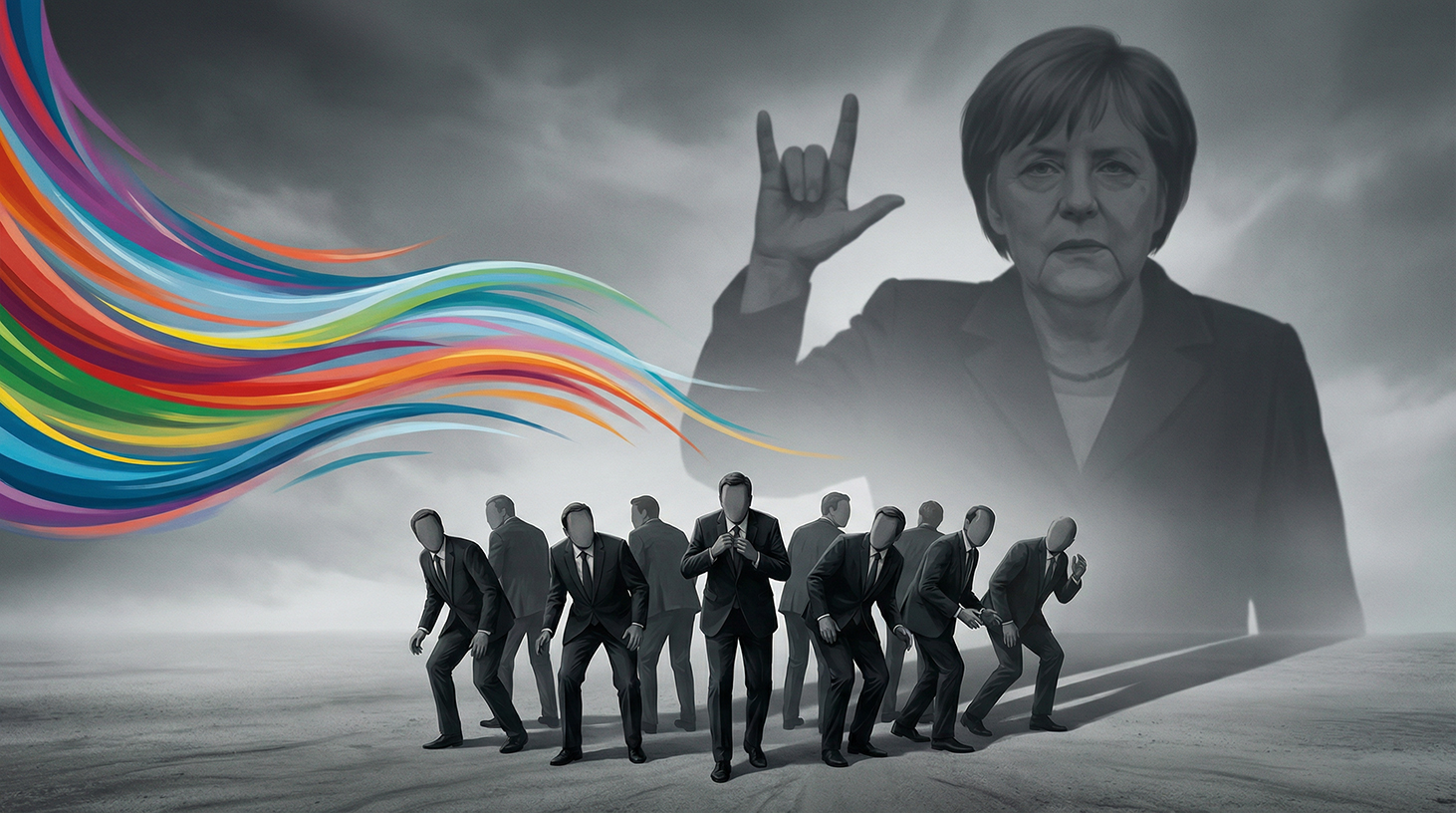
Well-behaved, conformist, opportunistic, lost – The structural cowardice of German conservatism – Image: Xpert.Digital
The Merkel effect is taking its toll: How the CDU/CSU lost its conservative core forever
When conformity becomes a danger: The shocking conclusion about Germany's political center
Fear of the left-wing zeitgeist: How the CDU is sacrificing its most prominent figures
Germany's conservative parties are mired in a deep, structural identity crisis. Those who take a clear stance are often isolated from their own ranks – a systematic pattern that has persisted from the Merkel era to Friedrich Merz. Instead of courageously defending what has proven successful and aggressively representing their own values, a "preventive opportunism" prevails in the CDU and CSU, driven by fear of left-wing opposition. The bitter consequence: The political center is losing its core identity, sacrificing prominent figures on the altar of coalition-building, and thus paving the way for more radical extremes. This is an in-depth analysis of the structural cowardice of German conservatism and the question of why constant adaptation as a survival strategy inevitably leads to political self-abandonment.
When adaptation becomes a survival strategy – and the party abandons itself in the process
The assessment sounds harsh, but on closer inspection it is virtually irrefutable: Germany's conservative parties – above all the CDU and CSU – suffer from a profound identity problem that goes far beyond tactical errors. It is a structural failure rooted in decades of opportunistic adaptation that has cleared the political space for more radical forces. The thesis that conservatives in Germany act too timidly and too opportunistically, and that those who actually show some rough edges are abandoned by their own party, is not merely a political opinion – it is a diagnosis supported by political science.
From preserver to conformist: The ideological exhaustion
The core of conservatism, as political scientist Thomas Biebricher of Goethe University Frankfurt puts it, lies in the ability and the will to preserve what has proven successful and to moderate social change. However, what has become of this fundamental stance in Germany can hardly be described as a conservative self-understanding anymore. For years, Biebricher has diagnosed a "process of hollowing out" the Christian Democratic Union (CDU), a "loss of conservative substance" that did not begin with Angela Merkel, but rather unfolded over several decades. The crisis of German conservatism is therefore not a personal one, but an ideological one.
The Berlin political scientist Paul Nolte formulated it as early as the beginning of the 2000s: Behind the personnel debates within the CDU lies a programmatic uncertainty of the greatest magnitude. This is evident, not least, in the fact that for decades the Union relied more on "procedural conservatism"—on managing change rather than shaping its content. They administered without leading. They governed without leaving behind a discernible value system. The result was a party that remained stable in the polls but was increasingly perceived as ideologically arbitrary.
Merkel's legacy: When success becomes a downfall
The 16 years under Chancellor Angela Merkel exemplify this process of gradual self-erosion. Merkel transformed the CDU into a kind of political administration party of the center – ideologically flexible to the point of being unrecognizable, but extremely successful in its electoral tactics. The nuclear phase-out after Fukushima, the opening of the borders in 2015, the de facto adoption of social democratic positions in pension and family policy – all of this contributed to the erosion of the conservative profile. CDU politicians who at that time called for a return to core convictions were marginalized or branded as reactionary backbenchers.
What Merkel achieved politically—namely, binding broad swathes of voters to the CDU—left behind, in the medium term, a party without a clear ideological DNA. Several CDU members, including the CDU energy policy expert Thomas Bareiß, criticized this course early on: the party was distancing itself thematically from its core constituency without gaining credibility with new voters. This warning went unheeded. The then-chairman of the Values Union, Alexander Mitsch, drew the bitter conclusion: thousands of conservatives and economic liberals no longer felt at home in the CDU under Merkel. The party had adapted so drastically to the left-wing, green zeitgeist that it could no longer credibly represent even core competencies such as internal security, economic liberalism, and migration control.
Opportunism as a system logic: How the fear of left-wing criticism paralyzes
It would be too simplistic to blame this adjustment process solely on Merkel. It reflects a deeper systemic failure, linked to the particular moral burdens faced by German conservatism. As the Tagesspiegel analyzes: The CDU has structurally lost its identity. After 1945, traditionally conservative concepts such as nation, order, and duty were ideologically compromised. Conservative politicians lived with the constant suspicion of being morally indebted to left-liberalism. This created a fundamental psychological stance of defensiveness that persists to this day.
This defensiveness manifests itself concretely in a phenomenon that could be described as "preventive opportunism": Conservative positions are not changed out of conviction, but to preempt anticipated attacks from the left. Jens Spahn, for example, once described conservatism so matter-of-factly as follows: "We slow down changes so that they are tolerable"—a definition that aptly captures the reactive nature of the conservative worldview, but also shows how difficult it is to develop an offensive political identity from this defensive position. Biebricher confirms: "At its core, it is profoundly reactive." The problem is that conservatives often act too late and then no longer fight for what is worth preserving, but for what is already disappearing.
Rough edges and rough edges: The abandoned
Particularly revealing is the way the CDU leadership deals with those politicians who actually hold clear, and sometimes uncomfortable, positions. Hans-Georg Maaßen is perhaps the clearest example. The former head of the Federal Office for the Protection of the Constitution, who pushed for more conservative positions on migration and security issues within the party, faced expulsion proceedings. Instead of engaging with his arguments on a substantive level, the CDU leadership chose the institutional path of isolation. Maaßen himself drew the consequences and left the party in January 2024, not without harsh words: The CDU had abandoned its values and was "just another variant of the socialist parties." How far this assessment corresponds to reality is debatable – but the pattern is symptomatic: Anyone in the CDU who is too clearly conservative is not debated, but rather sidelined.
It is telling that Markus Söder publicly described figures like Friedrich Merz, Roland Koch, and Erika Steinbach as painful losses for the CDU/CSU alliance as early as 2017. Steinbach, the long-serving CDU member of parliament and chairwoman of the Federation of Expellees, had left the party—not because she abandoned her convictions, but because the party no longer showed her any solidarity. The pattern is recurring: Conservatives with a distinct profile and convictions are not defended as valuable voices, but rather treated as a liability as soon as they come under fire from the left.
Our EU and German expertise in business development, sales and marketing

Our EU and German expertise in business development, sales and marketing - Image: Xpert.Digital
Industry focus areas: B2B, digitalization (from AI to XR), mechanical engineering, logistics, renewable energies and industry
More information here:
A thematic hub offering insights and expertise:
- Knowledge platform covering global and regional economies, innovation and industry-specific trends
- A collection of analyses, insights, and background information from our key areas of focus
- A place for expertise and information on current developments in business and technology
- A hub for companies seeking information on markets, digitalization, and industry innovations
Attack from the left, silence from within: Why the CDU is breaking apart without support – the structural problem explained
Left-wing attacks and a lack of solidarity: A structural problem
The question of party support is not a marginal internal party concern – it has concrete political consequences. During the 2025 federal election campaign, the CDU was subjected to a systematic pattern of left-wing extremist intimidation attempts: CDU offices were occupied, campaigners threatened, and party headquarters vandalized. The Baden-Württemberg Office for the Protection of the Constitution's report states that left-wing extremist groups specifically targeted mainstream parties like the CDU during the 2025 election campaign, significantly more so than in previous campaigns. In one specific incident in Berlin-Charlottenburg, around 40 masked left-wing radicals stormed a CDU office, cornered employees, and insulted them, calling them "fascists.".
The party leadership's reaction to such incidents reveals the core problem. While CDU General Secretary Carsten Linnemann made it clear that violence is not a tool of democracy, the further political and substantive debate—for example, clearly naming the left-wing extremist structures that enable such actions, or publicly standing up for attacked party colleagues—remained hesitant. It's a recurring dynamic: when conservative politicians are attacked from the left, they receive formal support, but rarely the vocal political show of solidarity they actually deserve.
In February 2025, the tabloid newspaper "Bild" reported on significantly increased security measures for Friedrich Merz following threats from the far left. At the same time, criticism of Merz's political style continued unabated, even from within his own party – he was attacked internally by the CDU, while he felt pressured from the outside. This pattern – hostility from the left and insufficient loyalty from within – structurally weakens leaders with clear positions.
The dilemma between profile and coalition capability
A key mechanism behind conservative opportunism is the perceived necessity of being able to form coalitions. Since the CDU has relied on forming majorities for decades, which is impossible without the political center, a party culture has developed in which maintaining broad coalition-building capabilities has become more important than representing clear convictions. Söder's balancing act between substantive policy development and coalition loyalty to Merz's Berlin exemplifies this. The CSU leader repeatedly criticizes the Chancellor's course publicly without jeopardizing the coalition – a political acrobatics that voters hardly perceive as authentic.
The CDU's dangerous dilemma lies precisely in this: the more it strives to form coalitions with left-progressive partners, the more it loses its core identity and, with it, those voters who seek a genuinely conservative option. Political scientist Biebricher speaks in this context of moderate conservatives being crushed between liberals and right-wing authoritarians – for democracy, he emphasizes, this is bad news. For when the conservative center dissolves, the extremes benefit. This is exactly what has happened in Germany: to the extent that the CDU and CSU abandoned their conservative profile, the AfD gained strength.
International parallels: The conservative decline as a Europe-wide pattern
Germany is not an isolated case. In his widely acclaimed study, "Center/Right: The International Crisis of Conservatism," Biebricher analyzes how conservative parties across Europe have lost their positions of power to right-wing conservatives. In 13 of the 27 EU member states, right-wing populist and right-wing conservative parties have already overtaken traditional liberal-conservative parties or are virtually on par. The NDR television program "Panorama" succinctly summarized this in 2023: Many European conservative parties have become irrelevant – partly due to their empty centrism.
The tragedy lies in the fact that the attempt to minimize vulnerabilities by adapting to the left-progressive mainstream ultimately creates more – namely, the question of why a weak CDU is still needed when a more radical alternative caters to the same demographic. The magazine "Luxemburg" aptly analyzes this: the belief that the CDU can serve as a guarantor of stability has been lost. Election results consistently above 35 percent are therefore a thing of the past.
What a truly conservative stance would mean
What would the alternative be? Conservatism doesn't require radicalization, but it does require authenticity. Specifically, this means: addressing social problems without constantly focusing on the left's reaction to them; publicly standing up for party members who come under pressure for holding conservative positions; and being willing to speak unpopular truths, even if the media labels them as "controversial.".
The "Network for Academic Freedom," which includes prominent conservative professors such as the historians Jörg Baberowski and Andreas Rödder, has raised precisely this question: How can it be that simply naming unwelcome truths at German universities and in political discourse is punished with the adjective "controversial"? The spiral of silence that Elisabeth Noelle-Neumann described in the 1970s has returned in a new form – and conservative politicians are particularly affected. Anyone who understands the mechanism of this spiral and fails to counteract it is guilty of intellectual opportunism.
The Merz test: Attitude with limits
Since taking office, Chancellor Friedrich Merz has shown that he is at least partially willing to take a firm stance – for example, in the migration debate, where he also accepted the displeasure of the left-wing opposition and the public. However, Merz also reveals the structural problem: as soon as his party colleagues put pressure on him, he backtracks or softens his positions. When, after the failed judicial election in the Bundestag in 2025, he was asked whether parliamentary group leader Spahn was still the right man for the job, he answered "Definitely yes" – but this was more of a show of loyalty under coalition pressure than an act of courageous party leadership. Internally, disagreements about pension policy and leadership style arose again shortly afterward.
The Süddeutsche Zeitung accuses Merz of having made a leadership error within the system, one that will permanently burden the coalition. This is a fair assessment – but it doesn't just apply to Merz personally. It applies to a system that systematically penalizes strong conservative leadership while simultaneously rewarding a lack of clear direction.
Courage as the scarcest commodity in German politics
The thesis that conservatives in Germany act too timidly and opportunistically not only stands up to scrutiny—it is emphatically confirmed by political reality. It is no coincidence that the AfD has absorbed precisely those voters who seek a clear, unequivocal conservative stance. It is no coincidence that after 16 years of Merkel, the CDU no longer knows what it actually stands for. And it is no coincidence that those politicians in the CDU and CSU who actually represent positions with strong, uncompromising views are not actively defended by their own party, but rather quietly sidelined or publicly downplayed.
The lack of support for challenged conservatives is not the failure of individuals, but the result of a decades-long party culture in which adaptability was valued more highly than loyalty to one's convictions. This culture produces politicians who react to attacks from the left with preemptive obedience instead of defending their own position. It produces a party that avoids developing a distinct profile because having one makes it vulnerable. And it produces a political center that has lost its substance—and thus its ability to act as a stabilizing counterweight to the extremes.
True conservatism doesn't mean backward-looking, but it does mean taking a stand. The ability to withstand pressure. The courage to advocate and defend unpopular positions. And solidarity with those who summon this courage – especially when they are attacked. Without these fundamental virtues, German conservatism remains what it largely is today: an administrative party without a compass, which, in its search for security, has lost its own identity.










