
The simple and evolutionary-grown idea of the container base camp: a paradigm shift in global logistics
Xpert pre-release

Available in 27 languages 📢
Prefer Xpert.Digital on GoogleⓘPublished on: July 21, 2025 / update from: July 23, 2025 – Author: Konrad Wolfenstein

The simple as well as evolutionary idea of the container-base camp: a paradigm shift in global logistics – creative image: xpert.digital
The bookshelf for containers: How a simple idea changes the global ports forever – why this German invention ends the greatest waste in ports
What is a container base bearing and why do experts speak of a revolution?
A container base bearing, also referred to as a container high-bay warehouse or high-bay storage (HBS), is basically a simple and at the same time ingenious idea: instead of traditionally stacking containers, they are stored in a fully automated shelving system, similar to a huge bookshelf. Each container receives its own permanent storage space in a steel shelf up to 50 meters high and can be accessed directly at any time without other containers being moved.
The revolutionary nature of this technology lies in its apparent simplicity. While today we naturally assume that every book has its fixed place in a library and can be found immediately, this has been unthinkable in container logistics. Containers were always stacked, blocked and cumbersome. The container high-bay warehouse ends this inefficiency once and for all.
How did this seemingly simple idea come about and what makes it so innovative?
Ironically, the roots of the container high-base bearing are not in port logistics, but in the heavy industry. The Deutsche SMS Group has developed fully automated high -bay warehouse for decades for metal coils in steelworks weighing up to 50 tons. This proven technology was adapted in a joint venture with DP World from Dubai for containers and further developed into a boxbay system.
The innovative is to transfer an established industrial technology to a completely new field of application. Where other complexity saw, the developers recognized a simple analogy: a 40-ton container is ultimately just another heavy bearing material that has to be handled precisely. The decades of experience with shelf operating devices, automated cranes and warehouse management systems could be transferred directly to port logistics.
Why is this technology so relevant for port logistics?
The answer lies in the fundamental challenges that ports face worldwide. The global container envelope is growing continuously – around 161 million TEU were handled worldwide in 2024, an increase of 6.2 percent compared to the previous year. At the same time, most large seaports have grown historically and are located in densely populated urban areas, where a horizontal area expansion is practically impossible.
This shortage of surface leads to a vicious circle: ports have to stack more and more density, which dramatically worsens operative efficiency. In traditional container yards, between 30 and 60 percent of all crane movements must be carried out as unproductive “reshuffling” movements. This means that containers are only moved to get to the underlying containers – pure waste of time, energy and resources.
How does traditional container storage work and where are your limits?
In conventional container yards, containers in blocks are stacked directly on top of each other, usually five to six layers. If a certain container is required that is not in the top position, all containers above must first be removed with cranes and stored. Only then can the desired container be removed, whereupon the converted containers often have to be moved back.
This “reshuffling” problem becomes exponentially worse with increasing utilization. As soon as a warehouse block is more than 70-80 percent filled, the performance collapses because more and more unproductive movements are required. This leads to unpredictable waiting times for truck drivers, inefficient energy consumption and poor predictability of terminal operations.
In addition, the need for stacking limits the maximum stacking height. While theoretically could be stacked higher, this becomes practically impossible due to the accessibility problem. Modern RTG cranes create a maximum of 5-6 layers, which drastically limits the area efficiency.
What makes the container high-bay warehouse so fundamentally different?
The container high-bay warehouse solves these fundamental problems with a paradigm shift: instead of stacking containers, each container receives its own fixed storage space on a shelf. Fully automated shelves can reach every container directly at any time without having to move other containers. This leads to a 100 percent direct accessibility – reshuffling belongs to the past.
The technology enables the storage capacity to be tripled on the same base area. While traditional systems can usually only stack 3-4 containers on top of each other, container high-class bearings reach heights of 7 to 18 layers. The Boxbay system in Dubai, for example, is stored on up to 11 levels with a total height of 50 meters.
Which specific performance data show the superiority of this technology?
The Proof-of-Concept system from Boxbay in the port of Dubai delivers impressive numbers. After over 200,000 container movements since commissioning, the original service expectations have not only been achieved, but exceeded. The system proved to be faster and energy -efficient than originally assumed.
The first commercial implementation in the South Korean port of Busan will eliminate 350,000 unproductive movements per year and improve the truck release period by 20 percent. With a system with 792 container parking spaces, this corresponds to an enormous increase in efficiency.
The area efficiency is remarkable: a container high-bay warehouse only requires a third of the base of a conventional container camp with a comparable capacity. This enables ports to massively expand their capacity without having to open up new areas – a decisive advantage in land limited port cities.
How does this technology affect sustainability?
Container high-bay warehouse offer considerable environmental advantages. The power supply takes place via solar cells on the system roof, which means that the system can be operated in energy self -sufficient. The fully automated, electrically operated shelves are significantly more energy -efficient than diesel -powered portal cranes.
The elimination of unproductive reshuffling movements dramatically reduces energy consumption. If 30-60 percent of all crane movements are eliminated, the energy supplies also drop accordingly. In addition, the higher area efficiency leads to less land consumption and lower infrastructure costs.
The noise emissions are significantly reduced by the closed construction and electrical drives. Containers are protected from direct sunlight, which is particularly advantageous for cool containers and saves energy. The system is a resistant to the weather and can be operated in wind, rain and snow, while traditional crane operation often has to be set due to the weather.
Your intralogistics experts
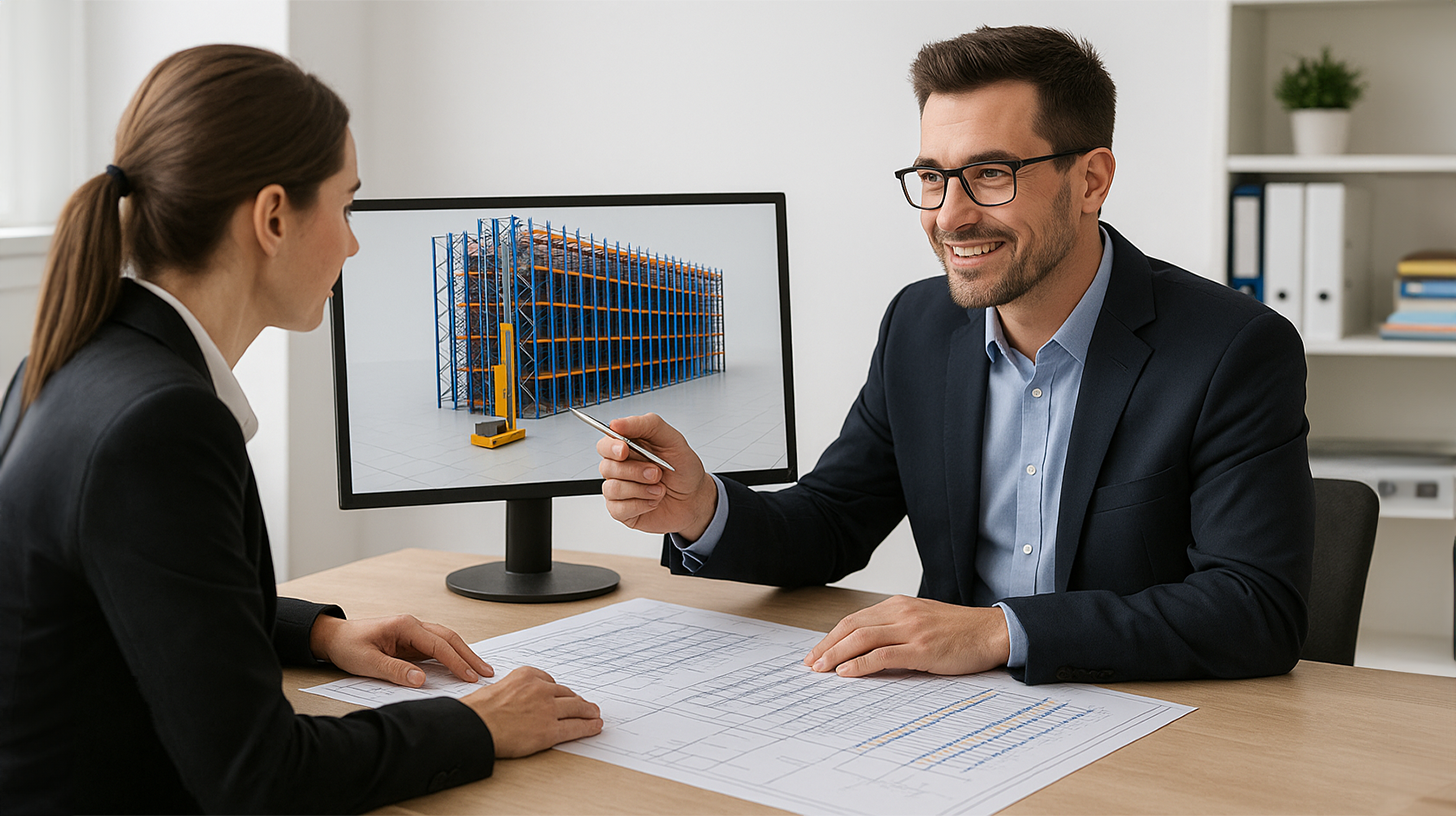
Advice, planning and implementation of complete solutions for high -bay warehouse and automated storage systems – Image: Xpert.digital
More about it here:
Automated ports of the future: revolutionary warehouse technology in check
What historical parallels are there on this technological revolution?
The container high-base warehouse technology is in a direct historical line to the original container revolution of Malcolm McLean. In 1956 the first container ship “Ideal X” with 58 containers left the port from Newark to Houston and revolutionized world trade. At the time, McLean realized that the time -consuming coached loading had to be replaced by standardized containers.
Like McLeans Innovation, the container high-base warehouse technology was initially skeptical. "When we look back on the history of the container, nothing has changed since it was introduced in 1956," said Carsten Heide from Amova. The container high-bay warehouse has been the first fundamental further development of container handling in over 65 years.
Both innovations followed the same principle: a proven technology from another area was transferred to logistics. McLean adapted the concept of intercourse bridge transport from the street to the ship. Container high-bay warehouse transfers the high-bay warehouse technology from industrial logistics to port logistics.
How does the market launch develop and where are we today?
The market launch runs on schedule and accelerates. After the successful practical test in Dubai, the first commercial contract for the Busan port in South Korea followed in 2023. This marked the transition from the proof-of-concept phase to commercial market penetration.
The SMS Group was awarded the German Logistics Prize for Boxbay technology in 2022. The jury particularly praised the combination of innovation and sustainability: "We see a compression of container areas to a third, noise and light protection, power generation beyond our own needs".
The market is developing from isolated pilot projects to an independent, rapidly growing market segment. Various manufacturers bring their own systems onto the market, from series tire market leaders such as Boxbay to specialized niche solutions for cooling containers or military applications.
Which challenges still have to be overcome?
The biggest challenge is to overcome the inertia of established systems. Port operators have invested in traditional Krantechnik and infrastructure for decades. A complete system change not only requires high initial investments, but also a complete rethink in the management.
The approach of Konecranes-Amova with her “Sidegrid Retrofit” concept is therefore interesting. Instead of building completely new systems, existing container yards are gradually modernized and supplemented with HBS rack structures. This enables a gradual transformation without gigantic initial investments.
Personnel qualification represents another challenge. Container high-base bearings require different skills than traditional crane operations. At the same time, however, they also offer better working conditions through ergonomic workplaces and lower weather dependency.
How does this technology change the entire logistics chain?
Container high-bay warehouse enables a new form of integrated logistics. The HBS can be physically attached directly to warehouses or production lines, which means that the intermediate transport by truck is eliminated. The container is transported fully automatically from the shelf to a specific loading ramp or conveyor technology interface.
This leads to a seamless chain from the ship to the production line as a single, automated and data -controlled process. The time savings are significant: no waiting times for trucks, no traffic jams in the port, no transport costs for the “last kilometer”.
Digitization plays a key role. Container high-bay warehouse is completely digital systems with energy management, warehouse management system and business intelligence modules. They can be integrated with any existing Terminal Operating System (TOS) and offer complete transparency via the position of each container.
What role does artificial intelligence play in the future of port logistics?
The combination of container high-bay bearings with AI technologies opens up completely new possibilities. AI can predict container streams, recognize maintenance and optimize operating processes. The complete digitization of the container high-base bearing creates the ideal database for AI applications.
In Hamburg, projects such as “Pin-Handling-MR” are already using autonomous robots for container operations. Mobile robots take over the implementation of locking cones on container trains and prove that purely manual activities have been automated.
The vision of the “Smart Ports” can be realized by container high-bay warehouse. Ports become intelligent, networked systems that can react autonomously to changes. 5G technology enables the necessary real-time communication between all system components.
Why is this development evolutionary and not just another technical innovation?
Container high-base bearings are evolutionary because they solve the fundamental problem of container logistics: the conflict of goal between area efficiency and operational efficiency. Since the invention of the container in 1956, this basic conflict has never been dissolved, but only managed by increasingly complex crane operations and farm strategies.
Evolution is also evident in the gradual expansion of the areas of application. What started as a solution for metal coils is now used for containers, air freight patients and even military applications. The technology develops from a niche solution to a universal platform for automated storage systems.
Social evolution is also important. Container high-bay warehouse makes it possible to integrate ports closer to urban areas without strain on the residents by noise and emissions. They create better working conditions and reduce the physical strain on port workers.
How will this technology change global logistics in the next few years?
The effects will be profound. Container high-bay warehouse will dissolve the capacity bottlenecks of the ports and thus enable the growth of world trade. The drastic increase in efficiency will reduce transport costs and make new trade routes economically.
The technology will initially prevail in area -limited ports, where the cost pressure is highest. From there it will spread to all major container terminals. Hybrid solutions such as the retrofit concept will facilitate and accelerate the transition.
In the long term, container high-bay warehouse will become the new standard, just as containers are a matter of course today. The next generation of port workers will no longer be able to imagine that containers had to be tediously re -stacked.
What does this mean for the future of world trade?
Container high-bay warehouse is more than just a technical innovation – they are a paradigm shift that redefines the basics of global logistics. Like Malcolm McLeans Containers 70 years ago, they make the impossible possible: another efficiency revolution in world trade.
The simple idea of storing containers like books on a shelf solves problems that were considered insoluble. It ends the era of reshuffling, overcomes area boundaries and creates the basis for fully automated, intelligent ports of the future.
Evolution is already underway. What started as an experiment in Dubai becomes a reality in Busan and soon to become standard worldwide. Container high-bay warehouse is not the future of global logistics – they are their present. The question is no longer whether they will prevail, but only how quickly the transformation takes place.
In a world that is increasingly closely networked and driven by speed, container high-base bearings offer exactly what the global economy needs: more efficiency, less resource consumption and the opportunity to grow in limited rooms. They are the evolutionary answer to the challenges of the 21st century – simple, elegant and inevitable.

Xpert.plus warehouse optimization – high -bay warehouse such as pallet warehouse advice and planning
Your global marketing and business development partner
☑️ Our business language is English or German
☑️ NEW: Correspondence in your national language!

Konrad Wolfenstein
I would be happy to serve you and my team as a personal advisor.
You can contact me by filling out the contact form or simply call me on +49 7348 4088 965 (Munich) . My email address is: wolfenstein ∂ xpert.digital
I'm looking forward to our joint project.











