
GitHub under Microsoft: The silent expropriation of the developer world

Available in 27 languages 📢
Prefer Xpert.Digital on GoogleⓘPublished on: April 4, 2026 / Updated on: April 4, 2026 – Author: Konrad Wolfenstein
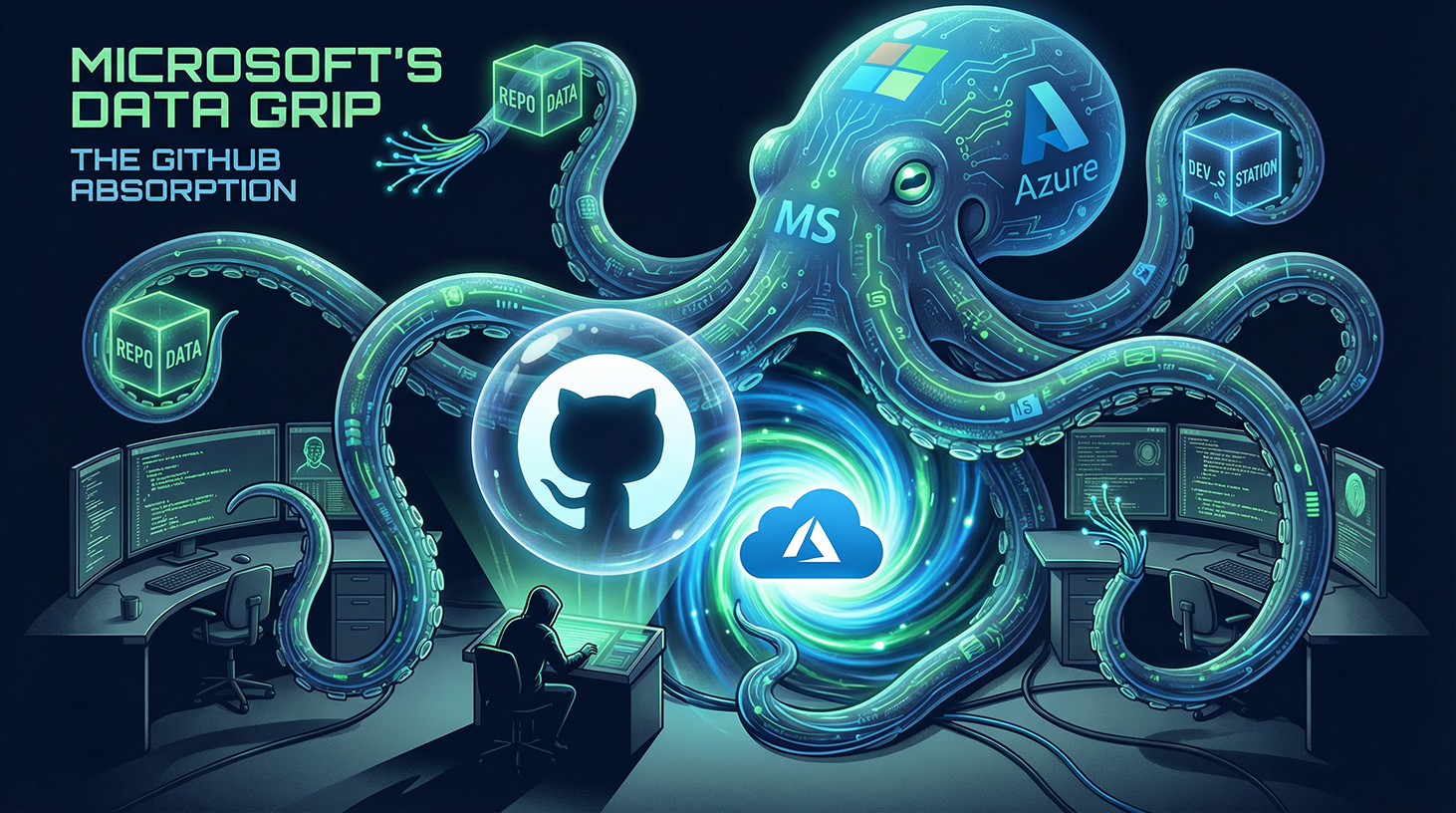
GitHub under Microsoft: The silent expropriation of the developer world – Image: Xpert.Digital
Deadline April 24: Anyone who remains silent on GitHub now is releasing their code to Microsoft's AI
A two-tier system in code: Why only paying GitHub customers are allowed to keep their data
The perfect move: How Microsoft lured the developer world into an AI trap
Microsoft is leveraging its market power on GitHub to train AI models on a massive scale – and millions of developers worldwide could involuntarily become data providers. A sweeping change to the privacy policy, taking effect on April 24, 2026, reverses this: Anyone who doesn't actively opt out will automatically consent to the use of their interaction data and code snippets. Particularly explosive is the fact that while private users, freelancers, and small teams will involuntarily provide the raw material for AI development, expensive enterprise customers will remain completely unaffected by the measure. This development marks the current culmination of a creeping disempowerment of the developer community. But it's no longer just about code – it's about highly sensitive knowledge, data privacy gray areas, and the question of whether individual opt-out alone can still solve the fundamental problem of the platform economy.
When privacy policies become a weapon – how a platform giant turns its 180 million users into a source of raw materials
A seemingly innocuous change to the privacy policy, a short window for objection, and a platform used by 90 percent of Fortune 500 companies: What GitHub is announcing for April 24, 2026, is not a technical update. It's a strategic move in the software industry's largest ongoing AI training project – and it follows a familiar pattern.
From a haven of developer freedom to a data acquisition system
When Microsoft acquired GitHub for $7.5 billion in 2018, a storm of outrage erupted in the developer community. Petitions were launched, waves of migration to GitLab and Bitbucket were predicted, and FSFE President Matthias Kirschner explicitly warned of the impending lock-in effects that Microsoft had made so successful with Windows. These fears were accurate and prescient. However, Microsoft initially acted with restraint: GitHub was allowed to operate as an independent brand, retaining its CEO and its cultural ethos as a developer-friendly platform.
This period of apparent independence has now effectively ended. In August 2025, CEO Thomas Dohmke left the company without appointing a successor. Instead, Microsoft fully integrated GitHub into its newly created CoreAI division, headed by former Meta executive Jay Parikh. The signal was clear: GitHub is no longer an autonomous company, but a strategic AI asset within the Microsoft group. GitHub employees were internally encouraged to switch from Slack to Microsoft Teams—a small but telling detail of the cultural assimilation.
In parallel, GitHub announced plans to fully migrate its entire infrastructure to Microsoft Azure within 24 months. Its own data centers, including the central warehouse in Virginia, are reaching capacity limits caused by the explosive growth of Copilot. CTO Vladimir Fedorov described it internally as an existential necessity. The consequence: New product features will be postponed for the time being, while the technical dependence on Azure is solidified.
The anatomy of the data protection amendment of April 24, 2026
On March 25, 2026, GitHub published an announcement on its official blog that initially sounded consultative in its wording, but was far-reaching in its substance. From April 24, 2026, GitHub and its parent company Microsoft are permitted to use interaction data from users of the Copilot Free, Pro, and Pro+ plans for training AI models – unless the users actively object.
The crucial detail lies not in what is being done, but in how: Instead of using an opt-in process where users would have to actively consent, the procedure has been reversed. Anyone who remains silent until the deadline will automatically consent. According to current estimates, this potentially affects millions of developers worldwide, many of whom will simply overlook the change. Those who previously objected to the use of their data for product improvements are exempt – their existing objection remains valid.
The list of recorded data types is remarkably extensive and has been documented in detail by Heise.de:
- Private repositories during the active user session
- Copilot suggestions accepted or modified by the user
- Input sent to Copilot, including code snippets
- Context code surrounding the cursor position
- User comments and documentation texts
- File names and repository structures
- Navigation behavior within the editor
- All interactions with Copilot features such as chat or inline suggestions
- Feedback in the form of thumbs-up and thumbs-down ratings
What GitHub explicitly excludes are dormant contents of private repositories, meaning the actual stored source code that is not actively used in a Copilot session. This distinction is legally relevant, but in practice less clear-cut than it sounds: Anyone who uses Copilot intensively and continuously opens code files from their private repository is effectively uploading significant portions of their codebase as training context.
The business model behind data policy
To understand the economic logic behind this move, it's essential to examine Microsoft's AI strategy. GitHub Copilot now boasts over 20 million users, and its enterprise customer base grew by 75 percent in the last quarter. More than 50,000 enterprise customers worldwide use the tool, and 90 percent of Fortune 100 companies utilize GitHub in some form.
AI language models improve proportionally to the quality and diversity of their training data. Microsoft has already demonstrated this correlation internally: When Microsoft's own employees, as the first test group, contributed their interaction data for training starting in early 2025, the acceptance rates of Copilot suggestions measurably improved in several programming languages. The model, which had previously been based on public code and manually created examples, experienced a significant qualitative leap through the use of real-world workflow data.
Now, this effect is to be reproduced on an industrial scale. GitHub CPO Mario Rodriguez explained that the goal is to better understand development workflows and thereby generate safer and higher-quality code suggestions. What he didn't mention: The collected data isn't just used for direct model training. It also flows to Microsoft, the parent company, where it can be used to train other AI systems across the entire Microsoft ecosystem. GitHub explicitly rules out sharing the data with external AI model operators – a statement that, given Microsoft's close financial ties to OpenAI, will likely face legal scrutiny.
A two-tier system in data protection
Perhaps the most strategically revealing aspect of this policy is who it doesn't affect. Users of Copilot Business and Copilot Enterprise are completely exempt. For Enterprise customers, the option to share data for training purposes doesn't even exist in the settings. This protection isn't an act of fairness, but a business necessity: Enterprise customers pay significantly more, are subject to stricter compliance requirements, and enter into framework agreements with negotiated data protection clauses.
This creates a structural two-tier system: private developers, freelancers, students, and small teams with Free, Pro, or Pro+ plans become training resources, while large corporations with Enterprise contracts retain control of their data. From Microsoft's perspective, this is an elegant solution: the target group with little bargaining power and high usage intensity provides the training data, which then benefits the Enterprise product for which affluent customers pay higher prices.
This mechanism is by no means new. It is a structural feature of the platform economy, which has been described academically for years: if the service is free or inexpensive, the user is not a customer, but a commodity. GitHub has now consistently transferred this logic to the developer ecosystem – with the special characteristic that this involves not recreational data, but highly sensitive commercial intellectual property.
The step-by-step strategy: How to slowly heat a frog
What is currently being discussed as a single data protection change is the latest step in a multi-year integration strategy that, in retrospect, appears remarkably coherent. The chronology can now be reconstructed:
In 2018, Microsoft acquired GitHub for $7.5 billion in its own stock and promised complete operational independence. This was the adjustment period. Developers were meant to learn how Microsoft would manage GitHub without any dramatic changes.
In the following years, Copilot was introduced, initially as a useful tool trained on public code. The service quickly gained millions of users and established itself as the de facto standard for AI-powered code completion. The dependency was created before the circumstances changed.
In August 2025, CEO Dohmke left the company, and GitHub lost its last institutional barrier against a complete Microsoft integration. At the same time, the Azure migration began: GitHub announced it would abandon all of its own data centers and move entirely to Microsoft infrastructure. With this step, GitHub lost its last vestige of technological independence.
And now, at the beginning of 2026, comes the privacy change: user interactions will be released for AI training by default. Anyone who hasn't yet left must take action now. Each step on its own seemed moderate. Taken together, the sequence reveals a clear pattern of strategic platform integration, which Microsoft has already successfully tested with LinkedIn, Skype, and other acquisitions.
🤖🚀 Managed AI Platform: Faster, safer & smarter to AI solutions with UNFRAME.AI

Managed AI Platform - Image: Xpert.Digital
Here you will learn how your company can implement customized AI solutions quickly, securely and without high entry barriers.
A managed AI platform is your all-inclusive, worry-free solution for artificial intelligence. Instead of dealing with complex technology, expensive infrastructure, and lengthy development processes, you receive a ready-made solution tailored to your needs from a specialized partner – often within just a few days.
The key advantages at a glance:
⚡ Rapid implementation: From idea to ready-to-use application in days, not months. We deliver practical solutions that create immediate added value.
🔒 Maximum data security: Your sensitive data stays with you. We guarantee secure and compliant processing without sharing data with third parties.
💸 No financial risk: You only pay for results. High upfront investments in hardware, software, or personnel are completely eliminated.
🎯 Focus on your core business: Concentrate on what you do best. We take care of the entire technical implementation, operation, and maintenance of your AI solution.
📈 Future-proof & scalable: Your AI grows with you. We ensure continuous optimization and scalability, and flexibly adapt the models to new requirements.
More information here:
Between data protection and market power: Microsoft's strategy behind GitHub's data policy
What's really at stake: The value of knowledge graphs
The public discussion understandably focuses on the question of data protection in the narrow sense: Who is allowed to see which code? However, this debate falls short. The real economic asset at stake is not the code itself, but the structural information that can be extracted from millions of developer sessions.
Architectural patterns
How do professional teams structure their codebases? What design decisions are typically made at different company sizes? Which libraries and frameworks coexist, and in what combinations?
Workflow intelligence
How do developers iterate? How often are specific functions revised? Where do typical errors occur? What do successful debugging strategies look like?
Security pattern
Which security vulnerabilities appear regularly? How are they typically fixed? Where are there systematic weaknesses in common code patterns?
Technological Roadmaps
What is currently being developed in private repositories but not yet published? Which technologies gain practical importance before becoming publicly visible?
All this information, aggregated from over 180 million developers and 630 million repositories worldwide, results in a knowledge graph of inestimable commercial value. It enables Microsoft not only to build better AI models, but also to identify market trends earlier, develop competitor products more effectively, and strategically secure its own platform position.
The legal dimension: GDPR in a field of tension
From a European perspective, the opt-out mechanism raises significant data protection concerns, even though GitHub has not yet explicitly addressed them. The General Data Protection Regulation (GDPR) requires, in principle, clear, informed, and freely given consent for the processing of personal data. A pre-selected opt-in that can only be overridden by active action only meets this requirement if the user in question has actually been able to take note of the change.
Microsoft's history with European data protection authorities is illuminating. For years, the company has struggled to gain acceptance for its data practices in Europe. As recently as 2020, the EU Data Protection Supervisor, Wiewiórowski, explicitly warned against the indiscriminate use of Microsoft products and recommended seeking alternatives with higher data protection standards. It wasn't until 2024 that the European Data Protection Supervisor determined that the European Commission had violated European data protection law by using Microsoft 365. The proceedings were discontinued in July 2025 after Microsoft implemented an EU data limit designed to minimize data transfers to third countries.
Whether these assurances also apply to the new GitHub training models and how the transfer of data to Microsoft, the parent company, can be classified under data protection law are open questions. GitHub assures that the opt-out preference will be retained during data transfer and that authorized Microsoft employees will only have access for model improvement and security audits. However, the contractual enforceability of these promises against a corporation that can unilaterally change its terms of service remains a structural risk.
Market power and the logic of having no alternative
The question of why millions of developers will remain on GitHub despite everything is an economic one, not a moral one. Over the years, GitHub has built a network infrastructure that is difficult for individual developers and companies to abandon. With over 180 million developers worldwide, more than 630 million repositories, and deep integration with CI/CD pipelines, package registries, issue tracking, and community interaction, GitHub is not just a replaceable tool for many teams, but rather the central coordination infrastructure for their work.
These network effects are well understood in the platform economy: with each additional user, the platform's attractiveness to everyone else increases. Anyone switching from GitHub to GitLab or a self-hosted system loses not only a tool, but also visibility, networking opportunities, and access to a global open-source community. The exit costs are real and substantial.
This very structure makes data privacy concerns so difficult to address. Even users who oppose the changes often won't switch – because the individual disadvantage of switching appears greater than the disadvantage of providing interaction data. Microsoft knows this. The opt-out deadline of April 24th is short, information about it is unevenly distributed, and resistance is hampered by the structural inertia of a platform with 180 million users.
Alternatives and their limitations: Self-hosting as a counter-strategy
Alternatives exist, and the current debate is likely to give their use new impetus. GitLab is the most direct competitor, offering a fully self-hosted Community Edition as well as a cloud-based version. Gitea and its fork Forgejo are lightweight, open-source solutions that can run on a simple server or even a Raspberry Pi and almost completely replicate GitHub's core functions—repositories, pull requests, issues, and wikis.
For companies with sensitive code, self-hosting offers the crucial advantage of complete data sovereignty: No external service provider has access to repositories, interaction data remains on the company's own infrastructure, and changes to the terms of service by a US corporation are simply irrelevant. The price for this is operational effort: Server operation, updates, backups, scaling, and security maintenance are the company's own responsibility.
For the vast majority of developers, especially individuals, students, and small teams without their own IT department, switching to a self-hosted solution remains a significant hurdle. This represents a market failure that is structurally difficult to remedy: the solution that best guarantees data privacy requires precisely the technical expertise that can be expected of professional developers but is realistically not possessed by many users.
The double standard of the comparative argument
In their announcement, GitHub and Microsoft point out that similar data practices are also common among competitors like Anthropic and JetBrains. This argument is rhetorically clever, but analytically weak. It establishes a structural problem across the entire industry as the norm and derives legitimacy from it. Just because everyone runs a red light doesn't make running a red light legal.
The key difference compared to other providers lies in its market position: GitHub is not a niche product, but the dominant global infrastructure for software development. Ninety percent of Fortune 100 companies rely on GitHub. This market dominance generates a qualitatively different form of bargaining power than that of a smaller competitor. When a service used by virtually every professional developer changes the terms and conditions, it's not a market decision in a competitive environment—it's a structural imposition with quasi-normative force.
Adding to the problem is the asymmetry of information: GitHub communicated the change via a changelog entry on its own blog. Those who don't read this – and that's the vast majority of its 180 million users – will, at best, learn about the change through secondary sources. This is formally transparent, but practically opaque.
Economic assessment: Short-, medium- and long-term effects
In the short term, the change will have predominantly positive effects for Microsoft. The quality of Copilot will improve through real user data, further expanding its market share in the growing market of AI coding assistants. Resistance and churn will remain moderate, as network effects are too strong and awareness too low.
In the medium term, regulatory countermeasures could emerge. European data protection authorities are likely to examine the opt-out model for AI training for its GDPR compliance, particularly regarding whether such consent can truly be given voluntarily when the service is, in effect, the only option. Such proceedings take years, but ultimately serve as a regulatory corrective.
In the long term, the strategic logic is clear: Microsoft is building a vertically integrated platform for AI-powered software development with GitHub, Copilot, and Azure, a platform that is entirely in-house, from infrastructure and tools to model training. In this context, the change in data privacy is not the goal, but rather a means to achieve sustained market leadership in the AI developer market – a market whose volume, according to current forecasts, will grow dramatically in the coming years.
Structural power and individual contradiction
The option to opt out of data usage until April 24, 2026, is real and should be used by everyone whose code is worth protecting. Opting out can be done in the GitHub settings at github.com/settings/copilot/features by disabling the option "Allow GitHub to use my data for AI model training".
But individual opt-outs don't solve the structural problem. They're merely a band-aid on a systemic wound. The real question isn't whether an individual developer can protect their data, but whether the way platform power is exercised in the digital economy is socially acceptable. GitHub, under Microsoft, exemplifies how an originally open, community-driven infrastructure is gradually transformed into a proprietary data collection system—not through a single major break, but through a sequence of small, seemingly plausible steps.
For professional developers, companies, and IT managers, this leads to a clear recommendation: Anyone hosting code with genuine competitive value should now seriously evaluate whether GitHub is the right platform for sensitive repositories. The technical alternatives exist. What's lacking is the political will to use them – and the structural framework that would realistically enable this transition for non-technical users.
The story that GitHub and Microsoft are currently writing is ultimately a story about power, dependency, and the economic logic of the platform society. It is far from over. But anyone who reads the first few chapters knows how it will end—if no one actively counters it.
Your global marketing and business development partner
☑️ Our business language is English or German
☑️ NEW: Correspondence in your native language!

Konrad Wolfenstein
I and my team are happy to be available to you as your personal advisor.
You can contact me by filling out the contact form here or simply call me at +49 7348 4088 965. My email address is : [email protected]
I'm looking forward to our joint project.
☑️ SME support in strategy, consulting, planning and implementation
☑️ Creation or realignment of the digital strategy and digitization
☑️ Expansion and optimization of international sales processes
☑️ Global & Digital B2B trading platforms
☑️ Pioneer Business Development / Marketing / PR / Trade Fairs
🎯🎯🎯 Data-driven B2B industry hub as a quasi-in-house solution

The quasi-in-house solution: How Xpert.Digital closes operational gaps in B2B marketing and sales – Smart Content-Driven Business - Image: Xpert.Digital
Xpert.Digital is a data-driven B2B industry hub led by Konrad Wolfenstein . The company acts as an external, quasi-in-house solution for industrial partners, closing operational gaps in marketing, content, and sales – without requiring additional resources on the client side.
More information here:









