
One billion for solar energy: Serbia focuses on solar power – What's behind the billion-dollar project from South Korea?
Xpert Pre-Release

Available in 27 languages 📢
Prefer Xpert.Digital on GoogleⓘPublished on: November 12, 2026 / Updated on: November 12, 2026 – Author: Konrad Wolfenstein
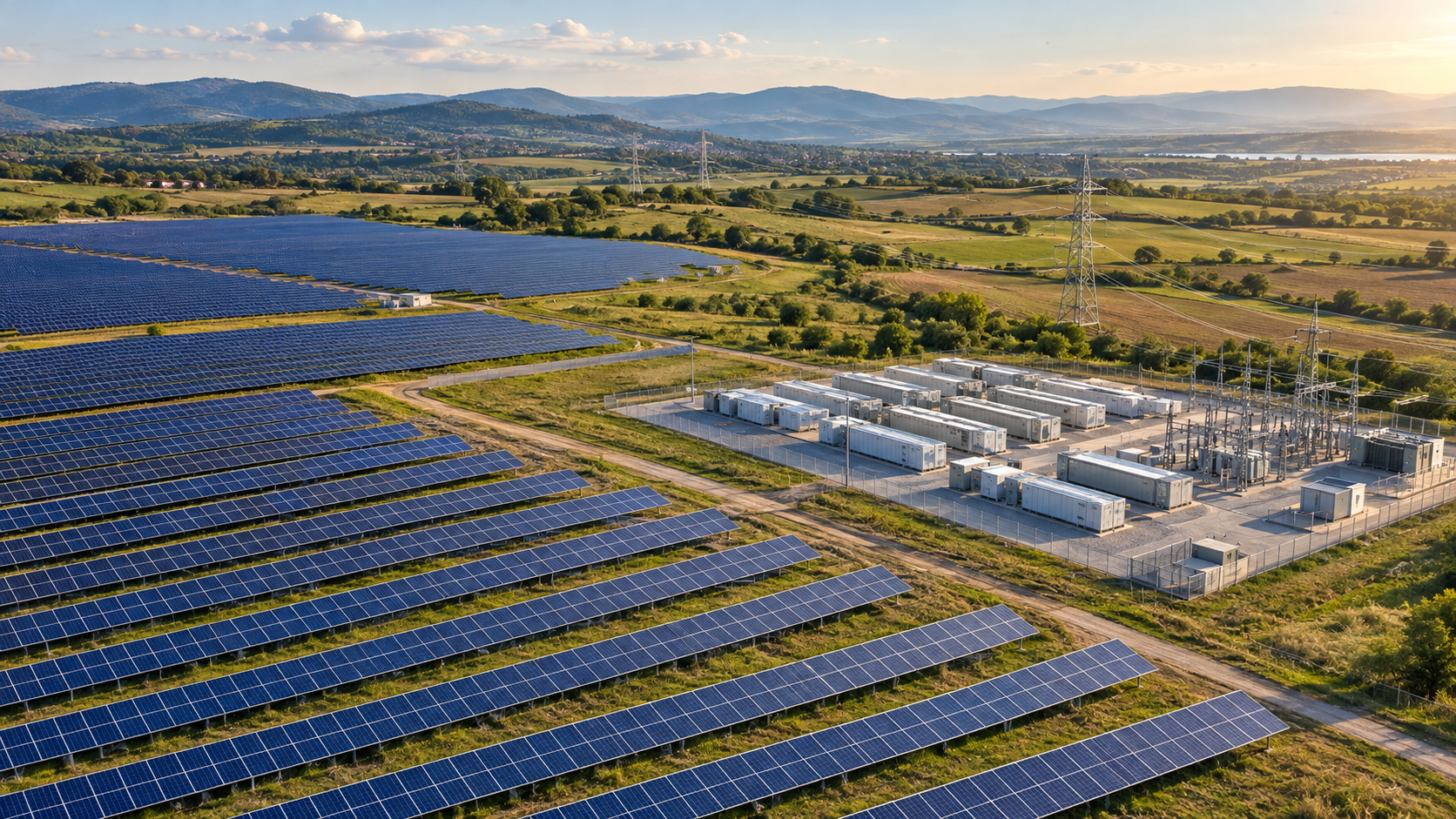
One billion for solar energy: Serbia focuses on solar power – What's behind the billion-dollar project from South Korea – Creative image on the topic, with AI: Xpert.Digital
South Korean capital for Serbia: These risks will determine the success of the solar project
1.2 gigawatts of solar power for Serbia: How much will this major project really deliver?
Serbia's solar offensive: Why grids, storage and financing are more important than modules
Serbia is poised to undertake one of the largest solar projects in its energy history: With support from the South Korean export credit agency K-Sure, a photovoltaic portfolio with a peak capacity of approximately 1.2 gigawatts is to be built. The financing package is estimated at around 900 million euros; battery storage systems are also planned. Upon completion, the plants will be transferred to the state-owned electricity provider EPS.
The project could modernize Serbia's heavily coal-based electricity supply and open up new opportunities for electricity trading and industrial development. However, high output alone does not guarantee affordable electricity or security of supply. Crucially, financing, grid expansion, storage, and operational management will depend on their synergy – and on whether EPS can economically integrate the plants into the existing electricity system. Serbia's solar initiative is therefore more than just a power plant project: it is a test of whether international capital and new technology can create a sustainably more efficient energy system.
Serbia's solar billion-dollar bet: How South Korean capital is changing the energy market in the Balkans
One billion for solar power – but neither modules nor sunshine will determine success
Serbia is facing a pivotal energy policy decision whose economic significance extends far beyond the construction of new solar power plants. The South Korean export credit agency Korea Trade Insurance Corporation (K-Sure) is supporting a large-scale photovoltaic project with a financing package of approximately €900 million, equivalent to roughly US$1 billion. The South Korean plant engineering company Hyundai Engineering and the US company UGT Renewables are involved in the project. The plans include solar power plants with a combined peak output of approximately 1.2 gigawatts, a grid connection capacity of one gigawatt, and supplementary battery storage. Upon completion, the plants will be transferred to the Serbian state-owned electricity provider Elektroprivreda Srbije (EPS).
The project thus combines several developments: the transformation of an electricity system that is still heavily reliant on coal, the increasing importance of state-backed infrastructure financing, and the competition among international industrial suppliers for European energy markets.
The crucial question, however, is not whether Serbia can generate more solar power. It is whether a large investment will result in an economically viable electricity system. For this to happen, financing, grids, storage, electricity marketing, and industrial development must all be aligned.
The economic perspective is therefore twofold: The project can trigger a significant modernization push. However, it can also demonstrate how little a high installed capacity alone says about security of supply, profitability, and actual independence.
The funding is substantial – but it does not equal the total project costs
The most important conceptual distinction concerns money. A financing package of around one billion US dollars is not automatically identical to the total investment volume. Likewise, the support of an export credit agency does not necessarily mean that it will immediately disburse the full amount as its own loan.
In this case, the discussion centers on export financing support. Other reports cite an estimated total project volume of approximately €1.1 billion. While these figures are consistent, they should not be treated as a definitively established cost and financing structure. Interest rates, maturities, equity capital, guarantees, and specific disbursement conditions are just as crucial for a reliable economic assessment as the publicly stated total amount.
Especially in large energy projects, the financing structure determines how expensive the electricity produced will actually be in the long run. Two technically comparable solar parks can have significantly different levelized costs of electricity (LCOE) if one receives favorable, long-term secured loans while the other has to pay high risk premiums.
Therefore, the financing package is more than just a capital commitment. It can change the perception of risk for the entire project. However, government guarantees do not replace a sound site selection or a realistic profitability calculation. They shift risks and facilitate financing; they do not eliminate them.
Why Serbia's electricity supply needs a structural overhaul
Serbia's starting point differs from that of many Western European electricity markets. The country has a historically developed energy supply in which coal-fired power plants and large hydroelectric plants play a central role. For 2024, coal accounted for approximately 60.5 percent and hydropower for 29.7 percent of national electricity generation. Solar energy, according to these figures, was only around 0.25 percent. These figures describe nationwide generation and should not be confused with the separate generation mix of EPS (Serbian Energy and Water Industries).
This structure has both economic strengths and weaknesses. Existing power plants, established operational processes, and domestic energy resources can initially provide stability. At the same time, dependencies arise on the condition of the plants, fuel quality, water levels, and long-term modernization costs.
New photovoltaic systems are changing this risk distribution. They do not require coal replenishment during operation and reduce dependence on the variable costs of thermal power generation. However, this increases the importance of weather forecasts, grid control, and temporal flexibility.
From an economic perspective, it's therefore not a matter of simply replacing one technology with another. Serbia needs to build a more diversified generation portfolio. Such a portfolio can better distribute risks if the individual technologies work together effectively.
Solar energy is an important component in this. However, it will not replace all coal-fired power generation in the short term, nor will it replace all the system services of conventional power plants.
What 1.2 gigawatts of power actually means
The different performance figures for the project are not necessarily contradictory. They describe different technical levels. Approximately 1.2 gigawatts of peak power refers to the installed photovoltaic modules. One gigawatt of grid connection capacity, on the other hand, describes the planned maximum feed-in power on the grid side. In addition, there are battery storage systems with approximately 200 megawatts of power and up to 400 megawatt-hours of storage capacity.
This distinction is economically relevant. Solar modules only reach their nominal power output under certain conditions. Throughout the day and year, the actual output is often lower. Therefore, a higher module output compared to the grid connection's capacity can help to better utilize the grid connection for more hours.
During particularly productive hours, however, more solar power may be generated than can be fed into the grid immediately. In such cases, electricity must be stored, used elsewhere, or curtailed. The most economically viable solution depends on the system configuration, grid conditions, and market prices.
The term gigawatt also easily gives a false impression of continuous availability. A gigawatt of solar connection does not mean that a gigawatt of electricity is supplied around the clock. For energy-economic evaluation, annual production, hourly feed-in profile, and guaranteed availability are therefore at least as important as the installed capacity.
Only these figures will show what contribution the project can actually make to supply.
The expected amount of electricity is significant, but it does not represent a complete energy transition
The solar portfolio is projected to generate approximately 1.5 terawatt-hours of electricity annually, equivalent to 1.5 billion kilowatt-hours. This is a forecast for future operation, not actual electricity generation. Actual yields will depend on factors such as solar irradiance, system availability, pollution levels, technical losses, and potential grid limitations.
The scale is nevertheless considerable. It shows that the project is not only intended to make a symbolic contribution, but will create a significant additional generation capacity.
At the same time, the annual output should not be confused with the available power at all times. A theoretically sufficient amount of electricity over twelve months does not guarantee an adequate supply on a windless winter evening or during a prolonged technical malfunction at other power plants.
Furthermore, there is the difference between generated and economically usable electricity. Not every additional kilowatt-hour has the same value. Electricity during periods of scarcity can be particularly valuable. Conversely, electricity generated during a regional surplus can only generate low revenue.
The expected 1.5 terawatt-hours are therefore a sensible starting point for the assessment. However, the actual economic benefit only becomes apparent when this amount of electricity is generated, what generation it replaces, and how well the system can absorb it.
Export credit agencies simultaneously finance the energy transition and their own industry
K-Sure's involvement follows an economic policy logic that extends beyond Serbia's electricity supply. Export credit agencies are intended to facilitate and secure international business for domestic companies. In this particular project, financing is linked to South Korean industrial interests. Hyundai Engineering is undertaking key tasks in planning, procurement, and construction. Central equipment such as solar panels and transformers are to be supplied by South Korean companies.
This creates a double benefit for South Korea. The companies gain access to a large foreign market, while the country strengthens its position as a provider of complex energy infrastructure.
This model could be attractive for Serbia because it combines capital, technical implementation, and supply chain coordination. An integrated offering may reduce interface problems between lenders, plant engineers, and equipment suppliers.
However, there is a potential drawback: financing advantages may be tied to specific suppliers or origin requirements. The cheapest loan may then not necessarily lead to the most cost-effective overall solution.
A proper evaluation must therefore consider financing costs and delivery prices together. Crucially, the total life cycle costs must be taken into account, including operation, spare parts, maintenance, and any potential technical dependencies.
The model is therefore neither mere development aid nor automatically problematic influence. It is a combination of export promotion, risk sharing, and infrastructure policy, the benefits of which depend on the specific conditions.
The real competition takes place on the cost of capital
Public discussions about photovoltaics often focus on module prices. For large projects, this is too narrow a view. Solar power plants incur a large portion of their costs before the first kilowatt-hour is generated. After that, ongoing fuel costs are comparatively low because no fuel needs to be purchased.
This gives particular importance to interest rates, maturities, and risk premiums. Financing that remains predictable over a long period can significantly improve profitability.
For Serbia, the potential benefit of export credit insurance lies in making certain political or economic risks more manageable for lenders. This can mobilize additional financing or enable more favorable terms. The actual extent of this effect cannot be reliably quantified without published contract terms.
At the same time, attention is shifting to risk distribution. Who bears the additional costs during the construction phase? Who is liable in the event of a delayed grid connection? What obligations exist in the event of lower electricity production? Which payments remain due even if electricity prices develop unfavorably?
These questions are more economically significant than the mere amount of financing pledged. A project is not profitable simply because it receives a large loan. It is profitable when the long-term usable electricity production is in reasonable proportion to all costs and risks assumed.
Foreign currency financing can turn an advantage into an additional risk
International financing provides access to major capital markets, but also introduces another dimension to valuation: currency. If commitments are made in euros or US dollars, while a significant portion of revenue is generated in Serbian dinars, an exchange rate risk can arise.
Whether and to what extent this risk exists in a specific project depends on the actual financing and revenue agreements. A complete currency structure cannot be deduced solely from the public mention of a euro or dollar figure.
However, the general principle is that a depreciation of the revenue currency can increase debt servicing costs if there is no sufficient hedging or natural offsetting asset. Revenues from cross-border electricity trading could partially provide such an offsetting asset. However, these revenues are themselves dependent on market prices, export opportunities, and regulatory conditions.
Even a government guarantee doesn't solve this problem. It only changes who ultimately bears the risk. In the worst-case scenario, it shifts from the project to the utility company or the public budget.
Sustainable financing should therefore not only function under normal conditions. It must also be able to withstand exchange rate fluctuations, lower electricity revenues, and unexpected operating expenses. Especially with long-term infrastructure, this resilience determines the true value of favorable initial conditions.
Battery storage provides flexibility, but not unlimited security of supply
The planned battery storage systems are a central component of the concept. With a capacity of 200 megawatts and an energy content of 400 megawatt-hours, the calculated discharge time at full power is two hours. Practically usable energy amounts also depend on operating limits, state of charge, and losses.
This is helpful, but it doesn't replace securing the entire solar output overnight. The storage capacity only represents a portion of the planned grid connection capacity of the solar portfolio.
Their economic benefit therefore lies primarily in short-term flexibility. Batteries can buffer rapid changes in feed-in, partially shift generation peaks, and improve the overall portfolio's operating dynamics. They can also help limit forecast deviations and achieve more valuable marketing hours.
Storage systems of this size are not designed for multi-day periods of darkness or extended outages of other generation facilities. The project therefore combines large-scale solar power generation with a limited, selectively deployable flexibility reserve.
From an economic perspective, it is crucial not to overload the battery with tasks. It can fulfill several revenue and system functions, but not each of them simultaneously to its full extent. Adding up all theoretically possible advantages easily leads to an overestimation of the actual economic efficiency.
New: Patent from the USA – install solar parks up to 30% cheaper and 40% faster and easier – with explanatory videos!

New: Patent from the USA – Install solar parks up to 30% cheaper and 40% faster and easier – with explanatory videos! - Image: Xpert.Digital
The core of this technological advancement is the deliberate departure from conventional clamp mounting, which has been the standard for decades. The new, more time- and cost-effective mounting system addresses this with a fundamentally different, more intelligent concept. Instead of clamping the modules at specific points, they are inserted into a continuous, specially shaped support rail and held securely in place. This design ensures that all forces – whether static loads from snow or dynamic loads from wind – are distributed evenly across the entire length of the module frame.
More information here:
Optimizing solar power marketing for higher revenues
Solar power is not paid for according to its average amount
As solar power capacity expands, the price structure of the electricity market changes. When many plants are producing electricity simultaneously, supply increases, especially during the same hours of the day. This can make the hours when solar power plants generate the most electricity cheaper.
Therefore, the average market price alone is not relevant for economic viability. The decisive factor is the price actually achieved by the specific generation profile. A solar park can generate significantly less revenue than a simple multiplication of its annual production by a general average annual price would suggest.
For the Serbian project, this means: High technical yields are valuable, but do not guarantee correspondingly high revenues. The marketing strategy must take the production timeline into account.
Long-term power purchase agreements (PPAs) can reduce some of this uncertainty. However, price, contract duration, volume risks, and responsibility for deviations must be carefully balanced. A seemingly stable agreement can contain significant risks if the promised delivery profiles do not match actual solar generation.
Batteries can improve the achievable electricity value by shifting part of the production process. However, this also incurs costs due to losses, aging, and tied-up capital.
The economic benchmark is therefore not maximum production at any price, but the highest possible usable value over the entire lifespan.
The grid connection is not a side issue, but rather the economic bottleneck
A solar power plant only generates economic benefit if its electricity can be reliably transported. Therefore, grid expansion is just as important as the installation of the modules.
For the Serbian project, grid connection agreements have already been announced with the transmission system operator Elektromreža Srbije, or EMS for short. Such agreements are an important planning step. However, they do not equate to the complete technical completion of all necessary grid measures.
For a large solar power portfolio, lines, substations, protection technology, metering systems, and operational management must be compatible. Furthermore, it is necessary to check whether multiple systems are feeding into the same grid sections simultaneously and thereby exacerbating bottlenecks.
The economic consequences of delayed connections can be significant. Invested capital is already incurring costs, while electricity revenues are not being generated. If completed systems are only operated to a limited extent, the utilization of the entire investment decreases.
Therefore, progress should not be assessed solely based on the number of modules installed. A meaningful picture only emerges from considering generation facilities, storage systems, and grid infrastructure together.
This results in a clear priority for national energy policy: the expansion of renewable energies must be linked to a robust grid plan. Otherwise, a situation risks arising in which technically available generation cannot be fully utilized economically.
EPS needs to transform from asset owner to active portfolio manager
The planned takeover of the facilities by EPS makes the project an integral part of the public electricity supply and not merely an isolated private generation investment. This gives particular importance to operational integration.
A utility company with a large solar portfolio requires different skills than a company whose operations are primarily based on coal and hydroelectric power plants. Weather-dependent generation demands precise forecasts, short-term deployment decisions, and a close link between technical operations and electricity trading.
The battery further complicates this issue. Its value depends on when it is charged and discharged, what reserve capacity it holds, and how heavily it is used. A purely technical analysis is insufficient.
This presents EPS with an organizational modernization challenge. Data quality, digital control, risk management, and qualified personnel become productive assets.
The handover of the systems must also be carefully planned from an economic perspective. Crucial factors include not only functioning components, but also reliable documentation, available spare parts, trained operating personnel, and clear warranty conditions.
A successfully constructed project can lose value if these prerequisites are lacking. Conversely, good operational organization can better utilize existing technology and reduce costs in the long term. The industrial learning process is therefore an essential part of the investment.
For industry, the quality of the power supply counts more than a green label
For Serbian companies, additional solar power generation can improve the attractiveness of their business location. This is particularly relevant for companies with high daytime electricity demands whose load profiles are partially compatible with solar power generation.
However, this does not automatically mean that every industrial customer will receive cheaper or demonstrably lower-emission electricity. This requires suitable supply products, transparent allocation, and reliable contract terms.
A company cannot simply rely on the construction of a national solar park if it has to provide customers with concrete evidence of its electricity procurement. Between additional domestic generation and a reliable operational electricity verification lie measurement, accounting, and contractual arrangements.
This becomes particularly challenging for businesses with continuous operation. They also need electricity at night and during periods of low solar production. Their procurement model must therefore combine solar energy with other sources of supply and, if necessary, flexibility.
Nevertheless, this presents a strategic opportunity for Serbia. A more modern electricity system can strengthen its attractiveness for export-oriented industries, logistics, and digital infrastructure.
What matters most is not so much the public promise of cheap energy, but the ability to offer a predictable long-term supply. Investors assess price, reliability, grid connection options, and emissions profile together. A weakness in one of these areas can negate advantages in another.
European climate requirements increase the pressure to modernize
Serbia's economic integration with the European Union makes the emissions intensity of its energy supply increasingly relevant. Different transmission pathways must be distinguished in this context.
Firstly, companies may face requirements from their European customers. Secondly, regulatory requirements for certain goods and cross-border electricity supplies also play a role. These connections should not be generalized to all exports and industries.
The European carbon border adjustment mechanism CBAM increases the economic pressure to adapt to emissions-intensive trade relationships. For Serbia, this makes the way electricity is generated, documented, and marketed increasingly important. However, the specific impact depends on the product in question, the applicable rules, and the recognized verification methods.
Additional solar energy can have strategic value in this environment. It expands the possibilities for developing lower-emission production and corresponding electricity supply.
However, it is not an automatic license to do as one pleases. A single solar project does not immediately change the entire national electricity mix. Nor does it eliminate all requirements for industrial production processes.
The economically sound perspective is therefore long-term: Serbia can improve its adaptability through renewable energy generation. The benefits will be particularly evident when energy policy, industrial investments, and verifiable emissions data are combined.
Security of supply arises from diversity, not from a new monoculture
Solar energy can reduce dependence on individual risks. However, it can create new dependencies if the transition is too one-sided.
A robust electricity system combines diverse generation profiles, flexible demand, grids, storage, and guaranteed availability. However, not every technology is equally well-suited for every task.
Photovoltaics provide electricity during the day with a weather- and season-dependent profile. Hydropower can offer flexibility depending on the plant type, but is dependent on water availability and operating conditions. Conventional power plants can fulfill other functions, but incur their own costs and risks.
The economic advantage lies in the synergy. For example, under suitable conditions, solar power can help conserve other resources for later hours. Whether this actually succeeds depends on technical possibilities and operational coordination.
For Serbia, it would therefore be problematic to simply replace the current focus on coal with a new focus on a single renewable technology.
The goal must be a system that functions even under unfavorable individual conditions. The economic viability of a solar project is therefore measured not only by its own costs, but also by how it affects the risks and costs of the rest of the electricity system.
Not every country in the Balkans can export the same surpluses at the same time
Serbia is part of a regionally interconnected electricity market. This presents opportunities for trade and mutual balancing. At the same time, the regional simultaneity of weather patterns limits some expectations.
When several countries significantly expand their solar power capacity, production often increases during similar hours. In such cases, additional exports are not automatically possible at high prices. Neighboring countries may be able to offer ample solar power themselves at the same time.
Conversely, prolonged periods of drought or other large-scale weather conditions can strain multiple power systems simultaneously. Cross-border trade remains important in such situations, but it does not offer unlimited protection.
For Serbia, this means that export revenues should be calculated cautiously. A business model that relies on consistently high prices for large midday surpluses would be vulnerable.
At the same time, the regional market can increase the benefits of the project if additional pipeline connections and different generation structures enable effective balancing.
The central economic challenge lies in linking physical exchange possibilities with realistic price assumptions. Electricity trading is not a replacement for national system planning, but rather a complement to it.
The Balkans will not become an attractive energy location simply through additional power plant capacity. The crucial factor is whether a high-performing regional market develops from numerous national investments.
Local value creation must extend beyond earthworks and assembly
A large international project does not automatically bring about a comprehensive boost in industrial development for the recipient country. A significant portion of the investment can flow into imported equipment and external services.
For Serbia, the challenge therefore lies in building realistic local value creation. In the short term, construction services, transport, installation, security services, and technical support are possibilities. In the long term, maintenance, operations management, data analysis, and specialized engineering services are particularly interesting.
Employment should not be equated with sustained industrial development. Many workers may be needed during the construction phase. However, the personnel requirements of a solar park during operation are typically structured quite differently.
More sustainable economic benefits arise when local companies acquire skills that they can later offer beyond the original project. These include knowledge of power electronics, storage integration, network technology, and digital monitoring.
A fully-fledged, in-house module industry is not strictly necessary. Often it makes more sense to complement existing industrial strengths rather than attempting to replicate an entire value chain at high cost.
The crucial question, therefore, is not just how much money is spent in the country. It is which skills will remain in the country after the construction phase is completed and enable new business opportunities.
Land use, environment, and communities influence real economic viability
Large open-space facilities require space. This space often has alternative uses and therefore economic value.
Proper site planning must therefore consider electricity yield, grid connection costs, soil quality, environmental concerns, and local interests together. The sunniest location is not necessarily the most cost-effective location overall.
High connection costs, difficult soil conditions, or protracted conflicts can negate an initially attractive return. Conversely, a somewhat less productive location can be economically advantageous if infrastructure is in place and land-use conflicts remain minimal.
The distribution of benefits is also important. Communities may have to bear the burden of changes to the landscape and additional costs during construction. If the economic benefits accrue primarily outside the region, acceptance may be lost.
Transparent local revenues, verifiable land use, and reliable decommissioning commitments are therefore not merely additional communicative issues. They influence project stability and long-term costs.
For the environmental assessment, not only avoided emissions during electricity operation are considered. Manufacturing, transport, maintenance, and subsequent disposal are also included in the life cycle analysis.
This does not fundamentally weaken the economic rationale for solar energy. It makes it more precise and protects it from an evaluation that only considers visible advantages.
Three development paths show what will determine success
A favorable development path requires that financing, construction, grid connection, and commissioning are closely coordinated. The plants achieve their expected yields, the storage facilities are used economically, and EPS successfully integrates the portfolio into procurement and supply.
Then the project can not only supply additional electricity. It can also build technical expertise, reduce import dependencies during certain hours, and facilitate further investment.
A moderate development path would be less spectacular, but still beneficial. The systems are functioning, while delays, temporarily low solar power prices, or limited grid capacity erode some of the potential benefits. The project contributes to diversification, but does not alter the country's overall competitive position in the short term.
An unfavorable development path arises when several risks coincide: higher financing costs, delayed connections, inadequate operational organization, and weaker revenues. In such cases, liabilities may remain even though the economic benefits fall short of expectations.
These scenarios are not predictions. They illustrate the key interrelationships.
The difference between them doesn't just depend on the weather. It depends primarily on institutional quality, technical coordination, and financing that remains sustainable even under adverse conditions.
It's not the biggest plant that wins, but the better organized electricity system
The South Korean-backed solar project has the potential to significantly modernize Serbia's energy supply. The combination of large-scale photovoltaic capacity, battery storage, international industrial expertise, and government-backed financing is economically significant.
The clearly reasoned perspective, however, is this: Long-term value does not arise from the announcement of billions of dollars itself. It arises from the ability to transform capital into a reliably usable, appropriately priced, and system-serving electricity supply.
Serbia needs more than modules for this. It requires high-performance networks, robust financing conditions, professional management, and an industrial strategy that transforms imported technology into lasting knowledge.
The key opportunity lies in advancing several modernization tasks simultaneously. Additional solar generation can diversify the electricity mix. Storage can create short-term flexibility. International financing can enable investments. A utilities company that adapts can use this to develop a better generation portfolio in the long term.
The main danger, on the contrary, lies in the fact that a technically large project will be mistaken for a comprehensive solution.
Serbia's multi-billion-euro solar gamble is therefore neither a guaranteed breakthrough nor a mere prestige project. It is a demanding economic test. Its outcome will show whether the country is simply building new power plants or actually creating the conditions for a more competitive energy system.
Your partner for business development in the fields of photovoltaics and construction
From industrial rooftop PV to solar parks and larger solar parking lots
☑️ Our business language is English or German
☑️ NEW: Correspondence in your native language!

Konrad Wolfenstein
I and my team are happy to be available to you as your personal advisor.
You can contact me by filling out the contact form here [email protected]:or simply call me at +49 7348 4088 965. My email address is
I'm looking forward to our joint project.







