
Salary increase at the AOK (a German health insurance company), fee cuts for doctors: billions for administration, cost-cutting measures in medical practices
Xpert Pre-Release

Available in 27 languages 📢
Prefer Xpert.Digital on GoogleⓘPublished on: April 16, 2026 / Updated on: April 16, 2026 – Author: Konrad Wolfenstein
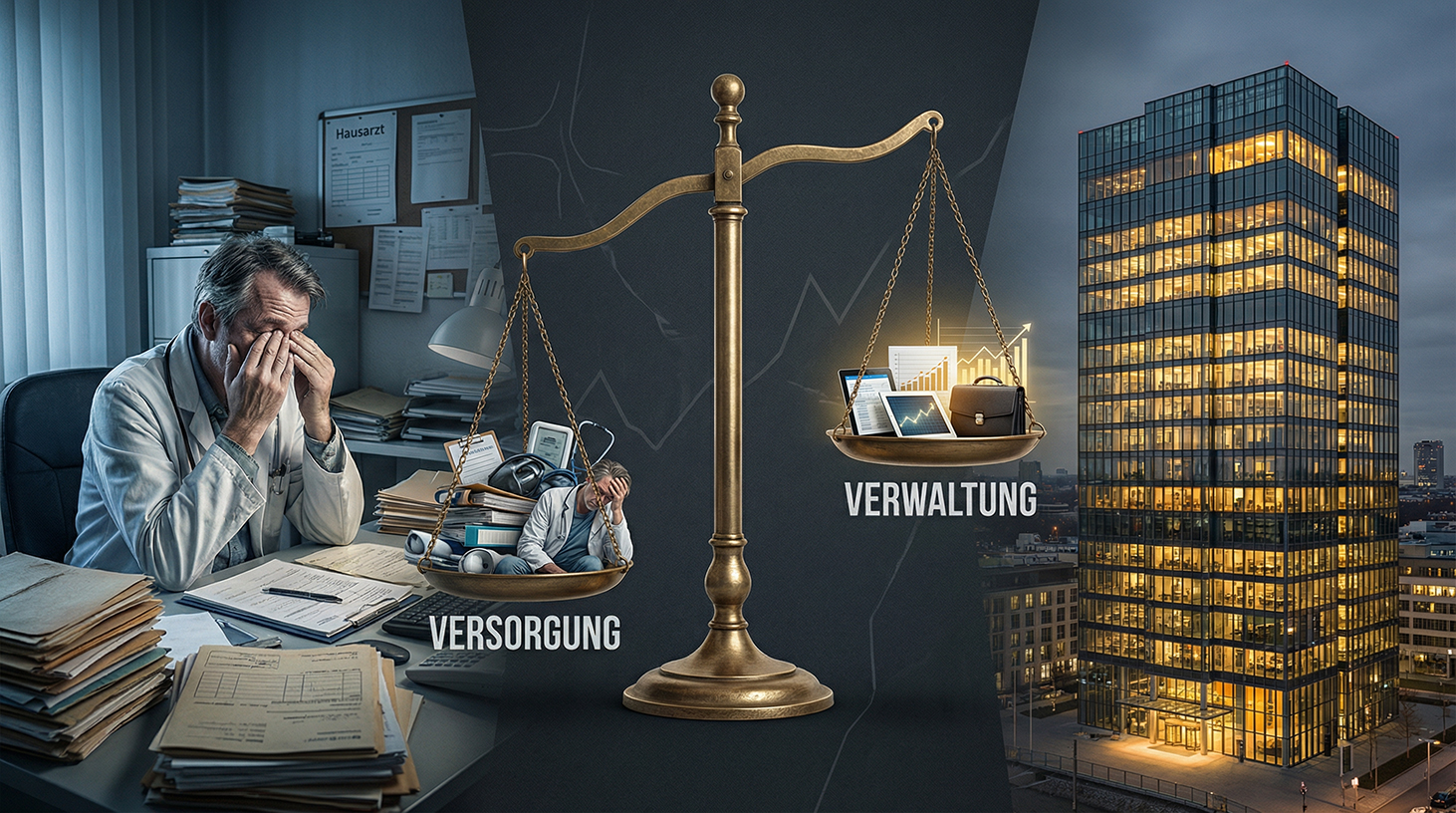
Salary increase at AOK, fee cuts for doctors: billions for administration, cost-cutting measures in medical practices – Image: Xpert.Digital
The absurd system of health insurance companies and the real scandal of our healthcare system
Silent Bleeding Out: Why the German Healthcare System is Collapsing Unnoticed
Fee reductions despite a 26-week waiting period: The fatal misconception in psychotherapy
The German healthcare system faces a massive, systemic contradiction: While health insurance companies pump billions into their own administration and their employees are striking nationwide for substantial pay increases, cuts are being made precisely at the expense of those who work directly with patients. General practitioners and psychotherapists are confronted with fee reductions, crushing bureaucracy, and a lack of appreciation. The result is a silent hemorrhage of outpatient care: Practices can't find successors, waiting times are exploding, and instead of genuine structural reforms, politicians are merely pointing to digitalization and artificial intelligence. This is a stark analysis of who truly supports our healthcare system – and why it threatens to collapse under its own administrative burden if we don't pull the emergency brake soon.
Related to this:

Who pays the price for a system that refuses to reform itself?
The German healthcare system: between structural self-blockage and the silent erosion of care
There are moments when a single discrepancy in the figures reveals more about a system than any major political speech. The German healthcare sector is currently providing just such a moment – and its starkness could hardly be greater. While the Extended Assessment Committee, the jointly represented body of the National Association of Statutory Health Insurance Physicians and the National Association of Statutory Health Insurance Funds, decided in March 2026 to reduce fees for psychotherapeutic services by approximately 4.5 percent, employees of the AOK (a major German health insurance provider) simultaneously went on strike nationwide for significantly higher wages. The ver.di union and the German Civil Service Federation (DBB) demanded, among other things, monthly salary increases of around 375 euros in the 2026 AOK collective bargaining round.
These two developments are not merely parallel; they stand in direct, systemically significant contradiction to one another. On the one hand, the remuneration of those working directly at the patient's bedside—or rather, at the treatment chair—is being reduced. On the other hand, the administrative staff of the system are fighting for income increases that, in absolute terms, exceed what a general practitioner in private practice earns on average per year from a single patient with statutory health insurance. This is not rhetorical exaggeration. It is a sober calculation, the result of which is politically inconvenient.
Related to this:

What a patient is really worth to the family doctor
To understand the extent of this discrepancy, it's worth examining the specific reimbursement structure for outpatient medical care. The consultation fee, i.e., the basic payment for a general practitioner visit within the statutory health insurance system, ranges between approximately 10 and 20 euros per case, depending on the quarter and the regional association of statutory health insurance physicians. Crucially, this fee is not paid per contact, but per quarter. A patient who visits three times in the same quarter does not generate three times the fee, but only a single one. While the removal of budget caps on general practitioner reimbursements, which will be phased in starting in October 2025, has led to improvements in certain services, the fundamental structural problem remains.
If you roughly calculate the annual reimbursement for a regularly treated statutory health insurance patient for a general practitioner – that is, four quarterly flat fees plus a calculated number of additional services – you arrive at an amount that, depending on the practice structure and region, is roughly between 100 and 300 euros per year per patient. This figure does not yet include practice expenses. After deducting personnel, rent, equipment, continuing education, insurance, and administrative costs, the doctor is left with significantly less. According to Destatis, the average net income of a medical practice fell noticeably in 2023, while expenses rose sharply. This net income may initially sound like a comfortable figure to outsiders – however, it is the owner's salary, excluding pension entitlements from the statutory pension insurance, often without traditional employer benefits, and bearing the full entrepreneurial risk.
The requested additional €375 per month for AOK employees equates to €4,500 per year. This exceeds what many general practitioners earn from an average statutory health insurance patient in an entire year – after all services, but before practice costs. This comparison is not a criticism of health insurance employees, who have a legitimate claim to fair compensation. It is a criticism of a system that distributes its resources in such a way that direct patient care remains structurally undervalued.
Fee reduction despite growing demand: The special case of psychotherapy
The decision of the Extended Assessment Committee of March 2026 to reduce psychotherapeutic fees by almost 4.5 percent from April 2026 affects a professional group that has been in a paradoxical situation for years: The demand for psychotherapeutic services is constantly increasing, while at the same time the framework conditions for independent psychotherapists are becoming increasingly unattractive.
The National Association of Statutory Health Insurance Physicians (KBV) reacted to the decision with sharp criticism and announced legal action. From the perspective of the National Association of Statutory Health Insurance Funds (GKV-Spitzenverband), however, psychotherapists remain "well-compensated" despite the cuts. This assessment, however, ignores the economic realities of private practices: rising energy, personnel, and rental costs, increasing demands for documentation and digitalization, as well as the investment costs of setting up a practice, mean that even small percentage reductions in fees have a significant structural impact.
The German Federal Chamber of Psychotherapists (BPtK) pointed out that fee cuts coupled with growing demand are putting further pressure on psychotherapeutic care. The average waiting time for an outpatient therapy appointment was recently around 142 days – according to a study by the BPtK – and more recent surveys indicate waiting times of up to 26 weeks for those with statutory health insurance. In a system genuinely committed to mental health, these figures would prompt consideration of expanding capacity. Instead, the incentives for establishing a private practice are decreasing – and consequently, in the medium to long term, so is the capacity for providing care.
The administrative machine grows while the supply chain shrinks
Anyone wanting to understand the core structural problem of the German healthcare system must look at the costs that are rarely discussed publicly: administrative costs. The statutory health insurance funds recently spent several billion euros annually on administration and organization alone. According to calculations by various associations, these administrative costs amount to roughly 12 to 14 billion euros annually, depending on what exactly is included under the term "administrative costs." Added to this are expenditures for advertising and member recruitment, which play a significant role in the competition among the more than 90 statutory health insurance funds.
It is noteworthy that political proposals for cost-cutting in this area are remarkably timid. If savings are to be made, they are to be in the advertising budget – not in the structure, not in the number of health insurance funds, not in administrative salaries. The reforms hinted at in the coalition agreement primarily affect the supply side: fewer benefits, lower fees, and greater personal responsibility for the insured. The demand side – that is, the costs for bureaucracy, oversight, marketing, and the administrative apparatus – remains largely untouched.
The statutory health insurance system as a whole closed 2025 with a preliminary surplus of around €3.5 billion. This sounds like financial stability. In reality, however, benefit expenditures rose significantly in the first three quarters of 2025 compared to the same period of the previous year, driven primarily by hospital costs. At the same time, numerous health insurance funds increased their supplementary contribution rates for 2026 – following increases that were already noticeable in 2025. The system is therefore not stable. It has become more expensive without a corresponding increase in the quality of care.
Related to this:

The demographic time bomb is detonating, while politicians react as always: too late
The real structural challenge still lies ahead. The shortage of doctors, already noticeable in rural areas, will worsen dramatically in the coming years. A study published by the Bertelsmann Foundation in autumn 2025 warned that by 2040, five more German states will face a widespread shortage of general practitioners, significantly exceeding the current level of the problem. According to various forecasts, up to 50,000 doctors could be needed by 2030. Der Spiegel reported in October 2025 that thousands of general practitioner positions, particularly in rural areas, will remain vacant.
The reasons are well-known and have been extensively documented: The majority of currently practicing general practitioners belong to birth cohorts that will retire within the next ten to fifteen years. At the same time, fewer and fewer medical graduates are choosing general practice, and even fewer are opting for private practice. The bureaucratic burden, the below-average remuneration compared to other specialties and abroad, the entrepreneurial risk of running a practice, and the increasing work-life balance orientation of younger generations of physicians are making the profession of practicing general practitioner or specialist structurally unattractive.
Instead of addressing these well-known causes with structural improvements—such as higher reimbursements, reduced bureaucracy, and better support for setting up a practice—politicians are turning to digitalization and artificial intelligence. Both technologies can certainly be useful additions. But they do not replace medical decision-making, a therapeutic relationship, or a physical examination. The idea that a chatbot could replace the family doctor in the medium term is not only medically questionable but also politically dangerous—because it reduces the pressure for genuine structural reform.
Our EU and German expertise in business development, sales and marketing

Our EU and German expertise in business development, sales and marketing - Image: Xpert.Digital
Industry focus areas: B2B, digitalization (from AI to XR), mechanical engineering, logistics, renewable energies and industry
More information here:
A thematic hub offering insights and expertise:
- Knowledge platform covering global and regional economies, innovation and industry-specific trends
- A collection of analyses, insights, and background information from our key areas of focus
- A place for expertise and information on current developments in business and technology
- A hub for companies seeking information on markets, digitalization, and industry innovations
Fragmented interests, fatal consequences: Why service providers must stand together
The economics of system stabilizers: Who really supports the system?
It's worth pausing for a moment to consider who actually supports the German healthcare system – not in a political sense, but in an economic one. Private practice physicians, psychotherapists, and pharmacists are formally self-employed. They are subject to entrepreneurial risk: practice start-up costs sometimes exceeding €200,000 to €400,000, personnel costs, rent, liability, and investment risks. They operate medium-sized businesses – with the crucial difference that they are not allowed to set their own prices. Fees are determined by a committee in which the other side – the health insurance companies – wields considerable negotiating power.
This structural asymmetry is the real scandal, one that receives far too little attention in public debate. A general practitioner who wants to increase their quarterly revenue by working more quickly hits the limits of budgeting – overtime simply isn't compensated at the same rate. A public health insurance administrator, on the other hand, can benefit from rising salaries through collective bargaining, salaries financed by increased contributions from policyholders. The risk distribution between those who actually provide care and those who administer the system is fundamentally unequal.
The fact that the KBV (National Association of Statutory Health Insurance Physicians) has now decided to file a lawsuit against the fee cuts for psychotherapists is symptomatic of a system that prefers to resolve structural conflicts through legal means rather than politically. Lawsuits cost time, money, and energy – and even if they are successful, they do not change the fundamental dynamic: that the healthcare provider side of the system is structurally disadvantaged.
False reforms: When digitalization serves as an excuse
For years, the political narratives surrounding healthcare reform have followed a similar pattern. The key terms are: digitalization, telemedicine, artificial intelligence, networking, efficiency. All of this sounds forward-looking and modern. And indeed, digitalization in healthcare has real potential: from electronic patient records and digital referrals to AI-supported diagnostic imaging. But if digitalization is primarily used as a cost-cutting measure—as an argument to justify less staff, lower fees, and fewer resources—then a valuable technology becomes a smokescreen for structural resistance to reform.
The reality in German medical practices is sobering: The introduction of the telematics infrastructure has resulted in significant additional administrative burdens for many practices, without corresponding increases in reimbursement. The electronic patient record, in its current stage of development, is far from reducing workload. And the documentation requirements, which have increased as a result of health insurance companies' quality assurance measures, tie up practice time that is then lacking for actual patient care. The costs of this administrative burden are borne not by the system, but by the individual doctor or therapist in their time.
Collective withdrawal: Utopia or real option?
The question that emerges at the end of this analysis is one that was long considered unthinkable in the health policy debate: What would happen if doctors, pharmacists, and psychotherapists collectively withdrew from the collective bargaining system? Legally, this is possible, albeit complex. The Bavarian Medical Journal published a corresponding article on the topic of "Collective System Withdrawal" as early as 2007. Contractual physician law stipulates that doctors can relinquish their accreditation with the statutory health insurance system. In practice, a nationwide withdrawal would hardly be feasible – and the moral question of patient care arises.
Nevertheless, the discussion about a collective withdrawal serves an important function: it makes clear that the willingness of healthcare providers to participate in a system is not a given, but rather subject to conditions. If the framework is permanently set in such a way that establishing a practice is economically unattractive and bureaucratically overwhelming, then the problem resolves itself through inaction: doctors migrate away, into private practice, abroad, into employment at medical care centers, or simply into retirement. This is not an active strike. It is a quiet, creeping disappearance of independent primary care.
The consequences for patient care would be severe. Even today, there are regions in Germany where the waiting time for a general practitioner appointment is weeks, and where practice transfers fail because no successor can be found. The political response to this development so far has not been to strengthen private practice, but rather to point to supra-regional care models, digital contact points, and a reform of the hospital system, which itself will take years.
Advocacy: Why medical associations are not yet exerting enough pressure
A key structural problem in the healthcare policy debate in Germany is the fragmentation of interests on the healthcare provider side. General practitioners, specialists, psychotherapists, pharmacists, and nurses share common interests, but operate within separate associations and negotiating structures. The National Association of Statutory Health Insurance Physicians (KBV) negotiates for physicians in private practice, the Chamber of Pharmacists for pharmacists, and the Federal Chamber of Psychotherapists for therapists. Joint action is the exception, not the rule.
The unions on the administrative side – ver.di, dbb – are significantly more effective in their campaigning, mobilization, and public communication. Warning strikes at the AOK (a major German health insurance provider) generate media attention and public pressure. In contrast, a practice that simply shuts down because it is no longer economically viable primarily creates frustration for patients – not for political decision-makers. This asymmetry in the pursuit of interests is a major contributing factor to the fact that the healthcare sector is structurally disadvantaged in the political process.
The call for stronger, unified advocacy among doctors, therapists, and pharmacists is therefore not just a political demand, but an economic necessity. If the system's service providers do not represent their interests collectively and vocally, they will continue to be the part of the system where cuts are made when necessary – because they are the invisible pillars of a healthcare structure whose collapse is only noticed once it has occurred.
Systemic flaw predictable: What a real reform would cost
An honest debate on health policy would have to acknowledge the true cost of a genuine structural reform of the German statutory health insurance system. This isn't about marginal shifts in fees or minor efficiency gains. It's about fundamental questions: How much is comprehensive outpatient care worth to society? What price are we willing to pay to attract doctors and therapists to underserved regions? How much bureaucracy can we expect a self-employed healthcare professional to bear before the profession becomes unattractive to the next generation?
These questions have clear economic answers. The removal of budget caps on general practitioners' fees, which came into effect in autumn 2025, is calculated to cost an additional 400 million euros annually. That sounds like a lot – but it corresponds to less than three percent of the annual administrative costs of statutory health insurance. A significant increase in fees for all office-based physicians and psychotherapists would be financially feasible within a system with a total volume of well over 300 billion euros annually – if there were a willingness to adjust other levers.
The political will is lacking because it would have unpopular short-term consequences: higher contributions, reduced services in other areas, and a renegotiation of the societal consensus on what healthcare should cost. Instead, politicians are choosing the path of least resistance: cutting fees for those who are too distracted and busy to effectively resist, combined with the promise that digitalization and AI will solve the problem.
The gap is widening: A flawed logic of cost-cutting
The German healthcare system is not facing a crisis that is just beginning to unfold. It is already in the midst of a structural imbalance, the symptoms of which are visible everywhere: in the waiting times for therapy appointments, the shortage of doctors in rural areas, the rising contribution rates coupled with a shrinking range of services, and the unattractiveness of setting up a private practice for young physicians. Recent developments—fee cuts for psychotherapists, warning strikes at the AOK (a major German health insurance provider), and political debates about austerity measures that primarily affect healthcare provision—are not the causes of this crisis. They are its most visible current symptoms.
The crucial decision is still pending. Either policymakers recognize that a system that consistently underinvests in its healthcare providers will, in the medium term, have no providers left – and act accordingly. Or the system continues to stabilize at a lower level of care, with increasing privatization of primary care, growing regional disparities, and the gradual withdrawal of independent physicians from rural areas. What remains in this second scenario is not a reformed, efficient healthcare system. It is a managed care deficit.










