

Retrofit for the Circular Economy: How to make your warehouse fit for the circular economy
Xpert Pre-Release

Available in 27 languages 📢
Prefer Xpert.Digital on GoogleⓘPublished on: September 9, 2026 / Updated on: September 9, 2026 – Author: Konrad Wolfenstein
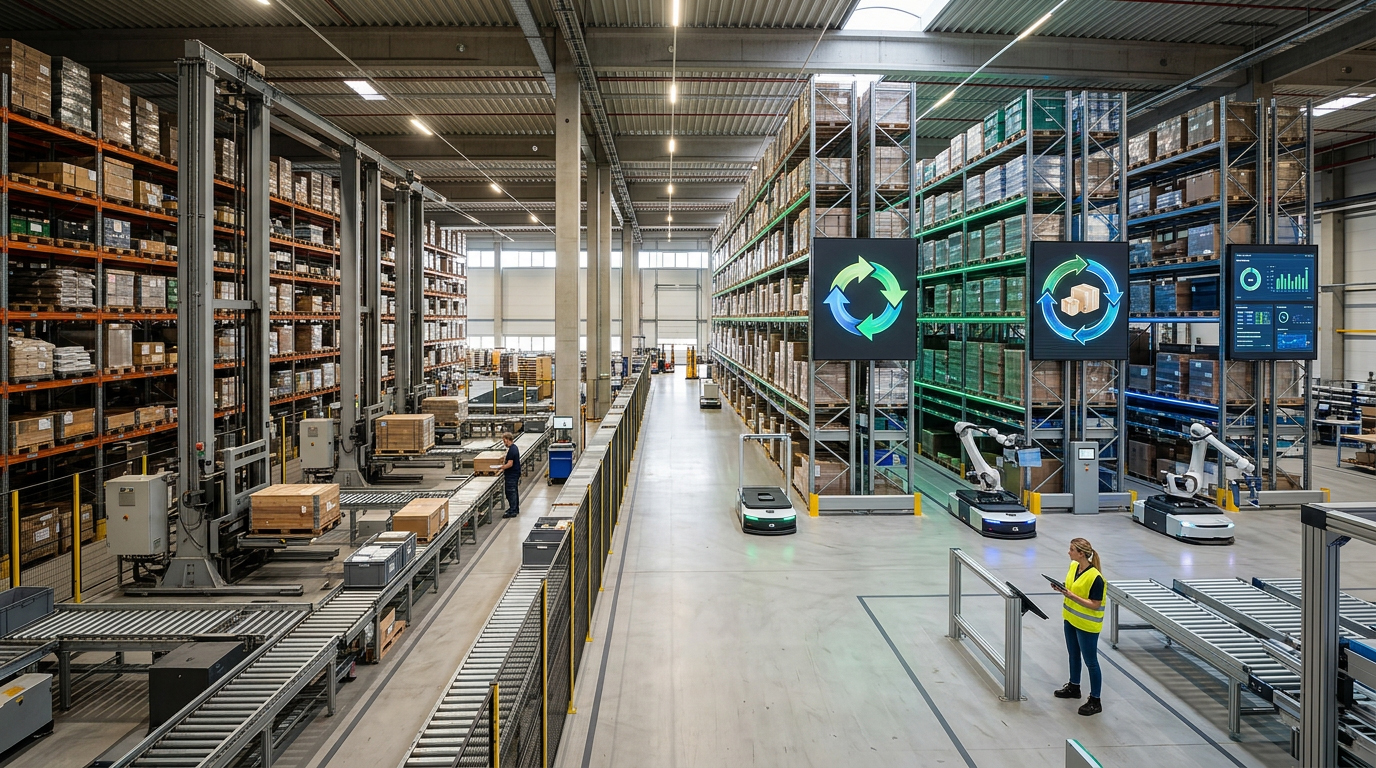
Retrofit for the Circular Economy: How to make your warehouse fit for the circular economy – Creative image on the topic, with AI: Xpert.Digital
Why your current warehouse concept will be too expensive in 5 years – and what to do now
No new construction! How retrofitting makes your warehouse fit for the circular economy
The one-way street is obsolete: 5 cornerstones for the circular high-bay warehouse of tomorrow
The era of the one-way street in logistics is inevitably drawing to a close. For years, a simple principle governed warehousing: goods are delivered, processed, and distributed to the end customer. However, disrupted global supply chains, volatile raw material prices, and increasingly stringent legal requirements—such as the EU Circular Economy Act—are forcing companies to radically rethink their approach. The future of logistics is circular. Today, the modern warehouse must do far more than simply act as a passive buffer; it is becoming an active infrastructure that manages returns, preserves value, and reintegrates resources into the cycle. Those who respond to this transformation with rigid new construction projects not only waste valuable time but also tie up capital unnecessarily and generate additional emissions. The far more economical and sustainable solution is retrofitting. Through targeted modernization during ongoing operations, the use of intelligent software, and flexible automation, existing infrastructure can be future-proofed. The following article examines in detail why adhering to the linear model becomes a financial risk, which technical and data-driven cornerstones are crucial for a circular inventory, and why hesitation is the most expensive option today.
Why sticking with linear inventory will make your business model expensive in five years
The warehouse as a purely through-process system between production and sales belongs to an era that is economically drawing to a close. What was considered efficient for decades—namely, moving goods only in one direction—is increasingly proving to be a structural risk for companies that must react to raw material prices, supply chain disruptions, and regulatory requirements. The transition to circular warehouse logistics is therefore not an ideological sustainability project, but an economic necessity reflected in concrete key performance indicators such as material costs, downtime, and capital tied up in inventory.
The turning point: When warehouses become active infrastructure
Traditionally, a warehouse was a passive buffer between production and consumption, its sole purpose being to temporarily store goods and quickly redistribute them. In the circular economy, this function fundamentally changes, as the warehouse becomes active infrastructure that organizes returns, ensures value retention, and fulfills regulatory documentation requirements. This reverse logistics—the systematic return of products, components, and materials from their use cycle to production or reprocessing—becomes a central building block of any functioning circular economy. For a warehouse to fulfill this dual role, it needs inspection zones, refurbishment areas, sorting by condition, and flexible layouts that can accommodate uncertain product conditions.
Why new construction is usually the worse choice
For many companies, constructing a completely new high-bay warehouse is hardly economically viable, which is why modernizing existing systems plays a central role in practice. A new building ties up enormous amounts of capital for years, causes productivity losses during the construction phase, and generates additional emissions from concrete, steel, and transportation, contradicting the very logic of sustainability. A typical retrofit concept includes replacing storage and retrieval machines, renewing conveyor technology, modernizing control systems and sensors, and switching to current software architectures, with particular emphasis placed on ensuring that implementation can be carried out gradually and during ongoing operations. This advantage—the ability to continue working during the conversion—is economically crucial because every day of downtime in an automated warehouse directly costs revenue.
The technical cornerstones of a circular warehouse architecture
A clear set of requirements for a high-bay warehouse strategically aligned with the circular economy can be derived from the combination of various case studies and research findings. First, the conveyor technology must be able to process both standardized new goods and heterogeneous returns and secondary raw materials without requiring structural modifications during ongoing operations. Second, warehouse management software is needed that comprehensively documents material origin, quality levels, and processing paths and integrates seamlessly with higher-level enterprise systems. Third, a modular, retrofittable architecture is crucial so that future adaptations to new material flows do not require a complete rebuild but can be implemented gradually during ongoing operations, as has already been successfully demonstrated in numerous modernization projects. Fourth, robot-assisted handling systems should be integrated, specifically designed for processing non-uniform material shapes, as typically encountered in remanufacturing and recycling processes. Fifth, the energy efficiency of the drive technology gains additional strategic importance, as frequency-controlled, energy-efficient drives not only reduce operating costs but also contribute directly to the overall climate footprint of the circular economy strategy.
Software as the actual lever of transformation
Beyond the purely mechanical aspects, the software determines whether a retrofit actually works or remains merely a cosmetic upgrade. A warehouse management system with real-time tracking alone is insufficient, which is why a dedicated inventory management system is also recommended. This system ensures a constant overview of returned products or used parts. Crucially, the system must be able to efficiently process homogeneous new goods as well as heterogeneous returns, refurbished components, and variable recycling fractions within the same facility. Modern warehouse management systems must therefore be able to map complex inventory states and serial numbers, while a transport management system optimizes return routes and the selection of suitable transport partners. Additionally, digital product passports, RFID tagging, and, in some cases, blockchain technologies are used to immutably document material composition and maintenance history, which is particularly relevant for remanufacturing and regulatory requirements.
Reverse Logistics as a Security Policy Issue
The need for functioning reverse logistics now extends beyond purely economic considerations and touches upon issues of industrial sovereignty and security of supply. Companies that rely on imported raw materials and components reduce their dependence on volatile global supply chains and geopolitical risks through functioning reverse cycles. This strategic dimension explains why political actors are increasingly intervening through regulation: The EU Circular Economy Act, among other things, introduces a register for digital product passports and prohibits the destruction of unsold textiles and shoes, further strengthening the circular design of supply chains. Those who fail to invest in reverse logistics-capable infrastructure today risk compliance violations and the loss of market access in regulated segments tomorrow.
Specific components of a circular storage system
In practice, this creates new functional zones within existing warehouses that were not present in traditional distribution centers. These include dedicated return and inspection areas that prevent returns from disrupting normal outgoing goods, as well as repair and refurbishment bays designed as modular work cells that can scale with increasing volume. These areas are complemented by spare parts pooling for the reuse of components instead of complete product replacement, material consolidation areas for the efficient bundling of recyclable streams, and digital traceability systems that support product passports, test protocols, warranty data, and resale prices. Energy and resource efficiency measures such as rooftop solar panels, rainwater harvesting, and on-site waste management further strengthen the commercial case for circular economy operations.
LTW Intralogistics Solutions

LTW Intralogistics – Engineers of Flow - Image: LTW Intralogistics GmbH
LTW offers its customers not individual components, but integrated complete solutions. Consulting, planning, mechanical and electrotechnical components, control and automation technology, as well as software and service – everything is networked and precisely coordinated.
In-house production of key components is particularly advantageous. This allows for optimal control of quality, supply chains, and interfaces.
LTW stands for reliability, transparency, and collaborative partnership. Loyalty and honesty are firmly anchored in the company's philosophy – a handshake still means something here.
Related to this:
Logistics in transition: Why inflexible warehouses are now becoming a cost trap
Economic reality: Vacancies despite demand
The warehouse space market currently presents a paradoxical picture that underscores the urgency of the issue. The vacancy rate in the warehouse real estate sector has risen from 5.0 percent to 5.5 percent because net absorption continues to lag behind new completions. At the same time, demand remains positive, particularly for modern, automated facilities, while overall demand is insufficient to absorb the additional capacity in the market. Warehouse occupancy growth is projected to be only moderate in 2026, with a return to positive net absorption becoming more likely only in 2027. Specifically, this market situation means that companies with outdated, inflexible warehouse concepts will increasingly struggle to remain competitive in a market with high supply, while modernized, circularly oriented facilities serve precisely those demand segments that continue to grow.
The returned item as an underestimated value carrier
A fundamental shift in perspective is shaping the industry this year: returned, damaged, and surplus products are increasingly viewed as recoverable assets rather than operational losses. This change plays a crucial role in closing the gap on the path to a circular economy by ensuring materials remain in circulation longer and waste is minimized. Every reusable asset reduces waste and simultaneously lowers costs, making salvage and recommerce activities increasingly central to supply chain strategies. Current estimates suggest that reverse logistics already recovers around half of all materials from returns, supported by updated classifications for recyclable materials. Over 40 percent of major retailers have now established their own circular economy initiatives because waste reduction and resource efficiency directly and positively impact both the environmental footprint and the bottom line.
Flexible automation instead of rigid fixed systems
Another structural shift concerns the understanding of automation itself. Automation is no longer a static, fixed system, but adapts, scales, and evolves in line with the changing operational requirements of the company. This includes autonomous mobile robots, robot-assisted picking, scalable automated storage and retrieval systems, and hybrid workflows between humans and machines. This flexibility is so important because product categories and return patterns are constantly changing, requiring systems to adapt without necessitating costly modifications each time. Investing in rigid, monofunctional systems effectively builds in the next modernization requirement.
Data-driven control as the new operating standard
By 2026, three forces will significantly shape warehouse strategy, with data-driven orchestration at the forefront. The modern warehouse is no longer a static storage space, but rather an intelligent control point. Automation, IoT sensors, and real-time analytics enable adaptive putaway strategies, predictive replenishment planning, and transparent performance dashboards, while leading logistics providers are linking warehouse management systems with transportation management systems to create unified visibility from goods receipt to the last mile. Sustainability is increasingly becoming a design standard and no longer just an efficiency measure, with renewable energy integration, energy-efficient lighting, and carbon-neutral operations becoming standard requirements.
Practical implementation: From pilot project to scaling
For logistics managers looking to pilot circular economy initiatives, a structured approach is recommended. First, a product line with clear repair or reuse potential should be selected, followed by a complete mapping of forward and reverse flows, including all touchpoints and ownership. Next, a small, dedicated returns bay equipped with inspection and sorting tools is set up, while the existing warehouse and transportation management system is enhanced with condition codes, refurbishment workflows, and asset tracking for reusable packaging. Establishing local partnerships with repair shops, recycling companies, or pooling services for specialized tasks is also crucial. Finally, key performance indicators (KPIs) are measured and processes are iteratively refined before widespread scaling. Useful KPIs for measuring success include return and recovery rates, refurbishment yield and average refurbishment costs, reusable packaging utilization, and transportation costs and CO₂ emissions per return cycle.
The underestimated role of medium-sized businesses
While large corporations and major real estate companies have already installed extensive solar capacity on their warehouse roofs, and online marketplaces are equipping their fulfillment centers with thousands of solar panels, small and medium-sized enterprises (SMEs) often lack the capital for comparable large-scale projects. However, a pragmatic roadmap exists for these businesses, beginning with a sustainability assessment to identify obvious savings potential. This is followed by piloting cost-effective changes such as optimizing delivery routes. The third step involves utilizing government funding programs for impactful investments like solar panels, while the fourth step involves monitoring progress using IoT sensors and adjusting the strategy accordingly. Finally, marketing the achieved sustainability results is recommended to specifically target environmentally conscious customer groups. Simple measures such as motion-activated LED lighting have proven to be quick wins with short payback periods, typically recouping the investment within three years.
Regulatory and customs pitfalls in cross-border trade
As soon as reverse circulation processes involve cross-border flows of goods, such as the return of imported goods for refurbishment, customs and duty regulations become significantly more important. Customs warehouses can store imported items until they are repaired or re-exported without incurring immediate duties, which considerably reduces the financial burden of such circular economy models. Importers should carefully review the necessary permits and documentation for refurbished goods and work with customs brokers to minimize administrative hurdles. For internationally oriented companies, such as those with production or procurement sites in Eastern Europe, this regulatory complexity becomes a key strategic planning factor that extends beyond the pure value of the goods.
Typical operational hurdles and their solutions
In practice, companies regularly encounter similar problems when implementing circular warehousing concepts. These include fluctuating return quality, fragmented data, and unpredictable volumes, all of which hinder smooth operations. Standardized evaluation criteria for the condition of returned goods, clear customer return instructions, scalable staffing models, and flexible warehousing solutions such as shared fulfillment centers and temporary reprocessing facilities have proven effective as countermeasures. Collaboration with experienced reverse logistics providers or specialized consultants can significantly accelerate implementation. Crucially, a thorough analysis of the current state is essential before any technical decision is made, along with structured project planning, verification of the compatibility of new technology with legacy systems, and a smooth migration during ongoing operations.
The path from process to technology: The correct sequence
A common mistake in retrofit projects is selecting technical solutions before identifying the actual process bottlenecks. Before evaluating specific technical systems, a comprehensive process analysis must be conducted to identify bottlenecks and define realistic performance targets. Only then should the mechanical and control systems be assessed to determine what should be retained and what needs to be replaced. This is followed by the integration of new technology, ensuring compatibility and interfaces. A thorough risk assessment and precise project planning, which considers ongoing operations throughout the entire implementation, complete the process. This sequence – process before technology – prevents costly misinvestments in systems that, while technically impressive, fail to address the underlying operational problems.
Economic outlook: Why hesitation is the more expensive option
A comprehensive overview of current developments paints a clear picture: those who fail to invest in the retrofit capability of their warehouse infrastructure today are merely postponing unavoidable costs into the future, where they will become more expensive under increased regulatory and competitive pressure. The combination of rising vacancy rates in inflexible standard warehouse spaces, growing demand for automated and circularly oriented facilities, and stricter EU regulations (such as the Circular Economy Act) creates a window of opportunity that is predictably closing. Companies that act now not only secure lower retrofit costs compared to a later new build, but also strategic advantages in terms of material safety, regulatory compliance, and positioning with sustainability-conscious business partners. The question, therefore, is less about whether modernization will be necessary, but rather whether it will be carried out in a controlled and phased manner or forced under time pressure and less favorable conditions.
Consulting - Planning - Implementation

Konrad Wolfenstein
I would be happy to serve as your personal advisor.
You can contact me at wolfenstein∂xpert.digital or
Just call me on +49 7348 4088 965 .
Your intralogistics experts

Consulting, planning and implementation of complete solutions for high-bay warehouses and automated storage systems - Image: Xpert.Digital
More information here:










