Reshoring and automation: Daifuku is shaping the future of warehouse logistics
Xpert Pre-Release

Available in 27 languages 📢
Prefer Xpert.Digital on GoogleⓘPublished on: October 18, 2026 / Updated on: October 18, 2026 – Author: Konrad Wolfenstein
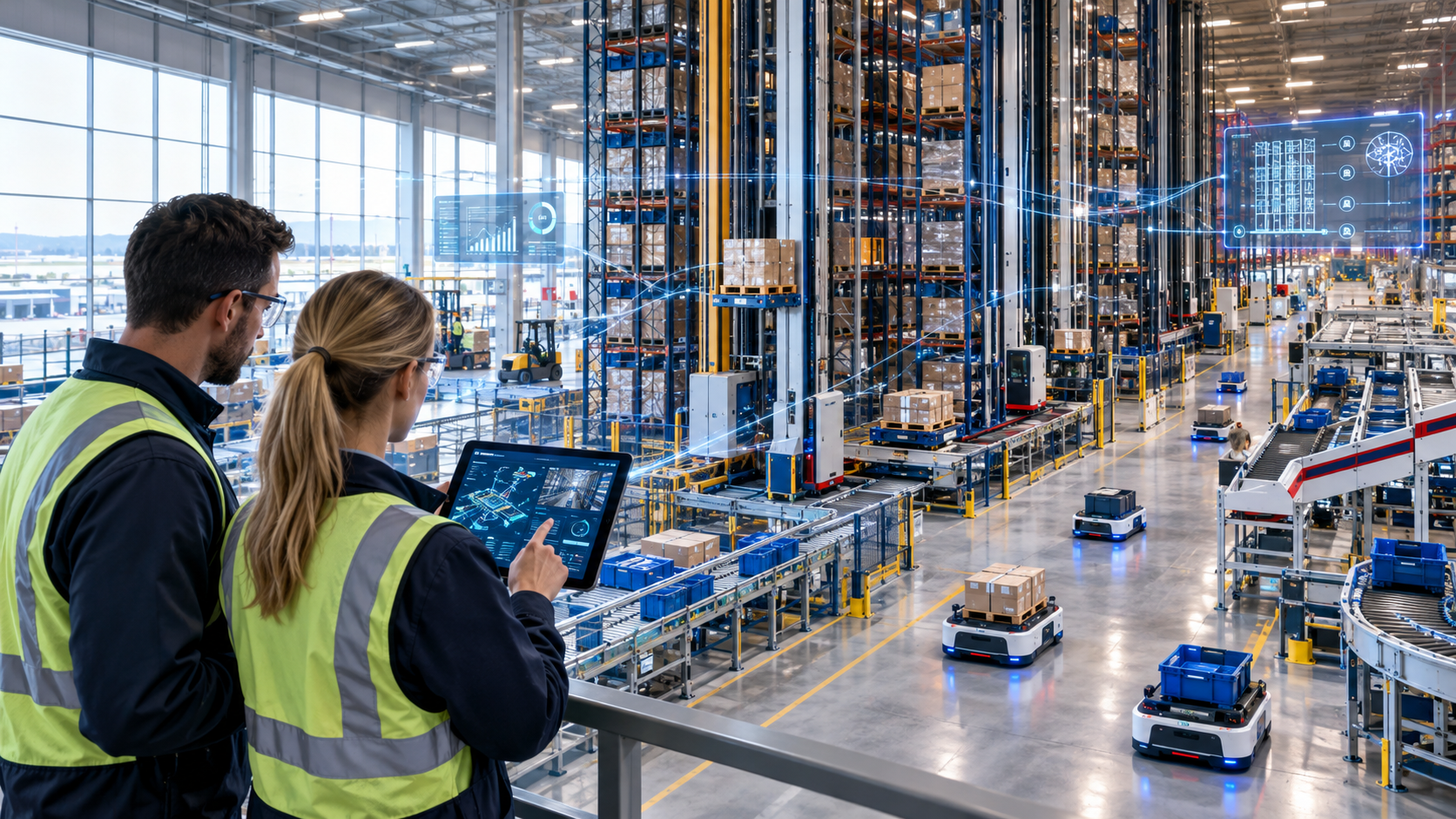
Reshoring and automation: Daifuku is shaping the future of warehouse logistics – creative image on the topic, with AI: Xpert.Digital
Reshoring without automation? Why companies are simply shifting their costs
Daifuku's innovative approaches to warehouse automation in the age of reshoring
Warehouse automation as the key to success: Lessons from Daifuku
The concept of reshoring, or the relocation of production facilities back to domestic markets, has gained significant traction in recent years. Companies want to produce closer to their sales markets to shorten supply chains and reduce dependence on distant locations. At first glance, this development seems like a simple step toward returning home, but local economic conditions are often challenging. Higher wages, a shortage of skilled workers, and rising operating costs pose serious challenges. To remain competitive in this new economy, companies must not only relocate their production sites but also fundamentally rethink their processes. Daifuku, a leading provider of intralogistics solutions, demonstrates how the use of automation technologies and a well-designed software architecture can create efficient and productive warehouse logistics. The company has successfully expanded its production capacity in the US and shows that reshoring must go hand in hand with automated material flows to not only shift costs but also create real added value. This article highlights the key aspects that companies should consider when reshoring and implementing the associated automation in order to be successful in the long term.
Reshoring needs robots: How Daifuku is shaping the new economy of warehouse automation
Those who bring production back but do not automate material flows are merely shifting their costs
Reshoring is often described as an industrial policy movement returning to the US: factories are to be relocated closer to sales markets, supply chains shortened, and dependence on distant locations reduced. However, this view is economically inaccurate. Production returning to the US from a low-cost country encounters higher wages, a shortage of skilled workers, high construction costs, and intense competition for capital. Therefore, it cannot simply be continued in the same organizational form. Reshoring only becomes competitive when local manufacturing, automated material flow, software-supported control, and a robust database are planned as a cohesive production system.
Daifuku's North American expansion demonstrates the practical application of this logic. The Japanese intralogistics specialist has expanded its facility in Hobart, Indiana, by 300,000 square feet, or approximately 27,871 square meters, effectively doubling the site's capacity. This investment of roughly $35 million represents more than just increased floor space. It shifts manufacturing capacity closer to North American customers, integrates production with development and testing, and lays the foundation for locally producing Japanese technology for a regional market. This makes the plant an example of a new form of industrialization: global expertise remains international, while manufacturing, customization, service, and data processing become more regionalized.
This development is neither a simple triumph of reshoring nor proof of the imminent full automation of all warehouses. Rather, it is a response to an economic tension. Companies need higher productivity and resilience, but at the same time must manage investment risks, integration costs, and fluctuating demand. This creates a market in which the most spectacular robotics does not win, but rather the combination of mechanics, software, data, and service that makes a specific material flow permanently more economical.
Hobart becomes an industrial touchstone
The expansion in Hobart is more strategically significant than a typical capacity increase. Daifuku responded quickly to anticipated market demand and brought the additional space online in 2025; the expanded capacity will be fully available by 2026. Production will include conveyor technology, sorting systems, and other equipment for internal material handling. The site also handles product development and testing, thus shortening the timeframe between design, manufacturing, commissioning, and market feedback.
Such consolidation reduces several hidden transaction costs. Technical changes can be implemented in production more quickly. Integration problems can be investigated on real-world equipment before they lead to costly downtime at the customer's site. Spare parts, service personnel, and application expertise are located closer to the point of use. At the same time, a supplier can adapt its products to North American buildings, safety regulations, pallet standards, workflows, and industry-specific requirements. The economic value of local manufacturing therefore lies not only in avoided transportation costs, but also in shorter learning cycles and faster response times.
For Daifuku, Hobart also serves as a bridge between Japanese technological expertise and North American implementation. The company can transfer proven systems without importing them unchanged. Local manufacturing enables product variations better suited to regional customers and reduces dependence on long international supply chains. At the same time, the demand for personnel is growing not only in production but also in robotics, sorting, software, sales, and service. Reshoring, therefore, does not represent a return to labor-intensive mass production. Rather, it fosters a technology-intensive employment model that requires fewer simple, routine tasks but more technical, digital, and inclusive skills.
Reshoring is a productivity strategy
The political debate often treats reshoring as a question of tariffs, subsidies, or national supply security. For companies, however, location decisions are based on total costs and the ability to reliably meet demand. A product manufactured more cheaply abroad can become significantly more expensive due to long lead times, high inventory levels, quality issues, exchange rate risks, trade barriers, and delayed market launches. Conversely, local manufacturing remains uneconomical if high labor and capital costs are not offset by increased productivity, flexibility, and faster response times.
Automation changes this equation. The lower the direct labor input per unit produced or moved, the less the wage gap determines location decisions. At the same time, an automated material flow improves predictability. Machines don't tire, but they do require maintenance; software doesn't fluctuate daily, but can be misconfigured. As a result, costs become less labor-intensive and more dependent on capital, energy, data, and expertise. This doesn't necessarily reduce overall costs, but it shifts their structure and makes them more scalable with stable capacity utilization.
This creates a crucial connection: Reshoring increases the pressure for automation, while automation is what makes reshoring economically viable in the first place. These two developments reinforce each other. Companies are bringing production closer to the market to reduce risks and delivery times. Because they encounter higher operating costs there, they invest in automated storage, conveying, sorting, and order picking. The resulting productivity gains, in turn, improve the profitability of the regional location. This cycle explains why intralogistics providers are expanding their own manufacturing in North America, while their customers are simultaneously demanding more automation.
The market is growing, but not evenly
Following the pandemic-driven investment surge, the warehouse automation market initially experienced a correction. Many retail and logistics companies had leased additional space, brought forward capacity expansions, and built up large inventories. Rising interest rates, economic uncertainty, and normalized e-commerce growth rates subsequently led to postponed projects. However, the market did not disappear. In 2025, global orders for warehouse automation rebounded by approximately seven percent, with some of the nominal growth attributable to higher steel, labor, and project costs, as well as a few very large investments.
This composition is important. An increase in order value does not automatically mean that the number of projects or installed capacity will increase to the same extent. Large customers can significantly influence the market, while medium-sized companies remain hesitant. At the same time, the technologies are diverging. Fixed automation has developed more robustly than initially expected, while forecasts for mobile robotics have been revised downwards. This contradicts the widespread assumption that flexible robots will displace traditional conveyor and storage technology in the short term.
A broader recovery is emerging for 2026, but it will remain selective. Brownfield projects, meaning the modernization of existing sites, will play a larger role in the short term than entirely new logistics centers. This favors modular solutions, compact units, and clearly defined applications. Only with declining vacancy rates and increased new construction activity is the greenfield market expected to pick up significantly again. Daifuku's expansion is therefore both proactive and risky: The additional capacity positions the company for a recovery, but it must be sufficiently utilized to make the high fixed costs economically viable.
Automated warehouses are becoming the backbone
Interest in automated storage and retrieval systems (AS/RS solutions) and mini-load technology for smaller load carriers is growing particularly strongly. Their benefits lie in the combination of space efficiency, throughput, and controlled inventory access. Conventional warehouses require considerable space for aisles, manual operation, and safety clearances. Automated systems can be built more densely, utilize greater heights, and systematically coordinate transport. This is especially valuable where land, buildings, and qualified personnel are expensive.
With Shuttle Rack LX, Daifuku addresses the pallet storage sector. The four-directional shuttle moves within the racking structure in multiple directions, combining high storage density with high throughput. Compared to more rigid solutions, this system can react more flexibly to different movement patterns. However, for customers, technical flexibility is not the only decisive factor. Economically relevant aspects include the number of simultaneous transports, redundancy in case of failures, accessibility for maintenance, and the possibility of incremental capacity expansion.
Fine Shuttle, on the other hand, is designed for containers and smaller units. Such systems often form the basis for goods-to-person processes, where items are automatically transported to ergonomic workstations. Employees no longer walk through long aisles of shelves but concentrate on picking, checking, and packing. This can increase productivity and accuracy, but it shifts the bottleneck: performance is no longer determined by walking distance, but by the supply logic, station utilization, replenishment planning, and software coordination.
The parallel introduction of pallet and container solutions demonstrates that modern intralogistics must integrate multiple levels. Pallets form the inbound flow, containers support storage and order picking, conveyor or mobile technology transports units between process steps, and end-of-line systems handle sorting, packaging, or palletizing. The economic advantage arises not from a single piece of equipment, but from the coordination of these levels.
The software determines the throughput
Mechanical systems remain visible, but the real competition is increasingly shifting to software. A warehouse can have high-performance conveyors, shuttles, and robots and still miss its targets if orders are poorly prioritized, routes are inefficiently planned, or buffers are incorrectly sized. The software must continuously integrate inventory levels, order sequences, available resources, and disruptions. It translates business objectives into concrete machine movements.
Daifuku therefore develops software that supports the integration of its own solutions. This level is less intuitive than a robot, but it determines whether different systems operate as a cohesive unit. A clear separation of control levels is essential. Local machine controllers react to sensors and safety conditions in milliseconds. Above this lies a coordinating level that manages material flows, priorities, and capacities. Higher-level communication doesn't need to control every motor impulse; it must send the correct command to the correct resource and reliably monitor the system status.
Modularity is more than just a technical design issue. It reduces the costs of reuse. When functions for order release, fleet management, inventory reconciliation, fault management, or simulation are designed as robust modules, a completely new system doesn't need to be developed for every customer. Adaptations focus on processes and interfaces, while the core remains tried and tested. This improves scalability, maintainability, and quality. At the same time, modularity limits project risk because changes in one area don't necessarily destabilize the entire architecture.
The downside is a stronger dependency on the system integrator. The more processes depend on their software model, the higher the switching costs and dependencies become. Customers should therefore pay attention to open interfaces, traceable data models, exportable operational data, and clearly defined responsibilities. An integrated system should not be confused with a closed system. An architecture is economically sustainable if it allows for expansions and the integration of complementary technologies without turning every change into an expensive special project.
Artificial intelligence begins with operational data
The term artificial intelligence raises high expectations, but in warehouse practice, data quality is usually more important than a particularly complex model. An algorithm can only meaningfully predict, optimize, or detect anomalies if timestamps, order data, sensor readings, fault messages, and inventory information are correct and consistent. If uniform definitions are lacking or events are only incompletely recorded, the model learns not about reality, but about the errors in the data.
Real-world operational data is particularly valuable because it contains variations that are missing in idealized simulations. These include irregular article dimensions, damaged load carriers, short-term priority changes, shift handovers, manual interventions, and rare malfunctions. Such events often determine whether a solution is robust in continuous operation. Simulation data can expand scenarios and pre-test new configurations, but should be calibrated against real-world processes.
Daifuku therefore pursues a step-by-step approach. Initially, easily accessible added value is sought, such as improved fault diagnostics, transparency regarding system conditions, or the detection of recurring bottlenecks. With functioning models, further potential benefits can become apparent. Some insights remain customer-specific, such as particular order profiles or product structures. Other patterns are universal, for example, typical causes of blockages, unfavorable buffer utilization, or wear signals.
The ability to collect, filter, and clearly present data is crucial. Raw data alone is not an asset. It only becomes valuable when placed in a business context and enables better decision-making. For this to happen, the software must combine complementary information and identify redundant signals. Only by considering machine status, order status, material position, and available capacity can a holistic picture emerge. This picture can then be used for predictive maintenance, dynamic prioritization, capacity planning, or process improvement.

Expert partner in warehouse planning and construction
Challenges and opportunities in industrial reshoring
Humans remain part of the control loop
Despite increasing data processing, a significant portion of the analysis is still performed manually. This is not necessarily a sign of technological backwardness. Many malfunctions are rare, context-dependent, and have varying degrees of economic relevance. An experienced employee recognizes correlations that have not yet been sufficiently structured and can assess whether a deviation requires immediate intervention or is tolerable. Automation should not blindly replace this judgment, but rather provide targeted support.
During the transition phase, a hybrid operating model emerges. Systems collect and consolidate information, while humans evaluate exceptions and improve rules. The more frequently a problem occurs and the clearer its characteristics, the sooner it can be automatically detected or resolved. Rare, safety-critical, or unusual business situations, on the other hand, remain under human supervision for longer. This division of labor is more economically sound than attempting to create a fully autonomous system from the outset.
At the same time, qualification requirements are changing. Fewer employees are manually handling materials, while more are monitoring systems, analyzing malfunctions, maintaining master data, and coordinating maintenance. This can reduce physical strain and the risk of accidents, but it doesn't eliminate the need for labor. It shifts the demand toward mechatronics, control engineering, software, data analysis, and process knowledge. This shift can become a bottleneck, especially in reshoring: capital can be raised, but qualified personnel cannot be produced quickly.
Specialized systems beat the universal robot
At trade fairs, the image of the universally applicable robot, capable of learning almost any task with artificial intelligence, often dominates. However, in real-world investment decisions, the demand for application-specific systems remains high. Conveyor technology, automated warehouses, sorters, and specialized robots solve clearly defined problems with predictable performance. Customers aren't buying technological showpieces, but rather guaranteed throughput, a certain level of availability, and controllable operating costs.
Universal robotics offers advantages where items, processes, or quantities change frequently. However, its flexibility can come at the cost of lower peak performance, increased training requirements, or more complex safety measures. More rigid systems, on the other hand, are more cost-effective for high, stable volumes. Therefore, the most economically viable architecture is rarely either completely rigid or completely flexible. It combines high-performance infrastructure for baseline performance with flexible modules for variable tasks and peak loads.
From this perspective, Daifuku's approach of applying artificial intelligence to manageable, concrete activities is plausible. A clearly defined process provides defined inputs, measurable results, and sufficiently repeatable data. This allows for a better assessment of a model's quality. Instead of automating an entire supply chain in one step, a company can, for example, improve a depalletizing cell, order prioritization, or fault detection. The benefits become apparent more quickly, and errors remain spatially and functionally limited.
Partnerships are becoming an architectural principle
No single supplier possesses the same depth of expertise in all areas of modern intralogistics. Mechanics, control systems, robotics, image processing, gripping technology, warehouse management, simulation, and artificial intelligence are evolving too rapidly for each area of competence to be fully developed in-house. Strategic partnerships are therefore becoming increasingly important. However, these partnerships only function effectively if interfaces, responsibilities, and economic interests are clearly defined.
The collaboration between Daifuku and Cellumation on a compact depalletizing cell illustrates this model. Cellumation contributes a software-defined conveyor system, while Daifuku provides its expertise in integration, material flow, and marketing. Over a development period of two to three years, a solution was created in which both companies remained within their respective areas of expertise. This reduces duplication of effort and can accelerate time to market.
A successful partnership, however, is more than just a demonstration in the innovation center. It must cover maintenance, spare parts, software versions, liability, cybersecurity, and long-term product support. For the customer, the collaboration must not lead to unclear responsibilities. If a cell fails, they need a clearly defined contact person and established response times. The integrator thus assumes a crucial economic role: they reduce the complexity of many specialized components into a manageable overall system.
This capability can become a stronger competitive advantage than owning each technology individually. Components become more comparable, but knowledge about their reliable combination remains scarce. An integrator who combines real-world test environments, installation expertise, and operational data builds experiential knowledge that is slow to replicate.
Real-time capability needs clear boundaries
Customers are increasingly demanding intelligent, real-time material handling. However, the term needs to be differentiated. Not every decision requires a millisecond response. Safety controls, collision avoidance, and motor control do indeed operate with very short cycles. In contrast, order distribution, replenishment planning, or storage space optimization can occur in seconds, minutes, or even longer intervals.
A good system architecture assigns every decision to the appropriate time level. This avoids unnecessary data volumes and dependencies. If a central platform had to process every local control impulse, it would become a technical and economic bottleneck. Local control ensures fast, reliable responses; higher-level software coordinates objectives and resources. This principle increases robustness because a problem at one level does not automatically shut down the entire system.
The same applies to artificial intelligence. A demand forecasting model doesn't necessarily have to directly control a production line. It can provide recommendations for workforce planning, inventory positioning, or order waves. A visual recognition model, on the other hand, intervenes directly in a work step and requires stricter checks. Therefore, a clear delineation of decision-making authority is a prerequisite for scalable automation.
The business case extends far beyond personnel costs
Automation projects are often justified by the savings in working hours. This is understandable, but incomplete. The economic benefits also include better space utilization, lower error costs, less damage, more stable throughput, improved ergonomics, increased workplace safety, and shorter response times. Furthermore, there are strategic effects: A company can manage growth even without additional staff and ensure its ability to deliver during peak periods.
On the cost side, the focus shouldn't stop at the hardware. The total investment includes building modifications, fire protection, energy supply, network, security concept, software integration, testing, training, spare parts, and start-up losses. Operational costs include maintenance, licensing, energy, and updates. Additionally, it must be considered that a system must be able to adapt to changing product ranges and quantities throughout its lifespan.
The most important factor is capacity utilization. A capital-intensive AS/RS solution only becomes advantageous when sufficient volume flows through the system. In cases of persistently low or highly unpredictable demand, flexible, less capital-intensive technology can be more economical. Conversely, an undersized system can stifle growth and necessitate costly upgrades. Therefore, the business case should cover several scenarios: a baseline scenario, a demand decline, a growth scenario, and disruptions in personnel, energy, or supply.
Reshoring expands this calculation to include avoided risks. Shorter supply chains can reduce safety stock, transportation times, and tied-up capital. Local production can react more quickly to changes and resolve quality issues sooner. These benefits are real, but harder to measure than a job saved. A sound investment decision therefore assesses not only efficiency but also the economic consequences of supply disruptions, delays, and a lack of adaptability.
More capacity also means more risk
Doubling capacity in Hobart is a sign of confidence, but no guarantee of success. High fixed costs make a location vulnerable to weak demand. If customers postpone projects, interest rates remain high, or the logistics space market cools again, occupancy rates will decline. At the same time, steel prices, tariffs, and shortages of electrical components can increase project costs. A local plant reduces international dependencies, but doesn't eliminate them entirely, because many components and raw materials will still be sourced globally.
The shortage of skilled workers has a twofold effect. It increases the pressure on customers to automate, but at the same time makes it more difficult for suppliers to establish production, engineering, commissioning, and service capabilities. The more systems are installed, the greater the demand for qualified technicians. A manufacturer can therefore win orders and still fail due to limited implementation capacity. Training, standardized modules, remote diagnostics, and maintenance-friendly design are becoming crucial factors for scaling.
Added to this is the technological risk. Faster innovation cycles can cause components or software architectures to become obsolete prematurely. Customers expect long lifespans, while digital platforms require regular updates. The supplier must reconcile both: industrial stability over many years and continuous digital development. If this balancing act fails, security gaps, integration problems, or costly upgrades will arise.
Cybersecurity is becoming production insurance
The more interconnected warehouse technology becomes, the larger its digital attack surface. Cloud services, remote maintenance, APIs, and external software partners improve scalability and service, but also create additional entry points. A cyberattack on a highly automated warehouse can not only steal data but also disrupt the physical flow of goods. This makes cybersecurity a question of supply chain reliability.
Companies must consider information technology and operational technology together. Role-based access, multi-factor authentication, network segmentation, encrypted communication, controlled remote access, and documented update processes are essential. Restart plans are equally important. A warehouse needs to know which functions can continue manually or in a secure emergency mode in the event of a failure.
This creates additional responsibility for integrators. They connect systems from different manufacturers and are familiar with the interfaces. Security requirements should therefore be integrated into the development, testing, and acceptance processes from the outset. Retrofitting security measures is more expensive and can impair availability. Therefore, cybersecurity must be treated as an integral part of plant quality in tenders and investment calculations, and not as an optional IT accessory.
Daifuku's competitive advantage lies in the connection
Daifuku competes not only with traditional conveyor technology and warehouse automation providers, but also with robotics companies, software firms, and specialized startups. The boundaries between these groups are becoming increasingly blurred. Mobile robots are taking over transport, software platforms are coordinating heterogeneous fleets, and specialized cells are automating individual process steps. In this environment, an established integrator cannot rely solely on size to succeed.
The potential advantage lies in combining multiple capabilities. Local manufacturing improves delivery capability and customization. Development and testing facilities reduce project risks. A demonstration center in Chicago allows customers to experience solutions firsthand. Proprietary software creates a common control plane. Partnerships complement technology without requiring the in-house development of every component. Real-world operational data, in turn, improves diagnostics, simulation, and future models.
These elements form a system that is difficult to replicate, provided they actually work together. The crucial test is not whether every element is present, but whether it reduces project duration, stabilizes commissioning, and measurably improves operations. If local manufacturing only incurs higher costs, software adds complexity, or partnerships blur responsibilities, the model loses its value. The strategy only proves its worth through operational discipline.
What European companies can learn from this
Although the expansion is taking place in the US, the economic logic is relevant for Europe and Germany as well. Here, too, high labor costs, skills shortages, geopolitical uncertainty, and the desire for more resilient supply chains converge. European companies frequently discuss nearshoring in Central and Eastern Europe instead of full reshoring. The basic principle remains the same: the location decision should not be based solely on hourly wages, but rather on total costs, delivery capability, automation potential, and market proximity.
For German manufacturers and logistics companies, this means that automation must be integrated into site planning earlier. Those who only define a building and then try to automate processes within it are missing out on potential. Rack geometry, material flow, fire protection, energy supply, data architecture, and personnel model should be developed jointly. For existing facilities, on the other hand, a modular, phased plan makes sense, eliminating bottlenecks one after the other and making the benefits of each phase verifiable.
Bulgaria and other Southeast European locations can also benefit from this development. They offer a combination of EU market access, comparatively lower costs, and growing technical expertise. However, with increasing automation, the advantage derived solely from low wages diminishes. Locations must therefore also offer compelling advantages such as energy availability, digital infrastructure, logistics connections, technical training, and reliable permitting processes. This makes nearshoring more demanding, but also more value-added.
The real bottleneck is the orchestration
The future of automated warehousing is not a question of humans versus robots, or of fixed conveyor systems versus mobile systems. The key bottleneck is orchestration: the ability to align people, machines, software, and data toward a common operational goal. Many companies already have isolated automation units, but fail to fully exploit their potential because interfaces are lacking, master data is unreliable, or responsibilities are fragmented between operations, IT, and engineering.
A successful transformation therefore begins with the process, not the product. First, volumes, fluctuations, service targets, error patterns, and growth assumptions must be understood. Only then can decisions be made about which tasks should be standardized, automated, or deliberately left manual. Technology follows the economic objective. This approach may seem less spectacular than a fully autonomous vision of the future, but it delivers more reliable results.
Daifuku's combination of local manufacturing, automated storage technology, modular software, real-world testing environments, and select partnerships points in a promising direction. The approach is particularly strong where specific applications are clearly defined and then integrated into a comprehensive system. The challenge lies in preventing the growing technological diversity from leading to new levels of complexity.
Reshoring without automation remains an expensive illusion
The reshoring of production is not a nostalgic project to restore past industrial jobs. It is a reorganization of value creation under changed geopolitical, demographic, and technological conditions. Local manufacturing can make supply chains more robust, response times shorter, and quality control more direct. However, without high productivity, these advantages are eaten up by higher costs.
Automated warehousing and material flow systems are therefore not a secondary addition to reshoring, but rather an integral part of its economic foundation. They reduce the need for hard-to-find personnel, increase the utilization of expensive space, and generate the data required for improved planning and artificial intelligence. However, their success depends on realistic capacity utilization, seamless integration, qualified personnel, and sustainable software for the long term.
Daifuku's investment in Hobart exemplifies this new industrial economy. The company is producing closer to its customers, expanding its technical team, integrating development and testing with manufacturing, and bringing new pallet and container systems to market. Simultaneously, it is relying on a software layer that not only controls machines but also visualizes them as a cohesive system. Partnerships complement specialized skills, while real-world operational data provides the foundation for progressively smarter processes.
The clear outlook is therefore this: Reshoring and warehouse automation will continue to drive each other forward, but not every project will be economically viable. The winners will not be the companies with the most robots or those with the largest factories. Success will come to those who combine capital, data, technology, and human expertise in such a way that a resilient productivity system emerges from local production. Those who merely reclaim space and copy old processes, on the other hand, are not shifting added value, but only costs.
Your intralogistics experts

Consulting, planning and implementation of complete solutions for high-bay warehouses and automated storage systems - Image: Xpert.Digital
More information here:
Your global marketing and business development partner
☑️ Our business language is English or German
☑️ NEW: Correspondence in your native language!

Konrad Wolfenstein
I and my team are happy to be available to you as your personal advisor.
You can contact me by filling out the contact form here [email protected]:or simply call me at +49 7348 4088 965. My email address is
I'm looking forward to our joint project.
☑️ SME support in strategy, consulting, planning and implementation
☑️ Creation or realignment of the digital strategy and digitization
☑️ Expansion and optimization of international sales processes
☑️ Global & Digital B2B trading platforms
☑️ Pioneer Business Development / Marketing / PR / Trade Fairs
Our global industry and economic expertise in business development, sales and marketing

Our global industry and economic expertise in business development, sales and marketing - Image: Xpert.Digital
Industry focus areas: B2B, digitalization (from AI to XR), mechanical engineering, logistics, renewable energies and industry
More information here:
A thematic hub offering insights and expertise:
- Knowledge platform covering global and regional economies, innovation and industry-specific trends
- A collection of analyses, insights, and background information from our key areas of focus
- A place for expertise and information on current developments in business and technology
- A hub for companies seeking information on markets, digitalization, and industry innovations