
China: Deli Group with Daifuku: From warehouse to logistics leadership – high-bay warehouse automation as a strategic weapon
Xpert Pre-Release

Available in 27 languages 📢
Prefer Xpert.Digital on GoogleⓘPublished on: April 2, 2026 / Updated on: April 2, 2026 – Author: Konrad Wolfenstein
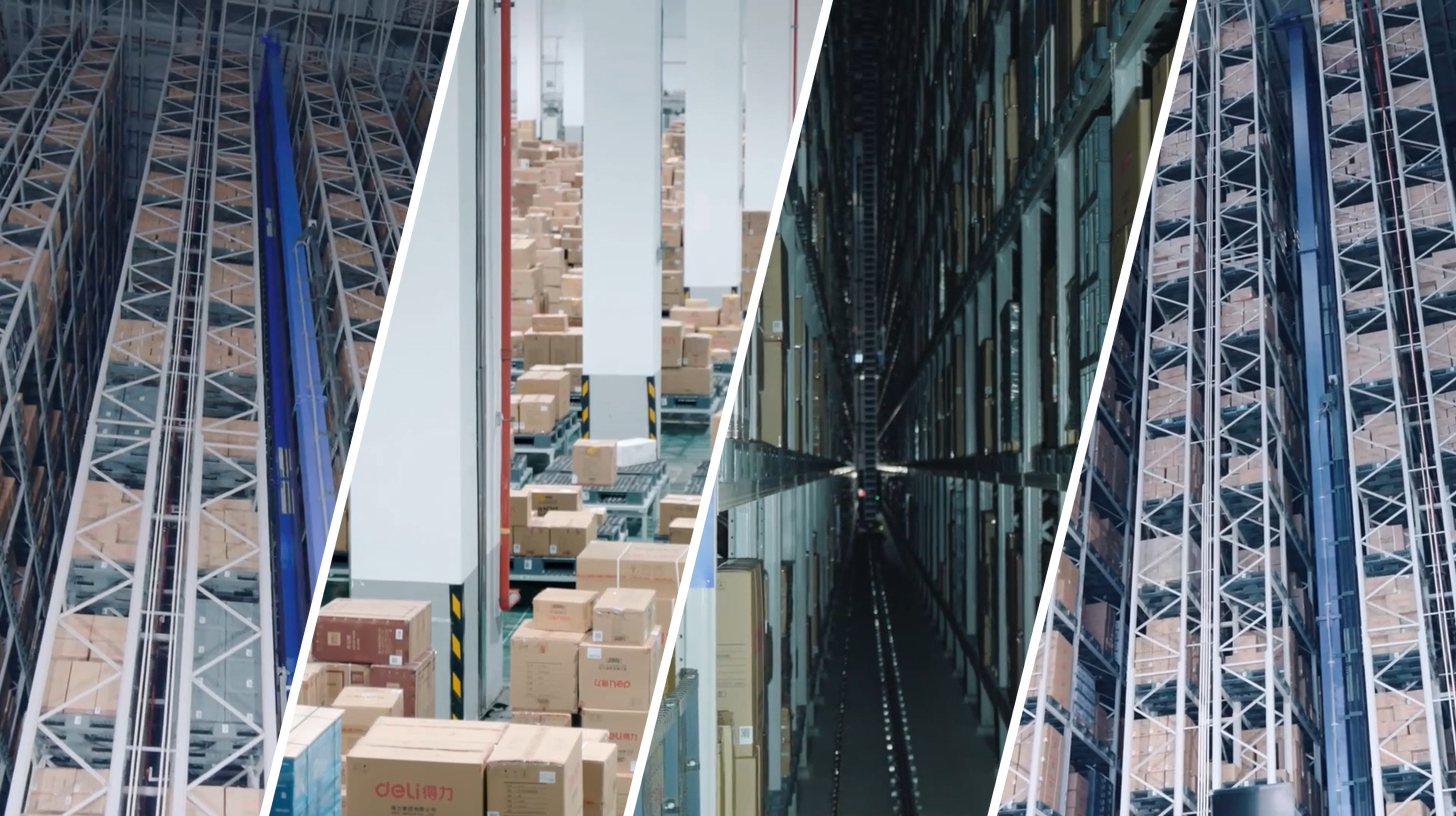
China: Deli Group with Daifuku: From warehouse to logistics leadership – High-bay warehouse automation as a strategic weapon – Image credits: Daifuku / Image: Xpert.Digital
30 meters high, fully automated: A look inside the Deli Group's smartest logistics center
From workshop to global player: How an office supplies and stationery giant conquered the world market with the Daifuku high-bay warehouse
The Deli Group impressively demonstrates that the path to global leadership in the stationery and office supplies industry today leads only through a radical technological realignment. Faced with extraordinary growth and rapidly rising labor costs in China, the company's traditionally outsourced, largely manual warehousing system had reached insurmountable limits. The answer to this growth dilemma is a 110,000-square-meter, highly intelligent logistics center, built in close partnership with automation specialist Daifuku. With a capacity of 2.8 million cartons and a fully automated, 30-meter-high infrastructure, Deli is setting new industry standards. This article delves into how the group left behind error-prone manual labor and is using state-of-the-art warehouse automation not merely to reduce costs, but as a strategic weapon for international scalability, resilience, and sustained competitive leadership.
The Deli Group's story is no ordinary corporate history. It's the record of a structural transformation that goes far beyond simply replacing forklifts with robots. What Deli has achieved in its Intelligent Logistics Center is paradigmatic proof that automation is not an end in itself, but can be the foundation for growth, scalability, and international competitiveness. In a market populated by over seven million registered stationery manufacturers, the ability to scale efficiently is not a luxury—it's a necessity for survival.
From workshop to global corporation
Founded in 1981 and headquartered in Ninghai, Zhejiang Province, Deli Group Co., Ltd. has become one of the leading manufacturers of office and school supplies in China. The company now covers 24 product categories, including office and school supplies, office equipment, consumables, and office paper products, and markets its goods under distinct sub-brands such as Deli Office, Deli Stationery, Agnite, Nu Sign, and Deli Tools. This brand strategy allows Deli to target different customer segments without compromising the consistency of its core portfolio.
The export network spans more than 130 countries and regions, including the United States, Europe, South America, the Middle East, and Southeast Asia. Behind this global reach lies a business model that integrates three manufacturing types: OBM (Own Brand Manufacturing), where Deli produces under its own brand name; OEM (Original Equipment Manufacturing), where Deli manufactures for third-party suppliers; and ODM (Original Design Manufacturing), where Deli designs and manufactures for third-party suppliers. This three-tiered model structure makes the company resilient to both market fluctuations and dependence on individual clients—but it also entails considerable logistical complexity, as each type places different demands on goods receipt, quality control, warehousing, and order picking.
In a market where Chinese stationery retail sales reached approximately US$22 billion in 2021, nearly tripling in a decade, Deli holds a leading position. The total revenue of the Chinese stationery and office supplies industry is projected to reach approximately US$29.3 billion in 2024, with a forecast annual growth rate of 5.8 percent through 2029. The Chinese Ministry of Commerce has recognized Deli as a national showcase example of smart manufacturing – the only company in the industry to be included in its 2025 list of exemplary smart factories.
The growth dilemma: When success becomes a burden
Despite its impressive market position, Deli long faced a structural problem that, paradoxically, was caused by its own success. The faster the company grew, the more pressing the limitations of its existing warehousing and logistics strategy became. The company had traditionally outsourced its warehousing operations – an approach that appears pragmatic in early growth phases but becomes costly, inflexible, and prone to errors as the business deepens.
In practice, external warehousing meant a significant need for personnel, high rental costs for warehouse space, and management costs that increased proportionally with each increase in volume. In economic centers, where warehouse space is already scarce and expensive, the availability of sufficiently large facilities proved to be a particular obstacle. At the same time, wages in China rose structurally: Chinese industrial labor costs have more than sextupled since the early millennium, making the labor-intensive manual warehousing model increasingly unattractive from an economic standpoint.
There was also a qualitative dimension: Manual warehouse processes produce errors. Order picking errors mean returns, customer complaints, and reputational damage—toxic factors for a brand manufacturer looking to scale internationally. For Deli, the decision to switch from a rented, manually operated approach to its own fully automated center was therefore not just a matter of cost reduction, but also of strategic repositioning.
Architecture of Change: The Intelligent Logistics Center in Detail
The result of this strategic decision is the Deli Intelligent Logistics Centre – a complex with a total area of approximately 110,000 square meters, realized in close partnership with the Japanese-German automation specialist Daifuku. What has been created on this site sets a benchmark not only for the stationery industry, but for Chinese intralogistics as a whole.
The core of the center consists of two Unit-Load AS/RS (Automated Storage and Retrieval Systems), one of which is equipped with near-rack picking, as well as a Mini-Load AS/RS, a Shuttle Rack M system, and several Sorting Transfer Vehicles (STVs). This ensemble is complemented by a robotic picking area, a high-speed sorting system, and a fully automated handling system. Together, these components form a highly integrated system that covers every step of the goods flow from receiving to shipping.
The raw figures illustrate the sheer scale of the operation: 50 stacker cranes, reaching heights of up to 30 meters, along with hundreds of STVs (automated guided vehicles), robots, and high-speed sorters. The storage capacity amounts to 2.8 million cartons. Daifuku supplies its Unit-Load AS/RS systems, which can reach heights of up to 40 meters and are designed for precise positioning with low energy consumption – thanks to integrated energy recovery systems, the stacker cranes save an average of 15 to 20 percent of the total machine energy.
Goods receipt: Automated initial recording
The receiving area has been completely converted to AGVs. Incoming OEM goods are detected by a dedicated goods receipt recognition system and then automatically transported to the goods staging area. This first step is crucial, as it eliminates the traditional bottleneck of manual goods receiving – a process that often acts as a source of errors and delays in conventional warehouses.
Conveyor: Precise interplay of conveyor technology and stacking cranes
In the conveying area, conveyor belts, in combination with stacker cranes, transport pallets to their assigned storage locations in the AS/RS. The interaction of these components is not trivial: stacker cranes must be precisely synchronized with conveyor belt speeds, and the overarching Warehouse Management System (WMS) must optimize storage location assignments in real time – taking into account pick probabilities, product weights, and access frequencies.
Storage and quality assurance: Two-stage material flow
For OEM goods requiring quality inspection, the system utilizes forklift-mounted AGVs and elevators to transport the goods to a two-story quality inspection area. Items that do not require inspection are routed directly from AGVs to the conveyor belt for putaway operations. This differentiation within the same material flow system demonstrates the flexibility of modern AS/RS concepts: they can handle different process requirements in parallel without requiring separate physical infrastructure.
Order picking: System-controlled precision
During order picking, stacking cranes and conveyor belts working in tandem ensure that pallets are moved to the picking stations. There, personnel confirm the required quantities of cartons according to the WMS specifications and carry out the picking operation – a so-called goods-to-person model that minimizes personnel walking distances and simultaneously reduces the error rate through system-guided quantity confirmation. Compared to purely manual warehouses, where pickers have to cover considerable distances and incorrect picks are almost unavoidable, this represents a quantum leap in quality.
Shipping: High-speed sorting as the final filter
In the final process step, picked cartons are transported via conveyor belt to the shuttle rack and sorted there by a sorting system according to shipping destinations or order characteristics. High-speed sorting systems, as used in modern distribution centers, achieve throughput rates that would simply be unattainable with manual sorting processes.
Economic impact: What the numbers tell us
The measured results of the Deli Intelligent Logistics Centre are impressive and, at the same time, insightful for evaluating automation investments in general. The center's maximum daily inbound and outbound volume amounts to 400,000 cartons – thus exceeding the originally targeted capacity of 200,000 cartons per day by a factor of two. This overachievement of capacity targets is no accident, but rather the result of a conservative planning philosophy that deliberately incorporates growth buffers.
For a company like Deli, whose core product range includes office and school supplies, the ability to scale is particularly important. Demand is cyclical – the start of the school year, the beginning of semesters, company budget cycles – and fluctuates significantly seasonally. A system that operates at 50 percent of its maximum capacity under normal circumstances not only offers growth potential but also considerable resilience to peak demand. This isn't inefficiency; it's strategic intelligence.
The reduction in labor and management costs in the warehouse compared to conventional processes is documented, although not published with precise percentages. Comparable AS/RS implementations at other companies typically show reductions in personnel costs in the warehouse section of 50 to 80 percent, although these savings must be partially offset by increased investment costs and maintenance expenses. Crucially, the isolated cost dimension is not the deciding factor, but rather the relationship between investment expenditure and achievable capacity expansion: With a fraction of the area of a conventional flat warehouse – with full vertical space utilization up to a height of 30 meters – Deli achieves a storage capacity of 2.8 million cartons.
The AS/RS system also enables significantly improved inventory accuracy. Conventional warehouses exhibit inventory discrepancies of several percentage points – due to manual putaway errors, misidentified items, or physical loss. In a fully automated system, where every movement is recorded and verified by the system, these error rates drop to fractions of a percent. For an assortment with thousands of SKUs – Deli alone covers 24 product categories with countless variations – this inventory precision directly impacts sales: no incorrectly delivered items, no returns due to handling errors, no cancellations due to alleged unavailability.

Expert partner in warehouse planning and construction
Flawless and scalable: How Deli is redefining logistics in China with mega-automation
The strategic context: China's automation wave and its drivers
The Deli project is not an isolated phenomenon. It reflects a broad, structural transformation that the Chinese logistics sector is undergoing. The Chinese market for warehouse automation was valued at approximately US$3.17 billion in 2024 and is projected to grow to US$16.68 billion by 2033 – representing an annual growth rate of 18.05 percent. Other surveys estimate the market volume even higher: Grand View Research projects growth of 20.1 percent annually until 2030.
Several structural drivers underlie these figures. First, rising labor costs. China is no longer the low-wage country of the early reform years. Industrial wages have increased by several hundred percent since 2000, making labor-intensive warehousing processes increasingly unsustainable. Second, the e-commerce boom. The state postal regulatory authority reported more than 140 billion parcel shipments for 2025 – an average of over 530 million parcels per day, with peak days exceeding 600 million. Distribution centers without high automation simply cannot handle these volumes. Third, government support. More than 30 Chinese provincial governments actively offer financial incentives for modernizing intralogistics, further increasing companies' willingness to invest.
In this environment, over 65 percent of all new logistics warehouses in China have opted to implement pallet automation technologies. AS/RS systems in China are experiencing an annual adoption rate of 14 percent. Daifuku, the global leader in automated material handling systems, has delivered over 34,000 stacking cranes worldwide – an indicator of the maturity and widespread adoption of this technology. Deli has thus invested in a technology environment based on proven platforms and with a predictable risk profile.
The dimension of verticality: Space utilization as a competitive advantage
An often underestimated aspect of Deli's automation strategy is the spatial dimension. Conventional flat warehouses are inefficient: the usable height typically ends at eight to ten meters, and wide aisles for forklifts significantly reduce racking density. AS/RS systems with stacker cranes, on the other hand, utilize the entire available building height – up to 30 meters in the case of the Deli center, and even up to 40 meters with Daifuku's most advanced systems.
This vertical integration is economically significant. Land in Chinese economic centers is scarce and expensive. A warehouse that stores three to four times the conventional capacity on a given plot of land dramatically reduces the effective cost per carton stored. For Deli, which operates in rapidly growing urban areas and yet must maintain competitive warehousing costs, this vertical efficiency is not abstract – it directly impacts the bottom line.
Stacker crane systems in AS/RS configurations also offer complete accessibility to all storage locations, real-time inventory through system-integrated accounting, and 24/7 operation without shift premiums or fatigue. Compared to manually operated warehouses, 24/7 operation means a significant increase in effective annual capacity without additional fixed costs.
Technological integration: WMS as a nerve center
The hardware – stacker cranes, AGVs, STVs, sorters – is impressive, but without the overarching warehouse management system, it's only half as valuable. The WMS is the true nerve center of the facility: It controls putaway strategies in real time, optimizes picking routes, dynamically manages storage location occupancy, and coordinates material flow across all system components.
For a company like Deli, which handles OBM, OEM, and ODM orders simultaneously, this system-based control is essential. Each order type has different requirements for traceability, quality status, and shipping priorities. Only a WMS that processes these differentiations in real time and translates them into physical warehouse movements can eliminate the error rates that manual processes inevitably produce. The Daifuku system integrates this intelligence directly into material flow control—from the AGV route to the crane sorting sequence.
The reduction of errors through system-driven processes is not trivial to quantify, but its impact is substantial. Incorrect deliveries not only generate direct costs through returns and reshipments, but they also damage the trust of trading partners and end customers. In a company that exports to 130 countries, where trading customers depend on punctual and accurate deliveries, being error-free is not a luxury, but a prerequisite for market entry.
Supply Chain Perspective: Potentials and Open Questions
The intelligent logistics center has transformed core warehouse operations – but Deli itself admits that the work is not yet finished. The company explicitly identifies the challenge of overcoming delays in the digitalization and systematization at the end of the product distribution chain. This refers to the gap between the highly efficient center and the downstream distribution network, which is not yet fully digitally connected.
This vulnerability is no small matter. The full value of an automated warehouse is only realized when information flows along the entire supply chain – from the supplier through the center to the retail customer – are seamlessly integrated. As long as the logistics center operates as a data isolation, failing to communicate in real time with ordering systems, transportation networks, and inventory forecasts from trading partners, a significant portion of the potential efficiency gains remains unrealized.
Deli articulates this goal precisely: Once the information network between the logistics center and the distribution network is strengthened, the company believes that the entire supply chain will become significantly more efficient due to the resulting synergy effect. This commitment to systemic integration goes beyond the optimization of individual nodes – it is the approach to a true supply chain transformation.
Competitive dynamics: Deli in comparison
A complete picture requires looking at the competition. The toughest direct competitor in the Chinese market is Shanghai M&G Stationery, which reported sales of approximately 24.2 billion renminbi for fiscal year 2024 and, according to figures for 2025, holds around 18 percent of the Chinese stationery market, and even over 30 percent in the student writing instruments segment. M&G is a serious strategic force – with over 81,000 retail endpoints in mainland China and an increasingly strong B2B component through its subsidiary Colipu.
The key difference between the two companies lies in the depth of their automation investments. Deli has created a logistics infrastructure with its Intelligent Logistics Center that scales within its core business without generating proportionally increasing personnel costs. M&G competes with a broad branch network and strong brand positioning, but according to available information, without a comparable automated distribution center. In a market with over 1,500 active companies, an infrastructure advantage is a strategically difficult-to-attack advantage.
Deli has also invested in five smart manufacturing and logistics bases worldwide, including a production facility in Vietnam that supports its international business. This geographical diversification of its production base is a direct means of hedging against geopolitical risks and rising Chinese labor costs – and a clear signal that Deli is thinking strategically, not just operationally.
Implications for industry and investors
What lessons can be learned from the Deli example for the wider industry? First, the case demonstrates that investments in automation within intralogistics don't only make sense for companies of a certain size – the crucial factor is the ratio of scaling potential to investment costs. Companies like Deli, operating in a highly fragmented, competitive market with enormous export ambitions, don't need incremental improvements, but rather structural leaps in capacity.
Secondly, this case demonstrates that automation solves a quality problem that cannot be solved simply by increasing staff. The risk of human error in manual warehouse processes is systemic – more employees do not necessarily mean fewer errors, but often more coordination effort and thus even more potential sources of error. System-controlled processes, in which the WMS records and verifies every transaction, fundamentally break this vicious cycle.
Thirdly, the Deli project illustrates the economic logic of capacity reserves. A system that operates at 50 percent of its maximum capacity of 400,000 cartons per day under normal circumstances appears oversized at first glance. On closer inspection, however, it is a shrewd business buffer that absorbs growth, seasonality, and market expansion without requiring immediate new infrastructure investments. In a world where speed of adaptation is often more important than optimal resource utilization in the moment, this philosophy is modern and rational.
Outlook: Automation as a transformation platform
The commissioning of the Deli Intelligent Logistics Centre is not an end point, but a platform. The company is on a transformation path that is gradually encompassing the entire supply chain – from raw material procurement and smart manufacturing lines in Ninghai and Vietnam to the last mile in the Chinese distribution network. The next phase that Deli is explicitly pursuing is strengthening data connectivity between the center and the downstream trading network.
In a broader context, Deli is part of a Chinese industrial transformation driven by government support, rising labor costs, e-commerce growth, and the technological maturation of automation systems. The Chinese logistics automation market is projected to reach US$80 billion by 2031 – in an ecosystem where early investors like Deli have established a structural advantage over latecomers, one that will be difficult for the latter to overcome.
The real message of the Deli case is therefore neither technical nor logistical. It is strategic: Those who understand automation not as a cost-cutting program but as a growth infrastructure derive a qualitatively different benefit from it. The Deli Intelligent Logistics Centre doesn't just deliver boxes faster – it enables growth that would be unthinkable without this foundation.
Your intralogistics experts
Consulting, planning and implementation of complete solutions for high-bay warehouses and automated storage systems - Image: Xpert.Digital
More information here:
Your global marketing and business development partner
☑️ Our business language is English or German
☑️ NEW: Correspondence in your native language!

Konrad Wolfenstein
I and my team are happy to be available to you as your personal advisor.
You can contact me by filling out the contact form here or simply call me at +49 7348 4088 965. My email address is : [email protected]
I'm looking forward to our joint project.
☑️ SME support in strategy, consulting, planning and implementation
☑️ Creation or realignment of the digital strategy and digitization
☑️ Expansion and optimization of international sales processes
☑️ Global & Digital B2B trading platforms
☑️ Pioneer Business Development / Marketing / PR / Trade Fairs
Our global industry and economic expertise in business development, sales and marketing

Our global industry and economic expertise in business development, sales and marketing - Image: Xpert.Digital
Industry focus areas: B2B, digitalization (from AI to XR), mechanical engineering, logistics, renewable energies and industry
More information here:
A thematic hub offering insights and expertise:
- Knowledge platform covering global and regional economies, innovation and industry-specific trends
- A collection of analyses, insights, and background information from our key areas of focus
- A place for expertise and information on current developments in business and technology
- A hub for companies seeking information on markets, digitalization, and industry innovations










