
High-speed rail lines and rail freight: Germany and France compared
Xpert Pre-Release

Language selection 📢
Published on: February 11, 2026 / Updated on: February 11, 2026 – Author: Konrad Wolfenstein
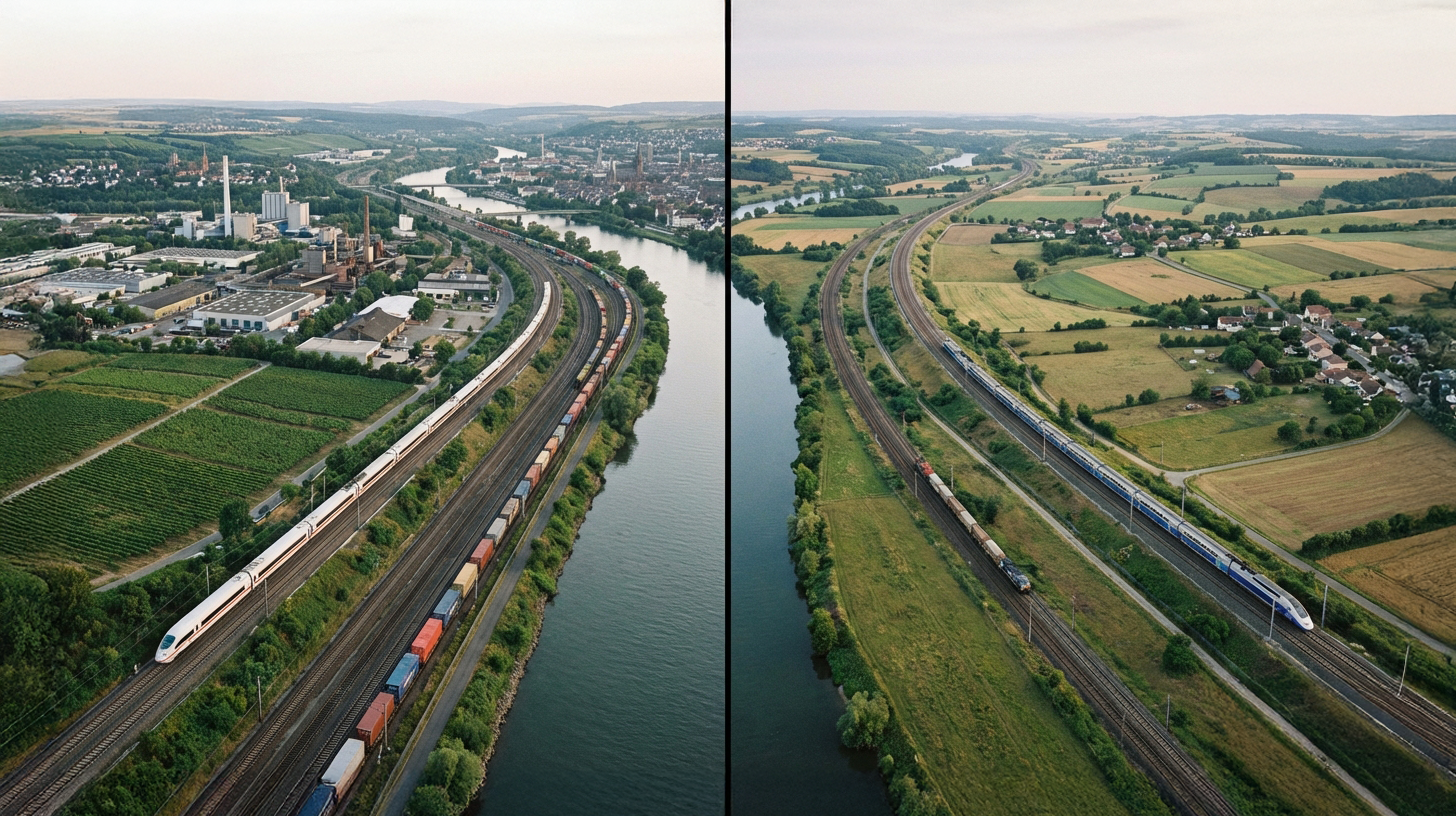
High-speed rail lines and rail freight: Germany and France compared – Image: Xpert.Digital
Network collapse or gold standard? What Germany can learn from France regarding railway expansion
Rail system comparison: Two neighbors, two completely different philosophies
Travel time check Paris-Frankfurt: Why the train is increasingly beating the plane
When the German ICE and the French TGV meet on the tracks, it's not just two technological flagships that collide, but two fundamentally different worldviews on transport policy. While France, with its "Lignes à Grande Vitesse" (LGV), relies on elite high-speed lines that catapult passengers across the country at speeds of up to 320 km/h, Germany pursues an integrative approach: a vast, dense network that connects every corner, but must share the same tracks for freight and passenger traffic.
The following comparison illuminates the economic and infrastructural consequences of these strategies. It shows why, while French passengers reach their destinations faster and utilize high-speed lines more efficiently, Germany, in contrast, stands as the undisputed European champion in rail freight. However, the price for the German "everything-on-one-track" principle is high: delays and capacity bottlenecks at hubs are the logical consequence of a system that is reaching its physical limits.
Learn how network design, capacity utilization, and political priorities affect your travel time, why freight trains in France often get the short end of the stick, and what lessons both countries must learn for the future of mobility. Because in the race against trucks and airplanes, it's not just top speeds that matter, but the resilience of the entire system.
More speed on the railways – but where does the economic advantage lie?
The rail link between Germany and France is one of the most important corridors in Europe and significantly shapes both passenger and freight transport. Economically, the two countries differ considerably in terms of high-speed lines and the performance of their rail freight systems: Germany has the largest rail network in Europe with a complex mixed operation of passenger and freight trains, while France boasts a highly centralized but technically very modern high-speed network. Both systems reflect different political, infrastructural, and economic priorities and each has specific strengths in capacity utilization and efficiency.
High-speed rail lines: network design, capacity and utilization
The French high-speed rail network is primarily based on dedicated, newly built lines, known as "Lignes à Grande Vitesse" (LGV), designed for speeds of 300 to 350 km/h. The French high-speed rail network now comprises approximately 2,700 to 2,800 kilometers of pure high-speed lines, radiating out from Paris to major cities and regions. Technically, France is a leader in this field: the average travel speed of TGV trains on the LGV infrastructure is often around 320 km/h, allowing journeys such as Paris to Marseille to be completed in well under four hours. Furthermore, the lines boast very high occupancy rates per passenger kilometer and per kilometer of track, demonstrating the extremely efficient economic utilization of investments in high-speed rail in France.
Germany, in contrast, uses a different network concept: The high-speed lines are significantly shorter, totaling only about 1,600 kilometers, with a large proportion of ICE journeys taking place on modernized older lines at speeds of up to 200 or 230 km/h. New lines are often designed for speeds of 250 to 300 km/h, but these speeds are only selectively achieved due to track geometry, junctions, and mixed traffic. With a total length of approximately 39,000 kilometers, the German rail network is the longest in Europe, which strengthens the capacity base for rail freight but makes the high-speed infrastructure itself appear relatively limited. At the same time, mixed traffic is considerably more prevalent than in France, leading to capacity bottlenecks, particularly at major junctions and in busy corridors, resulting in delays and reduced performance.
Intermodal competition and travel times across borders
Franco-German connections are served via several main corridors, including Paris–Frankfurt, Paris–Stuttgart, Paris–Munich, and Paris–Saarbrücken. On these routes, ICE and TGV trains compete in a highly international environment, with travel times varying significantly depending on the specific infrastructure. On the Paris–Frankfurt route, served via both Strasbourg and Saarbrücken, scheduled travel times range from approximately 3 hours 40 minutes to 3 hours 50 minutes, with TGV trains traveling considerably faster on the French LGV line than ICE trains on the German sections. The fact that the TGV operates at speeds of only 120–160 km/h on large sections of the route in Germany, while it reaches speeds of up to 320 km/h in France, highlights the structural differences in infrastructure design: France has technically optimized, largely dedicated high-speed lines, whereas Germany uses a highly mixed network.
Especially in times of air travel and truck logistics, travel time is a crucial economic factor. Travel times between Paris and major German cities are, on average, significantly shorter than flight times when checking in, security checks, and travel to and from the airport are taken into account. This makes rail travel more attractive in terms of price and environmental impact, provided the infrastructure capacity grows accordingly. However, the high traffic density on the core corridors means that any additional capacity expansion is already considered critical, particularly at hubs like Frankfurt, Mannheim, and Saarbrücken. France has an advantage here because its high-speed rail lines were designed for high-speed rail use and therefore experience fewer conflicts with regional traffic.
Rail capacity and infrastructure: Network size versus focus
Network size is a key factor for the flexibility and resilience of rail freight. Germany has the largest rail network in Europe, which theoretically offers high capacity for rail freight. In practice, however, a large part of the infrastructure is heavily used and often technically outdated, meaning that the actual capacity is significantly lower than the theoretical figure. Studies tend to define the capacity limit of the German rail network rather pragmatically, as the known bottlenecks are already almost at capacity. Without extensive expansion measures and modernization of signaling and safety technology, a significant increase in freight transport performance is limited.
France has a significantly smaller network, but it is structured differently due to its centralized high-speed rail (LGV) system. Here, capacity is increased by focusing on high-speed lines, while regular lines are sometimes operating at higher capacity. The separate LGV lines reduce conflicts between passenger and freight traffic, which improves passenger efficiency but simultaneously increases pressure on existing main lines that must continue to handle freight. The French government's plans to double the share of rail transport by 2030 are ambitious and require that the infrastructure be geared not only towards high-speed rail but also towards freight capacity. Currently, freight capacity in France is rather limited, which means that increased demand does not automatically translate into increased transport performance.
Performance of rail freight transport: Germany leads the way
In purely quantitative terms, Germany is clearly in the lead when considering the performance of rail freight. Rail freight transport volume in Germany is approximately 130 to 140 billion tonne-kilometers per year, representing around 20 percent of the modal split. This is a relatively high figure compared to other European countries and demonstrates the central role rail plays in Germany's economic freight transport sector. Deutsche Bahn and numerous private freight companies utilize the network to transport raw materials, chemical products, automotive parts, and containers, thereby supporting industrial value creation in Germany.
French rail freight capacity is significantly lower, as the focus of French infrastructure is on high-speed and passenger services. Rail freight performance in France is considerably lower than in Germany, which has steered capacity and efficiency in favor of passenger transport. French plans to increase rail freight capacity are promising, but implementation is difficult due to the limited network size and high modernization costs. Germany benefits from its large network size and high traffic density, which enhance the efficiency and competitiveness of its rail freight sector.
Hub for Security and Defense - Advice and Information

Hub for Security and Defense - Image: Xpert.Digital
The Security and Defence Hub offers expert advice and up-to-date information to effectively support companies and organizations in strengthening their role in European security and defence policy. Working closely with the SME Connect Defence Working Group, it particularly promotes small and medium-sized enterprises (SMEs) that wish to further develop their innovative capacity and competitiveness in the defence sector. As a central point of contact, the Hub thus creates a crucial bridge between SMEs and European defence strategy.
Related to this:
Rail duel: Why Germany's network beats France's TGV system
Capacity utilization and utilization: Different approaches
The utilization of high-speed rail lines in France is extremely high, maximizing efficiency and the return on investment. The number of passenger-kilometers per kilometer of track is significantly higher in France than in Germany, demonstrating that the lines are being used optimally from an economic perspective. The French infrastructure has been standardized to maximize capacity for high-speed rail, resulting in high utilization but also creating bottlenecks for other modes of transport.
Germany, on the other hand, utilizes capacity across a broader spectrum, which can be seen as both a strength and a weakness. The high traffic density on the network leads to high utilization, but also to conflicts between different modes of transport. This mixed-use situation results in capacity losses, as the infrastructure must be used by all modes simultaneously. The German infrastructure is not as technically homogenized as the French, which affects capacity and efficiency, but increases flexibility. The introduction of digital control and safety technology and capacity expansions in the core networks are necessary to optimize utilization and increase performance.
Interoperability and cross-border connections
Interoperability between Germany and France is a key aspect of rail transport. Franco-German freight trains use multi-system locomotives that support both German and French power and signaling systems. This enables seamless connections between the two countries and increases the efficiency of freight transport. Cross-border connections are also closely integrated with regional transport systems, further increasing capacity and efficiency.
Passenger transport connections between Germany and France are also closely integrated. The DB-SNCF cooperation offers direct connections between Paris and eleven German cities, with services via Strasbourg and Saarbrücken. Travel times are significantly shorter than flights when check-in and arrival times are taken into account, making rail travel more competitive. Some connections are closely integrated with regional transport systems, increasing capacity and efficiency.
Capacity, efficiency and future
The high-speed rail lines between Germany and France are a key element of rail transport in Europe. France, with its high-speed rail network, boasts a technically optimized infrastructure that maximizes capacity for high-speed passenger services, while Germany, through its network size and infrastructure versatility, increases capacity for rail freight. High-speed rail lines in France have higher utilization rates, maximizing efficiency and return on investment, while Germany's high traffic density enhances the efficiency of its freight transport.
The future of rail transport between Germany and France depends on capacity expansion and infrastructure modernization. The plans of the German and French governments to increase capacity and modernize infrastructure are promising, but implementation is difficult due to high costs and complex political frameworks. The introduction of digital signaling and control technology and capacity expansions on the core networks are necessary to optimize utilization and increase performance. Interoperability and cross-border connections are crucial for the efficiency and competitiveness of rail transport in Europe.
Goods supply duel: Germany versus France – who is better positioned?
Does France find it easier to supply its population with goods? In the short term, yes; purely in terms of quantity, France needs less capacity – but structurally, France does not automatically find it easier to supply goods; on the contrary, Germany has a significantly higher overall capacity in rail freight transport.
Different starting points: population, area, density
At the end of 2023, Germany had approximately 84.7 million inhabitants, while France had about 68.4 million at the beginning of 2024. This means that the German logistics system has to handle significantly higher volumes of goods for consumption, industry, and export.
Although France has fewer inhabitants, it is significantly larger in area and has a lower population density on average. For logistics, this means longer distances have to be covered, supplies are more geographically dispersed, and some regions are sparsely populated. Per capita, France tends to move less volume, but not necessarily less per kilometer – especially when supplying major centers like Paris, Lyon, Marseille, and their ports.
Per capita demand versus total load in the system
From the perspective of goods volume per capita, France has a structural advantage: Fewer inhabitants, at a similar level of prosperity, tend to mean a smaller total volume of consumer goods, food, and B2B supplies that need to be distributed domestically. This reduces the minimum required basic transport capacity per day.
From a systems perspective, however, absolute transport performance is what counts. Germany moves significantly more goods domestically than France, across all modes of transport, including rail. The share of rail in freight transport in France is well below 10 percent, while Germany achieves around 18 to 19 percent. This means that despite a larger population and a stronger industrial base, Germany has already physically shifted a larger share of its goods to rail – this is more operationally demanding, but indicates a higher system efficiency.
Role of the rail network: structure more important than population
The question of whether a country has an "easier time" depends less on the population size and more on the structure of the rail network and the overall logistics system:
Germany has the largest rail network in Europe and therefore generally high spatial penetration, but also many bottlenecks and mixed operation of passenger and freight trains.
France has a smaller network, but a highly focused high-speed network (TGV/LGV) primarily for passenger traffic, while many conventional lines have been neglected in terms of infrastructure.
Because TGV lines in France are almost never used for freight traffic, freight trains there compete with regional and intercity trains on a relatively limited conventional network. This makes it difficult to expand rail freight capacity, even though the population is smaller.
Rail freight transport: Germany more efficient despite higher loads
Germany has higher figures than France for rail freight, both in terms of absolute volume and market share. In 2021, around 388 million tons of goods were transported by rail in Germany, with rail accounting for a market share of almost 19 percent. According to European comparisons, France's rail share is only in the single digits, meaning it lags significantly behind.
In economic terms, this means:
- Germany operates a rail freight system that handles significantly higher volumes, including large-volume industrial and transit flows.
- Although France has a lower overall logistical burden due to its smaller population, it can only partially shift this to rail and remains heavily road-oriented, which puts a strain on the system on highways and in urban areas.
Although France plans to significantly increase the share of rail freight transport, this objective underlines the fact that current capacities and structures are considered inadequate.
Fewer inhabitants ≠ automatically easier provision
While the smaller population reduces the absolute minimum amount of goods that need to be moved to supply the population, it does not automatically make the logistical task "easier", especially not on the railways.
The following are crucial:
- Density and condition of the network
- Industrial and export structure
- Division into road, rail, waterway
- Capacity utilization of nodes and corridors
Germany demonstrates that a larger and more complex market can still be served with a comparatively strong rail network, while France, despite a smaller population, is structurally at a disadvantage in rail freight transport.
Consulting - Planning - Implementation

Markus Becker
I would be happy to serve as your personal advisor.
Head of Business Development
Chairman SME Connect Defense Working Group
Consulting - Planning - Implementation
Konrad Wolfenstein
I would be happy to serve as your personal advisor.
contact me at wolfenstein ∂ xpert.digital
Just call me on +49 7348 4088 965 (Munich) .
Your dual-use logistics experts

Dual-use logistics experts - Image: Xpert.Digital
The global economy is currently undergoing a fundamental transformation, a watershed moment that is shaking the foundations of global logistics. The era of hyper-globalization, characterized by the relentless pursuit of maximum efficiency and the "just-in-time" principle, is giving way to a new reality. This new reality is marked by profound structural breaks, geopolitical power shifts, and increasing fragmentation of economic policy. The once taken-for-granted predictability of international markets and supply chains is dissolving and being replaced by a period of growing uncertainty.
Related to this:










