
Large-scale solar parking lot and a look at France: This is how Germany too can tap into the 1.8 billion euro potential of solar carports

Language selection 📢
Published on: February 3, 2026 / Updated on: February 3, 2026 – Author: Konrad Wolfenstein
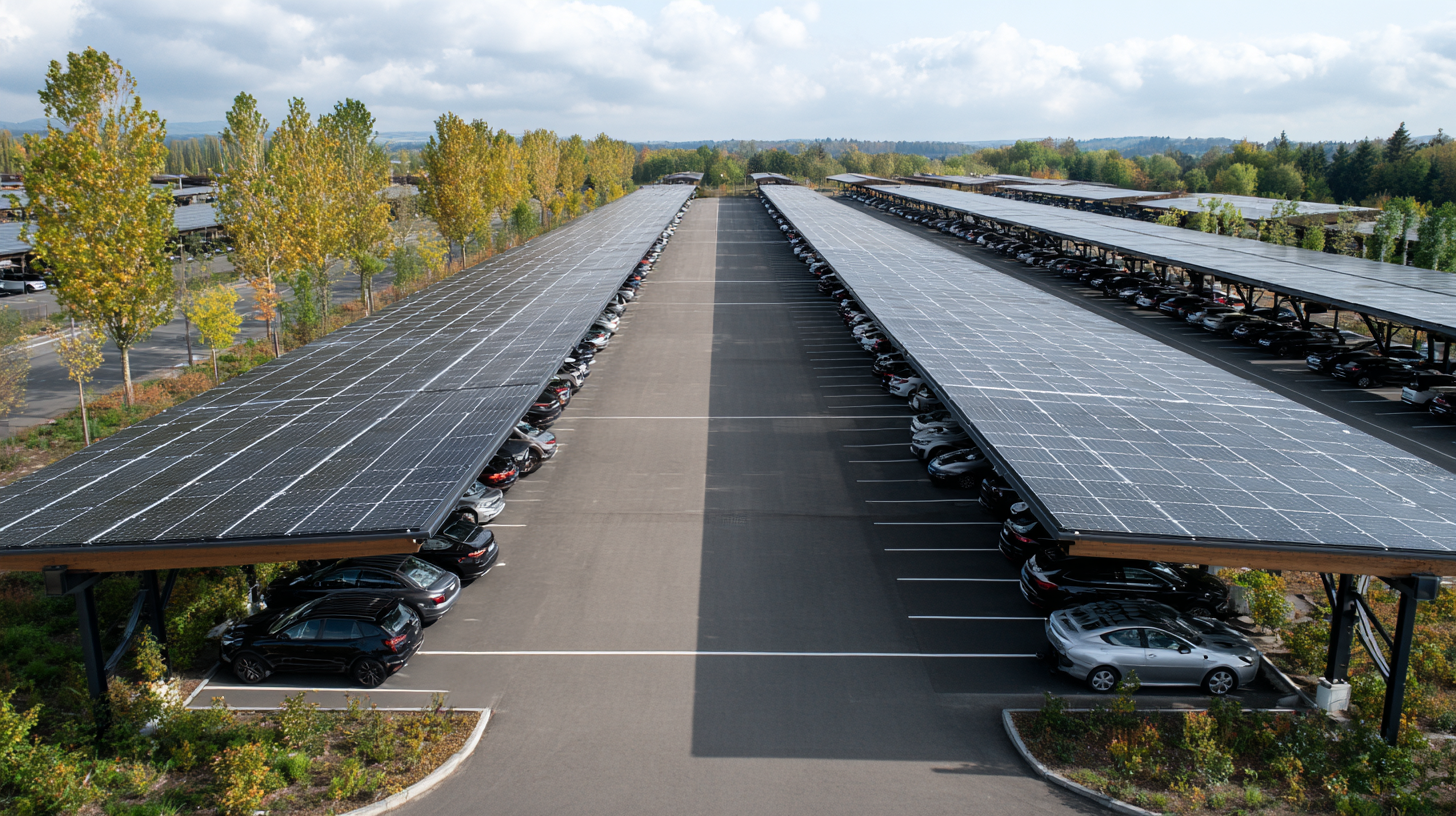
Large-scale solar car park and a view towards France: This is how Germany too can tap into the 1.8 billion euro potential of solar carports – Creative image: Xpert.Digital
Hidden energy giants: Why supermarkets and companies now need to invest in parking lot PV
From grey asphalt to green energy source: The unequal battle for Europe's solar parking spaces
Across Europe, a quiet but profound transformation is underway in the way we use urban space. Parking lots, previously mere storage areas for vehicles and often symbols of soil sealing, are evolving into one of the most dynamic segments of the energy transition. But while the technology matures and the economic potential runs into the billions, Europe remains divided.
A detailed analysis of the solar carport market reveals a fascinating two-speed race: On the one hand, there is France, which, with its rigorous APER law and the threat of fines, is forcing a massive boom and holding parking lot operators accountable. On the other hand, there is Germany – technically adept and equipped with a gigantic untapped potential of up to 59 gigawatts, but hampered by a patchwork of federal regulations and investment reluctance.
The following report not only highlights the impressive growth figures of a market projected to double by 2032, but also delves deeply into the economic viability analysis. When does a solar carport become worthwhile for small and medium-sized enterprises (SMEs)? What technological advancements are making the dual use of space more attractive than ever? And how are e-mobility and battery storage changing return expectations? Read on to discover why carports are far more than just a shade-providing luxury and how the balance of power in the European solar market is currently undergoing a fundamental shift.
Shade for cars, electricity for the grid: The silent revolution in Europe's parking lots
The transformation of sealed surfaces into energy sources is currently taking place at different speeds in Central Europe. While France is triggering a veritable solar parking boom through legislative mandates, Germany and other European countries are acting more cautiously. Nevertheless, the market for solar parking canopies is developing into one of the most dynamic segments of the photovoltaic industry. A detailed analysis of market developments for premium solar parking facilities with five or more parking spaces and large-scale systems with thirty or more spaces reveals significant growth potential, but also highlights regional differences in regulation, investment readiness, and technological implementation.
Market volume and growth dynamics
The European market for commercial solar carports reached a volume of approximately €608 million in 2024. Market analysts predict a doubling to €1.36 billion by 2032, corresponding to an average annual growth rate of ten percent. Other calculations anticipate even more dynamic growth, estimating the European market at US$1.5 billion in 2024 and expanding to US$5.2 billion by 2033, which would represent a growth rate of 16.3 percent.
This discrepancy in market estimates can be explained by differing definitions of market segments. While some analyses consider only commercial installations, others also include private applications and smaller installations. Regardless of the precise scale, there is a consensus on the direction of growth: The market is expanding continuously, driven by regulatory requirements, rising energy prices, and the need to provide electromobility infrastructure.
Globally, the solar carport market is projected to grow from US$481.5 million in 2023 to US$1.82 billion by 2033. Europe occupies a key position in this growth, as the continent leads in both installed photovoltaic capacity and regulatory density. The untapped potential in Germany alone is estimated at up to 59 gigawatts, equivalent to the output of approximately 59 large coal-fired power plants.
Germany between potential and reluctance
At the end of 2024, Germany had an installed photovoltaic capacity of more than 100 gigawatts, making it one of the leading solar nations in the European Union. Despite this impressive overall capacity, the specific segment of solar parking lots remains underdeveloped. While no consolidated statistics exist on the installed capacity of parking lot photovoltaics, industry analyses indicate that Germany holds a market share of only 19.3 percent compared to other European countries. France leads with a narrow 20.9 percent, which is surprising given the different sizes of the two economies and Germany's pioneering role in renewable energies.
The regulatory landscape in Germany is fragmented across the federal states. Baden-Württemberg was the first state to introduce a solar panel mandate for parking lots with more than 35 spaces in January 2022. North Rhine-Westphalia followed suit with a similar regulation in the same year. Rhineland-Palatinate sets the threshold at 50 spaces, while Schleswig-Holstein plans to implement a requirement only for parking lots with 100 or more spaces. Lower Saxony has mandated solar canopies for parking lots with more than 50 spaces since 2023.
This heterogeneity complicates nationwide investment decisions. A company with locations in different federal states faces varying requirements, which reduces planning certainty and increases transaction costs. Permit procedures also differ considerably: In Bavaria, carports up to 50 square meters are exempt from permitting, in Baden-Württemberg the limit is 40 square meters, and in North Rhine-Westphalia only 30 square meters. However, stricter standards regularly apply to commercial solar parking lots with integrated photovoltaic systems, as the building's technical equipment constitutes a significant modification.
Despite this regulatory complexity, impressive reference projects are emerging in Germany. In Riedstadt, Hesse, Germany's largest solar carport, with a capacity of 17 megawatts, went online in November 2025. The facility covers 76,000 square meters and houses nearly 28,000 solar modules. Even more ambitious is the project by the Mosolf Group in Kippenheim, Baden-Württemberg, which is being realized in cooperation with the Swiss energy company Axpo. By the end of 2026, a solar roof with a peak output of 24 megawatts will be completed there, spanning 109,000 square meters – roughly the size of 15 football fields. More than 54,000 solar modules will generate over 26,700 megawatt-hours of electricity annually, 85 percent of which will be fed into the public grid.
These large-scale projects demonstrate the technical feasibility and economic viability. However, they remain exceptions. The vast majority of German companies, municipalities, and retailers are still hesitant to invest in solar parking facilities. This is due, on the one hand, to the high initial investment costs—commercial systems cost between €5,000 and €8,000 per parking space—and, on the other hand, to the uncertainty regarding amortization periods. Industry experts estimate seven to ten years until the investment is recouped, which is bordering on unacceptable for many medium-sized businesses.
France's special regulatory path
In March 2023, France implemented a legislative paradigm shift that is having a lasting impact on the European solar parking market. The so-called APER law requires all operators of outdoor parking lots with an area exceeding 1,500 square meters to equip at least 50 percent of this area with solar panels or green roofs. The regulation applies to both newly constructed and existing parking lots, thus establishing a retrofit obligation – a requirement that is unique in Europe to date.
The implementation deadlines are staggered: Parking lots with an area of 10,000 square meters or more must meet the requirement by July 1, 2026. For areas between 1,500 and 10,000 square meters, the deadline is July 1, 2028. Failure to comply will result in substantial fines: up to €40,000 annually for parking lots larger than 10,000 square meters, and €20,000 for smaller facilities. This sanction is not a one-time penalty but is repeated annually until the obligation is fulfilled, creating considerable economic pressure.
In November 2024, the French government clarified the calculation methods, exemption criteria, and enforcement mechanisms through Decree 2024-1023. Exemptions apply to locations with listed buildings, technical or geological obstacles, excessive shading from trees, or insufficient sunlight. However, the operator must demonstrate that installation is impossible or uneconomical. Parking spaces used exclusively by vehicles with a gross vehicle weight exceeding 3.5 tons are also currently exempt.
The potential of this legislation is enormous. Estimates suggest that full implementation could generate between 6.7 and 11 gigawatts of additional solar capacity – equivalent to the output of ten nuclear power plants. France had 23.7 gigawatts of installed solar capacity in September 2024 and aims to increase this to between 35 and 44 gigawatts by 2028. The mandatory solar parking requirement will make a significant contribution to achieving this goal.
The largest solar parking facility currently operating in France is located at Disneyland Paris. Urbasolar, a subsidiary of the Swiss energy company Axpo, built a 36.1 megawatt peak output plant on 20 hectares of parking land. Approximately 82,000 solar panels cover 11,200 parking spaces for cars, camper vans, and coaches. The facility produces 36 gigawatt-hours of electricity annually, equivalent to the consumption of a city with 17,400 inhabitants. All of the generated electricity is fed into the grid without any on-site consumption, as stipulated in a 30-year operating contract.
Another major project underlines the French dynamism: GreenYellow, a subsidiary of the Casino Group, signed a contract in July 2024 with the supermarket chain Carrefour for the installation of more than 350 megawatts of solar carports at 350 locations by 2027. The project is considered the largest decentralized solar program in Europe and will generate 450 gigawatt hours of electricity annually.
This state-enforced market penetration is fundamentally changing the competitive landscape. French companies must invest to avoid penalties. This creates economies of scale, reducing costs and accelerating innovation. German and other European suppliers are increasingly competing with French firms, which are realizing experience curve effects through the domestic mandatory program and are aggressively expanding into neighboring markets.
Segmentation by plant size
The distinction between premium solar parking facilities with five or more parking spaces and large-scale systems with 30 or more spaces is economically and technologically significant. Smaller systems, typically in the five-to-30-space segment, are primarily aimed at medium-sized businesses, commercial enterprises, hotels, restaurants, and municipal facilities. These installations have outputs between 15 and 150 kilowatts, depending on the module technology and the roof area.
A typical premium solar parking facility with ten parking spaces generates approximately 15 to 25 kilowatts of peak power. With average solar irradiance in Central Europe, this corresponds to an annual production of 15,000 to 25,000 kilowatt-hours. This amount is sufficient to power about three to five electric vehicles with an annual mileage of 15,000 kilometers or to partially supply a small business with electricity. The investment costs for such systems range from €75,000 to €200,000, depending on site conditions, module quality, foundation solution, and the integration of charging infrastructure.
The economic viability of these smaller systems depends significantly on the proportion of self-consumption. Companies that can use the generated electricity directly – for example, through internal appliances or electric vehicle fleets – achieve amortization periods of five to eight years. However, if a large portion of the energy is fed into the grid, the amortization period extends to ten to twelve years, as the feed-in tariff, at seven to eight cents per kilowatt-hour, is considerably lower than the cost of purchasing electricity, which is 30 to 40 cents.
Large-scale solar parking facilities with 30 or more parking spaces achieve outputs ranging from 100 kilowatts to the megawatt range. These systems primarily serve shopping centers, industrial parks, logistics companies, airports, park-and-ride facilities, and automotive manufacturers. The aforementioned Mosolf plant in Kippenheim, with 24 megawatts, represents the upper limit of this segment. Such large-scale systems benefit from economies of scale: The cost per kilowatt of installed capacity decreases with increasing size, as planning efforts, grid connection costs, and administrative processes do not increase proportionally to the size of the system.
Another difference lies in the foundation solution. Smaller facilities can often be built with simpler foundations, while larger facilities require more structurally sophisticated designs. Innovative foundation systems such as geoscrews – steel screws that are screwed directly into the ground – are gaining in importance. They reduce the amount of concrete required, shorten construction time, and minimize disruption to sealed surfaces. This technology is particularly suitable for existing parking lots where excavating the asphalt surface is to be avoided.
Integrating charging infrastructure is possible in both segments, but becomes more economically attractive for larger systems. For example, a solar parking lot with 50 spaces can accommodate ten to twenty charging points without requiring additional grid connection capacity, as the solar system directly provides some of the charging power. Intelligent load management systems optimize the distribution between self-consumption, battery storage, vehicle charging, and grid feed-in, thus increasing the overall return on investment.
Cost structures and profitability
The investment costs for solar parking spaces vary considerably depending on the system size, site conditions, module type, and additional equipment. For private single parking spaces or double carports, providers estimate costs between €10,000 and €25,000. A complete double carport with six kilowatts peak output, inverter, mounting system, and wallbox currently costs around €22,000 to €24,000 in Germany. In the United Kingdom, comparable systems cost between £10,000 and £12,000.
Commercial parking facilities are often billed per parking space. Typical market prices range between €5,000 and €8,000 per covered parking space. Row parking systems, such as those used in supermarket car parks, start at around €11,990 per space, plus €3,890 for installation. British suppliers calculate turnkey installations, including earthworks, steel structure, solar panels, and electrical connections, at around £10,000 per space.
These investment sums are nominally high, but this becomes less significant when considering amortization. A 2024 industry survey determined an average amortization period of 7.3 years for German commercial projects. Projects with high self-consumption reach break-even after just five years. Amortization depends on several factors:
Electricity price fluctuations significantly impact profitability. With current commercial electricity prices of around 30 cents per kilowatt-hour, every self-consumed kilowatt-hour of solar power saves approximately 20 cents compared to the production costs of eight to eleven cents. A company with a solar parking lot that produces 100,000 kilowatt-hours per year and consumes 70 percent of it on-site saves approximately €14,000 annually in electricity procurement costs. For an investment of €200,000, this results in a payback period of about 14 years, not including subsidies.
Government subsidies significantly shorten amortization periods. In Germany, plant operators benefit from various support programs. The KfW bank offers low-interest loans for photovoltaic systems and charging infrastructure. Some federal states grant investment subsidies of between ten and 30 percent of eligible costs. In France, there is a self-consumption premium for photovoltaic systems up to 100 kilowatts peak output. For systems between nine and 36 kilowatts, the premium is €200 per kilowatt, paid out over five years.
The operating costs of solar parking lots are low. Modern photovoltaic systems require minimal maintenance. Manufacturers estimate annual operating costs of approximately ten euros per kilowatt of installed capacity. For a 100-kilowatt system, this equates to 1,000 euros per year for insurance, monitoring, cleaning, and occasional repairs. This sum is negligible compared to the revenue generated from self-consumption and feed-in tariffs.
The systems have a lifespan of at least 25 years, with modern modules still delivering 80 percent of their original output even after three decades. The steel structures of carports are designed for a service life of 40 years. Consequently, after the amortization period, solar parking lots continue to generate virtually free energy for another 15 to 20 years. This extended period of net returns makes the investment highly attractive from a life-cycle perspective, even if the initial amortization period seems too long for some investors.
The "Helios" solar carport system from Alumil Solar – Transformation of urban areas through integrated photovoltaic carport systems

The "Helios" solar carport system from Alumil Solar – Transformation of urban areas through integrated photovoltaic carport systems – Image: Alumil Solar
Modern urban planning and commercial real estate development increasingly face the challenge of using limited space more efficiently while simultaneously meeting rising demands for sustainability and energy self-sufficiency. Within this complex environment, solar carports are evolving from a niche solution to a central component of modern infrastructure management. A detailed examination of the Helios system from Alumil Solar, particularly the H2700 and H2700 MAX models, allows for an exemplary analysis of the economic and technical implications of such investments. This involves not simply erecting a shelter, but rather transforming passive parking spaces into active, value-creating power plants that pay for themselves through multifunctional use.
More information here:
France is leading the way: Why soon every large parking lot will have to be a power plant
Technological developments and innovations
The efficiency of solar parking lots has improved significantly in recent years due to technological advancements. Bifacial solar modules, which absorb light from both the front and back, achieve yields of up to 30 percent higher compared to conventional modules. This technology is particularly suitable for carport applications, as the reflection from asphalt and concrete provides the back of the modules with additional radiation. Bifacial modules with a glass-glass construction also offer a longer lifespan and greater resistance to weathering.
Semi-transparent solar modules allow partial light transmission, which can be aesthetically advantageous for shopping centers or hotels. These modules create pleasant shade without causing complete darkness. However, they cost about 15 to 20 percent more than conventional modules and are therefore primarily used in the premium segment.
The integration of energy storage systems is gaining importance. Lithium-ion battery systems store excess solar energy during midday hours and make it available in the evening for charging or powering industrial appliances. Prices for battery storage have fallen dramatically in recent years. In 2016, a kilowatt-hour of storage capacity cost €1,700, while at the beginning of 2026 it cost only €325 – a decrease of over 80 percent. This development makes storage solutions economically attractive even for medium-sized commercial facilities.
DC-DC coupling architectures significantly improve system efficiency. Traditional solar power systems convert the direct current (DC) generated by the modules into alternating current (AC) to feed into the building's electrical system or the public grid. However, electric vehicles and battery storage systems operate natively on DC. Multiple conversions between DC and AC result in losses of five to ten percent per conversion. DC-DC systems eliminate these losses by directly coupling solar modules, storage systems, and vehicle batteries on a DC basis. This increases overall efficiency by up to 15 percent and reduces the required grid connection capacity.
Intelligent energy management systems optimize power flows in real time. These systems monitor current solar production, building consumption, battery charge levels, grid electricity prices, and the availability of electric vehicles. Algorithms decide, down to the second, whether electricity flows into the building, is used to charge the battery, fed into the grid, or used for vehicle charging. Particularly advanced systems utilize weather forecasts and historical consumption data for predictive control.
The design of carports themselves is constantly being improved. Modern systems use aluminum support structures that are corrosion-resistant, lightweight, and recyclable. Modular systems allow for flexible expansion: An operator can initially cover ten parking spaces and later add any number of units without having to recalculate the overall structural integrity. Integrated gutters ensure controlled drainage of rainwater and can be connected to infiltration systems, offering ecological benefits.
Vandal-resistant designs are becoming increasingly important, especially for publicly accessible parking areas. Reinforced module frames, raised mounting points, and robust cable management protect against deliberate damage. Some manufacturers offer integrated impact protection devices that prevent maneuvering vehicles from damaging the supports.
Synergy with electromobility
The combination of solar parking spaces with charging infrastructure for electric vehicles generates significant synergies. A covered parking space with photovoltaic modules produces approximately 2,000 to 3,000 kilowatt-hours of electricity per year. An average electric vehicle with an annual mileage of 12,000 kilometers requires about 2,400 kilowatt-hours. The ratio of electricity generation to electricity consumption is therefore almost balanced.
For companies with vehicle fleets or employees who use electric vehicles, there is a double return: The investment in the solar parking facility pays for itself through savings on electricity costs, while at the same time the company's attractiveness as an employer increases. Employees who can charge their vehicles for free or at a reduced rate with company electricity consider this a benefit in kind. Companies can grant this benefit with tax advantages.
Charging costs differ dramatically between self-consumption and public charging infrastructure. At public fast-charging stations, users currently pay around 40 to 50 cents per kilowatt-hour. Charging via the home electrical system costs about 30 cents. Solar power incurs production costs of eight to eleven cents. A company that charges its fleet of vehicles with its own solar power reduces fuel costs per 100 kilometers from twelve euros to two to three euros. For a fleet of ten vehicles, each with an annual mileage of 15,000 kilometers, the savings amount to approximately 13,500 euros per year.
Intelligent load management prevents grid connection overloads. If all vehicles were charging simultaneously at maximum power, the required connection capacity would skyrocket, triggering high grid fees. Load management systems dynamically distribute the available power among the connected vehicles. When solar production is high, the charging power is increased; during cloudy weather or in the evening hours, it is reduced or switched to grid power.
Solar-optimized charging at park-and-ride facilities or commuter parking lots is particularly interesting. Vehicles parked for several hours during the day can be recharged at a lower charging rate. A study from Munich proposes equipping such parking spaces with simple sockets that allow a charging capacity of 2.3 kilowatts. Over an eight-hour parking period, this would allow for approximately 18 kilowatt-hours of charging – enough for 100 kilometers of range. Infrastructure costs remain low, as there is no need to install expensive fast-charging stations.
The combination of solar carports with bidirectional charging systems opens up further possibilities. Vehicle-to-grid (V2G) technology enables electric vehicles to feed stored energy back into the grid when needed. The vehicle batteries act as decentralized buffer storage, mitigating grid bottlenecks and smoothing out electricity price peaks. Initial pilot projects demonstrate the technical feasibility, but regulatory hurdles are delaying widespread market introduction.
Challenges and obstacles
Despite the positive market outlook, substantial hurdles exist that are slowing the spread of solar parking facilities. The high initial investment costs pose a particular barrier for small and medium-sized enterprises (SMEs). While large corporations can finance the necessary sums from cash flow or obtain favorable loans, smaller businesses often lack the creditworthiness or the risk appetite for investments with amortization periods exceeding five years.
The complexity of permitting procedures varies considerably between European countries. In Germany, building permits are often required for solar parking facilities if the installations exceed certain sizes or are located next to public roads. Obtaining these permits takes several months and requires structural calculations, fire safety assessments, and, where applicable, environmental impact assessments. In France, solar legislation has introduced a simplification: for most solar parking facilities, a building notification suffices instead of a full permit, thus speeding up the process.
Structural limitations restrict feasibility. Not all parking lots are suitable for solar roofs. Requirements include sufficient spacing between parking spaces, minimal shading from trees or buildings, a stable subsoil for the foundations, and suitable orientation to the sun. Parking lots with a slope of more than ten percent, heavy shading, or an unfavorable north-south orientation yield lower returns and are uneconomical.
Integrating solar power into existing electrical infrastructure can be complex. Many older buildings have grid connections that are not designed to handle the additional feed-in of solar energy. Grid expansion measures cost tens of thousands of euros and extend the project duration. Distribution network operators are increasingly demanding that solar parking facilities contribute to grid stabilization, for example through active power control or reactive power provision, which requires additional technical components.
Weather variability affects planning certainty. Solar yields are subject to seasonal and daily fluctuations. A solar parking lot in northern Germany achieves approximately 850 to 950 kilowatt-hours per kilowatt of installed capacity per year, while in southern Germany or southern France, 1,000 to 1,100 kilowatt-hours are realistic. This difference of about 20 percent significantly impacts profitability and must be considered in site-specific calculations.
The European solar market as a whole is slowing down. After years of annual growth rates exceeding 40 percent, the EU market grew by only four percent in 2024. The decline in electricity prices following the end of the energy crisis is reducing the profitability of self-generation systems. Private households see less urgency to invest in photovoltaics once grid electricity prices fall again. Lower electricity prices are also leading to longer amortization periods in the commercial sector.
Political uncertainties are dampening investment activity. Changes to subsidy regulations, feed-in tariffs, or tax depreciation allowances can retroactively worsen the profitability of existing plants. The Solar Peak Act, passed in Germany in January 2025, stipulates that feed-in tariffs will be suspended during periods of negative electricity prices. Such regulatory interventions increase the perceived investment risk.
Market outlook and strategic implications
The market development for solar parking facilities in Germany, France, and Europe will be shaped by several factors in the coming years. France's regulatory mandate will trigger a massive expansion by 2028. It is estimated that tens of thousands of parking spaces will need to be retrofitted, generating investments in the tens of billions of euros. This boom will create demand for manufacturers, installers, and project developers far beyond France's borders.
Germany is expected to follow suit, albeit at the federal level. Other states are likely to introduce mandatory solar panel installations in parking lots or tighten existing regulations. Discussions about nationwide harmonization of the requirements are intensifying, as the current fragmentation is perceived as a competitive disadvantage. A uniform federal regulation would create planning certainty and stimulate investment.
The electrification of transport is increasing the demand for charging infrastructure. The European Union aims to have at least 30 million zero-emission vehicles on the road by 2030. These vehicles require charging options. Employers, retailers, and municipalities are under increasing pressure to provide charging points. Solar parking lots offer an integrated solution that combines energy generation, parking space, and charging infrastructure.
Technological advances will further improve economic viability. Module prices have fallen by 80 percent since 2016 and are continuing to decline. Storage prices are following a similar trend. More efficient inverters, more durable materials, and automated installation processes are continuously reducing costs. New business models such as contracting or power purchase agreements enable operators to develop solar power plants without their own investment, as third parties finance, install, and operate the systems.
Competition between manufacturers and suppliers is intensifying. German companies like Schletter, IBC Solar, Sopago, and PILLAR are competing with international players such as Tata Power Solar, SolarEdge, and Chinese module manufacturers. Consolidation is progressing: In October 2025, Anywhere.Solar and MEISER Solar announced their merger to become more competitive through combined expertise in design, engineering, and manufacturing.
Investors are recognizing the long-term appeal of solar infrastructure. Infrastructure funds, insurance companies, and pension funds are increasingly allocating capital to renewable energies. Solar power plants offer stable, predictable cash flows over decades, which is attractive to institutional investors. Third-party financing models, in which investors pre-finance the plants and operators enter into long-term power purchase agreements, are gaining in importance.
Linking solar parking facilities to other sustainability goals increases their appeal. Companies that must meet ESG (Environmental, Social, Governance) criteria use solar parking facilities as a visible contribution to CO₂ reduction. Municipalities use them to achieve climate neutrality goals. Combining them with greening – for example, through the integration of trees or green roofs on adjacent buildings – creates additional ecological benefits and improves the microclimate.
The European Green Deal and the European Commission's REPowerEU initiative are creating further incentives. Billions in funding are flowing into the expansion of renewable energies. The revision of the Renewable Energy Directive (RED III) could in the future stipulate minimum quotas for solar car park roofs, which would replicate the French approach across Europe.
The decarbonization of real estate portfolios is driving commercial demand. Large retail chains, logistics companies, and automotive groups have committed to net-zero emissions by 2040 or 2050. Solar parking lots on company-owned properties significantly reduce Scope 2 emissions (purchased energy) and contribute to achieving these targets. Companies like IKEA, Amazon, and DHL are already investing heavily in solar roofs for their logistics centers and distribution centers.
The digitalization of energy management opens up new business models. Networked solar park systems can be bundled as virtual power plants that provide on-demand balancing power or trade on electricity exchanges. Blockchain-based peer-to-peer energy trading systems enable operators to sell surplus electricity directly to neighbors or other companies, without intermediaries.
The untapped superpower: How parking lots replace the output of 100 coal-fired power plants
France's legislative commitment is catalyzing a surge in expansion that will transform the sector by 2028. Germany is following more cautiously, with federal regulations providing initial impetus, but nationwide harmonization is still pending. The economic environment has improved significantly due to falling module and storage prices as well as rising grid electricity costs. Payback periods of between five and ten years are realistically achievable for commercial systems with high self-consumption.
The technological maturity is there: Bifacial modules, DC-DC couplings, intelligent load management, and modular construction systems enable efficient, scalable solutions for all system sizes. The synergy with electromobility further enhances its appeal, as solar parking lots simultaneously generate energy and provide charging infrastructure. For companies with vehicle fleets or commuter traffic, this results in a double return on investment through savings on electricity procurement costs and reduced fuel expenses.
Challenges remain: High initial investments, complex permitting processes, structural limitations of individual sites, and political uncertainties are slowing diffusion. The slowdown of the overall European solar market following the end of the energy crisis is dampening short-term momentum. In the long term, however, all fundamental drivers point to accelerated growth: decarbonization targets, electrification of transport, land scarcity for ground-mounted photovoltaics, and increasing pressure from ESG requirements.
Germany has 59 gigawatts of untapped potential on parking lots – more than half of its currently installed total photovoltaic capacity. France could activate an additional 11 gigawatts by mandating parking for solar installations. Across Europe, the potential totals over 100 gigawatts, roughly equivalent to the output of 100 coal-fired power plants. Unlocking this potential requires coordinated regulations, reliable support frameworks, innovative financing models, and technological advancements.
This environment presents significant opportunities for investors, project developers, and operators. The European market for solar carports is projected to grow from its current value of approximately €600 million to €1.5 billion to €1.4 to €5.2 billion by 2032 – a three- to fourfold increase within a decade. Companies that build expertise early, implement reference projects, and develop scalable business models will play a key role in shaping this growth market. The transformation of sealed surfaces into productive energy sources has only just begun. The coming years will reveal whether Europe – led by France and followed by Germany – consistently leverages this potential or whether regulatory fragmentation and investment reluctance will delay its realization.
Consulting - Planning - Implementation

Konrad Wolfenstein
I would be happy to serve as your personal advisor.
contact me at wolfenstein ∂ xpert.digital
Just call me on +49 7348 4088 965 (Munich) .







