
Red alert! BlackRock pulls the emergency brake: Is the private credit market on the verge of collapse? When Wall Street giants turn off the money tap
Xpert Pre-Release

Language selection 📢
Published on: March 17, 2026 / Updated on: March 17, 2026 – Author: Konrad Wolfenstein
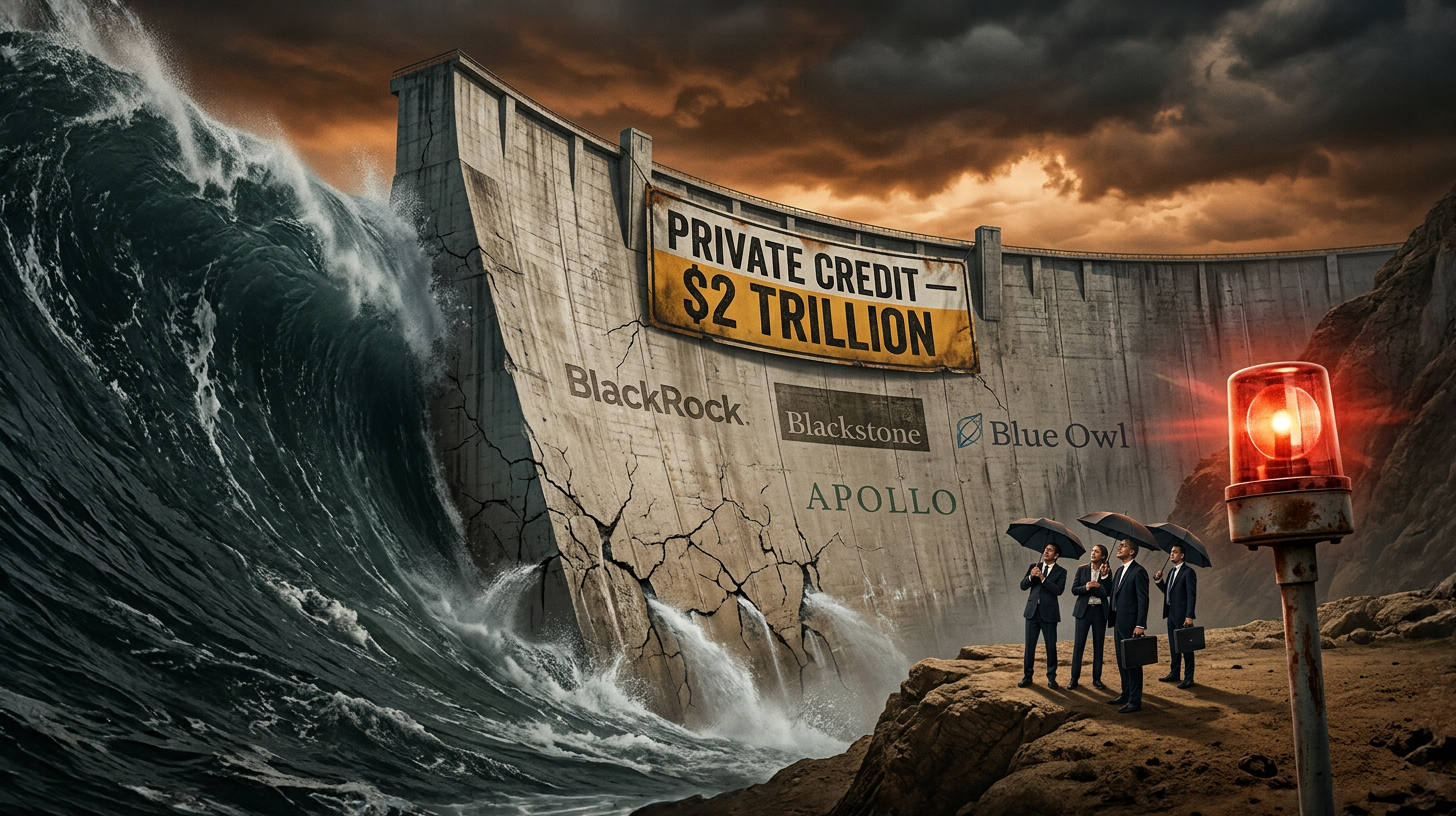
Red alert! BlackRock pulls the emergency brake: Is the private credit market on the verge of collapse? When Wall Street giants turn off the money tap – Image: Xpert.Digital
Bankruptcies, fraud, and a permanent halt: Is the first major financial domino effect about to topple?
Painful cleanup process: Why BlackRock, Blackstone and Co. are suddenly faltering
Billions in loan redemptions halted: The hidden risk in the private credit market
For years, the private credit market was considered a lucrative and seemingly safe goldmine outside the regular banking system. But in the spring of 2026, warning signs are mounting that the ecosystem, which has grown to over two trillion dollars, is facing a critical test. When giants like BlackRock, Blackstone, and Blue Owl are suddenly forced to drastically cap or completely halt billions in payouts to their investors, it's no longer just normal market noise. Triggered by high-profile bankruptcies and fraud allegations against major borrowers, a structural liquidity problem is revealed. As the share prices of the major asset managers plummet and memories of the eve of the 2008 financial crisis resurface, Wall Street and investors worldwide are faced with the pressing question: Are we merely witnessing the painful correction of an overheated market – or the beginning of a new, uncontrollable chain reaction in the financial system?
Private credit on the brink? The $2 trillion stress test
When the world's largest asset manager turns off the money tap, it's no coincidence
In early March 2026, something happened that was immediately recognized as a warning sign by the financial markets: BlackRock, the world's largest asset manager with roughly ten trillion dollars in assets under management, informed investors in its HPS Corporate Lending Fund that it would only process half of their redemption requests. Those who wanted their money back received only 620 million dollars instead of the requested 1.2 billion dollars – with the explanation that a contractual clause was invoked that capped quarterly redemptions at five percent of the outstanding shares. BlackRock's stock subsequently fell by over eight percent. It was the first time in the fund's history that this clause had to be activated. And it wasn't the beginning of the story, but rather a turning point in an already ongoing crisis.
The Anatomy of the Private Credit Market
To understand why this moment set off so many alarm bells, one must understand the structure of the private credit market. Following the 2008 global financial crisis, regulatory reforms forced banks to significantly reduce their exposure to risky corporate loans. Non-bank lenders—direct lending funds, business development companies, and specialized lending platforms—flocked to fill the resulting gap. The outstanding loan volume of these vehicles rose from around $100 billion in 2010 to over $1.2 trillion by mid-2024, as documented by the Bank for International Settlements. The entire private credit ecosystem, including asset-based lending and structured loans, is estimated in various analyses to be worth between $1.8 and $2.5 trillion.
The basic model of these funds seemed robust: They granted loans to medium-sized and larger private companies at higher interest rates than investment-grade bonds, with variable interest components that delivered attractive returns during the high-interest-rate phase starting in 2022, and with collateral and covenants that offered a degree of protection. The structural problem, however, lies in a liquidity mismatch inherent in the system: The funds issue loans with maturities of five to seven years, but often allow their investors to withdraw their funds quarterly. This works without problems as long as investor confidence is high and outflows remain low. It ceases to work when – for whatever reason – many investors simultaneously demand their money back.
The initial spark: Tricolor and First Brands
The path to the current crisis began in the fall of 2025 with two bankruptcies that, at first glance, appeared to be isolated incidents, but turned out to be harbingers of a deeper structural problem. Tricolor Holdings, a Texas-based subprime auto lender, filed for Chapter 7 bankruptcy protection on September 10, 2025 – the most severe form of corporate liquidation under American law. US prosecutors later indicted founder and CEO Daniel Chu and COO David Goodgame: The managers are alleged to have systematically inflated the value of their loan collateral since at least 2018, thereby raising billions from lenders and investors. A classic Ponzi scheme, packaged in a modern financial architecture.
Just a few weeks later, on September 28, 2025, First Brands Group, a US auto supplier backed by Apollo Global Management, filed for Chapter 11 bankruptcy protection, revealing a mountain of debt ranging from ten to fifty billion dollars against assets of only one to ten billion. Here, too, the investigation uncovered a web of special purpose vehicles, factoring arrangements, and asset-backed structures off the regular balance sheet—debts that many creditors only recognized very late. Founders Patrick James and his brother Edward were indicted in New York in January 2026 on charges of multibillion-dollar loan fraud. Prominent financial institutions such as UBS O'Connor and Jefferies Financial Group had injected hundreds of millions of dollars into both companies.
In October 2025, JPMorgan CEO Jamie Dimon found a fitting metaphor for what was becoming apparent: if you see one cockroach, there are probably more. The warning would prove prophetic.
The domino effect is starting to fall: Blue Owl and the permanent stop
The next crucial escalation came in February 2026. Blue Owl Capital, one of the most prominent players in the private credit universe, permanently halted redemptions from its $1.6 billion OBDC-II fund—not a temporary measure, but a permanent cessation. Simultaneously, the firm announced the liquidation of $1.4 billion in assets from three loan funds to meet remaining redemption requests at 30 percent of the current investment value. Blue Owl's stock subsequently plummeted by as much as 10 percent. The signal to the market was clear: when even large, well-capitalized private credit providers close their doors, it points to systemic liquidity problems.
Exactly three weeks later came the BlackRock shock of March 6, 2026 – and shortly thereafter, it was revealed that industry leader Blackstone was also facing record redemption requests. Investors demanded approximately $3.8 billion from its flagship BCRED fund – equivalent to 7.9 percent of the fund's assets, significantly exceeding the normal quarterly limit of five percent. To prevent panic, Blackstone raised the limit to seven percent and closed the remaining gap with $400 million in private contributions from over 25 senior partners. A signal of remarkable symbolic power: The leadership of the world's largest alternative asset manager was dipping into its own pockets to maintain trust.
Our US expertise in business development, sales and marketing

Our US expertise in business development, sales and marketing - Image: Xpert.Digital
Industry focus areas: B2B, digitalization (from AI to XR), mechanical engineering, logistics, renewable energies and industry
More information here:
A thematic hub offering insights and expertise:
- Knowledge platform covering global and regional economies, innovation and industry-specific trends
- A collection of analyses, insights, and background information from our key areas of focus
- A place for expertise and information on current developments in business and technology
- A hub for companies seeking information on markets, digitalization, and industry innovations
Financial crisis 2.0? Why Wall Street is now trembling before a new 2008
Market reaction: When the Wall Street heavyweights fall
The reaction on the stock markets was pronounced. In the six months following the start of the crisis, Blackstone lost roughly a third of its market value, Blue Owl over 42 percent, KKR 32 percent, and Apollo Global Management around 20 percent. Apollo's shares had already lost 30 percent that year when Apollo's CEO, Marc Rowan, openly described the situation at the Bloomberg Invest Forum in New York on March 3, 2026: The $1.8 trillion private credit market was undergoing a prolonged consolidation process.
Rowan identified two key structural drivers. First, software companies accounted for roughly 30 percent of the leveraged buyout market and thus represented a corresponding share of total credit-financed business—a highly concentrated risk that became strikingly apparent due to growing concerns about AI-driven disruption of software business models. UBS analyses warn that 25 to 35 percent of total private credit portfolios are exposed to significant AI disruption risk. Second, the structural migration of credit risks from the banking system to the private credit market—a deliberate consequence of the regulatory reforms after 2008—designed the system as it functions today. This can be painful, but it is fundamentally part of the design.
The system question: 2008 or something else?
The obvious historical analogy is, of course, the financial crisis of 2007 and 2008. In August 2007, funds managed by the French bank BNP Paribas froze their payouts – an event now considered one of the early triggers of the global financial crisis. This image looms over the current debate, and economist Mohamed El-Erian – former head of the world's largest bond manager, PIMCO – has explicitly spoken of a possible classic contagion effect: one market segment comes under pressure, trust erodes, investors become cautious and withdraw capital, which then puts pressure on the next segment.
The differences from the 2008 crisis, however, are structurally significant. The financial crisis was a dense web of reciprocal credit relationships between banks, securitizations that packaged credit risks into opaque products, and derivative exposures that interconnected the entire system. When one thread broke, the whole web trembled. Today, many risks reside in closed fund structures—direct lending funds, BDCs, specialized credit platforms—that are largely separated from the banking system by regulatory frameworks. This limits the risk of systemic contagion, but does not eliminate it entirely. The interface between private credit funds and the regular banking system still exists—through credit lines, joint lending, and the fact that JP Morgan restricted lending to private credit funds in early March 2026.
At the same time, Goldman Sachs signaled its intention to offer bets on the decline in the value of corporate loans – an offering the bank had made in a similar form shortly before the outbreak of the 2008 financial crisis, and which is perceived by insiders as a warning signal. The parallels may be coincidental. Or perhaps not.
According to former fund managers,
In early March 2026, a text by former Fidelity fund manager and hedge fund founder George Noble went viral on the social media platform X. Noble described how we were witnessing a financial crisis unfold in real time. He argued that when the world's largest asset manager began preventing investors from getting their money back, it wasn't just market noise, but a warning sign. This pointed statement struck a chord and was shared millions of times – not least because it articulated a fear that many investors already harbored but hadn't yet openly voiced.
Noble's analysis is neither nonsense nor a certainty. The private credit crisis is real and is affecting real investors who are suffering real losses. However, it is not yet 2008 – the systemic spillover to the regular banking system and the broader real economy has not yet materialized. Citigroup CEO Jane Fraser emphasized at the end of February 2026 that she did not see a systemic risk to the financial system, even though there were problems in individual areas. UBS analysts estimated potential default rates of up to 15 percent in the worst-case scenario – significantly higher than current levels, but still below the scenarios of a systemic catastrophe.
Painful cleansing process
What current developments likely herald is not a systemic collapse, but a painful shakeout of a market segment that, in ten years, has transformed from a niche to a crucial source of financing for American and increasingly European small and medium-sized enterprises (SMEs). The private credit market has experienced unprecedented expansion since 2010, made possible by a low-interest-rate environment with little competitive pressure and even less regulatory scrutiny.
Now structural risks are returning: Companies that can no longer manage their debt under higher interest rates will become insolvent. Funds that have built up risky portfolios will have to realize losses. Investors who sought attractive returns by investing in illiquid products are now encountering the limits of contractual redemption restrictions. And regulators, who have previously paid little attention to the sector, will now be monitoring it more closely.
The real question for the coming months is not whether it will hurt—it already does, and it will hurt even more. The question is whether the institutional structures of the private credit market are robust enough to absorb the shakeout without undermining confidence in broader financial markets. The alarm bells are ringing in the engine room of the monetary system. Whether they herald a conflagration or merely the beginning of a long-overdue normalization will be revealed in the next quarterly earnings season.
Your global marketing and business development partner
☑️ Our business language is English or German
☑️ NEW: Correspondence in your native language!

Konrad Wolfenstein
I and my team are happy to be available to you as your personal advisor.
You can contact me by filling out the contact form here or simply call me at +49 7348 4088 965. My email address is: [email protected]
I'm looking forward to our joint project.
☑️ SME support in strategy, consulting, planning and implementation
☑️ Creation or realignment of the digital strategy and digitization
☑️ Expansion and optimization of international sales processes
☑️ Global & Digital B2B trading platforms
☑️ Pioneer Business Development / Marketing / PR / Trade Fairs
🎯🎯🎯 Benefit from Xpert.Digital's extensive, five-fold expertise in one comprehensive service package | BD, R&D, XR, PR & Digital Visibility Optimization

Benefit from Xpert.Digital's extensive, five-fold expertise in a comprehensive service package | R&D, XR, PR & Digital Visibility Optimization - Image: Xpert.Digital
Xpert.Digital possesses in-depth knowledge across various industries. This allows us to develop tailored strategies precisely aligned with the requirements and challenges of your specific market segment. By continuously analyzing market trends and monitoring industry developments, we can act proactively and offer innovative solutions. The combination of experience and expertise generates added value and provides our clients with a decisive competitive advantage.
More information here:










