
Looking for parking lot solar: Planning a solar car park or building a system in Dormagen, Grevenbroich, Herten or Bergheim?

Available in 27 languages 📢
Prefer Xpert.Digital on GoogleⓘPublished on: October 20, 2021 / Updated on: October 20, 2021 – Author: Konrad Wolfenstein
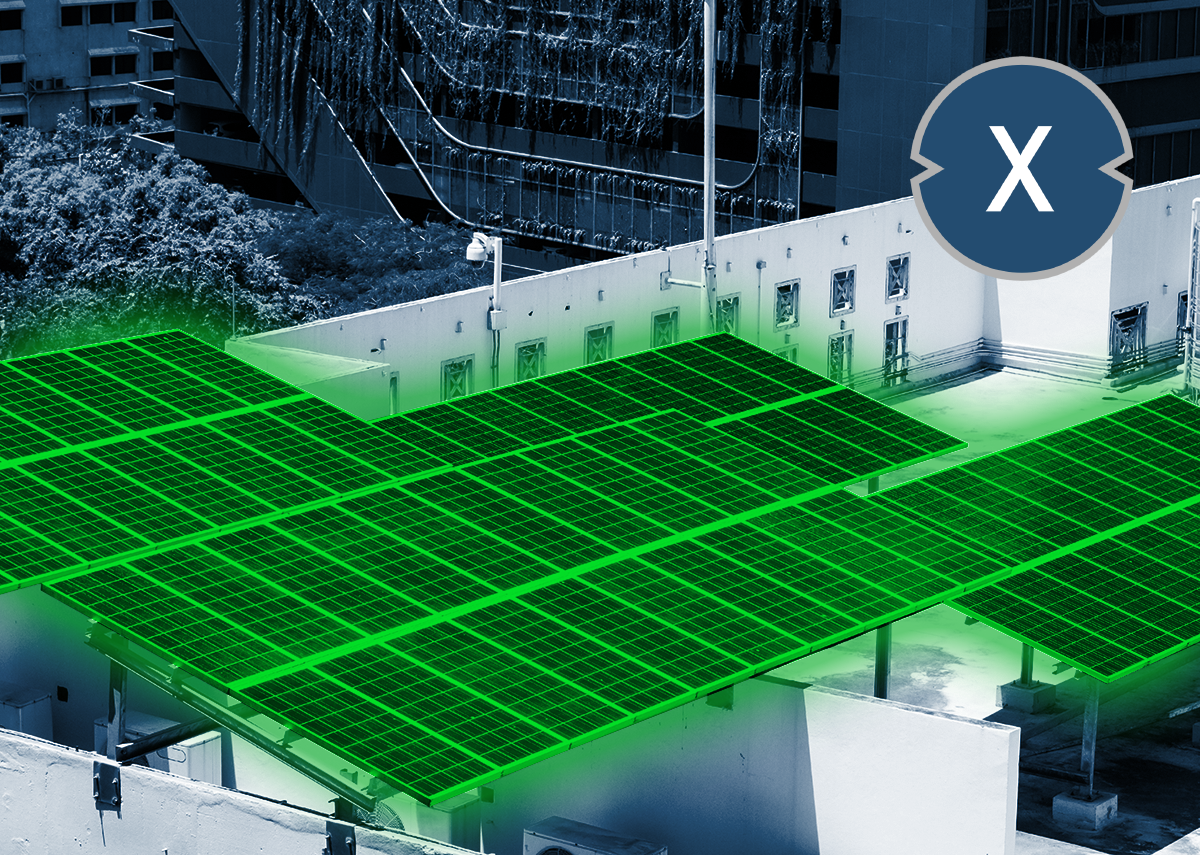
Looking for parking space solar: Solar carport – Image: Xpert.Digital / Apirakthanakorn|Shutterstock.com
Expanding photovoltaic potential with solar carports
Demand for solar carports is rising. Undoubtedly, the mandatory installation of solar panels in some German states plays a significant role in this. Solar energy isn't a new topic, but it's increasingly coming into focus due to the EU's and the German government's climate-neutral, emission-free CO2 policies. Until recently, solar carports weren't standard or weren't seriously considered alongside rooftop solar panels or large-scale photovoltaic installations. There were a few large solar carport projects here and there, but few had yet dared to implement them.
Solar carports for open parking lots play a key role in the development of electromobility. The government's planned transition from the current 48 million registered passenger cars to electric vehicles must be completed within the next 10 to 15 years. This cannot be achieved without expanding the necessary infrastructure. Solar carports, in combination with charging stations and energy storage systems, are intended to help with this.
The business model for parking lot owners is particularly interesting, whether it's company parking lots or those at discount stores. The expansion of covered solar installations combined with charging infrastructure offers smaller businesses the opportunity to compete with large energy companies and their extensive networks of gas stations, allowing them to generate revenue from refueling and charging.
But private households also have the opportunity to become more independent from rising fuel and charging prices by generating their own energy for transportation.
Our solar carport solutions for covering open parking areas are modular and scalable:
- Quick and easy assembly
- Customizable design (color, materials, surface, size, etc.)
- Installation of charging stations and inverters is possible at any time
- Scalable & modular: Available as a single, double or infinitely scalable row carport
- Suitable for use even in the standard version for very high wind and snow loads
- …and much more
📣 Open parking areas: Photovoltaic solutions for industry, retail and municipalities
Everything from a single source, specifically designed for solar solutions for large parking areas. Refinance or offset your future costs with your own electricity generation.
🎯 For solar installers, plumbers, electricians and roofers
Consultation and planning including a non-binding cost estimate. We connect you with strong partners in photovoltaics.
👨🏻 👩🏻 👴🏻 👵🏻 For private households
We have a regional presence throughout the German-speaking world. We have reliable partners who will advise you and implement your wishes.
With over 1,000 articles published, we cannot present all topics here. Therefore, you will find a small selection of our work here, and we would be delighted if we have sparked your interest in learning more about us:
Our Solar PDF Library

Photovoltaic Library (PDF) – Image: Xpert.Digital / Benvenuto Cellini|Shutterstock.com
Large PDF library: Market monitoring and market intelligence on the topic of photovoltaics.
Data is reviewed and its relevance assessed at regular intervals. This usually yields a number of interesting pieces of information and documentation, which we summarize in a PDF presentation: our own data analyses and marketing intelligence, as well as external market observations.
More information here:
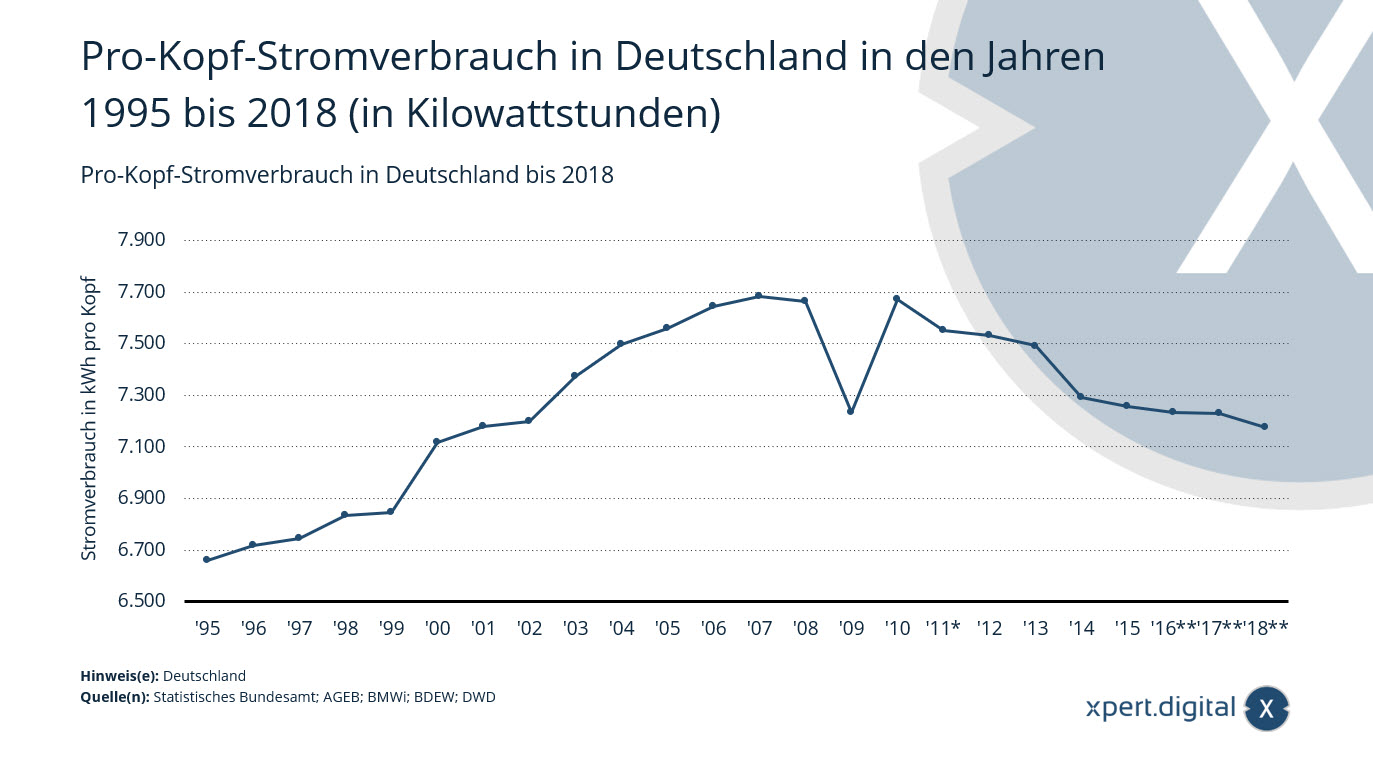
Per capita electricity consumption in Germany up to 2018
Per capita electricity consumption in Germany – Image: Xpert.Digital
Per capita electricity consumption in Germany in 2018 was approximately 7.2 megawatt hours. In 1995, the figure was 6.7 megawatt hours. A total of 599 terawatt hours of electricity was consumed nationwide in Germany in 2018.
Electricity consumption of private households
Industry accounts for almost half of the electricity consumed in Germany. Roughly a quarter each is split between the consumer groups "business, trade, and services" and "households." Electricity prices for residential customers in Germany have been rising steadily since 2007. Among the EU-28 countries, Germany has the highest electricity prices for households, followed by Denmark and Belgium. Bulgaria and the Netherlands, on the other hand, have the lowest household electricity prices.
Global electricity consumption
Global electricity consumption has been rising for almost 40 years. China consumes the most electricity, followed by the USA and India. Germany ranks seventh among the countries with the highest electricity consumption worldwide. China also has the highest share of global renewable energy consumption. Germany ranks third, after the USA.
Per capita electricity consumption in Germany from 1995 to 2018 (in kilowatt hours)
- 1995 – 6,661 kilowatt hours
- 1996 – 6,719 kilowatt hours
- 1997 – 6,747 kilowatt hours
- 1998 – 6,834 kilowatt hours
- 1999 – 6,845 kilowatt hours
- 2000 – 7,116 kilowatt hours
- 2001 – 7,178 kilowatt hours
- 2002 – 7,200 kilowatt hours
- 2003 – 7,372 kilowatt hours
- 2004 – 7,498 kilowatt hours
- 2005 – 7,558 kilowatt hours
- 2006 – 7,644 kilowatt hours
- 2007 – 7,683 kilowatt hours
- 2008 – 7,665 kilowatt hours
- 2009 – 7,233 kilowatt hours
- 2010 – 7,670 kilowatt hours
- 2011 – 7,552 kilowatt hours
- 2012 – 7,533 kilowatt hours
- 2013 – 7,491 kilowatt hours
- 2014 – 7,293 kilowatt hours
- 2015 – 7,257 kilowatt hours
- 2016 – 7,234 kilowatt hours
- 2017 – 7,231 kilowatt hours
- 2018 – 7,176 kilowatt hours
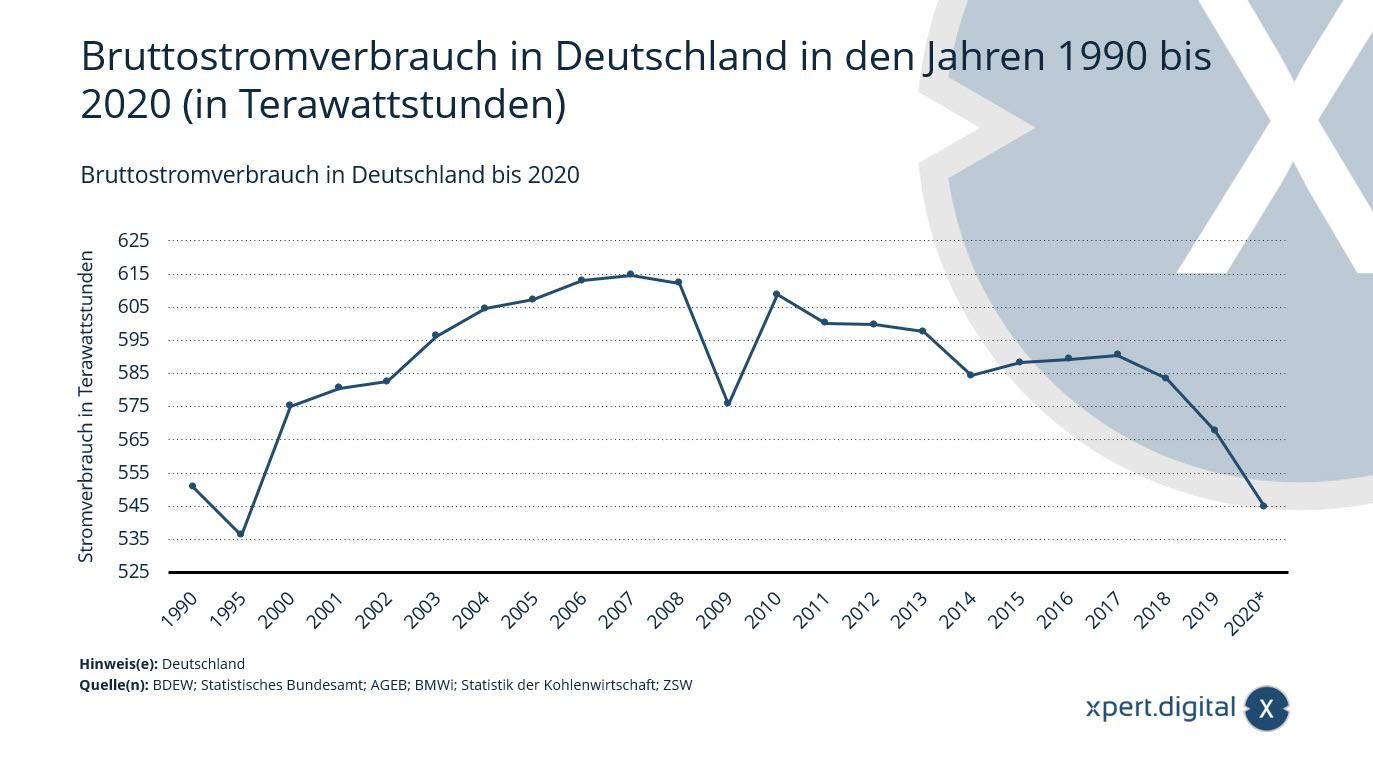
Gross electricity consumption in Germany
Gross electricity consumption in Germany – Image: Xpert.Digital
Gross electricity consumption in Germany in 2020 was around 545 terawatt hours. This means that consumption during the COVID-19 pandemic was below the level of 1990. Gross electricity consumption refers to the electrical energy used by consumers before deducting the power plants' own energy consumption and transmission and grid losses.
Global electricity consumption
Global electricity consumption is steadily increasing. While it was 7,300 terawatt-hours in 1980, global consumption is now roughly three times higher. The industrial sector accounts for the largest share, followed by private households, businesses, and the public sector. Transportation represents a relatively small share of global electricity consumption.
Electricity supply in Germany
The number of companies in the electricity supply sector in Germany has been increasing since 1980. At the same time, however, the number of people employed in the electricity supply industry in the country has been steadily declining. Furthermore, the difference between electricity imports and exports to and from Germany has been widening over the years. Today, significantly more electricity is exported than imported into Germany.
Gross electricity consumption in Germany from 1990 to 2020 (in terawatt hours)
- 1990 – 550.7 terawatt hours
- 1995 – 536.2 terawatt hours
- 2000 – 575.1 terawatt hours
- 2001 – 580.6 terawatt hours
- 2002 – 582.6 terawatt hours
- 2003 – 596.2 terawatt hours
- 2004 – 604.5 terawatt hours
- 2005 – 607.3 terawatt hours
- 2006 – 613 terawatt hours
- 2007 – 614.6 terawatt hours
- 2008 – 612.2 terawatt hours
- 2009 – 575.7 terawatt hours
- 2010 – 608.8 terawatt hours
- 2011 – 600.2 terawatt hours
- 2012 – 599.7 terawatt hours
- 2013 – 597.7 terawatt hours
- 2014 – 584.3 terawatt hours
- 2015 – 588.3 terawatt hours
- 2016 – 589.3 terawatt hours
- 2017 – 590.5 terawatt hours
- 2018 – 583.4 terawatt hours
- 2019 – 567.6 terawatt hours
- 2020 – 544.9 terawatt hours
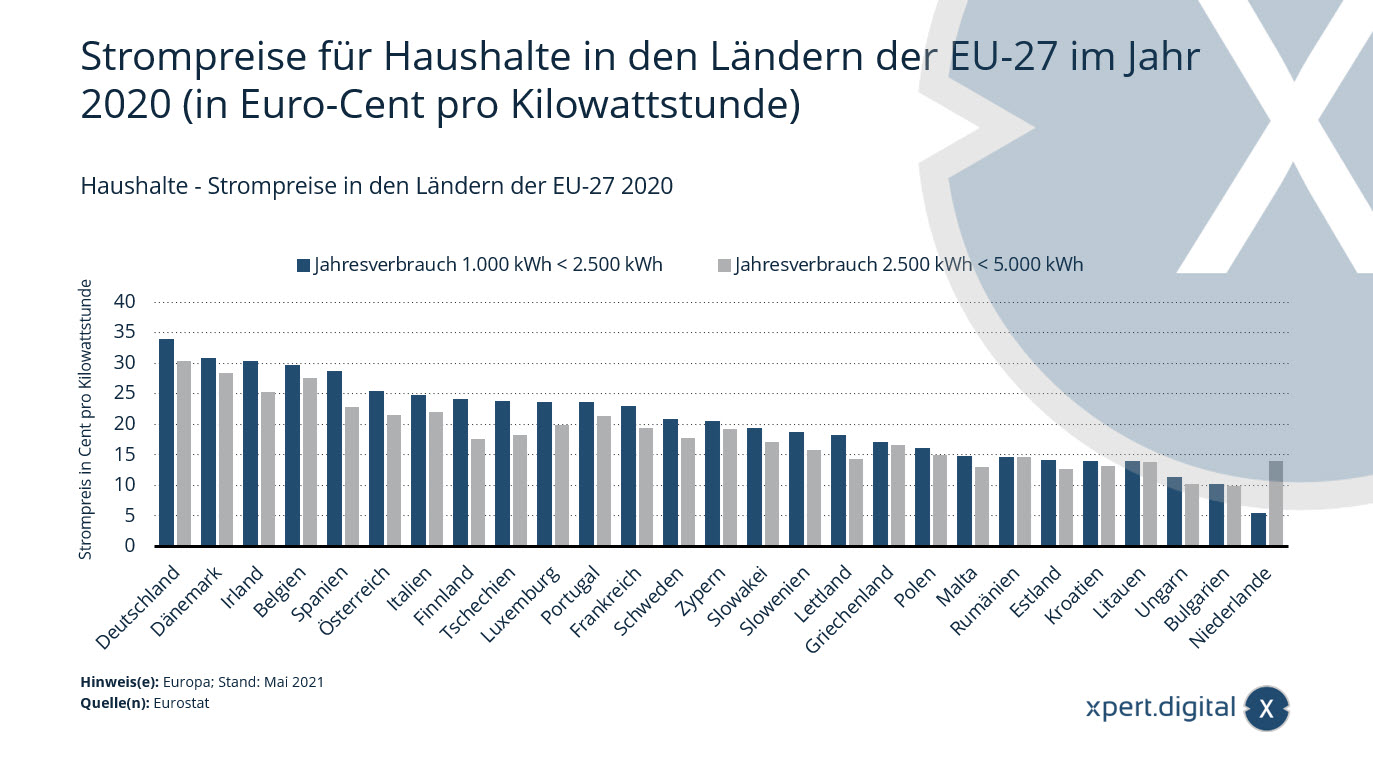
Households - Electricity prices in EU countries
Households – Electricity prices in EU countries – Image: Xpert.Digital
The statistic shows the electricity prices for household customers in the EU-27 countries in 2020. The electricity price for private households in Denmark in 2020 was approximately 28.26 cents per kilowatt hour for an annual consumption of 2,500 to 5,000 kilowatt hours.
Electricity prices* for households in the EU-27 countries in 2020 (in euro cents per kilowatt hour)
As of May 2021. Including all taxes. The figures are annual averages.
Annual consumption 1,000 kWh < 2,500 kWh
- Germany – 33.87 cents
- Denmark – 30.80 cents
- Ireland – 30.22 cents
- Belgium – 29.68 cents
- Spain – 28.64 cents
- Austria – 25.39 cents
- Italy – 24.69 cents
- Finland – 24.05 cents
- Czech Republic – 23.74 cents
- Luxembourg – 23.57 cents
- Portugal – 23.53 cents
- France – 22.84 cents
- Sweden – 20.77 cents
- Cyprus – 20.42 cents
- Slovakia – 19.29 cents
- Slovenia – 18.71 cents
- Latvia – 18.14 cents
- Greece – 17.02 cents
- Poland – 16.08 cents
- Malta – 14.75 cents
- Romania – 14.60 cents
- Estonia – 14 cents
- Croatia – 13.98 cents
- Lithuania – 13.97 cents
- Hungary – 11.29 cents
- Bulgaria – 10.19 cents
- Netherlands – 5.45 cents
Annual consumption 2,500 kWh < 5,000 kWh
- Germany – 30.25 cents
- Denmark – 28.26 cents
- Ireland – 25.15 cents
- Belgium – 27.47 cents
- Spain – 22.69 cents
- Austria – 21.39 cents
- Italy – 21.90 cents
- Finland – 17.57 cents
- Czech Republic – 18.18 cents
- Luxembourg – 19.86 cents
- Portugal – 21.27 cents
- France – 19.26 cents
- Sweden – 17.72 cents
- Cyprus – 19.16 cents
- Slovakia – 17.05 cents
- Slovenia – 15.71 cents
- Latvia – 14.26 cents
- Greece – 16.58 cents
- Poland – 14.93 cents
- Malta – 12.91 cents
- Romania – 14.54 cents
- Estonia – 12.64 cents
- Croatia – 13.04 cents
- Lithuania – 13.74 cents
- Hungary – 10.20 cents
- Bulgaria – 9.90 cents
- Netherlands – 13.94 cents
Electricity - German exports to other countries
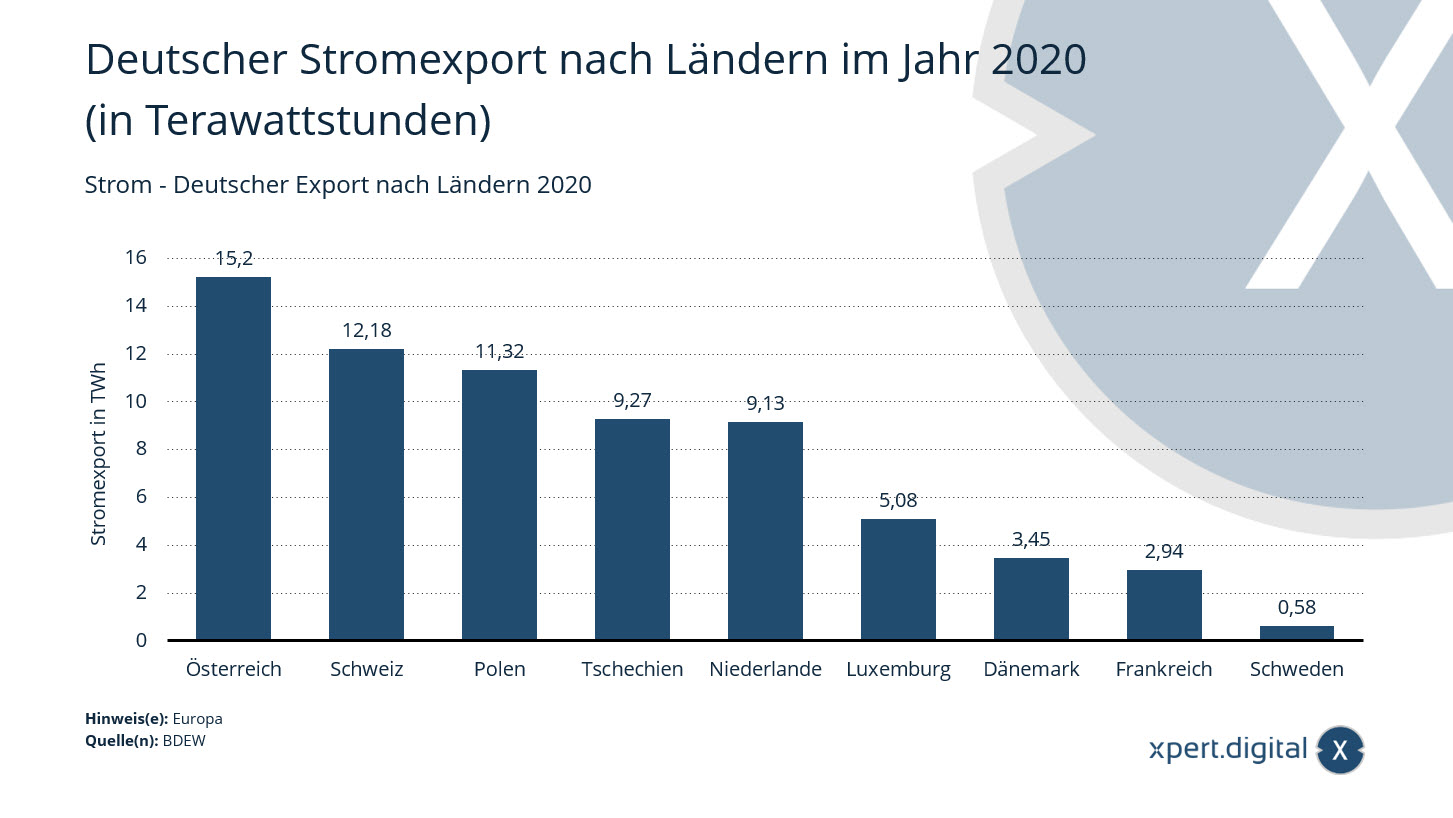
Electricity – German exports to countries – Image: Xpert.Digital
The statistic shows German electricity exports by country in 2020. In 2020, the physical electricity flow from Germany to the Polish grid amounted to approximately 11.3 billion kilowatt hours.
German electricity exports by country in 2020* (in terawatt hours)
- Austria – 15.20 terawatt hours
- Switzerland – 12.18 terawatt hours
- Poland – 11.32 terawatt hours
- Czech Republic – 9.27 terawatt hours
- Netherlands – 9.13 terawatt hours
- Luxembourg – 5.08 terawatt hours
- Denmark – 3.45 terawatt hours
- France – 2.94 terawatt hours
- Sweden – 0.58 terawatt hours
Photovoltaics: Solar heating with renewable energy

Heating with renewable energy? With photovoltaics? – Image: Xpert.Digital & Studio Harmony|Shutterstock.com
Over two-thirds of residential buildings constructed in 2020 are heated with renewable energy – Just over two-thirds (68.8%) of newly constructed residential buildings in Germany in 2020 are heated entirely or partially with renewable energy. As reported by the Federal Statistical Office (Destatis), this share increased slightly again compared to 2019 (67.2%). In 2015, it was 61.5%. For the first time in 2020, renewable energy was used as the primary energy source, i.e., the energy source predominantly used for heating, in more than half (50.5%) of the total 112,935 new residential buildings (2015: 38.0%).
Renewable energy sources for heating include heat pumps (geothermal or ambient heat), solar thermal energy, wood, biogas/biomethane, and other biomass. Conventional energy sources include oil, gas, and electricity. District heating represents another energy source that is not classified as either renewable or conventional in the statistics.
More information here:
Is waste incineration a renewable energy source?

EU: Waste incineration is renewable energy – Image: @shutterstock | DeawS – atabik yusuf djufni
Non-renewable energy can only be used once. It is a limited resource and not available indefinitely. This includes nuclear power. Nuclear power plants require enriched uranium, which must first be produced industrially. Depleted uranium is produced as a waste product. What happens to this waste, as well as to the fission products generated during nuclear fission—that is, highly toxic radioactive waste—is another matter. In contrast, fossil fuels cause environmental pollution and global warming through the release of greenhouse gases.
Up to this point, everything is logically comprehensible: Renewable energy is available in unlimited quantities and does not harm the environment.
More information here:
The most popular electric car worldwide

Which is the most popular electric car worldwide? – Image: TierneyMJ|Shutterstock.com
Electric cars are becoming increasingly popular among German drivers. While gasoline and diesel vehicles still lead in absolute numbers, registrations for both types of engines have declined noticeably this year, as this graphic shows. One reason for this trend is likely the purchase incentives currently offered by the federal government and manufacturers. According to a forecast, the share of combustion engines in total automotive engine production is expected to decrease significantly by 2030. By that year, only five percent of cars produced are projected to have a diesel engine, and 47 percent a gasoline engine.
More information here:
What is the demand for electric cars?

Demand for electric cars is rising, production is increasing – Image: Alexander Limbach|Shutterstock.com
Roughly one in five cars that rolled off the assembly line in Germany last March was an electric vehicle. As the graphic, based on data from the German Association of the Automotive Industry (VDA), shows, the share of electric cars in total production volume has recently increased significantly. Back in March 2019, it was just 3.3 percent, with around 15,000 electric cars produced. The graphic also shows that overall car production in Germany has recovered considerably after the slump in 2020. However, in March 2021, it was still around 16 percent below the total production volume of March 2019.
More information here:

- Warehouses, production halls and industrial buildings with their own power source from a rooftop photovoltaic system – Image: NavinTar|Shutterstock.com

- Industrial plant with its own power source from a ground-mounted photovoltaic system – Image: Peteri|Shutterstock.com

- Planning solar power systems with photovoltaic solutions for freight forwarding companies and contract logistics
- B2B Solar Systems and Photovoltaic Solutions & Consulting
- Planning photovoltaics on warehouses, commercial buildings and industrial buildings
- Industrial plant: Planning a photovoltaic open-field system or open-area system
- Planning solar power systems with photovoltaic solutions for freight forwarding companies and contract logistics
- B2B Solar Systems and Photovoltaic Solutions & Consulting
Photovoltaic system solutions: Xpert.Solar for planning and consulting in the area of solar carports, solar systems on roofs and photovoltaic systems in general for Dormagen, Grevenbroich, Herten and Bergheim

Konrad Wolfenstein
I would be happy to serve as your personal advisor.
You can contact me by filling out the contact form below or simply call me on +49 7348 4088 965 .
I'm looking forward to our joint project.
Write to me

Xpert.Digital – Konrad Wolfenstein
Xpert.Digital is a hub for industry focusing on digitalization, mechanical engineering, logistics/intralogistics and photovoltaics.
With our 360° Business Development solution, we support renowned companies from new business to after-sales.
Market intelligence, smarketing, marketing automation, content development, PR, mail campaigns, personalized social media and lead nurturing are part of our digital tools.
You can find more information at: www.xpert.digital – www.xpert.solar – www.xpert.plus
Keep in touch









