
Looking for a parking space roof with solar/photovoltaics: building a solar carport or planning a system in Paderborn, Bottrop, Bergisch Gladbach or Recklinghausen?

Available in 27 languages 📢
Prefer Xpert.Digital on GoogleⓘPublished on: October 13, 2021 / update from: October 13, 2021 - Author: Konrad Wolfenstein
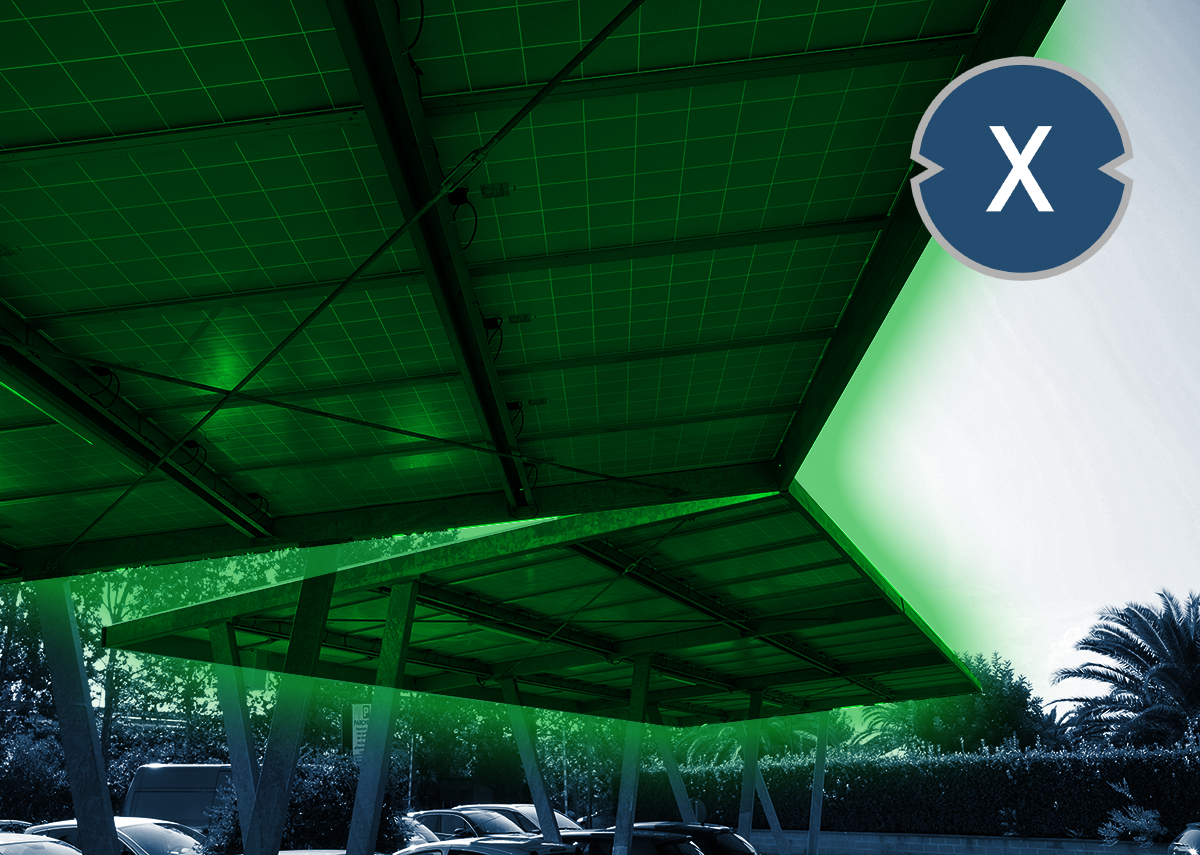
Solar parking lot roofing for a variety of applications – Image: Xpert.Digital / robypangy|Shutterstock.com
Optimum use of sealed areas with solar carports
The solar potential is practically on the street. More specifically, on the sealed parking spaces and open parking spaces for street vehicles. With the possibility of generating electricity from solar energy, the mostly ugly and previously one-sidedly usable soil seals now have an important function in relieving the burden on the environment and nature. The solar roof offers another option for protection from the weather, which helps extend the life of the vehicles. With the addition of charging stations, another convenient addition is optionally possible: decentralized charging/refueling of electric vehicles, which will have a noticeable impact on driving behavior in just a few years and will help reduce the burden on road traffic.
Our solar carport solutions for covering open parking areas are modular and scalable:
- Quick and easy assembly
- Individually customizable design (color, materials, surface, size, etc.)
- Installation of charging stations and inverters is possible at any time
- Scalable & modular: Available as a single, double or arbitrarily scalable row carport
- Even the standard version can be used for very high wind and snow loads
📣 Open parking areas Photovoltaic solutions for industry, retail and municipalities
Everything from a single source, specially designed for solar solutions for large parking areas. You refinance or counterfinance into the future with your own electricity generation.
🎯 For solar engineers, plumbers, electricians and roofers
Advice and planning including a non-binding cost estimate. We bring you together with strong photovoltaic partners.
👨🏻 👩🏻 👴🏻 👵🏻 For private households
We are positioned across regions in German-speaking countries. We have reliable partners who advise you and implement your wishes.
With over 1,000 specialist articles, we cannot present all topics here. Therefore, you will find a small excerpt from our work here and we would be pleased if we have piqued your interest in getting to know us better:
Our solar PDF library

Photovoltaic Library (PDF) – Image: Xpert.Digital / Benvenuto Cellini|Shutterstock.com
Large PDF library: Market monitoring and market intelligence on the subject of photovoltaics.
Data is viewed at regular intervals and checked for relevance. This usually brings together some interesting information and documentation, which we combine into a PDF presentation: our own data analyzes and marketing intelligence as well as external market observations.
More about it here:
Development of industrial electricity prices in Germany

Development of industrial electricity prices in Germany – Image: Xpert.Digital
Index on the development of industrial electricity prices in Germany from 1998 to 2021 (1998 = Index 100)
Forecast from 2021 to 2030 in various scenarios. The statistics shows the index for the development of the industrial electricity price in Germany from 1998 to 2021. Starting from 1998 (index value = 100), the index value for the development of the industrial electricity price in Germany in 2021 was 195 points.
The information refers to industry supplied by medium voltage with an annual electricity consumption of 160 to 20,000 megawatt hours.
Following decisions on the coal phase-out and the 2019 Climate Protection Act, electricity prices are expected to rise by around 40% by 2030.
Industry - electricity price (including electricity tax) in Germany until 2021
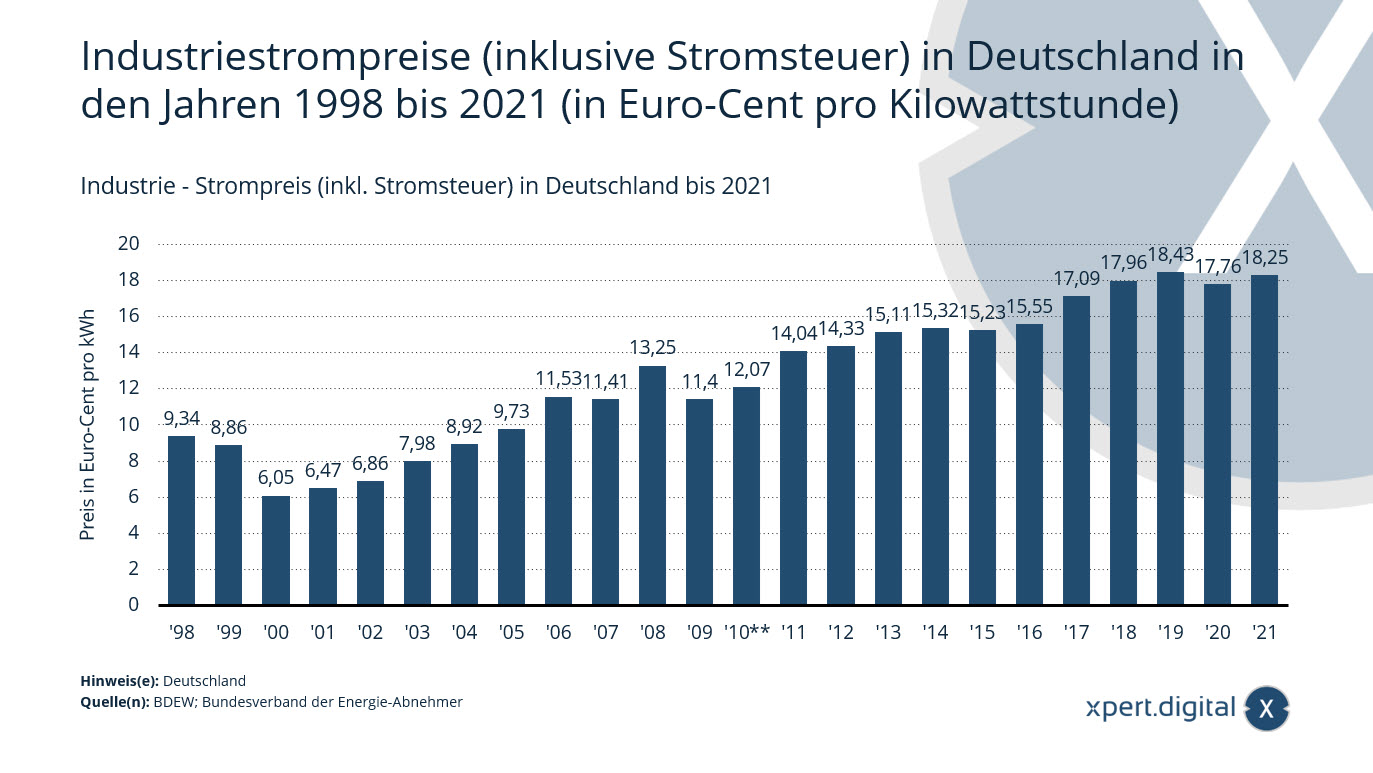
Industry – Electricity price (including electricity tax) in Germany until 2021 – Image: Xpert.Digital
Electricity price including taxes for industrial consumers. Industrial electricity prices* (including electricity tax) in Germany from 1998 to 2021 (in euro cents per kilowatt hour)
The industrial electricity price including electricity tax in Germany was 18.25 cents per kilowatt hour in 2021. The index for the development of industrial electricity prices in Germany also shows that electricity prices have risen significantly in recent years. However, if the prices are considered without taxes imposed, a decline can be seen in this country.
Composition of the industrial electricity price
The German industrial electricity price including taxes is made up of various items. The item “Procurement, network fees and sales” takes up the largest share, followed by the EEG levy, through which the expansion of renewable energies in Germany is financed. With an annual electricity consumption of 500 to 2,000 megawatt hours, the price for industrial electricity, excluding taxes, was highest in Europe in the Republic of Malta, Ireland and Cyprus. Germany was in twelfth place among European countries in terms of industrial electricity prices.
Household electricity prices
However, when it comes to electricity prices for household customers with an annual consumption of 1,000 to 2,500 kilowatt hours, Germany was one of the countries with the highest electricity prices in an EU comparison. Electricity was cheapest for households in the European Union in Bulgaria, Hungary and Lithuania. In this country, the prices mentioned have tended to rise since 2007. As in industry, the price was mainly made up of the items network fees, procurement and sales as well as the EEG surcharge.
Industry - Composition of electricity prices in Germany 2021
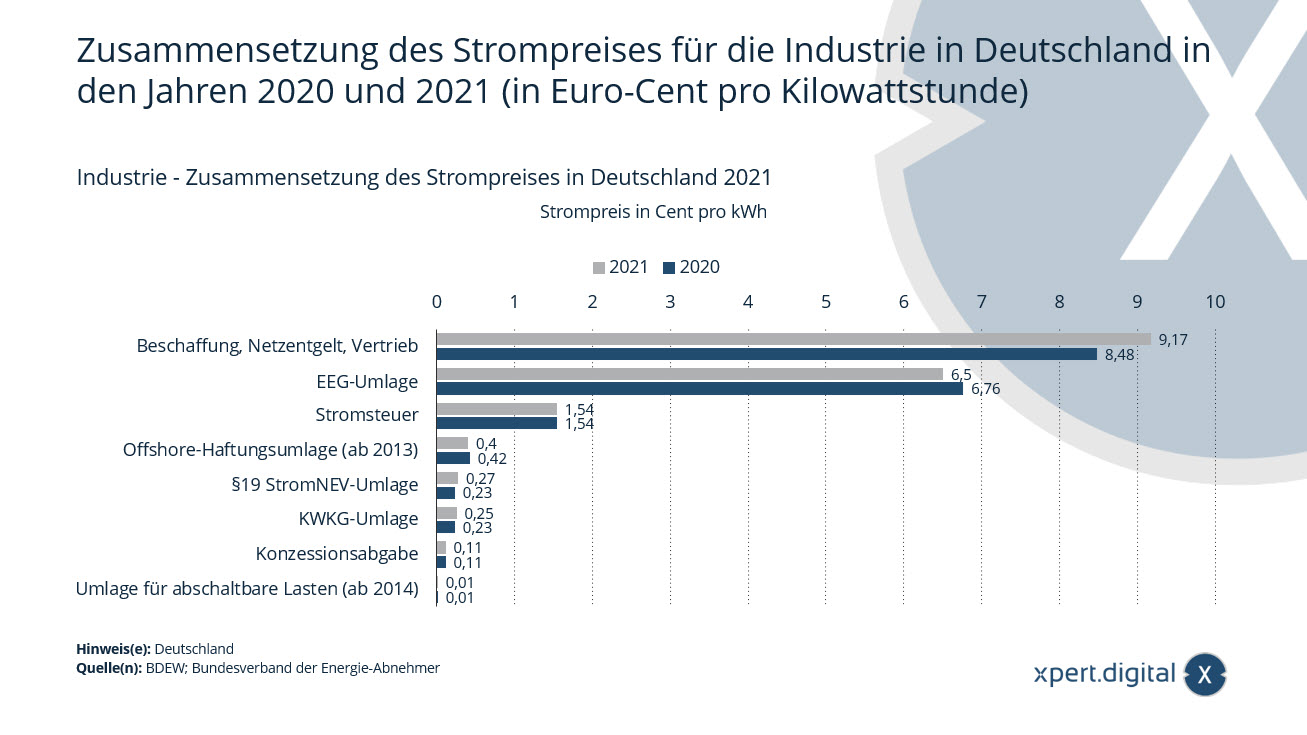
Industry - Composition of the electricity price in Germany 2021 - Image: Xpert.Digital
Industrial companies supplied on the medium voltage side (acquisition from 100 kW/1,600 h to 4,000 kW/5,000 h); Annual consumption 160 to 20,000 megawatt hours. The Compensation Mechanism Ordinance will apply from 2010. Some values have been rounded.
The statistics show the composition of the electricity price for industry in Germany in 2020 and 2021. In 2021, the electricity tax for an industrial company in Germany supplied by medium voltage was 1.54 cents per kilowatt hour.
Composition of the electricity price for industry in Germany from 2017 to 2021 (in euro cents per kilowatt hour)
Industry – composition of the electricity price in Germany 2021
- Procurement, network fees, sales – 9.17 cents per kilowatt hour
- EEG levy – 6.50 cents per kilowatt hour
- Electricity tax – 1.54 cents per kilowatt hour
- Offshore liability levy (from 2013) – 0.40 cents per kilowatt hour
- §19 StromNEV levy – 0.27 cents per kilowatt hour
- CHP levy – 0.25 cents per kilowatt hour
- Concession fee – 0.11 cents per kilowatt hour
- Surcharge for loads that can be switched off (from 2014) – 0.01 cents per kilowatt hour
Industry – composition of the electricity price in Germany 2020
- Procurement, network fees, sales – 8.48 cents per kilowatt hour
- EEG levy – 6.76 cents per kilowatt hour
- Electricity tax – 1.54 cents per kilowatt hour
- Offshore liability levy (from 2013) – 0.42 cents per kilowatt hour
- §19 StromNEV levy – 0.23 cents per kilowatt hour
- CHP levy – 0.23 cents per kilowatt hour
- Concession fee – 0.11 cents per kilowatt hour
- Surcharge for loads that can be switched off (from 2014) – 0.01 cents per kilowatt hour
Industry – composition of the electricity price in Germany 2019
- Procurement, network fees, sales – 9.48 cents per kilowatt hour
- EEG levy – 6.41 cents per kilowatt hour
- Electricity tax – 1.54 cents per kilowatt hour
- Offshore liability levy (from 2013) – 0.42 cents per kilowatt hour
- §19 StromNEV levy – 0.20 cents per kilowatt hour
- CHP levy – 0.28 cents per kilowatt hour
- Concession fee – 0.11 cents per kilowatt hour
- Surcharge for loads that can be switched off (from 2014) – 0.01 cents per kilowatt hour
Industry – composition of the electricity price in Germany 2018
- Procurement, network fees, sales – 8.97 cents per kilowatt hour
- EEG levy – 6.79 cents per kilowatt hour
- Electricity tax – 1.54 cents per kilowatt hour
- Offshore liability levy (from 2013) – 0.04 cents per kilowatt hour
- §19 StromNEV levy – 0.24 cents per kilowatt hour
- CHP levy – 0.26 cents per kilowatt hour
- Concession fee – 0.11 cents per kilowatt hour
- Surcharge for loads that can be switched off (from 2014) – 0.01 cents per kilowatt hour
Industry – composition of the electricity price in Germany 2017
- Procurement, network fees, sales – 8.02 cents per kilowatt hour
- EEG levy – 6.88 cents per kilowatt hour
- Electricity tax – 1.54 cents per kilowatt hour
- Offshore liability levy (from 2013) – 0 cents per kilowatt hour
- §19 StromNEV levy – 0.25 cents per kilowatt hour
- CHP levy – 0.29 cents per kilowatt hour
- Concession fee – 0.11 cents per kilowatt hour
- Surcharge for loads that can be switched off (from 2014) – 0 cents per kilowatt hour
How is solar energy developing, especially in Europe?

Photovoltaics and electromobility worldwide – Image: m.mphoto|Shutterstock.com
A look at Europe shows that solar energy is not only booming in Germany. According to the industry association Solarpower Europe, new photovoltaic systems with an output of around 16.7 gigawatts (GW) were installed there last year. Compared to 2018, this corresponds to an increase of a whopping 104 percent.
The association's figures also show that sun-drenched Spain was the front runner with 4.7 GW realized. Germany follows closely behind, reaching an impressive 4.0 GW in 2019. Both countries have very ambitious goals. Spain wants to increase the share of renewable energy in electricity generation to 74 percent by 2030, while Germany is aiming for 65 percent.
Walburga Hemetsberger, CEO of SolarPower Europe: “Solar energy in the European Union is flourishing. We have entered a new era of solar growth, with more new solar capacity installed in 2019 than any other power generation technology. This installation boom shows that solar energy in Europe is on the right track and with bold climate leadership from the new Commission, solar energy can help make the European Green Deal a reality.”
More about it here:
Power shortage soon?

Power gap soon – Image: ESB Professional|Shutterstock.com
The pace of photovoltaic expansion must be multiplied, otherwise there is a risk of a power gap in 2023. Against the background of the latest social, economic and political developments, the Bonn-based market and economic research company EUPD Research updated a study carried out last autumn in cooperation with the German Solar Industry Association and the innovation platform The smarter E.
Market researchers warn of an electricity generation gap due to slow expansion of renewable energy (renewable energies) with a simultaneous phase-out of nuclear power and coal - 46 terawatt hours are already missing in 2023 - tripling the pace of photovoltaic expansion can prevent a power gap - BSW: Adjust the government's expansion targets upwards and solar market barriers remove
Bonn researchers warn that a gap in the German electricity supply could arise as early as 2023. Only if the current pace of photovoltaic expansion is doubled from 2021 and tripled from 2022 can security of supply be guaranteed and the climate goals achieved.
As an impact of the economic crisis caused by the corona pandemic, market researchers at EuPD Research predict a decline in net electricity demand of four percent to just under 500 terawatt hours (TWh) in 2020. However, forecasts for economic recovery suggest that the economy's electricity consumption will rise as early as 2021.
More about it here:
CO2 neutrality with photovoltaics?

CO2 neutrality with photovoltaics – Photo: Wetzkaz Graphics|shutterstock
Competitiveness and conquering market shares come at a price. Therefore, Amazon leaves nothing to chance. Not only is Amazon the leader in research spending, it is also investing in expanding its robotics. Not only is robotics faster and more powerful, it is also less error-prone and more reliable. The idea behind it: The higher the share of automation through robotics, the lower the share of its personnel costs and the lower the advantages of cheaply available labor.
Amazon has also made impressive progress in the area of photovoltaics, increasing from zero to almost 330 megawatts of energy output in just five years. A 45 MW solar farm will be completed in Virginia this year and is expected to deliver 100,000 megawatts of clean electricity annually. Solar farms are currently planned in Seville (Spain) with 149 MW, in Lee County, Illinois (100 MW) and in Northern Virginia (80 MW).
In the US, Amazon ranked first in 2018 for the number of solar systems installed and second for the total number of solar systems installed to date.
Amazon now has 70 renewable energy projects worldwide (21 wind and solar farms and 50 solar systems on logistics centers), with an estimated total capacity of 1,900 MW, providing 5.3 million megawatt hours (MWH) of climate-neutral electricity annually.
More about it here:
Was there actually a record share of renewable energy of 55.8 percent in 2020?

Record share – renewable energy management – Image: ConceptCafe|Shutterstock.com
Net electricity generation in the first half of 2020: On July 1st, the Fraunhofer Institute for Solar Energy Systems ISE presented the data on public net electricity generation for the first half of 2020, which comes from the Energy Charts data platform. With a share of 55.8 percent of net electricity generation for public electricity generation - i.e. the electricity mix that comes from the socket - renewable energies set a new record. In February their share was even 61.8 percent. Solar and wind energy systems together fed 102.9 terawatt hours (TWh) into the public grid, compared to 92.3 TWh in the first half of 2019. Electricity production from coal, on the other hand, fell sharply: the share of lignite fell to 13.7 percent, hard coal only comes to 6 percent. Wind energy was once again the strongest energy source with a share of 30.6 percent.
More about it here:

- Warehouses, production halls and industrial halls with their own power source from a photovoltaic roof system - Image: NavinTar|Shutterstock.com

- Industrial plant with its own power source from an outdoor photovoltaic system - Image: Peteri|Shutterstock.com

- Plan solar systems with photovoltaic solutions for freight forwarding and contract logistics

- B2B solar systems and photovoltaic solutions & advice

- Plan photovoltaics for warehouses, commercial halls and industrial halls
- Industrial plant: Plan a photovoltaic open-air system or open-space system
- Plan solar systems with photovoltaic solutions for freight forwarding and contract logistics
- B2B solar systems and photovoltaic solutions & advice
Solar system solutions: Xpert.Solar for planning and consulting in the area of solar carports, solar systems on roofs and photovoltaic systems in general for Paderborn, Bottrop, Bergisch Gladbach and Recklinghausen

Konrad Wolfenstein
I would be happy to serve as your personal advisor.
You can contact me by filling out the contact form below or simply call me on +49 7348 4088 965 .
I'm looking forward to our joint project.
Write to me

Xpert.Digital – Konrad Wolfenstein
Xpert.Digital is a hub for industry with a focus on digitalization, mechanical engineering, logistics/intralogistics and photovoltaics.
With our 360° business development solution, we support well-known companies from new business to after sales.
Market intelligence, smarketing, marketing automation, content development, PR, mail campaigns, personalized social media and lead nurturing are part of our digital tools.
You can find out more at: www.xpert.digital – www.xpert.solar – www.xpert.plus
Keep in touch










