
Looking for a solar system for a parking space: build a solar carport or plan a system in Lippstadt, Dinslaken, Kerpen or Herford?

Available in 27 languages 📢
Prefer Xpert.Digital on GoogleⓘPublished on: October 19, 2021 / update from: October 19, 2021 - Author: Konrad Wolfenstein
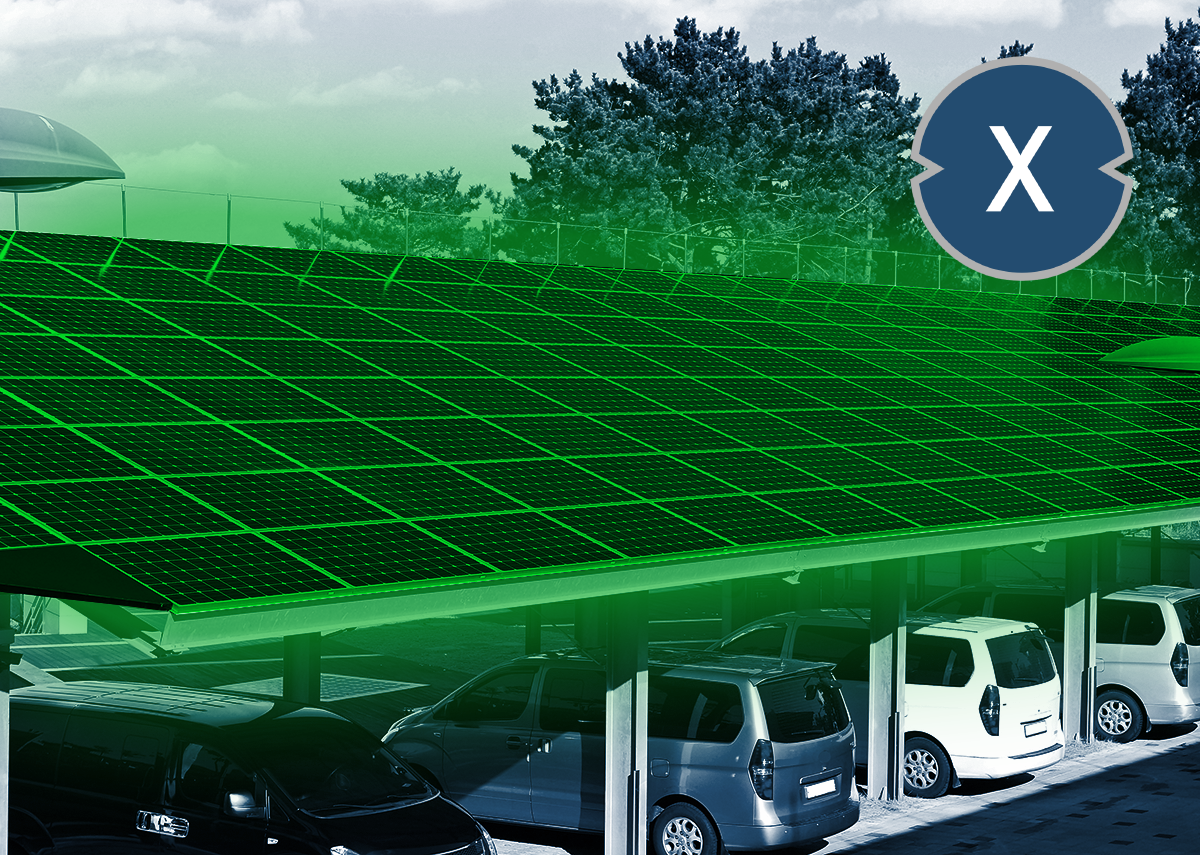
Solar system parking lot – solar carport – Image: Xpert.Digital / seo byeong gon|Shutterstock.com
“Solar carports sunbathe powerful electricity”
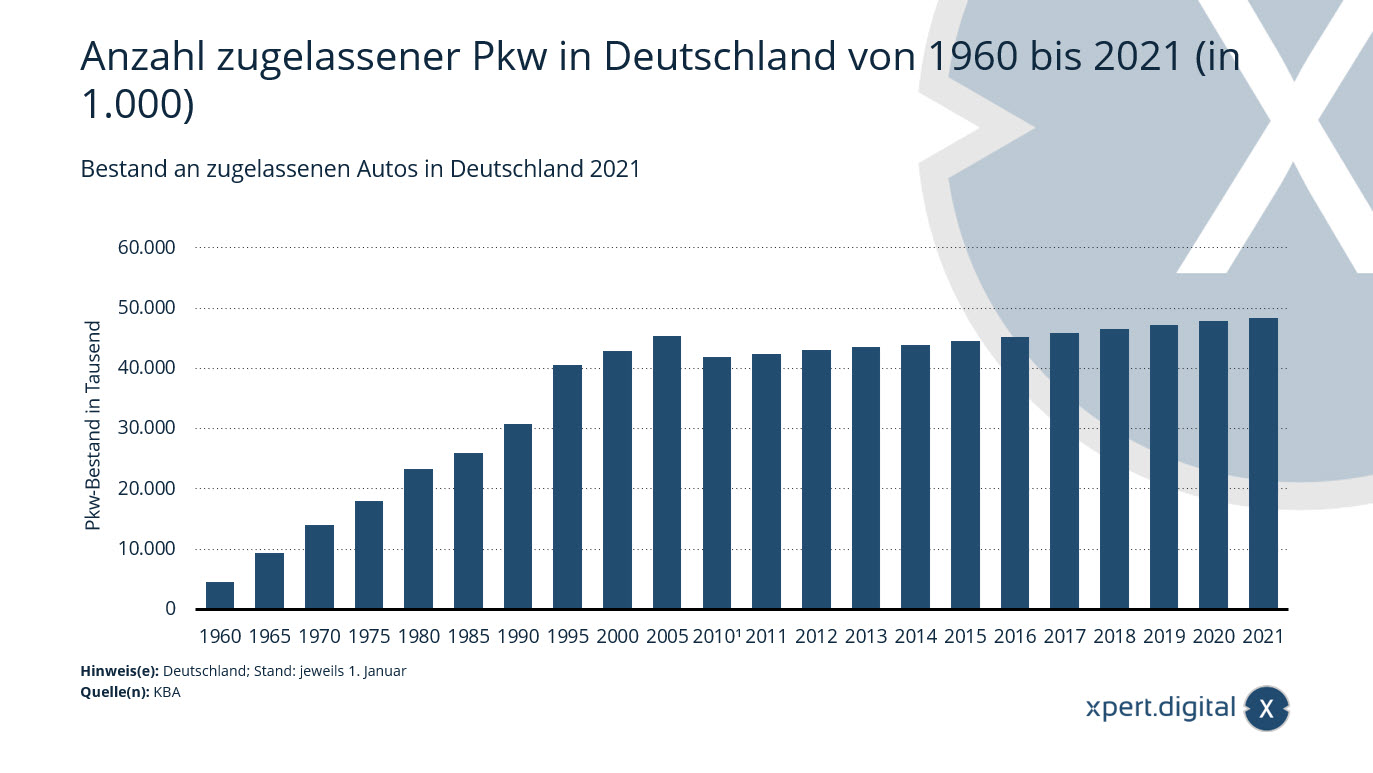
Over the decades, a huge number of parking spaces have been built to meet the growing market for means of transport. In 1960 there was a comparatively manageable number of just under 4.5 million registered cars. In 2021, 61 years later, a new record was set with well over 48 million registered cars. In addition to the expansion of the transport network, the expansion of open parking spaces was also promoted. Most of these sealed areas are used for just one purpose: parking.
This is, so to speak, the solar potential for switching from vehicles with combustion engines to electric vehicles. The government's planned switch from 48 million registered cars to electric vehicles should not be completed in the next 61 years, but in the next 10 to 15 years!
This change will not be possible with solar carports alone.
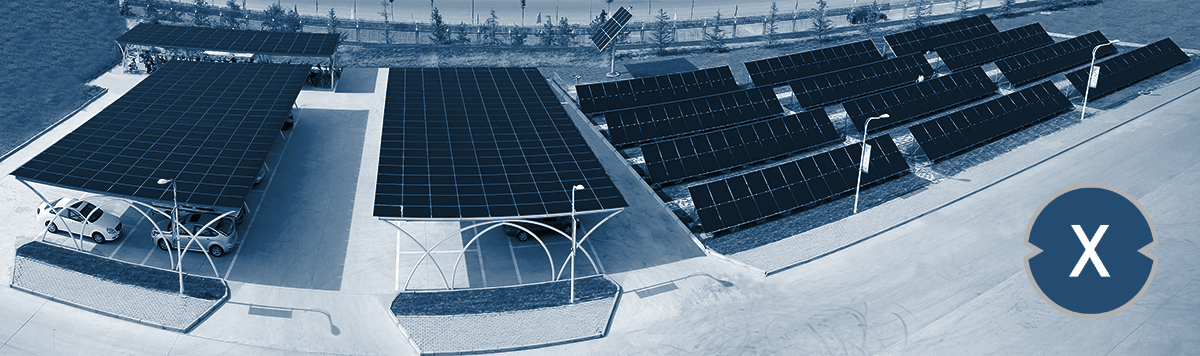
Xpert – your solar carport and open space system expert
Ground-mounted systems and rooftop solar systems will also make their contribution to this.
The electricity, in turn, can be used in a variety of ways. Either through the optional provision of charging stations, for households or other uses. The use of electricity storage is also possible to avoid sun-free times such as. B. to bridge the gap at night.
Solar carports are available in different sizes and for all requirements. Single carports, double carports and from row carports to double row carports. For large covered solar parking spaces, for example, it is important that they are stable and durable. Require little maintenance and, in the worst case scenario, will not fail until completely repaired in every collision.
On the other hand, there are also other requirements for solar carports that must be designed to be representative. Be it for municipalities, hotels or for events and events. Transparent glass-glass solar modules for a solar carport are the ideal solution.

Aesthetic solar carport system with transparent solar modules
Our solar carport solutions for covering open parking areas are modular and scalable:
- Quick and easy assembly
- Individually customizable design (color, materials, surface, size, etc.)
- Installation of charging stations and inverters is possible at any time
- Scalable & modular: Available as a single, double or arbitrarily scalable row carport
- Even the standard version can be used for very high wind and snow loads
- ... and much more
📣 Open parking areas Photovoltaic solutions for industry, retail and municipalities
Everything from a single source, specially designed for solar solutions for large parking areas. You refinance or counterfinance into the future with your own electricity generation.
🎯 For solar engineers, plumbers, electricians and roofers
Advice and planning including a non-binding cost estimate. We bring you together with strong photovoltaic partners.
👨🏻 👩🏻 👴🏻 👵🏻 For private households
We are positioned across regions in German-speaking countries. We have reliable partners who advise you and implement your wishes.
With over 1,000 specialist articles, we cannot present all topics here. Therefore, you will find a small excerpt from our work here and we would be pleased if we have piqued your interest in getting to know us better:
Our solar PDF library

Photovoltaic Library (PDF) – Image: Xpert.Digital / Benvenuto Cellini|Shutterstock.com
Large PDF library: Market monitoring and market intelligence on the subject of photovoltaics.
Data is viewed at regular intervals and checked for relevance. This usually brings together some interesting information and documentation, which we combine into a PDF presentation: our own data analyzes and marketing intelligence as well as external market observations.
More about it here:
Stock of registered cars in Germany
Stock of registered cars in Germany – Image: Xpert.Digital
Record number of passenger cars in Germany - the number of cars registered in the Federal Republic reached the highest value ever on January 1, 2021, at around 48.25 million vehicles. The number of cars has increased continuously since 2008. Since 2008, only registered vehicles have been taken into account in the statistics on the number of passenger cars. Vehicles that have been parked in the meantime are excluded from the statistics.
Gasoline cars are the most common
If you look at the number of cars in Germany by fuel type, vehicles with gasoline engines make up the largest group. The second most common type of drive for cars in Germany is diesel. Alternative forms of drive, such as electromobility, hybrid drives or autogas play a rather marginal role in the drive mix in Germany.
Germans trust local brands
If the registered cars are considered by brand, German automobile brands occupy the top positions. Of the top six brands in this area, five come from Germany. Only Ford, in fourth place in the ranking, is an American automobile brand. The inventory of Volkswagen vehicles is particularly large. In Germany at the beginning of 2021 there were almost twice as many cars from VW as from the second-place brand Mercedes.
Number of registered cars in Germany from 1960 to 2021
- 1960 – 4,489,000 registered cars
- 1965 – 9,267,000 registered cars
- 1970 – 13,941,000 registered cars
- 1975 – 17,898,000 registered cars
- 1980 – 23,192,000 registered cars
- 1985 – 25,845,000 registered cars
- 1990 – 30,685,000 registered cars
- 1995 – 40,404,000 registered cars
- 2000 – 42,840,000 registered cars
- 2005 – 45,376,000 registered cars
- 2010¹ – 41,738,000 registered cars
- 2011 – 42,302,000 registered cars
- 2012 – 42,928,000 registered cars
- 2013 – 43,431,000 registered cars
- 2014 – 43,851,000 registered cars
- 2015 – 44,403,000 registered cars
- 2016 – 45,071,000 registered cars
- 2017 – 45,804,000 registered cars
- 2018 – 46,475,000 registered cars
- 2019 – 47,096,000 registered cars
- 2020 – 47,716,000 registered cars
- 2021 – 48,249,000 registered cars
¹ From 2008: Excluding temporarily deregistered vehicles
Values have been rounded for better understanding
Some of the older values were taken from previous year's publications
Households - electricity prices in Germany
Households – electricity prices in Germany – Image: Xpert.Digital
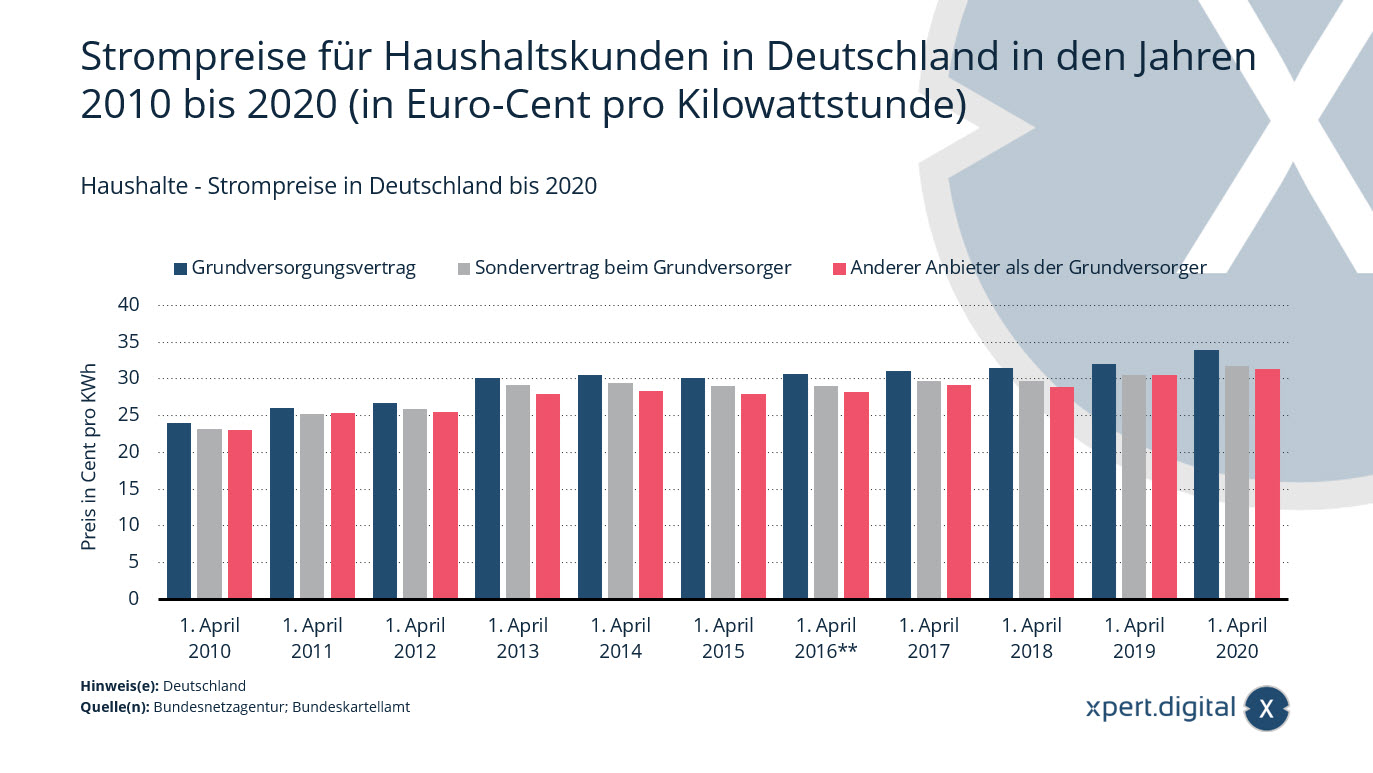
As of April 1, 2019, household customers in Germany paid an average of 33.8 cents per kilowatt hour of electricity in the basic supply tariff. As of 2016, the stated electricity prices correspond to an annual electricity purchase of between 2,500 and 5,000 kilowatt hours.
Electricity prices in a 3-person household
In a sample household with an electricity consumption of 3,500 kilowatt hours, three people in Germany paid an average of 91.50 euros per month for electricity (as of January 2020). The electricity price for private individuals was largely made up of the factors network fees, procurement & sales and the EEG surcharge. The latter finances the expansion of renewable energies in Germany.
Electricity prices in a country comparison
With an annual consumption of 2,500 to 5,000 kilowatt hours, Germany ranked first in the EU in terms of household electricity prices. Electricity was cheapest in Bulgarian households. Even in a global comparison, Germany was one of the countries with the highest electricity prices for households. Likewise, when looking at the index values for the development of household electricity prices, it becomes clear that electricity prices in Germany continue to rise.
Electricity prices* for household customers in Germany from 2010 to 2020 (in euro cents per kilowatt hour)
Quantity-weighted averages. Until 2015, electricity prices correspond to an annual electricity purchase of around 3,500 kilowatt hours. As of 2016, electricity prices correspond to an annual electricity purchase of between 2,500 and 5,000 kilowatt hours.
The values before 2020 were taken from the previous year's publications.
Electricity supply - number of companies in Germany
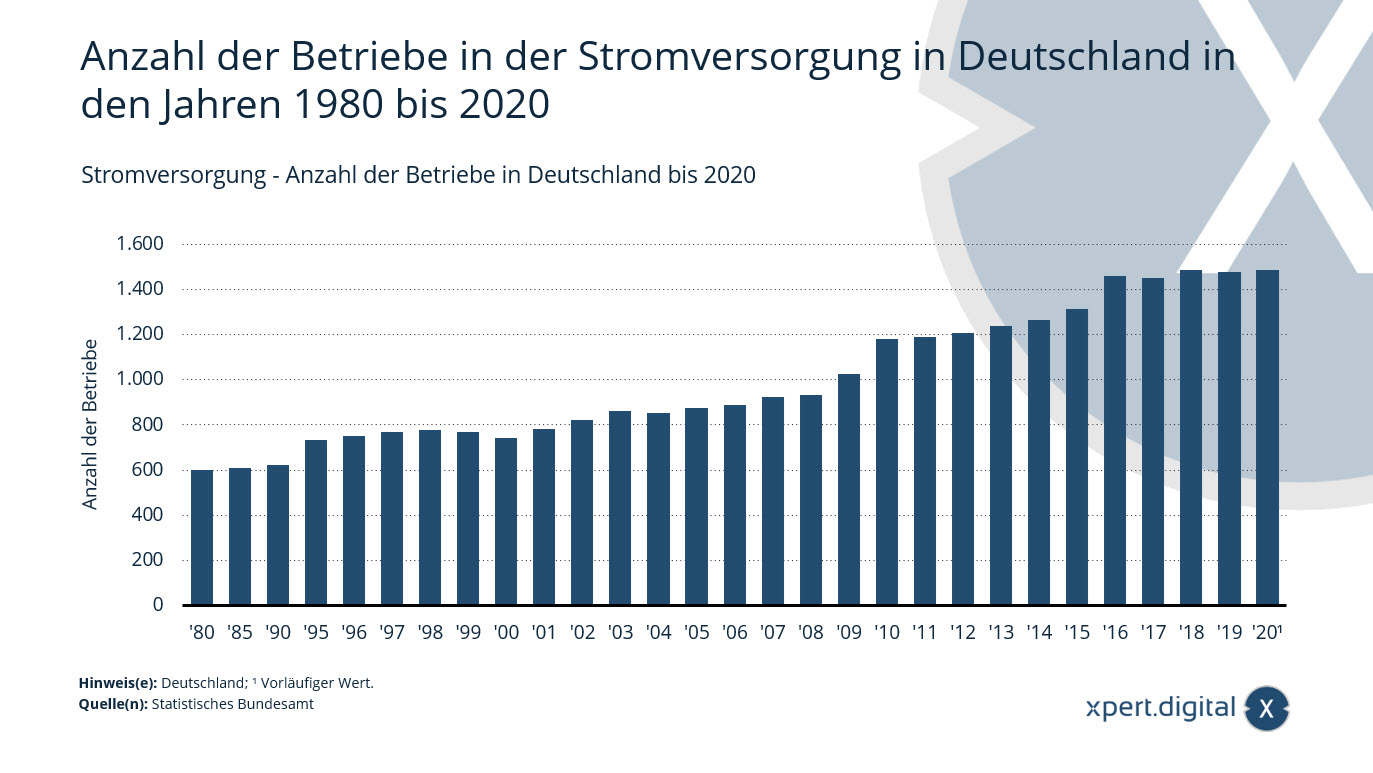
Power supply – number of companies in Germany – Image: Xpert.Digital
The statistics show the number of companies in the electricity supply sector in Germany from 1980 to 2020. In 2020, 1,485 companies were counted in Germany that are active in the electricity supply sector.
Number of companies in the electricity supply in Germany from 1980 to 2020
- 1980 – 600 electricity supply companies
- 1985 – 606 electricity supply companies
- 1990 – 619 electricity supply companies
- 1995 – 731 electricity supply companies
- 1996 – 747 electricity supply companies
- 1997 – 766 electricity supply companies
- 1998 – 774 electricity supply companies
- 1999 – 764 electricity supply companies
- 2000 – 740 electricity supply companies
- 2001 – 781 electricity supply companies
- 2002 – 819 electricity supply companies
- 2003 – 858 electricity supply companies
- 2004 – 851 electricity supply companies
- 2005 – 873 electricity supply companies
- 2006 – 886 electricity supply companies
- 2007 – 919 electricity supply companies
- 2008 – 929 electricity supply companies
- 2009 – 1022 electricity supply companies
- 2010 – 1176 electricity supply companies
- 2011 – 1186 electricity supply companies
- 2012 – 1205 electricity supply companies
- 2013 – 1235 electricity supply companies
- 2014 – 1263 electricity supply companies
- 2015 – 1309 electricity supply companies
- 2016 – 1459 electricity supply companies
- 2017 – 1446 electricity supply companies
- 2018 – 1485 electricity supply companies
- 2019 – 1474 electricity supply companies
- 2020¹ – 1485 electricity supply companies
¹ Preliminary value
The information refers to companies with 20 or more employees
Electromobility: Electricity consumption by consumer group in Germany
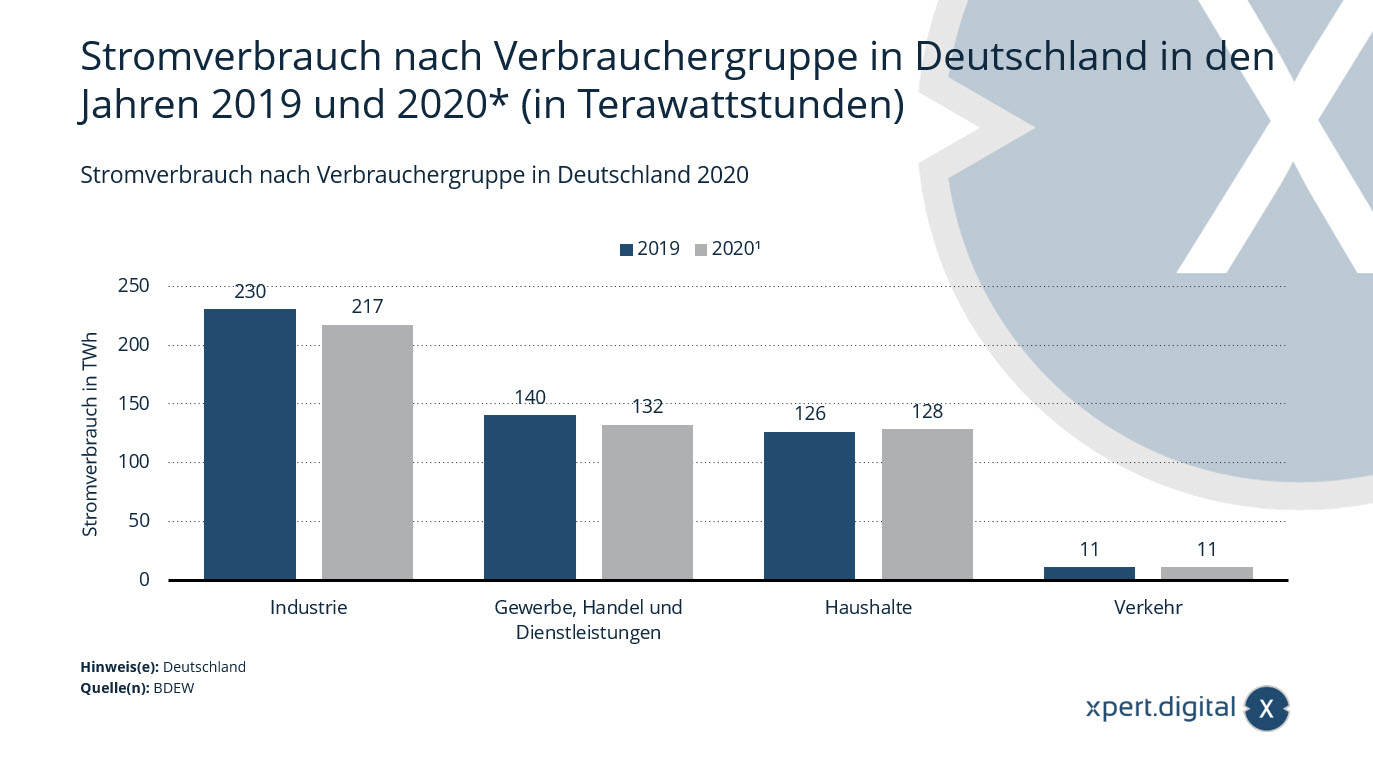
Electricity consumption by consumer group in Germany – Image: Xpert.Digital
The statistics show the net electricity consumption by consumer groups in Germany in 2019 and 2020. In 2020, according to preliminary information, German households consumed around 128 terawatt hours of electricity.
Electricity consumption by consumer group in Germany 2020¹
- Industry – 217 terawatt hours
- Business, trade and services – 132 terawatt hours
- Households – 128 terawatt hours
- Traffic – 11 terawatt hours
Electricity consumption by consumer group in Germany 2019
- Industry 230 terawatt hours
- Industry – 230 terawatt hours
- Business, trade and services – 140 terawatt hours
- Households – 126 terawatt hours
- Traffic – 11 terawatt hours
¹ Preliminary. As of February each year
The absolute values were calculated independently from the share values and rounded.
Electromobility: How is the charging infrastructure developing?

Charging infrastructure for electromobility – Image: BigPixel Photo|Shutterstock.com
In addition to heat and cold, petroleum is an important component for mobile transportation. Globally, transport accounts for 40% of oil consumption. In the EU it is even more than 60%! The Federal Institute for Geosciences and Natural Resources assumes that oil will be used up in 40 years if things continue as before.
For this reason alone, a timely rethink is necessary and continuing to compare the emissions of electric cars and combustion engines is not helpful. Electric cars run emission-free. Combustion engines are more environmentally and climate-friendly in their manufacture and production. The current Achilles heel of the electric car is battery production. Another weak point is currently the availability of charging points or charging stations.
However, while the ecological balance of combustion vehicles is almost exhausted, there is still a lot of potential optimization possible for electric vehicles. A life cycle assessment looks at the entire life cycle of a product, from raw material extraction and production through transport and use to disposal. With the expansion of renewable energies, the ecological balance of electric cars will improve and the lead for climate-friendly driving will expand.
More about it here:
How is electromobility developing?

Electromobility is coming slowly, but it is coming – Image Xpert.Digital, Roman Babakin|Shutterstock.com
In addition to renewable energies, electromobility is one of the central building blocks of the European energy transition. But China is miles ahead of the Europeans, with the number of electric cars in China amounting to over 5 million in 2020. That's almost three times as much as second place - the USA - in a global comparison. In China, an electric car quota came into force in spring 2019, banning the production of automobile models with high fuel consumption. Manufacturers are therefore obliged to maintain a percentage of alternative drives in the production and sales of their vehicles. In the electric car business, Chinese automobile manufacturers dominate the market in China. Foreign manufacturers are far behind. Many of the Chinese automobile manufacturers are still hardly known in the Western world.
More about it here:
How is the expansion of charging stations for electromobility going?

Smart car photovoltaics: charging station expansion is making (slow) progress – Image: Fahroni|Shutterstock.com
The expansion of fast and standard charging points for electrically powered cars in Germany is not keeping pace with the increasing number of new registrations. This is shown by the graphic based on data from the European Alternative Fuels Observatory. While there were six electric cars per charging point in 2018, in 2020 there are now 13 cars per charging point. The reason for this development is the sharp increase in registration numbers. As this graphic shows, the number of new registrations of electric cars in Germany reached a new record in 2020. As the Federal Motor Transport Authority (KBA) announced, there were 446,756 new registrations of cars with hybrid drives last year - almost 208,000 vehicles more than in the previous year. One reason for the positive trend in approvals of alternative drives is likely to be the purchase bonuses that are currently being granted by the federal government and manufacturers.
More about it here:
Digital Innovation Hub from the very beginning for photovoltaics

Digital Innovation Hub for logistics and photovoltaics – Image: Xpert.Digital & kentoh|Shutterstock.com
“Of course, the rapid technological change does not stop at the boundaries of logistics. That’s why we have decided to use Xpert.Digital to present exciting questions and solutions, regardless of the industry, that will accompany us in our everyday work in the future.”
With photovoltaics for industrial autonomous power supply. The bridge from industry to renewable energies such as photovoltaics is quickly built. In addition to the demands and obligation of politicians on the economy to increase the use of renewable energies, there are already numerous implementations in this direction.
More about it here:

- Warehouses, production halls and industrial halls with their own power source from a photovoltaic roof system - Image: NavinTar|Shutterstock.com

- Industrial plant with its own power source from an outdoor photovoltaic system - Image: Peteri|Shutterstock.com

- Plan solar systems with photovoltaic solutions for freight forwarding and contract logistics

- B2B solar systems and photovoltaic solutions & advice

- Plan photovoltaics for warehouses, commercial halls and industrial halls
- Industrial plant: Plan a photovoltaic open-air system or open-space system
- Plan solar systems with photovoltaic solutions for freight forwarding and contract logistics
- B2B solar systems and photovoltaic solutions & advice
Photovoltaic system solutions: Xpert.Solar for planning and consulting in the area of solar carports, solar systems on roofs and photovoltaic systems in general for Lippstadt, Dinslaken, Kerpen and Herford

Konrad Wolfenstein
I would be happy to serve as your personal advisor.
You can contact me by filling out the contact form below or simply call me on +49 7348 4088 965 .
I'm looking forward to our joint project.
Write to me

Xpert.Digital – Konrad Wolfenstein
Xpert.Digital is a hub for industry with a focus on digitalization, mechanical engineering, logistics/intralogistics and photovoltaics.
With our 360° business development solution, we support well-known companies from new business to after sales.
Market intelligence, smarketing, marketing automation, content development, PR, mail campaigns, personalized social media and lead nurturing are part of our digital tools.
You can find out more at: www.xpert.digital – www.xpert.solar – www.xpert.plus
Keep in touch










