
“Operational elasticity”: Up to 10,000 parts per hour – This robot system puts permanently installed sorters in the shade
Xpert Pre-Release

Available in 27 languages 📢
Prefer Xpert.Digital on GoogleⓘPublished on: June 7, 2026 / Updated on: June 7, 2026 – Author: Konrad Wolfenstein
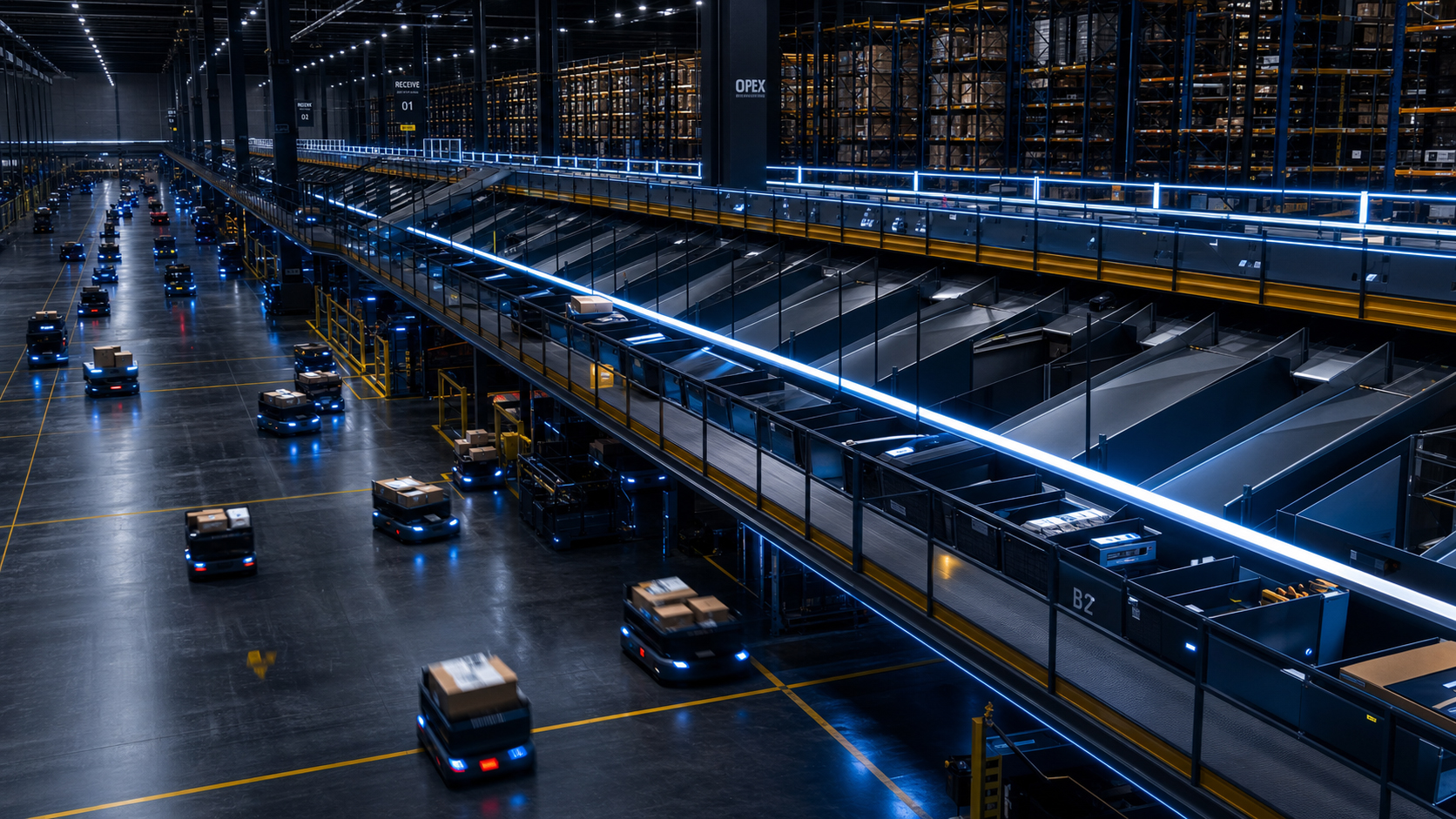
“Operational elasticity”: Up to 10,000 parts per hour – This robot system puts permanently installed sorters in the shade – Image: Xpert.Digital
The end of the classic sorter? How mobile robots are revolutionizing intralogistics
Why rigid conveyor technology is dying out – and what that means for billions in warehouse investments
Million-dollar trap conveyor belt: Why rigid sorting systems are becoming a risk today
Intralogistics is facing a massive paradigm shift. For years, fixed cross-belt conveyors and tilting tray sorters were the undisputed backbone of large fulfillment centers. But in an era of exploding product variety, unpredictable demand peaks, and rising energy and operating costs, this rigid infrastructure is increasingly becoming an economic burden. The reason? It lacks the most important characteristic of modern logistics: operational flexibility. Where conventional systems either run at expensive full capacity or, in the event of a breakdown, paralyze the entire warehouse, mobile robot swarms promise the much-needed solution. Systems like Daifuku's new SOTR series impressively demonstrate how intelligent robot swarms can replace rigid conveyor belts, minimize downtime risks, and adjust costs linearly to actual demand. This article delves into why the future of order picking and sorting no longer follows fixed paths but moves completely freely in space – and why investors must now radically reassess their logistics assets.
Mobile robotics in sorting and order picking
Why rigid conveyor technology is a dying breed – and what that means for billions in investments in intralogistics
Today's fulfillment centers face a structural contradiction: The demand for sorting and order picking capacity fluctuates more dramatically than ever before, while the dominant infrastructure – the rigid sorting conveyor – was designed for precisely the opposite: a consistent, predictable, continuous load. This gap between what operators need and what permanently installed systems can deliver is no longer a marginal phenomenon. It has become the core economic problem of modern distribution.
The Fulfillment Dilemma: When Complexity Outpaces Infrastructure
The structural drivers of this change can be precisely identified. First, SKU diversity is growing exponentially. What was once a single product now exists in dozens of variations – as a bundled product, promotional set, slightly modified version, or value-adding combination. Each of these variations occupies warehouse space, requires its own handling logic, and creates complexity in order consolidation. Amazon alone manages over 350 million active SKUs, according to industry estimates – a volume that conventional sorting technology simply cannot handle without incurring significant error rates or bottlenecks.
Secondly, order patterns have changed radically. Demand peaks, which were previously predictable seasonally, now occur with less warning and are more pronounced. In multi-tenant environments – i.e., in 3PL operations, shared warehouse concepts, or Amazon-like fulfillment networks – the order patterns of different customers overlap unpredictably. A facility that runs smoothly in the morning can be confronted with an order surge at midday that renders any static capacity planning obsolete. The fact that 59% of all 3PL warehouses are operating at more than 90% capacity illustrates just how small the buffers already are.
Thirdly, and most consequentially: Rising operating costs are making the current practice of overbuilding unsustainable. 72% of 3PL providers cite rising operating costs as their biggest challenge, and 49% see cost management as a key problem. Those who continue to rely on excess capacity in fixed infrastructure to cover peak demand in this situation are paying permanent standby costs for a service that is only needed sporadically.
The structural weakness of the classic sorter
A conventional cross-belt conveyor or tilting tray sorter is an engineering marvel – optimized for its specific task. Under consistently high loads, with a uniform product mix and stable operation, it delivers reproducibly high throughput. However, its inherent problem lies in its binary operating logic: the system either runs or it stops. There is no gradual adjustment to the actual load.
This has serious economic consequences. Because cross-belt conveyors must operate continuously regardless of the current sorting load, they consume the same amount of energy during periods of low load as under peak load. There is no partial load operation, no idle periods for individual conveyor sections, and no adaptive timing. Every kilowatt that is converted into motion and frictional heat during low utilization is wasted operating resources.
Added to this is the systemic risk factor. A single mechanical defect—a broken drive element, a jammed carrier, an overheated drive motor—can paralyze the entire sorting center. The economic consequences of such failures have been empirically documented: A leading US retailer lost more than $250,000 per location per year in direct downtime costs alone due to regular cross-belt failures—not including consequential losses from delayed deliveries or customer churn. This single point of failure is not a calculable residual risk; it is a structurally built-in system flaw that inevitably manifests itself after sufficiently long operating times.
Furthermore, the maintenance of conventional conveyor systems requires dedicated maintenance windows, which in practice typically have to be scheduled for nighttime hours to avoid disrupting daytime operations. This night-shift logic ties up personnel, drives up costs, and increasingly clashes with the trend toward 24/7 fulfillment operations. Retrofitting such systems into existing buildings costs 60 to 80% more than a greenfield installation, and even a single week of downtime for retrofit work is estimated to destroy $50,000 in throughput revenue.
Elasticity as a new performance promise of intralogistics
The answer to these structural weaknesses lies not in optimizing existing system architectures, but in a paradigm shift: away from the continuously operating conveyor belt and towards a demand-driven, mobile robot network. The crucial difference lies in the concept of operational elasticity – the ability of a system to scale its active capacity proportionally to the actual load without requiring modifications to permanently installed infrastructure or causing it to become permanently overloaded.
Mobile robot sorting systems achieve this flexibility through a simple yet economically effective mechanism: Each robot is an independent capacity unit. At low loads, units remain stationary or are selectively recharged while a core fleet handles the incoming orders. As the sorting workload increases, additional units are activated and integrated into the routing network. Total energy consumption rises proportionally to the actual work performed – not to the nominal system maximum. A typical LiBiao sorting robot, for example, consumes just 30 watts during operation – comparable to a small table lamp – thus enabling virtually linear scaling of energy consumption with workload.
This feature has far-reaching business consequences. Energy costs, which represent a relatively constant fixed cost for traditional sorters, become a variable that correlates with actual power consumption. For operators, this means not only direct energy savings during off-peak hours, but also significantly improved predictability of operating costs.
Daifukus SOTR-S: Technical performance dimensions of a new system approach
Based on this conceptual foundation, Daifuku – one of the world's leading providers of intralogistics solutions – has developed the Sorting Transfer Robot S (SOTR-S), a system that fully exploits the potential of mobile robotics architecture for small-item sorting. The technical specifications are remarkable: The system achieves travel speeds of up to 180 meters per minute and is capable of sorting up to 10,000 positions per hour – values that are fundamentally comparable to those of classic sorting technology, but are realized under fundamentally different structural conditions.
The two-level system layout is more than just a design detail. It solves the congestion problem that can occur with space-intensive robot fleets by organizing traffic flow on two independent levels. Vehicles on the upper and lower levels cannot block each other, enabling continuous throughput even at high vehicle densities. At the same time, the tilting tray technology significantly reduces aisle width, allowing the SOTR-S to operate with less than half the footprint of conventional sorting systems – a crucial advantage in a market where warehouse space costs are among the biggest cost drivers.
The operating logic is order-based rather than conveyor-based. Operators place individual items onto the robots, which then autonomously navigate to their assigned destinations. A higher-level Robot Traffic Controller (RTC) handles dynamic route assignment and coordinates the robotic system in real time. This architecture eliminates one of the most common stress factors in stationary conveyor technology: employees no longer have to throw items onto a conveyor belt moving at a constant speed, which reduces error rates and meets the ergonomic requirements of modern workplace design.
The European premiere of the SOTR-S and its sister models SOTR-M (container sorting) and SOTR-L (palletizing) at LogiMAT 2026 in Stuttgart signals that Daifuku is actively driving the serial market launch of the entire SOTR series in Europe and Great Britain. The platform architecture – three models for three load classes – thus addresses the entire weight spectrum from individual items to pallets and creates a comprehensive robotics solution for heterogeneous fulfillment environments.
Resilience mechanics: How distributed systems structurally resolve single points of failure
The perhaps underestimated economic advantage of mobile robot systems is not throughput, but distributed fault tolerance. In a stationary sorting system, system availability is a binary variable: either the system runs at full capacity, or it's down. Every maintenance measure, every malfunction, every mechanical defect has system-wide repercussions. This design forces operators to implement costly preventive maintenance regimes, nighttime inspection windows, and expensive redundancy designs, further increasing the overall cost.
Mobile robot systems solve this problem through radical decentralization. Since each robot is an independent functional unit, the failure of a single unit is isolated and localized. The workload is dynamically redistributed across the remaining fleet, and the sorting process continues uninterrupted – with only a minimal loss of capacity. Routine maintenance can be performed on individual units during operation without interrupting the overall process. Scheduled maintenance windows requiring nighttime operation become obsolete.
This feature is particularly valuable for 3PL operators and multi-tenant warehouses. Here, service level agreements with customers are tied to specific throughput and delivery time commitments. An unforeseen system failure is not just an operational problem; it's a contractual risk. Decoupling system availability from individual component failures structurally reduces this risk – making it a calculable factor rather than an existential unknown.
This also applies to handling peak loads. Instead of permanently designing the entire system for the maximum scenario, operators can maintain a base fleet and temporarily activate additional units for foreseeable peaks – for example, through extended RaaS (Robotics-as-a-Service) agreements. This model transfers the scaling logic of cloud IT to physical intralogistics infrastructure: You only pay for what you actually use.

Expert partner in warehouse planning and construction
Why mobile robots are changing the future of sorting technology faster than you think
Economic comparison: Investment models in a system comparison
The investment decision between stationary conveyor technology and mobile robot architecture cannot be reduced to a simple comparison of capital costs. It is a multidimensional assessment that must include operating costs, scaling paths, risk costs, and strategic flexibility.
Fixed conveyor technology offers familiar cost structures and proven technology for consistent high-load scenarios. For standard applications with constant throughput and a uniform product mix, it will remain competitive for the foreseeable future. The problem lies in the hidden costs: Retrofitting existing buildings costs 60 to 80% more than new installations, downtime costs amount to $50,000 per week, and a single sorter failure can cause more than $250,000 in direct losses per site per year, according to real-world data.
Mobile robot solutions, on the other hand, require a more nuanced capital analysis at the outset. Smaller fleets of 5 to 10 robots are feasible starting at US$200,000 to US$400,000, with a typical payback period of two to three years. Alternatively, RaaS models are increasingly available, transforming investment costs into operating expenses – a particularly attractive model for businesses with seasonal fluctuations that do not want to commit capital permanently.
The strategic system advantage of mobile architecture lies in its incremental scaling path. While expanding stationary conveyor technology typically requires significant interventions in the building structure and ongoing operations, adding individual vehicles or additional discharge chutes to a robot fleet is a logistical, not a structural, task. Körber describes this characteristic as the ability to adjust investments in small steps rather than in discrete large blocks – a fundamental difference in planning logic that is particularly relevant for growing operations.
Robotic systems also perform structurally better than stationary systems in terms of energy consumption. Stationary sorters continue to operate with constant energy consumption regardless of the actual load, which directly generates wasted operating costs during periods of low demand. Mobile sorters, on the other hand, only consume energy when they are actively sorting. This difference is not marginal – in seasonal operations with significant volume fluctuations, it can lead to substantial annual energy savings.
Market dynamics: Mobile robotics displaces stationary automation as a growth category
The structural transformation in intralogistics is reflected in the growth data of the relevant market segments. The global warehouse robotics market was estimated at US$14.7 billion for 2024 and is projected to expand at an annual growth rate of 23.1% until 2034. By comparison, the growth of stationary automation technology is forecast at only 2.4% per year over the same period. Mobile robots, on the other hand, are expected to experience an annual growth rate of 19% between 2024 and 2030 – with a market volume projected to increase from under US$5 billion in 2024 to US$14 billion in 2030.
This divergence is not a short-term hype, but rather the manifestation of a fundamental reassessment of investment risks in the industry. Operators who have made multi-billion-dollar commitments to fixed infrastructure in recent years are now sitting on assets designed for a demand dynamic that no longer exists. The adaptation costs are enormous: A complex retrofit involving new wiring, ground leveling, and software integration can cost two million US dollars or more.
In Germany – the leading European market for warehouse robotics, with a market value of US$820 million in 2024 and a projected tripling to US$2.34 billion by 2032 – structural factors are reinforcing this trend. Demographic change, labor shortages in the logistics sector, and the requirements of the Industry 4.0 strategy are driving institutional demand for automation. The overall European market for warehouse robotics is expected to grow from US$1.72 billion in 2025 to US$5.22 billion by 2035 – a development that makes Daifuku's decision to launch the SOTR series directly at LogiMAT 2026 appear to be a precise market positioning.
Batch picking and consolidation: Where mobile robotics has the greatest impact
A key performance area of mobile sorting systems lies in supporting the batch picking process – the method in which items required for multiple orders simultaneously are picked in a single pass and then sorted and consolidated by order. This process is widely used in small-item picking because it drastically reduces picker walking distances, but at the same time increases sorting complexity in the subsequent step.
This is precisely where mobile sorting technology demonstrates its greatest operational advantage. With batch picking, the flexibility in determining which items need to be sorted where is dynamic and order-dependent – a fixed conveyor belt with a pre-configured output reaches its systemic limits here. Mobile robots, on the other hand, receive their target specifications in real time from the warehouse control system and can adjust their routes ad hoc. If an order changes its status, an address is added, or a priority needs to be changed, the robot network reacts dynamically – without manual system configuration.
For 3PL operators, this translates into a significant competitive advantage: those equipped with mobile sorting technology can not only offer their customers faster turnaround times but also implement short-term configuration changes without system downtime. In a market where 48% of shippers expect deliveries within two days, and where technological expertise has become the decisive selection criterion for 56% of shippers when choosing a 3PL partner, this is a genuine differentiator.
Limitations and the need for differentiation: Not a universal tool
A balanced analysis must also identify the limitations of mobile sorting architectures. Mobile systems are not the superior choice in every scenario. For very high, stable, and predictable throughput volumes with a uniform product mix—for example, in the automated parcel distribution of large CEP (courier, express, and parcel) service providers—an optimally configured cross-belt conveyor can operate with comparable unit costs per sorting operation and still compete at peak performance. The superiority of mobile systems lies not in raw throughput, but in the combined performance of throughput, flexibility, scalability, and resilience.
The complexity of implementation should not be underestimated. While the absence of a fixed conveyor infrastructure simplifies the setup, operating a coordinated fleet of robots requires sophisticated warehouse execution software, reliable Wi-Fi infrastructure, precise floor preparation, and qualified personnel for system maintenance and administration. Integration and software costs are a substantial part of the overall investment and must be included in any serious cost-benefit analysis.
Furthermore, there's the amortization logic to consider: While RaaS models lower the initial investment barrier, they can result in higher total costs over the entire usage period than an outright purchase. The tax treatment – depreciation for capital expenditures versus immediate expense for operating expenditures – is a significant decision factor, depending on the company structure and tax environment.
Strategic implications for operators and investors
This analysis yields a clear course of action for fulfillment center operators. Anyone investing in new sorting infrastructure today should explicitly include the investment risks of stationary systems in their calculations: the structural energy disadvantage at partial load, the systemic downtime cost factor, and the limited adaptability to business model changes. Flexible robot architectures pay for themselves not only through lower operating costs, but above all through greater strategic optionality – the ability to react to changing market conditions without infrastructure overhaul.
For 3PL operators in particular, the switch to mobile sorting technology is also a question of the future viability of their business model. In an environment where customers increasingly use IT expertise and operational flexibility as selection criteria, and where 87% of shippers have expanded their use of 3PLs, technological differentiation is no longer optional. It's essential.
For investors and business appraisers, the growth dynamics of the mobile robotics market—with its 19% annual growth rate compared to 2.4% for stationary automation—signal a shift in the technological paradigm that is structurally impacting asset valuations in intralogistics. Facilities with modern, scalable robot infrastructure will increasingly command premiums in valuation models, while older, rigidly configured sorting systems will lose economic residual value.
Business synthesis: Flexibility as a new key performance indicator for sorting technology
The key finding from this analysis is as follows: Historically, the dominant metric in sorting technology was throughput – positions per hour, sorting accuracy, and reliability in regular operation. While this metric remains relevant, it is losing its sole dominance to a new key performance indicator: operational elasticity.
Operational elasticity describes a system's ability to adjust its resource input proportionally to the actual workload—both upwards during peak demand and downwards during periods of inactivity. Rigid conveyor systems structurally have a value of zero for this metric: they cannot modulate. Mobile robotic systems, on the other hand, incorporate elasticity as a system property.
Daifuku's SOTR series is not just a new product in this context, but a symptom of a broader architectural shift in intralogistics. With speeds of up to 180 meters per minute, a sorting volume of 10,000 positions per hour, and a footprint less than half that of conventional systems, the system demonstrates that the trade-off between flexibility and performance in the latest generation of mobile robotics has been overcome. The market has taken note. The question is no longer whether, but how quickly, conventional sorting infrastructure will be replaced by adaptive robotic systems.
Your intralogistics experts

Consulting, planning and implementation of complete solutions for high-bay warehouses and automated storage systems - Image: Xpert.Digital
More information here:
Your global marketing and business development partner
☑️ Our business language is English or German
☑️ NEW: Correspondence in your native language!

Konrad Wolfenstein
I and my team are happy to be available to you as your personal advisor.
You can contact me by filling out the contact form here [email protected]:or simply call me at +49 7348 4088 965. My email address is
I'm looking forward to our joint project.
☑️ SME support in strategy, consulting, planning and implementation
☑️ Creation or realignment of the digital strategy and digitization
☑️ Expansion and optimization of international sales processes
☑️ Global & Digital B2B trading platforms
☑️ Pioneer Business Development / Marketing / PR / Trade Fairs
Our global industry and economic expertise in business development, sales and marketing

Our global industry and economic expertise in business development, sales and marketing - Image: Xpert.Digital
Industry focus areas: B2B, digitalization (from AI to XR), mechanical engineering, logistics, renewable energies and industry
More information here:
A thematic hub offering insights and expertise:
- Knowledge platform covering global and regional economies, innovation and industry-specific trends
- A collection of analyses, insights, and background information from our key areas of focus
- A place for expertise and information on current developments in business and technology
- A hub for companies seeking information on markets, digitalization, and industry innovations










