
Nvidia's AI marvel "Ruby" for AI data centers: No water consumption – but there's a major drawback
Xpert Pre-Release

Available in 27 languages 📢
Prefer Xpert.Digital on GoogleⓘPublished on: June 25, 2026 / Updated on: June 25, 2026 – Author: Konrad Wolfenstein
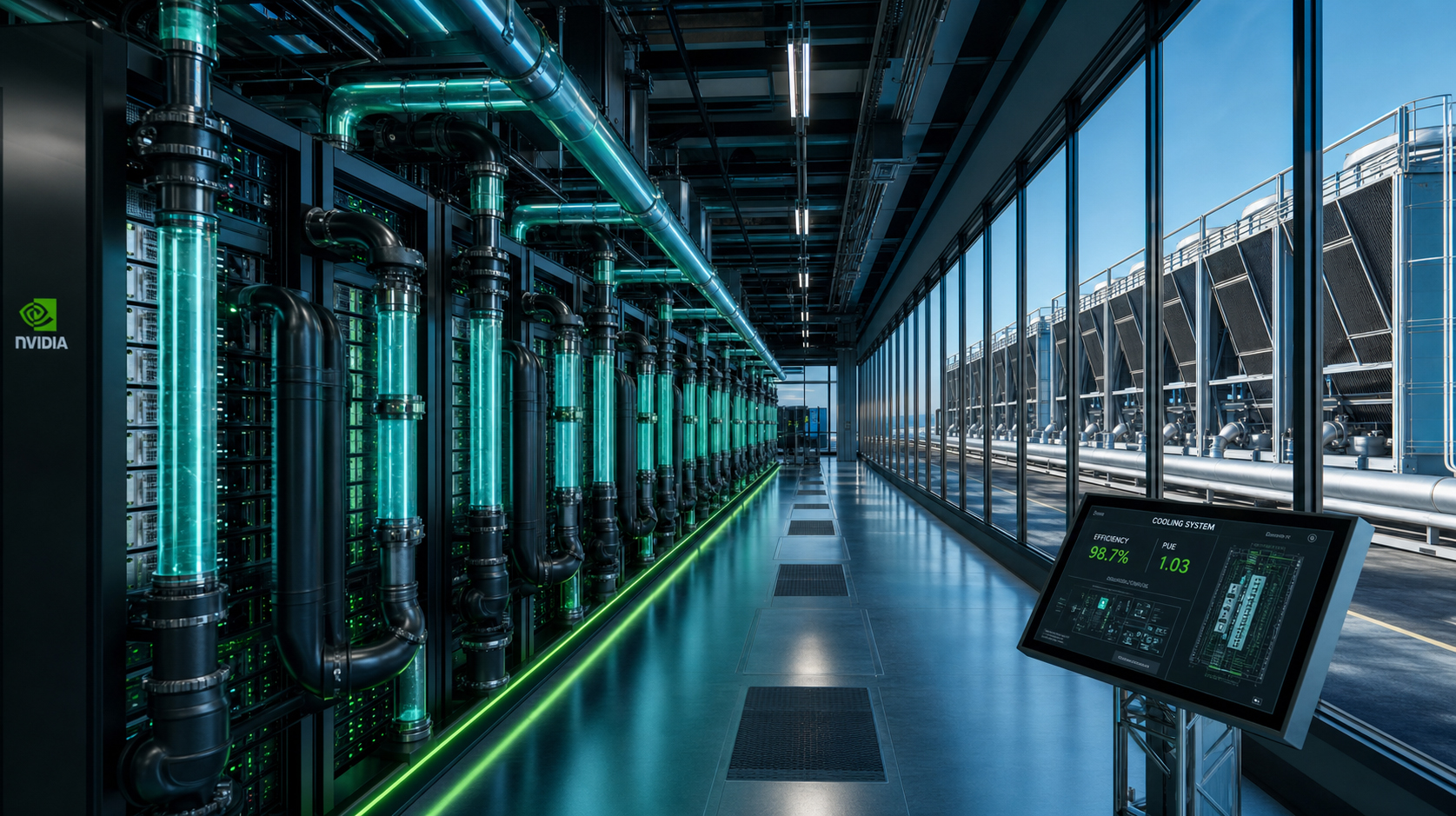
Nvidia's AI marvel "Ruby" for AI data centers: No water consumption – but there's a major drawback – Image: Xpert.Digital
End of the water madness? How Nvidia now plans to drain AI data centers
Silent revolution in the data center: How Nvidia plans to solve AI's biggest environmental problem
Without a drop of water: Nvidia's new cooling revolution for the entire AI industry
The unstoppable rise of artificial intelligence comes at a massive, often-overlooked price: a gigantic, exponentially growing consumption of water and electricity, pushing entire regions worldwide to the brink of ecological collapse. With its new "Ruby" chip generation and a radical departure from traditional air cooling, industry leader Nvidia promises a long-overdue paradigm shift. A fully liquid-cooled reference design is intended to reduce the water consumption of massive AI data centers to almost zero, saving billions of liters of fresh water. But while the concept is technically impressive and appears highly lucrative economically, a critical examination of the overall balance sheet remains essential. Is Nvidia truly solving the biggest environmental problem in the AI industry – or is it merely shifting it invisibly? This is an in-depth analysis of the technology, economics, and unwritten truths of the new AI infrastructure.
Water was yesterday: Nvidia's Ruby generation and the silent revolution of AI cooling
Whoever controls heat controls the AI industry
At London Climate Action Week in June 2026, Nvidia unveiled a fully liquid-cooled reference architecture for its upcoming Rubin generation, making a claim that is almost unparalleled in its radicalism: the water consumption of an AI data center is to be reduced to near zero. This represents nothing less than a paradigm shift in an industry that has hitherto burned freshwater on an industrial scale, thereby becoming a serious societal problem in regions like Arizona, Texas, and Utah. Whether Nvidia's promise is technically sound, economically scalable, and truly environmentally sustainable is a question that extends far beyond the Climate Action Week presentation hall.
The extent of a suppressed problem
The water dependency of modern AI data centers is no longer a niche issue. In 2023, all data centers in the US combined consumed around 64 billion liters of water – and experts are already predicting a fourfold increase by 2028. The International Energy Agency (IEA) estimates the global water consumption of all data centers in 2023 at around 560 billion liters, more than half of London's annual water needs. By 2030, this figure could exceed 1.2 trillion liters – a value that surpasses London's total water consumption.
Behind these abstract figures lie very real local conflicts. Texas alone faces a development where the state's data centers could consume over 189 billion liters of water by 2025 – with a projection of well over 1.5 trillion liters by 2030. A single meta-data center in rural Newton County, Georgia, uses around 1.9 million liters of water daily, which is roughly ten percent of the county's total water consumption. Such dimensions can no longer be downplayed by pointing to technological progress.
Paradoxically, two-thirds of the data centers built since 2022 are located in water-stressed regions. An analysis by Bloomberg News shows that approximately 45 percent of all data centers worldwide are situated in river basins already facing significant water risk. In Phoenix, Arizona—one of North America's fastest-growing metropolitan areas with over 150 planned or operational data centers—the consulting firm Ceres has classified the region as "highly water-stressed." If all the planned facilities are completed, the city's water consumption could increase by 32 percent. At the same time, groundwater levels are falling, the Colorado River is shrinking, and agriculture is struggling to survive.
Global political pressure has arrived. During London Climate Action Week in June 2026, mayors from 40 cities – including London, Phoenix, and Melbourne – signed the Global Urban Data Centres Pact, which sets standards for water efficiency, clean energy, and better integration into urban planning. This collective response from municipalities demonstrates how far the issue has moved from the engine room of the technology sector into the democratic discourse.
How cooling became a systemic risk
To understand the problem, it's worth looking at the physics and economics of data center cooling. Cooling systems consume between 30 and 55 percent of a data center's total electricity consumption, depending on their efficiency, with an industry average of around 40 percent. The common industry indicator Power Usage Effectiveness (PUE) measures the ratio of a facility's total energy consumption to the energy consumption of the actual IT equipment. A PUE of 1.0 represents theoretical perfection, while a value of 2.0 means that the infrastructure itself consumes as much energy as the computers it cools. In practice, the most efficient hyperscale facilities have PUE values around 1.2, while older buildings sometimes have values above 1.6.
The water problem arises primarily from so-called evaporative cooling towers. In these systems, heat is released into the surrounding air through the controlled evaporation of water – a principle familiar from industrial cooling systems and power plants, and one that has proven cost-effective. The drawback: the evaporated water is irretrievably lost. According to Nvidia's Chief Sustainability Officer, Josh Parker, conventional cooling tower systems consume approximately 9.8 million liters of fresh water per megawatt of installed computing power per year. For a modern hyperscale data center with 50 megawatts of computing power, this equates to almost 500 million liters annually – the annual consumption of a medium-sized town.
Water consumption has increased dramatically in recent years simply due to growing computing power. AI workloads, such as training large language models or inferring billions of daily queries, are significantly more energy-intensive than traditional cloud services. A study from the University of California, Riverside, provides a vivid illustration: each 100-word input to an AI model consumes an estimated half a liter of water. A December 2025 study in the scientific journal Patterns estimated that AI systems alone could be responsible for 312 to 765 billion liters of annual water consumption—more than the IEA attributed to the entire global data center industry in 2023.
Nvidia's Ruby approach: The technology behind the promise
Against this backdrop, Nvidia's announcement of the Ruby generation is no ordinary product presentation. The DSX reference design for AI factories breaks with decades of air-based cooling practices and relies entirely on closed liquid circuits, without fans or evaporative coolers. The coolant is a mixture of 75 percent water and 25 percent propylene glycol – a combination whose basic principles are similar to automotive coolant and which has long been an industry-proven standard solution in data centers.
What's remarkable about the Ruby architecture is the system's thermal tolerance. The coolant enters the chips at 45 degrees Celsius and, according to Nvidia, exits at around 55 degrees Celsius. The heat absorbed is dissipated to the ambient air via external dry coolers – without any evaporation or direct water loss. The coolant circulates in a completely closed loop; no fresh water enters the system, nor does any evaporated water leave. The 25 percent propylene glycol additive serves a dual purpose: it lowers the freezing point of the mixture to approximately minus ten degrees Celsius, thus protecting the external pipework from freezing, while simultaneously suppressing the growth of biofilms in the cooling plates' microchannels.
The physical key to realizing this architecture lies in the thermal tolerance of the Rubin GPUs themselves. With a Thermal Design Power (TDP) of 2,300 watts per chip in the performance-maximized Max-P configuration, the Rubin GPUs generate almost twice as much heat as the current Blackwell generation, which is designed for 1,000 to 1,400 watts. A fully populated NVL72 rack of the Rubin generation requires between 180 and 220 kilowatts—roughly the combined consumption of 40 to 80 average American households. This immense power density makes air cooling simply impossible. Nvidia itself no longer describes liquid cooling for Rubin as an option, but as a requirement.
According to Nvidia's Chief Sustainability Officer, Josh Parker, the DSX design reduces water consumption from approximately 9.8 million liters per megawatt per year to almost zero. For a 50-megawatt system, this equates to annual savings of more than four million US dollars in cooling energy and water costs alone, according to the company. However, Ali Heydari, Nvidia's Director of Data Center Cooling and Infrastructure, adds an important caveat: In approximately one percent of the year, the use of a conventional cooling system might still be necessary in certain climates. This limitation applies to extreme summer heat waves in hot climates, where the ambient temperature is too high to reduce the heated return temperature of 55 degrees Celsius back down to 45 degrees Celsius using only dry coolers.
Competition never sleeps: Amazon and industrial change
Nvidia's announcement comes at a time when the entire hyperscaler industry is renegotiating the cooling issue. According to reports from the technology magazine The Verge, Amazon Web Services has also communicated a strategy of higher thermal tolerances for its primarily air-cooled data centers as part of a broader efficiency program. This move is less radical than Nvidia's all-liquid cooling, but it signals that even the world's largest cloud provider acknowledges the thermal limitations of conventional architectures.
Nvidia itself explains in its blog post that virtually every cloud provider and data center operator building for the Rubin generation is making the switch to liquid cooling. This statement is less a prediction than a description of the technical necessity: At 2,300 watts per GPU and up to 600 kilowatts per rack in the future Rubin Ultra NVL576 configuration, the physics of airflow is simply overwhelmed. Specialized cooling companies like Frore Systems have already developed direct cooling plates for the Rubin chips, which, according to the company, improve cooling performance by over 50 percent compared to current solutions and reduce maximum chip die temperatures by 7.5 degrees Celsius.
The development of capital costs is remarkable. Liquid cooling was long considered prohibitively expensive in the industry. Recent studies, including a comprehensive analysis by Schneider Electric, show that the investment costs are virtually identical for the same power density of 10 kilowatts per rack: air cooling costs approximately $7.02 per watt, liquid cooling approximately $6.98 per watt. The higher costs for pumps, piping, and cooling plate technology are almost exactly offset by the elimination of chillers, computer cabinet cooling units, and complex air distribution systems. Once the higher compression density enabled by liquid cooling is taken into account—that is, 20 or 40 kilowatts per rack instead of 10—the ratio shifts significantly in favor of liquid cooling: at 20 kilowatts per rack, capital costs decrease by ten percent, and at 40 kilowatts by 14 percent.
A new dimension of digital transformation with 'Managed AI' (Artificial Intelligence) - Platform & B2B solution | Xpert Consulting

A new dimension of digital transformation with 'Managed AI' (Artificial Intelligence) – Platform & B2B solution | Xpert Consulting - Image: Xpert.Digital
Here you will learn how your company can implement customized AI solutions quickly, securely and without high entry barriers.
A managed AI platform is your all-inclusive, worry-free solution for artificial intelligence. Instead of dealing with complex technology, expensive infrastructure, and lengthy development processes, you receive a ready-made solution tailored to your needs from a specialized partner – often within just a few days.
The key advantages at a glance:
⚡ Rapid implementation: From idea to ready-to-use application in days, not months. We deliver practical solutions that create immediate added value.
🔒 Maximum data security: Your sensitive data stays with you. We guarantee secure and compliant processing without sharing data with third parties.
💸 No financial risk: You only pay for results. High upfront investments in hardware, software, or personnel are completely eliminated.
🎯 Focus on your core business: Concentrate on what you do best. We take care of the entire technical implementation, operation, and maintenance of your AI solution.
📈 Future-proof & scalable: Your AI grows with you. We ensure continuous optimization and scalability, and flexibly adapt the models to new requirements.
More information here:
Nvidia says "no water" – Zero Water? The hidden water footprints of AI infrastructure
The environmental impact: What Nvidia doesn't say
That Nvidia's announcement was strategically placed at London Climate Action Week is no coincidence. The event, which takes place from June 20th to 28th, 2026, is one of the most influential climate policy forums worldwide. Nvidia is using the platform to position itself as part of the solution – and is doing so with a message that is seductive in its simplicity: The AI industry's water problem has been solved.
The reality is more complex. What Nvidia's publication omits is the complete lifecycle assessment of this new infrastructure. Three dimensions deserve particular attention.
First, the construction. Building a fully liquid-cooled, next-generation data center requires massive amounts of steel, copper, aluminum, and plastic for piping systems, dry coolers, and cooling plates. Nvidia makes no mention of the environmental footprint during the construction phase in its blog post. Propylene glycol production is a petrochemical process, and the raw material consumption for liquid-cooled infrastructure systematically exceeds that for air-cooled systems. This one-time expense is not factored into the reported savings figures.
Secondly, there's the electricity. While liquid-cooled data centers consume significantly less water during operation, they still require substantial amounts of electrical energy. And electricity generation itself is a water-intensive process: thermal power plants—whether coal-, gas-, or nuclear-powered—require cooling water. The IEA estimates that around 60 percent of a data center's total water consumption is indirectly related to electricity generation. As long as a large portion of the electricity comes from water-intensive sources, the indirect water footprint persists, even if not a single drop of tap water evaporates on-site. Nvidia does not address the source of its required electricity.
Thirdly, there's the propylene glycol issue. Propylene glycol is significantly less toxic than ethylene glycol and is generally considered more environmentally friendly. Nevertheless, leaks can lead to an increased biological oxygen demand in surface waters, endangering aquatic life. Since Nvidia's reference architecture uses closed loops, the risk of leakage during normal operation is low – but not zero, especially during construction, maintenance, or system aging. Furthermore, there's a growing debate within the industry about whether propylene glycol as a refrigerant should be replaced by even more sustainable alternatives in the long term.
The energy dilemma: More computing power, more electricity
Regardless of water consumption, the energy problem remains the fundamental challenge of AI infrastructure. US data centers consumed around 650 billion kilowatt-hours in 2023 – equivalent to 4.4 percent of total US electricity consumption. By 2028, depending on the projection model, this figure could reach between 1,200 and 2,100 billion kilowatt-hours, or 6.7 to 12 percent of national electricity consumption. Globally, the IEA forecasts an increase in data center electricity consumption to between 650 and 1,050 billion kilowatt-hours by 2026.
The Ruby generation exacerbates this trend instead of mitigating it. Each Ruby GPU with a 2,300-watt TDP consumes more than twice the energy of a Blackwell chip under full load. While performance per watt is said to have increased significantly—Nvidia promises ten times cheaper inference for Ruby compared to Blackwell—the absolute energy demands of entire data centers are growing, as both the power density per chip and the total number of installed chips increase exponentially. While energy-efficient cooling helps to reduce overall consumption, it does not fully compensate for the increased demand resulting from higher computing power.
The power grid is reaching its limits. The sheer size and concentration of energy demand from hyperscale data centers is overwhelming existing grid infrastructures and operational protocols. Experts emphasize that the solution requires a shared responsibility from grid operators and data center operators: investments in transmission capacity, decentralized on-site power generation, battery storage, and dynamic load management. Some national research centers are already achieving PUE values close to 1.05 with adapted cooling concepts. The potential savings through liquid cooling are real – but it doesn't solve the fundamental structural problem of exponentially growing energy demand.
The economic dimension: investment calculation and location economics
Beyond the technical debate, an economic analysis is worthwhile. Nvidia's announcement comes at a time when the global hyperscaler industry is planning investments on an unprecedented scale. According to the company, the annual cost savings from the DSX design amount to over four million dollars for a 50-megawatt facility. With a typical data center lifecycle of ten to fifteen years and rising water costs in water-stressed regions, this figure could increase considerably.
Added to this is the regulatory dimension. Municipalities and regions worldwide are beginning to restrict or impose conditions on water access for new data centers. In Arizona, the issue has already become politically explosive. Companies that rely on waterless cooling technology gain not only an ecological advantage but also a regulatory one: they are more feasible to build in water-stressed regions, can obtain permits more quickly, and are less vulnerable to future regulatory restrictions.
For operators of the next generation of AI data centers, the decision to use liquid cooling is no longer a matter of green marketing, but a fundamental economic decision regarding long-term operational viability. Those planning to build in water-stressed regions—and this represents a significant portion of planned new capacity—simply can no longer afford to rely on evaporative cooling. The technology is entering the market not only due to its efficiency gains, but also due to regulatory pressure from below.
Open questions and structural limitations
Despite the momentum generated by Nvidia's announcement, key questions remain unanswered. Nvidia's communication is decidedly focused on operations, deliberately omitting the construction phase, the source of electricity, and the complete environmental lifecycle. Anyone taking the "zero water consumption" message seriously must understand that it refers exclusively to cooling water consumption at the site during ongoing operations.
Furthermore, the DSX reference design is initially just that – a blueprint, not a finished product. Its actual adoption depends on how quickly cloud providers and colocation operators can restructure their infrastructures. Existing data centers cannot simply be converted to liquid cooling; they require complete rebuilds or extensive renovations. This means that the communicated savings will only become apparent in the global balance sheet with a considerable delay, while water consumption in existing facilities will continue to rise in the coming years.
The question of coolant maturity and long-term stability also remains open. Propylene glycol mixtures are technically proven, but within the expert community, there is growing debate about whether they will still be sufficiently efficient at the extremely high power densities of the next generation of chips or whether they need to be replaced by other cooling media. The thermodynamicist and the business economist see the same equation from different perspectives: What is physically optimal is by no means necessarily what can be operated in millions of square meters of data center space worldwide.
The political economy of AI infrastructure
London Climate Action Week 2026 demonstrated that the political and economic dimensions of AI infrastructure have arrived. Mayors are negotiating data centers like they would power plants – and rightly so, because the societal costs, such as water depletion, increased electricity prices, and soil sealing, are borne by the public, not just the operators. The signing of the Global Urban Data Centres Pact by 40 cities worldwide sends a political signal that the industry cannot ignore.
Nvidia's announcement is strategically well-placed in this context. The company wants to demonstrate that technological progress and sustainability are not mutually exclusive – and that the market leader in GPU infrastructure is also a pioneer in sustainability solutions. Whether this succeeds depends not only on the technology. It depends on whether transparency regarding total costs and overall financial statements is guaranteed, whether regulators establish the right framework, and whether the industry consistently implements the communicated standards.
One thing has become clearer as a result of Nvidia's announcement: the cooling problem is not just an engineering problem. It is a political, economic, and environmental problem all in one – and the industry itself now knows this. The question is no longer whether the transformation to closed, low-water cooling systems will happen. The question is how quickly, how completely, and at what societal cost it will be accomplished.
Nvidia's Rubin reference architecture is a compelling sign that the AI industry has begun to take its water dilemma seriously from a technical perspective. The impressive figures—nearly zero water consumption compared to 9.8 million liters per megawatt per year, four million dollars in annual savings for a 50-megawatt plant, a fully closed cooling system without fans—are groundbreaking. However, they don't address the fundamental energy problem, ignore the construction phase, and conceal the indirect water footprints generated through power generation. An honest economic analysis of the next generation of AI infrastructure must fill these gaps—and the industry needs to deliver more than just reference designs.
🎯🎯🎯 Data-driven B2B industry hub as a quasi-in-house solution

The quasi-in-house solution: How Xpert.Digital closes operational gaps in B2B marketing and sales – Smart Content-Driven Business - Image: Xpert.Digital
Xpert.Digital is a data-driven B2B industry hub led by Konrad Wolfenstein . The company acts as an external, quasi-in-house solution for industrial partners, closing operational gaps in marketing, content, and sales – without requiring additional resources on the client side.
More information here:
Your global marketing and business development partner
☑️ Our business language is English or German
☑️ NEW: Correspondence in your native language!

Konrad Wolfenstein
I and my team are happy to be available to you as your personal advisor.
You can contact me by filling out the contact form here [email protected]:or simply call me at +49 7348 4088 965. My email address is
I'm looking forward to our joint project.









