
Nvidia's Neocloud Empire: Jensen Huang's battle against Microsoft, Amazon, and Google for AI infrastructure
Xpert Pre-Release

Available in 27 languages 📢
Prefer Xpert.Digital on GoogleⓘPublished on: March 15, 2026 / Updated on: March 15, 2026 – Author: Konrad Wolfenstein
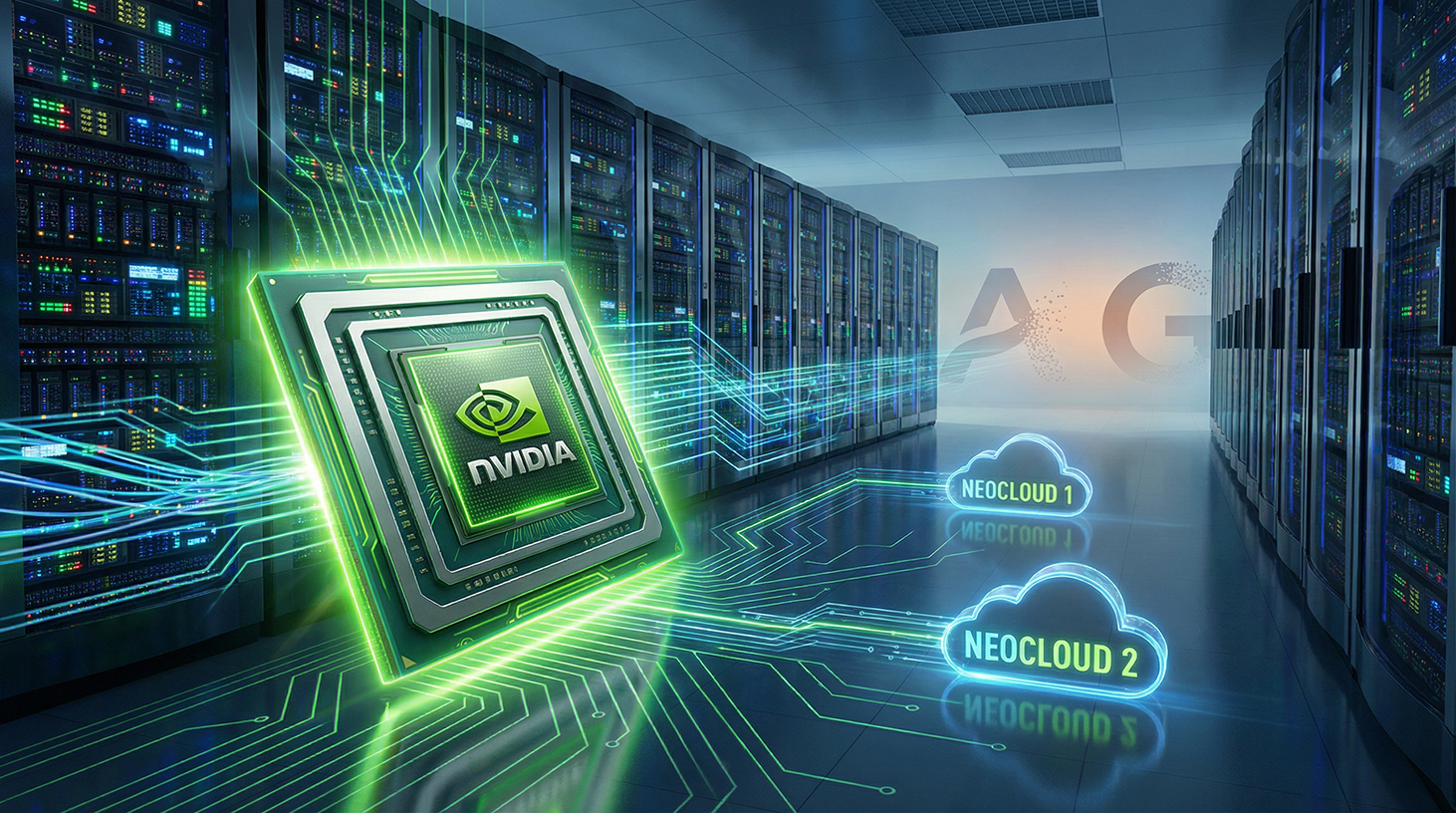
Nvidia's Neocloud Empire: Jensen Huang's battle against Microsoft, Amazon, and Google for AI infrastructure – Image: Xpert.Digital
Nvidia's Trojan Horse: The real reason why the chip giant is opening up its technology
Attack on the hyperscalers: Why Nvidia is now pumping billions into ex-Yandex engineers
Jensen Huang likes to present himself as a modest engineer in a leather jacket, but behind the scenes, he's working with surgical precision on a new world order for the age of artificial intelligence. For years, Nvidia was the most important, but ultimately just one, supplier for tech giants like Amazon, Microsoft, and Google. Because these so-called hyperscalers are now increasingly developing their own AI chips to break free from this dependency, Nvidia is launching a large-scale counterattack. The weapon of choice: "Neoclouds." With multi-billion-dollar investments in emerging providers like CoreWeave and the Nebius Group, the chip monopolist is building direct competition for AWS and Azure. Read here how Nvidia's clever platform strategy, covert technological Trojan horses, and gigantic 5-gigawatt data centers are completely redefining the war for global AI infrastructure—and what dangerous monopoly risks this new empire harbors.
Related to this:

From chip supplier to infrastructure architect
Jensen Huang presents himself on stage as a modest engineer who just happened to develop the right technology at the right time. But anyone who has followed his strategic actions over the past twelve months will see a different picture: that of a business leader surgically reshaping the ownership structure of the global AI infrastructure. In January 2026, Nvidia invested two billion US dollars in CoreWeave, securing a roughly nine percent stake in a company that has become the central GPU cloud platform for OpenAI's Stargate project. Just weeks later, in March 2026, an identical investment in the Nebius Group followed – the same playbook, the same target size, the same strategic logic.
Each of these investments, taken individually, could be interpreted as opportunistic capital in high-growth partners. However, taken together and in conjunction with Nvidia's parallel activities at the hardware, software, and cloud levels, they present a coherent strategic picture: The world's largest chipmaker is building a network of dependent but independent cloud providers that rely exclusively on Nvidia hardware, gain early access to new product generations, and together form a market counterweight to the hyperscalers Amazon Web Services, Microsoft Azure, and Google Cloud.
This Neocloud strategy is not a reaction to market trends. It is an anticipatory response to a structural threat that Nvidia has long recognized: The three major hyperscalers are developing their own AI chips – Amazon's Trainium3, Google's TPUs, and Microsoft's Maia – with the stated goal of reducing their dependence on Nvidia. The more they invest in proprietary silicon solutions, the less Nvidia hardware they buy. Nvidia's answer is to counter the hyperscalers with an alternative infrastructure ecosystem.
Nebius: The Phoenix story behind the Neocloud deal
To fully understand Nvidia's decision to choose Nebius as an investment target, it's worth looking at the company's unusual history. Nebius Group is not a typical Silicon Valley startup. It is the direct successor to Yandex NV, the Dutch parent company of the Russian technology giant Yandex. Founded in 1997 as a Russian search engine, Yandex grew into one of Europe's most important internet companies—until Russia's war of aggression against Ukraine in February 2022 tore the company apart. Its shares were suspended from the NASDAQ, Western partners withdrew, and co-founder Arkady Volozh, a resident of Europe for decades, faced the task of saving Yandex's international operations.
What followed was one of the most remarkable restructurings in recent technology history. In July 2024, Yandex NV sold all of its core Russian operations to a consortium of Russian investors—the search engine business, the taxi platform, and the e-commerce division. What remained were the international operations: a team of approximately 1,000 to 1,300 highly skilled former Yandex engineers, geographically dispersed across Europe, with deep expertise in large-scale cloud infrastructure. Yandex NV rebranded as Nebius Group NV, with Volozh as CEO, and returned to the NASDAQ in October 2024.
What Nvidia sees in Nebius is not a fresh start-up with ambitious plans and limited engineering expertise, but a company that has acquired its full-stack engineering capabilities by operating one of Europe's most widely used internet platforms. Nebius has already established partnerships with Microsoft and Meta Platforms and has received approval to build a 1.2-gigawatt AI production facility on a 400-acre site near Independence, Missouri – with planned operations starting in the second half of 2026.
The 5-gigawatt target: What Nvidia's investment actually finances
Both Neocloud deals – CoreWeave and Nebius – share an identical strategic goal: to build more than five gigawatts of Nvidia-based computing capacity by 2030. Five gigawatts is equivalent to the electrical output of five medium-sized nuclear power plants. It's a figure that makes the scale of the AI infrastructure investment wave tangible: what's being built here isn't a cloud as we know it, but a physically massive energy infrastructure that needs to be built permanently and on a global scale.
Nvidia's $2 billion investment each in CoreWeave and Nebius is not primarily intended as a source of capital for building this infrastructure—CoreWeave's planned total expenditures are many times greater. Nvidia's share of CoreWeave's infrastructure spending is estimated at around two percent. The true purpose of these investments is strategic: Nvidia secures early influence over the production plans of its largest hardware customers and guarantees that the world's most important data centers will be built exclusively on Nvidia platforms. In return, CoreWeave and Nebius gain early access to Nvidia's next generation of hardware—the Rubin platform, Vera CPUs, and BlueField storage systems.
This early access is an exceptionally valuable asset in a market where GPU shortages are limiting the expansion plans of all major AI vendors. Being the first to receive the latest generation of GPUs allows companies to build more powerful clusters, attract higher-value customers, and differentiate themselves through price competition. CoreWeave capitalized on this dynamic, achieving year-over-year revenue growth of 235.4 percent in 2025. Meta signed a $14.2 billion contract with CoreWeave in October 2025—a single agreement that underscores the company's strategic positioning at the heart of the AI ecosystem.
A new dimension of digital transformation with 'Managed AI' (Artificial Intelligence) - Platform & B2B solution | Xpert Consulting

A new dimension of digital transformation with 'Managed AI' (Artificial Intelligence) – Platform & B2B solution | Xpert Consulting - Image: Xpert.Digital
Here you will learn how your company can implement customized AI solutions quickly, securely and without high entry barriers.
A managed AI platform is your all-inclusive, worry-free solution for artificial intelligence. Instead of dealing with complex technology, expensive infrastructure, and lengthy development processes, you receive a ready-made solution tailored to your needs from a specialized partner – often within just a few days.
The key advantages at a glance:
⚡ Rapid implementation: From idea to ready-to-use application in days, not months. We deliver practical solutions that create immediate added value.
🔒 Maximum data security: Your sensitive data stays with you. We guarantee secure and compliant processing without sharing data with third parties.
💸 No financial risk: You only pay for results. High upfront investments in hardware, software, or personnel are completely eliminated.
🎯 Focus on your core business: Concentrate on what you do best. We take care of the entire technical implementation, operation, and maintenance of your AI solution.
📈 Future-proof & scalable: Your AI grows with you. We ensure continuous optimization and scalability, and flexibly adapt the models to new requirements.
More information here:
More than just chips: Nvidia's ingenious plan to outsmart the cloud giants
Lepton instead of DGX Cloud: The quiet realignment of Nvidia's cloud strategy
To properly understand Nvidia's current positioning, it's necessary to also consider its limitations and adjustments. Nvidia launched DGX Cloud, an ambitious attempt to enter the cloud computing market directly – a premium offering for enterprise customers at $36,999 per H100 instance per month. During a period of extreme GPU shortage, this pricing model was justified. However, with normalized markets and falling prices from hyperscalers – AWS reduced its prices by as much as 45 percent in some cases – DGX Cloud lost its competitive edge.
Nvidia has drawn its conclusions from this and recalibrated its cloud strategy: DGX Cloud is used internally for research purposes but plays virtually no role externally. Instead, Lepton, a GPU marketplace that acts as an intermediary and distributes AI workloads to a network of partners – including AWS, Azure, and smaller cloud providers – is taking center stage. Nvidia is thus no longer positioning itself as a direct competitor of the hyperscalers, but rather as an aggregator and orchestrator of global GPU traffic. This is a smarter position: less risk from its own infrastructure costs, more influence through control over the distribution of computing capacity.
TD Cowen and other investment banks have assessed this repositioning as a strategically consistent signal: Nvidia accepts that the battle for the mass-market cloud customer has been won by AWS and Azure and is instead focusing on the layers where its influence is strongest – hardware design, chip ecosystem and the strategic control of capacity allocation.
Related to this:

NVLink Fusion: The Trojan horse in the data center of the future
A second strategic lever that Nvidia unveiled at Computex in Taiwan in May 2025 deserves special attention in the context of its Neocloud strategy: NVLink Fusion. Until now, NVLink, Nvidia's proprietary high-speed data bus between chips, was exclusively accessible to Nvidia's own hardware. With NVLink Fusion, Nvidia is opening this standard to chips from other manufacturers – MediaTek, Marvell, Qualcomm, and Fujitsu will soon be able to connect their processors to Nvidia GPUs via NVLink.
At first glance, this appears to be a liberalization that weakens Nvidia's market power. The opposite is true. By making NVLink the open standard for heterogeneous AI data center architectures, Nvidia is establishing its own interconnect technology as the indispensable nervous system of every future AI factory – regardless of whose CPUs or ASICs are used. Anyone using NVLink is using Nvidia's infrastructure. Competitors Broadcom, AMD, and Intel are not yet part of the NVLink Fusion ecosystem – an exclusivity advantage that remains significant for Nvidia.
In parallel, Nvidia is building the first industrial AI cloud on European soil in Germany: 10,000 Blackwell GPUs, configured as "Germany's AI highway"—as CEO Jensen Huang put it at the Vivatech conference in June 2025. The project is part of a European strategy that envisions 20 AI factories in seven countries and explicitly targets the issue of technological sovereignty—an argument that carries considerable weight in European capitals given the current geopolitical landscape.
The structural dilemma of hyperscalers
Nvidia's Neocloud alliance strategy hits the hyperscalers at a moment of structural weakness. Amazon, Microsoft, and Google have benefited from Nvidia's chip dominance for years while simultaneously trying to break free from it. Amazon's Trainium3 was unveiled in early December 2025—a 3-nanometer chip with four times the performance of its predecessor while using 40 percent less power. AWS is using NVLink in its next generation of chips—illustrating the irony of the situation: even when building its own AI chips, Amazon cannot completely bypass Nvidia's ecosystem.
Google actively funded its own TPU developments and conspicuously stayed away from the recent DGX marketplace initiative—a gesture of strategic distancing that, however, does not change the fact that Google's market share in the cloud business lags significantly behind AWS. AWS generated more than $107 billion in revenue in 2024 and accounts for over 60 percent of Amazon's operating income—a profitability dominance that serves as a benchmark for other hyperscalers and significantly limits their strategic options for competing with Nvidia.
The real strategic question preoccupying analysts and industry observers is therefore not whether Nvidia can replace the hyperscalers – that's not realistic in the foreseeable future. The question is whether Nvidia can curb the growth of the hyperscalers in their most profitable segment – AI infrastructure for enterprise customers – through its Neocloud network. If CoreWeave, Nebius, and similar providers become the preferred infrastructure for developers and AI-first companies, the balance of power in this growth segment will shift – even if the overall size of the hyperscaler market remains unchanged.
The risks of the Nvidia empire
A balanced assessment requires acknowledging structural risks. Nvidia is suspected of creating circular economies through its investments in neocloud providers: it invests capital in companies that use this capital to purchase Nvidia hardware. Jensen Huang has publicly dismissed this as a marginal phenomenon – Nvidia's investment represents only about two percent of CoreWeave's planned infrastructure spending. Nevertheless, the model creates incentive structures that make an independent evaluation of the hardware selection more difficult.
Furthermore, the question of market concentration remains open. A market in which a single chip supplier dominates both the hardware and controls capacity allocation through strategic investments has structural similarities to monopoly situations that have historically attracted regulatory attention. Initial voices from Brussels and Washington are already addressing Nvidia's dominant market position. What regulatory responses will look like and when they will take effect remains to be seen – but they represent a structural risk to the neocloud strategy, one that becomes more likely with Nvidia's increasing market power.
What remains in any case is the realization that the battle for control of the AI infrastructure of the next decade has long since begun – and that Nvidia is no longer just a supplier in this battle, but a fully-fledged player with its own strategic program.
Consulting - Planning - Implementation

Konrad Wolfenstein
I would be happy to serve as your personal advisor.
contact me at wolfenstein ∂ xpert.digital
Just call me on +49 7348 4088 965 (Munich) .









