

Oil power loses, data power gains: IMF forecast reveals the frightening new truth of the global economy
Xpert Pre-Release

Available in 27 languages 📢
Prefer Xpert.Digital on GoogleⓘPublished on: July 20, 2026 / Updated on: July 20, 2026 – Author: Konrad Wolfenstein
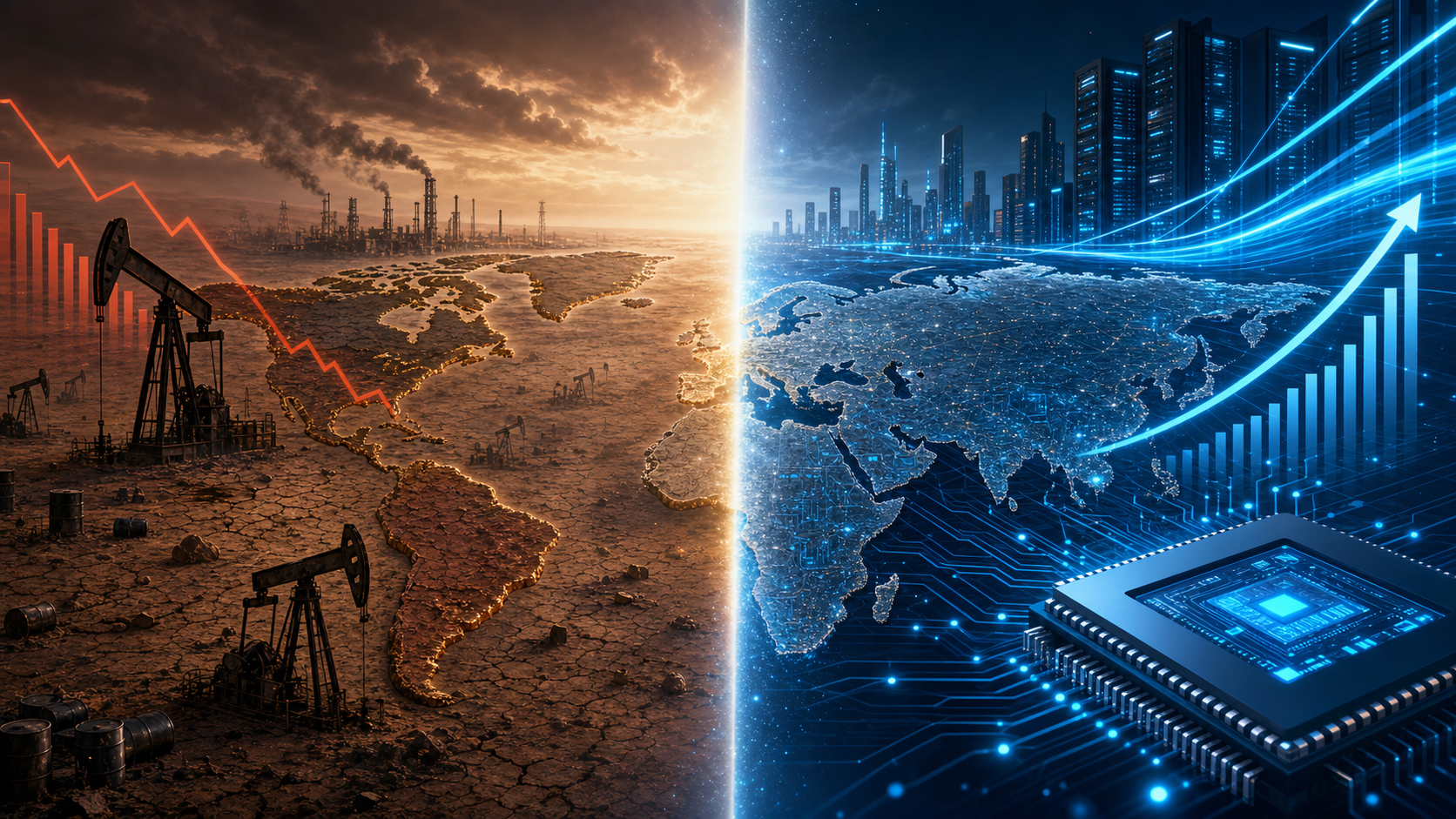
Oil power loses, data power gains: IMF forecast reveals the frightening new truth of the global economy – Image: Xpert.Digital
Data power instead of oil tankers: Who benefits in the new global economy – and who loses?
Global turning point: Why data centers are the new oil (and what that means for Europe)
The IMF warns of the AI bubble bursting: Will semiconductors save us or plunge us into crisis?
The global economy is facing a historic turning point: Semiconductors and data centers are increasingly displacing oil as the primary engine of global growth. This is the stark conclusion reached by the International Monetary Fund (IMF) in its latest update from July 2026. While traditional oil-producing nations are experiencing massive slowdowns in growth due to the war in the Middle East and disrupted supply chains, Asian and American tech hubs are experiencing an unprecedented AI boom. However, this structural transformation carries enormous risks: The IMF not only warns of persistent inflation and a looming technology bubble, but also delivers a sobering realization for Europe and Germany. Those who fail to invest heavily in the new world order dominated by artificial intelligence and data networks risk being left behind entirely in the face of soaring energy costs.
When data centers become more important than oil tankers
The International Monetary Fund (IMF), in its latest World Economic Outlook Update from July 2026, has revealed a remarkable shift in the global growth architecture. The revisions to growth forecasts for 2026 and 2027 vary fundamentally across different country groups, and these differences tell a story that goes far beyond mere percentage points. While the IMF has significantly lowered its expectations for the oil-producing countries of the Middle East and North Africa, it has substantially raised its forecasts for leading exporters of AI hardware. This comparison is based on a juxtaposition of the July 2026 forecast with those published in January and April 2026.
Specifically, this means that the Middle East and Central Asia region experienced the sharpest downward revision of all world regions, while countries like South Korea, deeply integrated into the global artificial intelligence technology supply chain, are among the biggest winners of the latest revision. This divergence is not statistical noise, but rather an expression of a structural transformation of the global economy, in which traditional resource power is increasingly being replaced by digital value creation power.
Two speeds of the global economy
The IMF forecasts global economic growth of 3.0 percent in 2026 and 3.4 percent in 2027. This is significantly below the average of 3.5 percent for each of the past two years and thus marks a noticeable slowdown in the pace of global economic growth. The Fund itself aptly describes the situation in its report entitled "Global Economy in Crosscurrents of War and Technology" as an interplay of two opposing forces: the economic slowdown caused by the war in the Middle East on the one hand, and the technology-driven investment boom surrounding artificial intelligence on the other.
These two forces do not affect all countries equally. IMF economist and report author Denise Egan speaks in this context of a “V-shaped recovery” from the shock triggered by the escalation of the Middle East conflict, with this recovery being highly unevenly distributed across the world's regions. Countries closely linked to the global technology supply chain benefit from the demand for AI investments, while energy-importing and commodity-dependent economies suffer from higher energy costs and imported price shocks.
The collapse of oil regions in figures
The Middle East and Central Asia region received the most significant downgrade from the IMF, with its 2026 growth forecast reduced by 1.2 percentage points to just 0.7 percent compared to the April forecast. At the same time, the Fund sharply raised its 2027 forecast for the region by 1.9 percentage points to 6.5 percent. This suggests an expected recovery following the acute shock of the war, once the situation around the Strait of Hormuz has normalized. The IMF's model assumes that this crucial oil transit route will gradually reopen from mid-July 2026 and reach pre-war levels again by March 2027.
A key parameter in the IMF's model is the assumption of an average oil price of $89 per barrel—a level significantly higher than pre-war levels and, according to Egan, high enough to maintain the divergence between oil exporters and importers. The Fund stated that, at the time of the report, energy prices were already 25 percent higher than before the outbreak of war on February 28, 2026, and were expected to remain elevated. Paradoxically, this represents a short-term economic burden for the Gulf states themselves, even though they should actually benefit from high energy prices because war-related disruptions to production and exports are impacting output volumes more than the price increase can compensate for.
South Korea's example of the technology turbo
No other major country saw its growth forecast revised upward as sharply in July as South Korea's. The IMF raised its 2026 forecast for South Korea's economy by 0.7 percentage points to 2.6 percent, compared to its April forecast of 1.9 percent. The country imports a significant portion of its energy from the war-torn Middle East and should therefore be among the losers of the crisis. Instead, a boom in semiconductor and AI hardware exports propelled the South Korean economy to a surprising annualized growth rate of 7.5 percent in the first quarter of 2026 – more than four times the 1.8 percent forecast in April.
This case exemplifies how strongly the tailwind from global demand for chips and AI can support individual economies, even if their energy balance is actually vulnerable. The IMF also points to a broader analysis showing that the four largest net exporters of AI hardware experienced an average positive growth surprise of 4.4 percentage points in the first quarter of 2026, while the rest of the world suffered an average negative surprise of 0.3 percentage points. This gap of almost five percentage points in a single quarter underscores the extent of economic polarization.
Moderate burden on established industrialized nations
Even established industrialized countries with net energy imports, including Germany, are experiencing downward revisions, though these are considerably more moderate than those for oil-producing regions. The IMF now forecasts growth of 0.7 percent for Germany in 2026 and 1.0 percent in 2027, 0.1 and 0.2 percentage points lower, respectively, than projected in April. For the entire eurozone, the Fund lowered its 2026 forecast by 0.2 percentage points to 0.9 percent, while the expectation for 2027 remained unchanged at 1.2 percent.
The comparison with the United States is interesting. Its growth forecast for 2026 remained almost unchanged at 2.3 percent compared to the April estimate, while for 2027 it was even slightly raised by 0.1 percentage points to 2.2 percent. The reason for this is obvious: The US is not only relatively energy self-sufficient, but also the epicenter of the global AI investment cycle, which allows it to absorb the war-related burdens much better than the Eurozone, which has neither significant domestic energy resources nor a comparably strong domestic technology industry.
Emerging markets are showing remarkable resilience
For emerging and developing economies, the downward revision is comparatively small, at just 0.1 percentage points to 3.8 percent for 2026, while the forecast for 2027 was even raised by 0.3 percentage points to 4.5 percent. The development in China is particularly striking, where the IMF increased its growth forecast for 2026 by 0.2 percentage points to 4.6 percent – a figure that is above the April estimate of 4.4 percent. For 2027, the Fund expects Chinese growth of 4.1 percent, also an improvement over the previous forecast.
Even India, one of the world's fastest-growing major economies, saw its growth rate for 2026 slightly revised downward to 6.4 percent, but was subsequently raised to 6.7 percent for 2027. These figures demonstrate that the narrative of resource-dependent versus technology-driven economies does not align perfectly with the traditional division into industrialized and developing countries. Rather, a country's position in the global technology supply chain and its energy balance increasingly determine its economic fate, regardless of its formal development status.
🎯🎯🎯 Data-driven B2B industry hub as a quasi-in-house solution

The quasi-in-house solution: How Xpert.Digital closes operational gaps in B2B marketing and sales – Smart Content-Driven Business - Image: Xpert.Digital
Xpert.Digital is a data-driven B2B industry hub led by Konrad Wolfenstein . The company acts as an external, quasi-in-house solution for industrial partners, closing operational gaps in marketing, content, and sales – without requiring additional resources on the client side.
More information here:
IMF warns: Fertilizers, energy and the new price wave of 2026 – How the AI boom is driving inflation and who loses
Inflation as collateral damage of the conflict
The IMF simultaneously raised its global inflation forecast for 2026 to 4.7 percent, an upward revision of 0.3 percentage points compared to its previous estimate and significantly higher than the 4.1 percent projected for 2025. For 2027, the Fund expects a decline to 3.9 percent. The Fund also warns of drastically rising prices for fertilizers and food: fertilizer prices could rise by up to 26 percent overall in 2026, and food prices by around eight percent, driven by higher energy and transportation costs. This development indicates that the global disinflationary trend observed since the beginning of 2024 has now come to a standstill.
At the same time, global trade volume is also slowing significantly: After growth of five percent in 2025, which was heavily influenced by imports being brought forward in anticipation of threatened US tariffs, the IMF expects trade growth of only 3.5 percent for 2026, before the rate is projected to recover to 4.3 percent in 2027. This combination of rising inflation and weaker global trade makes adjustment particularly difficult for those countries that do not benefit from either high commodity prices or the technology boom.
Not a productivity miracle, but a pure demand effect
A key and often misunderstood point of the IMF analysis is that the observed technological surge so far is not based on an actual increase in productivity through artificial intelligence. Egan explicitly clarified that the Fund's short-term baseline forecast for this year and next does not assume an exogenous productivity boost from AI. What the IMF is already seeing in its data and incorporating into the forecast is, rather, the pure demand effect of a strong and accelerating global technology cycle—that is, massive investments in data centers, chips, and infrastructure, but not their productive return in the broader economy.
This distinction is economically significant. A pure demand effect can provide short-term support, but simultaneously carries the risk of further fueling inflation because it increases aggregate demand at a time when war-related supply shocks are already driving prices up. In other words, while the AI boom alleviates the economic symptoms of the Middle East war, it may simultaneously exacerbate its side effect in the form of higher inflation.
The risk of a burst AI bubble
The IMF explicitly points to a downside risk in its report, which it itself has calculated in a scenario entitled "AI disappoints, risk-off ensues." This scenario models three successive levels of stress: First, investors reconsider the extent of future productivity gains from artificial intelligence and reduce their enthusiasm for AI-related investment spending. Subsequently, technology markets experience a sharp correction with stock losses roughly half the size of those seen during the dot-com bubble burst. Because AI investments and the associated market leadership are heavily concentrated in the United States, this reversal ultimately triggers broader spillover effects through declining demand for US assets.
Taken together, these three shocks would reduce global economic output by around 1.2 percent over the next two years, according to the IMF. While this may seem moderate at first glance, it would represent a significant additional setback given the current, already subdued growth rates, potentially jeopardizing the fragile recovery of energy-importing countries, while at the same time the oil-producing regions would still be far from overcoming their own crisis.
Africa and Latin America in a field of tension
Within Africa, the gap between energy exporters and importers is also starkly evident. The IMF forecasts overall growth of 4.3 percent for sub-Saharan Africa, with the burden of high energy and food prices falling primarily on those countries that import oil and lack significant natural resource reserves. At the same time, some of the region's larger economies, bolstered by previous macroeconomic stabilization measures, structural reforms, or a net energy export position, are faring considerably better. Nigeria was explicitly mentioned as an economy benefiting from its net energy export status, even if it is not a major direct beneficiary of the global AI boom.
In Latin America, the IMF forecasts growth of 2.4 percent for Brazil by the end of 2026, while the same figure is expected for the region as a whole. These figures are in line with regional averages and suggest that Latin America as a whole is neither particularly affected by the positive nor the negative special factors of the current global situation, but rather is experiencing a period of cyclical stagnation.
What this shift means in economic policy
This analysis presents policymakers with a twofold challenge. On the one hand, governments in energy-dependent economies must ensure price stability and reduce their external vulnerabilities, while simultaneously regaining fiscal space depleted by the energy crisis. On the other hand, they must position their economies to benefit from the next wave of technology investment, rather than being left behind.
This carries a particularly uncomfortable message for Germany and the Eurozone as a whole. The European economy has so far benefited significantly less from the AI boom than, for example, South Korea, the USA, or parts of East Asia, while at the same time suffering disproportionately from the energy price effects of the Middle East conflict, as the continent is traditionally heavily dependent on energy imports. This double disadvantage—having to bear both the shortfall in technological gains and high energy costs—is likely to further cement Europe's structural growth weakness in the coming years unless decisive investments are made in domestic AI and semiconductor capacities as well as in a diversified energy supply.
A global economy in transition
The IMF data from July 2026 paints a picture of a global economy splitting into two parallel development paths. One path continues to follow the old geopolitical fault lines over oil, gas, and raw materials, dramatically exacerbated by the war in the Middle East. The other path follows the new logic of the data economy, where semiconductors, data centers, and AI infrastructure determine economic success or failure. Countries like South Korea demonstrate that it is possible to thrive on the second path, even when structurally disadvantaged on the first.
The crucial question for the coming years will be whether this divergence deepens or whether a relaxation of tensions in the Middle East and a broader distribution of AI value creation can narrow the gap again. The IMF itself remains cautiously optimistic in its assessment, but at the same time explicitly warns of the risks of overheating technology markets. This would hit hardest precisely those countries that have so far relied most heavily on the AI boom as a driver of growth. The global economy is thus at a crossroads, where geopolitical stability and technological pragmatism will equally determine the distribution of wealth in the next decade.
🎯🎯🎯 Data-driven B2B industry hub as a quasi-in-house solution
The quasi-in-house solution: How Xpert.Digital closes operational gaps in B2B marketing and sales – Smart Content-Driven Business - Image: Xpert.Digital
Xpert.Digital is a data-driven B2B industry hub led by Konrad Wolfenstein . The company acts as an external, quasi-in-house solution for industrial partners, closing operational gaps in marketing, content, and sales – without requiring additional resources on the client side.
More information here:
Your global marketing and business development partner
☑️ Our business language is English or German
☑️ NEW: Correspondence in your native language!

Konrad Wolfenstein
I and my team are happy to be available to you as your personal advisor.
You can contact me by filling out the contact form here [email protected]:or simply call me at +49 7348 4088 965. My email address is
I'm looking forward to our joint project.
☑️ SME support in strategy, consulting, planning and implementation
☑️ Creation or realignment of the digital strategy and digitization
☑️ Expansion and optimization of international sales processes
☑️ Global & Digital B2B trading platforms
☑️ Pioneer Business Development / Marketing / PR / Trade Fairs
📈🚀 From visibility to trust 👀🤝 Your scalable path with Xpert.Digital

From visibility to trust: Your scalable path with Xpert.Digital - Image: Xpert.Digital
In industrial B2B, sustainable business relationships rarely emerge overnight. They develop step by step – through visibility, professional relevance, recurring touchpoints, and growing trust. Xpert.Digital's 4-stage model addresses precisely this: It offers a structured path that begins with a manageable entry point and can evolve into deeper collaboration in business development if needed.
Instead of relying on loud marketing promises, this model puts the relationship at the forefront. Companies start with clearly defined, easily calculable measures and then decide, based on their own experience, how far they want to expand the collaboration. A key factor for this undisturbed trust-building process: The platform completely avoids annoying advertising ads, so the editorial focus remains solely on the companies' expertise.
More information here:










