

Neo-Nearshoring: How the global trade war is radically changing the construction of high-bay warehouses – From warehouse to protective buffer
Xpert Pre-Release

Available in 27 languages 📢
Prefer Xpert.Digital on GoogleⓘPublished on: April 5, 2026 / Updated on: April 5, 2026 – Author: Konrad Wolfenstein
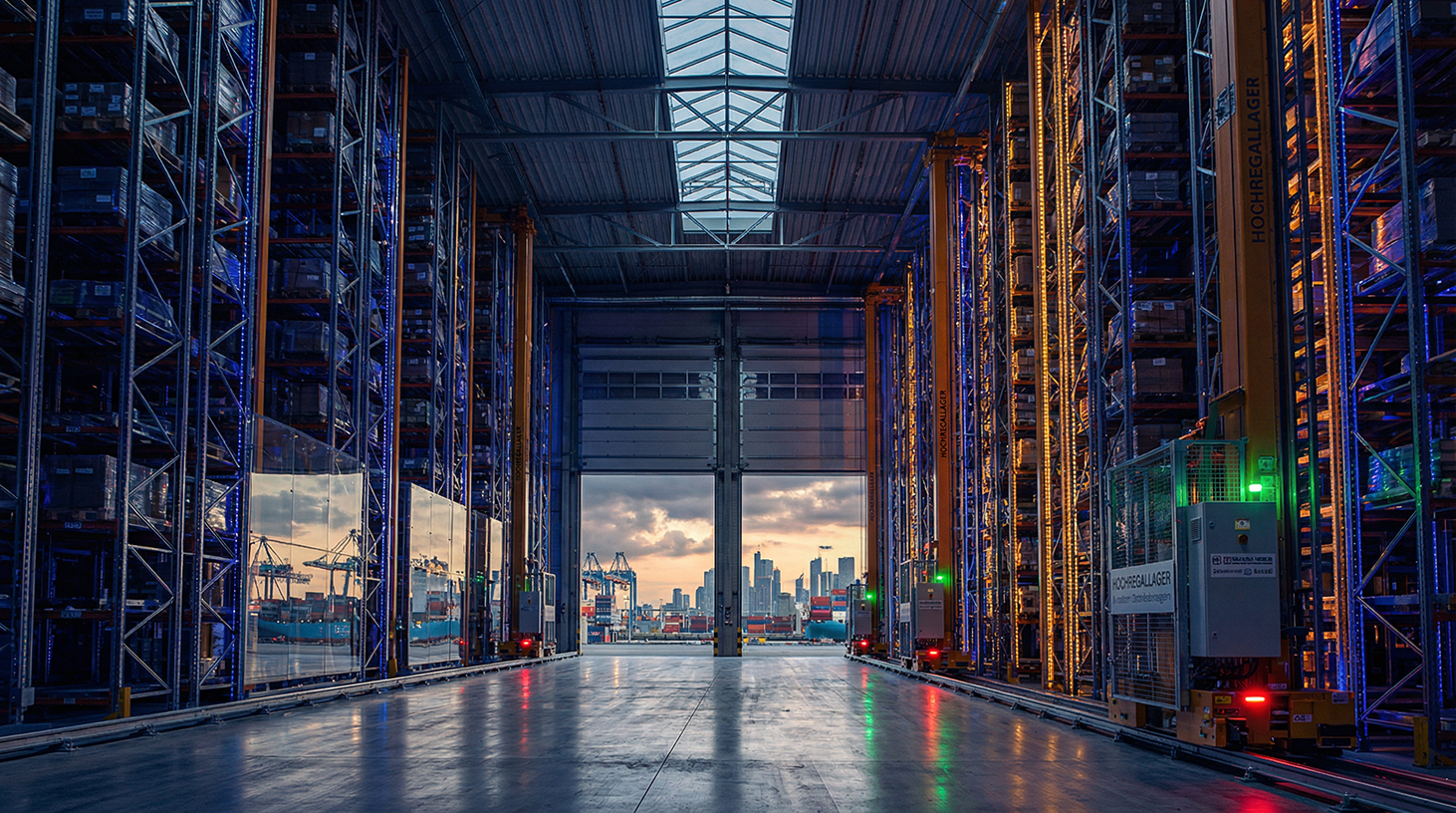
Neo-Nearshoring: How the global trade war is radically changing the construction of high-bay warehouses – From warehouse to protective buffer – Image: Xpert.Digital
Silo or warehouse? How to plan your new high-bay warehouse to be crisis-proof for the year 2050
A multi-billion dollar trend in logistics: This is why high-bay warehouses are now a crucial geopolitical factor
For a long time, building a high-bay warehouse was a purely mathematical and technical task: How many pallets fit in a given area, and how quickly can they be moved? But those days are over. In an era of global trade wars, fragile supply chains, and the definitive end of the "just-in-time" illusion, the high-bay warehouse has evolved from a simple cost factor into a strategic shield. The new trend toward "neo-nearshoring" and the return of robust buffer storage ("just-in-case") are forcing companies to completely rethink their logistics networks. This article explores why high-bay warehouse planning is now deeply intertwined with geopolitics, which construction methods are best suited for the future, and what really matters in terms of technical and economic dimensioning in an increasingly unpredictable world.
When warehouses become part of geopolitics: Why the high-bay warehouse is more than just a building today
For a long time, the decision regarding the planning and dimensioning of a high-bay warehouse was a purely technical matter – floor load-bearing capacity, rack geometry, throughput. Those days are over. Anyone planning a high-bay warehouse today must understand how global trade is structurally changing, why classic just-in-time strategies have reached their limits, and what strategic role regional warehouse infrastructure plays in so-called neo-nearshoring. The high-bay warehouse has become the safety net of a fragile global economy.
The new disorder: How global trade is changing its rules of the game
Global trade structures are undergoing a sustained, structural transformation that extends far beyond temporary disruptions. According to an analysis by Allianz Trade, the volume of trade affected by restrictions has almost tripled since 2024 alone, impacting goods worth an estimated US$2.7 trillion – nearly 20 percent of global imports. By mid-October 2025, 309 new tariffs had been imposed, almost twice as many as in the entire year of 2024. The result is a massive loss of confidence in long-term trade relationships, forcing companies to strategically realign their operations.
Particularly serious is the dynamic of geopolitical fragmentation: the greater the political distance between two economies, the less they trade with each other. If geopolitical distance increases by ten percent, bilateral trade falls by approximately two percent. This mathematically quantifiable rule has far-reaching consequences. The trend toward so-called friendshoring—that is, favoring geopolitically allied trading partners—significantly accelerates the regionalization of supply chains. At the same time, protectionism and state industrial policy are on the rise, so that supply chain security has now, in some cases, become a matter of national security.
For 2026, Allianz Trade forecasts global trade growth of just 0.6 percent – a decline of roughly two-thirds compared to 2025 (+2 percent). The trade war between the US and China, as well as the broader escalation of tariffs, will only fully unfold their delayed effects this year. This slowdown is not merely a cyclical jitter, but a structural shift that is forcing companies with global supply chains to fundamentally reassess their warehousing and procurement strategies.
The end of the illusion: Why just-in-time is obsolete
For decades, the just-in-time principle was considered the epitome of modern production logistics. Originally developed by Toyota in the 1970s, the idea was to minimize warehousing costs by ensuring that materials and components arrived precisely when needed. The model worked brilliantly – as long as the general conditions were stable, ports operated reliably, and political circumstances remained predictable.
The pandemic, the Suez Canal incident, the war in Ukraine, and now the global trade war have completely shattered this illusion. According to a study supported by SAP, up to 85 percent of the companies surveyed in the US and UK planned to switch from just-in-time to just-in-case production by 2023 at the latest. A survey of 5,000 companies by the ifo Institute in Germany confirmed that more than 40 percent of industrial companies intend to significantly restructure their procurement or have already done so. Just-in-case means: deliberately stockpiling more, deliberately planning for buffers, and deliberately accepting the costs associated with resilience.
This paradigm shift is not merely a reaction to crises, but rather the expression of a deeper realization: Optimizing for cost efficiency while neglecting risk buffers is not a model of entrepreneurial virtue, but a dangerous gamble on stability – a gamble that has increasingly been lost. Increasing safety stocks, diversifying the supplier base, and building regional warehousing capacities are the strategic responses that follow from this realization. The high-bay warehouse forms the physical foundation of this new resilience strategy.
Neo-nearshoring: More than cost optimization, a geopolitical reflex
The term nearshoring is not new, but in its current form it has acquired a new quality that justifies its own designation: neo-nearshoring. It is no longer primarily about exploiting wage cost advantages in Central and Eastern Europe, but about a fundamental realignment of production and supply networks with the aim of security of supply, speed of response, and geopolitical decoupling from critical dependencies.
The figures impressively demonstrate the trend: According to the ABB Supply Chain Survey 2025, 86 percent of the German companies surveyed are planning reshoring or nearshoring to make their supply chains more resilient. European and US companies are planning reindustrialization investments of $4.7 trillion over three years – an increase of more than a third compared to previous estimates (Capgemini 2025). This is clearly visible in megaprojects such as the ESMC semiconductor plant in Dresden (TSMC + Bosch + Infineon + NXP) or the VW PowerCo battery project in Salzgitter, with a combined investment volume of over €15 billion.
Nearshoring investments in Europe rose by 62 percent in 2022 and 2023 compared to 2018/19, while average investment spending per project tripled to $131 million. Nevertheless, caution is advised: Reshoring – the complete relocation of production back to the home country – remains economically expensive. The ifo Institute calculated that complete reshoring would reduce German GDP by 9.7 percent. Nearshoring to the EU plus Turkey plus North Africa reduces this damage to 4.2 percent. Furthermore, wages in Central and Eastern Europe are rising 3.5 times faster than productivity, eroding the initial cost advantages of these locations.
The decisive driver of neo-nearshoring is therefore no longer wage arbitrage, but rather the strategic consideration that shorter transport routes, more predictable political framework conditions, and the ability to react more quickly to market changes represent the more important capital. For warehouse planning, this means: New production sites in Europe require new regional warehouse infrastructure – quickly, efficiently, and with future-proof technology.
The high-bay warehouse as a strategic asset: Planning begins with the right question
A high-bay warehouse is designed for a service life of 20 to 30 years or more. The decisions made during the planning phase therefore determine a company's logistical capabilities for decades to come. Anyone planning today is planning for a world that will look like in 2040 or 2050 – and which is likely to be fundamentally different from today's.
The first strategic question in the planning process is not the racking technology, but rather the clarification of roles: Should the high-bay warehouse serve as a buffer warehouse close to production, as a regional distribution center in a neo-nearshoring structure, as an emergency buffer in a just-in-case model, or as a fully integrated part of an automated production line? This functional role definition determines all subsequent decisions regarding location, size, degree of automation, and operating strategy.
The second fundamental question concerns the sizing approach. Traditionally, the required capacity was derived from historical consumption data and projected growth. In an era of volatile supply chains and abrupt market shifts, this is no longer sufficient. Robust sizing today must include scenario analyses: What does a three-week supply disruption from the main supplier mean for the capital requirements in the warehouse? What buffer size is needed to remain operational during a geopolitical shock? What capacity growth results from an accelerated nearshoring scenario? These questions cannot be answered by looking at the past – they require forward-looking planning.
Site selection and building design: silo or hall – a fundamental decision with consequences
The choice between silo construction and conventional warehouse construction is one of the most consequential decisions in the entire planning process. In silo construction, the racking systems themselves form the load-bearing structure: they support not only the stored loads but also the roof, exterior cladding, and external forces such as wind, snow, and earthquakes. The decisive advantage: construction work is minimal, assembly is faster, and the overall costs are significantly lower than those of conventional warehouses. Silo construction allows for building heights of up to 45 meters and eliminates disruptive intermediate columns, thus optimizing space utilization.
Conventional warehouse construction, in which the high-bay racking system is installed as a separate structure within an existing or newly constructed building, offers greater flexibility for future modifications and changes in use. It is particularly suitable when changes in warehouse use are anticipated or when operational requirements necessitate a separation of the building envelope and the warehouse structure. The higher construction costs are the main drawback.
Location selection is also a strategic decision with long-term consequences. In addition to classic infrastructure criteria such as motorway and rail connections, the availability of skilled workers, and energy costs, new factors are gaining importance in the neo-nearshoring era: proximity to new production sites, access to intermodal hubs for cross-border transport, and the regulatory and tax framework of the respective host country. Customs clearance capacities and border infrastructure play an often underestimated role, particularly when developing new supply chains in Eastern Europe, Turkey, or North Africa.
The soil conditions and seismicity of the site are technical parameters that must be examined early in the planning process. A high-bay warehouse exerts considerable forces on the ground due to its height and mass. For silo construction, the ratio of the building's height to its smallest horizontal dimension should not exceed four. Earthquake resistance, wind loads, and soil bearing pressure must be verified through structural calculations – in earthquake-prone regions, which include parts of the Mediterranean, stricter foundation requirements must be met.
LTW Intralogistics Solutions

LTW Intralogistics – Engineers of Flow - Image: LTW Intralogistics GmbH
LTW offers its customers not individual components, but integrated complete solutions. Consulting, planning, mechanical and electrotechnical components, control and automation technology, as well as software and service – everything is networked and precisely coordinated.
In-house production of key components is particularly advantageous. This allows for optimal control of quality, supply chains, and interfaces.
LTW stands for reliability, transparency, and collaborative partnership. Loyalty and honesty are firmly anchored in the company's philosophy – a handshake still means something here.
Related to this:
How to plan efficient high-bay warehouses – Automated warehouse: Investment calculator, ROI facts and dark warehouse potential
Technical dimensioning: capacity, throughput and the right system selection
The core objective of technical dimensioning is to strike a balance between the required storage capacity (measured in pallet spaces or container locations) and the necessary throughput (measured in storage and retrieval operations per hour). Together, these two parameters determine the number of racking aisles, the number of storage and retrieval machines or shuttles, and the dimensions of the storage system.
The technical throughput of a high-bay warehouse with stacker cranes depends on several factors: the travel and lifting speed of the stacker crane, the aisle length and height, the warehouse occupancy rate, and the warehouse operating strategy – in particular, whether single or double cycles are used. Double cycles, in which the stacker crane both stores and retrieves goods in a single work cycle, significantly increase throughput and are standard practice when high throughput is required. Simulation is recommended for preliminary planning, as organizational factors – occupancy rate, order mix, batch sizes – make precise analytical calculations complex.
Modern automated storage and retrieval systems (AS/RS) utilize stacker cranes that operate in very narrow aisles of approximately 2,000 millimeters – freeing up to 40 percent more usable floor space for actual storage compared to conventional storage solutions. Crane systems can operate at heights of over 30 meters, and modern AS/RS solutions, with their shuttle systems, can even reach heights of up to 50 meters. AS/RS systems held a market share of 30.5 percent in the automated storage solutions sector in 2024; autonomous mobile robots (AMRs) are growing significantly faster, with an annual growth rate of 20.5 percent, and are well-suited for flexible supplementary tasks.
The decision between a conventional unit-load AS/RS – i.e., a system for full pallets or large-volume loading units – and a mini-load AS/RS for smaller containers and cartons depends on the product portfolio and order structure. For pure pallet warehouses in industrial and consumer goods logistics, the classic storage and retrieval machine for Euro pallets remains dominant; in e-commerce and pharmaceutical logistics, smaller, highly dynamic shuttle systems are gaining in importance.
Automation as an economic driver: Investment and return on investment
The investment costs for a fully automated, medium-sized high-bay warehouse range from five to twenty million euros – a considerable capital outlay that requires careful cost-benefit analysis. In addition, integration costs of approximately 20 to 30 percent of the system costs are incurred for incorporating the system into existing IT systems, warehouse management software (WMS), and warehouse execution systems (WES). The total investment for a medium-sized high-bay warehouse therefore often amounts to ten to 25 million euros or more in practice, depending on complexity and the degree of automation.
The economic justification stems from several key benefits: Automation significantly reduces personnel costs, minimizes human error, and allows for 24/7 operation—without proportionally increasing labor costs. Robotics and automation can increase warehouse productivity by 25 to 70 percent. The use of automated guided vehicles (AGVs) reduces internal transport costs by up to 40 percent. With machine vision, the error rate for machine-based order picking is a mere 0.05 percent—a figure virtually unattainable with manual processes. In practice, autonomous mobile robots pay for themselves in less than 24 months, with a return on investment (ROI) exceeding 250 percent.
An often overlooked advantage of fully automated high-bay warehouses is the possibility of so-called dark warehouse operation: Without human employees in the warehouse area, lighting, heating, and climate control requirements comparable to those of human working conditions are eliminated. Especially in frozen food logistics, a growing segment given the ten percent increase in consumption of chilled and frozen products since the pandemic, the elimination of these operating costs represents a significant competitive advantage. At the same time, automation enables precise, real-time inventory transparency, which is essential for just-in-case management and the accurate control of buffer storage strategies.
Buffer stocks and safety stocks: The new currency of supply chain security
In the age of neo-nearshoring and fragile supply chains, safety stock has taken on new strategic importance. Buffer stocks act as temporary storage between different production or distribution processes, compensating for differences in cycle times, seasonal demand fluctuations, and unforeseen supply disruptions. What was long considered waste in the context of lean philosophy—namely, tying up capital in idle inventory—is now re-evaluated as an insurance premium against supply chain disruptions.
The challenge lies in finding the right balance. Buffers are expensive: they tie up capital, require storage space, and create handling and shelf-life risks. At the same time, an insufficiently sized buffer can lead to production stoppages in a crisis, costing many times more than the storage costs. The answer is not maximum inventory, but intelligent, data-driven buffer sizing: larger buffers will be justified for critical components with long lead times and high risk profiles than for standardized mass-produced goods with many available suppliers.
For companies establishing new production sites or switching to European suppliers as part of neo-nearshoring, the transition phase presents an increased need for buffer capacity. The shift from long sea freight shipments from Asia to shorter land routes from Europe significantly reduces transit time—thus enabling lower safety stocks while maintaining the same level of supply security. In this context, the high-bay warehouse of the neo-nearshoring era is not a static, long-term storage facility, but rather a highly dynamic buffer system with short turnover cycles, capable of flexibly responding to changing supply situations.
Digital Integration: The Warehouse as a Data-Driven Control Center
The modern high-bay warehouse is no longer an isolated physical object, but a data-driven hub in a digital value network. The complete integration of warehouse management systems (WMS), warehouse execution systems (WES), ERP systems, and supplier platforms is no longer optional, but a fundamental requirement for operation. IoT sensors in advanced warehouse facilities—at densities of up to 20 sensors per square meter—enable real-time tracking of storage location, environmental conditions, and equipment status. 5G connectivity ensures that connected systems respond in less than 50 milliseconds.
Artificial intelligence transforms this sensor data into operational decisions: Predictive algorithms optimize storage location allocation to minimize picking routes—Amazon, for example, reduced its picking routes by 60 percent using this method. Anomaly detection systems identify equipment malfunctions before downtime occurs. Dynamic routing software optimizes warehouse movements in real time based on current order intake. For inventory planning, this digitalization means that the foundation of just-in-case management is not intuition, but data: predictive analytics that automatically calculate and adjust the optimal safety stock based on supplier performance, transport reliability, and historical disruption patterns.
The digital maturity of a warehouse system thus has a direct impact on its physical dimensions. A warehouse with complete data transparency and AI-based inventory management can operate with lower safety stock levels than a manually managed warehouse because deviations can be detected and corrected earlier. Investments in digitalization and automation should therefore not be considered in isolation, but rather as an integrated optimization system that affects both physical capital requirements and operational costs.
Sustainability and energy efficiency: From cost factor to certification requirement
High-bay warehouses are among the most energy-intensive building types in industrial infrastructure. The main energy consumers are continuous lighting, heating, ventilation and air conditioning systems, cooling systems in temperature-controlled storage areas, electric conveyor technology and storage and retrieval machines, as well as IT and communication systems. Given rising energy prices and increasing ESG requirements from supply chain legislation, lenders, and major customers, the energy efficiency of the warehouse system is now a crucial competitive factor.
Modern planning approaches integrate energy efficiency from the outset: LED lighting with motion sensors, solar energy on large roof surfaces, heat recovery systems, efficient refrigeration compressors for temperature-controlled areas, and demand-controlled ventilation systems. Fully automated high-bay warehouses offer the specific advantage of being able to operate in dark warehouse mode: Without employees present in the storage area, the need for comfortable air conditioning and continuous lighting is completely eliminated. This translates into significant energy savings, especially in deep-freeze facilities, because door openings and heat input from people are minimized.
The sustainability of a high-bay warehouse is also evident in its space efficiency: an automated system, with its vertical design and narrow aisles, can reclaim up to 85 percent of the floor space compared to conventional warehousing. On increasingly scarce and expensive commercial land—especially near the European production sites so sought after in the neo-nearshoring era—this represents a tangible economic advantage. Furthermore, land sealing is a growing regulatory and societal concern; the compact, vertically optimized high-bay warehouse performs significantly better in this regard than sprawling single-story warehouses.
Economic risks and strategic miscalculations in planning
The most frequent and consequential errors in high-bay warehouse planning arise not from technical issues, but from strategic thinking. A systematic underestimation of future growth and changing inventory requirements leads to oversized expansion investments just a few years after commissioning. Conversely, some companies overestimate their automation needs and invest in systems whose complexity and rigidity restrict operational flexibility.
In the context of neo-nearshoring, particular caution is required when planning locations: Anyone building a high-bay warehouse near an existing offshore site today could face the problem in just a few years that the production landscape has shifted and the warehouse is no longer optimally positioned. Nearshoring locations such as parts of Poland, the Czech Republic, or Romania, which currently appear attractive, will come under pressure in the medium term due to the rapidly increasing productivity gap between wages and actual value creation. A high-bay warehouse with a twenty-year lifespan should therefore not be built solely on current cost calculations, but also on scenario-robust site analyses.
Equally critical is the underestimation of integration costs: For a fully automated high-bay warehouse, the pure equipment costs often account for only 70 to 80 percent of the total investment. The remaining 20 to 30 percent is attributable to IT integration, training, commissioning, and the adaptation of downstream processes. These costs are regularly underestimated in early project phases, leading to budget overruns and delays. Likewise, ongoing costs for maintenance, software updates, and the replacement of wear parts must be fully considered in the life cycle assessment.
The high-bay warehouse as an answer to a wounded world order
Today's high-bay warehouse is a product of a wounded world order. The fragmentation of global trade, the rise of neo-nearshoring, the abandonment of just-in-time delivery, and the transition to robust just-in-case strategies are collectively creating a new demand for regional, intelligent, and resilient warehouse infrastructure in Europe. The global trade war, the consequences of which, according to Allianz Trade 2026, will be a collapse in global trade growth to 0.6 percent, is further accelerating this dynamic.
Companies investing today in a well-planned, properly sized, and fully digitized high-bay warehouse are acquiring more than just a building. They are gaining strategic capability in a world where the ability to ensure security of supply is becoming a competitive advantage. Planning such a system requires a combination of technical precision, economic foresight, and geopolitical awareness—a combination that is not standardized but determines the success or failure of the investment.
Consulting - Planning - Implementation

Konrad Wolfenstein
I would be happy to serve as your personal advisor.
contact me at wolfenstein ∂ xpert.digital
Just call me on +49 7348 4088 965 .
Your intralogistics experts

Consulting, planning and implementation of complete solutions for high-bay warehouses and automated storage systems - Image: Xpert.Digital
More information here:










