
NATO in transition: Europe's defense without America – no longer a pipe dream, but not yet a guarantee of security
Xpert Pre-Release

Available in 27 languages 📢
Prefer Xpert.Digital on GoogleⓘPublished on: April 12, 2026 / Updated on: April 12, 2026 – Author: Konrad Wolfenstein
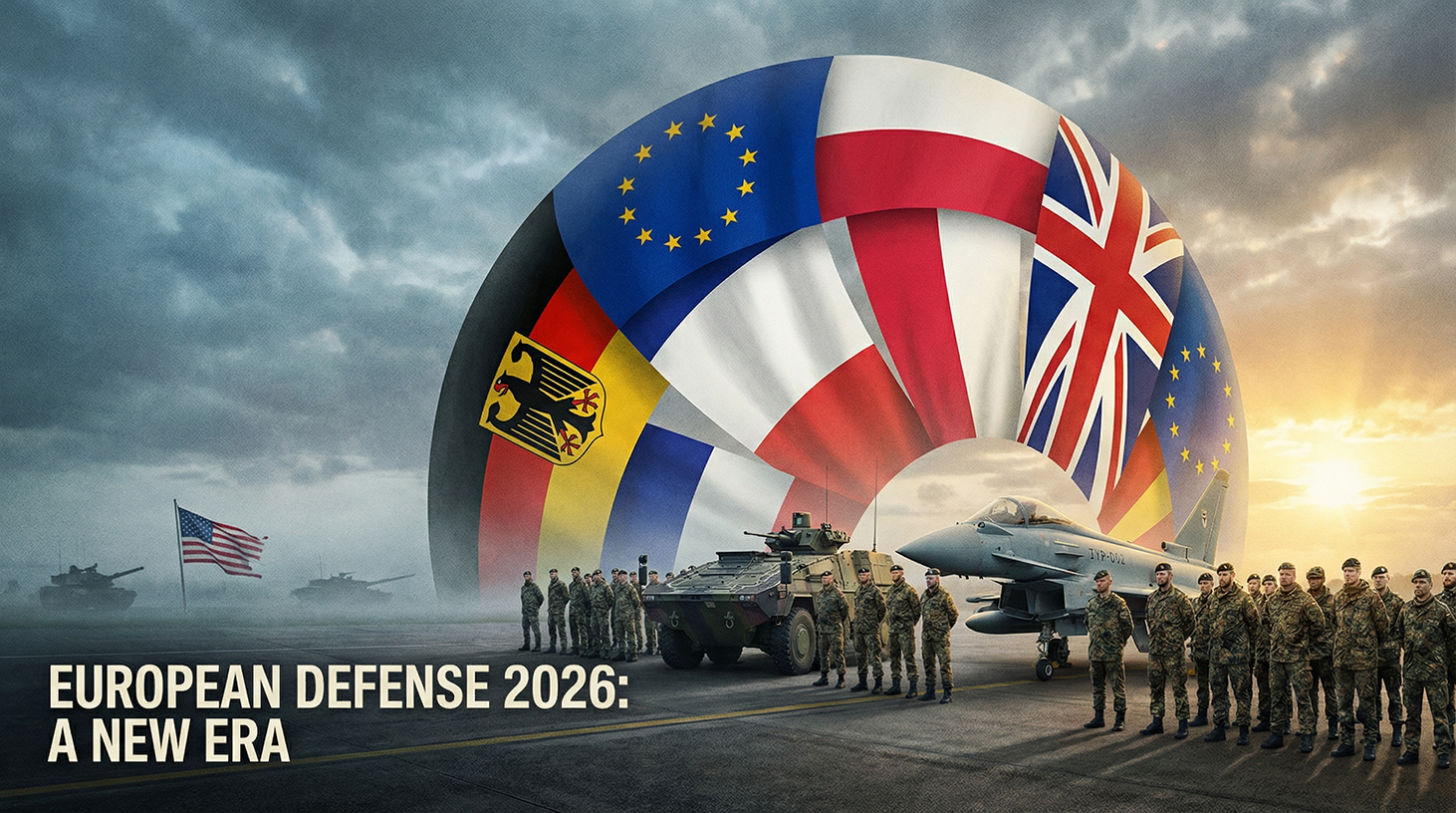
NATO in transition: Europe's defense without America – no longer a pipe dream, but not yet a guarantee of security – Image: Xpert.Digital
A turning point in 2026: Can Europe truly defend itself against Russia?
Three scenarios for what Europe's security will look like in the future
Europe's 4 most dangerous defense gaps: What we really face without the USA
A political earthquake is shaking the transatlantic security architecture: While the US, under a new administration, is rapidly shifting its geopolitical focus toward Asia and homeland security, Europe faces its greatest defense policy challenge since the end of the Cold War. The unmistakable message from Washington is that European allies will have to bear the brunt of their conventional security in the future. But is the continent even capable of doing so? Although European defense budgets are reaching historic highs—especially in Germany—dangerous gaps still exist between political will and actual operational capability. A lack of nuclear deterrence, dependencies on strategic intelligence, and logistical shortcomings raise a pressing question: Is talk of an independent European defense a realistic strategy for the future or a dangerous overestimation of its own abilities? The following analysis sheds light on the unvarnished reality of the arms race, the American shift away from Europe, and the question of how much time Europe has left to truly stand on its own two feet.
Related to this:

Between the will to rearm and a strategic gap – what Europe can and cannot really do
It was a statement that caused considerable irritation in Brussels. NATO Secretary General Mark Rutte declared unequivocally before the European Parliament in January 2026: If anyone believed that the EU or Europe as a whole could defend itself without the US, they should keep dreaming. "You can't. We can't. We need each other," Rutte stated. The reaction from the European foreign ministers was predictably sharp. French Foreign Minister Jean-Noël Barrot immediately countered on social media, arguing that Europe could and must assume responsibility for its own security. Spanish Foreign Minister José Manuel Albares called for a European army.
This exchange illustrates the fundamental tension shaping the European security debate of 2026: between the sobering reality check of existing capability gaps and the political will for a new European security doctrine, increasingly demanded by the United States. The question of whether Europe can defend itself without America is not merely academic. It has become one of the central strategic questions of the decade, as the Trump administration in the White House and the US National Defense Strategy 2026 jointly signal that Europe must assume primary responsibility for its conventional defense.
The context: American withdrawal signals and their strategic consequences
The most significant shift in the transatlantic security architecture of 2026 is not a single event, but a pattern. US Defense Secretary Hegseth stated that the American presence in NATO could not be assumed to last forever. Trump referred to NATO without the US as a “paper tiger” on Truth Social—a comment made during a dispute with allies over US operations in the Strait of Hormuz. The US National Defense Strategy 2026 explicitly states that European nations should assume primary responsibility for their own conventional defense, while Washington shifts its focus to homeland security and containing China. The NATO target of 5 percent of GDP for defense (3.5 percent for nuclear military spending plus 1.5 percent for security-related spending) was agreed upon at the 2025 Hague Summit.
US Secretary of State Elbridge Colby outlined the new assessment of the situation in Brussels: There is a "very strong basis for a NATO 3.0 based on partnership rather than dependence." The US is thus not signaling a complete withdrawal, but a fundamental readjustment of the burden-sharing. Europe is to primarily handle conventional defense itself; the US will retain nuclear deterrence and strategic intelligence capabilities.
The figures: Europe's arms buildup is real, but unevenly distributed
First, the good news: The momentum of European defense spending since 2022 is historic. In 2024, EU countries spent a total of €343.2 billion on defense. The European Defence Agency projects this figure to reach €392 billion in 2025 – almost double the €198 billion spent in 2020. Collective European NATO spending, including Canada, was expected to reach approximately US$580 billion in 2025.
Germany has become the largest European contributor to defense spending. The 2026 defense budget comprises more than €108 billion – made up of €82.69 billion in budget line 14 and €25.51 billion from the special fund for the German Armed Forces. By 2029, the defense budget is projected to rise to around €152 to €153 billion – almost three times the amount spent in 2021. Germany plans to reach the NATO target of 3.5 percent of GDP as early as 2029, six years ahead of schedule.
France follows with €59.6 billion (2024), Italy with €32.7 billion, and Poland with €31.9 billion. Poland stands out in particular: with over 4 percent of its GDP spent on defense – the highest figure of all NATO members – Polish policy reflects a fundamentally altered security awareness resulting from its geographical proximity to the front line. By 2025, seven NATO countries were spending more than 3 percent of their GDP on defense; three countries had already reached the 3.5 percent target.
Hub for Security and Defense - Advice and Information

Hub for Security and Defense - Image: Xpert.Digital
The Security and Defence Hub offers expert advice and up-to-date information to effectively support companies and organizations in strengthening their role in European security and defence policy. Working closely with the SME Connect Defence Working Group, it particularly promotes small and medium-sized enterprises (SMEs) that wish to further develop their innovative capacity and competitiveness in the defence sector. As a central point of contact, the Hub thus creates a crucial bridge between SMEs and European defence strategy.
Related to this:
Europe in a period of arms transformation: How realistic is genuine defense autonomy?
The skills gaps: What the numbers don't show
Despite these impressive figures, NATO's sobering analysis remains valid: spending and operational capabilities are not the same thing. The structural gaps that Europe faces without American support are significant and cannot be closed in the short term.
The most critical gap is nuclear deterrence. Only France and Great Britain possess nuclear capabilities in Europe. Rutte's warning that an independent European nuclear deterrent would require 10 percent of GDP instead of the current 5 percent target and would cost hundreds of billions of euros to develop an independent nuclear capacity is a sobering calculation.
The second critical gap is strategic intelligence, surveillance, and reconnaissance (ISR). To this day, Europe remains heavily reliant on American satellites, reconnaissance aircraft, and data sharing. The third gap is the capability for high-volume troop and equipment transport over long distances—a strength of the US armed forces for which Europe has no equivalent alternative. A fourth dimension is munitions production: The experience of the Ukraine war has shown that European arms production capacities are insufficient to support a high-intensity conflict over an extended period.
Chatham House clearly summarizes the timeframe: Europe needs at least five to ten years for full rearmament, while NATO estimates that Russia could attempt an attack on NATO territory within four years. The current European response lacks urgency and strategic vision.
Related to this:

Three scenarios for NATO's future
The debate about the future of NATO and European defense autonomy is crystallizing around three realistic scenarios:
- In the first scenario – “Transatlantic NATO Minus” – the US remains in the alliance but reduces its military footprint in Europe. Europe assumes primary conventional responsibility, while Washington contributes key areas such as nuclear deterrence, strategic intelligence, and high-value capabilities. This scenario aligns with the current direction of the US National Defense Strategy 2026.
- In the second scenario – “European Defense Union” – the US withdraws from NATO, and Europe organizes its own security. According to Chatham House, this scenario requires not only enormous procurement budgets but also a deepening of European political integration over decades, something most governments are not yet seriously pursuing. The first step would be achievable; the second requires political courage on a scale that is historically rare.
- In the third scenario – “NATO as a modular system” – the US formally remains involved, but without assuming a leadership role. This is the most unstable scenario, as it offers neither the clarity of a genuine European leadership claim nor the reliability of an American security guarantee.
The EU as a defense actor: PESCO and the 800 billion mobilization
Parallel to the NATO debate, the EU is expanding its own defense capabilities. Within the framework of Permanent Structured Cooperation (PESCO), Europe is now pursuing over 70 projects – from unmanned ground systems and integrated air and missile defense to cyber capabilities. At the Munich Security Conference in 2026, EU Commission President von der Leyen announced the mobilization of up to €800 billion for defense capabilities – from air and missile defense to drones and military mobility. The Commission's "Defence Readiness Roadmap 2030" already includes initial milestones for 2026.
In certain areas, Europe already demonstrates independent strengths in terms of quality. In maritime and cyber capabilities, Europe already operates at a high level without full American oversight: NATO operations in the North Atlantic in spring 2025 were conducted without a single US ship in the task force.
The key question: Rearmament as a serious turning point in history or a political slogan?
The former president of the Federal Academy for Security Policy, Karl-Heinz Kamp, puts forward a remarkably optimistic thesis: Russia's military capabilities for a NATO attack and Europe's deterrent capacity are developing dynamically in opposite directions. Russia's military has been significantly weakened, exhausted, and worn down by the war in Ukraine – while at the same time, Europe's conventional capabilities are growing. In such a case, that is, with a largely US decoupling from Europe, the European NATO partners would indeed be capable of building their own defense against a declining Russia.
This assessment is not merely optimistic, but sober in both directions. Yes, Germany is increasing its defense budget from approximately €50 billion in 2022 to a planned €108 billion in 2026 – that is a real increase in power. No, Europe cannot completely replace the US today – that would be a dangerous overestimation of its own capabilities. The central political message for 2026 is therefore this: Europe does not need ten years to build a capable defense alliance that can deter conventional Russian aggression. But it will still require about five years of consistent, well-funded, and politically determined efforts – and the certainty that the transatlantic alliance will not completely collapse during this transition period.
Sleeping is over, waking is only just beginning
Europe's security policy paradigm shift is real. The figures demonstrate a historic increase in defense spending. The political will is there, and awareness of the seriousness of the situation has grown. But the path from rising budgets to operational capability is long: weapons systems must be developed, procured, integrated, and soldiers trained on them. Command structures must be reformed, ammunition stockpiles replenished, and interoperability gaps closed. Rutte's warning is uncomfortable, but analytically correct—for the current situation. Kamp's thesis is also correct—but for the situation in five to eight years. The year 2026 lies precisely in the middle: Europe is no longer sleepy, but not yet awake enough to stand alone.
Consulting - Planning - Implementation

Markus Becker
I would be happy to serve as your personal advisor.
Head of Business Development
Chairman SME Connect Defense Working Group
Consulting - Planning - Implementation
Konrad Wolfenstein
I would be happy to serve as your personal advisor.
contact me at wolfenstein ∂ xpert.digital
Just call me on +49 7348 4088 965 .





