
Europe's defense via inland ports and waterways: From logistical bottleneck to strategic multiplier
Xpert Pre-Release

Available in 27 languages 📢
Prefer Xpert.Digital on GoogleⓘPublished on: September 5, 2025 / Updated on: October 6, 2025 – Author: Konrad Wolfenstein

Europe's defense via inland ports and waterways: From logistical bottleneck to strategic multiplier – Image: Xpert.Digital
Tanks stuck in traffic? How Europe's rivers are solving NATO's biggest logistics problem
The forgotten front: Why civilian inland ports are suddenly becoming strategic NATO bases
Since the Russian invasion of Ukraine in 2022, European security has faced a new reality in which the rapid deployment of troops and heavy equipment has become a strategic necessity. However, traditional transport routes—roads and railways—are already chronically congested and only partially suitable for transporting tanks, artillery, and supplies on a large scale. At this critical juncture, a long-underestimated system is coming into focus for EU and NATO defense planners: Europe's extensive network of inland waterways and ports.
Previously considered purely civilian transport arteries for the economy, the Rhine, Danube, and other waterways are revealing themselves to be a hidden strategic resource. Their enormous capacity for heavy loads, the reduced bureaucratic burden, and the possibility of 24/7 operation make them the ideal transport route for quickly and efficiently supplying NATO's eastern flank in a crisis. However, this "hidden defensive power" can only be realized if massive challenges are overcome: decades of deferred maintenance, infrastructure bottlenecks, and the increasing threat of climate-related low water levels.
This article analyzes how Europe's waterways can transform from a logistical bottleneck into a crucial strategic multiplier within the framework of the EU's "Military Mobility" concept. It is the story of a fundamental reassessment in which civilian infrastructure such as ports and canals becomes a central pillar of European collective defense, requiring new ways in which policy, technology, and military planning intertwine.
The hidden defensive power of inland ports in Europe's infrastructure
Why is inland navigation becoming a focus of European defense planning?
The geostrategic landscape of Europe has fundamentally changed since the Russian invasion of Ukraine in 2022. This watershed moment has underscored with new urgency the critical importance of robust logistics and the ability to rapidly deploy troops for credible deterrence and the defense of Alliance territory. The capacity to move military forces and heavy equipment quickly, seamlessly, and on a large scale has transformed from a secondary technical issue into an urgent strategic priority for the European Union (EU) and NATO. In this context, Europe's extensive network of inland waterways and ports, traditionally a purely civilian domain, is undergoing a fundamental reassessment as a strategic resource for collective defense.
The shift towards waterways is less a matter of mere opportunity than a strategic necessity. It stems from the recognized vulnerability and increasing saturation of traditional land transport routes. Civilian logistics already suffers from chronically congested road and rail networks. Large-scale military transports, particularly of tanks, artillery, and other heavy or oversized equipment, dramatically exacerbate these bottlenecks and are often fraught with extreme bureaucratic and physical obstacles. Inland waterway transport, on the other hand, possesses considerable spare capacity and is systemically far better suited for heavy-load transport. The strategic realignment towards waterways is therefore a logical diversification move to increase the resilience of the entire European defense logistics system. The aim is to reactivate a third, high-capacity transport corridor and upgrade it for military purposes.
This report examines how the “hidden defensive power” of waterways can transform from a potential logistical bottleneck, characterized by a backlog of repairs and the consequences of climate change, into a strategic multiplier for European security. The analysis progresses from the civilian foundations of inland navigation, through the military-strategic requirements of “military mobility” and existing infrastructural deficits, to concrete potentials, case studies of strategic ports, and future technological and political perspectives.
The civilian foundation – Europe's inland waterways as the logistical backbone
What role does inland navigation play for the European economy and logistics?
Inland waterway transport is an integral and often underestimated component of the overall European transport system. It is a cost-effective, safe, and, compared to road and rail, particularly environmentally friendly mode of transport with high energy efficiency and, crucially for future needs, still considerable spare capacity. The systemic advantages are evident: An inland vessel can transport one ton of cargo almost four times as far as a truck with the same energy consumption and produces significantly lower CO2 emissions. Germany plays a central role in this, handling approximately half of the EU's total inland waterway traffic.
Their systemic relevance is particularly evident in the transport of bulk goods. Inland waterway transport is an indispensable supply artery for key industries such as steel and chemicals, which obtain large quantities of raw materials like ores, coal, petroleum products, and basic chemicals via waterways. For example, around 40% of the steel industry's transport volume is handled by water. Furthermore, container transport, especially in the traffic to and from major seaports, is steadily gaining importance and integrating the hinterland into global supply chains.
The economic structure of the sector is predominantly fragmented. It is characterized by a large number of small companies, the so-called "participants," who often operate only one or two vessels. Despite its fundamental importance to the economy, transport performance is volatile. It is influenced by economic cycles, but also increasingly by external factors such as the extreme low water levels of recent years. For example, the volume of goods transported on German inland waterways fell to 172 million tons in 2023, the lowest figure since German reunification.
What characterizes the infrastructure of inland ports and how has their function changed?
The role of inland ports has changed dramatically in recent decades. Formerly mere transshipment points for the transfer of goods between shipping and land transport, they have transformed into highly developed, multifunctional logistics and industrial centers. These hubs now host significant logistical value creation, ranging from packaging, order fulfillment, and distribution to repair services and the further processing and finishing of goods. Functions traditionally located in major seaports are increasingly shifting to inland ports, further enhancing their strategic importance.
The crucial prerequisite for this development is the trimodal connectivity that characterizes strategically important ports such as Duisburg and Vienna. They seamlessly link the transport modes of waterway, rail, and road, thus functioning as integrated hubs within the European transport network. This intermodal capability is the key to efficient and resilient supply chains. Recognition of this systemic importance was already established at the European level in 2001 with the official inclusion of inland ports in the Trans-European Transport Network (TEN-T). Today, around 70% of Germany's federal waterways have international significance as part of this core network.
This functional transformation of inland ports from mere transshipment points to comprehensive logistics hubs is the crucial foundation for their potential military use. A purely transshipment port would be insufficient for the complex requirements of military logistics. Military deployments are more than just transporting materials from point A to point B; they require secure staging areas, vehicle maintenance and repair facilities, large and secure storage areas, and the ability to reassemble and repack units and materials for onward transport. Modern inland ports already offer precisely these capabilities—warehouses, repair services, distribution areas, and heavy-lift cranes—to the civilian sector. Military use thus directly benefits from this already advanced civilian development. A port's ability to serve as a "strategic multiplier" depends directly on its level of development as a modern, integrated logistics hub. The new defense policy requirements therefore accelerate and reinforce a civilian transformation that is already underway.
The strategic context – Military mobility as a cornerstone of alliance defense
What lies behind the concept of “military mobility” and why is it so crucial for the EU and NATO?
The concept of “military mobility” refers to the ability to move military personnel, materiel, and equipment quickly, efficiently, and without hindrance within and across the borders of the European Union. Often referred to as “military Schengen,” it aims to eliminate the two main obstacles to rapid troop movements: bureaucratic barriers and physical infrastructure deficiencies. The overarching goal is to ensure that the armed forces of alliance partners are “in the right place at the right time,” whether in the context of an EU or NATO operation.
The political framework for this initiative was established in 2017 with the creation of a dedicated project within the framework of Permanent Structured Cooperation (PESCO), led by Germany and the Netherlands. Building on this, the European Commission presented an initial action plan in 2018. Following Russia's full-scale invasion of Ukraine in 2022, this plan was revised with renewed urgency and relaunched as the "Military Mobility Action Plan 2.0" for the period 2022-2026. Both the EU's Strategic Compass and NATO's Strategic Concept of 2022 emphasize the essential importance of military mobility for collective defense.
Military mobility is a prime example of the complementary and strategic partnership between the EU and NATO. Cooperation is clearly divided: while NATO defines the military requirements – that is, which forces need to be deployed where and how quickly – the EU focuses on the civilian and regulatory framework that enables this. This includes adapting transport infrastructure, harmonizing legal procedures, and providing funding. The transatlantic relevance of the project is underscored by the fact that strategic partners such as the USA, Canada, Norway, and the United Kingdom have joined the PESCO project. This approach marks a paradigm shift in European security policy: the EU is leveraging its inherent civilian expertise in transport, infrastructure, and the internal market, as well as its powerful financial instruments, to close a genuinely military capability gap. It is thus circumventing its own treaty limitations in the area of “hard” defense by strategically deploying its civilian policy areas. In this way, the EU becomes an indispensable actor for NATO – not by providing armies, but by creating the physical and regulatory conditions for their deployment. Infrastructure policy thus becomes geopolitics.
What specific obstacles – bureaucratic and physical – hinder the rapid deployment of troops in Europe?
Despite political prioritization, significant obstacles remain. A European Parliament report in 2025 soberingly noted that seven years after the first action plan of 2018, many of the problems identified at that time—outdated bridges, tunnels, railways, and inconsistent regulations—remain unresolved. Progress is slowed by the EU's complex structure and the fact that defense and infrastructure planning largely remain national competences.
The first major obstacle is bureaucratic. A patchwork of lengthy and non-harmonized national procedures exists for cross-border movement permits. Each border crossing often requires separate applications for diplomatic clearances, customs formalities, and special permits for transporting dangerous goods or oversized and overweight equipment. The stated objective of the EU Action Plan is to reduce the time required to issue such permits to a maximum of three working days – an objective that will require significant national efforts. The European Defence Agency (EDA) is therefore working on technical agreements to standardize and simplify these procedures for land, air, and water transport.
The second, equally serious obstacle is physical. Much of Europe's transport infrastructure is not designed to meet the demands of modern military transport. Many bridges cannot support the weight of heavy battle tanks, tunnels are too low, and railway lines are unsuitable for loading wide military equipment. Particularly within the Trans-European Transport Network (TEN-T), bottlenecks and missing links persist, preventing seamless and rapid transport. Identifying and eliminating these physical weaknesses is therefore a core objective of the EU initiative.
Hub for security and defense - advice and information

Hub for security and defense - Image: Xpert.digital
The hub for security and defense offers well-founded advice and current information in order to effectively support companies and organizations in strengthening their role in European security and defense policy. In close connection to the SME Connect working group, he promotes small and medium -sized companies (SMEs) in particular that want to further expand their innovative strength and competitiveness in the field of defense. As a central point of contact, the hub creates a decisive bridge between SME and European defense strategy.
Suitable for:
Dual-use on the rivers: Using CEF funds for military mobility
The logistical bottleneck – infrastructural deficits and systemic weaknesses
What specific infrastructural deficiencies limit the capacity of European waterways?
European, and particularly German, waterway infrastructure suffers from a significant and long-standing backlog of necessary repairs, severely limiting its capacity. A large portion of the network does not meet modern requirements for efficient freight transport. For example, almost 60% of the waterways in Germany's core network fail to meet minimum quality standards, such as a lock length of 110 meters for modern large motor cargo vessels or a guaranteed draft of 2.80 meters for at least 250 days a year. The aging of the infrastructure is dramatic: around half of all locks are over 80 years old, and more than 70% of weirs are in a precarious structural condition. The situation is exacerbated by a lack of personnel in the responsible planning and administrative authorities, which further slows down the implementation of urgently needed repair and expansion projects.
The most frequent bottlenecks hindering shipping are insufficient bridge clearances, which, for example, make economically important double-stacked container transport impossible, inadequate and unreliable channel depths, and outdated or undersized locks. A prominent example is the Danube section between Straubing and Vilshofen in Germany. Although extensive studies were conducted that clearly demonstrated the benefits of further development, the German authorities opted for a solution that does not provide a sustainable improvement in navigability. The European Court of Auditors, in a special report, criticized the fact that many EU-funded projects address only individual bottlenecks in isolation, without contributing to a general improvement in navigability on the major corridors.
Besides these bottlenecks, important gaps in the network ("missing links") still exist, such as the still-unfinished Seine-Scheldt connection between France and Belgium. A continuous waterway network navigable by modern, large motor cargo vessels is not in sight in Germany for the foreseeable future.
How does climate change exacerbate the vulnerability of inland navigation?
In addition to the backlog of necessary repairs, inland navigation is becoming increasingly vulnerable due to the effects of climate change. The biggest and most pressing problem is the more frequent and prolonged periods of extremely low water, which particularly affect the Rhine, Europe's most important waterway. While there used to be an average of 20 low-water days per year on the Rhine, a recent extreme year saw 132. The years 2018 and 2022, with their record-low water levels, dramatically demonstrated just how fragile the system is.
The logistical and economic consequences are severe. Low water levels prevent ships from utilizing their full cargo capacity, forcing them to operate with significantly reduced tonnage. This considerably increases transport costs per ton and undermines the cost advantages of inland navigation. In extreme cases, when critical water levels are reached, shipping traffic on entire sections of the river comes to a complete standstill. This jeopardizes the supply security of vital industries that rely on waterways and leads to massive economic losses. As a result, freight transport on German waterways declined by 25 million tons, or 11.1%, in 2018 alone.
In response, various adaptation measures are being pursued. These include structural interventions such as riverbed stabilization in sections to counteract the drop in water levels and create more reliable navigation conditions. Simultaneously, the development and modernization of the fleet towards vessels with shallower drafts is being accelerated. Another important component is the improvement of digital forecasting tools, which provide stakeholders with longer-term predictions of expected water levels, thus enabling better planning. Although less frequent, extreme flooding events can also lead to shipping closures lasting for days, as has been the case several times on the Upper Rhine in recent decades.
To what extent does the fragmentation of infrastructure pose a particular challenge for NATO's eastern flank?
NATO's eastern flank, stretching over 4,000 kilometers from the Baltic Sea to the Black Sea, is characterized by a particularly fragmented and strategically vulnerable infrastructure landscape. Structural deficiencies in roads, whose load-bearing capacity is often insufficient for heavy military vehicles, in rail networks with differing track gauges between Western and Eastern Europe, and in under-equipped ports and airfields hamper NATO's ability to rapidly deploy and sustainably supply forces in a crisis. This particularly affects the deployment of rapid reaction forces such as the NATO Response Force (NRF), which must be ready for deployment within a few days.
In this context, the Rhine-Main-Danube corridor is of paramount strategic importance. It represents the only continuous waterway connection linking the industrial and logistical centers of Western Europe with the Black Sea region and thus with NATO's southeastern flank. While the Rhine, the Main, and the Main-Danube Canal boast a high standard of development, the Danube downstream from Germany suffers from significant navigability problems and bottlenecks, particularly in the sections through Hungary, Bulgaria, and Romania. These deficiencies disrupt the logistical chain and prevent the corridor's full potential from being realized.
Defense planning for the eastern flank requires robust logistics, including fuel supply. The NATO Pipeline System (NPS), built for Western Europe during the Cold War, is insufficiently developed on the eastern flank. Large quantities of fuel would therefore have to be transported primarily via the already overburdened rail and road networks, further emphasizing the importance of waterways as an alternative and high-capacity transport route. Upgrading this corridor is thus not only a matter of economic efficiency, but a key element in strengthening military deterrence and defense capabilities on the eastern flank.
The strategic multiplier – The waterway as a military transport route
What inherent advantages does inland waterway transport offer for the transport of large military equipment?
Inland waterway vessels offer a number of inherent advantages that make them particularly well-suited for transporting heavy military equipment and for armed forces logistics. The most obvious advantage is their enormous transport capacity. A single modern inland vessel can carry the cargo of 50 to 90 trucks or several dozen railcars. A push convoy consisting of a pusher tug and four barges can move up to 7,000 net tons of cargo, equivalent to the capacity of 280 trucks. This mass-carrying capability is ideal for deploying large formations or large quantities of ammunition, fuel, and supplies, as the equipment remains together and does not need to be distributed among hundreds of individual vehicles.
Closely related to this is its outstanding suitability for heavy and bulky cargo, referred to in logistics jargon as "high and heavy." Inland waterway transport is ideally suited for transporting goods that are too heavy, too wide, or too high for road or rail transport. This includes virtually the entire spectrum of heavy military equipment, from main battle tanks and infantry fighting vehicles to bridge-laying tanks and engineering equipment, right up to large radar systems. The cargo holds of inland vessels can accommodate extremely high point loads, and there are specialized heavy-lift inland vessels for particularly demanding project cargoes.
Another crucial advantage lies in the improved predictability and reduced bureaucratic hurdles. While every single heavy transport by road requires a complex and often months-long permitting process for the specific route, which can include route inspections, police escorts, and traffic management measures, the use of federal waterways for such transports is largely permit-free. Furthermore, there are no weekend, holiday, or nighttime navigation bans on the waterways, enabling round-the-clock operation and reducing transport times. Finally, inland waterway vessels are considered a very gentle mode of transport, subjecting sensitive and expensive cargo to only minimal physical stresses such as vibrations or abrupt accelerations, and the risk of accidents is extremely low compared to other modes of transport. The practical feasibility was recently and impressively demonstrated during the NATO exercise "Major Crossings 2025," in which multinational engineering forces successfully crossed the Rhine using various bridge and ferry systems without significantly disrupting ongoing civilian shipping traffic.
How is the civilian-military dual-use of infrastructure defined and financed?
The term “dual-use” originates from export control and refers to goods, software, and technologies that can be used for both civilian and military purposes, such as a high-powered laser or specialized machine tools. In the context of military mobility, the EU has strategically extended this concept to transport infrastructure. A bridge, port, or railway line becomes “dual-use infrastructure” when, during modernization, it is upgraded to not only improve civilian traffic flow but also meet the specific requirements for military heavy transport – for example, a higher load capacity or a larger clearance gauge.
This redefinition was also enshrined in law. The revised TEN-T Regulation, adopted in June 2024, establishes the concept of a “military mobility network” in EU law for the first time. It tasks the European Commission, in coordination with the Member States and NATO, with identifying priority military mobility corridors and ensures that the entire TEN-T network is gradually developed into a largely civilian-military infrastructure.
The financing of these ambitious projects is largely provided through the Connecting Europe Facility (CEF), the EU's central financing instrument for strategic investments in transport, energy, and digital infrastructure. Within the current multiannual financial framework (2021-2027), a specific fund of €1.69 billion was established within the CEF transport budget for projects to improve military mobility. This fund is used to co-finance dual-use projects on the TEN-T network. The strategic importance of this approach is reflected in future plans: a significant increase in funding is planned for the next EU budget (2028-2034). The budget for military mobility is set to increase tenfold, reaching €17.65 billion. This underscores the long-term political commitment to systematically upgrading European infrastructure for defense purposes.
How CEF funds strengthen roads and railways for dual-use infrastructure
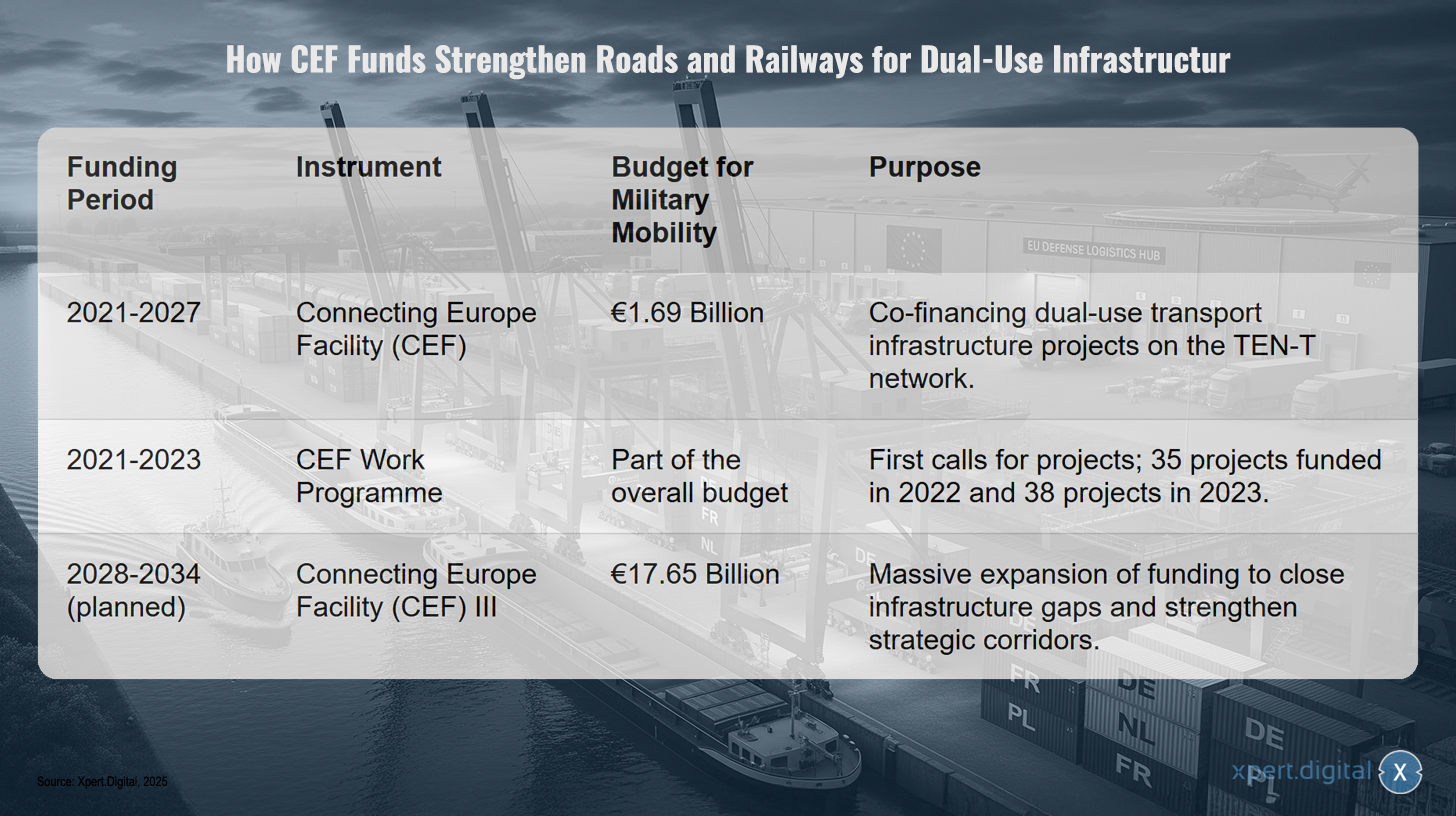
How CEF funds strengthen roads and railways for dual-use infrastructure – Image: Xpert.Digital
Between 2021 and 2027, the Connecting Europe Facility (CEF) is providing €1.69 billion within the framework of military mobility to co-finance dual-use transport infrastructure projects on the TEN-T network. The CEF work program 2021–2023, part of this overall budget, initiated the first calls for proposals; 35 projects were funded in 2022 and 38 in 2023. For the planned funding period 2028–2034, CEF III envisages a significant expansion to €17.65 billion to close infrastructure gaps and strengthen strategic corridors.
Analysis of strategic hubs – focus on corridors and ports
What geostrategic significance does the Rhine-Main-Danube corridor have for supplying NATO's eastern flank?
The Rhine-Main-Danube Corridor is the geostrategic main artery of the European inland waterway network. As the only continuous navigable connection between the North Sea and the Black Sea, it forms the backbone of freight transport between Western and Southeastern Europe. The corridor connects the highly industrialized regions of France, the Benelux countries, and Germany with the NATO partners Austria, Slovakia, Hungary, Bulgaria, and Romania, and extends to the Ukrainian border. In a crisis or defense scenario, this waterway would be invaluable for the deployment of heavy military equipment and the sustainable logistical supply of troops on NATO's southeastern flank. It represents a high-capacity alternative to the already heavily burdened and potentially vulnerable land transport routes.
The military use of the Danube has a long historical tradition, ranging from the fleets of the Romans and the Chaiks of the Habsburg Monarchy to the fierce battles of the Romanian and Soviet Danube flotillas in World War II. The enormous efforts undertaken by the German Wehrmacht during World War II to transport small warships and submarines overland and by river to the Black Sea underscore the strategic importance of this waterway even today.
The corridor's greatest weakness, however, remains its heterogeneous infrastructure. While the Rhine, Main, and the Main-Danube Canal boast a high and reliable standard of development, the Danube downstream from Germany suffers from significant navigability problems. Bottlenecks, insufficient channel depths, and a lack of maintenance, particularly in the sections within Hungary and along the Bulgarian-Romanian border, prevent continuous and predictable transport with modern vessels. Eliminating these bottlenecks is therefore a key project of European transport and security policy.
Case study Duisburg: How can the world's largest inland port serve as a logistics hub for national and alliance defense?
The Port of Duisburg, known as duisport, is the world's largest inland port and a logistics hub of European importance, ideally suited to play a central role in national and alliance defense. Its strategic location on the Rhine, with excellent trimodal connections to a dense network of highways and Germany's largest rail freight center, makes it the perfect hub for military transport. Equipment and troops arriving at major North Sea ports like Rotterdam or Antwerp can be efficiently transferred from Duisburg by rail, road, or further by inland waterway to the interior or eastward.
The port's infrastructure is already designed to meet the demands of large and heavy-load transport. The Duisburg Gateway Terminal (DGT), currently under construction, will, upon completion, offer an area of almost 150,000 square meters, six full-track rail lines directly beneath cranes, and several berths for inland vessels. These capacities, combined with the existing expertise in handling extremely heavy and oversized goods – such as those already used for transporting wind turbines or heavy machinery – can be directly applied to the needs of the military.
Furthermore, duisport is positioning itself as a pioneer in sustainable and resilient logistics. The DGT is slated to be the first climate-neutral container terminal in Europe, partly through the use of hydrogen produced on-site by large electrolysis plants. These investments in an independent energy supply not only increase sustainability but also the port's strategic resilience in times of crisis, as they reduce dependence on external power grids. Due to its size, multimodal connectivity, and comprehensive logistics services, the Port of Duisburg is ideally suited as a central collection, transshipment, and deployment hub for military forces in the heart of Europe.
Case study Danube ports: What role do ports like Constanța, Bratislava and Budapest play as gateways to the Black Sea and Eastern Europe?
The ports along the Danube form crucial logistical gateways to NATO's southeastern flank. Foremost among them is the Romanian port of Constanța. Its direct location on the Black Sea and its connection to the Danube via the Danube-Black Sea Canal make it the most important eastern gateway for all European inland waterway traffic. It functions as a crucial hub for goods traffic between the EU and the Black Sea region and is of central importance for supplying Romania and Bulgaria, as well as for transit to Ukraine. With 30 kilometers of quays, 156 berths, and heavy-duty cranes, its infrastructure is designed to handle enormous volumes of cargo.
Further upstream, the ports of Bratislava (Slovakia) and Budapest (Hungary) form key hubs in the heart of Central Europe. They are important multimodal logistics platforms that closely link the Danube waterway with national and international rail and road networks. For NATO, they are indispensable for the distribution and onward transport of materials and supplies to the Central and Eastern European member states.
The Danube ports are technically well-equipped for handling heavy and oversized cargo. They have specialized terminals, such as the heavy-lift port in Linz, and the technical capabilities for both vertical (lift-on/lift-off, LoLo) and horizontal (roll-on/roll-off, RoRo) transshipment, which is crucial for vehicle loading. The Danube itself, with its more generous bridge clearances compared to the Rhine and the 24/7 operation of its locks, offers excellent nautical conditions for such transport. Developing these ports into efficient military logistics hubs is a key element in strengthening the entire eastern flank. This is furthered by the establishment of "Military Mobility Corridors," such as the one between Greece, Bulgaria, and Romania, which aim to reduce regulatory hurdles and upgrade infrastructure in a coordinated manner.
Technological innovation and political integration as enablers
How can digitalization and automation increase the efficiency and safety of inland navigation?
Digitalization and automation are key drivers for making inland navigation and its ports more efficient, safer, and more resilient. Advanced digital tools are already being implemented in inland ports. Projects like “MultiRELOAD” utilize the concept of the “digital twin”—a virtual representation of the port and its operations—to monitor operations in real time, optimize them using AI-supported simulations, and improve resource utilization. Initiatives like “GREEN INLAND PORTS” promote the development of a master plan for digitalization to increase operational efficiency while simultaneously reducing the environmental footprint.
Another crucial step is the data-driven networking along entire transport corridors. The cooperation between the ports of Rotterdam and Duisburg and the Swiss Rhine ports aims to create a continuous digital corridor in which data can be seamlessly exchanged between seaports and inland ports, terminals, and freight forwarders. This transparency simplifies planning, reduces complexity, and increases the efficiency of the entire supply chain.
The most revolutionary long-term development is autonomous shipping. While the technology for maritime shipping is already well advanced, transferring it to the complex conditions of inland waterways – with narrow channels, changing currents, locks, and bridges – presents a particular challenge. EU-funded research projects such as “ReNEW” and “SEAMLESS” are working intensively on solutions for autonomous or remotely controlled inland vessels and the necessary infrastructure adaptations. For military logistics, autonomous ships offer enormous strategic advantages: They reduce the risk to human personnel, can operate in decentralized swarms to minimize vulnerability to attacks, and enable flexible just-in-time supply directly to crisis zones.
What political and regulatory steps are necessary to unlock the full potential of waterways for European defense?
To fully exploit the strategic potential of inland waterways, concerted political, financial, and regulatory efforts are required. First and foremost is the need for sustainable investment and clear political prioritization. Addressing the massive backlog of repairs and the well-known bottlenecks in waterway infrastructure must be pursued vigorously. The significantly increased EU funding from the CEF fund for military mobility is a crucial lever in this regard, but it must be complemented by corresponding national investment programs and personnel resources within the relevant administrations.
Secondly, the harmonization of cross-border procedures must be consistently completed. The technical agreements developed within the framework of PESCO and the EDA to simplify permitting must be fully implemented by all Member States in order to move from slow, case-by-case solutions to a reliable, standardized system. The greatest challenge here is not technological or financial, but political and cultural: overcoming national silos. Success depends on whether logistics can be understood as a shared, transnational, and interdepartmental task. This requires a shift in mindset away from nationally limited infrastructure projects and towards thinking in terms of pan-European, strategic corridors where regulation, infrastructure, and technology seamlessly integrate.
Thirdly, climate resilience must become a central planning principle. Future infrastructure projects must not only focus on capacity expansion but must systematically consider the impacts of climate change, particularly the risk of low water levels. Investments must aim to ensure year-round navigability, which also includes promoting innovative vessel types and examining new water management strategies.
Finally, deeper and more institutionalized coordination between the EU and NATO is essential. Joint infrastructure planning, the establishment of technical standards, and the regular conduct of joint exercises must ensure that civilian investments fully meet military requirements and that genuine interoperability is guaranteed. The development of military mobility corridors, which, as pragmatic “coalitions of the willing,” overcome fragmentation, is a promising model in this regard and must be further expanded.
Your container high-bay warehouse and container terminal experts

Container terminal systems for road, rail, and sea in the dual-use logistics concept of heavy-duty logistics - Creative image: Xpert.Digital
In a world characterized by geopolitical upheavals, fragile supply chains, and a new awareness of the vulnerability of critical infrastructure, the concept of national security is undergoing a fundamental reassessment. A state's ability to ensure its economic prosperity, the supply of its population, and its military capability increasingly depends on the resilience of its logistics networks. In this context, the term "dual-use" is evolving from a niche category of export control to a overarching strategic doctrine. This shift is not merely a technical adaptation, but a necessary response to the "turning point" that requires the profound integration of civilian and military capabilities.
Suitable for:
Advice - planning - implementation

Markus Becker
I would be happy to serve as your personal advisor.
Head of Business Development
Chairman SME Connect Defense Working Group
Advice - planning - implementation
Konrad Wolfenstein
I would be happy to serve as your personal advisor.
contact me under Wolfenstein ∂ Xpert.digital
call me under +49 89 674 804 (Munich)





