
Think of defense again: What Europe and NATO can learn from China's global military logistics and AI use
Xpert pre-release

Available in 27 languages 📢
Prefer Xpert.Digital on GoogleⓘPublished on: June 8, 2025 / update from: June 11, 2025 - Author: Konrad Wolfenstein

Think of defense again: What Europe and NATO can learn from China's global military logistics and AI use-Image: Xpert.digital
China's military logistics as a model: What Europe can learn from Beijing's strategic approaches
From civil-military integration to AI: how China revolutionizes its logistics strategy and inspired Europe
This article analyzes China's advanced global and innovative military logistics and identifies transferable teachings for European defense logistics. In view of the changing geopolitical landscape, a robust and adaptable logistics for Europe is of strategic imperative. China demonstrates through its long-term planning, comprehensive civil-military integration for resource optimization, the rapid technological adaptation-especially in the area of artificial intelligence (AI)-and the establishment of a global logistics presence principles that can serve Europe, adapted to its own values and structures, for inspiration. A direct takeover of the state -controlled Chinese model is neither feasible nor desirable. Nevertheless, the underlying strategic approaches offer valuable paradigms. Central recommendations for Europe include the bypassing harmonization of cross -border military transports, the piloting of joint logistics hub, including the private sector and the acceleration of data inter -operability. In the long term, strategic investments in critical dual-usable infrastructure, the establishment of a Pan-European defense logistic industrial and technology gas as well as the cultivation of a profound joint culture are essential. The goal is a coherent, technologically progressive and resilient European logistical framework.
The changing landscape of Chinese military logistics: global reach and innovation
Beasts of the logistical modernization of the People's Liberation Army: from the doctrine to "intelligentization"
The comprehensive modernization of the People's Liberation Army (VBA), which began in the late 1970s, has experienced significant acceleration under XI Jinping with the revised goal of being completed by 2035. This modernization encompasses profound reforms: the unknown of the military of civil politics, a reorganization in partial forces commands (Theater Command) for improving joint operations, personnel reduction towards a slimmer troop and the emphasis on warfare connected. The doctrinal development towards the "Volkskrieg under modern conditions", which emphasizes a defensive defense and combined weapons tactics, served as a driving force for the transformation of logistics.
A core aspect is the focus on the production of local equipment and technological upgrade. This manifests itself in the introduction of advanced vehicles such as the Type-15 tank and the protective armor ZBD-04 as well as the use of unmanned aircraft (UAVS) for fast critical air support, which demonstrates a clear commitment to self-sufficiency and high technology.
Central to the current phase of modernization is the concept of "intelligence" (智能化), in particular the integration of artificial intelligence (AI) in all facets of military operations, including logistics. China sees AI as a strategic bet in order to potentially achieve technological advantages over other military power. The changeover of the VBA from a large, partially outdated force to a slimmer, more technologically progressive and organized army organized under partial forces commands requires a fundamental rethink in the logistical requirements. Instead of pure mass supply, more agile, more precise and reaction -quick support systems are now required that can support quick installations, distributed operations and complex, multidimensional effects. The emphasis on "intelligence" indicates that China not only sees data and AI as efficiency increasers for logistics, but also as transformative elements that can provide a decisive operational advantage and may skip traditional logistics paradigms. This implies the use of AI for predictive logistics, autonomous supply supply and optimized resource allocation in dynamic environments.
Military-Civile Fusion (MCF): A paradigm for resource mobilization and technological progress
The "military-civile fusion" (MCF) is an aggressive national strategy led by the China (KPCH) Communist Party with the aim of developing the most technologically advanced military in the world by eliminating barriers between civil research and economic sectors as well as the military and defense industrial sector. XI Jinping personally monitors the implementation of this strategy, which aims to enable "intelligent warfare". The most important targeted dual-use technologies include quantum computing, big data, semiconductor, 5G, advanced nuclear technology, aerospace technology and AI. The methods of technology acquisition are diverse and include investments in private companies, talent acquisition programs, the orientation of academic and research collaborations for military benefits, forced technology transfer and also theft.
As part of the MCF, the logistics experience a conceptual redefinition: "Modern logistics is military-civilian fusion logistics" (现代后勤就是军民融合后勤), whereby logistical infrastructure systems are treated as dual-use goods that serve both economic and defense policy goals. Private logistics companies such as SF Express, YTO Express and China Post Express & Logistics are obliged to support state defense and to participate in military logistics pilot projects and to build up the appropriate infrastructure. SF Express, for example, has an extensive network of over 950 overseas warehouses worldwide, including seven in important US cities whose dual-use potential is obvious.
The MCF is not just a cooperation, but a state -prescribed integration in which civilian actors have a legal obligation to support military goals. This creates a huge, state -controlled ecosystem for innovation and bundling resources, which is difficult to encounter market economy -oriented economies directly. The dual-use nature of the targeted technologies and the logistical infrastructure within the framework of the MCF deliberately blurred the boundaries between commercial and military activities. This makes it difficult for other nations to assess intentions and risks, especially with regard to globally acting Chinese commercial enterprises, and can provide China strategic advantages, for example through hidden information procurement or the prosition of material under commercial guise.
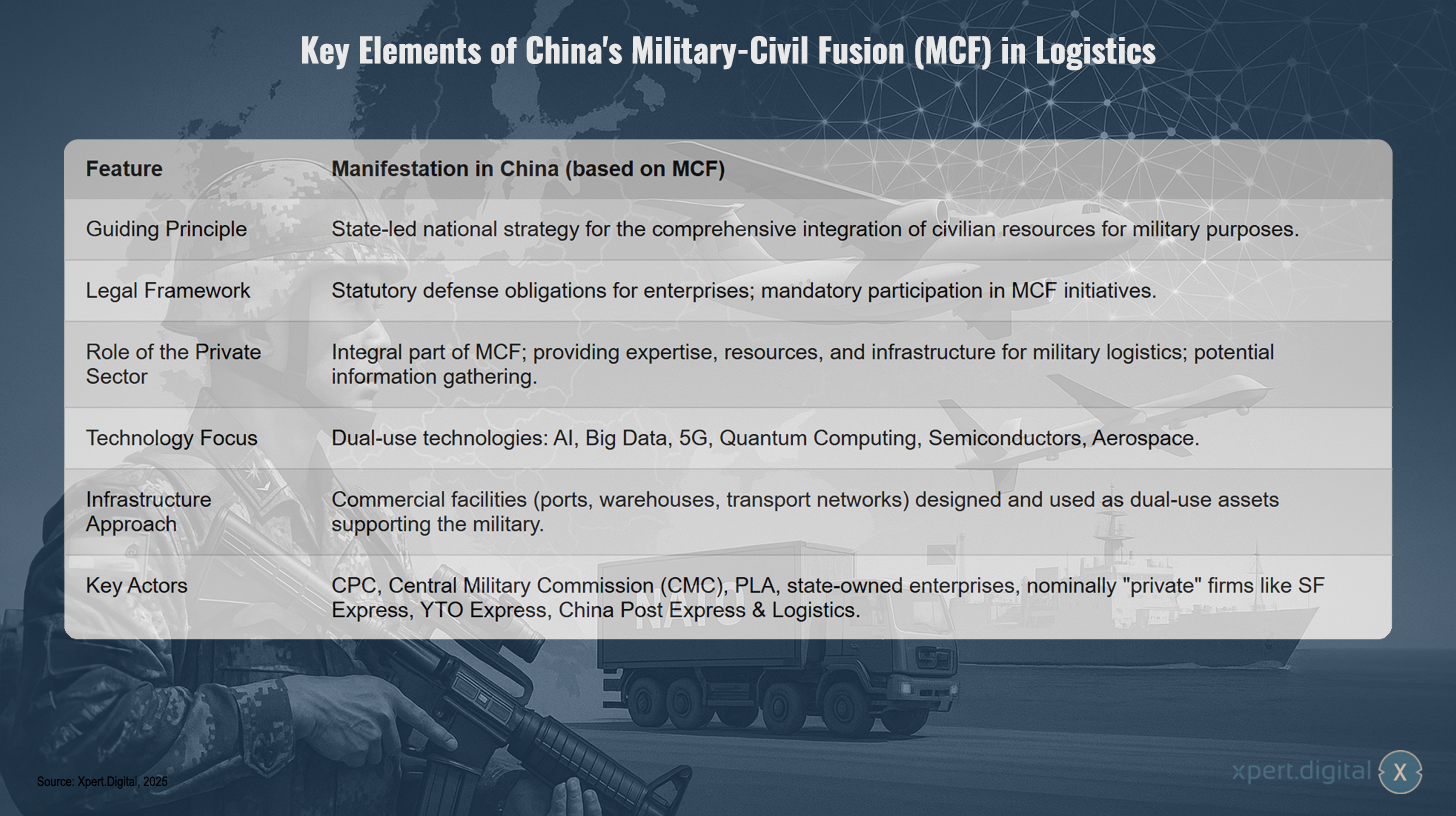
Key elements of the Chinese military-civilian fusion (MCF) in logistics
Key elements of the Chinese military-civilian fusion (MCF) in logistics-Image: Xpert.digital
The Chinese military-civile fusion (MCF) in logistics is based on a state-led national strategy for the comprehensive integration of civil resources for military purposes. The leading principle is supported by a legal framework that provides for statutory defense obligations for companies and demands mandatory participation in MCF initiatives.
The private sector plays a central role as an integral part of the MCF. Companies provide know-how, resources and infrastructure for military logistics and potentially also serve to procure information. The technology focus is on dual-use technologies such as artificial intelligence, big data, 5G, quantum computing, semiconductors and aviation technologies.
In the infrastructure, China follows an approach in which commercial systems such as ports, warehouses and transport networks are designed and used as military-supporting dual-usets. The key players include the Chinese Communist Party (KPCH), the Central Military Commission (ZMK), the People's Liberation Army (VBA), state -owned companies and nominal “private” companies such as SF Express, YTO Express and China Post Express & Logistics.
Power projection: China's global logistics network and dual-use infrastructure
China follows a strategy to expand its global logistics presence to support its growing oversees. These include foreign investments, trade routes as part of the "Belt and Road Initiative" (BRI) and the ability of the VBA to operations in distant sea areas. The establishment of the first official overseas military base in Dschibuti is a clear sign of this strategy. The base is characterized by its strategic location and capacity, including mechanized infantry, hangars for helicopters and UAVs as well as a pier system for several ships.
In addition, the development and use of commercial port facilities with a double usage, such as Gwadar in Pakistan and Hambantota in Sri Lanka, play a central role as a node for naval operations, resting phases and supplies. These developments have significant strategic implications for regional powers such as India, which fears a circle and threats of its sea -supported deterrence. Other potential locations for Chinese military bases or access points include Cambodia, Equatorial Guinea, Namibia, the United Arab Emirates, Cuba, Tanzania and Myanmar. The primarily declared mission of this overseas locations is the protection of sea connection lines (SLOCs) and the support of operations in peace, although its military benefit is the subject of ongoing ratings in the event of war.
China's approach to the establishment of overseas places often follows a "commercial-first" or "dual-use development model". For example, the development of the port of DSchibuti was preceded by the construction of the military base, and Gwadar and Hambantota are commercial ports with considerable military potential. This approach provides economic influence, reduces the initial political resistance of the host countries and offers a plausible denomination with regard to military intentions. It is a patient long -term strategy that enables a gradual establishment of a presence that can later be militarized or used for military support. Even if the immediate kinetic benefits of these bases may be limited against a competitor of the same point as the United States by 2030, their strategic value is in the presence of peace, information acquisition, power projection, the SLOC protection and the creation of dilemma for opponents. This gradually moves the regional power relationships and lies the foundation for future, more robust skills.
European defense logistics: Current skills, persistent challenges and strategic imperative
The patchwork of progress: evaluation of the EU and NATO logistics initiatives
Europe has a number of framework works and initiatives that aim to improve defense logistics and reflect awareness of their necessity. As part of the constant structured cooperation (PESCO), the project "Network of Logistic Hubs in Europe and Support to Operations (Netloghubs)" should be emphasized. It aims at a multinational network based on existing skills to shorten response times and increase the sustainability of operations. Other pesco projects, such as "Strategic Airlift for Outsized Cargo", address specific gaps in ability.
The Action Plan Military Mobility 2.0 of the EU (MMAP 2.0) pursues the goal of a quick and seamless laying of personnel and material. The achievements include the financing of dual-use infrastructure projects with around 1.7 billion euros, the revision of the TEN T regulations to take into account military requirements and efforts to simplify cross-border approval procedures. The European Defense Agency (EDA) supports the Member States in the standardization of logistical skills, the development of logistics hubs, researching new technologies such as additive manufacturing (AM) and improving security of care (Security of Supply, SOS) through framework agreements.
The Readiness Action Plan (RAP) was initiated within NATO after 2014, the very High Readiness Joint Task Force (VJTF) and the NATO Response Force (NRF) were strengthened and new battle rounds set up on the eastern flank. In May 2024, the NATO logistics action plan was adopted to advance changes in the areas of maintenance, care, stock and medical support. Initiatives such as log fas and the Jedi concept aim to improve data inter-operability.
Despite these large number of initiatives, European efforts in the field of defense logistics appear fragmented. There is often a single, overarching strategic authority or a sufficiently authorized coordination body, which can lead to double work, inefficiencies and slower progress than would make a more unified system. The project management at PESCO varies strongly and some projects are left behind the expectations. A report by the European Court of Auditors (Eurh) refers to "complex governance structures" and the lack of a central point of contact for military mobility at EU level. Many European initiatives also rely heavily on “dual-use” concepts. Although this is pragmatic, it may not address completely purely military requirements or the extent required for highly intensive conflicts, in particular in view of financing restrictions and the competition with civilian priorities. The focus of the Connecting Europe Facility (CEF) on dual-use infrastructure and not on purely military infrastructure, which is still urgently needed, is an example here.
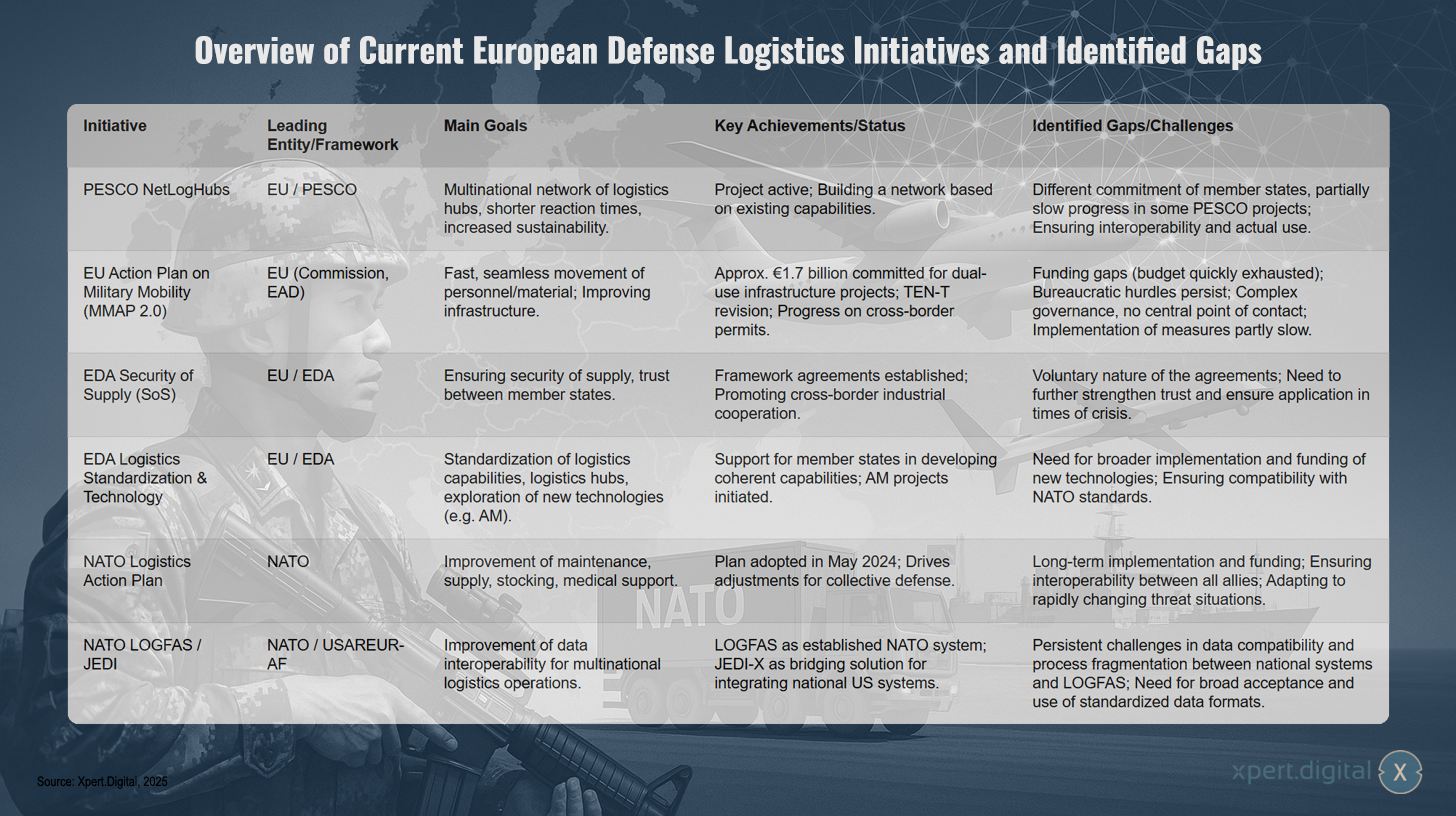
Overview of current European defense logistics initiatives and identified gaps
Overview of current European defense logistics initiatives and identified gaps - Image: Xpert.digital
The current European defense logistics initiatives show both significant progress and considerable challenges. The Pesco Netloghubs project under EU leadership aims to create a multinational network of logistics hubs in order to shorten reaction times and increase sustainability. Although the project is actively promoted and based on existing skills, problems can be seen through different commitment of the Member States and slow progress in ensuring interoperability and actual use.
The EU Action Plan Military Mobility (MMAP 2.0) pursues the goal of quick and seamless laying of personnel and material through infrastructure improvements. With around 1.7 billion euros for dual-use infrastructure projects and progress in the TEN-T revision and cross-border permits, important milestones have already been achieved. Nevertheless, there are considerable funding gaps, since the budget is quickly exhausted, bureaucratic hurdles continue and the complex governance slows down the implementation without a central contact.
The EDA Security of Supply Initiative focuses on ensuring security of supply and building trust between the Member States. Despite established framework agreements and the promotion of cross -border industrial cooperation, the voluntary character of the agreements remains problematic, and there is a need to further strengthen trust and to ensure the application in times of crisis.
In the area of EDA logistics standardization and technology, the standardization of logistical skills and research into new technologies such as additive manufacturing is promoted. While the support of the Member States in the development of coherent skills and the initiation of AM projects are positive developments, the broader implementation and financing of new technologies and ensuring compatibility with NATO standards requires further efforts.
The NATO Logistik Action Plan, which was adopted in May 2024, aims at improving maintenance, care, supply and medical support and is making adjustments to the collective defense. The challenges lie in the long -term implementation and financing, the guarantee of interoperability between all the Allies and the adaptation itself quickly changing threats.
Finally, NATO LOGFAS and Jedi are working on improving data inter -operability for multinational logistics operations. While logfas acts as an established NATO system and serves Jedi-X as a bridge solution to integrate national US systems, there are still challenges in data compatibility and process fragmentation between national systems and log fas, which underlines the need for broad acceptance and use of standardized data formats.
Critical deficits: infrastructural bottlenecks, bureaucratic hurdles and interoperability gaps in NATO/EU nations
European defense logistics suffer from a number of critical deficits that significantly restrict their effectiveness. In the area of infrastructure, chronic underfunding of dual-us and purely military infrastructure can be found. The budget of the Connecting Europe Facility (CEF) for military mobility of 1.7 billion euros was exhausted by the end of 2023 and was significantly below the originally proposed 6.5 billion euros. The European Investment Bank (EIB) estimates an annual investment requirement of 80 billion euros solely for the transport infrastructure. Physical restrictions such as tight roads, inadequate rail capacities, different lane widths (e.g. delays at Rail Baltica), not bridges laid out for heavy loads and a lack of special railway wagons tighten the location. In addition, there is strategic vulnerability through inadequate transport and storage capacities, especially in the energy sector. The need to upgrade ports, railways and airports for heavy military equipment is particularly evident in regions such as the Black Sea.
Bureaucratic and regulatory hurdles are another massive problem. Approval for cross -border military movements can take up to 45 days. "Bureaucracy" is mentioned as the main obstacle. Different national regulations, for example for the transportation of dangerous goods or weight restrictions for tanks, as well as incomplete implementation of harmonized procedures hinder quick relocations. The lack of a central point of contact for military mobility at EU level and complex governance structures contribute to slowing down.
In the area of interoperability, there are continuing challenges in technical (e.g. safe communication, common fuel), procedural (doctrine, terminology) and human dimension (language, trust) within the NATO. There is a lack of agreed formats and standards for data acquisition and common evaluation instruments. Logistic interoperability is explicitly mentioned as a challenge, and efforts such as Logfas/Jedi-X to bridge gaps underline the existing problems. Further challenges include inadequate strategic air transport capacities (aging An-124 in the context of Salis), excessive dependence on the private sector for transports, which is problematic in the event of war, and a fragmented defense industrial basis that is unable to quickly scale or close capacity.
The era of the "peace dividend" after the Cold War led to systematic sub -investment in the defense infrastructure and to reduce robust military logistics structures. The consequences are clearly visible today. To reverse this not only requires funds, but a cross-generational mentality and priority change. The bureaucratic and regulatory hurdles are not only administrative inconvenience, but also significant operational obstacles that an opponent could take advantage of. They reflect a lack of political will or effective mechanisms at EU/NATO level in order to assert standardization and harmonization across the Member States, although technical solutions would often be available. The lack of technical and data interior operability limits the ability to carry out really integrated multinational operations and to use modern data -controlled logistics. This is a critical weak point at a time when information superiority and speed are of the greatest importance, especially compared to China's efforts to "intelligence".
The imperative for improved European strategic autonomy in defense logistics
Robust, autonomous logistics capacities are fundamental for Europe's credibility as a security actor and its ability to act independently if necessary. The war in Ukraine has underlined the critical importance of logistics and supplies that potentially represent Europe's greatest weakness in a larger conflict. The EU endeavor cannot be realized according to greater strategic autonomy without self -sufficient and resistant logistics. The European Defense Industry Strategy (EDIS) aims to support this.
The dependence on external actors, for example the USA for strategic air transport or non-EU-commercial companies for transports, creates weaknesses. The need to rebuild Europe's defense industrial basis in order to support sustainable conflicts and reduce external dependencies is of the utmost importance. This includes ensuring security of supply within Europe.
True European strategic autonomy in defense is unreachable without a previous "logistics autonomy". A force that cannot be relocated, care and can be traced back is fundamentally dependent on others, regardless of their combat skills. Even if Europe has advanced weapons systems, its strategic autonomy largely remains a dream if it cannot move and supply its armed forces effectively and independently. However, if it is not carefully managed, striving for strategic autonomy in logistics can lead to tensions with NATO, in particular with regard to resource allocation, standardization and defense industrial politics. Nevertheless, a more logistically more powerful Europe ultimately strengthens NATO. A Europe with stronger, autonomous logistics capacities would be a more capable partner within NATO who could better contribute to collective defense and relieve the United States. The key is in complementarity, not in competition.
Advice - planning - implementation

Markus Becker
I would be happy to serve as your personal advisor.
Head of Business Development
Chairman SME Connect Defense Working Group
Your dual -use logistics expert

Dual -use logistics expert - Image: Xpert.digital
AI-supported military logistics innovation as a model: What Europe can do for its defense skills
Teaching from Beijing: What Europe can adapt from the Chinese logistics model
Strategic coherence and long -term vision in logistics development
China's approach to modernizing the VBA, including its logistics, is a decades of centrally controlled undertaking with clear goals and schedules, as the goal year 2035 illustrates. Logistics is an integral part of this strategic planning and not a subsequent thought. The Central Military Commission (ZMK) provides a uniform leadership. For Europe, this means that a more standardized, long -term strategic vision is required for defense logistics that overcomes national interests and short -term budget cycles. While a single "European ZMK" is unrealistic, stronger coordination bodies within the EU and NATO structures are necessary to promote coherence and to counteract fragmentation.
China's ability to determine and pursue long -term strategic goals in logistics, supported by political will and resources, is in a sharp contrast to Europe's often reactive and gradually financed approach. European financing cycles, such as the multi -year financial framework (MFR), are more short -term and are subject to political negotiations, which leads to funding gaps. Pesco projects suffer from different commitment from Member States. Europe has to develop a more "campaign -like" strategic planning mentality for critical skills such as logistics. This would include clearer strategic goals for European logistics, the identification of the necessary resources, the establishment of a committed governance and the guarantee of sustainable political support for several decades.
Use of dual-use skills and civil-military synergies (a European "MCF light version"?)?)
China's MCF systematically integrates civil research, commercial sectors and infrastructure into military development. Private companies are subject to legal obligations to support VBA. Europe can identify and promote systematic dual-use synergies without adopting China's forced model. This requires the care of deeper, strategic public-private partnerships (PPP) for logistics, research and development as well as infrastructure development. Clear framework conditions, risk division and the attractiveness of defense contracts are crucial for this in order to counter the existing dependence on the private sector and the underfunded infrastructure.
Europe's current PPPS are often transactional or project -specific. A “European MCF light version” would include the creation of permanent strategic partnerships with key industries (logistics, technology, production). The aim would be the joint development of skills, the guarantee of security of supply and the development of civil innovation pipelines for defense logistics, potentially through special EU/EDA programs with clear incentives and long-term obligations. This would go beyond the current dual-use financing or ad hoc -öpps and could include strategic dialogues, coinvestment in F&E for logistics technologies, agreements about preferential access in crisis times and possibly regulatory framework that promotes the support of the private sector for national/EU security goals in critical areas Market principles.
Use of technological innovation: AI, data analysis and automation in logistics
The VBA invests massively in "intelligence" and uses KI for situation, decision -making, unmanned systems and logistics, since it sees AI as a means of catching up or even overtaking. Successes of commercial AI logistics serve as a model. For Europe, this means accelerating the introduction of AI, big data analyzes and automation (e.g. unmanned soil/aircraft for replenishment) in defense logistics. This requires targeted F&E finance, common data standards and test environments for new technologies. Research into additive manufacturing by the EDA is a good beginning, but requires a broader application to close technical interoperability gaps and keep up with technological progress.
China's "Intelligence" efforts aim at a fundamental transformation of warfare, including logistics. In contrast, Europe's introduction of AI in defense logistics appears more gradually. A missing, keeping up with China's pace and ambitions in the AI-controlled logistics could lead to a significant ability to skill that has an impact on everything, from the laying speed to the efficiency of care to surgical resistance. Europe needs a committed, well -equipped strategy for "intelligent logistics", not only isolated projects so as not to fall behind in this critical area of ability. This presupposes that standardized, accessible and secure data are initially available - a fundamental prerequisite for the effective use of AI at the coalition level.
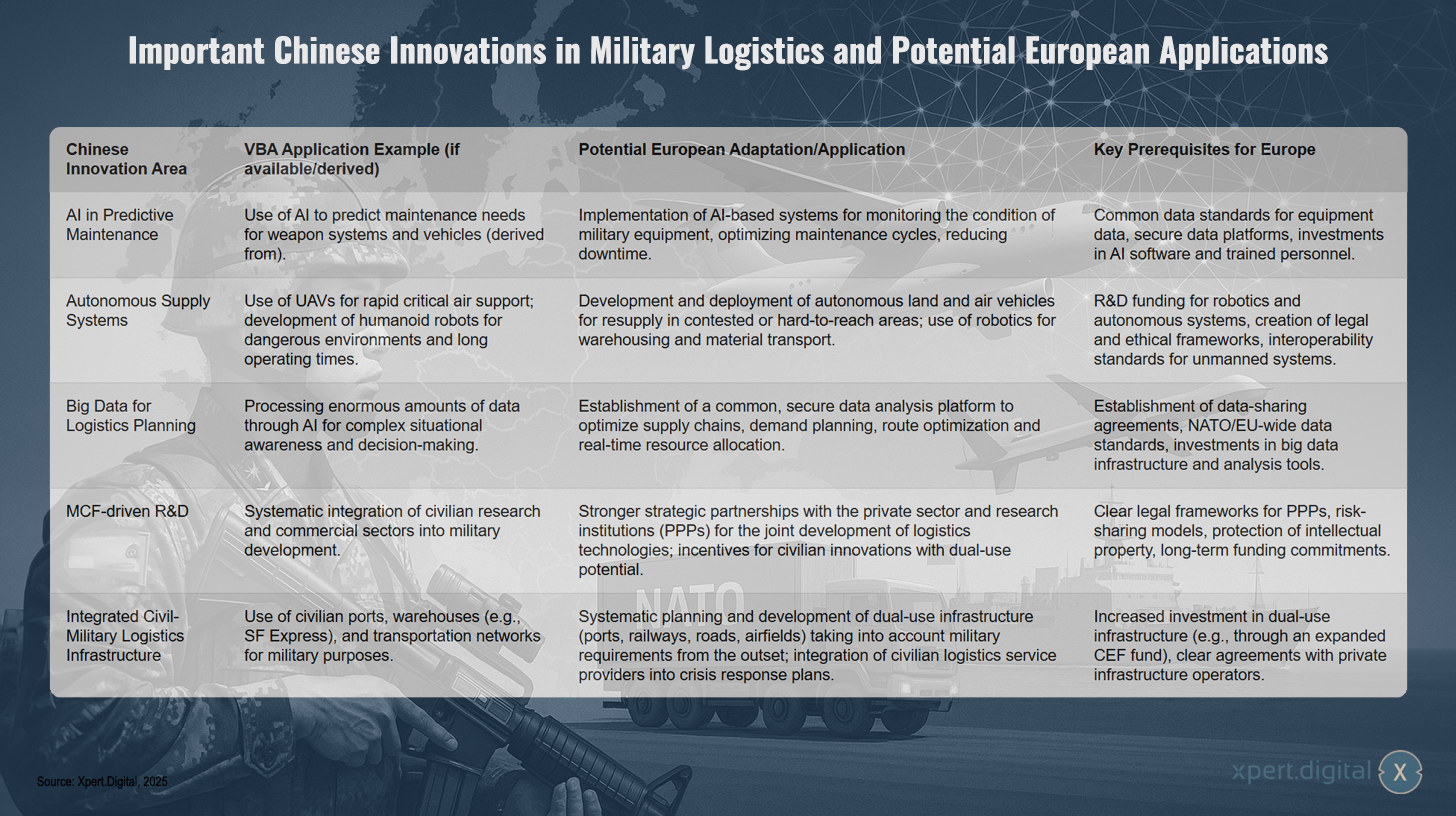
Important Chinese innovations in military logistics and potential European applications
Important Chinese innovations in military logistics and potential European applications - Image: Xpert.digital
The Chinese military logistics innovations offer important approaches for European applications. In the area of AI-based predictive maintenance, China uses artificial intelligence to predict maintenance needs for weapons systems and vehicles. Europe could implement AI-based systems for monitoring military devices to optimize maintenance cycles and reduce downtimes. A prerequisite for this are common data standards, secure data platforms as well as investments in AI software and trained staff.
In autonomous supply systems, China uses UAVS for critical air support and humanoid robots in dangerous environments. Europe could develop autonomous land and aircraft for supplies in contested areas and use robotics for warehousing. This requires F&-E-funding for robotics, legal framework and interoperability standards.
In the Big Data area, China processes enormous amounts of data for complex location recording through AI. Europe should build up a common, secure data analysis platform to optimize supply chains and real -time planning. Data sharing agreements, NATO/EU-wide standards and big data infrastructure investments are necessary.
MCF-driven research and development systematically integrates civilian research into military development. Europe could strengthen strategic partnerships with a private sector and create incentives for dual-use innovations. Clear legal framework conditions for public-private partnerships and long-term financing commitments are required.
In the integrated civil-military logistics infrastructure, China uses civilian ports and transport networks for military purposes. Europe should systematically plan dual-use infrastructure and integrate civil logistics service providers into crisis reaction plans. This requires increased investments in dual-use infrastructure and clear agreements with private operators.
Development of resilient and distributed logistics networks
China extends its global logistics infrastructure, including dual-use ports and warehouses (e.g. the SF Express network, Dschibuti, Gwadar, Hambantota). This creates redundancy and multiple access points. Europe must improve the resistance and distribution of its logistics networks. This includes the hardening of critical infrastructure, the development of more distributed logistics hubs (according to Netloghubs) and ensuring alternative supply routes and means of transport. The prosition of stocks and equipment is also crucial to counter weaknesses in the European infrastructure and to increase resilience towards disorders.
China's distributed network, although partially serving the power projection, also inherently creates resilience. Europe's current logistics infrastructure, often concentrated and with well -known bottlenecks, is more vulnerable. A European strategy must prioritize the identification and reduction of single points of failure and develop a logistics system based on a hub-and-spoke. This not only requires more hubs, but also robust connections and alternative transport options between them in order to reduce susceptibility to attacks or natural disasters.
🎯🎯🎯 Benefit from Xpert.Digital's extensive, fivefold expertise in a comprehensive service package | R&D, XR, PR & SEM

AI & XR 3D Rendering Machine: Fivefold expertise from Xpert.Digital in a comprehensive service package, R&D XR, PR & SEM - Image: Xpert.Digital
Xpert.Digital has in-depth knowledge of various industries. This allows us to develop tailor-made strategies that are tailored precisely to the requirements and challenges of your specific market segment. By continually analyzing market trends and following industry developments, we can act with foresight and offer innovative solutions. Through the combination of experience and knowledge, we generate added value and give our customers a decisive competitive advantage.
More about it here:
Dual-us logistics hubs and AI analysis: Europe's strategic plan against gaps in defense
Strategic ways to strengthen European defense logistics
Phase 1: Immediate strategic steps for quick successes (next 1-3 years)
Streaming of cross -border relocation: a "military Schengen 2.0"
One of the largest and at the same time the fastest addressable hurdles is the slow and bureaucratically complex handling of cross -border military transports. As an immediate measure, the complete, harmonized implementation of existing technical agreements (Technical Arrangements, TAS) should be promoted aggressively for agricultural, air and sea movements. For this purpose, a high-ranking EU/NATO-Taskforce could be set up, which identified and eliminated remaining regulatory and bureaucratic blockages within 12-18 months. The goal must be a notification and approval system that enables military relocations in crisis cases within 24 to 48 hours. This addresses a persistent problem, the solution of which is politically challenging, but is not primarily capital -intensive. A success here would create momentum and credibility. The achievement of a real "military Schengen" not only requires harmonized rules, but also a change in mentality towards a "default-to-yes/expedite" culture in national bureaucratia during crises, supported by strong political mandates.
Piloting common dual-us logistics hubs and technology test sets (inspired by Netloghubs & McF)
Building on the Netloghub Pesco project, expanded pilot hubs should be established at 2-3 strategic locations (e.g. eastern flank, Central Europe, Südflanke/Hafen). These hubs should explicitly include civil logistics providers - an apprenticeship from the effectiveness of the Chinese MCF, but on a voluntary basis - and serve as test environments for new logistics technologies such as AI, automation and additive manufacturing. Dedicated start -up financing by EU/NATO would be necessary. Such pilot projects would provide tangible demonstrations of improved cooperation, test new concepts in controlled environment and generate practical experience, which addresses infrastructure gaps and promoted innovation. These pilot hubs could develop into excellence centers, not only for storage and transit, but also for training, doctrine development and the promotion of civil-military logistics innovation ecosystems.
Improvement of data inter-operability: Introduction of standardized platforms and AI-based analysis (learning of logfas/Jedi-X and the "intelligentization" of the VBA)
The use of NATO log fas or compatible standard should be mandatory for all multinational operations and exercises. The development and implementation of solutions such as Jedi-X to bridge national systems must be accelerated. At the same time, investments in a common, secure data analysis platform for logistics are required, which integrates AI tools for predictive maintenance, demand forecasts and route optimization. This addresses critical interoperability deficits of NATO and is the basis for every future "intelligent logistics" in Europe. However, real data inter -operability requires more than just common software; It requires common data ontologies, security protocols and the willingness to exchange data, which presupposes overcoming national reservations and investments in a robust, safe cloud infrastructure for defense.
Phase 2: Sustainable structure for long-term resilience and skills (3-10+ years)
Strategic investments in critical dual-use infrastructure: closure of gaps and ensure resilience
A significantly larger, earmarked European defense infrastructure is required, which builds on the Military mobility facility of the CEF, but is equipped with significantly more means, as is repeated. Projects should be prioritized based on strategic military requirements (identified corridors, modernization of ports/airfields) and resilience aspects (hardening, redundancy). Civil and military planning for new infrastructure must be integrated from the start. This addresses the core problem of the underfunded and inadequate infrastructure and requires long -term commitment. Such infrastructure investments must be "threatening" and "future -proof", i.e. not only current gaps, but also developing threats (cyber, physical attacks), effects of climate change and the needs of future military equipment.
Promotion of a Pan-European defense logistic industrial and technology gas
The framework works of the EDIS and EDA should be used to promote collaborative F&E in logistics technologies (AI, robotics, advanced materials, AM). Incentives for the joint procurement of logistics platforms and systems must be created and European champions in important logistics technology areas to be developed. The security of supply from European sources for critical components must be guaranteed. This reduces external dependencies, strengthens strategic autonomy and stimulates innovation, while the fragmented European defense industry is consolidated. The establishment of such a basis requires overcoming national protectionism and promoting real cross-border industrial cooperation, potentially through harmonized defense creation regulations and common IP framework conditions for cooperation projects.
Cultivation of a culture of jointness and interoperability across the national armed forces
The scope, reach and complexity of common logistics exercises in NATO and EU frames must be increased. Permanent multinational logistics units that go beyond the components of the VJTF/NRF should be established. The training and certification of logistics staff must be standardized and personnel exchange programs must be promoted. This addresses gaps in human and procedural interoperability and builds trust and common understanding. Real jointing in logistics goes beyond common equipment; It requires a common operational culture, common doctrines and authorized multinational command structures - a long -term cultural change process.
Development of robust public-private partnerships for logistical support and innovation
Clear legal and financial framework conditions for long -term public transport must be created in defense logistics that define roles, responsibilities and risk division. Annations for private investments in dual-usable logistics capacities and innovations must be set. Mechanisms for prioritizing military needs in crises that also receive the attractiveness for commercial partners must be ensured. This opens up the efficiency and innovative strength of the private sector and addresses problems of overuse and availability in the event of war. Successful public transport in defense logistics require a change from purely transactional relationships to strategic partnerships in which the private sector is regarded as co -developers of skills and resilience, not only as a service provider.
Addressing specific challenges of NATO member states: tailor-made approaches within a uniform strategy
Although a uniform European strategy is necessary, your implementation must be flexible enough to take into account the different geographical, infrastructural, economic and political realities of the individual NATO/EU member states.
Nations of the eastern flank: The focus should be on fast reinforcement skills, robust host nation support infrastructure, prosition of stocks and the defense against A2/AD challenges. Rail Baltica is a key project here.
Hub nations (e.g. Germany, Netherlands): The focus is on the modernization of the transit infrastructure (rail, street, ports, airfields), the tightening of customs and approval processes and the function as central logistics nodes.
Nations of the south flank: The focus should be on maritime logistics, port infrastructure and skills to support operations in the Mediterranean and in Africa.
Nations with a strong industrial basis: can be leading in the development and production and production of advanced logistics technologies and platforms.
Nations with limited resources: can contribute niche skills or specialize in specific logistics functions as part of a load division.
A "one-size fits-all" approach will fail. Tailor -made solutions enable efficient resource use and the use of national strengths. A successful pan -European logistics strategy requires a sophisticated model of the load division and specialization, in which the nations make contributions based on their abilities and geostrategic situation, coordinated by a central mechanism (EU/NATO), which ensures that the collective needs are met. This is politically complex, but essential for efficiency and justice.
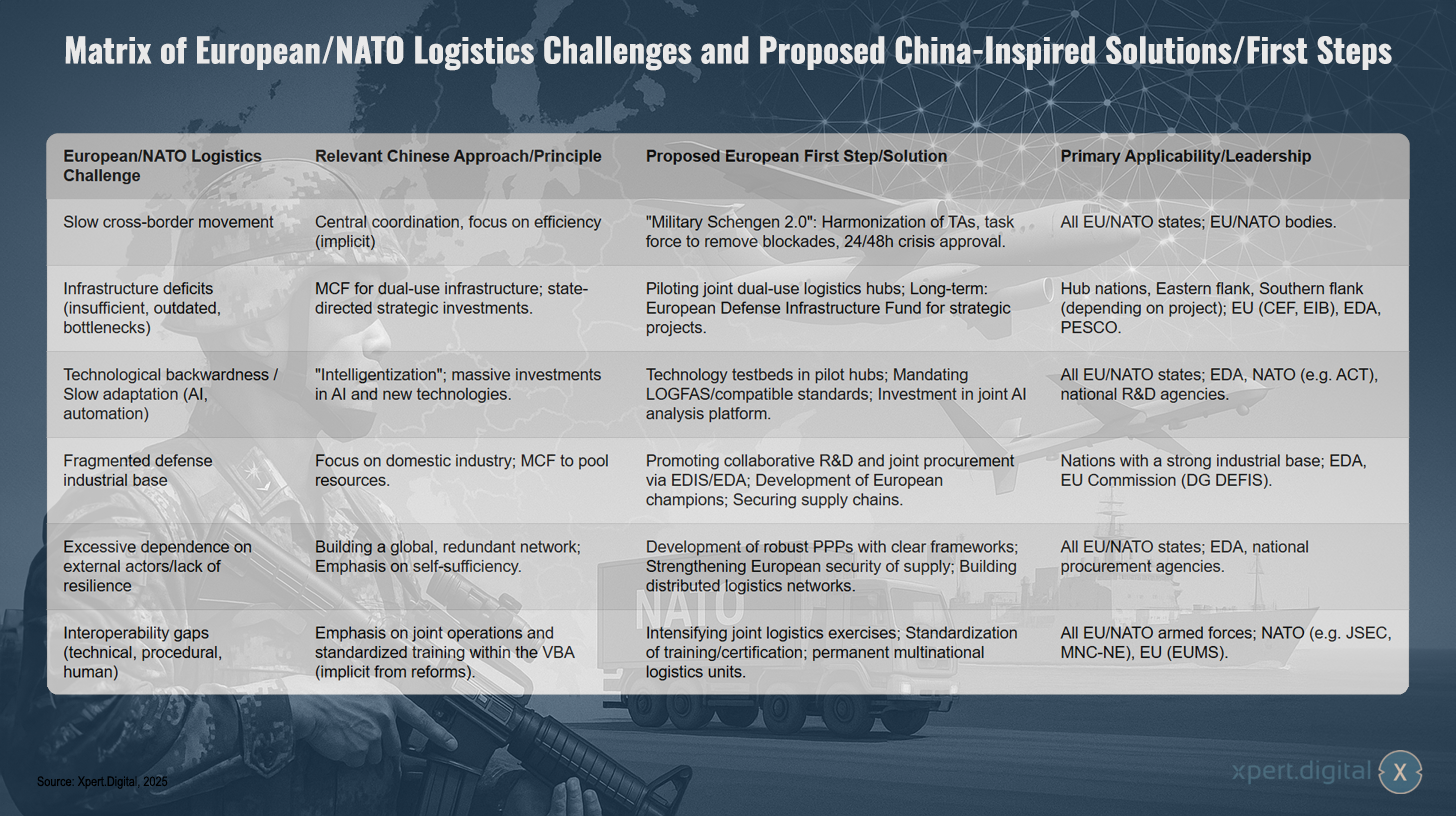
Matrix of European/NATO logistics challenges and proposed solutions inspired by China/first steps
Matrix of the European/NATO logistics challenges and proposed solutions inspired by China/first steps-Image: Xpert.digital
The matrix of European and NATO logistics challenges as well as the proposed solutions inspired by China shows various critical areas in which improvements are required.
With the slow cross -border laying of troops and material, the proposed approach is based on China's central coordination and efficiency focus. A “military Schengen 2.0” is proposed as a European solution, which includes the harmonization of transport permits, a task force to remove blockages and 24 to 48-hour crisis permits. These measures are to be implemented by all EU and NATO countries and the corresponding bodies.
The infrastructure deficits, which manifest themselves in inadequate, outdated systems and bottlenecks, are to be addressed by an approach that is based on China's military-civil fusion for dual-use infrastructure and state-controlled strategic investments. The piloting of common dual-use logistics hub is proposed and the establishment of a European defense infrastructure of strategic projects in the long term. Hub nations, the Eastern and South Flank as well as EU institutions such as CEF, EIB, EDA and Pesco should be in charge.
The technological deficit and slow adaptation of AI and automation require an approach that is based on China's “intelligence” and massive investments in AI and new technologies. European solutions include technology tests in pilot hubs, the mandating of log fas or compatible standards and investments in a common AI analysis platform. All EU and NATO countries as well as the EDA, NATO Act and national research and development agencies should participate.
The fragmented defense industrial basis is to be strengthened by a focus on the local industry and military-civile fusion for bundling resources, similar to the Chinese model. A proposed measures are the promotion of collaborative research and development as well as joint procurement through EDIS and EDA, the development of European champions and securing the supply chains. Nations with a strong industrial basis, the EDA and the EU Commission (DG Defis) should take the lead.
The excessive dependence on external actors and lack of resilience is to be reduced by building a global, redundant network and emphasizing self -sufficiency according to Chinese model. European approaches include the development of robust public-private partnerships with clear framework conditions, the strengthening of European supply security and the structure of distributed logistics networks. All EU and NATO countries, the EDA and national procurement offices are to work together.
Finally, interoperability gaps in technical, procedural and human terms are to be addressed through joint operations and standardized training within the reforms of the Volksbesurung Army reforms. A proposed European measures are the intensification of joint logistics exercises, the standardization of training and certification as well as the establishment of permanent multinational logistics units. All EU and NATO forces as well as NATO institutions such as JSEC and MNC-NE as well as the EU (Eums) should be in charge.
Designing a more agile and more resistant European defense logistics future
The transformation of European defense logistics is an urgent need. The analysis of the Chinese approaches shows that Europe can learn from certain principles: strategic long-term planning, effective civil-military synergy adapted to European values, aggressive technological innovation and the development of resilient, distributed networks. The Chinese model itself is not transferable for Europe, but the underlying strategic impetus and the determination to overcome challenges are instructive.
The implementation of the proposed short and long-term strategic paths requires sustainable political will, increased investments and intensified cooperation between the European nations, both in the EU and NATO framework. The specific challenges of the individual member states must be taken into account by tailor -made approaches within a coherent overall strategy.
A strengthened European logistical ability not only increases the security of Europe, but also contributes to a stronger and more balanced transatlantic partnership. Ultimately, the modernization of European defense logistics is not only a technical or financial challenge, but a profound strategic and political task. It requires a paradigm shift in the way in which Europe is collective in the willingness to defend and the development of ability, and the realization that robust logistics is a common, vital security interest.
We are there for you - advice - planning - implementation - project management
☑️ SME support in strategy, consulting, planning and implementation
☑️ Creation or realignment of the digital strategy and digitalization
☑️ Expansion and optimization of international sales processes
☑️ Global & Digital B2B trading platforms
☑️ Pioneer Business Development
Konrad Wolfenstein
I would be happy to serve as your personal advisor.
You can contact me by filling out the contact form below or simply call me on +49 7348 4088 965 (Munich) .
I'm looking forward to our joint project.
Write to me

Xpert.Digital - Konrad Wolfenstein
Xpert.Digital is a hub for industry with a focus on digitalization, mechanical engineering, logistics/intralogistics and photovoltaics.
With our 360° business development solution, we support well-known companies from new business to after sales.
Market intelligence, smarketing, marketing automation, content development, PR, mail campaigns, personalized social media and lead nurturing are part of our digital tools.
You can find out more at: www.xpert.digital - www.xpert.solar - www.xpert.plus
Keep in touch





