
Moldova: Via Romania to the EU? An economic analysis – How Transnistria is strangling Moldova's future
Xpert Pre-Release

Available in 27 languages 📢
Prefer Xpert.Digital on GoogleⓘPublished on: January 14, 2026 / Updated on: January 14, 2026 – Author: Konrad Wolfenstein
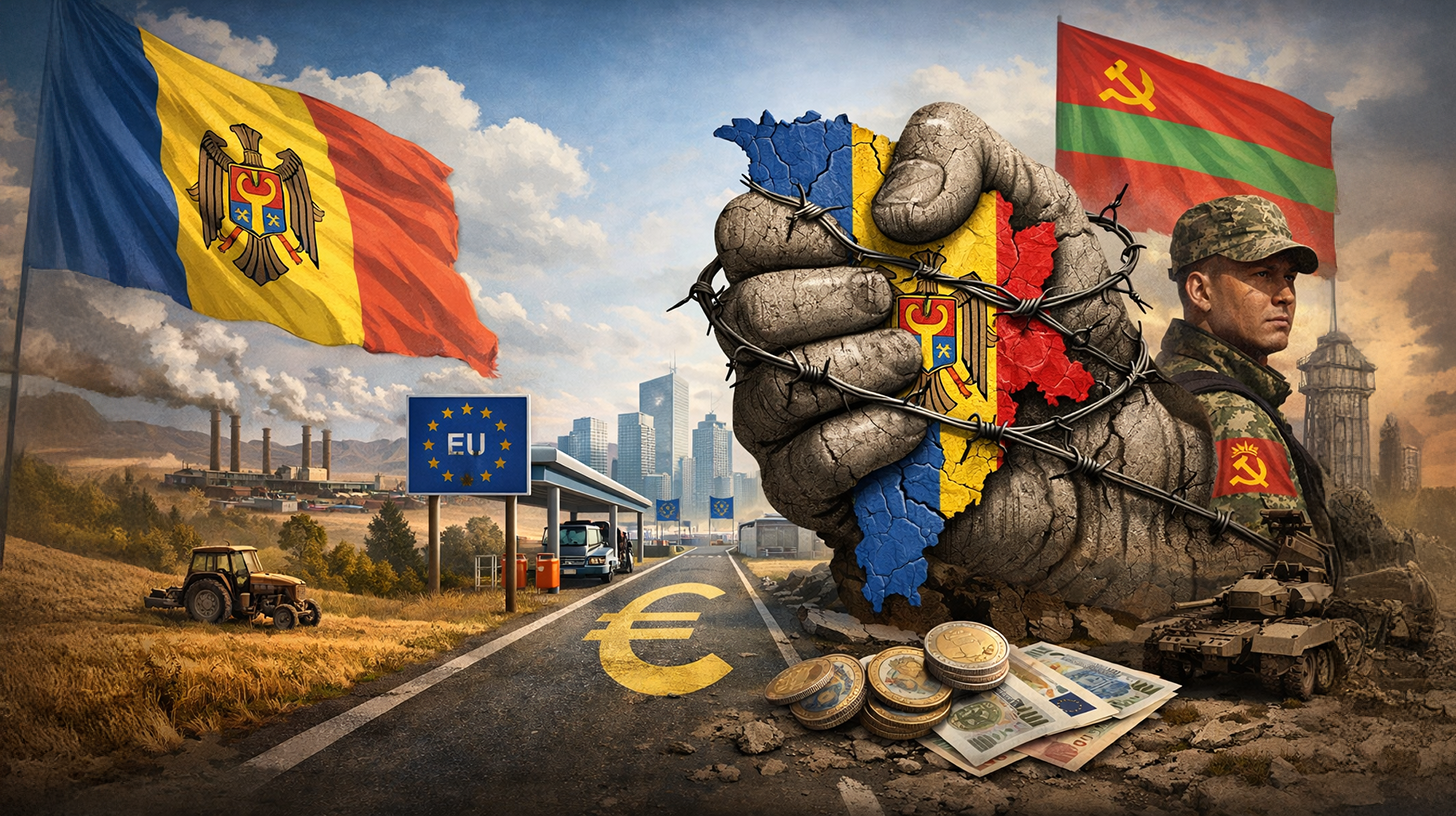
Moldova: Via Romania to the EU? An economic analysis – How Transnistria is strangling Moldova's future – Image: Xpert.Digital
Sandu's daring plan: An economic cry for help disguised as geopolitics?
Energy shock and gas debt: Is Moldova's state sovereignty still financially viable? An economic reality check
When Moldovan President Maia Sandu openly declared in January 2026 that she would vote for reunification with Romania in a potential referendum, it triggered a political earthquake across Europe. But what at first glance appears to be a geopolitical provocation or nostalgic romanticism, upon closer analysis reveals itself to be an almost desperate economic cry for help. Behind the scenes of the identity debate, the Republic of Moldova faces a vital question: Can a small state squeezed between energy blackmail, massive population decline, and the burden of the Transnistria conflict still survive economically on its own?
The gap between aspiration and reality could hardly be wider. While Romania, as an EU member, now boasts an economic output of over $380 billion, Moldova struggles with a figure that is less than 5 percent of that. This report analyzes the stark figures behind the unification debate – from the dramatic inequality of national wealth and the constant threat of energy dependence to the lessons that German reunification holds for Bucharest and Chisinau. It is an analysis of whether the path to the West lies in patient EU integration or whether the merging of two unequal states is the only way to avert economic collapse.
Between existential threat and sober calculation: Why small states are fighting for their economic survival in the 21st century
Moldovan President Maia Sandu's statement in January 2026 that she would vote for unification with Romania in a referendum may at first glance appear to be a political challenge. However, behind this statement lies a fundamental economic question that extends far beyond the direct relationship between Chisinau and Bucharest: Can small states with fewer than three million inhabitants survive economically independently in an increasingly interconnected world marked by political tensions? The economic answer to this question is far more complex than the emotionally charged political debate suggests.
The stark figures: An economic imbalance of historic proportions
The economic situation between Moldova and Romania can be precisely captured in clear key figures. Moldova's gross domestic product (GDP) amounted to approximately US$18.2 billion in 2024, while Romania's economic output of US$382.77 billion is more than twenty times greater. The difference is even more striking when looking at per capita income: at around US$3,872 per inhabitant, Moldova reaches only one-fifth of Romania's level of approximately US$17,600. This enormous gap is not merely a statistical figure, but reflects fundamental differences in the economic structures of the two countries, differences that have solidified over decades.
The Moldovan economy exhibits characteristics typical of former Soviet republics undergoing incomplete transformation. With annual growth of approximately 5.2 percent in the third quarter of 2025, the country demonstrates considerable dynamism, but this growth rate is heavily dependent on external factors. Private consumption, fueled by remittances from Moldovans living abroad, serves as the primary driver. In the second quarter of 2025 alone, these remittances amounted to US$278.8 million, illustrating the extent to which Moldovan domestic demand relies on labor migration. This structure reveals a fundamental weakness: the country exports its most important asset—skilled labor—and imports purchasing power in return.
Romania, on the other hand, has undergone remarkable, albeit not without its challenges, economic development since joining the EU in 2007. Integration into the European single market provided access to over €30 billion in funding for the period 2021 to 2027. The largest share of this, approximately €18 billion, flows through European funds into infrastructure projects, business development, and regional development. These massive influxes of capital have fundamentally transformed the Romanian economic structure, even though the actual utilization of these funds has not always been optimal due to administrative issues.
The historical dimension: Bessarabia as an economic heritage
To understand the current economic situation, a look at history is essential. The territory of present-day Moldova, historically known as Bessarabia, was part of Romania from 1918 to 1940. This interwar period was characterized by attempts at economic integration, which were abruptly ended by the Soviet occupation in 1940. During Soviet rule until 1991, the Moldovan economy was systematically aligned with the needs of a planned economy, with a strong focus on agricultural products and complete dependence on the Russian market.
This historical development has left deep scars. Even today, Moldova's economic structure remains largely geared towards the Russian consumer market, despite the EU having become its most important trading partner. By 2024, 67.3 percent of Moldovan exports went to EU countries, while the share to the former Soviet Union (CIS) had fallen below 20 percent. This realignment is a lengthy process involving significant adaptation costs. Moldovan industry must adapt its products to EU standards, develop new distribution channels, and compete in entirely different environments.
Romania underwent a similar transformation after the collapse of communism in 1989, but with one crucial difference: the country was able to begin this process earlier and had a clear strategic goal with its EU accession in 2007. However, the Romanian experience also demonstrates the difficulties and lengthy duration of such transformations. Despite massive EU aid, Romania still struggles with structural problems such as corruption, inefficient administration, and regional development disparities.
The Transnistria problem: An economic burden with geopolitical significance
A key factor complicating a serious economic assessment of a potential unification is the existence of the breakaway region of Transnistria. This narrow territory east of the Dniester River, with approximately 470,000 inhabitants, seceded from Moldova in 1992 and is effectively controlled by Moscow. The economic consequences of this secession are multifaceted and place a significant burden on the Moldovan economy.
Until 2025, Chisinau covered approximately 70 to 80 percent of its electricity needs with supplies from the Cuciurgan power plant in Transnistria, which was fueled by free Russian gas. With the cessation of Russian gas deliveries on January 1, 2025, this supply collapsed. Moldova now has to purchase significantly more expensive electricity from Romania, which has almost doubled electricity prices compared to the previous year. This sudden cost increase affects both private households and industry, leading to rising production costs that further weaken the international competitiveness of Moldovan companies.
At the same time, the Russian energy company Gazprom is billing the Moldovan government $709 million for alleged gas debts, primarily stemming from consumption in Transnistria. This scheme is deliberately designed to hold Moldova liable for debts originating in a region over which it has no control. President Sandu has repeatedly rejected these claims as artificial and illegitimate, but the existence of this debt burden is damaging the country's credit rating and hindering its access to international financial markets.
For three decades, the business model of the Transnistrian ruling class was based on free Russian gas, cheap labor, and criminal networks extending into Ukraine and Moldova. Products were exported to the EU without paying taxes or duties, while the costs were borne by the Republic of Moldova. This parasitic system systematically damaged the Moldovan economy and deprived the state of millions in revenue.
Energy dependency as a constant threat
The energy crisis since the beginning of 2025 has ruthlessly exposed the vulnerability of the Moldovan economy due to its dependence on Russian energy supplies. Until recently, Moldova was almost 100 percent dependent on Gazprom for gas and electricity. Without Russian gas, the country would have been exposed to harsh winters and widespread power outages. The first important step towards diversifying energy sources was taken in 2019 with the conversion of the Trans-Balkan pipeline for return flow, followed by the completion of the Iasi-Ungheni-Chisinau pipeline in October 2021, which created a supply route via Romania.
These construction projects were costly and were largely financed with EU funds. The European Union provided substantial sums for the development of Moldova's energy infrastructure, including a growth plan totaling €1.8 billion for the period up to 2027. Approximately €520 million of this was disbursed in 2025 alone. This massive financial support underscores the EU's strategic interest in reducing Moldova's energy dependence on Russia, but also reflects the fact that Moldova could not finance this transformation on its own.
The doubling of electricity prices since the beginning of 2025 is leading to further increases in the cost of living and production costs. Despite comprehensive compensation programs for particularly vulnerable population groups and support plans for businesses, this will negatively impact the competitiveness of the Moldovan economy in the medium term. At the same time, Moldova is working intensively on expanding renewable energy sources and constructing a direct power line between Vulcanesti and Chisinau via Romanian territory, scheduled for completion by the end of 2025. This line is intended to finally make the country independent of Russian energy supplies.
The issue of corruption: obstacles to economic development
Another fundamental obstacle to Moldova's economic development is the still high level of corruption. In the so-called Corruption Perceptions Index 2024, Moldova scored 43 points, ranking 76th out of 180 countries surveyed. While this represents a slight improvement compared to previous years, it remains significantly below the scores of established EU member states. Romania itself fares only marginally better, ranking 44th, demonstrating that corruption can persist even after EU accession.
In international rule-of-law rankings, Moldova falls to a low 68th place, indicating significant deficiencies in law enforcement, judicial independence, and administrative efficiency. Such indicators are crucial for foreign investors. A lack of legal certainty, opaque procedures, and corrupt structures massively increase the risk for lenders, resulting in a lack of capital urgently needed for economic modernization, or the diversion of capital to other markets.
The pro-European government under President Sandu has made considerable efforts since 2020 to address these deep-seated problems. Reforms have been initiated in the judiciary, public administration, and the fight against corruption. In 2025 alone, more than 500 laws were aligned with EU law. This pace of reform is impressive, but implementation in practice remains a challenge. There is a difference between laws existing on paper and those actually being lived within an administrative culture that has been shaped by different values for decades.
Our EU and Germany expertise in business development, sales and marketing

Our EU and Germany expertise in business development, sales and marketing - Image: Xpert.Digital
Industry focus: B2B, digitalization (from AI to XR), mechanical engineering, logistics, renewable energies and industry
More about it here:
A topic hub with insights and expertise:
- Knowledge platform on the global and regional economy, innovation and industry-specific trends
- Collection of analyses, impulses and background information from our focus areas
- A place for expertise and information on current developments in business and technology
- Topic hub for companies that want to learn about markets, digitalization and industry innovations
A country caught in a dilemma: This is why EU accession is Moldova's only way out
The problem of demographics: Shortage of workers as a long-term risk
Moldova's population trend is alarming and represents one of the greatest long-term threats to the country's economic future. The current population is estimated at between 2.4 and 3 million, though figures vary depending on the counting method. Since 1991, the population has been steadily declining, with an annual shrinkage of 1.362 percent in 2025. Projections indicate that the population will fall below 3.3 million by 2050 and below 2 million by 2100.
The main reason for this is the massive emigration of workers. Estimates suggest that between 350,000 and over one million Moldovans live and work abroad. This number is enormous for a country with only 2.4 million inhabitants and represents a loss of 15 to 40 percent of the potential workforce. What is particularly serious is that it is primarily young, well-educated people who are leaving the country. This talent drain deprives the Moldovan economy of precisely the skilled workers who are essential for renewal, increased productivity, and economic modernization.
The impact on the tax and pension systems is dramatic. With an employment rate of only about 45 percent of the population aged 15 and over in 2023, Moldova lags far behind the German level of approximately 77 percent. At the same time, the black market and unregistered work account for roughly 25 percent of economic output, meaning that a significant portion of economic activity generates no tax revenue. This situation leads to chronically underfunded public budgets, which in turn prevent sufficient investment in education, infrastructure, and healthcare.
Interestingly, however, substantial sums flow back into the country in the form of remittances. These funds amount to several hundred million US dollars per quarter and represent a significant factor in the stability of domestic demand. However, they lead to a paradoxical situation: the country loses labor and production capacity, but in return gains purchasing power that is primarily used for consumption. This structure is not sustainable in the long term, as it does not stimulate productive investment and tends to increase rather than reduce economic dependence.
Opportunities in agriculture: An underestimated economic factor
Despite its structural challenges, Moldova possesses remarkable economic potential, particularly in the agricultural sector. Moldovan goods exports to the EU increased from US$1.033 billion to US$2.392 billion between 2013 and 2024, representing a growth of approximately 131 percent. This impressive increase was primarily driven by agricultural products, including grains, fruits, nuts, wine, and processed foods.
Moldovan agriculture benefits from fertile soils and climatic conditions particularly well-suited to wine, apples, cherries, plums, and grain. With the Comprehensive Free Trade Agreement, in force since 2014, tariffs on Moldovan agricultural products in the EU have been largely eliminated. The EU has also facilitated market access for producers of grapes, plums, apples, and cherries, and grants Moldovan exporters of pork, poultry, milk, and butter improved access.
Programs from the European Union, the Bank for Reconstruction and Development, and the Moldovan Ministry of Agriculture support the expansion of processing plants, cold storage facilities, and warehouses necessary to meet EU standards. Up to five million euros have been secured for agricultural modernization alone in 2025, financed through international funds and private capital. The central goal is to transform agriculture using state-of-the-art technologies such as robotics, automation, and soil-conserving farming methods.
The development in the Swiss market is particularly interesting, where Moldovan products are increasingly perceived as a niche offering for certified organic products and high-quality goods. This demonstrates that Moldovan producers are capable of holding their own in demanding markets when the relevant quality standards are met. Improvements to the supply chain through digitized operations and modern refrigerated transport reduce fluctuations in exports and underscore the potential of this sector.
Nevertheless, significant obstacles remain. The biggest challenges are the labor shortage due to emigration, difficult access to capital due to high interest rates, and complicated customs procedures. Bank loans are often unattractive to farmers, which hinders investment in modern technology and equipment. Promoting cooperatives and including Moldova in EU business development programs could help alleviate these issues.
The question of unification from an economic perspective: opportunities and risks
A conceptual union between Moldova and Romania would achieve historic economic significance, unprecedented in Europe since German reunification in 1990. The German experience offers important lessons for a realistic assessment of the costs and challenges. German unity cost trillions of euros over decades. In 1990, productivity per employee in East Germany was only about 50 percent of the West German level, a ratio similar to the current situation between Moldova and Romania.
However, the Moldova-Romania case has some significant differences. Moldova's population is roughly 12 percent of Romania's. At the time of reunification, the former East Germany had a proportionally larger population compared to the West (around 25 percent). In purely proportional terms, the demographic challenge for Romania would therefore be less than it was for Germany at the time. Nevertheless, integrating such a much poorer region, with an income of only one-fifth of the Romanian level, would require substantial financial assistance.
Romania's economy is not yet in a position comparable to that of West Germany in 1990. The country is struggling with a budget deficit that exceeded 9 percent of its economic output in 2024. The European Commission warns of the risks associated with the necessary consolidation of public finances. Under these circumstances, Romania would hardly be able to make massive payments to Moldova without itself plunging into a severe financial crisis.
At the same time, however, significant economic opportunities would also arise. Unification would grant Moldova immediate access to the EU single market, the Eurozone, and all EU funding programs. Moldovan agriculture could operate without trade barriers. Romanian companies could invest in Moldovan infrastructure and industry without fear of legal uncertainties. The shared language and cultural similarities would significantly reduce the costs of integration compared to other cases.
An interesting perspective is offered by comparing the EU's eastward expansion. The accession of new countries was often accompanied by initial concerns. Critics warned of job losses and high costs. However, actual developments have shown that both sides have generally benefited. Countries like Poland and the Czech Republic have significantly increased their prosperity. The expansion was also advantageous for the older member states, as it created new markets.
The alternative: EU integration as a more realistic path
President Sandu herself has admitted that joining the European Union is a more realistic goal than unification with Romania. In fact, according to recent polls, only about a third of the Moldovan population supports union, while the majority opposes it. The reasons range from fear of losing their identity and concerns about land sales to investors to the cultural preferences of minority groups.
The Moldovan government aims for EU membership by 2030, an ambitious but achievable goal. Accession negotiations began in 2024, and the review of Moldovan laws for compliance with EU standards was successfully completed. The European Commission has given a positive assessment of Moldova's progress. This represents a significant breakthrough, especially given the many challenges the country faces.
The EU's €1.8 billion growth plan for Moldova promises to give the economy a boost. These funds are earmarked for reforms and infrastructure development. Considering the small size of Moldova's economy, this sum represents almost 10 percent of its annual economic output. Such substantial financial inflows can achieve a great deal if used wisely.
However, EU accession requires profound changes. Adapting to EU standards in areas such as competition, public finance, justice, and the fight against corruption is complicated and expensive. The experiences of other countries show that even after accession, strict controls may be necessary to ensure that the reforms are actually implemented.
Another critical aspect is the EU's own capacity to absorb new members. Accessing further member states requires reforms within the EU, particularly simpler decision-making processes to replace the requirement for unanimity. Without such reforms, an enlarged EU risks becoming paralyzed. The discussions surrounding the accession of Ukraine and Moldova have reignited this debate.
Small states in the global economy: advantages and disadvantages
The question of whether small states are economically disadvantaged is frequently discussed in research. For a long time, they were considered disadvantaged because they cannot benefit from mass production, have only a small market, and are more affected by external crises. However, studies have shown that these disadvantages do not necessarily lead to economic weakness.
Successful small states like Luxembourg or Singapore demonstrate that small size can also offer advantages. These include greater flexibility, faster adaptation, shorter decision-making processes, and a stronger sense of national unity. However, these successful states possess characteristics that Moldova lacks: stable institutions, high levels of education, a strong rule of law, and often a specialization in profitable sectors such as finance or technology.
Moldova, on the other hand, struggles with the disadvantages of its small size without yet being able to capitalize on its advantages. Its small domestic market makes the country heavily dependent on exports, increasing its vulnerability to international crises. The lack of a strong domestic currency and limited options for counteracting economic trends through government spending further reduce its room for maneuver.
The economic development of small countries is demonstrably more prone to fluctuations. International shocks, such as sudden declines in demand, hit them harder. Since they often have only a few industries, they find it more difficult to recover after a crisis. These disadvantages can be mitigated through sound policy, but not entirely eliminated.
The political reality: Why unification remains unlikely
Despite all economic considerations, a union between Moldova and Romania remains highly unlikely for several reasons. Firstly, there is a lack of political support among the Moldovan population. Polls consistently show that approximately two-thirds of Moldovans oppose union. This rejection stems from various deep-seated causes and societal anxieties.
Your global marketing and business development partner
☑️ Our business language is English or German
☑️ NEW: Correspondence in your national language!

Konrad Wolfenstein
I would be happy to serve you and my team as a personal advisor.
You can contact me by filling out the contact form or simply call me on +49 7348 4088 965 (Munich) . My email address is: wolfenstein ∂ xpert.digital
I'm looking forward to our joint project.
☑️ SME support in strategy, consulting, planning and implementation
☑️ Creation or realignment of the digital strategy and digitalization
☑️ Expansion and optimization of international sales processes
☑️ Global & Digital B2B trading platforms
☑️ Pioneer Business Development / Marketing / PR / Trade Fairs
🎯🎯🎯 Benefit from Xpert.Digital's extensive, five-fold expertise in a comprehensive service package | BD, R&D, XR, PR & Digital Visibility Optimization

Benefit from Xpert.Digital's extensive, fivefold expertise in a comprehensive service package | R&D, XR, PR & Digital Visibility Optimization - Image: Xpert.Digital
Xpert.Digital has in-depth knowledge of various industries. This allows us to develop tailor-made strategies that are tailored precisely to the requirements and challenges of your specific market segment. By continually analyzing market trends and following industry developments, we can act with foresight and offer innovative solutions. Through the combination of experience and knowledge, we generate added value and give our customers a decisive competitive advantage.
More about it here:










