
Mercosur | Europe can still do it: This is how the EU secures its raw materials for the future – The signal to Trump and XI comes just in time!
Xpert Pre-Release

Available in 27 languages 📢
Prefer Xpert.Digital on GoogleⓘPublished on: January 9, 2026 / Updated on: January 23, 2026 – Author: Konrad Wolfenstein
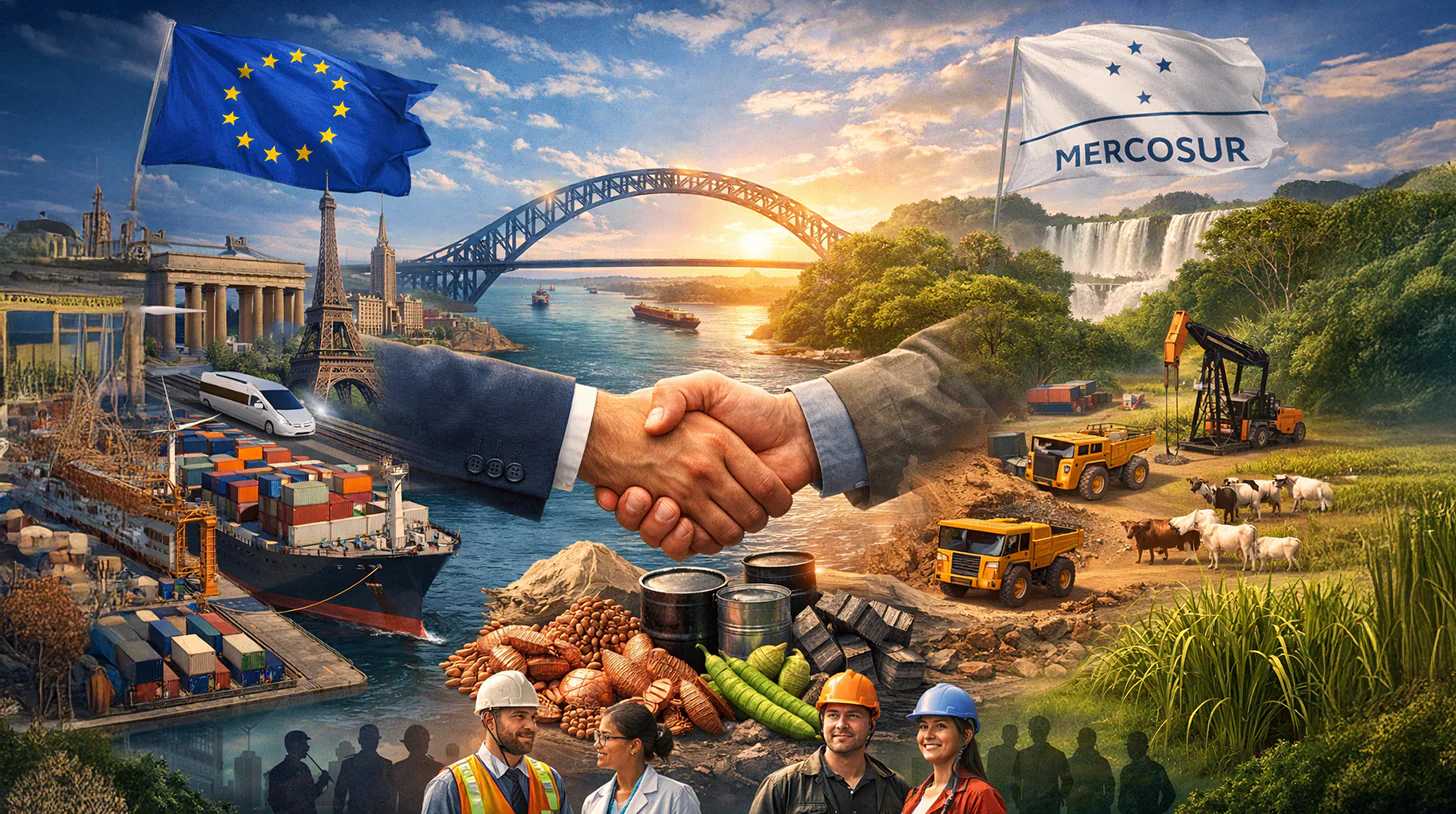
Mercosur | Europe can still do it: This is how the EU is securing its raw materials for the future – The signal to Trump and XI comes at the right time! – Image: Xpert.Digital
440,000 new jobs? The gigantic potential of the Mercosur agreement revealed
UPDATE 23.01.2025: HELP, Europe can't do it after all!
More about it here:

More than just a trade agreement: Europe's strategic move in the global power architecture
After a quarter of a century of arduous negotiations, the European Union set the course in December 2024 for a historic partnership agreement with the Mercosur countries. The decision marks a turning point in global trade policy and comes at a time when the Western world is seeking new strategic alliances. Negotiations with Brazil, Argentina, Paraguay, and Uruguay had dragged on for decades since 1999, with national interests and sectoral lobby groups repeatedly blocking the process. Now, the world's largest free trade zone, encompassing over 700 million people, is nearing completion, which could redraw the geopolitical map. The political agreement of December 6, 2024, was finalized in January 2026 with the approval of the European Council, after individual countries such as Italy, France, and Austria demanded additional safeguards. Signing is planned for the second half of 2026, with provisional application beginning in 2026 or 2027.
Suitable for:

Europe's economic opportunities in the South American market
The economic dimension of this agreement is considerable. The European Commission anticipates that annual EU exports to the Mercosur region could increase by up to 39 percent, representing an additional trade volume of €49 billion and the creation of over 440,000 jobs within the European Union. These figures illustrate the enormous potential inherent in cooperation with South America. Currently, 12,500 German companies already export to the region, 72 percent of which are small and medium-sized enterprises (SMEs) that would particularly benefit from improved market access. These SMEs form the backbone of the German economy and would especially profit from better market access conditions. German industry, which has been active in South America for over a century, sees the agreement as a long-overdue strengthening of its competitive position.
Particularly significant opportunities are seen for the automotive, mechanical engineering, pharmaceutical, and chemical industries. Currently, a 35 percent tariff is levied on car imports into the Mercosur countries, which would be eliminated under the agreement. The German chemical industry, which exported goods worth €4.3 billion to Mercosur in 2024, could considerably expand its market position. Mechanical engineering, another key sector of German exports, would also benefit significantly from the tariff reduction of up to 35 percent. These sectors are therefore central to Germany's export strategy, and the agreement sends a positive signal to industry that Europe is once again capable of taking action.
The agricultural question and its exaggerated dramatization
The impact on the agricultural sector is the subject of heated debate, with the actual risks often being significantly overestimated. Scientific modeling by the Thünen Institute for Agricultural Research shows that EU poultry production would decline by only 1.5 percent after the tariff reductions come into effect. More precisely, South Americans will produce only about one percent more poultry than without the agreement. The protection afforded by existing tariffs and standards remains largely intact, and the actual market effects are considerably less than the public debate suggests. At the same time, new export opportunities are opening up for European specialties such as wine, cheese, and olive oil, which have previously been disadvantaged by high tariffs in the Mercosur markets. The agreement allows the EU to export 30,000 tons of cheese per year duty-free to the Mercosur countries. Furthermore, the South American partners must protect around 350 geographical indications of origin, such as Bavarian beer or Nuremberg sausages, from imitations, which significantly strengthens the position of European quality products. These aspects are systematically underestimated in the public debate.
To safeguard the agricultural sector, the EU has also established comprehensive safeguard clauses. In the event of a harmful increase in imports from the Mercosur countries or an excessive drop in prices for EU producers, countermeasures can be swiftly implemented, temporarily suspending tariff advantages. These safeguard measures are a proven instrument in international trade agreements and offer substantial protection for European producers. However, this also reveals a problem: the public debate in some European countries is dominated by agricultural associations that paint an existential threat scenario, even though scientific data does not support this.
Suitable for:

Geopolitical significance and the signal to global rivals
The geopolitical significance of the Mercosur agreement far exceeds its purely economic aspects. At a time when the US, under Donald Trump, is employing protectionist measures and threatening tariffs of up to 50 percent against European exports, the agreement sends a clear signal of trade openness and strategic autonomy. China has already overtaken the European Union as the most important trading partner in Latin America, and Mercosur's trade volume with China is around 58 percent higher than that with the EU. China has increased its share of Mercosur trade fivefold, from just two percent in 2000 to an impressive 24 percent in 2023. Chinese trade with the Mercosur countries now amounts to approximately $185 billion, while EU-Mercosur trade relations are only around €180 billion. This is particularly dramatic in raw material exports: approximately 69 percent of Mercosur's soybean exports and 64 percent of its iron ore exports go to China. Chinese direct investment in Brazil increased by 34 percent in 2024 alone.
The EU's share of Mercosur's total foreign trade has collapsed from over 31 percent in 2000 to a meager 15 percent in 2023. This is not just a statistic, but rather an expression of a fundamentally shifted balance of power. The Mercosur countries no longer see themselves as supplicants, but as sought-after partners in a region where China is investing heavily and the US is attempting to revitalize its influence. China has achieved this increased presence not through a free trade agreement, but through systematic direct investment, lending, and strategic infrastructure projects such as the new deep-water port in Peru, which Xi Jinping personally inaugurated. The Mercosur agreement allows the EU to regain its influence in the region and to establish itself as a reliable partner for democracy and rules-based governance. Europe's soft power—its ability to exert influence through values and rules—is gaining in attractiveness, especially if the US, under Trump, once again treats Latin America like its backyard.
France's blockade and the limits of European decision-making
France's opposition to the agreement posed a significant challenge. President Emmanuel Macron repeatedly emphasized that France would not approve the agreement, a stance driven by massive domestic pressure from the agricultural sector. The French farmers' lobby, FNSEA, vehemently opposes the agreement, fearing that 100,000 tons of beef from Mercosur countries could enter the European market at reduced tariffs. However, these concerns are disproportionate given the limited actual impact and the extensive safeguard clauses. Macron has shifted his position several times, highlighting the difficulty of reconciling national interests with European strategic objectives. The French National Assembly and Senate voted overwhelmingly against the agreement, underscoring its political sensitivity. Ultimately, France was unable to block the agreement, as EU Council approval required a qualified majority, and a sufficient number of member states voted in favor.
Italy, under the leadership of Giorgia Meloni, initially demanded postponements and additional concessions. This obstructionist stance led to the postponement of the planned signing from the end of December 2024 to the beginning of January 2026. Meloni wanted to secure supplementary agreements at the beginning of the year before the signing could take place. With additional assurances to protect Italian farmers, the deadlock was ultimately overcome.
The strategic partnership with Mercosur and its institutional aspects
The strategic partnership with Mercosur encompasses far more than mere trade. The agreement includes comprehensive treaties for political dialogue and cooperation, paving the way for more intensive collaboration in research and development, education and training, and culture. These non-trade aspects are crucial for anchoring European interests in the region for the long term. The EU has lost prestige globally in recent years, including in Latin America. The Mercosur agreement offers the opportunity to restore this prestige and act as a reliable partner for multilateral solutions. European companies are already market leaders in many key Latin American sectors, such as finance, automotive, energy, telecommunications, and infrastructure. Without a binding agreement, these strategic advantages would be recklessly squandered. The agreement will first undergo legal review and translation, which are essential for the further process. Following the planned signing in the second half of 2026, ratification by the participating parliaments will take place, with the approval of the European Parliament remaining a critical step.
Our Latin America expertise in business development, sales and marketing

Our Latin America expertise in business development, sales and marketing - Image: Xpert.Digital
Industry focus: B2B, digitalization (from AI to XR), mechanical engineering, logistics, renewable energies and industry
More about it here:
A topic hub with insights and expertise:
- Knowledge platform on the global and regional economy, innovation and industry-specific trends
- Collection of analyses, impulses and background information from our focus areas
- A place for expertise and information on current developments in business and technology
- Topic hub for companies that want to learn about markets, digitalization and industry innovations
Europe's raw materials coup: How this deal secures our supply of lithium and hydrogen
Energy and raw material security as a central motivation
Energy and resource security is a central aspect of the agreement. The Mercosur countries possess abundant raw material deposits and are important suppliers of agricultural commodities and energy. The agreement secures access to these resources and significantly strengthens the EU's supply chain resilience. This is particularly relevant against the backdrop of geopolitical tensions and the search for alternative sources of supply. Latin America holds half of the world's lithium reserves, over a third of its copper deposits, and approximately one-fifth of the world's nickel and rare earth metals. Chile, Argentina, and Brazil are considered particularly attractive for European raw material investments. The International Energy Agency expects demand for critical raw materials to increase by more than 6 percent annually until 2030.
Reducing export taxes on soy from Argentina will lower the price of animal feed in Germany and strengthen the competitiveness of domestic agriculture. Based on announced projects, the region could produce over 7 million tons of low-emission hydrogen per year by 2030, with approximately 80 percent of the projects concentrated in the Mercosur region. This opens up enormous opportunities for European companies in the fields of green hydrogen and renewable energy. The agreement also aims to restrict the export of critical minerals to increase local value creation and not simply promote uncontrolled raw material extraction. These aspects are too rarely emphasized in the public debate, which tends to focus on perceived risks.
Suitable for:

A critical look at environmental protection regulations
Critics rightly point out that the environmental protection provisions in the agreement are not optimally designed. The European Deforestation Regulation enters into force on December 30, 2025, with the aim of prohibiting the sale of products on EU markets whose production destroys forests. However, the free trade agreement stipulates that the Mercosur countries will be "given preferential consideration" and their own official certifications will be recognized. This means that the very institutions that have done little to prevent deforestation in the past could have a say in compliance with European rules. The agreed clauses on deforestation and environmental standards are unenforceable and do not provide for direct sanctions in the event of violations of the Paris Climate Agreement or other sustainability goals. As a result, tens of thousands of hectares of land are threatened by deforestation every year, particularly in the Brazilian Cerrado and the Amazon.
The implementation of the European Deforestation Regulation in the Mercosur countries involves considerable regulatory costs, and the infrastructure for smooth implementation still needs significant development. Smallholder farmers, in particular, face a high risk of being excluded from EU value chains, as they are often unable to fulfill the necessary due diligence obligations and provide the required documentation. In addition to these technical gaps, there are also incentive problems for actors in producer countries to actually invest in implementing these standards. A key prerequisite for overcoming these challenges lies in establishing robust communication structures between the EU, national enforcement authorities, and actors from the producer countries.
Nevertheless, this critical view needs to be put into perspective. Scientific assessments of the impacts show that the risks to the European agricultural sector are overestimated. Model calculations by the Thünen Institute indicate moderate adaptation processes, while the opportunities for specialized exporters clearly outweigh the risks. The actual environmental effects depend significantly on the strict implementation of the agreed safeguard clauses and the enforcement of environmental standards. The Commission has committed to ensuring rigorous controls on imported products and monitoring compliance with European standards. Furthermore, it should be noted that European demand for soy, beef, and other products is already a driver of deforestation, regardless of whether a trade agreement exists. China is already importing massive amounts of South American products, thereby accelerating deforestation, without the need for a free trade agreement.
The global trade architecture and Europe's role
The long-term impact on Europe's global competitiveness is significant. The agreement positions the EU as an active shaper of the global trade architecture and strengthens its credibility as an international actor. At a time of increasing unilateralism and protectionist tendencies, the EU is sending a clear signal in favor of multilateral solutions and rules-based trade. This is particularly important given the challenges posed by China and the USA. The European economy depends on developing new markets and finding long-term strategic partners. The Mercosur agreement offers precisely this prospect while simultaneously securing access to key raw materials and energy resources. Chancellor Friedrich Merz hailed the EU decision as a "milestone" and emphasized that the agreement would strengthen the European economy and improve trade relations with partners in South America.
The geopolitical tensions are heightened by the current international situation. The US under Trump has made it clear that it is redefining its traditional alliances and considering protectionist measures against European exports. China, on the other hand, has massively expanded its presence in Latin America and replaced the EU as the region's most important trading partner. The Mercosur agreement is therefore not just an economic measure, but a strategic instrument for safeguarding European interests in a region that is increasingly becoming the arena of the global power struggle. The EU must decide whether to act as an active participant or a passive observer. The fact that both sides have finally reached an agreement after 25 years demonstrates that the necessity for such an agreement has become obvious.
Structural challenges of European decision-making
The debate surrounding the agreement also reveals the structural challenges of European decision-making. The need to reach a consensus among 27 member states with differing economic interests and political priorities significantly hinders swift and decisive action. The agricultural lobby in France and other member states wields considerable influence over national policy and can thus block the entire process. These veto structures jeopardize the EU's ability to act swiftly in an increasingly competitive global environment. The Commission therefore had to walk a fine line between the legitimate interests of farmers and the Union's strategic objectives. This was only possible through additional safeguards and direct assurances to countries like Italy that their concerns would be taken into account. In the end, the EU was able to deliver, demonstrating its ability to act under pressure. However, the process was considerably longer and more arduous than it should have been, and 25 years were lost during which China steadily expanded its influence.
The historical significance of the agreement
The historical dimension of the agreement should not be underestimated. After 25 years of negotiations, during which seemingly insurmountable obstacles repeatedly arose, the political agreement is proof of the EU's ability to negotiate and implement complex international agreements. This ability to enforce agreements is crucial in light of increasing competition from China and the USA. The EU has shown that, despite its complicated decision-making processes, it is capable of securing the necessary majority at the decisive moment. This strengthens the Union's credibility as a reliable partner and enables it to assert its values and interests in the world. The victory is not an overwhelming majority with enthusiasm, but a pragmatic recognition of necessity. But that is precisely what makes it significant. Chancellor Merz also emphasized clearly that 25 years of negotiations were far too long and that the EU must now swiftly conclude further free trade agreements.
Suitable for:
Practical implications for German and European companies
The economic opportunities for German industry are substantial. German mechanical engineering, the automotive industry, the chemical industry, and the medical device sector anticipate significant export growth due to the elimination of tariffs and trade barriers. The Mercosur countries require massive investments in infrastructure, renewable energies, hydrogen production, and the development of modern manufacturing structures. German technology and expertise are in demand worldwide in these areas. Companies should use the ratification phase to develop their market entry strategies and establish local partnerships. The German Chemical Industry Association (VCI) expressly welcomed the EU Council's approval, as did regional chambers of industry and commerce, which recognized the massive potential for local businesses. The Lower Saxony Chamber of Industry and Commerce describes Mercosur as a "key market" for German companies and acknowledges the elimination of tariffs of up to 35 percent as a significant benefit for exports.
The new free trade zone, encompassing over 700 million people, will be the world's largest of its kind. The agreement on the controversial deal was made possible by further concessions to the agricultural lobby and pragmatic assurances to skeptical countries. These solutions, however unsatisfactory they may sometimes seem, are occasionally necessary to bring complex international negotiations to a close. The question remains whether these compromises will be sufficient to secure the agreement's passage through the European Parliament, which still needs to formally approve it. However, the signals so far are rather positive. A resolution against the agreement was declared inadmissible by the European Parliament, meaning that its supporters are likely to have a majority there. The European Parliament's Budget Committee already approved safeguard mechanisms for agricultural imports from the Mercosur countries in early February 2025, indicating that practical work on ratification is underway.
Perspective for the European strategy
The Mercosur agreement is part of a broader European strategy for economic security and diversification. The EU aims to reduce its dependence on the markets of the US and China and strengthen its position in South America. Access to key raw materials such as lithium and nickel is crucial for Europe's energy transition and the development of its own battery and electric vehicle industries. Without secure supply chains for these raw materials, the European decarbonization strategy will fail. The agreement also helps European companies access new markets, thereby reducing their dependence on individual regions. This is an essential component of the EU's strategy for economic resilience and the offshoring of German and European production capacities.
A complete streamlining of European trade policy is necessary to remain competitive with China and the US. China pursues an active trade policy regardless of national opposition in individual provinces, while the US under Trump is prepared to sacrifice traditional alliances to improve its export opportunities. The EU must become equally agile and flexible, but it cannot afford to sacrifice its values and standards. The Mercosur agreement is an attempt to maintain this balance while simultaneously becoming more internationally effective. It is not perfect, but it is an important step in the right direction. History will show whether this step came quickly enough to preserve Europe's position in a rapidly changing global order.
🎯🎯🎯 Benefit from Xpert.Digital's extensive, five-fold expertise in a comprehensive service package | BD, R&D, XR, PR & Digital Visibility Optimization

Benefit from Xpert.Digital's extensive, fivefold expertise in a comprehensive service package | R&D, XR, PR & Digital Visibility Optimization - Image: Xpert.Digital
Xpert.Digital has in-depth knowledge of various industries. This allows us to develop tailor-made strategies that are tailored precisely to the requirements and challenges of your specific market segment. By continually analyzing market trends and following industry developments, we can act with foresight and offer innovative solutions. Through the combination of experience and knowledge, we generate added value and give our customers a decisive competitive advantage.
More about it here:
Your global marketing and business development partner
☑️ Our business language is English or German
☑️ NEW: Correspondence in your national language!

Konrad Wolfenstein
I would be happy to serve you and my team as a personal advisor.
You can contact me by filling out the contact form or simply call me on +49 7348 4088 965 (Munich) . My email address is: wolfenstein ∂ xpert.digital
I'm looking forward to our joint project.










