
Marketing as a Service (MaaS): Visibility in the AI Age – How Industrial Companies Must Restructure Their Customer Acquisition
Xpert Pre-Release

Available in 27 languages 📢
Prefer Xpert.Digital on GoogleⓘPublished on: August 13, 2026 / Updated on: August 13, 2026 – Author: Konrad Wolfenstein
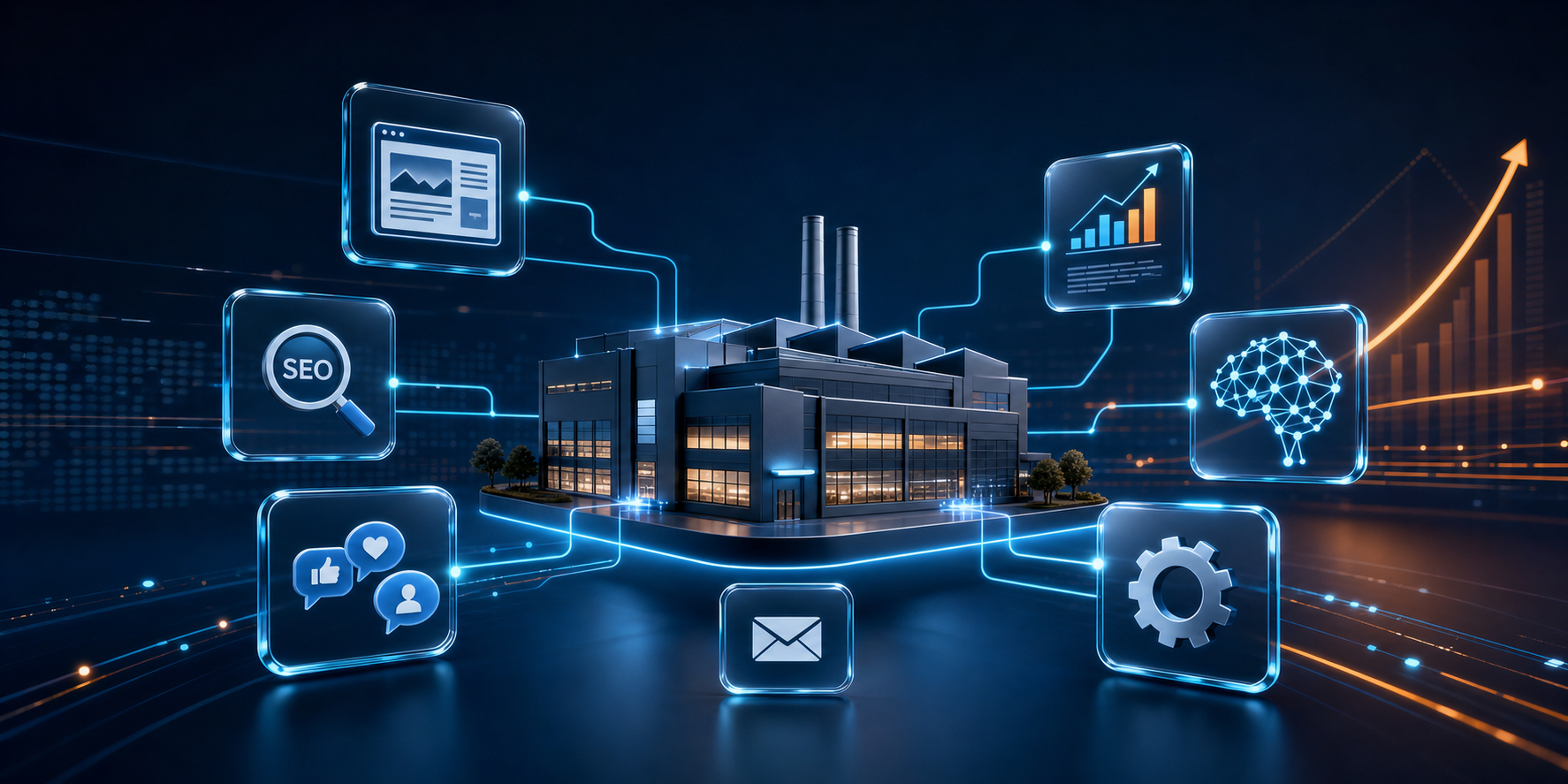
Marketing as a Service (MaaS): Visibility in the AI Age – How industrial companies need to restructure their customer acquisition – Image: Xpert.Digital
Overload instead of strategy: Is the classic marketing department obsolete?
The patchwork of expertise: Why a single marketing position is no longer enough
The industrial sector, particularly medium-sized businesses, faces a formidable challenge: the days when a single specialist could handle the entire company's marketing single-handedly are definitively over. Whether it's search engine optimization, content creation, social media, or the rapid rise of artificial intelligence – the demands of modern marketing communication have become so complex and multifaceted that traditional job profiles are reaching their limits. The result? Overburdened employees, an inefficient patchwork of skills, and the looming loss of digital visibility among B2B decision-makers. But how can medium-sized industrial companies, which are already often struggling with a shortage of skilled workers, overcome this hurdle? The answer lies in a fundamental structural shift towards modular solutions like "Marketing as a Service." This article explores why the old make-or-buy cost logic is obsolete, how internal expertise can be cleverly integrated with external specialization, and why AI doesn't replace marketing, but rather transforms it into a high-performance system.
Between overexertion and outsourcing
Germany's medium-sized industrial companies are facing a quiet but profound transformation of their marketing organizations. What was considered a manageable support function for decades is increasingly evolving into a complex network of disciplines that can hardly be covered by a single specialist. Website maintenance, search engine optimization, social media communication, content creation, campaign management, marketing automation, sales support, and now also visibility in AI-powered search systems, together form a set of requirements that would have been unthinkable just ten years ago. At the same time, artificial intelligence is fundamentally changing the way marketing is done and opening up new possibilities for making processes more efficient. For many medium-sized industrial companies, this is creating considerable pressure to change, which can no longer be met simply by filling vacant positions.
For a long time, the shortage of skilled workers was considered the central problem for marketing organizations in medium-sized businesses. Qualified marketing professionals with industrial experience are rare, especially in rural areas and highly specialized niche industries where many family businesses and hidden champions are located. However, a second, more subtle problem is now emerging: even when a marketing position is successfully filled, a single person can hardly oversee and professionally manage the multitude of disciplines. The expectation that a marketing position should simultaneously be a strategic manager, copywriter, search engine optimizer, social media expert, web manager, data analyst, and AI specialist is becoming increasingly unrealistic. This development marks a turning point in how medium-sized companies must organize their market communication and customer acquisition.
From communications department to high-performance system: Why marketing has become so complex today
The fundamental problem lies not in the competence or commitment of individual marketing managers, but in the increasing specialization of the entire field. Marketing has evolved from a primarily communicative function to a data-driven, technology-supported management area that combines skills from fields as diverse as computer science, statistics, psychology, design, and traditional business administration. Particularly in medium-sized industrial companies, these disciplines must also be closely integrated with technical product knowledge, sales processes, and often international markets, further increasing the demands.
In addition to traditional corporate communications, digital channels have emerged, each with its own logic, algorithms, and key performance indicators. Search engine optimization follows its own technical rules and changes with every algorithm update from search providers. Social media communication requires platform-specific know-how that differs significantly between LinkedIn, Instagram, and industry-specific networks. Content production, whether technical articles, videos, or interactive formats, demands both editorial and technical skills. Campaign management requires knowledge of media planning and budget allocation. And with the advent of AI-based applications, another layer is created that requires both technical understanding and strategic judgment. This simultaneous occurrence of such diverse requirements explains why traditional job profiles in marketing are reaching their limits.
The patchwork of skills: Why one job is no longer enough for everything
The key insight for business leaders is that a single marketing department is structurally no longer capable of covering all specialized disciplines with the necessary depth. A person responsible for strategic positioning typically cannot simultaneously be up-to-date with the latest technical search engine optimization, keep abreast of daily social media trends, and conduct data-driven campaign optimization. Attempting to combine all these tasks into one role, however, usually leads to superficial handling of individual areas, delays in implementation, and often to an overload for the employees involved.
For medium-sized industrial companies, a fundamental question therefore arises: Which marketing competencies must actually be maintained permanently and exclusively in-house, and which can be acquired externally on a situational or continuous basis? This question touches upon not only organizational but also strategic and economic dimensions, as it directly affects competitiveness in the areas of customer acquisition and brand building.
Marketing as a subscription: The principle behind the new service model
A logical response to this structural overload lies in a model that can be described as "Marketing as a Service." The basic principle is similar to proven concepts that companies are already familiar with from other functional areas, such as IT administration, server hosting, or external tax consulting. In these areas, it has long been standard practice that certain functions are not permanently developed internally, but rather organized as a continuous, externally provided service. Dedicated contacts, clearly defined task packages, and a predictable monthly budget ensure reliability and calculability.
The key difference compared to traditionally hiring an advertising or digital agency lies in the nature of the collaboration. While traditional agency engagements are usually project-based, with a defined start and end point – for example, for a new website or a single campaign – Marketing as a Service focuses on the continuous outsourcing of an entire marketing function. The external team doesn't act as a one-off service provider, but rather as a permanent, closely integrated part of the company's organization, comparable to an outsourced but fully integrated department.
This model offers medium-sized companies the advantage that they no longer have to try to build up and finance all specialized expertise internally. Instead, they can access a team that has already professionally integrated the various disciplines and continuously stays up-to-date in its respective fields.
Accelerator, not replacement: The true role of artificial intelligence in marketing
This development is further accelerated by the rapid advancement of artificial intelligence. AI systems can now significantly speed up research, data analysis, the production of draft texts, and the development of creative variations. Tasks that previously took hours or days can be prepared in a fraction of the time with the right tools. This technological acceleration is fundamentally changing the economics of marketing, as the cost-benefit ratio is shifting considerably in many operational areas.
The crucial difference, however, lies not in mere access to AI tools, but in their professional application. In principle, virtually anyone can use artificial intelligence today, whether through simple chat interfaces or integrated applications. However, the real productivity gains don't come from simply accessing these tools, but from experience, established and repeatable workflows, and the ability to professionally evaluate and further develop the results generated by AI. Someone who works with AI systems in marketing daily and routinely develops a fundamentally different approach to these tools than someone who occasionally enters a single prompt and accepts the initial result without reflection.
This observation has direct consequences for the question of who actually benefits from technological progress. Artificial intelligence can, in particular, help specialized teams deliver their services more efficiently, quickly, and on a larger scale because these teams possess the necessary experience to use the technology effectively. Strategic decisions, brand positioning in the market, and quality control of the generated content, on the other hand, remain genuinely human tasks that cannot be delegated to an automated system. In this understanding, artificial intelligence functions as a powerful tool, but not as a point of contact for customer concerns, and certainly not as an independent decision-making body in the marketing process.
Four building blocks instead of one universal position: How marketing performance can be organized modularly
A key component of the Marketing-as-a-Service approach is to organize marketing services not as a monolithic function, but in clearly defined levels, each reflecting different competency profiles and objectives. This differentiation allows companies to selectively procure the specific level of service that is actually lacking internally or additionally required, instead of building or outsourcing an entire department.
The first level, day-to-day marketing operations, encompasses the ongoing implementation of specific measures, such as content maintenance, channel management, and the technical execution of individual campaign components. The second level, marketing management, coordinates the various communication activities, aligns measures, and ensures seamless integration with sales, so that marketing activities directly support the sales process. The third level, strategic growth marketing, assumes overall control of market visibility and new customer acquisition, consistently aligning the marketing strategy with long-term corporate goals. Finally, the fourth level positions marketing and business development as an integrated function, adhering to the principle of organizational ambidexterity—that is, a company's ability to simultaneously leverage existing business areas efficiently and systematically develop new growth opportunities.
Related to this:

This four-stage differentiation allows companies to determine much more precisely which services they actually need, instead of organizing marketing either entirely in-house or entirely outsourced. A company with well-established operational marketing capabilities may primarily require strategic external guidance, while a company with strong strategic leadership is more likely to seek operational support for implementation.
🎯🎯🎯 Data-driven B2B industry hub as a quasi-in-house solution

The quasi-in-house solution: How Xpert.Digital closes operational gaps in B2B marketing and sales – Smart Content-Driven Business - Image: Xpert.Digital
Xpert.Digital is a data-driven B2B industry hub led by Konrad Wolfenstein . The company acts as an external, quasi-in-house solution for industrial partners, closing operational gaps in marketing, content, and sales – without requiring additional resources on the client side.
More information here:
Internal expertise versus external specialists: How to build a modern marketing organization
Two worlds of knowledge, one goal: How internal expertise and external specialization work together
In practice, a combination of internal and external resources often proves particularly effective. Internal company and product knowledge, developed over years and encompassing in-depth understanding of customer needs, technical product details, and industry-specific characteristics, can hardly be fully replaced by external partners. At the same time, a specialized external team possesses competencies that a single medium-sized company could hardly acquire internally in a cost-effective manner – such as profound technical expertise in search engine optimization, marketing automation, or the use of generative artificial intelligence.
This observation leads to a key principle for the future marketing organization of medium-sized businesses: Not every skill needs to be permanently on the company's payroll to be available to the company. Rather, a smart combination of internal knowledge and external specialist expertise can achieve a level of performance that neither a purely internal team nor a selectively commissioned agency could achieve alone.
The new make-or-buy calculation: Why the old cost logic is no longer sufficient
This structural change also has direct economic consequences for how companies calculate and evaluate their marketing organization. The traditional approach of comparing the annual salary of an internal marketing position with the ongoing costs of outsourcing to an agency falls short in light of these developments. Such a simplistic comparison overlooks the fact that a single internal position is structurally incapable of covering the entire required range of competencies, and that occasional agency engagements often fail to provide the continuous management function necessary for sustainable market success.
Instead, companies will need to take a more nuanced approach in the future, considering which different skills they actually require and how frequently and intensively these skills are used. Highly specialized technical expertise, needed only occasionally but then requiring a high level of in-depth knowledge, is more economically viable to outsource than to maintain permanently in-house. Conversely, expertise required daily and in close collaboration with internal departments is more likely to benefit from an internal solution or at least one that is very closely integrated with internal resources.
The crucial strategic question thus shifts from a binary decision between internal and external to a more nuanced organizational question: How can marketing be organized in such a way that a company has permanent and reliable access to the necessary competencies without jeopardizing the economic viability of the marketing organization? This reorientation of the economic perspective marks a significant shift in viewpoint compared to traditional organizational models in marketing.
Leading with both hands: What organizational ambidexterity means for marketing decisions
The concept of organizational ambidexterity, originally from strategic management research, describes the ability of organizations to simultaneously fulfill two seemingly contradictory requirements: the efficient exploitation of existing business models and customer relationships on the one hand, and the exploratory development of new markets, target groups, or business areas on the other. Applied to marketing organizations, this means that companies must ensure the ongoing, reliable support of existing customers and channels while also developing the ability to systematically test new formats, technologies, and market opportunities.
This dual requirement is difficult to address economically within a single internal marketing structure, as the necessary skill sets differ significantly. Efficient, repeatable processes demand different skills and working methods than the experimental development of new digital channels or the use of new AI applications. Flexible, service-based organizational models are therefore becoming increasingly important, particularly in medium-sized industrial companies, because they allow for the mobilization of appropriate resources for each requirement without requiring a company to attempt to build all necessary skills permanently and entirely in-house.
Related to this:

Visibility beyond search engines: Why AI systems are putting additional pressure on marketing
One aspect that further underscores the urgency of this organizational realignment concerns the changing logic of digital visibility. For many years, search engine optimization (SEO) focused on the traditional search engine results pages. However, with the increasing prevalence of AI-powered response systems that directly answer user queries in a summarized form, the way companies and their products are found and perceived is fundamentally changing. Visibility in these new systems follows different technical and content-related logics than traditional SEO, which means that marketing professionals need to acquire an additional specialized discipline alongside all their existing requirements and continuously develop their skills.
This development is particularly relevant for medium-sized industrial companies, whose products are often technically complex and require explanation. Purchasing decision processes in the B2B sector are already typically lengthy and involve multiple decision-makers, who are increasingly using AI-supported research tools. A company that is not visible or adequately represented in these new information channels risks simply not being considered in the early stages of the purchasing decision. This development underscores why marketing expertise today extends far beyond traditional advertising measures and is gaining increasing strategic relevance for a company's overall sales success.
Not a retreat from marketing, but a restructuring of its organization
The developments described do not mean that marketing as a corporate function is losing importance. On the contrary, they show that the demands on professional market communication and customer acquisition are constantly increasing, making marketing an increasingly crucial competitive factor – especially for medium-sized industrial companies that must hold their own in increasingly globalized and digitalized markets. What is changing is not the importance of marketing, but rather the way in which companies organize and provide the necessary expertise.
In the future, companies will need to more carefully consider which competencies they want to develop in-house on a permanent basis—for example, because they are closely linked to internal product knowledge or sensitive customer relationships—and which skills they can flexibly and as needed procure as external services. This nuanced decision requires a significantly higher degree of organizational and economic reflection than the traditional, often intuitive choice between building an in-house department and engaging a conventional agency.
What companies should specifically check now
For medium-sized industrial companies that want to adapt their marketing organization to the changed requirements, the developments described result in several concrete areas of action that can be meaningfully reviewed:
- An honest assessment of the internally available competencies and a clear identification of the gaps between the aspirations and reality of the existing marketing organization.
- An assessment of which marketing disciplines are closely linked to internal product and customer knowledge and should therefore remain more internally anchored.
- An examination to determine which highly specialized skills – such as in technical search engine optimization, marketing automation, or the professional use of artificial intelligence – can be sourced externally in a more economically viable way.
- An analysis of one's own visibility not only in classic search engines, but also in AI-supported information systems, which are increasingly influencing early phases of B2B purchasing decisions.
- A decision regarding the appropriate level of organization between continuous, service-oriented collaboration and ad-hoc project commissioning, depending on the strategic importance of the respective marketing function.
This systematic approach replaces the previously often blanket decision between building an in-house marketing department and outsourcing to a traditional agency with a differentiated, economically sound organizational strategy. This strategy is significantly better suited to today's demands for complexity, speed, and technological advancement.
Your global marketing and business development partner
☑️ Our business language is English or German
☑️ NEW: Correspondence in your native language!

Konrad Wolfenstein
I and my team are happy to be available to you as your personal advisor.
You can contact me by filling out the contact form here [email protected]:or simply call me at +49 7348 4088 965. My email address is
I'm looking forward to our joint project.
☑️ SME support in strategy, consulting, planning and implementation
☑️ Creation or realignment of the digital strategy and digitization
☑️ Expansion and optimization of international sales processes
☑️ Global & Digital B2B trading platforms
☑️ Pioneer Business Development / Marketing / PR / Trade Fairs
📈🚀 From visibility to trust 👀🤝 Your scalable path with Xpert.Digital

From visibility to trust: Your scalable path with Xpert.Digital - Image: Xpert.Digital
In industrial B2B, sustainable business relationships rarely emerge overnight. They develop step by step – through visibility, professional relevance, recurring touchpoints, and growing trust. Xpert.Digital's 4-stage model addresses precisely this: It offers a structured path that begins with a manageable entry point and can evolve into deeper collaboration in business development if needed.
Instead of relying on loud marketing promises, this model puts the relationship at the forefront. Companies start with clearly defined, easily calculable measures and then decide, based on their own experience, how far they want to expand the collaboration. A key factor for this undisturbed trust-building process: The platform completely avoids annoying advertising ads, so the editorial focus remains solely on the companies' expertise.
More information here:










