
Antizyclic SEO: Strategies for sustainable visibility in the age of AI search
Xpert pre-release

Available in 27 languages 📢
Prefer Xpert.Digital on GoogleⓘPublished on: April 26, 2025 / update from: April 26, 2025 - Author: Konrad Wolfenstein
Antizyclic SEO: Strategies for sustainable visibility in the age of AI search-Image: Xpert.digital
Ki meets SEO: How the search of the future breaks old rules
The need for a re -evaluation of SEO
The landscape of search engine optimization (SEO) is in a profound change. Traditional methods that aim to optimize websites for search engines such as Google or Bing in order to generate unpaid (“organic”) traffic. The main driver of this change is the unstoppable rise of artificial intelligence (AI) in search technologies. AI-supported viewfinder experiences such as Google's “Ai Overviews” (formerly Search generative experience, SGE) and conversation search engines such as Perplexity AI change fundamentally how users find and consume information.
This development questions established SEO practices and requires strategic rethinking. The mere optimization on keywords and the striving for top rankings in the traditional “blue links” may no longer be sufficient to secure long-term visibility and traffic. In this context, the concept of “anti -cyclical SEO” gains importance.
This article analyzes why an anti-cyclical approach to SEO is becoming increasingly important in times of growing AI search and outlines concrete strategies for implementation. It is examined how the AI search affects website traffic and user behavior and which core principles of a robust, future-proof SEO strategy must be based.
Suitable for:

The new paradigm: AI search and their effects
The integration of generative AI in search engines is not a gradual adaptation, but a paradigm shift that has far -reaching consequences for digital visibility.
Definition: What is “Antizyclic SEO”?
The term “anti -cyclical” originally comes from the economy and describes investment behavior or measures that move contrary to the general market trend or economic root. For example, anti -cyclical stocks tend to develop well when the overall economy weakens and vice versa.
Transferred to SEO, “anti -cyclical” does not necessarily mean working against seasonal trends (although this is a possible tactic, as indicated in by completing optimizations before the season). Rather, it describes a strategic approach that deliberately turns from short-term, reactive tactics that aim at volatile algorithm changes or the hype for new search functions. Instead, anti -cyclical SEO focuses on the structure of long -term, sustainable and resistant digital assets and authority, which also exist when the search landscape - as is through AI - changes dramatically. It is about investing in basic quality factors, brand confidence and direct target group relationships that are less susceptible to the fluctuations that bring new technologies such as AI search. It is an investment in stability and value if others may react panically to traffic losses or try to take advantage of short-term loopholes.
Direct effects on website traffic and visibility
The introduction of AI-supported answers directly in the search results (SERPS), as with Google's Ai Overviews (SGE), has a measurable effect on organic traffic. These AI generated summaries, which are often prominently placed above the traditional organic results, answer user inquiries directly, which means that the need for a click on a website is no longer necessary.
Studies indicate a potential decline in organic traffic in the range of 18% to 64%, whereby the effects vary greatly depending on the website and industry. Some websites could suffer extreme traffic burglaries of up to 95%, while others, especially those that are cited by the AI as a source, record growth of up to 219%. This enormous range of fluctuations underlines the high volatility and the changed rules of the game in the AI age. An environment is created in which the citation is extremely valuable in a response, while ignoring (especially with previously good rankings) can have devastating consequences. This unpredictability requires strategies that are not based on traditional rankings for broad search terms, but rather resilience through diversification (direct channels) and focus on becoming an indispensable, quotable source (authority, unique value).
A general click decline of around 6% across all industries has been observed since SGE was introduced. This is partially attributed to the fact that the AI answers move the traditional organic results by an average of around 1,562 pixels. Since AI-generated answers appear in almost 86% of the search queries, users find the required information more and more without having to visit a source website.
The effects are also industry-specific: travel websites recorded 9.8% fewer clicks, local search queries 14.9% less, and in the health sector 68% of the searches appear automatically SGE results. Railments of the click rate (CTR) for the first organic result have already been found for information -oriented search queries.
Change in user behavior and expectations
AI not only changes the Serps, but also how users interact with the search and what they expect:
- Conversational search: Users ask increasingly complete questions instead of just entering keywords, which is promoted by voice search and AI chatbots.
- Immediate satisfaction of needs: AI search functions provide direct, synthesized answers and thus create the expectation of obtaining information without detours.
- Semantic understanding: AI systems analyze the context and the implicit importance of a search query and go beyond pure keyword matching.
- Increased personalization: AI enables even stronger personalization of the search results based on user history, preferences and context.
These changes mean that the satisfaction of the user generation is increasingly taking place directly on the search results. AI overviews and reply engineers aim to meet informative needs immediately. The traditional model in which users click several links to collect and synthesize information is avoided for many inquiries. As a result, SEO has to develop: away from pure keyword optimization to strategies that aim to either place content in AI answers (through EEAT, structured data, clear answers) or intentions that are less suitable for a direct AI summary (complex transactions, deep research, access to unique resources).
The challenge of content commodification
The simple availability of generative AI tools enables the quick production of large amounts of content. This poses the risk of a flood of genetically inferior or even faulty AI generated content (“hallucinations”).
Google reacts to this by emphasizing criteria such as EEAT (experience, expertise, authoritativeness, trusting, trusting) and abductions without added value without added value. If basic information can easily be generated by AI, the value is moving to content that AI cannot simply replicate: real experience, profound expertise, established authority, verifiable trust, unique data and an authentic branded voice. Google's focus on EAT is a direct answer to this potential devaluation of generic content. An anti-cyclical strategy must therefore double the production of content with a high EEAT value and the structure of brand confidence, since they become decisive distinction features and potential ranking signals in a AI-saturated landscape.
Suitable for:

Core pillars of an effective anti-cyclical SEO strategy
In view of the changes triggered by AI search, SEO strategies must be adjusted in order to be successful in the long term. An anti -cyclical approach is based on several core columns.
Strengthening the fundamental & technical excellence (the indispensable basis)
Regardless of the quality of the content, search engines-traditional and AI-based-must be able to find, crawl, understand and present websites. Technical defects hinder the visibility and devalue even the highest quality content.
Although KI understands content semantically, it still rely on discovering this content through crawling and indexing mechanisms. A poor technical constitution (slow loading times, crawling errors, lack of mobile-friendliness) creates barriers that prevent even the best EAT content from AI systems such as SGE can be found. Investments in technical SEO are therefore not a mere “traditional” practice, but a basic requirement for effective participation in the AI search ecosystem. You ensure that high-quality, Eeat-compliant content can be found and evaluated at all.
Implementable tactics:
- Crawlability & indexability: a clean side architecture, logical URL structures, effective internal linking and a correct XML sitemap are essential. Necessary AI bots must not be blocked via the Robots.txt file. Crawling errors should be checked regularly in the Google Search Console.
- Side speed & core web vitals (LCP, FID, CLS): Image optimization, caching, code minimization and the use of a content delivery Networks (CDN) contribute to fast loading times. This is crucial for the user experience and an increasingly important ranking factor. Good values in Pagespeed Insights (Score> 90) should be sought.
- Mobile-friendliness: a responsive design is essential because most searches are made mobile and used Google Mobile-First indexing.
- Security (https): The implementation of HTTPS creates user trust and is a (small) ranking factor.
- User experience (UX): A simple navigation, a clear layout and the absence of disruptive interstitials improve the user experience. However, it should be noted that AI systems such as perplexity AI could attach less importance to UX metrics than on the clarity of the content.
Increase in content quality by EEAT (the central distinguishing feature)
In a world that is potentially flooded by AI-generated content, the detection of real experience (experience), expertise (expertise), authority (authority) and trustworthiness (Trustworthiness) Google's primary mechanism for identifying high-quality, reliable information is a decisive distinction. Trustworthiness is the most important factor.
Current generative AI has difficulties, real experiences from first -hand, specialist knowledge for years, to replicate authority recognized by specialist colleagues and the nuanced trust that arises from consistent, reliable interactions. While AI can imitate structures and synthesize information, she lacks the experience and the verifiable references that Eeat support. A strong investment in the detection of EEAT is therefore not only a task to comply with Google guidelines, but also a strategic need to create content that is naturally more valuable and resistant to AI generated alternatives. This is how people claim their advantage in content creating.
Implementable tactics:
- Experience (Experience): Show experiences from first -hand through case studies, personal insights, application examples and user -generated content such as evaluations and testimonials. Answer questions from an experienced perspective.
- Expertise (expertise): Contents should be created by demonstrably qualified people (references, professional titles, experience). Insert subject experts to the creation or check, especially with Ymyl topics (your money or your your life). Create detailed author profiles/sites with links to references/profiles. Concentrate on niche expertise.
- Authority (authority): Build the reputation of the website and the authors through high -quality backlinks of relevant sources, positive mentions, PR, industry recognition, awards and possibly guest contributions on viewed pages. Use external validation.
- Trustworthiness (Trustworthiness): Make factual correctness, quote reliable sources, keep content currently, offer clear contact information and transparent guidelines (data protection, terms and conditions), ensure a secure website (https), manage online reviews and avoid misleading practices. Characterize advertising and sponsored content clearly.
- Content production: Concentrate on the creation of unique, original, comprehensive, well-researched and really helpful content that offer significant added value compared to competitors. Avoid superficial (“Thin”) or purely AI generated content without human revision and added value. Update content regularly.
Practical Eeat implementation checklist:
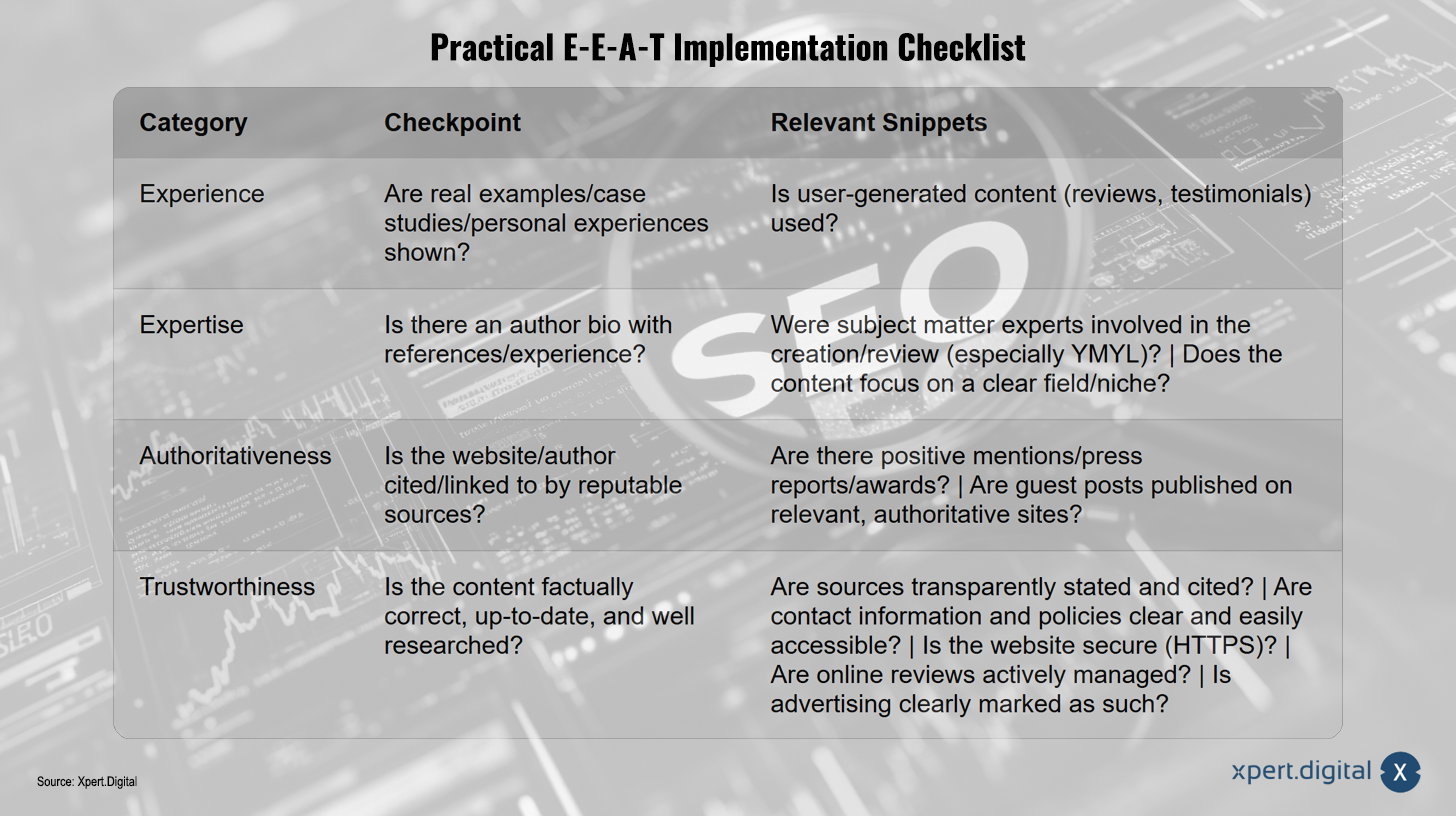
Practical Eeat implementation checklist-Image: Xpert.digital
The practical Eeat implementation checklist offers concrete approaches to evaluate and optimize content with regard to experience, expertise, authoritativeness and trusting. In the field of experience, it is checked whether real examples, case studies or personal experiences are integrated and whether user -generated content such as evaluations and testimonials are used. It is crucial for expertise whether there is a detailed authors biography with references and experiences, whether experts have been included in the creation or review, especially when it comes to content with Ymyl reference (your money or your your life) and whether the focus of the content is on a clearly defined field or a niche. Authoritativeness is reinforced by factors such as quotes or links from reputable sources, positive mentions, press reports, awards and the publication of guest contributions on authoritative websites. Trustworthiness is guaranteed by being objectively correct, up -to -date and well researched, sources are cited transparently and contact information and guidelines are clearly accessible. In addition, the security of the website (e.g. https), the active management of online reviews and a clear labeling of advertising plays an important role.
Strategic Keyword & Intent-Targeting (precision instead of volume)
Since AI search functions often answer broad information requests directly, the focus is becoming increasingly important for more specific, more nuanced search queries. Such traffic is less often intercepted by AI and often has a higher conversion potential.
AI overviews are most effective in the summary of common, broad information topics. Very specific long-tail inquiries, complex transactional searches or inquiries that require deep niche knowledge are less likely to be answered by a generic AI summary.
Users who are looking for such terms often have a stronger intention and are located below in the Conversion Funnel. An anti-cyclical keyword strategy should therefore deliberately focus on these lesser-catching inquiries and prioritize depth, specificity and the agreement with high user intent to do pure keyword volume.
Implementable tactics:
- Long-tail keywords: aim at longer, more specific phrases (3+ words) that signal a clearer user intention. These typically have less competition, but higher conversion rates. They often also correspond to search queries by voice input.
- Niche specialization: Concentrate on specific subject areas in which you can build in profound expertise and authority, which matches Eeat.
- Question-keywords & FAQ optimization: Align content on keywords that are formulated as questions ("how do you do", "what is", "why"), because users are increasingly looking for language and AI. Create dedicated FAQ areas/pages and use FAQ-Schema-Markup.
- In -depth user generation analysis: go beyond keywords to understand the why behind the search (informative, navigational, transactional, commercial) and create content that corresponds exactly to this intention.
- Topic cluster (Topic Cluster): Organize content for central Pillar Pages and supportive clusters Pages that cover relative sub-topics and long-tail keywords. This demonstrates extensive theme coverage and improves internal links.
Building sustainable authority & trust (brand as a protective shield)
In an environment full of information noise, trustworthy brands stand out. Authority signals such as backlinks, mentions and brand searches not only influence traditional rankings, but also potentially how AI systems weight sources. Avoiding manipulative tactics preserves long -term trust.
Since AI shows information directly, users may rely more on the perceived trustworthiness of the source or the brand that provides AI service (e.g. Google, Perplexity). Strong, well-known brands are implicitly classified as trustworthy and potentially also preferred by AI algorithms who have been trained on data that reflect brand prominence and a positive mood. Brand searches also avoid generic AI answers. Investments in the brand structure are therefore no longer just marketing activity, but a core component of an anti-cyclical SEO strategy. They create a advantage of trust that makes their content more likely to choose and enhances it, even if they are presented alongside AI summary.
Implementable tactics:
- Ethical link structure: Focus on earning high -quality, relevant backlinks of authoritative websites through excellent content, Outreach, PR and relationship structure. Avoid purchased links, inferior directories, spam guest contributions only for links and other risky tactics. Repair defective backlinks.
- Brand structure & Brand SEO: Actively build brand awareness and a positive perception of through consistent messages, a unique identity, content marketing, social media, PR and, if necessary, offline activities. Optimize for brand searches (Branded Searches). Pay attention to brand consistency across all platforms.
- Reputation management: monitor brand mention and online reviews. React to feedback and cultivate positive social proof.
- Avoiding negative/parasite SEO: Be aware of negative SEO tactics (harmful links, content scraping, calls to call), but understand that they are often ineffective and focus on building your own strength. Avoid unethical “Parasite SEO” (exploitation of highly autoritative pages without added value) that Google abts. Place on ethical guest blogging that delivers real value.
Development of unique & defensive assets (creation of unbopable values)
The creation of resources that AI cannot simply replicate or that offer a unique value positions your website as a goal (“destination”) and not just as a source of information. Such assets often attract high -quality backlinks in a natural way.
AI is characterized by the synthesis of existing information. However, it cannot replicate unique interactive tools, do not generate really new primary research or offer the curated value of a well-maintained, specialized resource hub. The development of such unique assets makes theirs
Website to a goal that users have to visit directly, and bypasses AI summits, since the value is in the resource itself, not only in the information it contains. This creates a strong defense against traffic erosion for certain types of content.
Implementable tactics:
- Proprietary data & research: carry out your own surveys, studies or analyzes and publish the results.
- Unique tools & computers: Develop free online tools, computers or configurators that are relevant for the needs of your target group (e.g. the nerdwallet example).
- Comprehensive guidelines & evergreen resources: Create profound, definitive guidelines or resource centers to core your niche.
- Curated data records or directories: Put unique, valuable data records or directories together and maintain them if relevant for your industry.
- Strategic programmatic SEO: Use programmatic SEO carefully to create unique value on a large scale (e.g. CANVA templates), not just superficial content. Make sure that the generated pages offer significant added value.
- High-quality original multimedia content: Invest in unique, high-quality original pictures and videos and avoid generic stock content. Optimize these assets (old text, file names, video metadata).
Our recommendation: 🌍 Limitless reach 🔗 Networked 🌐 Multilingual 💪 Strong sales: 💡 Authentic with strategy 🚀 Innovation meets 🧠 Intuition

From local to global: SMEs conquer the global market with clever strategies - Image: Xpert.Digital
At a time when a company's digital presence determines its success, the challenge is how to make this presence authentic, individual and far-reaching. Xpert.Digital offers an innovative solution that positions itself as an intersection between an industry hub, a blog and a brand ambassador. It combines the advantages of communication and sales channels in a single platform and enables publication in 18 different languages. The cooperation with partner portals and the possibility of publishing articles on Google News and a press distribution list with around 8,000 journalists and readers maximize the reach and visibility of the content. This represents an essential factor in external sales & marketing (SMarketing).
More about it here:
Success without search engine addiction and anti -cyclical success: SEO and target group structure away from seasonal tips
Use of off-cycle opportunities & direct channels to increase resilience
An anti -cyclical strategy not only includes the type of optimization, but also the timing and the structure of channels that are more independent of the fluctuations of the search engines.
Strategic timing (literally “anti -cyclical” aspect)
SEO takes time to deliver results. Optimization measures that are started before seasonal peak times or expected demand for demand enables rankings and visibility to develop in good time.
Implementable tactics:
- Use tools like Google Trends to identify seasonal keyword patterns and demand cycles.
- Plan the creation of content, technical optimizations and promotional campaigns in good time before peak times.
- Build links and authority in low season when the competition may be lower.
Building direct group relationships (reducing search dependency)
The sole dependency on search engine traffic makes companies susceptible to algorithm updates and AI-related disorders. The structure of direct channels creates stable, own traffic flows.
Traffic from email lists, committed social media followers and active communities is not directly dependent on search engine rankings or AI functions. These are your own or strongly influenced target groups that can be achieved directly. The investment in building these direct channels is a decisive strategy for risk reduction. It offers a basis for traffic and commitment, which remains even with fluctuating search visibility and makes the company more resistant - a core idea of the anti -cyclical approach.
Implementable tactics:
- Email marketing: Build an email list. Use emails to apply content, generate website traffic, maintain leads, announce new products/resources and build up loyalty. Vote for e-mail keywords on SEO keywords. Use e-mail content for blogs again. Encourage emails to share.
- Social media commitment: build a committed follower on relevant platforms. If you share valuable content, interact with users, direct traffic to your website and increase brand awareness. Optimize social profiles for the findability. Use social signals indirectly to increase authority and traffic.
- Building online communities: Create online forums or communities to your niche or participate. If you are authentic, offer added value, build up relationships and subtly distribute relevant traffic to your resources. Make sure that community platforms are technically optimized for SEO. Use user -generated content from communities.
Suitable for:

Success measurement beyond the traffic volume
The metrics for measuring success of SEO must adapt to the new reality of the AI search.
The limits of traditional metrics
Key figures such as the pure organic traffic volume, clicks and meetings can lose meaningfulness in the age of AI search, especially for informational content. Zero-Click searches mean that value can also be delivered without a click, since users receive their answer directly on the SERP.
Relocation of the focus on quality and business effects
The focus should be on metrics that reflect the quality of traffic and its contribution to the business objectives. If AI searches meet some user needs directly on the SERP, traditional click-based metrics for these inquiries will inevitably decrease. The traffic, which, however, clicks through, can have a higher intention, and the brand visibility and authority built up by SEO are worth an immense manner even without direct click. Companies must therefore introduce a more demanding measurement frame that records the full value of their SEO efforts, including brand structure, conversion of traffic with high intentions and influence within AI generated results, instead of only relying on pure traffic numbers.
Important metrics to be followed:
- Engagement: length of stay on the page, pages per session, bounce rate (for the incoming traffic), scroll depth, interaction with unique resources (tools, videos).
- Conversion rates: lead generation (form fillings, downloads, registrations), sales, target finishes. Follow conversions from different channels (organic, direct, email, social).
- Lead quality: Follow the quality of the leads generated by SEO measures, not just the quantity.
- Brand visibility: Monitor the search volume for brand names, branded mention, social media engagement and the Share of Voice.
- Performance in AI functions: Follow whether/when your content will be cited in AI overviews or rank well in response engine such as perplexity (requires manual review or special tools because direct tracking is limited).
- ROI (Return on Investment): Concentrate on the total amount of SEO activities taking into account the costs and the value generated by high-quality traffic and conversions.
Suitable for:

Future -proof SEO through an anti -cyclical way of thinking
The rise of AI search with its increased volatility, the phenomenon of the zero-click search and the challenges when creating content mandatory to depart from purely reactive SEO tactics towards a strategic, anti-cyclical approach.
This approach is based on several pillars: a solid technical basis, the consistent creation of content according to Eeat criteria, a precise keyword and intention strategy, the sustainable structure of brand auto and trust, the development of unique, defensive assets and strengthening direct channels to the target group.
Although tactics develop, the core principles of search engine optimization - the provision of real added value, the development of trust, the understanding of users and technical excellence - remain constant and have become even more important in the age of AI.
The future belongs to those who accept a proactive, adaptable and long -term strategic way of thinking for SEO. The focus must be on the construction of sustainable digital values and relationships instead of chasing short-term algorithm tricks. By implementing an anti-cyclical SEO strategy, companies can build a resistant, high-quality and user-centered online presence that also withstands upheavals by artificial intelligence.
We are there for you - advice - planning - implementation - project management
☑️ SME support in strategy, consulting, planning and implementation
☑️ Creation or realignment of the AI strategy
☑️ Pioneer Business Development

Konrad Wolfenstein
I would be happy to serve as your personal advisor.
You can contact me by filling out the contact form below or simply call me on +49 7348 4088 965 (Munich) .
I'm looking forward to our joint project.
Write to me

Xpert.Digital - Konrad Wolfenstein
Xpert.Digital is a hub for industry with a focus on digitalization, mechanical engineering, logistics/intralogistics and photovoltaics.
With our 360° business development solution, we support well-known companies from new business to after sales.
Market intelligence, smarketing, marketing automation, content development, PR, mail campaigns, personalized social media and lead nurturing are part of our digital tools.
You can find out more at: www.xpert.digital - www.xpert.solar - www.xpert.plus
Keep in touch








