
The end of debate and the illusion of the majority: How vocal minorities and AI swarms manipulate our opinions on social media
Xpert Pre-Release

Available in 27 languages 📢
Prefer Xpert.Digital on GoogleⓘPublished on: June 2, 2026 / Updated on: June 2, 2026 – Author: Konrad Wolfenstein
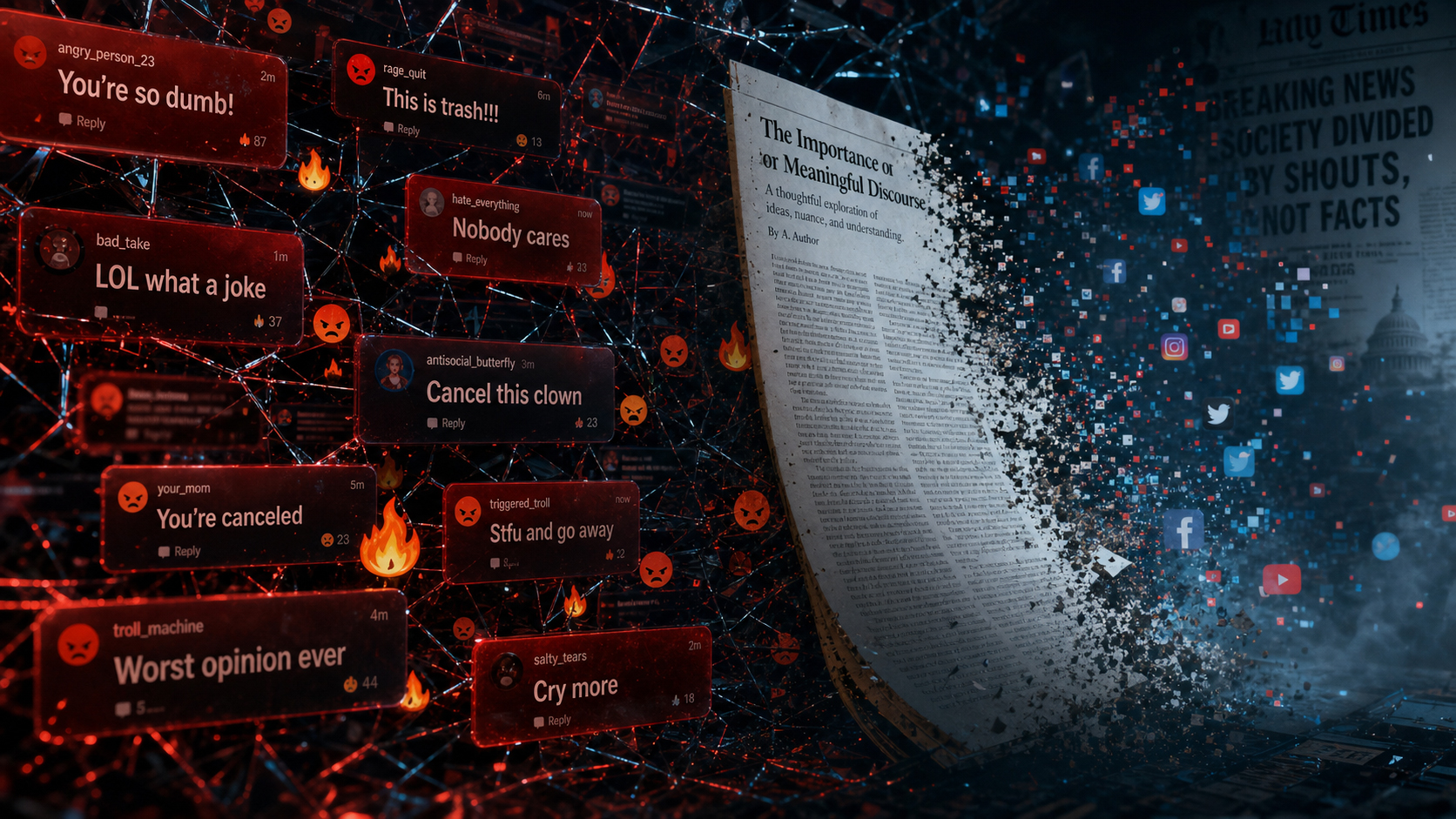
The end of debate and the illusion of the majority: How vocal minorities and AI swarms manipulate our opinions on social media – Image: Xpert.Digital
Trapped in the algorithm: Why complex topics are always ruined on Facebook, X, and LinkedIn
The Architecture of Outrage: Why Algorithms in Social Networks Punish Reason
The silence of the reasonable: Why more and more people are withdrawing from online discussions
Once hailed as a major breakthrough for democratic communication, social networks have long since transformed into machines of outrage and systematic oversimplification. Where there should be room for open exchange and in-depth debate, toxic comment sections, algorithm-driven rage, and vocal minorities that hijack public discourse now dominate. The problem lies not primarily in the supposed contentiousness of users, but is deeply rooted in the architecture of the platforms themselves: The format—whether on X, Facebook, Instagram, or LinkedIn—reward relentless speed and penalize in-depth analysis. Complex social, economic, or political issues are ground down beyond recognition into "snippets," while the reasonable majority increasingly withdraws from public discussion in disillusionment.
This text takes a sharp, analytical look at the structural deformation of our public discourse. Based on current studies, it illuminates how the economic incentives of platform operators penalize reason, why the dire warnings of philosopher Jürgen Habermas are more relevant today than ever, and what dangerous role AI swarms play in manipulating opinions. At the same time, the analysis reveals concrete solutions: why a growing counter-movement is focusing on "deep content" and deliberately long-form content – and how we can escape the trap of the attention economy in order to finally engage in genuine, constructive conversations again.
When noise drowns out the truth: The medium shapes the message — and deforms the content
How social media doesn't enrich public discourse, but destroys it — and why we urgently need alternatives
It is a mistake to view social media as a neutral tool that merely conveys content. The format itself is the real message—and that message is: brevity wins, complexity loses. Anyone who publishes on a platform like LinkedIn, X (formerly Twitter), Instagram, or Facebook submits to a structural dictate that systematically disadvantages in-depth analysis, nuanced argumentation, and intellectual honesty. The problem lies not with the writer, not with the reader, but with the vessel into which one tries to pour the wine of knowledge—a sieve.
Let's take as our starting point the classic form of public communication: the newspaper article or the lengthy academic text. An author has a message. The reader doesn't have to agree with every single point, but can accept certain arguments, follow them, or reject them. After reading, they can mentally review what they've read, reflect on it, and gradually refine their opinion. New convictions can emerge, and old ones can be refined. What has become legible is visible—and what is visible creates space for development and doesn't remain hidden and forgotten.
In social media, however, there is a fundamentally different structural problem: even complex topics can only be touched upon. One must immediately present the argument, cause, and solution in a concise form. The background, the intellectual development, the perspective that led to the statement—all of that is lost. And even if lengthy essays are published on a platform, they are overshadowed by the subsequent comments. The snippet format forces a form of communication that desperately needs intellectual stimulation.
The Architecture of Outrage: How Algorithms Punish Reason
Behind the apparent superficiality of social networks lies a sober economic logic. Platform operators optimize their algorithms for dwell time and interaction rates—and the strongest interaction doesn't generate reflection, but rather outrage. Social media platform algorithms prioritize content that triggers emotions like anger because this increases the likelihood that manipulated or more extreme posts will also appear.
A study from Yale University has empirically confirmed this mechanism: Angry thoughts spread fastest on social networks. Moral outrage receives more attention online than any other form of interaction. The researchers analyzed 12.7 million tweets from over 7,000 users and arrived at a disturbing conclusion: The incentives of social media are fundamentally changing the tone of political discussions. People are learning to express increasing outrage because they are rewarded for doing so by the very structure of the platforms. This is not an unintended side effect—it is the business model.
At the same time, the collective attention span is shrinking. Researchers at the Technical University of Berlin and the Max Planck Institute for Human Development have demonstrated that the duration for which the public shows interest in individual topics and content is becoming increasingly shorter, while interest jumps ever more rapidly from one topic to the next. This effect is not merely subjective—it is measurable and structural. Students who consume more than two hours of short social media videos daily perform significantly worse on attention and concentration tests than control groups. Fewer than 50 percent of film students have ever watched a film to the end—a figure that would have been almost unimaginable just a few decades ago.
The consequences for the quality of discourse are significant: Emotional content generates more attention, leads to more interaction, and is algorithmically favored. In the battle for attention, factual content regularly loses out to sensationalized narratives. This is not a failure of individual users—it is the predictable consequence of a system that reacts rationally to flawed incentives.
Comment hijacking: When the reaction buries the content
A particularly devastating structural feature of social media is what can be described as comment hijacking: comments are so prominently displayed that ultimately, all that happens is a pro-and-con exchange among the supposed readers. Many users don't even read the topic itself, but instead hijack attention with their comments to impose their preconceived opinions. When politicians or well-known figures are involved, this effect becomes extreme—details are no longer of interest, and all-out attacks are launched.
Research confirms this phenomenon. A study on Reddit showed that toxic environments deter most people from commenting, but attract a small, particularly active group. This group consists primarily of people who are politically engaged and habitually comment online. The result is a structural distortion: a small, vocal minority dominates public debates, while the silent majority—the lurkers—merely read along. At best, only around 16 percent of Facebook users participate in debates; participation is even lower on Instagram and YouTube. When the vast majority don't participate in discussions at all, it can no longer be considered a forum for everyone.
The research paper by market researcher Prof. Dr. Anna Schneider, published in May 2026, allows for a precise classification of comment culture: There are information hunters who want to understand what's going on, opinion checkers who compare their own views with the perceived majority, entertainment seekers who use comment sections as escapism, and—particularly relevant—drama fans who genuinely enjoy conflict. The last group, although small in number, produces a disproportionately large share of the visible discourse.
Debate culture in free fall: What the data says
The finding is clear, and it is alarmingly underscored by recent studies. The "Transparency Check" study by the German state media authorities, published in April 2026, based on an analysis of 9,418 comments on journalistic and editorial posts on Facebook, Instagram, and YouTube, as well as on articles from Bild, Der Spiegel, the Süddeutsche Zeitung, and Die Zeit, arrives at a devastating conclusion: Constructive debates are hardly possible online anymore and are sometimes even perceived as unwelcome.
At the same time, a clear majority of those surveyed desire precisely the opposite—a constructive exchange. This discrepancy between desire and reality is no coincidence, but rather the product of a system that structurally penalizes constructive debate. A quarter of those who actively comment simply want to express their own opinion; almost a quarter want to persuade others; and roughly one in eight people comment simply to vent their frustration. Overall, according to the study, the negative effects of discourse on social media outweigh the positive: extreme opinions prevail, and trust and morale decline after reading comments.
Added to this is a new, qualitative threat: AI swarms, that is, coordinated groups of artificial profiles with memory, their own style, and clearly defined roles, can imitate discussions and feign majorities. To outsiders, this appears to be a normal, lively discussion; in reality, a single actor is directing the interplay behind the scenes. People orient themselves toward what they perceive as the majority opinion—and AI swarms deliberately exploit precisely this psychological effect. They don't create a single error, but rather a persistent climate of apparent agreement—a new, barely perceptible form of manipulation of public discourse.
Snippet topics don't generate mature debates
Social media works very well with emotions and charged moods that are simple and populist. More complex topics don't just disappear there—they are destroyed, trampled on, and ground down beyond recognition. Anyone who tries to publish a nuanced analysis of an economic, social, or scientific topic on such a platform will find that reducing it to a snippet forces a simplification that distorts the issue. The perspective, the development of the argument, the contextualization—all of that is missing. What remains is a thesis without foundation.
This structural flattening brings no maturity to debates, no genuine listening, no understanding of the various facets of lines of reasoning. It only solidifies pro and con positions, pulling moods and opinions to one side or the other—and with alarming persistence. Communication science describes this process as fragmentation: Public communication shifts into isolated chambers, and this shift is not random, but rather driven by attitudes and opinions.
The term "echo chamber," coined by the American legal scholar Cass Sunstein in 2001, describes self-chosen media behavior in which users more frequently click on content or connect with people who confirm their own opinions. The complementary concept of the filter bubble—introduced by Eli Pariser in 2011—refers to the algorithmically generated personalization of content without users noticing. The distinction is crucial: the echo chamber is self-chosen behavior, while the filter bubble is structurally enforced. Together, they explain why societal debates on social media platforms, despite their apparent diversity of voices, rarely lead to genuine insights.
However, it would be an oversimplification to cite echo chambers and filter bubbles as the sole explanation. Communication science is increasingly critical of these concepts, as they lack clear definitions and are difficult to substantiate empirically. Studies show that most people combine media and do not live in closed bubbles. Nevertheless, the image remains powerful because it provides strong metaphors and is intuitively compelling. The real danger lies deeper: not in complete isolation, but in the gradual habituation to speed, simplification, and emotional manipulation.
The Silence of the Reasonable: When the Majority Falls Silent
One of the most frequently overlooked consequences of toxic debate culture on social networks is what communication researchers call the "spiral of silence": those who fear being isolated for holding a nuanced opinion don't express it in the first place. This effect is exacerbated on social media because the tone of the discussion becomes so quickly and so visibly aggressive that moderate voices are silenced.
The media authorities' study impressively confirms this: The poor quality of discourse is one of the main reasons why users are leaving platforms like Facebook and X (formerly Twitter). Many say they no longer participate because they leave feeling worse off than before. The paradox is evident: The loudest voices on social media are rarely the most thoughtful—and the most thoughtful voices are drowned out by the sheer volume of the discussion. What remains is a discourse space that appears active on the surface, but in reality only reflects the loudest, not the best, opinions.
This paradox has a dimension relevant to democracy, which the philosopher Jürgen Habermas sharply diagnosed in his work on the new structural transformation of the public sphere: While half a century ago, powerful mass media stifled individual opinions, today, the sheer number of opinions has eliminated public opinion. Everyone communicates, but no one can truly communicate. As Habermas aptly observed: The printing press made everyone a potential reader, digitization makes everyone a potential author—but how long did it take for everyone to learn to read? We are not yet ready to have and express an opinion on everything.
🎯🎯🎯 Data-driven B2B industry hub as a quasi-in-house solution

The quasi-in-house solution: How Xpert.Digital closes operational gaps in B2B marketing and sales – Smart Content-Driven Business - Image: Xpert.Digital
Xpert.Digital is a data-driven B2B industry hub led by Konrad Wolfenstein . The company acts as an external, quasi-in-house solution for industrial partners, closing operational gaps in marketing, content, and sales – without requiring additional resources on the client side.
More information here:
Deep Content vs. Click Economy: When Conversations Become Invisible – From WhatsApp Groups to Echo Chambers
The privatization of discourse: When conversation moves into the shadows
In response to the toxicity of public comment sections, researchers are observing a significant shift: Public debates are increasingly moving into private spaces. Fewer and fewer people are willing to argue about current events in public discussions. Many users still find news content in their feeds, but then post it in private groups on Facebook Messenger or WhatsApp.
This privatization presents a twofold problem: On the one hand, it grants greater control over the public sphere; on the other, it makes public debate and the dissemination of news more fragmented and difficult to follow. What is no longer publicly visible can no longer contribute to the formation of shared opinion. A society that conducts its essential debates in invisible echo chambers loses the common frame of reference upon which a democratic public sphere is built.
Added to this is the growing problem of disinformation and coordinated manipulation. The elimination of moderation mechanisms on platforms like X and Facebook facilitates the spread of disinformation. The role of bots and coordinated comment streams is also real: On controversial topics, the proportion of bot-generated or suspicious posts is significantly higher than average. Trolls, fake accounts, and coordinated comment streams are deliberately used to influence the course of discussions in comment sections. This means that a considerable portion of what appears as organic opinion on social networks is not.
Habermas was right — but for other reasons
Jürgen Habermas, the founder of the theory of communicative action and the deliberative model of democracy, had already pointed out the importance of a free, rational public debate for the functioning of democracy in his groundbreaking 1962 work, "The Structural Transformation of the Public Sphere." His initial concern was with the mass media, which he believed were turning citizens into passive consumers. Sixty years later, he identifies a new danger: that the political public sphere can no longer find itself in highly and individually curated platforms.
A functioning democracy needs a political public sphere where political problems are discussed as freely, equally, and rationally as possible. Public political discourse seems to be deteriorating, not least due to the digital transformation of the public sphere. The rapid spread of disinformation and fake news is leading to increasing polarization and fragmentation of the political community—and this development is worrying because, without a public sphere that includes everyone, the future of democracy is seriously threatened.
The business model of digital platforms fundamentally contradicts informed exchange among citizens—and thus the very concept of a democratic public sphere. Platform operators offer no incentives to change preferences, learn, or grow. They attempt to identify personal preferences in order to maximize attention—and ultimately advertising revenue. What is rational for a business model is destructive for a democratic society.
Length as a quality feature: The comeback of depth
Paradoxically, the oversaturation with social media content in recent years has led to a counter-movement. Newsletter platforms like Substack, which have grown significantly since the pandemic, cater to a need that social media systematically ignores: the need for depth, context, and intellectual respect for readers. Well-known journalists are leaving major media companies to launch their own newsletters on such platforms because they find the attention-grabbing logic of social media generates too much unnecessary noise.
According to the ARD/ZDF online study, 21 percent of people over 14 in Germany read a newsletter at least once a week. While this may sound like a marginal number, in a media landscape dominated by short formats, it's a remarkable sign. Newsletter authors describe their switch with the same argument: Instagram had become too fast-paced for them; they were looking for a medium that allowed more room for reflection. Email as a communication channel bypasses algorithmic whims and allows for a direct relationship between writers and readers—a relationship built on trust rather than outrage.
The concept of deep content—in-depth, argumentatively structured texts as opposed to the rapid production of mass-market posts—is gaining importance in B2B communication. The underlying insight is simple: anyone who wants to be seriously informed about a specialized topic needs context, structure, and nuance—all qualities that the social media format structurally prevents. Substance is not a matter of the writer's good intentions; it is a matter of the chosen format.
Moderation as a last resort — and its limits
The media authorities' study delivers an interesting and practically relevant finding: noticeable moderation can significantly improve the quality of discourse. The stricter the moderation and the more constructively the exchange is structured, the more respectful and balanced the discourse is perceived to be. This finding may sound banal, but it has far-reaching implications: good debates do not arise spontaneously from the aggregation of many individual opinions, but rather from the conscious shaping of the communication space.
The problem is obvious: resources for constructive community management are often scarce. Professional moderation in the comments section is expensive, labor-intensive, and doesn't scale well. This creates a classic market failure for media companies and content producers: the socially desirable quality of discourse is hardly profitable to produce for private companies. Platform operators have no economic interest in constructive debates—they have an interest in maximizing user engagement, which, as has been shown, is achieved more effectively through outrage than through reason.
It is therefore not a technical question, but a matter of regulatory policy, how to deal with this market failure. Some researchers and media policymakers are already asking whether a public-service alternative to purely privately organized digital public spheres is needed. The European Union's Digital Services Act is a first step—it obliges large platforms to be more transparent and accountable, without, however, calling into question the fundamental business model of the attention economy.
What AI can do — and what it cannot do
A natural question is whether artificial intelligence can solve or at least mitigate the problems described. The answer is nuanced, and it is important to clearly define both the possibilities and the limitations of this technology.
AI can be helpful in several areas within the context of social media debates: in the automatic detection and flagging of toxic content, disinformation, and coordinated manipulation campaigns; in supporting moderation processes that relieve human capacity; in developing summaries of long texts that facilitate access to more complex content; and in personalized content recommendations beyond mere outrage optimization—if platform operators have corresponding incentives or are obligated to do so.
AI cannot solve the fundamental structural problem, however, because it is not a technical problem. Even if algorithms were reprogrammed to prioritize substantive content over outrageous material, the challenge would remain: short formats necessitate simplification, and simplification breeds oversimplification. Anyone who presents a complex topic—be it economic policy, climate change, geopolitics, or social policy—in three sentences inevitably creates a distorted picture. No algorithm in the world can generate in-depth analysis from a snippet. The solution, therefore, cannot lie solely in the technical optimization of existing platforms.
AI can play a more constructive role as a production tool: it can help research, structure, and formulate in-depth analyses more quickly, thus reducing the effort required to create substantive content. In this sense, AI is a tool for democratizing depth—if used accordingly. It won't overturn the attention economy, but it can provide powerful tools to those who want to argue seriously.
Decoupling as a strategy: Ways out of the noise
The question of what a meaningful alternative to the aggressive communication of social media could look like is not a utopian question — it is already being answered practically in parts of media and intellectual life.
The first approach is a conscious retreat to longer formats: newsletters, blogs, podcasts, and lengthy articles that provide readers with the context that snippets deny. These formats create a different relationship between author and reader—one based on the trust that the reader is willing to invest time. They don't demand an immediate response, a comment, or a like. They create space for what has become almost impossible in social media formats: genuine reflection.
The second approach is platform choice as a political decision. Anyone who wants to communicate seriously about complex topics shouldn't choose social media as their primary channel, but rather as a referral channel—as an announcement of more in-depth content that can be found elsewhere. This is a modest but realistic strategy: don't avoid social media, but understand it. Know what it can and can't do. And don't be tempted to cram your expertise into snippets that devalue it.
The third approach is educational in nature: media literacy must be understood more strongly than before as a core competency. This means not only technical knowledge about platforms, but also a critical awareness of the structural distortions that different formats create. Those who understand how algorithms react to outrage are less susceptible to it. Those who have learned to distinguish between the volume of an opinion and its quality are better equipped for the digital information environment.
A fourth, more structural answer lies in the regulatory framework. Transparency regarding algorithmic decisions, mandatory moderation, clear liability rules for platforms—all these are instruments being discussed at the European level. They are necessary, but not sufficient. A democracy cannot wait for regulation to take effect; it must simultaneously cultivate its culture of communication.
Visibility as a condition of development
There is a principle that transcends all debates about social media, freedom of expression, and the quality of discourse: What has become readable is visible. And what is visible creates space for development—it doesn't remain hidden and forgotten, but can be discussed, questioned, and further developed. Social media has radically democratized the promise of visibility—and simultaneously perverted it. Anyone can publish, but not everything published is read. What gets read is determined by an algorithm that favors outrage. What gets discussed is determined by the loudest voice, not the most intelligent one.
Intellectual honesty demands that this finding not be confused with blanket criticism of social media. Social networks have genuine strengths: they enable the networking of like-minded individuals across geographical boundaries, the rapid dissemination of important information in times of crisis, and the organization of civil society movements. Their strengths lie precisely where they least affect their structural weaknesses: in the emotional, the mobilizing, the immediate reactive.
But social networks are structurally unsuited for what democracy and public discourse also require—namely, slow thinking, nuanced argumentation, the ability to tolerate complexity, and the willingness to revise one's own opinion in light of better arguments. This is not a failure of individual users. It is the inevitable result of a system that has established speed, brevity, and emotion as the highest virtues.
Anyone who wants to communicate effectively therefore consciously chooses not only what they say—but above all, where and in what form they say it. The medium is the message, and you should know this message before you choose it.
Your global marketing and business development partner
☑️ Our business language is English or German
☑️ NEW: Correspondence in your native language!

Konrad Wolfenstein
I and my team are happy to be available to you as your personal advisor.
You can contact me by filling out the contact form here simply call me at +49 7348 4088 965. My email address is [email protected]:or
I'm looking forward to our joint project.
☑️ SME support in strategy, consulting, planning and implementation
☑️ Creation or realignment of the digital strategy and digitization
☑️ Expansion and optimization of international sales processes
☑️ Global & Digital B2B trading platforms
☑️ Pioneer Business Development / Marketing / PR / Trade Fairs
B2B support and SaaS for SEO and GEO (AI search) combined: The all-in-one solution for B2B companies

B2B support and SaaS for SEO and GEO (AI search) combined: The all-in-one solution for B2B companies - Image: Xpert.Digital
AI search changes everything: How this SaaS solution will revolutionize your B2B ranking forever.
The digital landscape for B2B companies is undergoing rapid change. Driven by artificial intelligence, the rules of online visibility are being rewritten. For companies, it has always been a challenge not only to be visible in the digital mass, but also to be relevant to the right decision-makers. Traditional SEO strategies and managing local presence (geo-marketing) are complex, time-consuming, and often a battle against constantly changing algorithms and intense competition.
But what if there were a solution that not only simplified this process but also made it smarter, more predictive, and far more effective? This is where the combination of specialized B2B support with a powerful SaaS (Software as a Service) platform comes into play, specifically designed for the demands of SEO and GEO in the age of AI search.
This new generation of tools no longer relies solely on manual keyword analysis and backlink strategies. Instead, it leverages artificial intelligence to more accurately understand search intent, automatically optimize local ranking factors, and conduct real-time competitive analysis. The result is a proactive, data-driven strategy that gives B2B companies a decisive advantage: they are not only found, but perceived as the leading authority in their niche and location.
Here's the symbiosis of B2B support and AI-powered SaaS technology that transforms SEO and GEO marketing, and how your company can benefit from it to grow sustainably in the digital space.
More information here:










