
Photovoltaics (PV): Build a solar carport and solar system on a flat roof - looking for a system from Hanover, Braunschweig, Bielefeld or Kassel?

Available in 27 languages 📢
Prefer Xpert.Digital on GoogleⓘPublished on: July 24, 2021 / Updated on: September 24, 2021 – Author: Konrad Wolfenstein

Converting company parking lots or shopping center parking spaces to solar carports – Image: Xpert.Digital / PATSUDA PARAMEE|Shutterstock.com
Solar carports as the key component in e-mobility?
Now everything is supposed to happen very quickly: the transformation in mobility. The way we get around. For decades, we were told that oil reserves were dwindling and wouldn't last much longer. The figures were always 40, 50, even 100 years. Yet, little happened in terms of transport policy, because fuel still seemed to flow freely from the pump at the gas station. It's all the more surprising, then, that this argument is no longer even being raised. We've always known that our current form of transportation with combustion engines needed an alternative. That we can't continue like this in the long run, regardless of the environmental impact of our beloved gasoline and diesel vehicles. Electromobility is still in its infancy. It still has many flaws. But it also can't draw on decades of development like combustion engines, where improvements and optimizations, from emissions to fuel consumption, went hand in hand. Dieselgate, the diesel emissions scandal, not to mention the diesel scandal.
📣 Parking areas solar solutions for industry, retail and municipalities
Everything from a single source, specially designed for solar solutions for large parking areas. You refinance or counterfinance into the future with your own electricity generation.
🎯 For solar engineers, plumbers, electricians and roofers
Advice and planning including a non-binding cost estimate. We bring you together with strong photovoltaic partners.
👨🏻 👩🏻 👴🏻 👵🏻 For private households
We are positioned across regions in German-speaking countries. We have reliable partners who advise you and implement your wishes.
A legitimate criticism is the currently insufficient range of electric vehicles. This is compounded by the high purchase price, creating a twofold problem. This also explains why there are more company cars with electric drives than private electric vehicles. Tax advantages and depreciation benefits favor the former.
With plug-in hybrid vehicles, which combine an electric motor with a combustion engine, it has been observed that the electric-only mode is rarely used. The reasons given for this are the inadequate infrastructure for charging and the long charging times. Defective charging stations and malfunctioning charging cards were also cited.
Nevertheless, the debate about whether combustion engines can present a better environmental record than electric cars, from their inception to disposal, is pointless. Oil reserves are still finite, and the development and optimization potential for electric cars is still in its infancy. Better and more powerful batteries for greater ranges already exist, and work is underway to improve their efficiency and environmental compatibility. The same applies to energy storage systems.
All these points fall under the aspect of development and improvement. What is far more crucial now is that this progress is not delayed or even prevented by missing components.
play in open parking lots and storage areas. Our parking and charging habits will fundamentally change in the coming years, moving away from centralized refueling stations and towards decentralized charging points and charging stations. Traffic patterns will also change. To ensure that e-mobility doesn't reach a dead end in terms of emission-free energy supply due to the growing and enormous amounts of energy available, solar carports are intended to contribute a significant portion of the energy needed for electric vehicles.
This is when it all makes sense, better late than never. It's important to remember that fuel and conventional electricity don't simply spring from the pump or wall socket; there are numerous environmental and ecological issues involved. There are always pros and cons to both. However, the current approach has clearly and noticeably reached a dead end. Electromobility has potential, and there's certainly a lot of work to be done to improve it.
Suitable for:
We now have the opportunity to utilize solar energy, an inexhaustible energy source that is comparatively the most environmentally friendly. We just need to work on the components. And: Each of us can develop our own autonomous energy supply, something that was previously neither possible nor affordable.
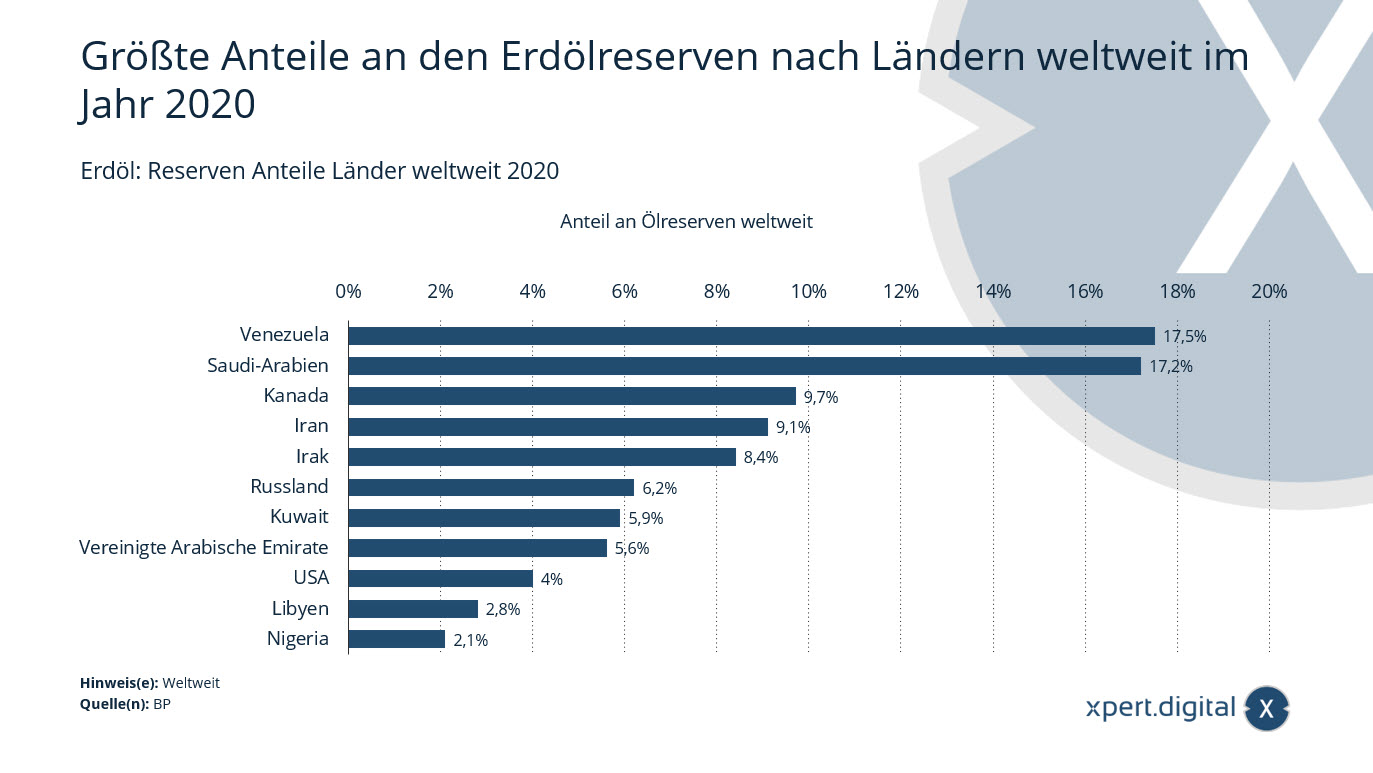
Shares of global oil reserves
Shares of global oil reserves – Image: Xpert.Digital
The statistic shows the share of oil reserves by country worldwide in 2020. According to the source, proven oil reserves generally include quantities that, based on geological and engineering information, can most likely be extracted in the future from currently known deposits and under current economic and technical conditions.
The United Arab Emirates accounted for approximately 5.6 percent of global oil reserves this year. In 2020, Venezuela possessed the world's largest oil reserves, with nearly 304 billion barrels. Saudi Arabia followed in second place with approximately 298 billion barrels. Proven oil reserves include the quantities that can be extracted from currently known deposits under present economic and technical conditions.
Oil reserves in detail
Most recently, global oil reserves were estimated at approximately 244.4 billion tons. Despite Venezuela's large oil reserves, roughly half of the global reserves are located in the Middle East. South and Central America, as a region, possesses nearly one-fifth of the world's oil reserves.
Petroleum as a raw material
Despite the Paris climate goals, which aim to limit the global average temperature increase to a maximum of 2° Celsius above pre-industrial levels, global oil consumption has risen in recent years. The USA is the country with the highest share of global oil consumption, accounting for approximately one-fifth of the world's annual oil use. Oil thus remains, alongside natural gas and coal, the most important fossil fuel.
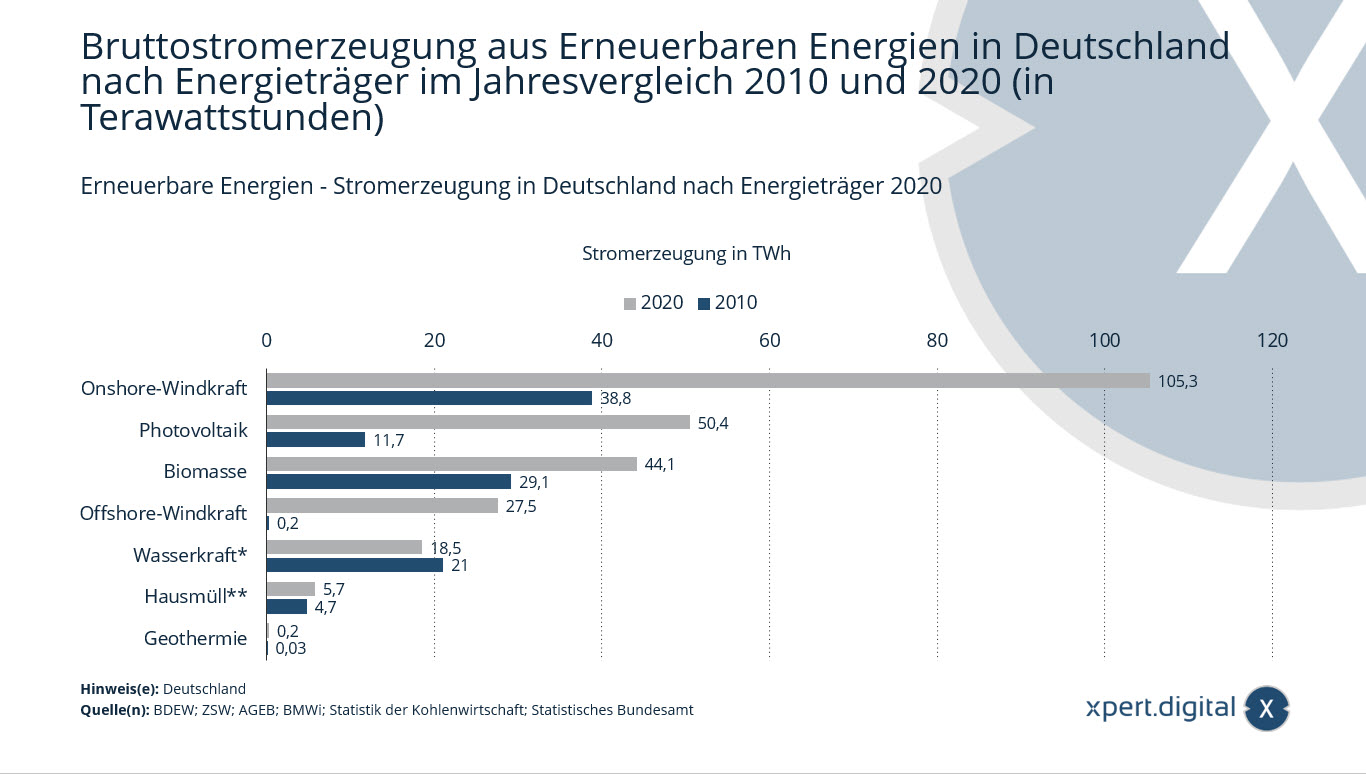
Renewable energies - electricity generation in Germany by energy source
Renewable energies – electricity generation in Germany by energy source – Image: Xpert.Digital
Gross electricity generation from renewable energy sources in Germany by energy source, year-on-year comparison 2010 and 2020: In 2010, 11.7 billion kilowatt-hours of gross electricity were generated from photovoltaic systems in Germany; by 2020, this figure had risen to approximately 50.4 billion kilowatt-hours. Photovoltaics thus increased its output by around 300 percent within the specified period. New photovoltaic systems were installed particularly in the years 2010, 2011, and 2012. Subsequently, the annually installed capacity tended to decrease.
Power output of wind turbines
Onshore wind energy also significantly increased its electricity generation. This is attributable to the growth in installed capacity, particularly between 2014 and 2017. However, the rate of expansion has declined considerably in the past two years. The market for offshore wind turbines has also recently been subject to significant fluctuations.
Output of renewable energy plants worldwide
Worldwide, the installed capacity of renewable energy plants is increasing annually. Most recently, Asia had the highest installed capacity. Europe recorded just under half the installed capacity of Asia. Among renewable energy plants, hydropower was the energy source with the highest installed capacity worldwide.
Gross electricity generation from renewable energies in Germany by energy source 2010
- Onshore wind power: 38.80 terawatt hours
- Photovoltaics: 11.70 terawatt hours
- Biomass: 29.10 terawatt hours
- Offshore wind power: 0.20 terawatt hours
- Hydropower*: 21 terawatt hours
- Household waste** : 4.70 terawatt hours
- Geothermal energy: 0.03 terawatt hours
Gross electricity generation from renewable energies in Germany by energy source 2020
- Onshore wind power: 105.30 terawatt hours
- Photovoltaics: 50.40 terawatt hours
- Biomass: 44.10 terawatt hours
- Offshore wind power: 27.50 terawatt hours
- Hydropower*: 18.50 terawatt hours
- Household waste** : 5.70 terawatt hours
- Geothermal energy: 0.20 terawatt hours
* Generation in run-of-river and storage hydroelectric power plants, as well as generation from natural inflow in pumped-storage power plants.
** Generation only from the biogenic fraction of municipal solid waste (approx. 50 percent).
2021: Amount of subsidies for the purchase of electric vehicles in Germany

Amount of the environmental bonus for the purchase of electric vehicles – Image: Xpert.Digital
Purchase bonus for electric vehicles and plug-in hybrids
The purchase or leasing of various types of electric cars is eligible for a government subsidy in Germany called the "environmental bonus." Eligible purchases (buying or leasing) are electric vehicles that are being registered for the first time and whose net list price for the base model does not exceed €65,000. Pure battery electric vehicles receive subsidies of up to €9,000, and hybrid electric vehicles receive up to €5,625. Two-thirds of the subsidy is covered by the federal government and one-third by the car manufacturer. This increased subsidy (previously €4,000 for pure battery electric vehicles and €3,000 for hybrid electric vehicles) was introduced as part of the economic stimulus package to combat the effects of the COVID-19 pandemic.
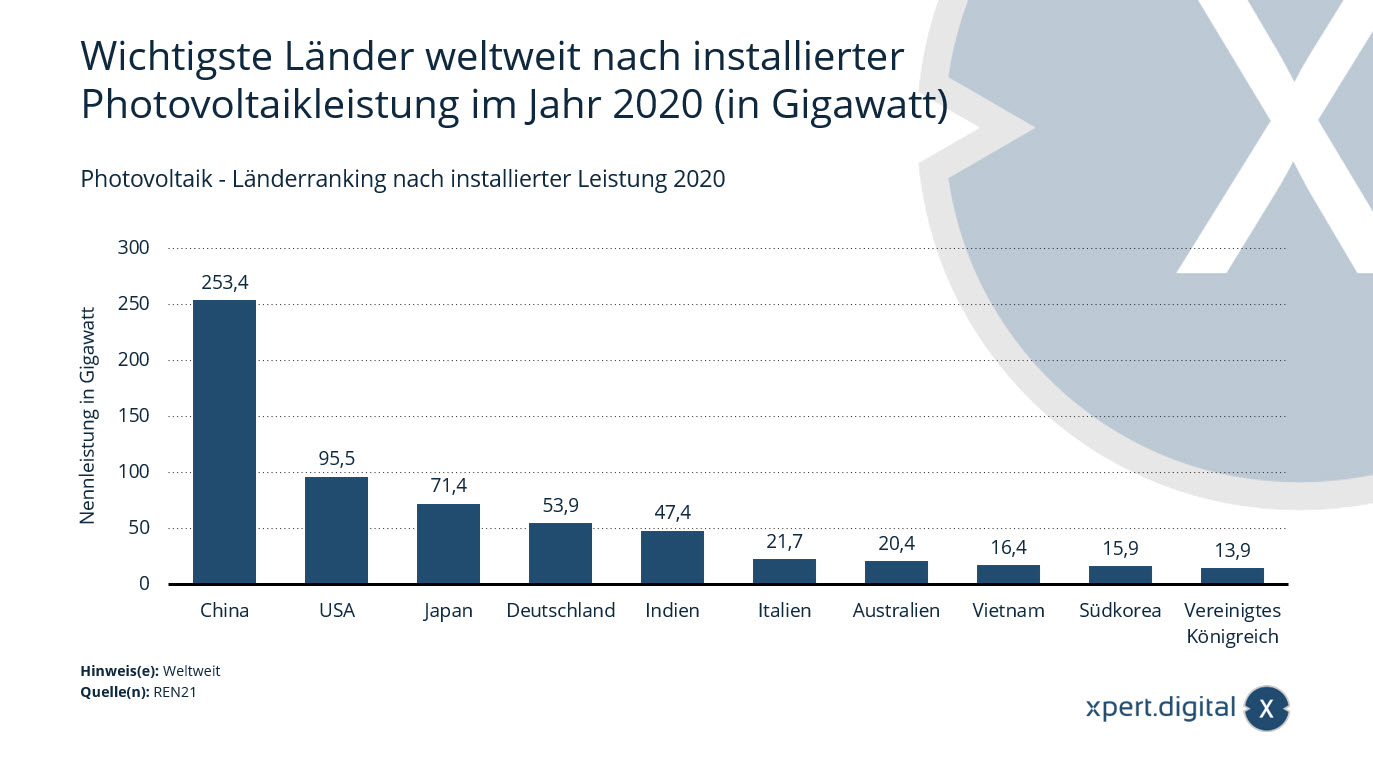
Photovoltaics - Country ranking by installed capacity
Photovoltaics – Country ranking by installed capacity – Image: Xpert.Digital
In 2020, the cumulative installed capacity of photovoltaic systems in China reached approximately 253 gigawatts – representing almost 33 percent of the world's total installed photovoltaic capacity. China was thus by far the country with the most installed photovoltaic capacity, followed by the USA, Japan, and Germany.
Photovoltaics
Energy generation through photovoltaic systems means that light energy is converted into electrical energy using solar cells. The cumulative installed capacity of photovoltaic systems has increased significantly not only in Germany, but also worldwide over the last ten years. China, Vietnam, and the USA were the leading countries worldwide in terms of newly installed photovoltaic capacity. Germany followed Japan in fifth place.
Renewable energy
Unlike fossil fuels such as oil and coal, renewable energy sources are renewable. The share of renewable energies in electricity generation in Germany has increased steadily in recent years – in 2020, around 45 percent of the electricity generated came from renewable sources. One-fifth of this renewable electricity generation is attributable to photovoltaics.
Top countries worldwide by installed photovoltaic capacity in 2020
- China: 253.4 gigawatts
- USA: 95.5 gigawatts
- Japan: 71.4 gigawatts
- Germany: 53.9 gigawatts
- India: 47.4 gigawatts
- Italy: 21.7 gigawatts
- Australia: 20.4 gigawatts
- Vietnam: 16.4 gigawatts
- South Korea: 15.9 gigawatts
- United Kingdom: 13.9 gigawatts
Suitable for:
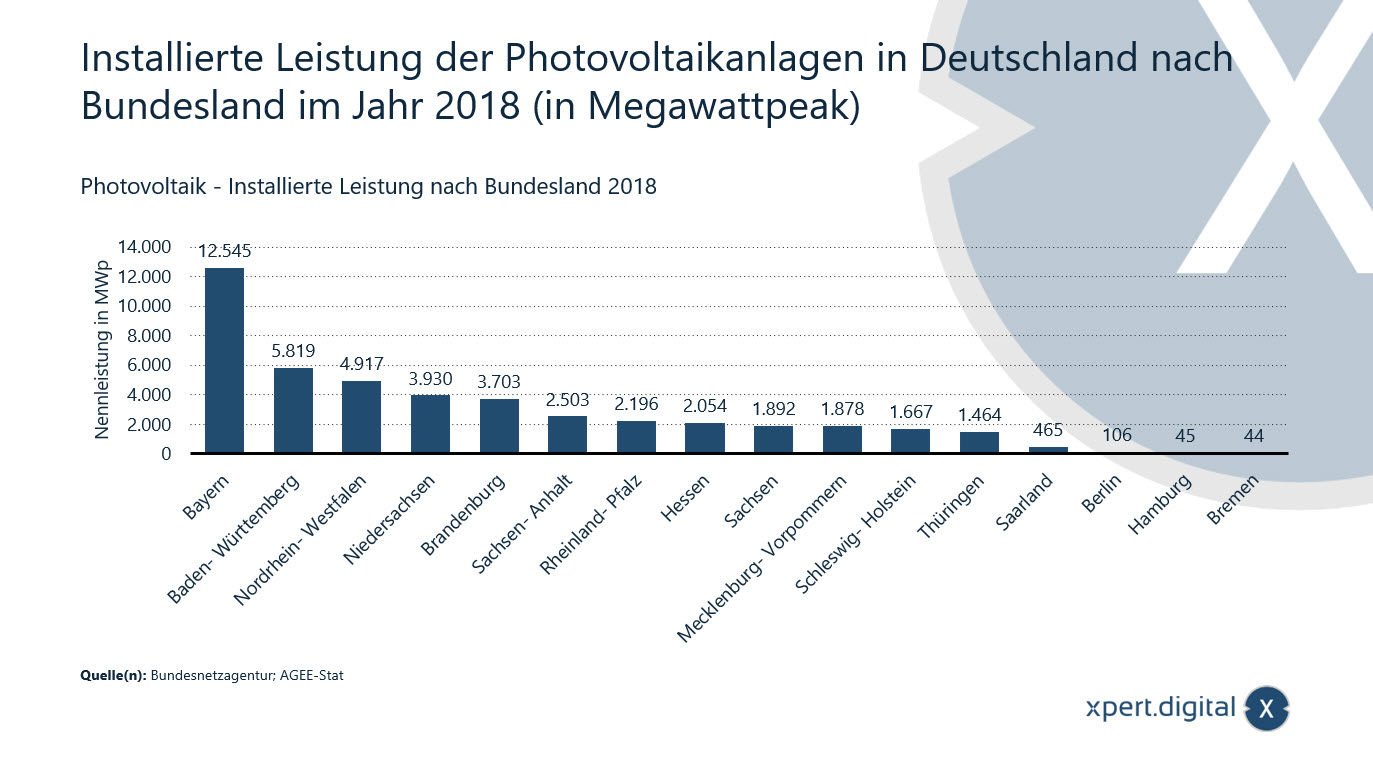
Photovoltaics - Installed capacity by federal state
Installed photovoltaic capacity in Germany by federal state – Image: Xpert.Digital
In Bavaria, the nominal output of photovoltaic systems is approximately 12.5 gigawatts peak. This makes Bavaria by far the German state with the most installed capacity in 2018. It is followed by the states of Baden-Württemberg and North Rhine-Westphalia. The city-states of Bremen, Hamburg, and Berlin have the lowest nominal output of photovoltaic systems compared to other German states.
Photovoltaic systems
Photovoltaic systems generate energy by converting light energy into electrical energy. In Germany, the installed capacity of photovoltaic systems is continuously increasing. This reflects global trends: of the approximately 402 gigawatts of total installed capacity, over a quarter is located in China. The USA, Japan, and Germany follow, with significantly less installed photovoltaic capacity.
Renewable energy sources
Renewable energies, unlike fossil fuels such as coal and oil, are renewable. Furthermore, their use reduces CO2 emissions, among other benefits. Hydropower is the world's leading renewable energy source, generating the most electricity. In Germany, wind power is particularly important, accounting for approximately 18 percent of total electricity generation.
Installed photovoltaic capacity in Germany by federal state in 2018
- Bavaria: 12,545 megawatt peak
- Baden-Württemberg: 5,819 megawatt peak
- North Rhine-Westphalia: 4,917 megawatt peak
- Lower Saxony: 3,930 megawatt peak
- Brandenburg: 3,703 megawatt peak
- Saxony-Anhalt: 2,503 megawatt peak
- Rhineland-Palatinate: 2,196 megawatt peak
- Hesse: 2,054 megawatt peak
- Saxony: 1,892 megawatt peak
- Mecklenburg-Western Pomerania: 1,878 megawatt peak
- Schleswig-Holstein: 1,667 megawatt peak
- Thuringia: 1,464 megawatt peak
- Saarland: 465 megawatt peak
- Berlin: 106 megawatt peak
- Hamburg: 45 megawatt peak
- Bremen: 44 megawatt peak
That's why Xpert.Solar offers consulting services for solar carports , solar systems and solar systems on flat roofs for Hannover, Braunschweig, Bielefeld and Kassel!

Konrad Wolfenstein
I would be happy to serve as your personal advisor.
You can contact me by filling out the contact form below or simply call me on +49 7348 4088 965 .
I'm looking forward to our joint project.
Write to me

Xpert.Digital – Konrad Wolfenstein
Xpert.Digital is a hub for industry with a focus on digitalization, mechanical engineering, logistics/intralogistics and photovoltaics.
With our 360° business development solution, we support well-known companies from new business to after sales.
Market intelligence, smarketing, marketing automation, content development, PR, mail campaigns, personalized social media and lead nurturing are part of our digital tools.
You can find out more at: www.xpert.digital – www.xpert.solar – www.xpert.plus
Keep in touch









