
Solar carport demand is also increasing thanks to environmental bonuses to promote electric cars

Available in 27 languages 📢
Prefer Xpert.Digital on GoogleⓘPublished on: July 9, 2021 / Updated on: July 9, 2021 – Author: Konrad Wolfenstein

Solar carport demand is increasing – Image: Xpert.Digital – stockphotofan1|Shutterstock.com
The environmental bonus was introduced in Germany in 2016. As a premium for the purchase of a new electric vehicle, it is intended to increase demand by incentivizing sales. The environmental bonus also applies to hybrid electric vehicles and hydrogen/fuel cell vehicles.
Promoting electromobility is seen as the key to climate-friendly mobility, which should take Germany one step further towards EU climate neutrality by 2050.
Private individuals, companies, foundations, corporations and associations can apply for the environmental bonus. Only purchases or leasing of new vehicles that were purchased and (first) registered from May 18, 2016 and remain registered to the applicant for at least six months are eligible for funding. In November 2019, as part of the concerted mobility campaign, it was decided to extend the environmental bonus until 2025 or until the total paid out amounted to 2.09 billion euros. Due to the COVID-19 pandemic, the parliamentary group leaders decided on June 3, 2020 to double the state share of the environmental bonus for electric vehicles as an innovation bonus.
In its 2008 "National Development Plan for Electromobility," the German Federal Government set the goal of having one million electric vehicles on German roads by 2020. The automotive industry, so important to the German economy, was also to play a key role in this, maintaining and further expanding its strong position in the global economy.
In 2009, there were just under 1,500 electric cars in Germany. A good decade later, as of April 1, 2011, there were around 365,000 electric vehicles in Germany. The goal of one million electric vehicles was therefore far from being achieved.
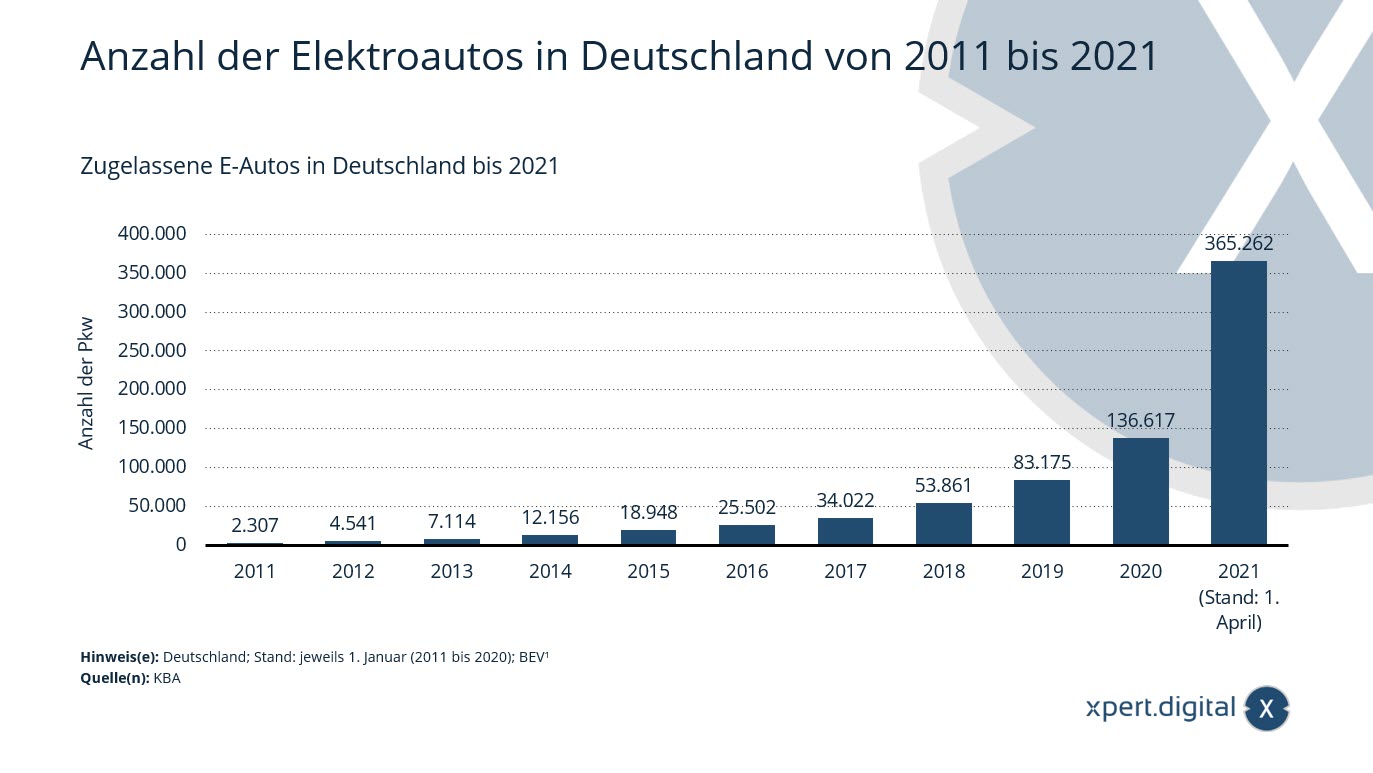
Registered electric cars in Germany up to 2021 – Image: Xpert.Digital
However, depending on the definition and interpretation, plug-in hybrid vehicles are also counted among electric cars. As of April 1, 2021, there were approximately 349,300 registered electric vehicles in Germany. Viewed in this light, the number of electrically powered passenger cars would be approaching the one million mark set by the German government in 2008.
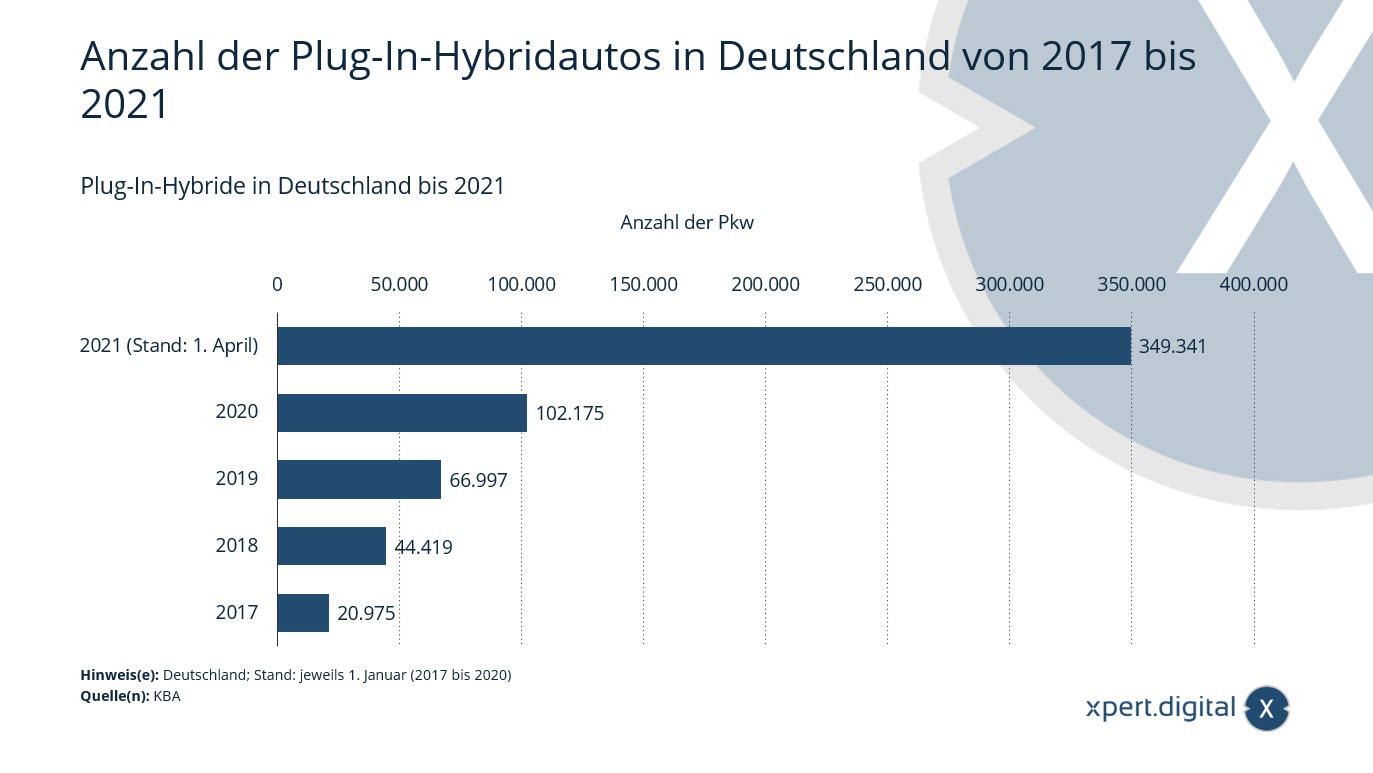
Number of plug-in hybrid cars in Germany – Image: Xpert.Digital
The difference between a hybrid vehicle and a plug-in hybrid car lies in the fact that hybrid vehicles, which also have an electric motor, are classified as electric cars (plug-in hybrids). In a pure hybrid vehicle, the electric motor only assists the combustion engine during acceleration, and the combustion engine takes over at higher speeds and low RPMs. This hybrid electric motor cannot therefore be considered an independent vehicle drive system or an equivalent electric motor in a plug-in hybrid car.
Generally, a hybrid vehicle has at least two energy converters and two integrated energy storage systems to power the vehicle. Energy converters include electric, gasoline, and diesel engines; energy storage systems include batteries, fuel tanks, and gas tanks. At the beginning of 2021, there were approximately one million hybrid vehicles in Germany (including plug-in hybrids).
Suitable for:
Solar carport development and potential
In light of the EU's zero-emissions policy, rising diesel and gasoline prices, and the increasing number of electric vehicles with the associated shortage of charging stations and charging points, the next few years will not only see a completely different driving and vehicle landscape, but also a radical shift in refueling and charging behavior. Refueling and charging will no longer be concentrated on centralized solar charging stations ; instead, they will be distributed throughout the region. Charging points and charging stations will be installed wherever parking is available.
An interesting new market with great potential is emerging for solar installers, driven primarily by political initiatives. The goal is not simply to continue using electricity from the wall socket, but rather to generate it locally using photovoltaic technology, primarily through the solar carport concept in open parking areas. These are not public parking spaces; open parking areas typically include both covered and uncovered parking spaces.
Not long ago, typical solar panels primarily in demand for pitched roofs on houses or flat roofs on production and industrial buildings. Solar parks and solar fields also enjoyed widespread acceptance. In a survey, 62% of respondents stated that they would prefer a solar park as a power generation facility in their neighborhood to, for example, a nuclear power plant. Only 5% expressed a preference for nuclear energy.
With the rise of electromobility and the lack of charging infrastructure, the idea of solar carports in open parking lots .
In a survey, experts from the e-mobility industry confirmed with over 70% that the expansion of the charging station network has a strong influence on the market for electric vehicles. Another 22% believe it is at least having an impact on the EV market.
Suitable for:
- Best practice solar carport: What trade and industry in Baden-Württemberg need to know now
- Charging stations and solar carports together make sense: the circle closes
Which form of a purchase incentive for new cars would you favor?

Purchase incentive for new cars? – Image: Xpert.Digital
The source does not specify the missing percentage points to reach 100 percent. The question was phrased in the source as follows: “Another proposal concerns so-called purchase premiums for the purchase of new cars. In this case, the state would cover part of the purchase price.”.
- Should such a purchase incentive only apply to electric cars? Should there also be a smaller purchase incentive for cars with combustion engines?
- Should there be the same purchase incentives for all new vehicles? Or are you completely against such government incentives for buying a new car?
The majority rejects government purchase incentives for automobiles: A total of 55 percent of respondents in the ARD-DeutschlandTREND survey stated they were completely against the introduction of a purchase premium for new cars, regardless of the type of drive system. As part of the economic stimulus package to overcome the economic consequences of the coronavirus crisis, the grand coalition decided to promote only alternative drive systems through bonus payments. The subsidies for the purchase of electric, hybrid, or hydrogen vehicles, which already exist in the form of the environmental bonus, are to be increased.
Amount of the environmental bonus for the purchase of electric vehicles in Germany in 2021

Amount of the environmental bonus for the purchase of electric vehicles – Image: Xpert.Digital
This statistic shows the amount of the purchase premium for electric vehicles, also known as the environmental bonus, by type of electric vehicle in Germany in 2021. The purchase (buying or leasing) of an electric vehicle, as well as corresponding used vehicles, are eligible for funding. The premium is shared equally between the federal government and the vehicle manufacturer. The environmental bonus for purely battery-electric vehicles with a net list price of up to €40,000 amounted to €9,000 per vehicle in 2021.
The stated subsidy rates apply retroactively to vehicles registered from June 4th onwards. According to BAFA, eligible vehicles include pure electric cars, plug-in hybrids, fuel cell cars, and corresponding used vehicles.
Number of environmental bonuses applied for for electric cars in Germany by manufacturer
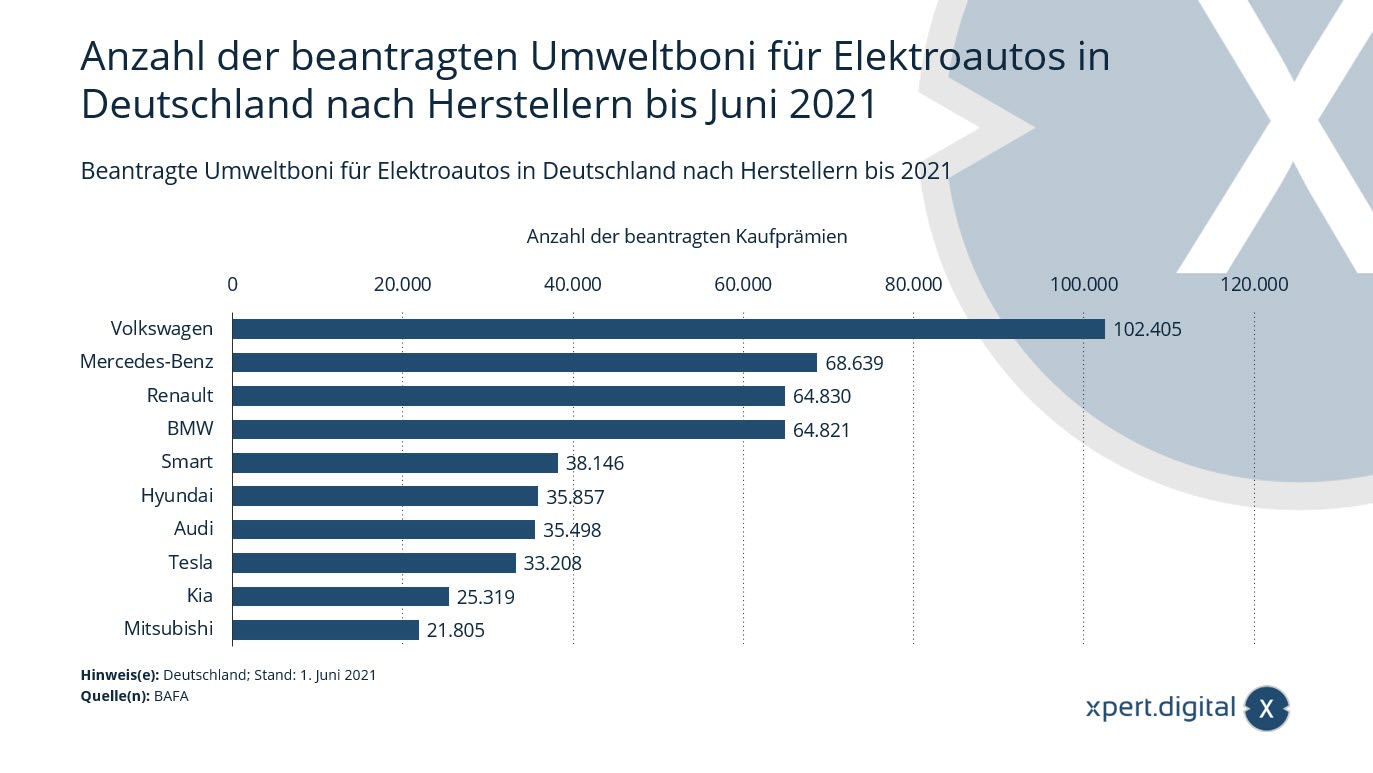
Number of environmental bonuses applied for for electric cars – Image: Xpert.Digital
That's why Xpert.Solar offers consulting and planning services for solar carports as a further step towards meeting the demand for emission-free electric cars.

Konrad Wolfenstein
I would be happy to serve as your personal advisor.
You can contact me by filling out the contact form below or simply call me on +49 7348 4088 965 .
I'm looking forward to our joint project.
Write to me

Xpert.Digital – Konrad Wolfenstein
Xpert.Digital is a hub for industry with a focus on digitalization, mechanical engineering, logistics/intralogistics and photovoltaics.
With our 360° business development solution, we support well-known companies from new business to after sales.
Market intelligence, smarketing, marketing automation, content development, PR, mail campaigns, personalized social media and lead nurturing are part of our digital tools.
You can find out more at: www.xpert.digital – www.xpert.solar – www.xpert.plus
Keep in touch







