
Photovoltaics (PV): Build a solar carport and solar system on a flat roof - looking for a system from Mannheim, Ulm or Freiburg?

Language selection 📢
Published on: June 15, 2021 / Updated on: August 4, 2021 – Author: Konrad Wolfenstein
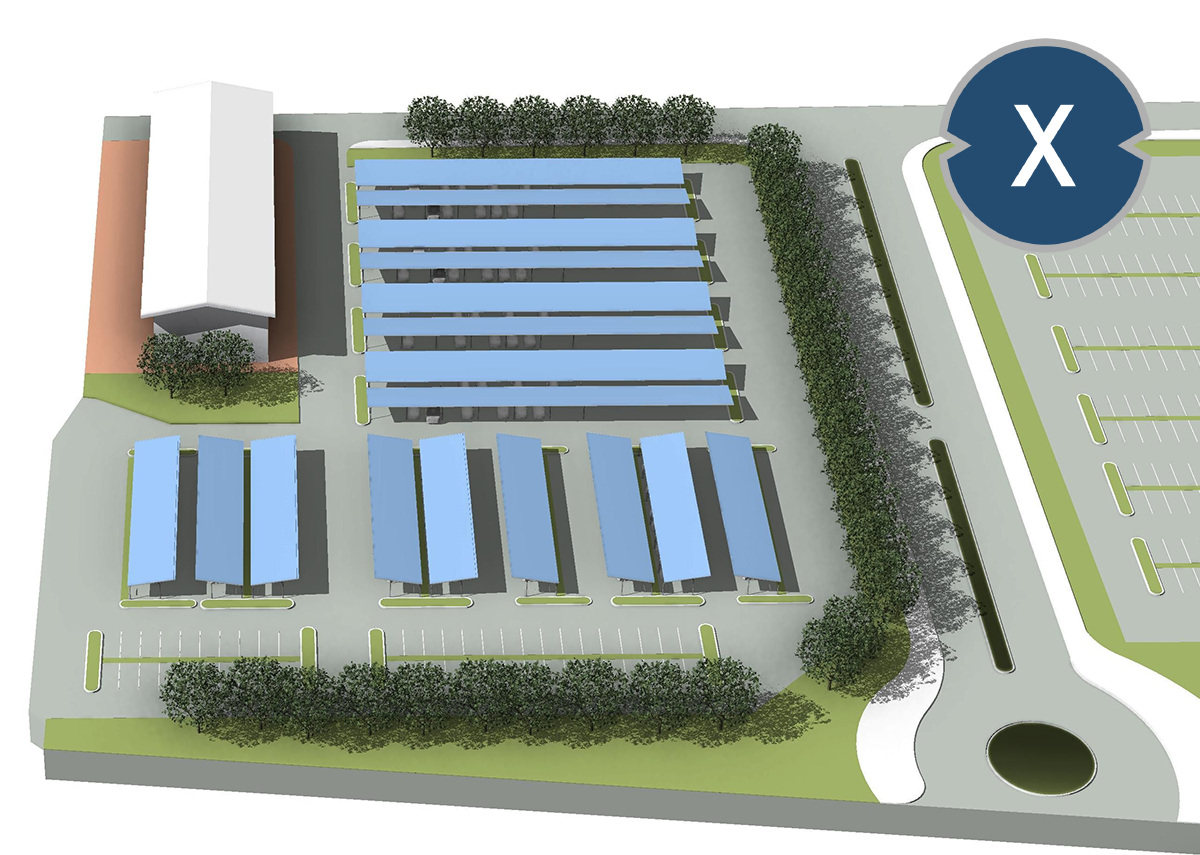
Planning solar carports, flat roofs, solar parks & open-field systems – Xpert.Digital
Charging stations and solar carports together make sense: the circle closes
Looking at the vehicle market in terms of new registrations, a shift occurred in the middle of last year. New registrations for gasoline and diesel vehicles are declining, while electric cars are slowly gaining ground. Currently, more hybrid cars than diesel cars are being registered. Is this a trend reversal?
Interestingly, in 2020, a disproportionately high 72.2 percent of new plug-in hybrid passenger cars in Germany were registered to commercial owners. For all new cars, the commercial share was 62.8 percent, more than ten percentage points lower. The German government estimated that as of October 1, 2020, around 80 percent of plug-in hybrid passenger cars registered to commercial owners were used as company cars with some private use. The Volkswagen Passat was the most popular plug-in hybrid passenger car model in Germany in 2020. Only one foreign manufacturer, the Mitsubishi Outlander, is represented in the list of the ten best-selling models of 2020.
The carbon footprint of plug-in hybrid vehicles depends significantly on how often they are driven electrically. A white paper from the Fraunhofer Institute for Systems and Innovation Research and the International Council on Clean Transportation shows that, in real-world driving conditions, plug-in hybrids primarily use their combustion engine. In Germany, privately owned vehicles cover an average of 43 percent of journeys electrically, while company cars cover only 18 percent. The paper attributes this discrepancy to the infrequent use of charging infrastructure. Its recommendations include better incentives for more frequent charging and improved funding for the installation of private charging stations.
📣 Parking areas solar solutions for industry, retail and municipalities
Everything from a single source, specially designed for solar solutions for large parking areas. You refinance or counterfinance into the future with your own electricity generation.
🎯 For solar engineers, plumbers, electricians and roofers
Advice and planning including a non-binding cost estimate. We bring you together with strong photovoltaic partners.
👨🏻 👩🏻 👴🏻 👵🏻 For private households
We are positioned across regions in German-speaking countries. We have reliable partners who advise you and implement your wishes.
With regard to the upcoming solar obligation in Baden-Württemberg from January 1, 2022, where all non-public parking lots with more than 75 parking spaces must install a solar carport system, which primarily affects trade, commerce and industry, the circle would be closed: The incentive for more frequent charging would be there, as well as the step towards more commercial hybrid plug-in and electric car registrations.
Many questions about solar carports need to be answered. Many people are encountering this topic for the first time, and good advice is invaluable. Xpert.Solar offers B2B customer consulting for businesses as well as interested solar installers. For end consumers, we recommend using the solar installer search function on our Xpert.Solar platform . Here, over 13,000 solar installers from German-speaking countries (Germany, Austria, and Switzerland) are listed.
Especially for commercial and industrial applications, solar carports must meet different requirements than private installations. Private solar carports, or carports in general, typically lack impact protection. Most private carports are primarily constructed of wood. In such cases, the prevailing attitude is: better to damage my carport in a collision than my car. With large-scale solar carport installations, the opposite is true. Here, the focus is on the safety of a large number of parking spaces, which cannot be maintained and serviced in the same way as a single private carport. A wooden structure requires regular upkeep, which can become a problem with large solar carport installations.
Suitable for:
- Are solar farms the most popular electricity generation systems?
- Solar carports: company parking spaces – sensible use of sealed areas
Our solar parking solution is modular and scalable:
- Quick and easy assembly
- Stable strip foundation as collision protection
- Individually customizable design (color, materials, surface, size, etc.)
- Installation of charging stations and inverters is possible at any time
- Scalable & modular: Available as a single, double or arbitrarily scalable row carport
- Can even be used in the standard version for very high wind and snow loads (s k = 2.2 kN/m²)
- Extra large and wide parking spaces and very easy parking thanks to W-shaped supports
- High-quality design for sophisticated and long-lasting requirements: Hot-dip galvanized steel construction (DIN EN 10346, DIN EN 1461)
- [Click here for more]
Suitable for:
Industrial flat roof solar systems and solar parks or outdoor photovoltaic systems are another alternative
Anyone considering investing in a solar carport should also consider installing a solar panel system on the company roof. Utilizing all available energy potential for an emission-free and autonomous power supply is also a competitive advantage and helps secure market share.
More about it here:
Charging infrastructure and charging stations
Should the energy generated be fed into the grid or parked in energy or electricity storage? What are the load profiles, the technical connection conditions, number of charging stations, vehicle downtime and ultimately the specified total PV output? Will the charges be recorded with the company if the employee charges their company car from home? These are questions that we will have to deal with in the future. It is different from what we are used to today.
Suitable for:
New registrations of electric cars in Germany up to 2021
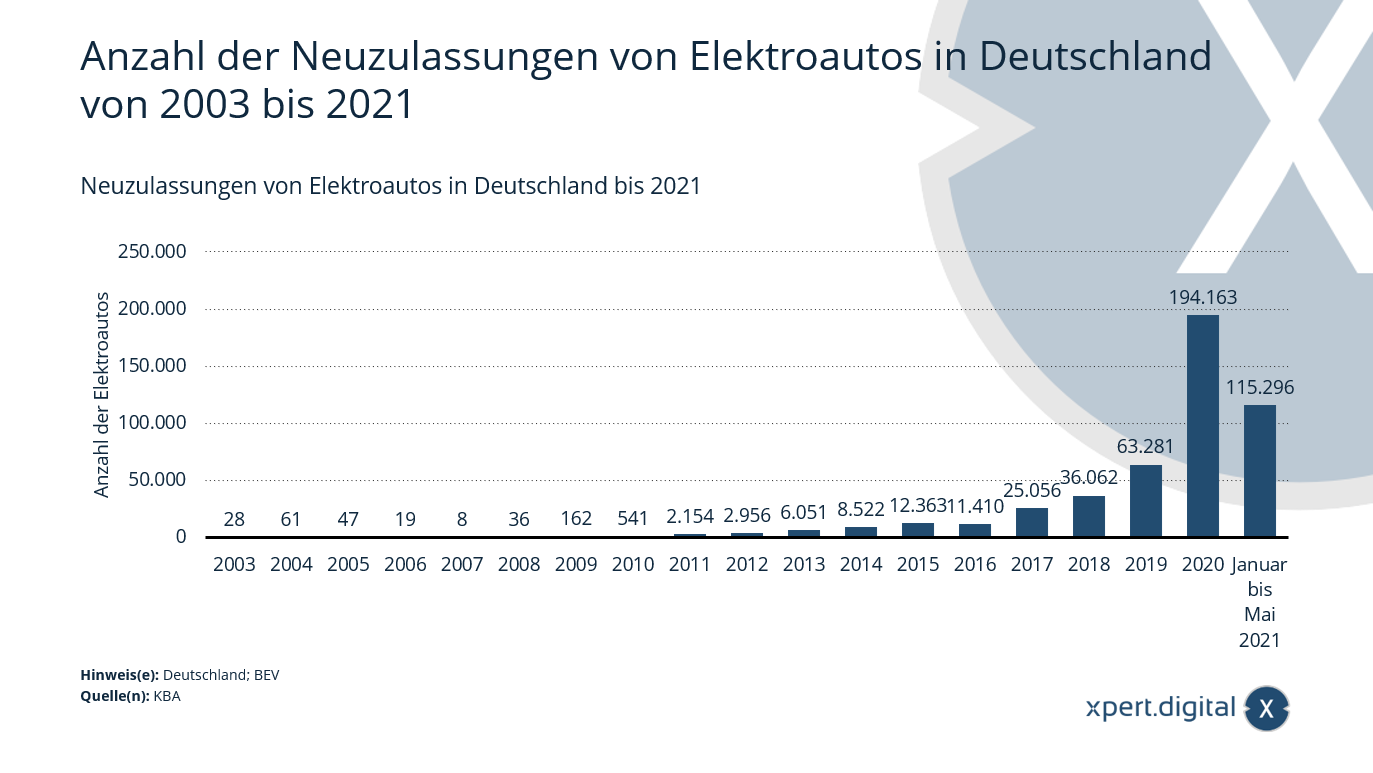
New registrations of electric cars – Image: Xpert.Digital
A record number of new electric car registrations were recorded in Germany in 2020 – with approximately 194,200 purely electric passenger cars registered, the highest number ever recorded. This represents a threefold increase compared to the previous year. The year 2021 also began with a significant increase compared to the same period of the previous year.
New registrations of battery electric vehicles (BEVs)
The statistics reflect new registrations of purely battery-powered electric cars. The term "electromobility" often encompasses various electric and partially electric drive systems. Battery electric vehicles are powered exclusively by an electric motor, which draws the necessary electrical energy from a traction battery. Plug-in hybrid vehicles, which have both an electric motor and a combustion engine and can only operate partially on electric power, are also generally included under the umbrella term "electromobility.".
Charging infrastructure is a basic requirement for the mobility transition
The number of publicly accessible charging stations is a key factor in the decision for or against an electric car. In 2020 alone, over 3,000 new charging points were added, bringing the total number of charging stations available to drivers to over 16,800 in December. Bavaria was the German state with the most charging stations in 2020.
Number of new electric car registrations in Germany from 2003 to 2021
- 2003 – 28
- 2004 – 61
- 2005 – 47
- 2006 – 19
- 2007 – 8
- 2008 – 36
- 2009 – 162
- 2010 – 541
- 2011 – 2.154
- 2012 – 2.956
- 2013 – 6.051
- 2014 – 8.522
- 2015 – 12.363
- 2016 – 11.410
- 2017 – 25.056
- 2018 – 36.062
- 2019 – 63.281
- 2020 – 194.163
- 2021 – 115,296 (January to May)
New passenger car registrations with hybrid drive in Germany up to 2021
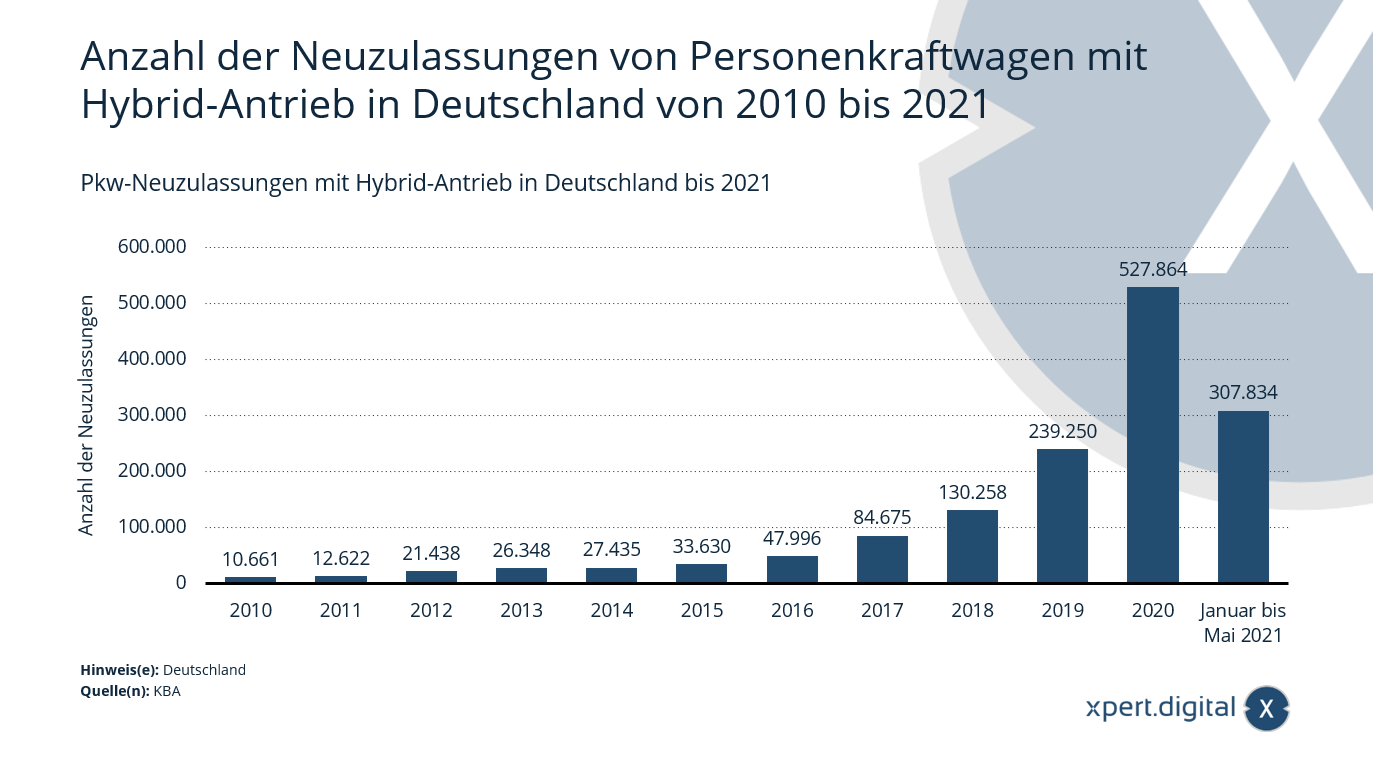
New passenger car registrations with hybrid drive – Image: Xpert.Digital
This statistic shows the number of new registrations of hybrid vehicles in Germany from 2010 to 2021. According to the UN definition, a hybrid vehicle is a vehicle with at least two energy converters and two integrated energy storage systems to power it. Energy converters include, for example, electric, gasoline, and diesel engines; energy storage systems include, for example, batteries or fuel tanks. In 2020, approximately 527,900 cars with hybrid drive systems were registered, including about 200,500 plug-in hybrids.
Number of new registrations of hybrid passenger cars in Germany from 2005 to 2021
- 2005 – 3.589
- 2006 – 5.278
- 2007 – 7.591
- 2008 – 6.464
- 2009 – 8.374
- 2010 – 10.661
- 2011 – 12.622
- 2012 – 21.438
- 2013 – 26.348
- 2014 – 27.435
- 2015 – 33.630
- 2016 – 47.996
- 2017 – 84.675
- 2018 – 130.258
- 2019 – 239.250
- 2020 – 527.864
- 2021 – 307,834 (January to May)
New passenger car registrations with plug-in hybrid drive in Germany up to 2021
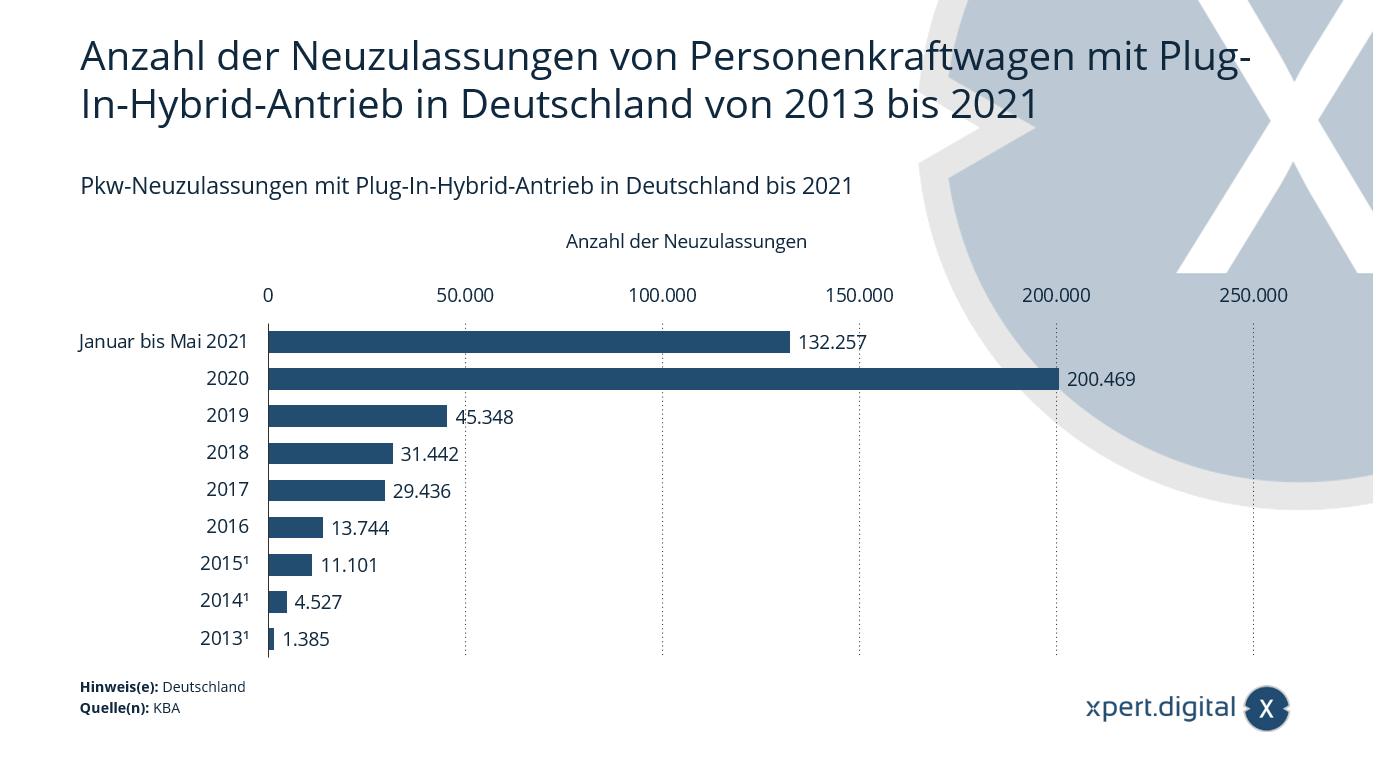
New registrations of passenger cars with plug-in hybrid drive
This statistic shows the number of new registrations of plug-in hybrid vehicles in Germany from 2013 to 2021. According to the UN definition, a hybrid vehicle is a vehicle that has at least two energy converters and two integrated energy storage systems to power the vehicle. Energy converters include, for example, electric, gasoline, and diesel engines; energy storage systems include, for example, batteries or fuel tanks. In 2020, approximately 200,500 cars with plug-in hybrid drive systems were registered.
The source states: “A statistical inaccuracy exists due to older type approvals prior to 2012, in which a plug-in vehicle was still classified as a hybrid. Therefore, not all newly registered plug-in vehicles are yet included.” Some of the older figures were taken from corresponding publications of the previous year.
A plug-in hybrid is a hybrid vehicle whose battery can be charged both via the combustion engine and via a plug (from the English "to plug in") on the electrical grid. A plug-in hybrid vehicle usually has a larger battery than a full hybrid and is therefore closer to a fully electric car. A commonly used abbreviation is PHEV (for plug-in hybrid electric vehicle).
The share of plug-in hybrid cars in all new car registrations in Germany has risen sharply in recent years: While it was still at 0.3 percent in 2015, which corresponded to 11,101 vehicles, the share of around 200,000 new plug-in hybrid cars in 2020 was already 6.9 percent.
Suitable for:
- Best practice solar carport: What trade and industry in Baden-Württemberg need to know now
- Solar carports as a further step for the growing charging station infrastructure
Number of new registrations of passenger cars with plug-in hybrid drive in Germany from 2013 to 2021
- 2013 – 1.385
- 2014 – 4.527
- 2015 – 11.101
- 2016 – 13.744
- 2017 – 29.436
- 2018 – 31.442
- 2019 – 45.348
- 2020 – 200.469
- 2021 – 132,257 (January to May)
Share of petrol and diesel in new passenger car registrations in Germany up to May 2021
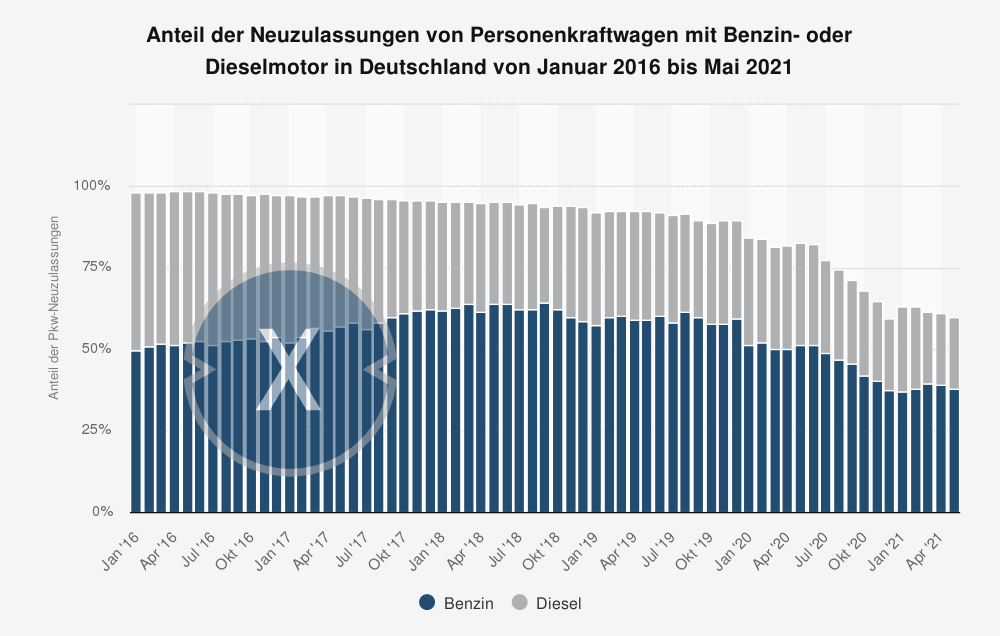
New car registrations (petrol and diesel) in Germany – Image: Xpert.Digital
Share of new passenger car registrations with petrol or diesel engines in Germany from January 2016 to May 2021: In May 2021, approximately 37.7 percent of newly registered passenger cars were equipped with a petrol engine. This corresponds to a total of around 86,900 vehicles and an increase of 1.1 percent compared to the same month of the previous year.
New registration: Initial registration of a brand-new vehicle with a license plate in Germany. Vehicles previously registered in Germany or abroad are not included. The figures for previous months were taken from the corresponding earlier publications.
Suitable for:
Number of new passenger car registrations in Germany by fuel type

New passenger car registrations by fuel type – Image: Xpert.Digital
This statistic shows the number of new passenger car registrations in Germany from May 2019 to May 2021, broken down by fuel type. 516 of the cars newly registered in Germany in May 2021 were powered by natural gas. Some older figures were taken from corresponding publications of the previous year. Alternative drive systems are becoming increasingly popular, but passenger cars with fuel cells as their energy source remain a niche product.
Suitable for:
Number of new passenger car registrations in Germany by alternative fuel type or energy source
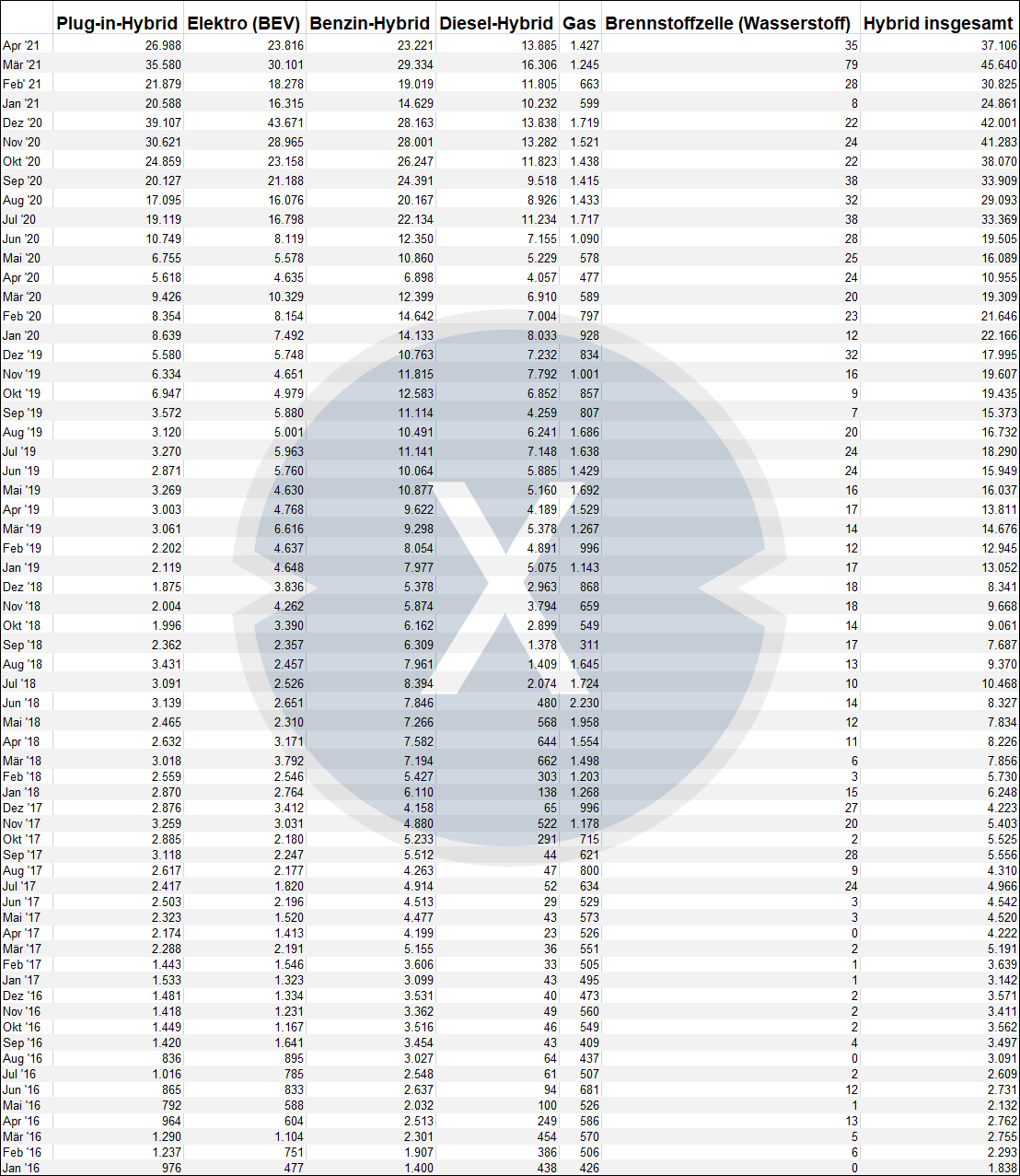
Monthly new passenger car registrations by alternative fuel type – Image: Xpert.Digital
This statistic shows the number of new passenger car registrations in Germany from April 2019 to April 2021, broken down by alternative fuel type or energy source. 35 of the cars newly registered in Germany in April 2021 were powered by a fuel cell. Alternative drive systems are becoming increasingly popular, but cars with gasoline and diesel engines remain in demand, although the share of these fuel types has been declining in recent months.

- Warehouses, production halls and industrial halls with their own power source from a photovoltaic roof system - Image: NavinTar|Shutterstock.com

- Industrial plant with its own power source from an outdoor photovoltaic system - Image: Peteri|Shutterstock.com

- Plan solar systems with photovoltaic solutions for freight forwarding and contract logistics

- B2B solar systems and photovoltaic solutions & advice

- Plan photovoltaics for warehouses, commercial halls and industrial halls
- Industrial plant: Plan a photovoltaic open-air system or open-space system
- Plan solar systems with photovoltaic solutions for freight forwarding and contract logistics
- B2B solar systems and photovoltaic solutions & advice
That's why Xpert.Solar offers consulting services for solar carports , solar systems and solar systems on flat roofs for Mannheim, Ulm and Freiburg!

Konrad Wolfenstein
I would be happy to serve as your personal advisor.
You can contact me by filling out the contact form below or simply call me on +49 7348 4088 965 .
I'm looking forward to our joint project.
Write to me

Xpert.Digital – Konrad Wolfenstein
Xpert.Digital is a hub for industry with a focus on digitalization, mechanical engineering, logistics/intralogistics and photovoltaics.
With our 360° business development solution, we support well-known companies from new business to after sales.
Market intelligence, smarketing, marketing automation, content development, PR, mail campaigns, personalized social media and lead nurturing are part of our digital tools.
You can find out more at: www.xpert.digital – www.xpert.solar – www.xpert.plus
Keep in touch









