
When peacetime infrastructure has to become war logistics | Germany's operations plan: The logistics hub under stress
Xpert Pre-Release

Available in 27 languages 📢
Prefer Xpert.Digital on GoogleⓘPublished on: January 22, 2026 / Updated on: January 22, 2026 – Author: Konrad Wolfenstein
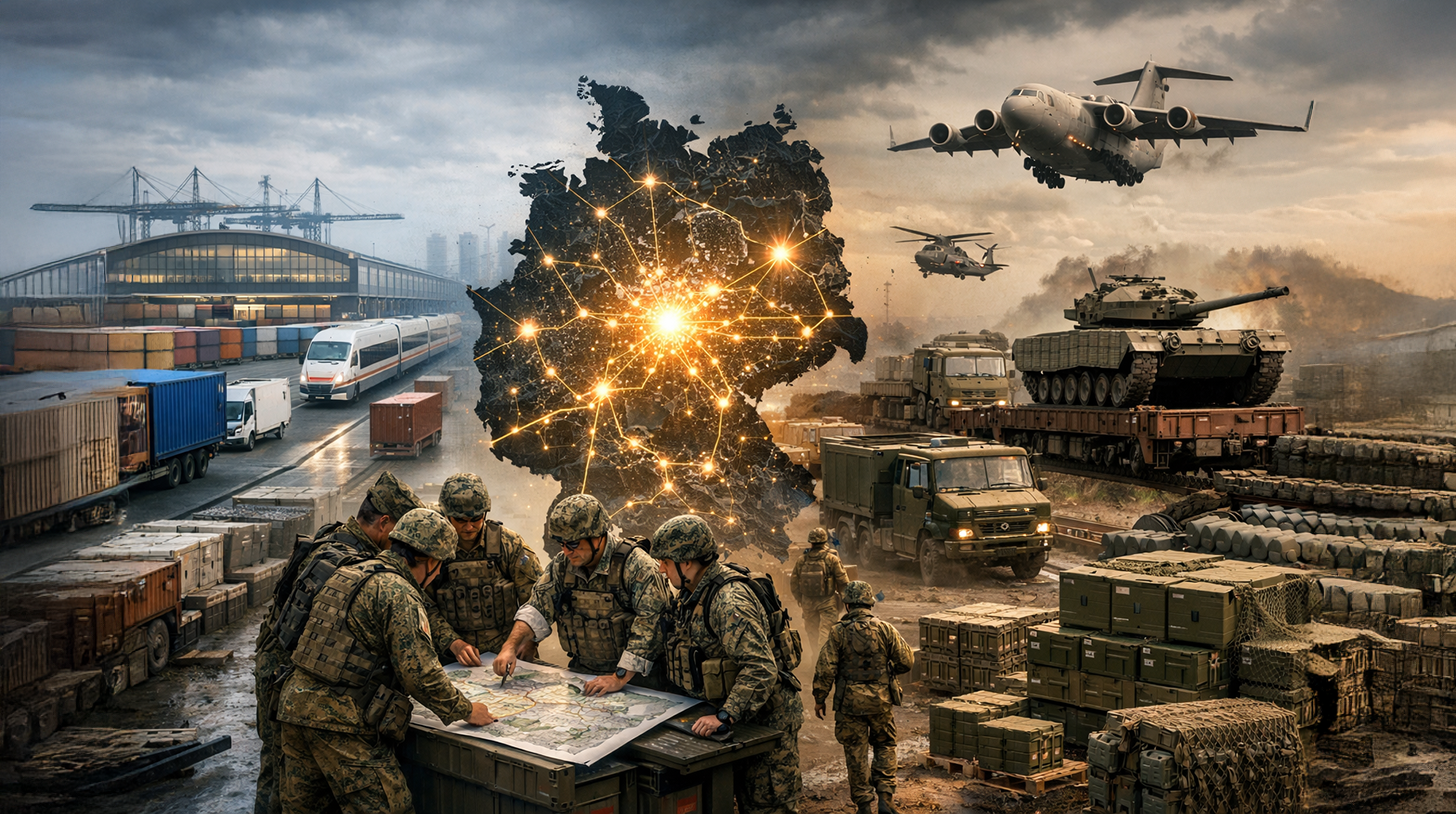
When peacetime infrastructure has to become war logistics | Germany's operations plan: The logistics hub under stress – Image: Xpert.Digital
No bunkers, no beds: Secret plan reveals drastic gaps in German civil defense
Germany is rehearsing for a worst-case scenario: Between secret general mobilization and dilapidated reality
For decades, Germany was considered a safe haven in the heart of Europe, a beneficiary of a peace dividend that believed military conflicts were far away. But that era is over. With the “Operations Plan Germany” (OPLAN DEU), a highly confidential blueprint of over 1,200 pages has now been presented, intended to radically transform the country: away from its civilian comfort zone and toward becoming the central logistical hub for a potential major NATO conflict. The intelligence scenarios are grim – Russia could possess the capabilities to attack NATO territory as early as 2029.
But while on paper tank columns roll and the civilian economy is seamlessly integrated into war logistics, a reality check reveals glaring weaknesses. From crumbling bridges that can't support a Leopard tank, to a healthcare system already operating at its limit in peacetime, to a population for which there are simply no air-raid shelters: the plan encounters an infrastructure that is hardly equipped for the "stress test" of war.
This article sheds light on the profound details of the operational plan, analyzes the dangerous gap between military ambition and social reality, and explores the question: What does it mean for each individual when peacetime infrastructure suddenly has to become war logistics?
“Operations Plan Germany”: This is what the German Armed Forces' secret 1,200-page document contains
The Federal Republic of Germany is facing a historic transformation. After decades in which Germany was considered a safe haven in the heart of Europe, the country is now to become NATO's central military-logistical hub. The Operations Plan Germany, a document exceeding 1,200 pages and officially in force since January 2025, outlines a scenario that long seemed unthinkable: preparations for a large-scale conflict in Europe in which Germany would not be a frontline state, but rather a transit zone and supply center.
The development of this plan began in March 2023, when the German Armed Forces' Territorial Command was tasked with developing a concept that would integrate military necessities with civilian support services. The first version was completed in March 2024, followed by a second, expanded version in March 2025. What at first glance appears to be just another planning document from the defense bureaucracy, reveals itself upon closer inspection as a comprehensive blueprint for the reorganization of large parts of German society in the event of a crisis.
The scale is breathtaking: In a crisis, up to 800,000 soldiers and 300,000 vehicles would have to be deployed through Germany to Eastern Europe. At the same time, large parts of the Bundeswehr itself would march eastward to reinforce NATO's eastern flank. Germany assumes a dual role in this: It provides its own troops – currently 35,000 soldiers as well as over 200 aircraft and ships are on high alert for the NATO Force Model – and simultaneously acts as a host nation for transiting allied units.
This new strategic positioning reflects a changed geopolitical reality. While Germany was considered a potential frontline state during the Cold War and benefited from a peace policy dividend after reunification, the Russian attack on Ukraine in February 2022 fundamentally shook Europe's security architecture. Military experts and intelligence agencies have long identified 2029 as a potential turning point, by which time Russia, according to current rearmament plans, could possess the capability to attack NATO territory. The president of the Federal Intelligence Service (BND), Martin Jäger, dramatically intensified this prediction in October 2025: Germany should not be complacent, he warned, as it was "already under fire." Russia is expanding its armed forces to 1.5 million soldiers and produces around 1,500 battle tanks annually – far more than would be needed for the war in Ukraine.
The German Operations Plan is the response to this threat. It defines clear tasks for all levels of government and, for the first time, systematically involves the private sector. The federal and state governments coordinate political and military decisions, districts activate their disaster relief agencies, and municipalities assume responsibility for protecting local facilities. Police, fire departments, rescue services, and the Federal Agency for Technical Relief (THW) provide personnel and equipment. Private companies, from logistics firms and energy suppliers to craft businesses, are expected to create additional capacity and keep it available for emergencies.
The German Armed Forces have already signed contracts with Deutsche Bahn, Autobahn GmbH, and private service providers. Rheinmetall was awarded the contract to provide equipment for 17 rest and assembly areas to supply troops passing through. A test depot has already been set up, operated, and dismantled – a trial run for a real-world scenario. This reliance on the private sector is not accidental, but rather a calculated move: the German Armed Forces simply do not have the capacity to implement the operational plan on their own.
The challenge is immense. Germany is expected to function as a central transit zone while a large portion of its own armed forces is already deployed on the eastern flank or en route there. This means maximum civilian service provision with a minimal military presence within the country. An American convoy traveling from a North Sea port toward Poland is not supplied by the Bundeswehr (German Armed Forces), but by civilian actors – freight companies, gas station operators, catering firms. The boundary between the military and civilian spheres is blurring.
This interconnectedness raises fundamental questions: How far can state coercion extend in the name of defense? The 1968 Employment Security Act allows for the conscription of citizens into civilian employment if defense-related tasks cannot otherwise be performed. Job centers could theoretically assign workers to where they are most urgently needed in a crisis – to energy supply, transportation, or repair shops. What sounds abstract in the legal text would, in a real emergency, mean that citizens would not be able to freely choose their occupation.
The German operations plan is therefore more than just a military document. It is an attempt to prepare a highly complex, specialized country with dilapidated infrastructure, limited resources, and a population that has lived in peace for decades for a scenario that no one wants to experience, but which, according to security authorities, can no longer be ruled out.
When bridges and railways become a strategic risk
The planning for Germany's operational plan is confronted with a sobering reality: Germany's transport infrastructure is in a state that regularly causes problems even in peacetime. Dilapidated bridges, overloaded railways, and outdated ports pose a significant risk to the plan's feasibility. Infrastructure deterioration is progressing faster than repairs – a development that has been building up over decades.
Of the approximately 130,000 bridges in Germany, tens of thousands are in need of repair. The Ministry of Transport has identified 4,000 bridges on federal highways alone as critical. The German Institute for Urban Affairs estimates that every second bridge on municipal roads is in poor condition. The challenge lies not only in the age of the structures – many date from the 1960s to the 1980s – but also in the intensity of their use. Since 1991, road freight traffic has more than doubled. Bridges are now bearing loads for which they were not designed.
The problem is exacerbated in the context of the operational plan. During the Cold War, roads and bridges were designed to withstand heavy military equipment. This practice has been neglected in recent decades. Now, the Federal Ministry of Transport is planning new specifications for bridge load-bearing capacity to make them suitable for modern tanks. These so-called Military Load Classifications are to be taken into account for new and replacement bridges – a measure that will require time and considerable financial resources.
The rail network is also in critical condition. Of the approximately 61,000 kilometers of railway lines in Germany, 17,636 kilometers are considered to be in urgent need of repair. In addition, 1,160 railway bridges need to be replaced with new structures – a number that increased between 2021 and 2023 despite ongoing renovation work. Deutsche Bahn is currently carrying out major overhauls of important sections of track, such as between Berlin and Hamburg. These measures are necessary, but result in line closures and diversions lasting for months.
The system's vulnerability was demonstrated by an incident in 2024 at the port of Nordenham. A cargo ship rammed the railway bridge over the Hunte River – the only rail link to this port, which serves as a central transshipment point for munitions shipments to Ukraine. Deutsche Bahn erected a temporary replacement bridge in just 60 days, 30 centimeters lower than the original structure. However, only a few months later, another ship damaged this temporary bridge again. The railway line was closed for months, and the munitions transport had to be rerouted via Poland. The Pentagon interpreted this logistical bottleneck as a warning sign.
The Nordenham incident highlights a structural problem: critical infrastructure is often inadequately protected against failures. Nordenham has only a single railway line, with no redundancy. Following the incidents, the district administrator of Wesermarsch called for "well-rehearsed escalation plans" and spoke of the need to consistently identify and protect infrastructure – through police patrols on the Weser River, strict access controls, and security. What no one likes to think about in peacetime becomes a matter of survival in times of crisis.
Ports play a central role in the operational plan, as a large portion of supplies from the US and Western Europe would pass through German seaports. However, connections to the hinterland are inadequate in many places. Hamburg, Bremerhaven, Wilhelmshaven – these ports would have to handle massively increased transshipment capacities in a crisis. But even today, transport routes are overloaded. Rheinmetall manager Armin Papperger stated that Europe is “not prepared for war” and emphasized the need for a massive expansion of infrastructure.
The German government has recognized the need for action and is investing in infrastructure. The Ministry of Transport announced nine billion euros for investments in federal highways and bridges by 2025. The comprehensive modernization of the rail network is intended to increase its resilience in times of crisis. 4,000 bridges will be modernized – an area equivalent to 450 football fields. However, the Federal Court of Auditors has expressed doubts as to whether the federal government's renovation schedule can be met. And even if the measures are successful, it could take years for them to be fully implemented.
Another problem is the complexity of responsibilities. While highways and federal roads are the responsibility of the federal government, many roads fall under the jurisdiction of the states, counties, or municipalities. The German Armed Forces are currently in talks with state representatives to ensure the freest possible passage for troop and supply convoys. Until now, permits were required for each individual transport – a bureaucratic burden that would be unmanageable in a real emergency.
German states bordering Poland are of particular importance. Brandenburg, Saxony, and Mecklenburg-Western Pomerania are not only home to Bundeswehr units that would have to be deployed eastward in an emergency, but also contain training areas that can serve as transit points for other units. The state commands of these states are already working on coordinating with local authorities.
The dilapidated infrastructure is not just a German problem, but a European one. The European Union is working on simplifying cross-border troop movements as part of the "Military Mobility" project. The goal is a so-called "Military Schengen Area" that eliminates bureaucratic hurdles and drastically reduces response times. The Rhine-Main-Danube corridor is identified as a strategic axis – the only continuous navigable connection between the North Sea and the Black Sea. However, bottlenecks are foreseeable here as well.
Reality shows that Germany is currently unable to fully fulfill its role as a reliable logistics hub. Every sudden onset of winter disrupts the railways, and every bridge closure leads to hours-long traffic jams. In a crisis, when hundreds of thousands of soldiers and hundreds of thousands of vehicles needed to cross the country, these weaknesses would lead to massive delays – with potentially fatal consequences for NATO's defense capabilities on its eastern flank.
Hub for security and defense - advice and information

Hub for security and defense - Image: Xpert.digital
The hub for security and defense offers well-founded advice and current information in order to effectively support companies and organizations in strengthening their role in European security and defense policy. In close connection to the SME Connect working group, he promotes small and medium -sized companies (SMEs) in particular that want to further expand their innovative strength and competitiveness in the field of defense. As a central point of contact, the hub creates a decisive bridge between SME and European defense strategy.
Suitable for:
Germany's forgotten craft: When the army rehearses for an emergency and only finds weaknesses
When reality overwhelms theory
Theory and practice diverge significantly in Germany's operational plan. This was strikingly demonstrated in September 2025, when the "Red Storm Bravo" exercise took place in Hamburg – the largest regional defense exercise since the end of the Cold War. Over three days, approximately 500 soldiers, together with the police, fire department, Federal Agency for Technical Relief (THW), the Hamburg Port Authority, and companies such as Airbus and Blohm + Voss, simulated the landing and onward transport of a NATO convoy.
The scenario was realistically chosen: events on the borders of the Baltic states necessitate a preemptive deployment of military forces to NATO's eastern border. Troops with their equipment and weapons systems would arrive at the Port of Hamburg and from there be transported eastward by road and rail – including through Hamburg's city center. The exercises primarily took place at night, as this is how they would be conducted in a real emergency to minimize disruption to traffic and the economy.
Seventy vehicles were supposed to roll through the city in a convoy. However, the crossing did not go smoothly. The required distances between the vehicles could not be consistently maintained, allowing civilian vehicles to cut in. The convoy took two hours to cover a distance of ten kilometers – significantly longer than planned. Unexpected disruptions also occurred: As part of the exercise, costumed reservists glued themselves to the road to simulate demonstrators. The police were responsible for clearing the area but initially lacked the necessary equipment. Real demonstrators also disrupted the maneuver.
Another problem was regulatory restrictions. Drones used to simulate attacks had to fly with their position lights on and adhere to civilian air traffic control regulations. While understandable for safety reasons, this prevented realistic training conditions. The German Armed Forces concluded that sending supply convoys through a city like Hamburg is feasible, but significantly more difficult than anticipated. Further exercises were necessary to improve procedures.
The shortcomings became even more apparent during an earlier test. As part of a military exercise, Rheinmetall had set up a field camp intended to accommodate 500 soldiers. The camp consisted of sleeping containers, showers, fuel stations, a field kitchen, and drone defense equipment. Security was provided by private security personnel. However, the camp did not function smoothly: it comprised several separate areas, between which buses had to travel. The camp was too small. A nearby intersection lacked a traffic light, which meant that convoys could not move smoothly through it.
These experiences are sobering, but valuable. They show that even in a peaceful training environment with months of preparation, significant problems can arise. In a real-world scenario, under time pressure, with tens of thousands of vehicles simultaneously, these difficulties would be exacerbated. The German Armed Forces have learned from the maneuvers and are working on improvements. But the learning curve is steep, and time could run out.
The maneuvers also reveal a deeper problem: Germany has failed for decades to practice what it is now expected to do. After the end of the Cold War, capabilities for mass supply and mass deployment were dismantled. Personnel were reduced, depots closed, and knowledge lost. Today, the Bundeswehr is geared towards foreign deployments with limited contingents – not large-scale territorial defense. Making this paradigm shift in just a few years is an enormous challenge.
To make matters worse, the operational plan involves not only military but also civilian actors. Municipalities must coordinate evacuations, hospitals must treat the wounded, energy suppliers must ensure the power supply, and police and fire departments must protect infrastructure. Civil-military cooperation is not always smooth even in peacetime – how can it possibly succeed in a crisis?
For example, the arson attack on Berlin's power grid in January 2026 led to a power outage that left approximately 45,000 households and over 2,200 businesses in southwest Berlin without energy for up to five days. It wasn't until two days later that the Senate Department declared a major emergency and requested assistance from the German Armed Forces. Coordination between the 37 participating agencies was chaotic. A central disaster management agency, planned for 2025, still does not exist.
If a single arson attack on a cable bridge can trigger such chaos, how is Berlin supposed to cope with a war scenario? The city doesn't have a single functioning public shelter. Bunkers have been dismantled since 2008. As an alternative, the Senate is now examining whether subway stations and train stations can be converted into emergency shelters – an interdepartmental working group has been established, but there are no concrete results yet.
Alexander King, a member of the Berlin House of Representatives representing the Sahra Wagenknecht Alliance, submitted extensive questions to the Senate in September 2025 regarding the impact of the operational plan on Berlin. The answers remained vague. The Senate repeatedly cited federal jurisdiction and confidentiality. King criticized the fact that parliamentarians were not permitted to review either the operational plan or subsequent plans – a problem for parliamentary and budgetary oversight.
The lack of transparency is not an isolated case. Germany's operational plan is largely classified. Only the basic outlines are publicly known. This may be understandable from a security policy perspective – after all, a potential adversary shouldn't know what weaknesses exist. But at the same time, this secrecy prevents a broad public debate about how far the militarization of society should go.
Experience from military exercises and real-world crises shows that Germany is currently insufficiently prepared. Infrastructure is dilapidated, coordination between civilian and military actors is faltering, and protection plans for the population are lacking. The German Operations Plan is an ambitious document – but its implementation falls far short of expectations.
When the healthcare system reaches its limits
One of the biggest challenges of Germany's operational plan concerns the healthcare system. In the event of a conflict, Germany would not only have to care for its own wounded, but also take in injured soldiers from allied forces being evacuated from the combat zones on NATO's eastern flank. At the same time, refugees and civilian war victims would require medical assistance. And all this while maintaining regular healthcare services for its own population.
The German Armed Forces (Bundeswehr) assume in their scenarios that, in the event of an alliance or defense emergency, 300 to 1,000 patients per day could arrive in Germany from deployment areas – about a third of them requiring intensive care. These figures may sound abstract, but they represent an enormous strain. For comparison: The five Bundeswehr hospitals together have approximately 1,800 beds. Even if all capacity were used exclusively for military patients, the system would be overwhelmed within a few days.
The International Physicians for the Prevention of Nuclear War (IPPNW) have examined the German healthcare system and reached a damning conclusion: it would be “completely overwhelmed.” The organization points out that, in addition to wounded soldiers, large numbers of refugees and civilian casualties would be expected. Ukraine already provides care for around 100,000 amputees – patients who require long-term care and rehabilitation. Similar or even higher numbers would be expected in a European conflict.
The civilian healthcare system would have to accommodate the additional military patients. However, even in peacetime, there is a shortage of personnel and capacity. Hospitals are closing, nurses are leaving the country, and intensive care beds are being reduced. The German Armed Forces Medical Service is therefore working intensively to involve all stakeholders in the German healthcare system – state and federal authorities, hospitals, private physicians, pharmacies, and the pharmaceutical industry. In July 2025, an information and performance exercise took place in Feldkirchen, which for the first time also integrated civilian partners. An arriving train carrying up to 500 wounded soldiers was unloaded and distributed among hospitals in the region.
The Commander of the Central Medical Service, Lieutenant General Ralf Hoffmann, summed it up: “The entire healthcare system must be awakened from its slumber with a view to national defense scenarios. We must prepare for a war scenario.” The Commander of the Bundeswehr's Healthcare Command, Lieutenant General Johannes Backus, emphasized: “Networking with high-performing and broadly positioned partners in the civilian healthcare system is the central challenge in providing care for the wounded in national and alliance defense.”.
But networking alone won't solve the capacity problem. In the event of war, losses among medical personnel would be expected – doctors and nurses who are reservists would be drafted. Military personnel who worked part-time or as volunteers in civilian healthcare would no longer be available. At the same time, hospitals and infrastructure could be damaged or destroyed by enemy attacks. All of this would have to be supported by a system that already lacks personnel and capacity in peacetime.
The situation would be particularly dramatic in a nuclear scenario. The IPPNW points out that there is no effective civil defense system, even against a limited use of nuclear weapons. The sheer number of burn victims alone could not be managed. The bomb dropped on Hiroshima, considered small by today's standards, killed 60,000 people, some suffering severe burns. 100,000 died instantly, and another 130,000 died by the end of 1945. Germany does not have the capacity to treat even remotely comparable numbers of victims.
The IPPNW has therefore launched a campaign against the militarization of healthcare. Healthcare professionals can publicly declare their support for a civilian healthcare system. The declaration states: “The prevention of wars, whether conventional or nuclear, is the best medicine. I consider all measures and precautions intended to prepare for behavior in the event of war to be dangerous. Only war-preventive measures can contribute to people's health.”.
This pacifist position stands in sharp contrast to official defense policy. For the German Armed Forces and NATO planners, preparing for a potential emergency is not an option, but a necessity. Deterrence only works if the potential adversary recognizes that an attack will fail. This includes the ability to care for the wounded and sustain one's own personnel.
The dilemma is obvious: On the one hand, preparing for a conflict is rational and necessary if one takes the threat analyses of the security authorities seriously. On the other hand, this preparation ties up resources that are urgently needed in the civilian healthcare system. If hospitals have to keep beds free for potential military patients, these beds are unavailable for the regular care of the population. If doctors and nurses are trained for an emergency, time is lacking for the treatment of current patients.
The President of the Federal Office of Civil Protection and Disaster Relief, Ralph Tiesler, emphasized at the information exercise in Feldkirchen: “The care and transport of a large number of injured people will only succeed if the civilian and military sides coordinate closely.” Civil-military cooperation in healthcare is of particular importance for the successful overall planning of Germany's operational plan.
But voting alone is not enough. The system needs more staff, more beds, more equipment, more medication. All of this costs money – and the question of who bears these costs remains unresolved. The German Association of Energy and Water Industries is already demanding that investments in protective measures be subject to fees and that the government contribute to the financing. Similar demands are likely to come soon from the healthcare sector as well.
The reality is: The German healthcare system is unprepared for war. Capacity is insufficient, staff are overburdened, and coordination between civilian and military actors is still in its infancy. Should a conflict actually break out, doctors and nurses would face impossible decisions: Whom do we treat first? Who gets an intensive care bed? Who has to wait? These are questions that shouldn't even be asked in a modern society – but in a crisis, they could mean the difference between life and death.
Your dual -use logistics expert

Dual -use logistics expert - Image: Xpert.digital
The global economy is currently experiencing a fundamental change, a broken epoch that shakes the cornerstones of global logistics. The era of hyper-globalization, which was characterized by the unshakable striving for maximum efficiency and the “just-in-time” principle, gives way to a new reality. This is characterized by profound structural breaks, geopolitical shifts and progressive economic political fragmentation. The planning of international markets and supply chains, which was once assumed as a matter of course, dissolves and is replaced by a phase of growing uncertainty.
Suitable for:
From the power grid to shelters: Germany's infrastructure is not crisis-proof
When promises of protection meet a lack of bunkers
A state that prepares its citizens for a potential war must also be able to guarantee their protection. However, Germany reveals glaring gaps in its civil defense system. The Federal Republic has 579 public shelters, which theoretically offer space for approximately 477,600 people. With a population of 83 million, this equates to a protection rate of about 0.6 percent. By comparison, Switzerland has shelters for almost its entire population.
The situation in Berlin is even more dramatic. The capital has not a single functioning public shelter. The public shelter concept was discontinued in 2007, and dismantling began in 2008. Bunkers built during the Cold War were sold, repurposed, or left to decay. When BSW representative Alexander King asked the Berlin Senate about operational bunker facilities in September 2025, the answer was: none.
Instead, the Senate is now examining whether subway stations and train stations can be converted into emergency shelters. An interdepartmental working group has been established, but there are no concrete results yet. In plain terms, this means that in a crisis, Berliners would have to seek shelter where they currently commute to work – in the tunnels and shafts of the subway. Stations like Alexanderplatz or Gesundbrunnen could be transformed from transportation hubs into makeshift bunkers.
In June 2025, Ralph Tiesler, president of the Federal Office of Civil Protection and Disaster Relief, announced that Germany should have one million shelters as soon as possible. This would involve upgrading tunnels, subway stations, underground parking garages, and the basements of public buildings. Since new bunkers with high protection standards are expensive and time-consuming, a faster solution is needed. The plans envision that people will be able to stay overnight in the shelters. They will be equipped with food, toilets, and possibly cots.
“It’s crucial that people quickly find out where they can find shelter,” said Tiesler. Apps and signs will indicate this in the future. A shelter concept is to be presented in the summer of 2026. But until then, the situation remains precarious. In a real emergency, millions of people would be left without adequate protection – especially in large cities, where basements and underground parking garages would quickly become overcrowded.
The question of what level of protection these improvised shelters can offer is controversial. Against conventional attacks—bombs, rockets, artillery—reinforced basements and subway tunnels can offer some protection, especially against debris and shrapnel. However, this protection is limited against nuclear, biological, or chemical weapons. Proper bomb shelters have air filters, emergency generators, water supplies, and food. Improvised shelters offer none of these.
Experts point out that in a nuclear war, public shelters only delay the moment when people need to return to the surface by a few days, up to a maximum of two weeks. In the worst-case scenario, widespread nuclear contamination, there is no protection for the general population. The situation is different with airstrikes or missiles with conventional warheads. Since cities are not completely destroyed and tactics like starting firestorms are unlikely, such attacks can often be survived in basements.
The Federal Office of Civil Protection and Disaster Relief recommends a 14-day emergency supply in case of power outages or evacuations. However, many citizens don't even have that. The events of the Berlin power outage in January 2026 demonstrated how unprepared the population is. In deep winter weather, approximately 45,000 households with around 100,000 people, as well as more than 2,200 businesses, were without electricity and district heating. Nursing homes, hospitals, doctors' offices, schools, and daycare centers were affected. It wasn't until two days later that the Senate Department declared a major emergency.
This case demonstrates that even in a localized incident, protective mechanisms fail. How, then, should Berlin handle a widespread crisis? According to Interior Senator Spranger, the city spends "a little over three euros per capita" on disaster preparedness. "But we urgently need five euros per capita," Spranger stated. What's needed are more emergency generators, increased storage capacity, additional software, its own fuel logistics, further expansion of the siren network, and improved security for certain properties.
The problem isn't limited to Berlin. Throughout Germany, civil defense capacities were reduced after the end of the Cold War. Sirens were dismantled, bunkers closed, and emergency supplies reduced. The conviction that a major war in Europe was impossible led to a peace policy dividend – but also to a dangerous security deficit. Now that the threat landscape has changed, the necessary structures are lacking.
Following the arson attack, Erik Landeck, managing director of Stromnetz Berlin, explained that the power grid will remain vulnerable to attacks in the future. “Such a complex infrastructure, visible throughout the city, cannot be protected 100 percent,” he said. The affected cable bridge over the canal in Zehlendorf was already physically secured, with security personnel regularly monitoring it. However, security measures will be further increased.
“The existence of such critical points is a fact in the Berlin power grid – and not only in the Berlin power grid,” said Landeck. In the future, security will play a greater role in permits and expenditures. Security personnel were already increased in 2025, 144 camera towers are in operation at facilities, and all network nodes are monitored.
The protection of critical infrastructure is a central component of Germany's operational plan. Energy supplies, communication networks, waterworks, transport hubs – all these facilities are potential targets for sabotage or military attacks. The German government is working on a comprehensive law for critical infrastructure (KRITIS) that will regulate, across sectors, how operators of critical infrastructure can be better protected. This law will supplement an EU directive and is scheduled to come into effect in summer 2026.
The legislation includes reporting requirements for operators, regular risk analyses, and emergency plans. Operators who fail to comply face fines. The German Association of Energy and Water Industries (BDEW) generally welcomes the law but simultaneously demands that investments in detection and protection systems be recognized as essential operating expenses and refinanced through fees. Furthermore, the government should contribute to the financing through the defense budget.
The costs of protecting critical infrastructure are substantial and currently difficult to quantify. The energy sector alone anticipates "massive additional burdens on the overall economy." These costs will ultimately be passed on to consumers – either through higher fees or taxes. The question of who pays for security in a crisis is one of the most pressing issues in the context of Germany's operational plan.
Alexander King summarized his criticism of the operational plan as follows: “The problem is that we, as citizens and members of parliament, are no longer allowed to understand a crucial part of the background to certain measures and plans in Berlin. This is a problem for parliamentary oversight, including budgetary control, because we parliamentarians are not allowed to see either the operational plan or subsequent plans.”.
When business associations remain silent and politicians warn
The public debate surrounding Germany's operational plan is strikingly asymmetrical. While business representatives and association officials are refraining from public statements, critical voices have been raised in the political sphere – primarily from opposition circles. The division does not follow traditional party lines, but rather lies between those who see the plan as necessary preparation and those who reject it as a dangerous militarization of society.
Business associations are seeking cooperation rather than confrontation. The Alliance for Security in Northern Germany's Economy has established a coordination office intended to "strengthen the exchange between politics, the German Armed Forces, authorities, and our member companies." Public criticism of the plans? None whatsoever. Instead, the focus is on practical questions: How will the necessary investments in security be financed? Can the costs be passed on to the consumer?
The German Association of Energy and Water Industries (BDEW) expects that the necessary investments in security will be subject to fees. Furthermore, the association believes the government should contribute to the financing. The association also fears competitive disadvantages due to the increased investments in protective measures and monitoring systems. This stance is understandable: companies operating critical infrastructure will be burdened with considerable additional tasks under the operational plan. They will have to train staff, maintain capacity, and install security systems – all at their own expense, unless government support is provided.
The political criticism comes primarily from the left. Alexander King of the Sahra Wagenknecht Alliance in Berlin submitted extensive questions to the Senate regarding the consequences of the operational plan for the capital. His inquiries revealed just how little protection actually exists. King finds this deeply unsettling: "The fact that the Senate, in its response, cites federal jurisdiction and the level of secrecy, and doesn't offer a single glimpse into the inter-agency agreements, is hardly confidence-inspiring.".
King draws a bitter conclusion: “Which decisions in Berlin politics are still based on the needs of the population – and which are based on secret directives from the Operational Plan Germany?” His criticism gets to the heart of the problem: The militarization of society is largely happening in secret, without broad public debate, without parliamentary oversight.
The International Physicians for the Prevention of Nuclear War (IPPNW) also voices sharp criticism. The organization warns of a “creeping militarization of the healthcare system” and calls instead for consistent war prevention. The IPPNW campaign is aimed at healthcare professionals, urging them to publicly commit to a civilian healthcare system. The organization argues that measures and precautions that prepare for behavior in the event of war are dangerous. Only war prevention measures can contribute to people's health.
This pacifist stance finds support in parts of civil society, but is rejected by security policymakers. From their perspective, preparing for a potential emergency is not warmongering, but deterrence. Those who are unprepared are inviting attack. Conversely, those who demonstrate that an attack would not be successful are preventing war.
Particularly noteworthy is the international criticism. American journalist and security expert Brandon J. Weichert, editor at the political magazine The National Interest, calls the Operation Germany plan “a fascinating spectacle of self-deception.” For him, the plan has little to do with the political, economic, and military realities in Europe. He accuses European, and especially German, politicians of masking their own negligence-induced weakness with empty gestures and false hopes.
Weichert points out that during the Cold War, West Germany had over 495,000 soldiers; today, it has barely 180,000. He argues that precisely because of this military weakness, the US would have to provide the lion's share of the 800,000 troops that NATO would deploy eastward for defense in the event of a conflict. He does not see a risk of a Russian attack on Europe, especially since the country could strike any point in Europe without much preparation, and the Europeans would be largely powerless to stop it. He therefore views the Operation Germany plan as an attempt to draw the US into a war with Russia and, moreover, to make them bear the brunt of the fighting.
This criticism is polemical, but it contains a kernel of truth: Europe is militarily weak and dependent on the US. For decades, Germany has underinvested in defense. The NATO target of two percent of gross domestic product for defense has been consistently undershot. Only in 2021 did defense spending reach its highest level since 1999, at just under 1.5 percent of GDP. Following the Russian attack on Ukraine, Chancellor Scholz announced a special fund of €100 billion to modernize the Bundeswehr (German Armed Forces). However, as of June 2024, this money has been completely spent or allocated. Without an increase in the regular defense budget, a funding gap of approximately €35 billion per year is looming from 2027 onward.
The question of financing is crucial. The paradigm shift that Chancellor Scholz proclaimed after the invasion of Ukraine requires massive investments – not only in the armed forces, but also in infrastructure, civil defense, the healthcare system, and the protection of critical facilities. These investments cost money that will be lacking elsewhere. Education, social services, climate protection – all these areas compete with defense for limited budget resources.
The debt brake has since been reformed to include defense spending, creating some financial leeway. However, the debate over how much Germany should spend on defense and at whose expense is far from over. The opposition is demanding even higher spending, peace groups reject rearmament, and the public is divided.
A broad public debate about Germany's operational plan has not yet taken place. This is partly due to secrecy: those who don't know exactly what is planned can hardly participate in the discussion. However, the few publicly known details are sufficient to recognize the extent of the planned transformation. Germany is preparing for a conflict that no one knows whether it will ever occur – but which security authorities say can no longer be ruled out.
Criticism from members of parliament like Alexander King shows that this development is not without controversy. The lack of parliamentary oversight, the lack of transparency, the restriction of civil liberties in a crisis – all these are legitimate points of criticism. At the same time, there are good arguments in favor of the operational plan: those who are unprepared are powerless in a crisis. Those who fail to offer a deterrent are inviting attack.
The dilemma is obvious: preparing for war can prevent war – or make it more likely. Deterrence only works if the potential adversary believes in the resolve and ability to defend oneself. But armament can also be perceived as a threat and lead to an escalation spiral. Finding the right balance is one of the most difficult tasks of security policy.
Between necessity and overextension
The German operational plan represents a historic turning point. After decades of peace, the possibility of a major war in Europe is returning to the consciousness of the political class. Preparing for this scenario is rational if one takes the threat analyses of the intelligence services and military seriously. Russia is massively rearming, conducting hybrid attacks, and testing the limits of the West. NATO must respond – and Germany, as the geographical center of Europe, plays a key role in this.
However, the implementation of the plan reveals massive shortcomings. The infrastructure is dilapidated, the healthcare system is overwhelmed, and civil defense is practically nonexistent. Maneuvers like Red Storm Bravo demonstrate that significant problems arise even under peacetime conditions. In a real emergency, under time pressure and with hundreds of thousands of soldiers deployed simultaneously, these difficulties would be exacerbated.
The German government has recognized the need for action and is investing billions in modernizing the Bundeswehr and infrastructure. The €100 billion special fund is an important step, but it is not enough to close the gaps of the past decades. Little time remains until 2029, the year in which security authorities believe a Russian attack would be possible.
Whether Germany will actually manage to turn things around by then remains to be seen. The plans are ambitious, the challenges immense. The German Operations Plan is a necessary document – but also a damning indictment. It shows how far Germany is from genuine defense capability and how much still needs to be done.
The central question remains: Is Germany capable of handling the burdens foreseen in the operational plan? The honest answer at present is: no. But the work has begun – and in a crisis, precisely this preparation could mean the difference between being able to act and chaos.
Advice - planning - implementation

Markus Becker
I would be happy to serve as your personal advisor.
Head of Business Development
Chairman SME Connect Defense Working Group
Advice - planning - implementation
Konrad Wolfenstein
I would be happy to serve as your personal advisor.
contact me at wolfenstein ∂ xpert.digital
Just call me on +49 7348 4088 965 (Munich) .
Our EU and Germany expertise in business development, sales and marketing

Our EU and Germany expertise in business development, sales and marketing - Image: Xpert.Digital
Industry focus: B2B, digitalization (from AI to XR), mechanical engineering, logistics, renewable energies and industry
More about it here:
A topic hub with insights and expertise:
- Knowledge platform on the global and regional economy, innovation and industry-specific trends
- Collection of analyses, impulses and background information from our focus areas
- A place for expertise and information on current developments in business and technology
- Topic hub for companies that want to learn about markets, digitalization and industry innovations





