
Cost explosion in intralogistics not just in 2030: Why the new EU Packaging Regulation (PPWR) will catch logistics companies off guard as early as 2026
Xpert Pre-Release

Available in 27 languages 📢
Prefer Xpert.Digital on GoogleⓘPublished on: August 5, 2026 / Updated on: August 5, 2026 – Author: Konrad Wolfenstein
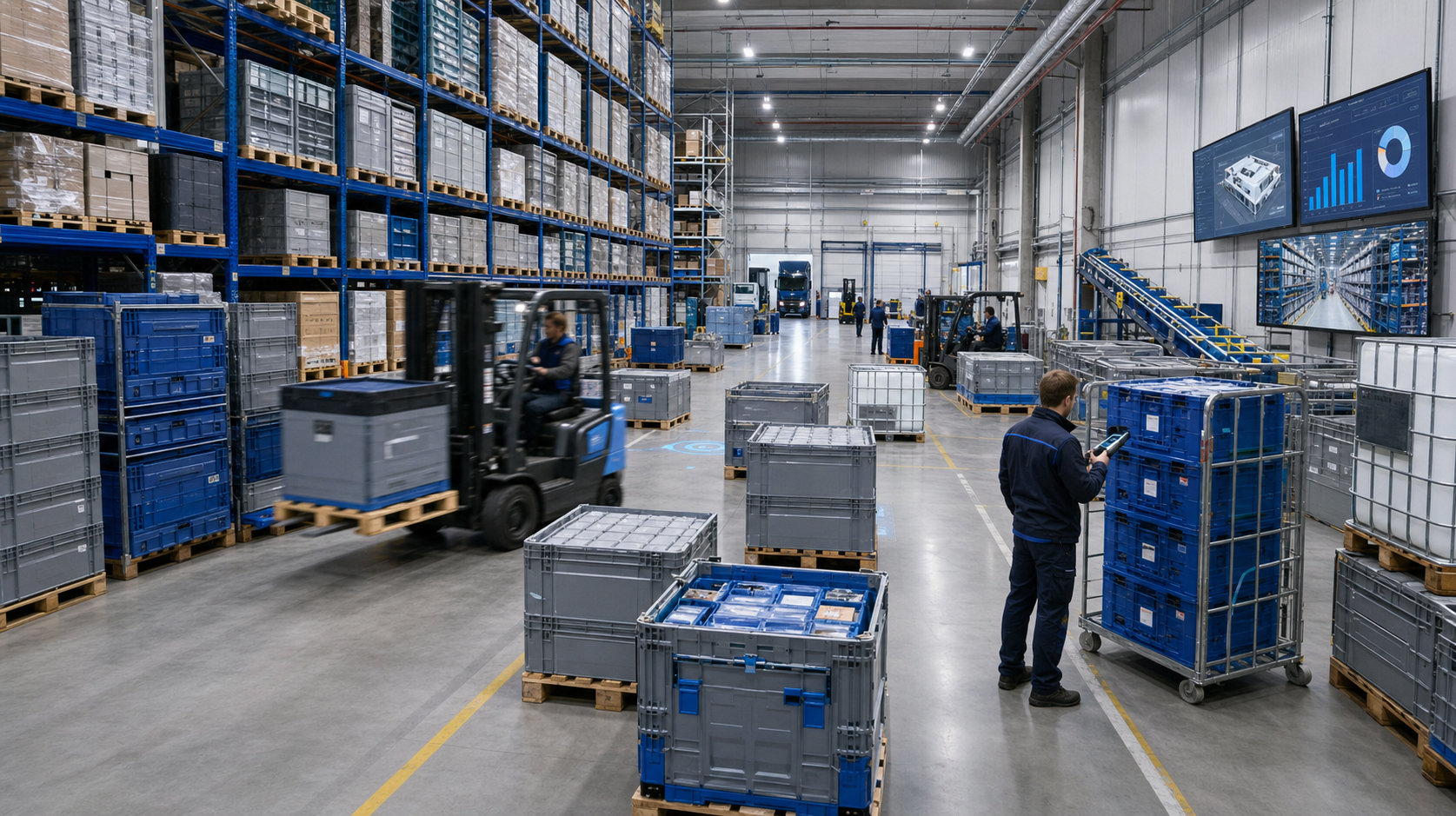
Cost explosion in intralogistics not just in 2030: Why the new EU Packaging Regulation (PPWR) will catch logistics companies off guard as early as 2026 – Creative image on the topic, with AI: Xpert.Digital
The 50 percent empty space limit: The inconspicuous PPWR law that turns every second logistics center upside down
The PPWR Trap: Why waiting is now by far the most expensive strategy for logistics companies
The EU Packaging Regulation (PPWR) is casting its shadow – and much sooner than many decision-makers in the logistics industry realize. Those who focus solely on the reuse rates for 2030 are overlooking a crucial turning point: as early as August 2026, packaging will become a strictly regulated, data-driven operating resource, both legally and economically. The shift from the familiar single-use mentality to a circular, reusable economy is not merely an ecological pipe dream, but a massive intervention in the architecture and cost structure of local and global supply chains. Whether it's the strict 50 percent empty space limit, extensive documentation requirements, or entirely new demands on intralogistics and storage space – the PPWR transforms transport packaging from a mere consumable into a rotating asset. This article analyzes in detail why the real cost explosions threaten not in the material itself, but in process complexity, how pooling is evolving into strategic infrastructure, and why simply waiting is by far the most expensive corporate strategy.
Between regulatory push and operational reality: Those who continue to view packaging solely as a matter of materials will experience the real cost explosions in warehousing and intralogistics
The PPWR will be the new binding regulatory framework for packaging in the EU internal market from 12 August 2026, fundamentally changing not only the environmental assessment of packaging, but above all the economic control logic in logistics, intralogistics and warehousing.
The real turning point is not in 2030, but in the operational start in 2026
Anyone who only associates the regulation with the reuse quotas from 2030 onwards underestimates the economically crucial lead time, because the general application of the PPWR already begins on August 12, 2026 and will force companies to provide proof of conformity, technical documentation and robust packaging governance.
This is particularly important for logistics companies because regulation here doesn't begin with quotas, but with the obligation to treat packaging as a regulated operating resource. The previous practice of managing packaging primarily through purchase price, material availability, and damage prevention is no longer sufficient, because the PPWR (Product and Production Regulations) transforms packaging into a compliance, data, and process object.
Economically, this means a shift from a linear to a circularly integrated packaging logic. Until now, transport packaging in many companies has been treated as cost-effective, interchangeable aids; in the future, it will become an asset with documentation requirements, a circular logic, return requirements, and systemic importance for warehouse and network design.
For companies with multiple warehouse locations, cross-dock structures, regional transshipment points, or close supplier relationships, this transition is critical. It's not just the target quota, but also the preparation for standardized reusable systems, material classification, allocation of responsibilities, and technical documentation that determines whether the subsequent conversion will be efficient or expensive.
PPWR is not an environmentally friendly paper, but rather an intervention in the operational economics of goods flows
Legally, the regulation covers all packaging placed on the market in the EU, regardless of material or origin. This ends the fragmented landscape of nationally determined packaging rules in favor of a directly applicable European framework, creating a uniform, but also stricter, playing field for logistics companies, retailers, manufacturers, and fulfillment providers.
This is economically relevant because packaging has traditionally been treated as a locally optimized secondary function in many supply chains. A warehouse might optimize for stackability, a purchasing department for unit price, a transport department for capacity utilization, and a sales department for availability; the PPWR (Product Packaging and Packaging Reform) forces these isolated optima into a common evaluation logic.
This increases the likelihood that previously hidden inefficiencies will become visible. As soon as packaging needs to be rotatable, documentable, traceable, and controllable within a reuse system, questions suddenly come to the fore that were often only addressed operationally in the past: What is the cycle time? Where are load carriers lost? Which locations generate the most empty transport? Which items truly require special packaging, and where could standardization be implemented?
This represents a structural turning point for intralogistics. Warehouse operations are no longer evaluated solely on the efficiency of goods movement in and out, but also on the cleanliness of packaging integrated into circular loops. Packaging return, sorting, cleaning, quality control, repairability, and inventory accuracy thus become key performance indicators.
Why transport packaging is at the heart of this change
The regulations for transport packaging and sales packaging with a transport function are particularly stringent. The regulation explicitly mentions pallets, foldable plastic boxes, boxes, trays, plastic crates, IBCs, buckets, drums and canisters, as well as certain flexible formats or pallet wrapping and strapping.
From January 1, 2030, economic operators must ensure that at least 40 percent of all transport packaging is reusable and integrated into a reuse scheme. A level of 70 percent is planned for 2040, while even stricter requirements apply to certain intra-company or national B2B flows.
The regulation is particularly comprehensive for transport between different locations of the same company, between affiliated or partner companies, and for deliveries to other economic operators within the same Member State. In these cases, the transport packaging in question must, in principle, be fully reusable and become part of a reuse system from 2030 onwards.
This is not merely a call for sustainability, but an intervention in the architecture of logistics networks. Anyone who has relied on single-use cardboard boxes, heterogeneous pallet solutions, one-off outer packaging, or non-standardized container flows will in future either have to completely restructure their packaging logic or rethink their product and location structure.
The implications for storage concepts are enormous. Single-use packaging is suitable for linear, often decoupled processes; reusable packaging, on the other hand, requires predictable returns, defined container cycles, standardized storage locations, documented inventory, and an operational separation between usable, repairable, and discarded units.
The reuse rate is only the visible tip of the problem
Many companies are currently focusing on the 40 percent quota and treating it like a mathematical target. This is too simplistic, because the quota can only be the result of a functioning system and cannot be achieved by simply procuring a few reusable containers in isolation.
The regulation requires that reusable packaging be part of a genuine reuse system. This means that reusable packaging is not simply a more robust load carrier, but rather a circulating object that can be managed across organizations, with a return logic, usage frequency, and operational control.
This is precisely where the economic challenge lies. A company can nominally purchase more reusable containers and still fail economically if cycle times are too long, loss rates too high, return transport too expensive, cleaning capacities too limited, or container standards too diverse. In such cases, capital commitment, process complexity, and service costs increase faster than the sustainability benefits.
This is where the discussion about pooling is so important. Shared pools and standardized reusable systems can increase utilization, consolidate empty container flows, and make inventory more efficient, but they only work if standardization, digital traceability, and reliable partner discipline are in place.
This transforms a packaging issue into a question of network economics. The economic advantage arises not primarily from the individual container, but from the quality of the overall system comprising circulation, data, process stability, and coordination.
Pooling is evolving from a niche topic to a strategic infrastructure
Under PPWR conditions, pooling is not merely an operational option, but for many goods flows probably the most efficient way to reconcile regulatory requirements and sound business practices. This is especially true where there are multiple warehouse locations, recurring supply relationships, standardized product groups, and high shipment frequencies.
The reason lies in the logic of pooling. Ideally, a shared pool reduces the number of company-specific packaging variants, facilitates repair and reconditioning, improves inventory planning, and lowers the need for safety reserves at each location.
In traditional warehouse management, this is a significant advantage. Standardized packaging reduces setup times, search times, sorting efforts, and the risk of incorrectly placed containers. At the same time, standardized formats often improve space utilization on shelves, pallets, and in trailers.
However, pooling is not a guaranteed success. It shifts the cost structure from one-off packaging purchases to ongoing service, circulation, and coordination. Companies must therefore not only compare unit prices but also consider the total cost of ownership: inventory, losses, repairs, downtime, cleaning costs, IT integration, handling time, and exceptional cases.
That's precisely why, in the coming years, those providers and operators who treat pooling not as a green add-on, but as a soundly modeled business infrastructure, will have the advantage. Those who fail to do so risk reacting to regulatory requirements, but in doing so, they risk building an economically inefficient shadow network of special cases, emergency purchases, and empty runs.
Intralogistics will be the real test of the regulation
In public debates, the PPWR (Product Packaging and Recycling Directive) is often discussed from the perspective of retailers, brand manufacturers, or consumer packaging companies. However, for many industrial companies and logistics providers, the greatest potential for change lies within the value chain itself, i.e., where pallets, containers, trays, KLTs, IBCs, and securing elements are moved, temporarily stored, transshipped, and returned on a daily basis.
Intralogistics is therefore crucial because it's where decisions about product rotations are made. A reusable system is only economically superior if the number of cycles is high enough and dwell times are low enough. Long downtimes, unclear ownership, delayed returns, or poor inventory transparency quickly negate this advantage.
This creates a new production objective for warehouse operators: not just throughput, but also packaging circulation. Containers are thus managed almost like production-related equipment. It is no longer sufficient to pick and load goods; it must also be ensured that the used packaging containers are returned to defined cycles.
This changes operational priorities. Goods receiving, empty container collection zones, sorting areas, container inspection, quarantine areas for damaged reusable containers, and, if necessary, cleaning or drying stations become more important. Even the routing within the warehouse can change when empty containers are not just waste, but current assets.
From an economic perspective, this is tricky because every additional handling loop generates costs. The challenge, therefore, is not to incorporate as many new sub-processes as possible, but to integrate them into the material flow in such a way that reusability is achieved without stifling throughput.
Warehousing must manage packaging as a circulating asset in the future
Traditional warehousing often strictly separates goods, load carriers, and consumables. Under PPWR (Productive Packaging and Recycling), this separation becomes less distinct because transport packaging increasingly needs to be treated as independent assets with their own availability, life cycle, and cost impact.
This primarily concerns inventory logic. Single-use packaging disappears into the waste or recycling stream after use; reusable packaging remains in the system and ties up capital. The longer the circulation period and the higher the loss rate, the larger the required pooled inventory.
This increases the demands on inventory management and transparency. Companies need significantly more precise information about how many reusable containers are located where, their condition, their turnover rate, and at which points stockpiles are accumulating. Without this transparency, duplicate purchases, inefficient safety stock, and operational bottlenecks are likely.
This leads to a new space economy for warehouse concepts. Reusable packaging requires space for empty containers, inspection, temporary storage, and returns. A warehouse designed for maximum product density without accompanying packaging returns can quickly reach its limits with the same building structure.
Especially in urban or high-capacity locations, this presents a strategic conflict of objectives. Every square meter used for empty container buffers, cleaning, or sorting is potentially unavailable for value-adding storage space. Therefore, in many cases, the PPWR (Product Packaging and Recycling Strategy) will influence not only packaging concepts but also space strategies and location decisions.
The economics of reusable packaging depend on rotations, return rates, and standardization
The core business principle of any reusable system is simple yet demanding: the higher acquisition and process costs only pay off if they are amortized over a sufficient number of uses. This is precisely why the number of rotations is so crucial.
The regulation itself states that the Commission is to establish minimum rotation numbers for frequently used reusable formats by means of a delegated act. This shows that reusability is understood not formally, but functionally: what matters is not whether a box could theoretically be used multiple times, but whether it is actually used a sufficient number of times in practice.
From an economic perspective, this means that the lower the actual turnover rate, the less effectively the investment costs are distributed across the usage units. Furthermore, cleaning, repair, sorting, and return transport become particularly significant with low turnover rates.
Research and practical experience show that standardized return models, shared systems, and improved transparency can unlock significant potential. In the use cases studied, substantial cost reductions, shorter amortization periods, and lower transport and inventory costs were achieved when return logistics and standardization were well-organized.
This leads to a key strategic insight: Reusability is not simply a matter of changing materials from an economic perspective, but rather a management challenge. Those who fail to master rotation, return discipline, and standardization will often find reusability more expensive than single-use packaging. Conversely, those who master these aspects can combine regulatory compliance with operational efficiency.
Not every exception relieves the burden on practitioners as much as it might seem at first glance
The PPWR contains several important exceptions for transport packaging. Among the items not covered by the objectives are packaging for the transport of dangerous goods, certain custom-designed packaging for large machinery, flexible packaging in direct contact with food or feed, and cardboard boxes.
For many companies, this initially sounds like a significant relief. In fact, these exemptions reduce the immediate pressure to adapt in individual segments, but they do not eliminate the structural change in logistics as a whole.
The exemption for cardboard boxes is particularly relevant because they can continue to play a dominant role in many B2B supply chains. This creates short-term flexibility, especially for companies whose transport packaging relies heavily on corrugated cardboard.
However, this relief is only relative. Firstly, other PPWR obligations remain, such as those relating to minimization, documentation, and general compliance. Secondly, cardboard is not automatically the most economically sound solution when high turnover, product protection, automation, and warehouse standardization favor reusable packaging.
The exception for pallet wrapping and strapping also requires nuanced consideration. The delegated act of February 2026 exempts these elements from the strict 100 percent requirement for internal and national B2B flows, but generally leaves them within the broader 40 percent range. This partially acknowledges operational impossibility without abandoning the system logic of the regulation.
LTW Intralogistics Solutions

LTW Intralogistics – Engineers of Flow - Image: LTW Intralogistics GmbH
LTW offers its customers not individual components, but integrated complete solutions. Consulting, planning, mechanical and electrotechnical components, control and automation technology, as well as software and service – everything is networked and precisely coordinated.
In-house production of key components is particularly advantageous. This allows for optimal control of quality, supply chains, and interfaces.
LTW stands for reliability, transparency, and collaborative partnership. Loyalty and honesty are firmly anchored in the company's philosophy – a handshake still means something here.
Related to this:
Reusable instead of disposable: How to prepare your warehouse for the new packaging regulations – Why the packaging regulations are becoming a driver of digitalization
The exception for pallet wrap solves an immediate problem, but not the strategic one
The exemption of pallet wrapping and strapping from the 100% reuse requirement was necessary for many logistics companies because practical and widely scalable reusable alternatives in this area have often been lacking. The Commission has thus acknowledged that technological and economic hurdles cannot be ignored.
Economically, this correction is significant because it reduces short-term investment pressure and operational disruptions. Companies therefore no longer need to rush into searching for insufficiently tested solutions for stretch film or strapping bands simply to meet formal 100 percent targets in internal or national flows.
At the same time, it would be a mistake to misinterpret this exception as a sign that everything is alright. The fundamental problem remains: packaging systems as a whole must continue to be developed towards reuse, standardization, and circularity. Anyone who uses this exception as an excuse for inaction is merely postponing the pressure to adapt.
In practical terms, this means that film and securing solutions should not be considered in isolation. Often, the greater potential for optimization lies in whether load units can be made more stable, standardized, and better adapted to containers, boxes, trays, or pool pallets, thus reducing the overall amount of securing material required.
This exception leads to a sobering but important insight: not every regulatory pressure needs to be met with an immediate technological response; often the smarter economic reaction is a better system design of the entire material flow.
The 50 percent empty space limit will change warehousing and packaging logic more than many quotas
In addition to the reuse targets, the requirement regarding empty space is particularly significant from an economic perspective. From January 1, 2030, at the latest, or three years after the relevant implementing act, a maximum empty space quota of 50 percent will generally apply to packaging used for collection, transport, and e-commerce.
Empty space is understood volumetrically, that is, as the difference between the internal volume of the packaging and the volume of the packaged product or the individual packaging units. Filling materials such as air cushions, paper, foam, or other cushioning materials are always included in the empty space calculation and do not help to reduce the percentage.
This has significant implications for logistics companies because many current processes are optimized for packaging robustness, simplification, and error prevention, but not for precise volumetric fit. Standard carton sets, safety margins, and generous buffers thus become more vulnerable to regulatory and economic challenges.
Especially in warehouse and fulfillment environments, the 50 percent limit necessitates a different packaging design. Instead of fewer universal shipping sizes, more graduated formats, dynamic cutting systems, or more intelligent packing algorithms become more economically viable.
The result is a familiar trade-off: More packaging variants improve fit, but increase storage complexity, setup costs, and master data maintenance. Companies must therefore balance the point at which additional carton formats or reusable containers still deliver efficiency and at which point they create operational disruption.
The obligation to minimize emissions begins as early as 2026, and this increases the pressure to act early
Although the rigid 50 percent limit only takes effect from 2030, the economically relevant pressure to adapt begins earlier. This is because the general obligation to minimize packaging is already in effect from the start of the regulation's application and makes oversized or inflated packaging solutions increasingly difficult to justify.
This is important for warehousing and intralogistics processes because many companies might opt for a late-stage conversion strategy: working with existing formats today and only making adjustments shortly before 2030. This strategy is risky because process data, technical documentation, and operational standards cannot be reliably established at the last minute.
Furthermore, the PPWR tightens the documentation requirements. From August 2026 onwards, when companies are required to document conformity, pressure will be placed on systematically justifying packaging decisions. A cardboard box will then no longer simply be "proven," but must, in case of doubt, be considered functionally appropriate, materially verifiable, and technically documented.
Economically, this benefits companies that link packaging data with WMS, ERP, and master data systems early on. Those who digitally manage volume, formats, material composition, application, and return data accurately not only reduce regulatory risk but also create the foundation for operational optimization.
The early minimization requirement is therefore more than a legal detail. It is the lever by which the regulation forces companies to reconcile packaging design and operational practice even before the quotas come into effect.
The new documentation requirement finally makes packaging a data object
A key, often underestimated element of the PPWR is the obligation for conformity assessment and the EU declaration of conformity for packaging. From August 12, 2026, every type of packaging placed on the EU market will require a corresponding declaration, supported by technical documentation according to the prescribed internal production control procedure.
The technical documentation must include, among other things, a description, area of application, design and material information, applied standards, and qualitative assessments regarding recyclability, minimization, and reusability. Extended retention periods of ten years apply to reusable packaging.
This has significant consequences for logistics companies, fulfillment providers, and industrial shippers. Many of them use packaging extensively but don't manufacture it themselves. This creates a new dependency on supplier and material data, which must be procured, checked, versioned, and made available internally in a timely manner.
In practice, this almost inevitably leads to packaging data management. Master data, bills of materials, material declarations, test reports, supplier declarations, and intended uses must be managed consistently. Packaging compliance thus becomes an interface task between purchasing, quality, legal, logistics, and IT.
Economically, this initially generates fixed costs. In the long term, however, precisely this data transparency can create efficiency gains because it reveals superfluous variants, eliminates unsuitable suppliers, and shifts packaging decisions from gut feeling to analytical foundations.
Those who don't digitally track packaging will hardly be able to manage reusable packaging economically
Reusable packaging in everyday industrial use depends not only on physical containers, but also on the quality of information. Without digital transparency regarding the location, condition, circulation, and loss rate of load carriers, even a well-intentioned reusable system can quickly lead to high safety stock levels and operational friction.
Therefore, the PPWR will indirectly drive digitalization in intralogistics and warehousing. Companies will need to invest more heavily in track-and-trace, container identification, inventory synchronization, and analytics-based control if they want to meet reusable packaging quotas economically and reliably.
This doesn't just affect large corporations. Medium-sized businesses with multiple halls, plants, or regional warehouses often suffer from informal container cycles, poorly standardized feedback, and manual exceptions. These weaknesses often remain hidden in single-use systems but quickly become costly in reusable systems.
A digitally managed packaging cycle also improves negotiating power with pool providers, customers, and suppliers. Those who know their own rotation and loss data can manage fee models, inventory levels, and service levels more objectively and are less likely to accept costs resulting from a lack of transparency.
The economic perspective is therefore clear: In the PPWR context, digitalization is neither an end in itself nor a mere image project. It is a prerequisite for preventing reusable packaging from becoming an inefficient capital commitment.
The issue of available space is underestimated in many camps
A point that is often under-discussed is the space requirement of circular packaging systems. Reusable packaging requires collection zones, buffers for empty containers, separation areas according to condition, sometimes washing or inspection processes, and often a different sequencing of material flows than single-use packaging.
This has mixed consequences for inventory and space efficiency. On the one hand, standardized, robust, and more easily stackable reusable containers can improve utilization in storage and transport. On the other hand, the space required for returns and ancillary processes increases.
The specific network configuration is therefore crucial. In high-frequency, standardized cycles with short distances, reusable packaging can improve space efficiency because it results in less chaotic packaging variety and more stable stacking patterns. In fragmented networks with many exceptions, however, the same approach can create additional space bottlenecks.
This results in a clear task for warehouse planning: empty containers should not be treated as residual flow, but as a planning-relevant component of the layout. Those who only realize after implementing a reusable packaging system that sorting, return, or quarantine areas are lacking usually have to retrofit at great expense or sacrifice throughput.
This is precisely why PPWR is also a topic for real estate and location strategy. In some cases, it is not the packaging itself, but the space restriction that becomes the actual bottleneck in the conversion process.
Costs do not increase linearly, but rather with increasing complexity
A key misconception in many debates is to assess the additional costs of PPWR compliance solely based on material prices or investment volume. In reality, the greatest economic effects often arise not directly from more expensive containers, but from added operational complexity.
Complexity manifests itself in more variants, more master data, more returns, additional checks, the need for coordination with partners, changed packaging specifications, and higher process sensitivity. These factors often only appear incompletely in traditional packaging cost calculations, but can significantly influence the actual system costs.
At the same time, the reverse is also true: standardization not only reduces material diversity but also cognitive and operational burdens. Uniform container types, clearly defined return processes, and compatible pool formats thus act as a productivity lever for the entire system.
Therefore, the best economic response to the PPWR is rarely a one-to-one replacement of individual packages. A more successful approach is usually a systemic streamlining of the packaging landscape, in which SKU structures, supplier relationships, packaging patterns, warehouses, means of transport, and IT logic are reviewed together.
Anyone who understands this recognizes the true rationality of the regulation: it rewards not merely ecological intention, but organizational maturity.
Which logistics models will face particularly high pressure?
Logistics models with numerous internal transport operations, national B2B deliveries, a high proportion of standardized load carriers, and close integration of warehouse and production sites are particularly under pressure to adapt. The stricter reuse requirements have the most direct impact in these cases.
Networks with large quantities of plastic crates, containers, trays, or IBCs are also affected, because these formats typically fall more directly within the scope of the regulations than simple cardboard solutions. Anyone currently operating without a robust return logic in this area will need to structurally upgrade their systems.
Fulfillment and distribution structures with high shipment frequencies are coming under additional pressure due to empty space limitations and minimization requirements. Setups that use a small number of standard cartons for very different order profiles are particularly problematic.
Less urgent, but by no means free from the need for action, are systems with a high proportion of cardboard or highly customized large packaging. Individual exceptions apply here, but the general documentation, minimization, and compliance obligations remain.
The decisive factor is therefore not the formal industry affiliation, but the structure of the goods flows. The more standardizable, recurring, and cross-site the logistics are, the more PPWR compliance becomes a question of a functioning reusable packaging system.
What logistics companies specifically need to change
First, companies must systematically inventory their packaging landscape. Without clear transparency regarding formats, materials, uses, ownership, locations, and return paths, neither a reliable compliance assessment nor an economically sound prioritization is possible.
Secondly, goods flows must be segmented according to regulatory logic. Transport between company sites, between affiliated companies, within a member state, and cross-border B2B flows must be analyzed separately because different requirements and priorities result from these.
Thirdly, companies should assess their reusable packaging capabilities not only in terms of format but also in terms of network. The crucial question is whether sufficient rotations, reliable returns, standardized handover points, and digital traceability are realistically achievable.
Fourthly, intralogistics requires an adapted layout. Empty container areas, inspection processes, return zones and, if necessary, cleaning or repair paths must be planned as a regular part of the material flow.
Fifthly, consistent packaging data management is necessary. Declarations of conformity, technical documentation, supplier data, material information, and internal testing processes must be auditable and quickly accessible.
Sixth, companies should evaluate pooling not ideologically, but from a business perspective. Where standardization, volume, and return rate are favorable, pooling is often the most efficient approach; where the network reality is too fragmented or unstable, hybrid models may be more suitable.
Seventh, the packaging strategy must be linked to WMS, ERP, and purchasing. Those who physically introduce reusable packaging but continue to operate digitally as with the single-use model create inconsistencies, losses, and high hidden process costs.
The economically sound perspective is neither alarmism nor waiting
A sober economic analysis leads to a more nuanced assessment. For logistics, intralogistics, and warehousing, the PPWR (Productive Production Reform) is not merely a sustainability signal, but a structural impetus with real costs, yet also with considerable potential for rationalization.
In the short term, the regulation increases complexity, documentation requirements, and in many cases, the need for investment. The transition will be particularly noticeable and sometimes painful where packaging structures have evolved historically, are poorly standardized, and lack data.
In the medium term, however, the PPWR can act as a catalyst for long overdue improvements. Standardized container cycles, better pooling, greater transparency, reduced packaging variety, and data-driven control are not only regulatory advantages but often also more cost-effective when implemented correctly.
The crucial dividing line therefore does not run between sustainable and non-sustainable companies, but between those who understand packaging as an integrated part of the supply chain architecture and those who continue to treat it as a cheap consumable.
Those who take a structured approach early on can use the PPWR (Production Planning Reform) to make warehousing and packaging processes more economically robust. Those who wait until quotas and controls exert immediate pressure will likely experience the most expensive form of adaptation: operational chaos under regulatory time pressure.
Consulting - Planning - Implementation

Konrad Wolfenstein
I would be happy to serve as your personal advisor.
You can contact me at wolfenstein∂xpert.digital or
Just call me on +49 7348 4088 965 .
Your intralogistics experts

Consulting, planning and implementation of complete solutions for high-bay warehouses and automated storage systems - Image: Xpert.Digital
More information here:










