
JD.com is attacking Amazon in Europe, relying on MediaMarkt and Saturn – JD.com combines stores, global logistics and online retail
Xpert Pre-Release

Available in 27 languages 📢
Prefer Xpert.Digital on GoogleⓘPublished on: November 17, 2026 / Updated on: November 17, 2026 – Author: Konrad Wolfenstein
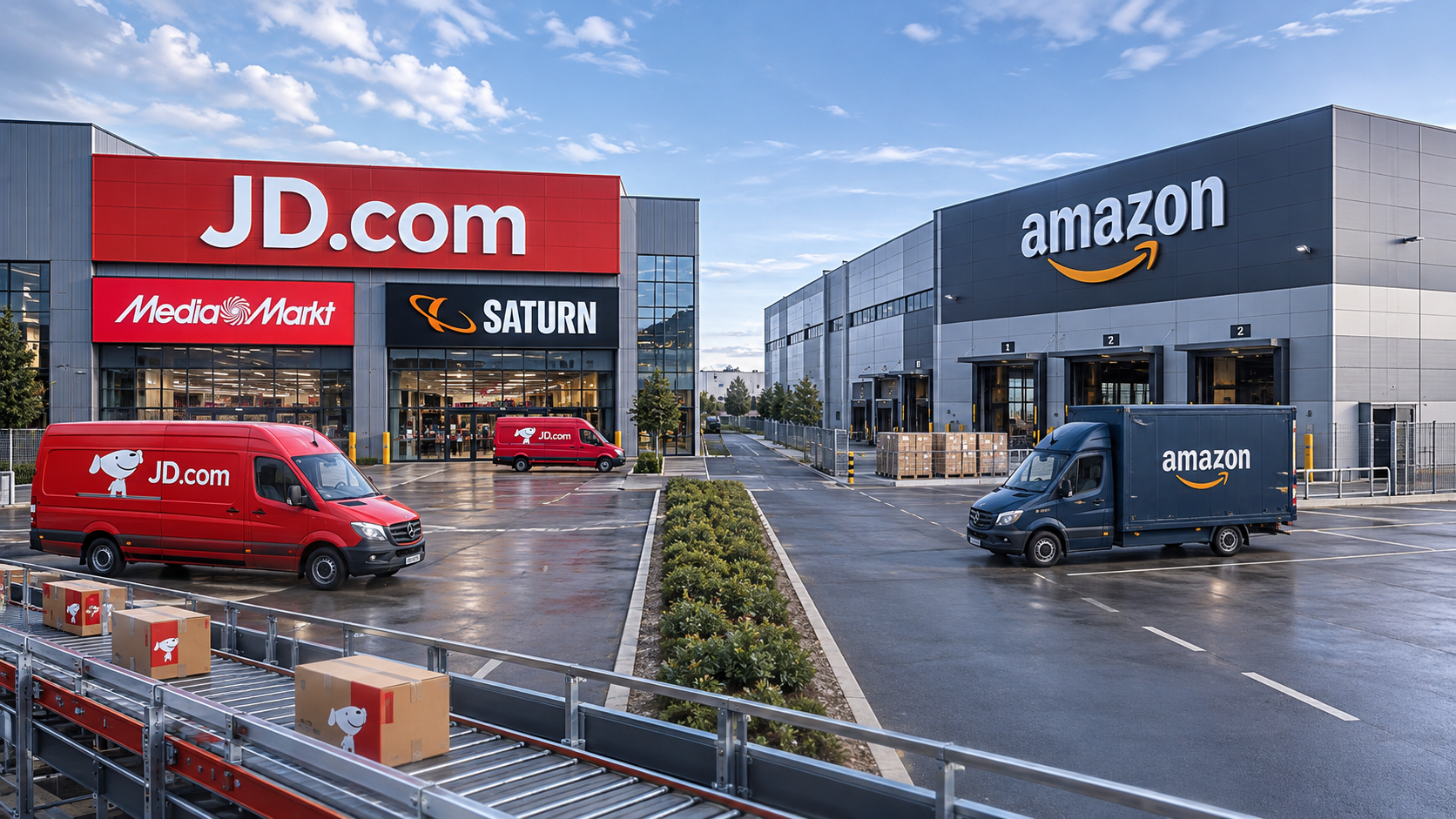
JD.com is attacking Amazon in Europe, relying on MediaMarkt and Saturn – JD.com combines stores, global logistics and online retail – Creative image on the topic, with AI: Xpert.Digital
More than just a new online shop: How JD.com is challenging Amazon's business model
Why JD.com's acquisition of Ceconomy could change European retail
JD.com is challenging Amazon in Europe – but the Chinese company isn't relying solely on lower prices or a new online store. With its control of Ceconomy, the parent company of MediaMarkt and Saturn, JD.com gains access to an established retail network with more than 1,000 stores in eleven European countries. At the same time, the company is expanding its online business, Joybuy, and extending its international logistics infrastructure.
Behind this lies a larger plan: JD.com aims to more closely integrate digital offerings, brick-and-mortar stores, inventory, and services. This could create advantages in purchasing, storage, delivery, and customer service – especially for electronics products where advice, setup, or repair are crucial. However, a large store network and powerful technology alone do not guarantee economic success. The decisive factor is whether JD.com can efficiently combine the various components and operate them profitably in the long term.
For Amazon, an integrated competitor with local brands and brick-and-mortar stores would pose a serious challenge. However, this doesn't necessarily signal an imminent shift in power: Amazon still possesses a broad ecosystem and is deeply embedded in the purchasing habits of many customers. The crucial question, therefore, is not just who delivers faster or sells more products, but who most efficiently manages the entire process from manufacturer to satisfied customer.
Related to this:

JD.com versus Amazon: Europe's retail sector is becoming the stage for a new infrastructure competition
Amazon sells convenience – JD.com buys the power behind it
The competition between JD.com and Amazon in Europe goes far beyond cheaper smartphones, faster shipping, or additional online stores. It's about economic control over a product's journey: from the manufacturer through financing, warehousing, and transport to ordering, delivery, repair, and subsequent purchase. Connecting these stages allows companies to reduce costs, deepen customer relationships, and unlock additional revenue streams. This is precisely the strategic importance of JD.com's European expansion.
With the acquisition of Ceconomy, the parent company of MediaMarkt and Saturn, the Chinese conglomerate gains established access to the European market. At the same time, it is further developing its own European online business, Joybuy, and expanding its international infrastructure. The planned logistics center in Abu Dhabi is part of this geographical expansion, even if it cannot be considered a direct supply hub for Europe.
The central economic thesis is therefore this: JD.com is not simply trying to attack Amazon with a similar online shop. The company is combining its digital market entry with the acquisition of established retail structures and the expansion of physical infrastructure. This could create a competitor that does not rely solely on the same strengths as Amazon, but instead combines brick-and-mortar customer proximity, its own inventory, international supply chains, and technology-supported services.
This is a serious attack on Amazon's individual competitive advantages. However, it doesn't necessarily mean the US company will be displaced. The crucial factor will be whether JD.com can economically integrate its various components. Size, capital, and technology create opportunities, but they don't automatically guarantee a sustainably profitable European retail alliance.
Related to this:

The decisive step has been taken: JD.com controls Ceconomy
Since November 12, 2026, the change of ownership is no longer just a plan. JD.com has acquired 59.8 percent of Ceconomy's share capital and voting rights for a total of €1.335 billion. The offer price was €4.60 per share. Together with Convergenta's 25.3 percent stake, this results in a combined ownership stake of approximately 85.2 percent. Convergenta's stake remains legally separate from JD.com's direct ownership. Since the completion of the transaction, Ceconomy has been included as a subsidiary in JD.com's consolidated financial statements.
It is also important to clarify the facts: JD.com did not acquire the largest retail chain in Europe overall. Ceconomy is a leading European electronics retailer. With MediaMarkt and Saturn, the group operates more than 1,000 stores in eleven European countries. Its strategic importance stems from this position in the electronics retail sector, not from a leading position across all retail industries.
This distinction is crucial for economic evaluation. Food retailers, fashion retailers, and consumer electronics retailers operate on different margin, logistics, and customer loyalty models. Ceconomy primarily provides JD.com with access to a market where products are relatively expensive, prices are transparent, and service is often decisive.
The acquisition thus provides more than just additional retail space. It includes established brands, qualified employees, supplier contacts, local market knowledge, existing customer relationships, and an organization for advice, returns, and services. A new online retailer would have to build these capabilities over years. JD.com significantly shortens this timeframe.
However, the company also acquires complexity in the process. Lease agreements, national labor market regulations, differing IT systems, and country-specific consumer habits don't simply disappear with a change of ownership. The strategic advantage only arises when the acquired structures become more efficient without losing their local strength.
A low revenue multiple is not necessarily proof of a bargain
The initial acquisition valuation of approximately €2.2 billion for the entire equity appears low in relation to annual sales of roughly €24 billion. It corresponds roughly to nine percent of annual sales. This comparison is a good starting point for questions, but not a sufficient measure of the attractiveness of the deal.
A trading company can move enormous quantities of goods and yet retain only a small portion of its revenue as profit. Purchasing, personnel, rent, transport, returns, IT, depreciation, and financing consume almost all of the revenue. Furthermore, equity valuation does not reflect the full economic value of the company. Financial debt, liquid assets, and lease obligations must be considered separately.
The preliminary figures for the 2025/26 financial year illustrate this dynamic. Ceconomy achieved sales of around €24 billion and adjusted earnings before interest and taxes (EBIT) of approximately €515 million. Adjusted operating profit was thus roughly 27 percent higher than the previous year's figure of €406 million. This translates to an operating margin of approximately 2.1 percent. The figures demonstrate a significant improvement, but still show a limited earnings buffer.
This results in a significant economic leverage effect. An additional operating margin of half a percentage point would, with constant revenue, theoretically mean approximately €120 million more in operating profit. The same change in the opposite direction could wipe out a considerable portion of the profit. This is a sensitivity analysis, not an earnings forecast.
For JD.com, the attractiveness therefore lies less in a supposedly sensationally low sales valuation than in potential productivity reserves. Better inventory management, fewer markdowns, more efficient transport, and more profitable services could have a significant impact. Crucially, however, these improvements will cost and require an investment of additional capital.
JD.com does not handle digital restructuring cases
The notion that a technologically superior buyer has to modernize a largely analog European retailer is too simplistic. Even before the change of control, Ceconomy had already built up a substantial online business and improved its profitability. For the 2024/25 financial year, online sales of around €5.7 billion and a reported online share of 26 percent were stated. Services and complementary solutions generated approximately €1.4 billion in revenue.
JD.com is therefore not starting from scratch. The new owner is taking over a company with its own transformation history, existing digital expertise, and ongoing development projects. This raises the bar for success: not every subsequent improvement can automatically be attributed to the acquisition.
The additional contribution compared to Ceconomy's independent development is economically relevant. If the retailer would have improved its processes, expanded its services, and increased its operating margin even without JD.com, the new owner must create further added value.
This distinction protects against a common misconception in acquisitions. Rising profits after a change of ownership do not, in themselves, prove successful integration. They can just as easily result from a stronger economy, already implemented measures, or favorable product cycles.
The true value contribution of JD.com should therefore be reflected in measurable changes: a better return on capital, lower processing costs, higher delivery reliability, or additional profitable customer relationships. Simply becoming part of a new corporate group does not automatically translate into a leap in productivity.
Joybuy and MediaMarktSaturn are opening up two different avenues of attack
The European expansion is not solely based on Ceconomy. Joybuy officially launched in the UK, Germany, France, the Netherlands, Belgium, and Luxembourg in March 2026. The platform positions itself with branded products, its own warehouses, and a fast delivery network. The so-called Double 11 model stipulates that in eligible regions, orders placed before 11:00 AM can arrive until 11:00 PM on the same day. Orders placed before 11:00 PM can be delivered the following day. These guarantees do not apply to every order across the board.
JD.com is thus pursuing two different market approaches. Joybuy enables the development of a new digital customer relationship. MediaMarkt and Saturn, on the other hand, contribute brand recognition, local presence, and established relationships of trust.
This combination can change the cost of customer acquisition. A new platform often has to buy attention at a high price. An established retailer already has customer contacts and everyday visibility. If both approaches complement each other effectively, JD.com could build reach without having to finance every additional customer relationship solely through online advertising.
However, this also creates a positioning problem. If Joybuy and MediaMarktSaturn offer the same products to the same customers, internal shifting is likely instead of additional demand. The group would then have multiple sales channels, but not necessarily more economic value.
Therefore, product range, pricing, services, and brand promises must be recognizably consistent. Complete standardization would not necessarily be beneficial. Different brands can cater to different customer expectations. The crucial point is that operational collaboration creates advantages without blurring the respective identities.
Amazon's real line of defense is the entire ecosystem
Amazon cannot be adequately described as a large online shop. The company combines its own retail operations, marketplace, logistics, advertising, subscriptions, and cloud services. These business areas differ significantly in their capital intensity and profitability.
In 2025, Amazon generated $716.9 billion in global revenue. However, this figure is not a directly comparable benchmark for the Ceconomy because it encompasses different countries and business models. A significant portion of Amazon's business consists of services that do not exist in the same form at a traditional electronics retailer.
The recent quarterly figures illustrate how significantly the revenue structure differs from pure merchandise sales. In the third quarter of 2026, Amazon achieved total operating income of $28.1 billion. Of this, $17.8 billion was attributable to AWS. The international commerce segment generated $1.6 billion in operating income on revenue of $43.1 billion. These figures describe different segments and should not be interpreted as an isolated statement about the profitability of the European electronics business.
For JD.com, this means that the competition is directed against a company with multiple revenue streams and deeply ingrained customer habits. A slightly lower price or similarly fast delivery is not enough to permanently break this position.
At the same time, Amazon's financial strength does not guarantee an unlimited willingness to drive every local competitor to losses. Even a large corporation must prioritize investments. This creates opportunities for a challenger who serves certain product groups or services more effectively from a business perspective.
The strongest point of attack lies where the parcel delivery business reaches its limits
Competition is particularly interesting for products whose purchase involves more than just delivery. A washing machine might require installation, a television assembly, and a laptop setup or data transfer. For such services, the product price isn't the only deciding factor.
Here, a branch network can offer a structural advantage. Customers can view devices, get answers to their questions, pick up products, or consult a physical contact person if problems arise. These functions are particularly valuable for expensive products or those requiring technical explanation.
However, the economic benefit depends on whether customers actually demand these services and whether they are offered at a cost-covering rate. Consulting requires personnel costs. Installation demands reliable partners, scheduling, and quality control. Poorly executed service can damage customer relationships more severely than a delayed standard package.
A viable strategy would therefore have to consider the entire usage scenario of a product. Not just the sale of the device, but also its setup, operation, maintenance, and eventual replacement become potential business opportunities.
This gives JD.com and Ceconomy a competitive edge over purely price-driven competition. At the same time, however, it forces the company to deliver high-quality service. Those who promise comprehensive service assume greater responsibility and additional cost risks.
Branches will only become logistics hubs if the math works out
A network of more than 1,000 stores can theoretically be used as decentralized infrastructure. Branches can serve as collection points, return locations, repair drop-off points, and, to a limited extent, starting points for local deliveries. This changes their economic function: they would no longer be solely retail spaces, but rather components of an integrated service network.
However, implementation is more complex than the sheer number of locations might suggest. A branch is typically not optimized for the same processes as a large distribution center. Employees have to search for, check, pack, and hand over goods. These tasks compete with customer service and sales.
Inventory accuracy is another crucial factor. If a system reports a product as available when it cannot actually be found, cancellations and additional costs result. The more branch inventory is integrated into digital delivery commitments, the more critical precise data and standardized processes become.
The most economically viable solution will therefore vary depending on the item, location, and demand. Some orders should come from central warehouses, others from regional stock, and still others should be made available for pickup.
The strategic advantage does not lie in turning every branch into a small warehouse. It lies in the ability to choose the most cost-effective and reliable processing method for each order.
Our EU and German expertise in business development, sales and marketing

Our EU and German expertise in business development, sales and marketing - Image: Xpert.Digital
Industry focus areas: B2B, digitalization (from AI to XR), mechanical engineering, logistics, renewable energies and industry
More information here:
A thematic hub offering insights and expertise:
- Knowledge platform covering global and regional economies, innovation and industry-specific trends
- A collection of analyses, insights, and background information from our key areas of focus
- A place for expertise and information on current developments in business and technology
- A hub for companies seeking information on markets, digitalization, and industry innovations
JD.com and Ceconomy: A new era in electronics retail
The underestimated profit leverage lies in the tied-up capital
In the electronics trade, the quality of inventory is crucial to success. Too little stock leads to lost sales. Too much stock ties up capital and increases the risk of price reductions. Especially with products that have short innovation cycles, the value of inventory can depreciate rapidly.
Technology-based forecasting can help identify demand differences between regions, distribution channels, and customer groups earlier. However, the impact does not come from forecasts alone, but from changed purchasing decisions, smaller stockouts, and better distribution of available goods.
A simplified model calculation illustrates the magnitude of the effect. Assuming an annual cost of goods sold of €20 billion, reducing the calculated storage period by one day would correspond to approximately €55 million less average capital tied up in inventory. This figure is not a published Ceconomy metric, but rather an illustration.
It is important to distinguish between liquidity and profit. Released inventory capital does not improve the annual operating result by the same amount. The impact on profit is primarily due to lower financing costs, reduced inventory expenses, and avoided write-offs.
For JD.com, this area could still be more important than spectacular delivery time promises. A retailer that meets the same demand with less tied-up capital and lower depreciation will be more financially resilient. This improvement can be sustainable, whereas aggressive discounting campaigns often only have a temporary effect.
Abu Dhabi expands global reach, but does not replace European logistics
In parallel with its European expansion, JINGDONG Property, together with the KEZAD Group, is planning a logistics facility of approximately 150,000 square meters in Abu Dhabi. The site is located in KEZAD Area A, specifically KEZAD Al Ma'mourah. Completion is scheduled for 2028. Upon commissioning, approximately 1,000 direct jobs are expected. The plans include automated warehouse systems, digital operational processes, and flexibly adaptable spaces.
Responsibilities within the group must remain clear. JINGDONG Property is the infrastructure investment and asset management division. It is not to be equated with European online retail or all operational logistics services. The project is aimed at various companies and is not described as an exclusive warehouse for MediaMarkt, Saturn, or Joybuy.
The geographical interpretation also requires caution. The presence of a location in Abu Dhabi does not automatically mean that European trade flows will be routed through the United Arab Emirates in the future. An additional transshipment point can increase costs and transit times if it offers no tangible benefit.
The strategic importance lies rather in expanding the international scope of action. Regional warehousing, distribution, inventory consolidation and services can open up additional markets and deepen cooperation with manufacturers.
Abu Dhabi is therefore a building block of a broader infrastructure strategy. Its contribution to the competition with Amazon in Europe is initially indirect: it can expand the international capabilities and customer base of the JD Group. However, a firmly established European supply role would be an unfounded exaggeration.
Square meters create opportunities, occupancy generates profit
The planned 150,000 square meters correspond to 15 hectares. However, this does not allow for a reliable calculation of annual goods turnover or a specific profitability. Building height, technical equipment, product profile, and process design are just as important as actual customer demand.
According to the underlying company information, JINGDONG Property has a global portfolio of more than 300 infrastructure assets with over 28 million square meters of gross floor area and more than US$16 billion in assets under management. These figures describe the international platform, not the investment amount in Abu Dhabi.
Essential data for a reliable investment calculation are missing for this individual project. This includes the specific investment volume, financing terms, rents, contractually secured users, and ongoing operating costs. Therefore, a precise return forecast would not be reliable.
The announced job creation figures also do not allow for a complete productivity assessment. Theoretically, this equates to approximately 150 square meters per direct workstation. However, without information on shift patterns, full-time equivalents, and throughput, this ratio is hardly meaningful.
For Abu Dhabi, the key factor is the added value generated. If maintenance, transport, IT, and other services are provided locally, the economic benefits increase. Conversely, if the facility remains primarily an isolated warehouse, the positive impact on the location is more limited.
Infrastructure creates economies of scale and new fixed cost risks
The convergence of trade and logistics can trigger a self-reinforcing process. More orders increase capacity utilization. Better capacity utilization can reduce the cost per unit processed. Lower costs enable more attractive prices or improved services, which in turn generate additional demand.
This connection explains why a European trading network and international infrastructure can be a strategic fit. A company's own trading business can generate baseline capacity utilization. External customers can contribute additional volumes and diversify risks.
However, the process also works in the other direction. If volumes fall short of expectations, high fixed costs are spread across too few orders. Automation, buildings, and IT incur costs regardless of whether a warehouse is fully utilized.
Therefore, not every additional facility is a competitive advantage. Infrastructure must be located in the right place, match the product profile, and have sufficient demand. A large network with low utilization can be less economically viable than a smaller network with well-coordinated processes.
For JD.com, the real challenge lies in synchronization. Customer acquisition, capacity building, and technical integration must be perfectly aligned in terms of timing. Expanding too early ties up capital. Expanding too late limits growth and service quality.
Europe's regulations do not limit competition, but rather certain transfers of advantages
The European Commission approved the merger on November 3, 2026, subject to conditions under the regulation on subsidies from third countries. The focus was on potential distortions of competition caused by state-subsidized financing and by logistical and technological capabilities developed with Chinese support.
The commitments are valid for ten years. Intra-group transactions between JD.com and Ceconomy, including financing, must be conducted at market rates. Furthermore, external companies will be required to provide warehousing, logistics, and technology services under the same conditions as Ceconomy. An independent trustee will oversee implementation under the supervision of the Commission.
This structure is economically significant. It does not prevent Ceconomy from becoming more efficient. It is intended to prevent state-sponsored advantages from distorting European competition through artificially cheap intra-group services.
This also puts the thesis of an unlimitedly subsidized attack into perspective. JD.com cannot assume that it is allowed to use all conceivable financing advantages or transfer prices without restriction.
Practical control remains challenging. Market conditions are more difficult to determine for complex software than for a standardized product. Not only price, but also scope of services, reliability, contract duration, and technical connectivity options influence the economic value.
If implementation succeeds, other traders could also benefit from efficient infrastructure. If it fails, new dependencies or inequalities that are difficult to detect could arise. The quality of supervision thus becomes a factor influencing market structure.
Customer data combines economic benefits with institutional risk
Data can improve demand forecasts, expedite service processes, and make customer offers more relevant. However, its value is not solely derived from its quantity. Crucial factors are quality, permissible use, and its connection to genuinely improved decisions.
For Ceconomy, a separate European technical architecture and safeguards for personal customer data were described as key components of the transaction. The German approval was also linked to control and security requirements.
This creates a conflict of objectives. Greater technical integration can enable efficiency gains. At the same time, extensive data linkage increases the requirements for access rights, purpose limitation, and control.
Neither a blanket all-clear nor the automatic equation of a Chinese owner with illicit data leaks would be appropriate. What matters are verifiable structures: Who can access which information, where is it processed, and what technical limitations exist?
This question is also relevant for external vendors. Anyone using the logistics or technology of a company that is also affiliated with a competitor must be able to protect their business information. Trust in such boundaries is not a secondary matter, but a prerequisite for a successful service business.
Manufacturers and retailers are entering into a new system of dependencies
For manufacturers, a more efficient European distribution partner can be attractive. Better availability, reliable services, and a wider reach facilitate sales. An internationally networked trading partner can also support the launch of new products.
At the same time, the retailer's negotiating power may increase. Those who have access to many customers, sales areas, data, and logistics services can exert greater influence on terms and marketing.
Manufacturers therefore face a dual challenge. They want to leverage their reach, but must not become entirely dependent on a single sales system. Maintaining their own distribution channels and several high-performing partners remains economically valuable.
For smaller retailers, productivity pressures are intensifying. They will rarely be able to consistently outperform a large, integrated supplier by offering the same standard products and prices. Opportunities lie more in specialization, consulting, regional proximity, or particularly reliable services.
Access to external infrastructure can be helpful. However, it should be linked to clear data rights, transparent costs, and realistic switching options. Outsourced processes are only advantageous if they do not create an economically insurmountable tie.
Employment and sustainability require more than blanket promises
Ceconomy reportedly had around 50,000 employees worldwide and nearly 20,000 in Germany. Agreements regarding the change of ownership include commitments concerning employees, brands, and locations. However, this does not guarantee that all activities and work processes will remain unchanged.
Digital inventory management and automation can reduce routine tasks. At the same time, they create new demands in technology, repair, data analysis, and omnichannel customer service. Whether this leads to better jobs depends on further training, work organization, and employee participation.
The environmental impact assessment is similarly nuanced. Better capacity utilization and fewer stockouts can save resources. Very fast deliveries, on the other hand, can trigger additional journeys. A branch network can facilitate returns, but it also incurs energy and space costs.
For Abu Dhabi, energy consumption, cooling, maintenance, and technical lifespan must also be considered. Specific sustainability impacts cannot be quantified without reliable operational data.
The most meaningful metric is therefore not the individual advertising claim, but the overall impact: energy and material input per fulfilled customer need, product lifespan, repairability, and actual transport performance. Economic and ecological efficiency can coincide, but they don't have to.
Three development paths illustrate the scope of the competition
In a favorable scenario, JD.com combines its technological capabilities with Ceconomy's local strength. Inventories are managed more precisely, services are offered more reliably, and investments generate a reasonable return. Joybuy gains additional customers without significantly shifting existing sales within the group. Amazon then faces a more serious competitor with a distinct performance profile.
In the medium term, individual processes improve, while integration efforts, price pressure, and rising costs erode a large portion of the benefits. Ceconomy remains competitive, Joybuy grows in selected regions, and the market becomes more fiercely contested. A fundamental shift in power does not occur.
In a worst-case scenario, technical and organizational differences are underestimated. Parallel systems increase costs, brand positioning overlaps, and infrastructure grows faster than demand. Market share might then temporarily increase through discounts, but without creating a sustainable revenue model.
These scenarios are not predictions. They illustrate that success does not depend solely on Amazon's actions. A significant portion is determined within the JD.com group of companies: through capital discipline, accountability, integration, and operational execution.
The decisive factor is the return on investment of the overall system
The most meaningful key performance indicators in the coming years will not be solely revenue and market share. Crucial factors will include free cash flow after necessary investments, capital tied up in inventory, and the return on the additional capital employed.
In addition, operational factors such as delivery reliability, return costs, complaint handling, and repeat purchase rates must be considered. Short delivery times are only an improvement if they are not achieved at a permanently uneconomical cost. A large customer base is only valuable if it leads to strong and profitable relationships.
For branches, their entire function within the network is what counts. A single location can provide consulting, service, returns, and local logistics. These contributions must be economically justifiable, rather than simply treated as an advantage of a large footprint.
For Abu Dhabi, occupancy rates, the quality of the user base, and local value creation are crucial. Construction completion in 2028 would be a milestone, but not yet proof of economic stability.
Compliance with European regulations is also part of the model's performance. A business model whose advantages only exist under special conditions that are difficult to verify would be less robust than one that is viable under transparent market conditions.
Europe's opportunity lies in the competition between high-performing systems
JD.com's expansion is neither merely a discount campaign nor proof of an impending power shift. It is a strategically sound attempt to more closely integrate digital commerce, brick-and-mortar market access, and international infrastructure.
The acquisition of Ceconomy gives the group a position that could not be achieved in the short term simply by setting up an online shop. Joybuy complements this access with its own digital customer relationship management. Abu Dhabi expands the global infrastructure perspective, although it cannot yet be considered a fixed link between Chinese production and European stores.
Amazon remains a competitor with considerable structural strengths: a broad ecosystem, well-established processes, and deep roots in the purchasing habits of many customers. JD.com's most promising path, therefore, likely lies not in a complete copy, but in a compelling combination of local presence, product expertise, service, and efficient inventory management.
The best development for Europe is not simply to replace one dominant supplier with another. What would be valuable is competition that increases productivity, offers consumers genuine alternatives, and also allows manufacturers and smaller retailers room to maneuver.
The real question of power, therefore, is not which logo is on the package. It is which company can manage the entire process from manufacturer to long-term customer satisfaction with the least economic effort and the highest reliable performance. This is precisely where it will be decided whether JD.com merely challenges Amazon in Europe or permanently takes market share.
🎯🎯🎯 Data-driven B2B industry hub as a quasi-in-house solution

The quasi-in-house solution: How Xpert.Digital closes operational gaps in B2B marketing and sales – Smart Content-Driven Business - Image: Xpert.Digital
Xpert.Digital is a data-driven B2B industry hub led by Konrad Wolfenstein . The company acts as an external, quasi-in-house solution for industrial partners, closing operational gaps in marketing, content, and sales – without requiring additional resources on the client side.
More information here:
Your global marketing and business development partner
☑️ Our business language is English or German
☑️ NEW: Correspondence in your native language!

Konrad Wolfenstein
I and my team are happy to be available to you as your personal advisor.
You can contact me by filling out the contact form here [email protected]:or simply call me at +49 7348 4088 965. My email address is
I'm looking forward to our joint project.