
Intersolar Europe 2026: The solar industry is booming – but the golden years of easy growth are over
Xpert Pre-Release

Available in 27 languages 📢
Prefer Xpert.Digital on GoogleⓘPublished on: June 23, 2026 / Updated on: June 23, 2026 – Author: Konrad Wolfenstein
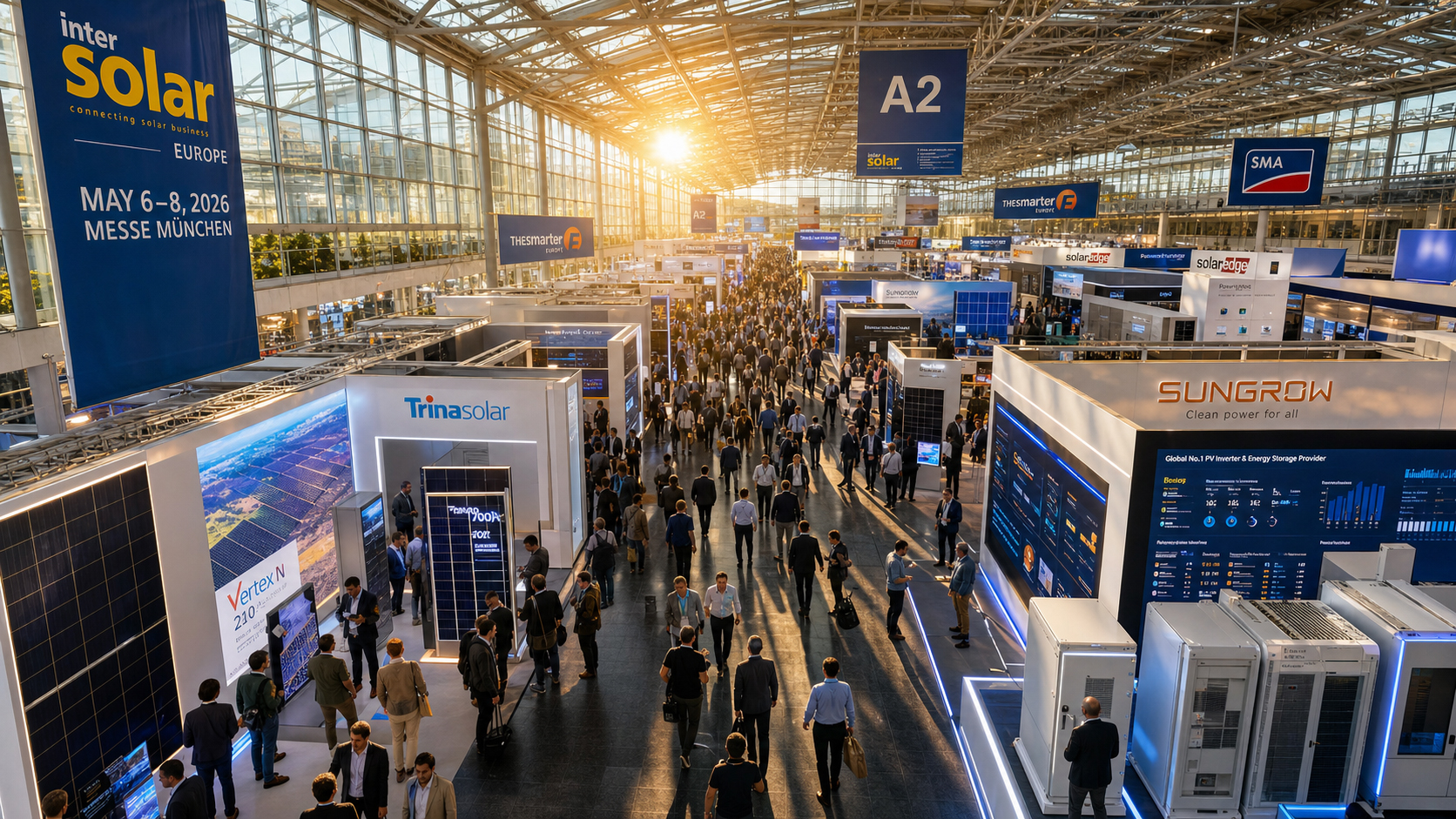
Intersolar Europe 2026: The solar industry is booming – but the golden years of easy growth are over – Creative image: Xpert.Digital
Historic turning point: How solar and wind power are dethroning coal worldwide
World's leading trade fair marked by a major structural shift: Home systems are faltering, large-scale storage is booming – The new reality of the solar world
The global solar industry stands at a historic crossroads. When Intersolar Europe opens its doors in Munich from June 23 to 25, 2026, it will showcase a sector undergoing a transition from a rapid, almost effortless ascent to a complex, mature industry. The days when cheap modules from the Far East and generous subsidies guaranteed automatic growth are definitively over. Instead, new rules of the game now define the market: Gigantic large-scale storage systems are replacing traditional residential installations as growth drivers, new geopolitical tensions stemming from US tariffs are disrupting supply chains, and a surprising shift in Chinese export policy could make solar modules and balcony power plants more expensive for end consumers for the first time in years. Yet, despite these structural disruptions and grid bottlenecks, one fact remains undeniable: Renewable energies are displacing fossil fuels at an unprecedented pace, finally dethroning coal and gas. The following text highlights the gigantic dimensions of this change and shows why the reassessment of the solar market represents an unexpected strategic opportunity, especially for the European location.
Intersolar Europe 2026: What the world's leading trade fair reveals about the future of our electricity
Intersolar Europe 2026 will open its doors from June 23 to 25 at the Munich Trade Fair Center – precisely at the moment when the global solar industry is undergoing one of the most profound transformations in its history. What appears on the surface to be another year of celebration reveals itself upon closer inspection as a complex reassessment: between record capacities and overproduction, between geopolitical disruption and regulatory realignments, between a collapsing residential segment and an exploding large-scale storage market. The world's leading trade fair for the solar industry will, for the first time in 2026, operate on a new Tuesday-to-Thursday schedule – a small detail that symbolically represents the restructuring the entire industry is currently undergoing.
The trade fair in numbers: A global industry gathering
Intersolar Europe is organizationally embedded in the event alliance "The smarter E Europe," which positions itself as Europe's largest trade fair platform for the entire energy industry. Under this umbrella, Intersolar, along with ees Europe (energy storage), Power2Drive Europe (electromobility and charging technology), and EM-Power Europe (energy management), are gathered in Munich. Together, this quartet occupies an exhibition area of 200,000 square meters, with Intersolar Europe alone occupying approximately 101,000 square meters. Around 1,300 exhibitors are expected at Intersolar alone, while the combined total of the four trade fairs will feature approximately 2,800 exhibitors from around the world.
Visitor expectations for the entire event exceed 100,000 trade visitors, thus reinforcing its position as the undisputed global industry meeting place. For comparison, the 2025 event attracted 107,000 visitors from 157 countries to 2,737 exhibitors from 57 nations. The accompanying conference, the Intersolar Europe Conference, along with its sister events, is expected to draw around 2,600 participants and will address the most pressing issues: market development, financing models, large-scale PV systems, agri-PV, and the integration of renewable energies into existing grid infrastructures. Bavaria, through its Bavarian Ministry of Economic Affairs, explicitly supports the trade fair as a strategic industry platform.
The thematic focus of Intersolar Europe 2026 is unmistakably on three complexes: Firstly, system integration through large-scale storage and PV hybrid systems; secondly, the emerging market of India as a new growth pole; and thirdly, the question of how solar power can remain profitable in an increasingly volatile electricity market.
Global environment: Record construction meets structural upheavals
The global data for solar energy is simply breathtaking. In 2025, an estimated 698 gigawatts of new photovoltaic (PV) capacity were installed worldwide – a significant jump compared to the approximately 600 gigawatts of the previous year. The International Renewable Energy Agency (IRENA) puts the addition of PV capacity alone at 511 gigawatts, bringing the cumulative installed PV capacity worldwide to over 2.4 terawatts. Solar and wind power combined reached a total capacity of around 4,174 gigawatts by the end of 2025, following a record 814 gigawatts added in the previous year.
Particularly noteworthy is the historic milestone projected by the International Energy Agency (IEA) for 2025 or 2026: Renewable energies will replace coal as the world's largest source of electricity. In April 2026, wind and solar power plants will generate more electricity worldwide than gas-fired power plants for the first time in a single month – solar and wind together accounted for 22 percent of global electricity generation, while gas accounted for 20 percent. Global electricity generation from wind and solar is expected to grow by an estimated 13 percent year-on-year.
Behind these impressive installation figures, however, lies a more nuanced growth dynamic. SolarPower Europe anticipates a temporary slowdown in global PV installation growth for 2026. The main reason lies in profound changes in the Chinese solar market: China dominates global expansion with at least 350 gigawatts and potentially up to 415 gigawatts in 2025 alone, but at the same time sits on enormous overcapacities that have driven the global market price for modules to historic lows. The five largest Chinese solar companies reported losses of more than eight billion yuan – roughly one billion euros – in 2025. Double-digit growth rates are expected again from 2027 onwards, and a cumulative global capacity of around 7 terawatts could be reached by 2030.
The China Paradox: Both Engine and Disruptive Factor
No other topic occupies the global solar industry as intensely as the role of China. The country is simultaneously the industry's largest market, largest producer, largest investor, and greatest geopolitical risk – a structural ambivalence that will be openly discussed at Intersolar Europe 2026.
China's overproduction strategy has systematically driven down solar panel prices for years. At the beginning of 2022, a watt of module power in China cost around 27 cents; by 2023, the price had fallen to 24 cents and continued its downward trend – experts report historic lows of just ten cents per watt. This oversupply is based on generous government subsidies and reflects China's strategic ambition to achieve a dominant market position in renewable energies. Many Chinese manufacturers have even accepted orders with negative margins to secure their market share.
Now China itself is embarking on a regulatory course correction: As of April 1, 2026, Beijing will abolish the existing VAT export discounts on solar modules. Experts expect this to lead to a price increase of around ten percent for a standard module. A balcony solar power system that previously cost 600 euros is likely to cost closer to 660 euros in the future. Paradoxically, this Chinese self-regulation acts as a market-correcting measure that European and American policymakers had been pushing for for years. The era of falling module prices is thus over, at least for now.
Nearly a third of all global investments in renewable energy originate in China, highlighting the systemic dependence of the world market on Chinese capital and production decisions. The IEA forecasts global energy investments of US$3.4 trillion for 2026, of which around US$365 billion is earmarked for solar energy alone.
US trade policy: Tariffs as a disruptive factor in the global market
The US government's trade offensive under President Donald Trump represents one of the most severe external shocks to the global solar industry. The US has imposed additional tariffs of up to 3,521 percent on solar panels from Southeast Asia – specifically Cambodia, Malaysia, Thailand, and Vietnam. The reason: A year-long trade investigation revealed that solar manufacturers in these countries unfairly benefited from government subsidies and offered their exports at prices below production costs.
The tariff structure is complex and directly reflects geopolitical tensions: Solar wafers, cells, and modules from China are subject to a 50 percent tariff under Section 301, plus a retaliatory tariff of an additional 34 percent. For Cambodia, the rate is as high as 3,521 percent nationwide, for Vietnam up to 395.9 percent, for Thailand 375.2 percent, and for Malaysia 34.4 percent. As a result, prices for Tier 1 solar modules in the US have already risen by approximately 19 percent, and Roth Capital forecasts a rapid increase in project costs of $0.10 to $0.15 per watt.
In parallel, Republicans have fundamentally reduced government subsidies for wind and solar energy with their new tax law. The investment incentives from the Biden era, introduced under the Inflation Reduction Act, are thus largely being phased out. This sends a double-edged signal to the European solar industry: On the one hand, Chinese modules, displaced by tariffs and subsidy cuts, could increasingly flood the European market; on the other hand, the US abandonment of solar subsidies opens up new opportunities for European manufacturers in global competition, provided Europe maintains its industrial policy course.
Europe: Historic turning point in the electricity mix
The European energy landscape will undergo a historic structural transformation in 2026, with societal and economic implications extending far beyond Intersolar Europe. In 2025, solar and wind energy combined exceeded 30 percent of the EU's electricity mix for the first time, overtaking fossil fuels, which fell to 29 percent. In 14 of the 27 EU member states, wind and solar generated more electricity than fossil fuels in 2025. Overall, renewable energies supplied almost half – around 48 percent – of the EU's electricity last year.
Solar energy grew by more than 20 percent for the fourth consecutive year, with total generation reaching 369 terawatt-hours in the EU. In the first quarter of 2026 alone, solar energy saved Europe around €67.5 billion in natural gas imports. Photovoltaics in Germany saw a 15 percent increase in production in the first quarter of 2026 compared to the same period of the previous year, rising from 63.6 to 73.2 gigawatt-hours. The share of renewable energies in the German electricity mix increased to 53.4 percent. The European PV market is undergoing a fundamental structural transformation: large-scale utility-scale installations now account for over 50 percent of new installations for the first time, while the residential segment is declining significantly.
This development has direct consequences for the electricity market: In Germany, the cumulative duration of negative electricity prices reached 468 hours in 2024 – an increase of 38 percent compared to the previous year. Negative prices occur when more electricity is fed into the grid than can be consumed. They undermine traditional business models based solely on generation and simultaneously force a transition to storage and flexibility solutions. Europe is thus faced with the challenge of shaping the growth of renewable energies not primarily through increased generation, but through smarter system integration.
Germany continues to lead the European rankings in annual PV installations, followed by Spain, France, Italy, and Poland. The European Net-Zero Industry Act (NZIA) aims to ensure that at least 40 percent of the EU's annual demand for strategic technologies—including solar modules, batteries, and heat pumps—is produced on the continent. This secondary legislation entered into force at the end of 2025 and must be implemented from 2026 onward, which de facto means that at least 30 percent of EU renewable energy tenders must be awarded based on non-price criteria such as sustainability and resilience.
New: Patent from the USA – install solar parks up to 30% cheaper and 40% faster and easier – with explanatory videos!

New: Patent from the USA – Install solar parks up to 30% cheaper and 40% faster and easier – with explanatory videos! - Image: Xpert.Digital
The core of this technological advancement is the deliberate departure from conventional clamp mounting, which has been the standard for decades. The new, more time- and cost-effective mounting system addresses this with a fundamentally different, more intelligent concept. Instead of clamping the modules at specific points, they are inserted into a continuous, specially shaped support rail and held securely in place. This design ensures that all forces – whether static loads from snow or dynamic loads from wind – are distributed evenly across the entire length of the module frame.
More information here:
Storage boom instead of home systems: What opportunities and risks are emerging now?
Germany: Structural change in the domestic market, boom in large-scale storage systems
The German solar market is undergoing a painful but necessary restructuring process in 2026. At the end of 2025, approximately 117 gigawatts of PV capacity were installed in Germany – meaning that more than half of the 215-gigawatt target for 2030 has already been achieved. This target envisions annual additions of up to 22 gigawatts from 2026 onwards, while the actual addition in the first quarter of 2026, at around 3.5 gigawatts, was six percent lower than in the same quarter of the previous year.
Behind this moderate overall decline lies a pronounced segmentation. Residential systems under 30 kilowatts peak (kWp) added only 850 megawatts in the first quarter of 2026 – a decrease of 21 percent. Commercial rooftop systems even collapsed by around a third. The market is currently being driven solely by the segment of large-scale ground-mounted systems above one megawatt, which grew by 20 percent to 1.97 gigawatts peak. BSW-Solar cites the Solar Peak Act, in effect since February 2025, and the planned reductions in subsidies for rooftop systems from 2027 onwards as structural impediments.
At the same time, the energy storage market is exploding. In the first quarter of 2026, more than two gigawatt-hours of new storage capacity were added – 67 percent more than in the same period of the previous year. The real driver is large-scale storage: its installation increased by 270 percent to over one gigawatt-hour, meaning that for the first time, large-scale and residential storage systems saw equal quarterly additions. LFP (lithium iron phosphate) cells now hold over 95 percent of the market share for stationary residential storage systems. This structural change is economically logical: falling battery costs, greater fluctuations in electricity prices, and new market roles are creating revenue potential. Storage systems can charge at low or negative prices and feed power into the grid at higher prices, in addition to revenue from system services such as balancing power.
Germany's newly established Climate and Transformation Fund (KTF), with a volume of €100 billion, is intended to finance investments in storage and system integration. The BDEW Progress Monitor 2026 emphasizes that the expansion of dispatchable capacities, the integration of storage facilities, and the ramp-up of the hydrogen economy are crucial for the security of supply of the energy system while increasing flexibility. Grid integration remains the absolute bottleneck of Germany's energy transition: lengthy approval processes and a lack of grid capacity are hindering even technologically advanced projects.
In 2026, existing customers in Germany are expected to pay around 31.2 cents per kilowatt-hour for electricity – 12.2 percent less than in the previous year. This means that the expansion of renewable energies is becoming increasingly noticeable in household electricity bills, which should strengthen political acceptance of the energy transition in the medium term.
Intersolar as a seismograph: What the trade fair reveals about the state of the industry
A leading global trade fair is more than just a commercial sales event – it's a seismograph for the state of an industry. The thematic focus of Intersolar Europe 2026 reveals much about the tectonic shifts currently taking place.
Large-scale storage systems and PV-battery storage hybrid systems are explicitly the focus. This focus signals that the industry has understood that simply increasing capacity is no longer a sufficient answer to the demands of an increasingly complex electricity system. Only the combination of photovoltaics and battery storage (BESS) secures supply, relieves pressure on the grid, and protects plant operators from costly curtailment. Hybrid systems link generation, storage, and grid integration directly on-site – making them a critical success factor for the next growth phase of the solar market.
A second thematic focus is India as a growth market. In 2025, India achieved a solar installation capacity of 37.5 gigawatts – an increase of 50 percent compared to the previous year. Further expansion to 45 to 50 gigawatts is expected for 2026. India aims to install a total of 500 gigawatts of renewable energy capacity by 2030, of which 280 gigawatts will be photovoltaics. Since 2010, the cost of solar power in India has fallen by more than 80 percent. At the same time, India is increasingly developing into a production hub for photovoltaic components – driven by government programs promoting local manufacturing. For European companies pursuing a diversification strategy in China, India is therefore a key market.
Thirdly, the question of new financing models is shaping the debates at Intersolar. While regulatory instruments such as Contracts for Difference (CfDs) are reshaping the support framework, the industry is responding with market-based solutions such as PV hybrid power plants and hybrid Power Purchase Agreements (PPAs). According to forecasts by European energy research institutes, the European energy storage market is poised to exceed the 200-gigawatt-hour mark by 2030. This growth is driven by two forces: the increasing recognition by national governments of the strategic value of storage and the growing maturity of market mechanisms.
Investment landscape: Trillions are flowing, but not evenly
The financial flows toward solar energy in 2026 are historically unprecedented. The IEA estimates global energy investments for 2026 at US$3.4 trillion. Of this, around US$2.2 trillion is earmarked for clean energy – from solar and wind power to storage solutions. This means twice as much money is flowing into green technologies as into fossil fuels. Around US$365 billion will be invested in solar energy alone, and spending on battery storage will exceed US$100 billion for the first time. At the same time, investments in oil and gas are declining by 6 percent.
The global solar power market is estimated at US$726 billion for 2026 and is projected to grow to US$1.711 trillion by 2035, with an annual growth rate of 10 percent. According to a study by ISC Konstanz and Fraunhofer ISE, commissioned by the VDMA, the market volume for PV manufacturing equipment is expected to increase from US$16.6 billion in 2025 to US$43.8 billion in 2035 – a cumulative market volume of US$250 to 300 billion in ten years.
However, these figures reflect a structural imbalance. Almost a third of all global investments in renewable energy originate in China, highlighting the asymmetric concentration of capital. At the same time, the IEA warns that the more than US$400 billion earmarked for transmission lines and transformers in 2026 will not be sufficient to adapt the grid to the increasing load of renewable energy generation. Investment gaps in grid infrastructure are considered the greatest systemic risk to the further acceleration of the energy transition – including, and especially, in Germany.
Structural change as an opportunity: The recalibration of the solar industry
It would be analytically inaccurate to interpret the current disruptions in the solar market as a mere crisis. Rather, the industry is undergoing a maturation process that will strengthen its long-term economic resilience. The phase of almost automatic growth—driven by subsidies, learning curve effects, and cheap Chinese modules—is over. What follows is a market that rewards capital and system intelligence and weeds out those focused solely on quantity.
The shift from the residential to the utility-scale sector is not a setback, but rather an expression of market maturity. Large-scale systems are more efficient, more professionally planned, and better integrated into grid structures. At the same time, the boom in large-scale storage is forcing the industry to gain a deeper understanding of system operation and market mechanisms. The storage rate for new PV systems in Germany is projected to be over 105 percent in March 2026 – meaning that, statistically, more than one storage system is installed for every new PV system. This is not just a technological trend, but an economic signal: The value of solar power is increasingly measured by when and how reliably it can be supplied.
This presents a strategic opportunity for the European solar industry. The Net-Zero Industry Act opens up tenders to non-price criteria, thereby strengthening European manufacturers who focus on quality and resilience – and not solely on the lowest price. The major drawback remains the grid infrastructure: as long as permitting processes take years and local grid operators act as bottlenecks, the full potential of storage and hybrid systems will remain untapped. This is where the crucial political challenge lies – not only in Germany, but across Europe.
Renewable energies: Momentum despite headwinds
The overarching question – whether renewable energies are continuing their global advance – can be answered unequivocally in the affirmative, despite all the complexities. No other chapter in global energy history exhibits a similar dynamic. Wind and solar energy will be the leading energy sources in the EU for the first time in 2025. In more than half of the EU member states, generation from renewable sources exceeds that from fossil fuels. The share of fossil fuels in the EU electricity mix fell by a full 37 percent between 2020 and 2025.
Globally, wind and solar power surpassed gas generation for the first time in a single month in April 2026, and renewable energies as a whole are expected to overtake coal as the world's largest source of electricity in 2025 or 2026. The cumulative total capacity of all renewable energies increased by 692 gigawatts in 2025 to a total of 5,149 gigawatts. The new installations in 2025 can generate around 1,046 terawatt-hours of electricity annually – enough to power all of Germany for about two years.
The headwinds from Trump's trade policies, Chinese price increases, and grid bottlenecks are at best slowing the growth rate in certain segments and regions, but are not reversing the underlying trend. Economic logic favors renewables: solar energy is now the cheapest new investment in electricity generation capacity in almost every part of the world. Since 2010, the cost of solar power in India has fallen by over 80 percent, and similar cost developments have boosted the expansion of solar and wind power in emerging markets in Africa, Southeast Asia, and Latin America. The energy transition is no longer an ideological project—it is simply the economically rational course of action.
Intersolar Europe 2026 is therefore not taking place in times of triumph, but neither in times of crisis. It is taking place in times of transition: from the growth phase to the efficiency phase, from dependence on subsidies to market maturity, from pure capacity logic to system integration. Those who understand and shape this shift will be among the winners of the next decade. The trade fair in Munich is the right place – and the right time – for this.
🎯🎯🎯 Data-driven B2B industry hub as a quasi-in-house solution

The quasi-in-house solution: How Xpert.Digital closes operational gaps in B2B marketing and sales – Smart Content-Driven Business - Image: Xpert.Digital
Xpert.Digital is a data-driven B2B industry hub led by Konrad Wolfenstein . The company acts as an external, quasi-in-house solution for industrial partners, closing operational gaps in marketing, content, and sales – without requiring additional resources on the client side.
More information here:
Your global marketing and business development partner
☑️ Our business language is English or German
☑️ NEW: Correspondence in your native language!

Konrad Wolfenstein
I and my team are happy to be available to you as your personal advisor.
You can contact me by filling out the contact form here [email protected]:or simply call me at +49 7348 4088 965. My email address is
I'm looking forward to our joint project.







