
Red alert: The Iran war exposes the West's biggest arms disaster – interceptor missiles exhausted
Xpert Pre-Release

Available in 27 languages 📢
Prefer Xpert.Digital on GoogleⓘPublished on: March 4, 2026 / Updated on: March 4, 2026 – Author: Konrad Wolfenstein
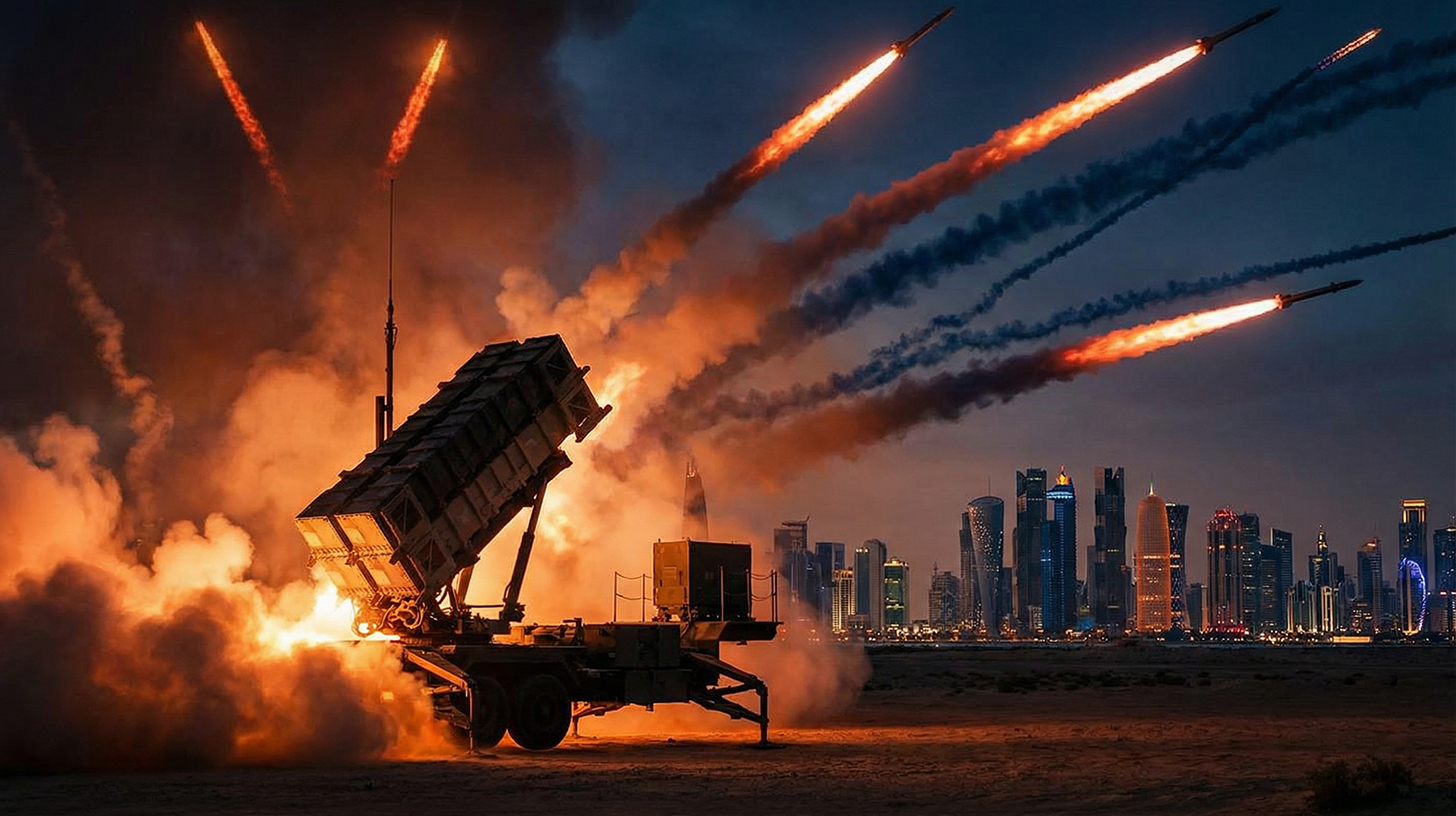
Red alert: The Iran war exposes the West's biggest arms disaster – interceptor missiles exhausted – Image: Xpert.Digital
After only 4 days of war: This fatal weakness puts the US alliance in a difficult position
$15 million per shot: The dangerous miscalculation of Western armaments and the collapse of the US protective shield in the drone swarm
The open war that escalated in 2026 between the US, Israel, and Iran revealed a chilling truth: Western, state-of-the-art air defenses were on the verge of collapse. While Tehran strategically bombarded the Arab Gulf states with masses of inexpensive drones and missiles, the allies were firing interceptor missiles worth an entire year's production within a matter of days. Each THAAD missile fired cost $15 million—an asymmetric cost ratio that not only pushed the Middle East to the brink of disaster but also plunged Washington into a grave strategic dilemma. The rapid depletion of ammunition exposed decades of Western arms policy as an illusion and served as a painful wake-up call for Europe. Is the global security architecture facing its greatest stress test because, quite simply, its magazines are empty?
Four days of war were enough to expose decades of Western arms policy as an illusion
Since February 28, 2026, the United States and Israel have been at open war with Iran. What US President Donald Trump announced as a targeted operation to destroy Iran's missile and military capabilities has escalated within days into a regional conflict whose dimensions far exceed its initial scope. Tehran's retaliation is not only targeting Israel, but also, with hundreds of missiles and drones, the Arab Gulf states, including Kuwait, Qatar, Bahrain, Saudi Arabia, and the United Arab Emirates. And with each passing day of attacks, a weakness becomes apparent that fundamentally undermines the strategic calculations of the Western alliance: the defenders are running out of interceptor missiles.
Four days that laid bare decades
The figures are sobering. During the twelve-day war between Israel and Iran in June 2025 alone, the US fired approximately 150 THAAD interceptor missiles, representing a quarter of its entire stockpile of these high-performance missiles. Each THAAD missile costs around $15 million and is manufactured by Lockheed Martin. However, the production rate is nowhere near keeping pace with consumption: only eleven new THAAD missiles were produced last year, and only twelve more are expected this fiscal year. This means that the US consumed more than a decade's worth of production in a single, short conflict.
Tom Karako, an expert on missile defense systems at the Center for Strategic and International Studies, put it bluntly: The Israelis and their allies must act with all due haste and do everything that needs to be done, because they cannot afford to sit idly by. Kelly Grieco, a senior researcher at the Stimson Center, summed up the core problem: The interceptor missiles are being used up faster than they can be produced.
The Gulf States in a Dilemma
For the Gulf states, the conflict is an existential test. As hosts of tens of thousands of US troops and several strategically important military bases, including the Al-Udeid Air Base in Qatar, the Ali Al-Salem Air Base in Kuwait, and the Al-Dhafra Air Base in the United Arab Emirates, their geographical proximity to Iran makes them easy targets for Tehran's retaliatory attacks. Now, Iran is not only attacking US military bases but is also targeting embassies, hotels, airports, and residential and industrial areas.
Bloomberg reported that at the current rate of Iranian attacks, Qatar's stockpile of interceptor missiles would be depleted in just four days. While Qatar and the UAE dismissed the report as false, expert assessments support the claim. Although the UAE has maintained an interception rate of over 90 percent, its THAAD and Patriot interceptor missiles are expensive and take years to manufacture. The UAE has now used up a significant portion of an interceptor missile stockpile that took years to build up.
Washington's stance is particularly worrying. At least one Gulf state that came under Iranian fire has requested additional supplies from American officials, but has been turned down. Another Gulf state responded to US inquiries about the use of its air bases by asking about the US commitment to its air defense systems, but received no satisfactory answer. A former US official familiar with the discussions within the administration clarified: Whatever ammunition has been produced in recent months, stockpiles worth several years' worth of production have been expended in the last few days.
The asymmetric cost problem
Iran's strategy systematically aims to exhaust Western missile defenses. According to Iranian analysts close to security circles, the Revolutionary Guard is pursuing a multi-phase strategy. First, they target US radar systems stationed in the Gulf states; then, they launch inexpensive drones and missiles to deplete air defenses. Only after this phase would more advanced weapons be deployed.
This asymmetric cost ratio is a fundamental problem. While a THAAD interceptor missile costs $15 million and a PAC-3 MSE missile around $5 million, the Iranians use Shahed drones and simple missiles that cost only a fraction of that. The cost of Iran's attacks on the Gulf states was estimated at up to €360 million, while defense cost many times that amount. Typical military doctrine calls for firing two or three interceptor missiles at each incoming target to maximize the probability of a hit. With hundreds of targets, the consumption adds up exponentially.
According to an analysis by the Chatham House think tank, the Iranian leadership has little incentive to exercise restraint in a fight for survival and to limit the conflict geographically. With counterattacks extending far beyond Israel, Tehran is likely primarily trying to drive up the costs of the war and, through the US-allied Gulf states, exert pressure on Washington to end the attacks.
Hub for Security and Defense - Advice and Information

Hub for Security and Defense - Image: Xpert.Digital
The Security and Defence Hub offers expert advice and up-to-date information to effectively support companies and organizations in strengthening their role in European security and defence policy. Working closely with the SME Connect Defence Working Group, it particularly promotes small and medium-sized enterprises (SMEs) that wish to further develop their innovative capacity and competitiveness in the defence sector. As a central point of contact, the Hub thus creates a crucial bridge between SMEs and European defence strategy.
Related to this:
The missile shock: Why the arsenals are suddenly empty
America's strategic dilemma
The United States faces a fundamental strategic dilemma. The THAAD systems are not only intended for the Middle East, but also form a crucial part of the deterrent system against other rivals such as China. Every THAAD missile launched in the Middle East is potentially unavailable in a future scenario in the Taiwan Strait or on the Korean Peninsula. The US possesses a total of seven THAAD systems, two of which were deployed in Israel in June 2025.
The Pentagon attempted to allay concerns. Spokesman Kingsley Wilson declared that the US military was stronger than ever and possessed everything necessary to carry out any mission, anywhere, at any time. However, this rhetoric stands in stark contrast to the facts. While US Defense Secretary Pete Hegseth emphasized that this was not an endless war, and that the US pursued three clear objectives—destroying the missile threat, destroying the navy, and preventing nuclear weapons—it remained unclear whether ground troops would be deployed to achieve these goals.
Europe's unexpected role
In this situation of acute shortage, Europe, of all places, is emerging as a potential supplier of interceptor missiles. France has already declared its willingness to support the Gulf states in their defense, with Foreign Minister Jean-Noël Barrot explicitly naming Saudi Arabia, the United Arab Emirates, Qatar, Iraq, Bahrain, Kuwait, Oman, and Jordan. The Franco-Italian SAMP/T system, along with the American Patriot, is one of the two main systems on which European air defense relies.
But Europe's own situation is far from comfortable. Due to years of neglect, European countries lack sufficient quantities of interceptor missiles and production capacity to keep pace with the expected missile arsenal of an adversary like Russia. The European Sky Shield Initiative (ESSI), which now has 21 member nations, is taking shape. Germany's Arrow-3 procurement is intended to provide the exo-atmospheric layer, and Diehl Defence is increasing production of its IRIS-T SLM missiles to 400 to 500 units per year starting in 2025. MBDA reported a 33 percent increase in air defense missile production in 2024, with a planned doubling of that figure by 2025.
The production offensive
The realization that Western arsenals are not designed for a protracted conflict has triggered an industrial catch-up effort. Lockheed Martin has reached an agreement with the US Department of Defense to rapidly accelerate the production and delivery of its PAC-3 MSE interceptor missiles over a seven-year period. Annual production capacity will more than triple, from approximately 600 to 2,000 units. The ordered systems will then be delivered to the armed forces of the US, its allies, and partners.
But even this drastic increase takes time. A complete Patriot system costs over a billion dollars, and it typically takes around three years from order placement to delivery. The respected Center for Strategic and International Studies criticizes the fact that US industry has been unable to adapt its supply chains to the high demand for major weapons systems like Patriot. At the same time, the US government has temporarily halted exports of Patriot systems, as the Pentagon considers them scarce and intends to reserve them primarily for domestic use.
One bright spot is the Israeli Iron Beam system, a high-energy laser with a range of up to ten kilometers, which entered service in December 2025. Laser systems could solve the asymmetric cost problem in the long term, since each shot costs only a fraction of a conventional interceptor missile. However, until laser weapons are available in sufficient numbers and performance, missile defense will remain dependent on conventional munitions.
A wake-up call for Western security architecture
The missile shortage in the 2026 Iran war is far more than a logistical problem. It reveals a systemic failure of Western arms planning, which for decades was based on the assumption that small numbers of high-tech precision weapons would suffice to deter potential adversaries. This assumption has proven to be an illusion.
The Gulf states are caught in a dilemma: As US allies, they are targets of Iranian attacks, but they can neither produce enough weapons themselves nor expect rapid resupplies. They don't want a major war on their own soil, but they can hardly afford to intercept attacks for weeks without retaliating. The question of which side can outlast the other is sobering, as former Israeli naval commander Eyal Pinko observed: Many more attacks are coming. Iran possesses thousands of missiles and drones and vast stockpiles, and it will do everything to maintain its regime.
For Europe, the crisis represents a painful reality check. The defense industry, neglected for many years, is now being ramped up at breakneck speed, but the lead times for complex weapons systems cannot be shortened indefinitely. Since the beginning of 2025, Germany has been protecting the Rzeszów-Jasionka logistics hub in southeastern Poland—the lifeline of Western support for Ukraine—with two Patriot batteries. Many Patriot systems in Europe are outdated and cannot fire current PAC-3 MSE guided missiles. Their predecessors, the PAC-3 CRI, have not been manufactured since 2020, so there is no supply.
The lesson of the Iran war in 2026 is clear: In a world of saturation attacks with inexpensive drones and missiles, the highly precise but low-volume Western arms production is insufficient. Europe needs significantly larger, redundant production lines for interceptor missiles, radar modules, and key components. The best algorithm is of little use if the missile container is empty. The question of whether Western democracies will muster the political will and industrial capacity to close this gap before an adversary exploits it is one of the most pressing security policy questions of our time.
Consulting - Planning - Implementation

Markus Becker
I would be happy to serve as your personal advisor.
Head of Business Development
Chairman SME Connect Defense Working Group
Consulting - Planning - Implementation
Konrad Wolfenstein
I would be happy to serve as your personal advisor.
contact me at wolfenstein ∂ xpert.digital
Just call me on +49 7348 4088 965 (Munich) .





