
World Power in Layers: The Decisive Industrial and Economic Clusters of the Present
Xpert Pre-Release

Available in 27 languages 📢
Prefer Xpert.Digital on GoogleⓘPublished on: April 2, 2026 / Updated on: April 2, 2026 – Author: Konrad Wolfenstein
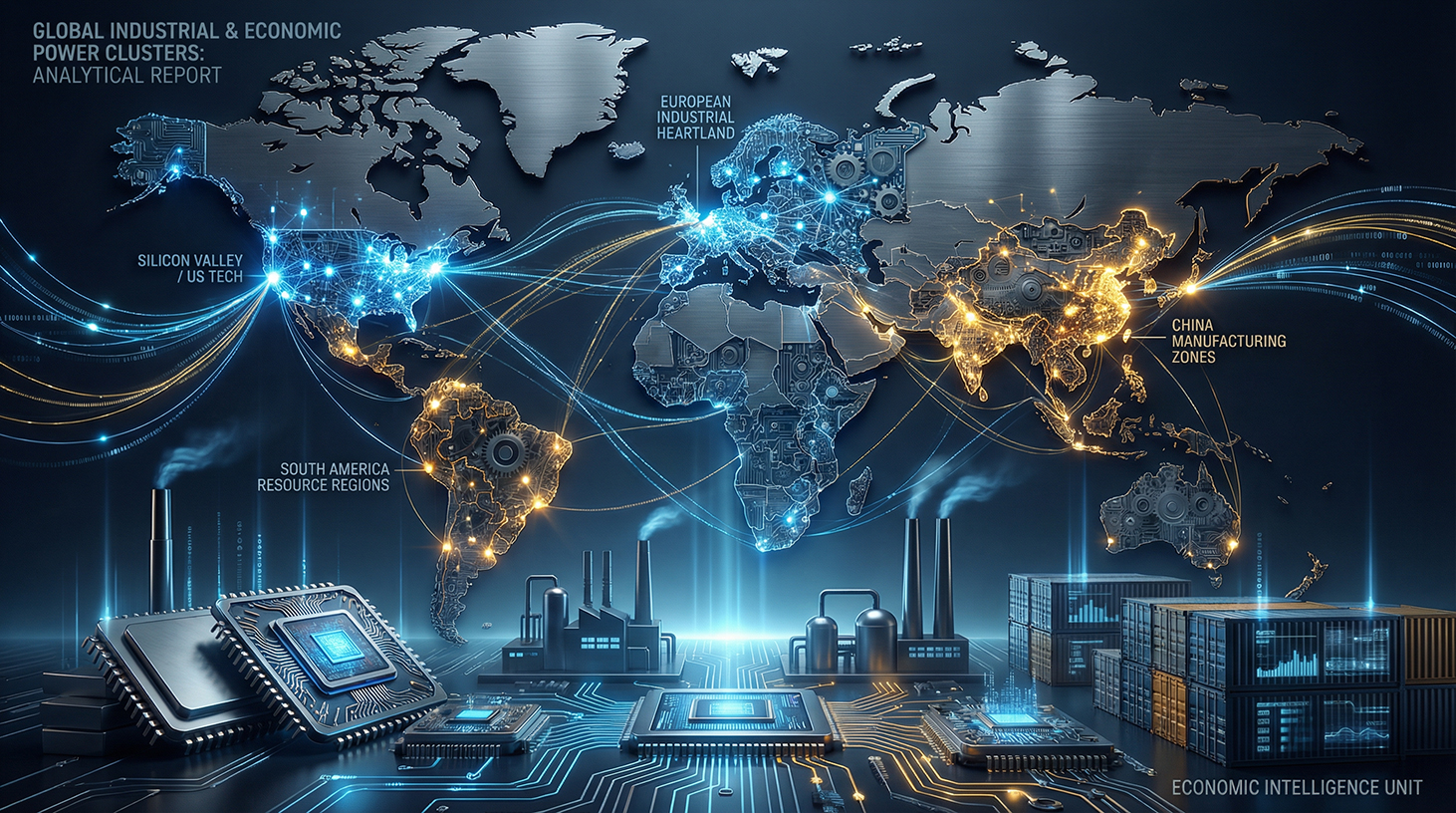
Global power in layers: The key industrial and economic clusters of today – Image: Xpert.Digital
The end of free trade? These new power centers will dominate tomorrow's global economy
The new geography of power: How industrial clusters dictate tomorrow's world order
We are currently witnessing a tectonic shift in global power dynamics – and it cannot be measured solely by national gross domestic products or political summits. The true currency of geopolitical and economic dominance in the 21st century is clusters: geographically densely populated mega-centers where capital, cutting-edge research, infrastructure, and industry merge into unique ecosystems. Whether it's the unprecedented AI boom in Silicon Valley, the rapid return of semiconductor manufacturing to the American Rust Belt, China's ruthless efficiency in the Pearl River Delta, or South America's strategic wealth of raw materials – in these epicenters, it will be decided who sets the pace of the global economy in the coming decades.
At the same time, a closer look at these clusters reveals deep cracks in the old system: the decades-long consensus of global free trade is crumbling. It is being replaced by protectionism, friendshoring, and a ruthless race for technological sovereignty and critical raw materials. While the US is pumping billions into reindustrialization and China continues to export its high technology despite a historic deflationary spiral, Europe—with Germany at the epicenter of a worrying downturn—stands at a historic crossroads. The following analysis takes a sober, data-driven look at the 18 key economic arenas of our time. It shows where trillions of dollars in value will be created by 2040, what geopolitical Achilles' heels the respective regions possess, and why mere access to resources is now worthless without the corresponding value chain.
Whoever controls the clusters controls the future – a sober look at the global power centers of the economy
Why clusters determine economic hegemony
The global economy of the early 21st century no longer operates according to the principle of evenly distributed industrial production. It is concentrated in clusters – geographically dense ecosystems of companies, research institutions, investors, and specialized infrastructure that mutually reinforce each other. This concentration is not a historical accident, but the result of targeted industrial policy, natural economies of scale, knowledge transfer, and institutional frameworks. Analyzing these clusters reveals the power dynamics of the global economy more directly than any GDP statistic.
In a comprehensive study, the McKinsey Global Institute identified 18 so-called "arenas" that could generate between 29 and 48 trillion US dollars in revenue by 2040 – including e-commerce, electric vehicles, digital advertising, semiconductors, batteries, biotechnology, and artificial intelligence. These arenas are not emerging in a vacuum, but almost without exception in dense geographic clusters: in the technology hubs of the USA, in China's coastal regions, in Northern Europe's industrial corridors, and in the emerging resource zones of South America. This document systematically analyzes these clusters – with the aim of clearly identifying their strengths, weaknesses, geopolitical vulnerabilities, and economic trajectories.
United States: Between AI euphoria and structural reindustrialization
From Silicon Valley to the AI capital of the world
Silicon Valley, located in Santa Clara County southeast of San Francisco, remains the world's most cited economic cluster—yet a sober assessment is warranted. The region's gross domestic product is projected at $840 billion, roughly 2.7 percent of the national GDP. The region is home to 19 Fortune Global 500 companies and 1.72 million jobs, nearly a third of which are in the software sector. In 2024, a record 23,622 patents were granted in the region. Simultaneously, approximately 57 percent of all US venture capital flowed into Silicon Valley in 2024—with $15.2 billion invested in young companies in the first quarter of 2025 alone.
This concentration, however, also carries structural risks. The Milken Institute downgraded San Jose to 108th out of 200 major metropolitan areas in 2025 – down from its former 44th place. This decline reflects the migration of workers to more remote-friendly, lower-cost metropolitan areas, a direct consequence of its own past success. Silicon Valley's real strength today lies less in its physical concentration than in the global ecosystem it has cultivated over decades: Stanford and UC Berkeley as research hubs, an unparalleled network of venture capitalists, and a corporate culture that embraces failure as a learning opportunity. The AI boom, in particular, is giving the region new momentum: tech companies are investing around $300 billion annually in expanding their AI infrastructure, which economists say accounts for roughly half of current economic growth.
Arizona and Ohio: The new semiconductor belt
One of the most strategically significant industrial policy decisions in recent US history is the CHIPS and Science Act—a $52.7 billion program to bring semiconductor manufacturing back to American soil. The results are beginning to materialize. TSMC is receiving up to $6.6 billion in direct funding for three new fab plants in Phoenix, Arizona, with a total investment exceeding $65 billion. This investment is creating approximately 6,000 direct manufacturing jobs and more than 20,000 construction jobs this decade alone. Intel, for its part, received $8.5 billion for manufacturing facilities in Chandler, Arizona, and New Albany, Ohio, making Arizona one of the world's leading locations for microchip design, testing, and manufacturing.
What makes this development so special is its geopolitical dimension: For the first time in decades, the most advanced semiconductors – the “brains” of the next generation of AI – are being produced on American soil. The transition from political ambition to industrial reality marks a fundamental shift in the global semiconductor supply chain system and profoundly alters geopolitical dependencies. The vulnerability exposed by the COVID-19 pandemic and its resulting chip shortages has found its industrial policy response here.
Boston: The global center of life sciences
The Greater Boston Area has established itself as a world-leading biotech and pharmacology cluster, boasting a concentration of top universities (MIT, Harvard, Tufts), venture capital, and clinical infrastructure that is unparalleled globally. Biotech employment in Massachusetts alone grew from approximately 46,000 in 2006 to over 106,000 in 2022. Massachusetts companies accounted for more than 16 percent of the total U.S. drug pipeline and approximately 6.4 percent of the global pipeline in 2025. Particularly noteworthy is the nearly 14 percent growth in the biopharmaceutical pipeline in Massachusetts in 2025 – compared to the national average of just 6.8 percent. Leading companies such as Biogen, Vertex Pharmaceuticals, Moderna, Alnylam, and Takeda are headquartered here, driving innovation in areas ranging from gene therapy to mRNA technology.
Houston: Energy Cluster in Transition
Houston remains the undisputed energy capital of the US, employing nearly 200,000 people in the sector—more than in New York and Los Angeles combined. However, the sector is undergoing a profound transformation. Renewable energy saw a 20.7 percent increase in employment in 2024; the solar sector alone grew by 45.4 percent. HETI member companies have invested over $95 billion in low-emission technologies since 2017, reducing their Scope 1 emissions by 20 percent. Simultaneously, a “Data City” is emerging around Houston, with a planned 5 gigawatts of data center capacity by 2030—an example of the convergence of energy and digital infrastructure. The Texas energy sector anticipates load growth of around 5 percent annually until at least 2030, driven by AI data centers and industrial electrification.
The Rust Belt: Between nostalgia and new substance
The industrial regions of the Midwest—Ohio, Michigan, Pennsylvania, and Indiana—have endured decades of deindustrialization pressure. However, the combination of geopolitical reshoring pressure, the Inflation Reduction Act (IRA), and the CHIPS Act has triggered a remarkable wave of reindustrialization: Manufacturing output nearly quadrupled between 2020 and 2024 and now accounts for 10 percent of all U.S. construction. Factories worth $500 billion are in the pipeline in the electric vehicle, solar equipment, and semiconductor sectors alone. The crucial unknown remains the future shape of trade policy under President Donald Trump: Should the IRA be significantly curtailed, many of these investments could lose their economic viability.
Europe: Between industrial erosion and structural renewal
The German dilemma: Deindustrialization as a warning for the continent
Germany, long the undisputed industrial heart of Europe, is in the midst of a structural crisis of historic proportions. In 2024, economic output shrank by 0.2 percent – making Germany the only major EU country to experience negative growth. An industry report forecasts a further decline in production of 2 percent for 2025. BDI President Peter Leibinger spoke openly of an economic location "in free fall" and diagnosed four years of declining production coupled with growing reluctance to invest. The causes are structural: excessively high energy costs resulting from Russia's war of aggression against Ukraine, stagnant labor productivity due to demographic change, high wage costs, and a delayed digital transformation compared to its competitors.
Nevertheless, the Ruhr region – once the industrial backbone of Germany – holds the potential for transformation. Seven municipalities, including Dortmund, Bochum, and Essen, are already considered digital pioneers in the region. Their self-imposed goal is: "Transformation into the greenest industrial region in the world." The Rhenish mining region is facing an unprecedented physical transformation, for which around €15 billion in structural funds are available until 2038, invested in the future-oriented fields of energy, resources, innovation, and infrastructure. Whether these funds will be sufficient and whether the political structures will react quickly enough is the crucial open question.
Poland: Eastern Europe's new growth center
While Western European industrial giants are faltering, Poland has become the most dynamic large economy in the EU. GDP grew by around three percent in 2024 and is projected to rise to between 3.3 and 3.5 percent in 2025. Since joining the EU in 2004, average annual growth has been almost four percent – real GDP has doubled. Poland achieved G20 status for the first time in 2025. Trade with Germany exceeds €171 billion and continues to grow – Poland is expected to soon overtake France as Germany's fourth-largest trading partner.
Poland's strengths lie in its young, well-educated workforce, moderate labor costs, a geostrategically advantageous location between Western Europe and the Baltic markets, and substantial EU cohesion funds that flow into infrastructure and education. The downside: Poland's growth is not decoupled from the German economy. In July 2025, the Polish industrial PMI stood at only 45.9 points, driven by plummeting orders from Germany. This close correlation makes Poland structurally vulnerable to fluctuations in the German industrial cycle – a risk that is easily underestimated in the current growth euphoria.
Northern Italy and Milan: Digital Renaissance of a traditional industrial location
Milan is one of the biggest surprise centers of the European economy in recent years. The Lombard metropolis, traditionally known for fashion, mechanical engineering, and financial services, has transformed itself into one of Europe's most important digital hubs. By early 2025, 70 percent of all Italian data centers were located in the greater Milan area, with a capacity increase of 34 percent in 2024 alone. Microsoft is investing a colossal €4.3 billion in hyperscale cloud data centers and AI capabilities in the region between 2025 and 2026. Amazon Web Services plans to invest around €1.2 billion in several data centers in and around Milan by 2029. Milan's unemployment rate is 4.2 percent, well below the Italian average of 7.8 percent.
The European competition problem: What the Draghi report says
The Draghi report on the future of European competitiveness, published in September 2024, is a wake-up call. Key findings: The EU lags behind the US by around 34 percent in per capita income at purchasing power parity and invests only half as much in research and development. Europe risks falling behind in key technologies such as artificial intelligence and quantum computing. High energy prices, complex bureaucracy, and a fragmented internal market structure are hindering the innovation efforts of high-growth companies.
Draghi recommends three strategic reform blocks: first, a new European industrial strategy with active sectoral policies instead of general horizontal policies; second, the completion of the single market by removing cross-border barriers; and third, a massive shift of research spending to the EU level to achieve economies of scale. The report explicitly states: “In critical areas, the EU must act less like a confederation and more like a federal state.” The new European Commission has made competitiveness a central agenda item, but the gap between political ambition and the speed of institutional implementation remains—as is so often the case in the EU—a chronic problem.
Our global industry and economic expertise in business development, sales and marketing

Our global industry and economic expertise in business development, sales and marketing - Image: Xpert.Digital
Industry focus areas: B2B, digitalization (from AI to XR), mechanical engineering, logistics, renewable energies and industry
More information here:
A thematic hub offering insights and expertise:
- Knowledge platform covering global and regional economies, innovation and industry-specific trends
- A collection of analyses, insights, and background information from our key areas of focus
- A place for expertise and information on current developments in business and technology
- A hub for companies seeking information on markets, digitalization, and industry innovations
Five power lines by 2030: AI, raw materials and the geopolitical division of the industrial landscape
China: Industrial dominance between deflationary spiral and technological rise
Technological sovereignty as a national goal: China's Five-Year Plan and its consequences for global investors
The paradox of strength: growth despite structural pressures
China presents a fascinating paradox to the global economy: despite an ongoing trade conflict with the US, a simmering real estate crisis, and structural deflation, industrial production in the first half of 2025 saw overall year-on-year growth of 5.1 percent, while high-tech production even increased by over 8 percent. GDP growth in the second quarter of 2025 was around 5 percent, once again exceeding analysts' expectations. At the same time, China is experiencing its longest period of sustained industrial deflation since the 1990s. This phenomenon—referred to in China as "involution"—describes a ruinous price competition in which systemically built-up overcapacities erode margins both domestically and internationally.
Pearl River Delta and the Greater Bay Area: China's industrial heart
The Pearl River Delta in Guangdong Province—comprising the cities of Guangzhou, Shenzhen, Dongguan, and Foshan, as well as the special administrative regions of Hong Kong and Macao—forms the Greater Bay Area (GBA). This megalopolis spans 56,000 square kilometers and is home to 71.2 million people. The combined GDP of the GBA exceeded 14.5 trillion RMB in 2024—well over 10 percent of China's total GDP. Shenzhen alone has become a global leader in electronics manufacturing and technological innovation. Over 70 percent of China's leading electronics suppliers are based in this region. Companies like Huawei, ZTE, DJI, and Tencent are headquartered here, transforming the region into what many experts call Asia's emerging Silicon Valley.
The Great British Amazon (GBA) is conceived as an integrated economic area aiming for global leadership by 2035. It combines mainland China's manufacturing strength with Hong Kong's financial and legal services and Macau's gaming and tourism sectors to create an economic ecosystem without global parallel. For foreign investors, Shanghai and Shenzhen offer digitalization and financial hubs, while Chengdu and Xi'an provide lower costs and emerging industrial clusters.
Yangtze River Delta: China's High-Tech Corridor
The Yangtze River Delta – a megacluster encompassing Shanghai and the provinces of Jiangsu, Zhejiang, and Anhui – has become China's most advanced manufacturing and technology region. In December 2025, the State Council adopted the region's first national spatial planning plan for 2035, prioritizing the strengthening of technology and industrial innovation. The region is home to 26 world-class national manufacturing clusters, representing 32.5 percent of all Chinese national clusters. In integrated circuits, the Delta accounts for roughly three-fifths of the national share, and in artificial intelligence, one-third. The region's foreign trade reached a record high in 2024, accounting for 36.5 percent of China's total foreign trade.
Shanghai is taking on the role of integrator: The metropolis is coordinating spatial planning with Nanjing, Hangzhou, Hefei, and Ningbo to build a world-class urban cluster. The G60 Science and Technology Innovation Valley, a flagship industrial policy project along the Shanghai-Kunming high-speed rail line, links research institutes, startups, and manufacturing companies into a learning system.
The structural challenge: Technological independence as a national objective
China's industrial policy is guided by the principle of technological sovereignty. The next five-year program, 2026–2030, whose outlines are already emerging, will focus on expanding technological independence and boosting domestic consumption. Key objectives include modernizing the industrial structure using artificial intelligence and consolidating overcapacity in sectors. This presents an increasingly challenging environment for foreign companies: New regulations for public procurement, effective January 1, 2026, place a strong emphasis on local value creation, while competition from Chinese companies intensifies. China's leading industries, in turn, are pushing more aggressively into foreign markets—an export offensive that is particularly noticeable in Germany's automotive sector.
South America: Abundant raw materials and the difficult leap to industrial value creation
Mexico: Nearshoring champion in the shadow of the tariff conflict
Mexico has emerged as one of the most strategically important winners of the global supply chain restructuring. In 2024, the country exported goods worth US$617 billion, approximately 84 percent of which went to the United States. Its industrial sector contributes 30 percent to GDP. Mexico is one of the world's largest automotive exporters, and its metropolitan areas—particularly the Monterrey-Nuevo León corridor and the maquiladora zones along the US border—have become preferred locations for nearshoring. Nearly 60 percent of global executives, according to a Capgemini Research Institute study, stated they would continue their nearshoring plans despite higher costs; 65 percent are actively reducing their reliance on Chinese products. Mexico directly benefits from this shift, given its close geographical, cultural, and political ties to North American markets.
The greatest structural risk is the political and economic dependence on the US. US tariff policies under President Trump, which effectively put pressure on every Mexican exporter, clearly demonstrate this vulnerability. Furthermore, the country struggles with deep-seated security problems and an infrastructure that cannot keep pace with its growth.
Brazil: São Paulo as a global industrial hub
São Paulo is the undisputed economic center of gravity in Brazil and an industrial hub of global importance. The greater São Paulo area is home to over 1,300 German industrial companies – the largest concentration outside of Germany worldwide. Volkswagen invested around €2.2 billion in three factories in the greater São Paulo area, and Toyota is building a new production complex for hybrid models in Sorocaba with an investment volume of over US$2 billion. In 2025, Liebherr established a new research and high-tech manufacturing center in Guaratinguetá for the global aerospace industry.
The Brazilian economy as a whole is growing moderately: The IMF forecasts growth of around 2 percent for both 2025 and 2026. The key interest rate, which the central bank raised to 15 percent in June 2025, is dampening investment activity. Structurally, Brazil benefits from the global energy transition: As a country with ideal conditions for wind, solar, and biomass energy use, it is actively promoting energy-intensive industries through the concept of powershoring. The potential ratification of the EU-Mercosur agreement could significantly improve access to the European market in the long term and generate new trade flows. At the same time, the Lula government's goal of achieving digital transformation by 2030 is ambitious: 90 percent of companies are to be digitized (currently 23.5 percent), and national production in high-tech sectors such as Industry 4.0 and semiconductors is to be tripled.
Chile: Resource power at a strategic crossroads
Chile is the world's largest copper producer, with a global market share of 23.6 percent, and the second-largest lithium producer, with a share of approximately 30 percent. Latin America as a whole possesses half of the world's lithium reserves, a third of its copper deposits, and almost a fifth of the world's nickel and rare earth metals. Given the International Energy Agency's forecast that demand for critical raw materials will increase by more than 6 percent annually until 2030, Chile is in an exceptionally advantageous strategic position.
The crucial political and economic question for Chile, however, is whether to remain solely focused on exporting raw materials or to develop its own value chain. The government has banned the export of unprocessed lithium; companies like SQM are already processing lithium into carbonate and hydroxide. Ten years of consultation with indigenous communities in the Salar de Atacama have yielded 13 principles for more sustainable resource use, which attempt to reconcile economic interests, environmental responsibility, and social participation. Chile, Uruguay, and Costa Rica are also among the pioneers of the green innovation wave in Latin America, with massive investments in renewable energy projects and carbon-neutral production.
Argentina: The radical experiment and its industrial consequences
Argentina under President Javier Milei is a much-watched experiment in radical, real-time neoliberal economic reform. Inflation has been reduced from an inherited 211 percent at the time of his inauguration to around 31 percent in 2025. The national budget has been balanced. But while the commodities sector is booming, industry is in recession: Manufacturing, which accounts for just under 19 percent of gross value added, is struggling with the pain of transition caused by a loss of purchasing power, abrupt subsidy cuts, and capital controls.
Milei's long-term economic bet is that cheap energy and abundant natural resources can make Argentina an attractive location for data centers and AI infrastructure. The RIGI investment incentive regime has already attracted around US$25 billion in investment in the energy and resource sectors. Whether this translates into sustainable industrial growth depends on how quickly the promised tax reform, the reduction of export taxes, and the liberalization of the labor market take effect—and whether Argentine society politically supports the transition process.
Comparative analysis: What separates and connects the clusters
The key differentiating features
When comparing global industrial clusters, four structural determinants of their competitive position can be identified: innovation ecosystem, resource availability, institutional quality, and geostrategic embedding.
The US clusters – particularly Silicon Valley and Boston – possess the world's most mature innovation ecosystem: deep access to capital, unparalleled connections between academia and industry, and a strong risk culture. Their Achilles' heel is increasingly their own valuation bubble in the AI sector: should the enormous AI investments fail to generate proportional productivity gains, an abrupt course correction is possible.
China's clusters – the Pearl River Delta and the Yangtze River Delta – combine state-capitalist control with enormous economies of scale and a complete value chain from raw material processing to the finished product. The risks lie in excessive state intervention, which can stifle innovation, and in geopolitical vulnerabilities to technological export restrictions imposed by Western countries.
Europe's clusters – Germany, Northern Italy, Poland – are technologically mature but struggle with high energy costs, demographic pressures, and political fragmentation. The European model needs institutional transformation to keep pace with the speed of the US and Chinese clusters. The Draghi report clearly diagnosed the problem; the cure still awaits decisive implementation.
South America's clusters are resource-rich but industrially underdeveloped. The structural shift from raw material extraction to value-added industrial production is the region's defining economic challenge. If it succeeds—and there are encouraging signs in parts of Brazil and Chile—South America could become an indispensable pillar of the global supply chain for the energy transition.
Geopolitical recalibration and the end of the free trade consensus
The most profound turning point, affecting all four clusters equally, is the end of the decades-long free trade consensus. Trump's tariff policies, China's increasingly protectionist procurement practices, and Europe's strategic pursuit of autonomy signal a world order in which cluster development is driven more than ever by geopolitical calculations and less by pure efficiency considerations. Reshoring, friendshoring, and nearshoring are not temporary reactions but structural reorientations: Two-thirds of the largest Western companies are actively planning in these categories, and almost 65 percent are reducing their dependence on Chinese products.
For cluster analysis, this means that geographical proximity to end markets, political reliability of partners, and raw material security become primary location factors – alongside efficiency and cost. This shifts the attractiveness in favor of Mexico, Poland, and Brazil as industrial bridge regions, while clusters with high one-sided dependencies – China's export orientation to Western markets, Germany's dependence on Chinese sales markets – come under structural pressure.
Technological convergence as a common denominator
Despite all the differences in economic structure, institutional quality, and resource endowment, all the analyzed clusters share a common trend: the technological convergence of digitalization, the energy transition, and automation. AI and data centers are shaping Houston as much as Texas, Milan as much as Shenzhen. Green manufacturing processes and renewable energies are just as relevant in Chile as they are in Dortmund. The question is not whether these technologies will transform the clusters—they already are—but rather which clusters possess the institutions, capital, and human capital to shape this transformation, instead of being shaped by it.
Five decisive power dynamics by 2030
The overall picture reveals five structural power relations that will significantly determine the development of global industrial and economic clusters until 2030.
First: The US AI infrastructure gamble. Tech companies and the government are investing in AI infrastructure on an unprecedented scale. If they succeed in demonstrating genuine macroeconomic productivity gains, US technological hegemony will be solidified. If they fail, an economic correction with global repercussions is likely.
Second: China's way out of the deflation trap. The ruinous price competition in the Chinese industrial ecosystem is structural. Whether the consolidation policy of the new Five-Year Plan 2026–2030 takes hold will determine China's profitability as a production location and thus its attractiveness for foreign investment.
Thirdly: Europe's institutional responsiveness. The Draghi report formulated a reform agenda whose implementation will determine Europe's industrial survival on an equal footing with the US and China. EU institutions have historically acted slowly – in a technological transformation pace measured in semiconductor cycles of two to three years, this is a critical time disadvantage.
Fourth: Latin America's raw material-to-value-added leap. The region possesses the physical prerequisites for the energy transition – lithium, copper, nickel, green energy. If Brazil, Chile, and Mexico succeed in capturing more value creation domestically, a new industrial middle class will emerge. If this leap fails, the region will remain trapped in an extractive pattern.
Fifth: The geopolitical bifurcation risk. The global economy is moving toward two largely technologically decoupled spheres—one dominated by the US and its allies, and the other by China. Clusters that fail to find a clear position in this bifurcation—or cannot for political reasons—risk being left behind by both sides. The clusters that survive in this new world order will be those that most skillfully combine technological expertise, political reliability, and physical resources.
Your global marketing and business development partner
☑️ Our business language is English or German
☑️ NEW: Correspondence in your native language!

Konrad Wolfenstein
I and my team are happy to be available to you as your personal advisor.
You can contact me by filling out the contact form here or simply call me at +49 7348 4088 965. My email address is : [email protected]
I'm looking forward to our joint project.
☑️ SME support in strategy, consulting, planning and implementation
☑️ Creation or realignment of the digital strategy and digitization
☑️ Expansion and optimization of international sales processes
☑️ Global & Digital B2B trading platforms
☑️ Pioneer Business Development / Marketing / PR / Trade Fairs
🎯🎯🎯 Data-driven B2B industry hub as a quasi-in-house solution

The quasi-in-house solution: How Xpert.Digital closes operational gaps in B2B marketing and sales – Smart Content-Driven Business - Image: Xpert.Digital
Xpert.Digital is a data-driven B2B industry hub led by Konrad Wolfenstein . The company acts as an external, quasi-in-house solution for industrial partners, closing operational gaps in marketing, content, and sales – without requiring additional resources on the client side.
More information here:










