
The end of the Orbán era – What Hungary's historic power shift means for Europe, Russia and the USA
Xpert Pre-Release

Available in 27 languages 📢
Prefer Xpert.Digital on GoogleⓘPublished on: April 13, 2026 / Updated on: April 13, 2026 – Author: Konrad Wolfenstein
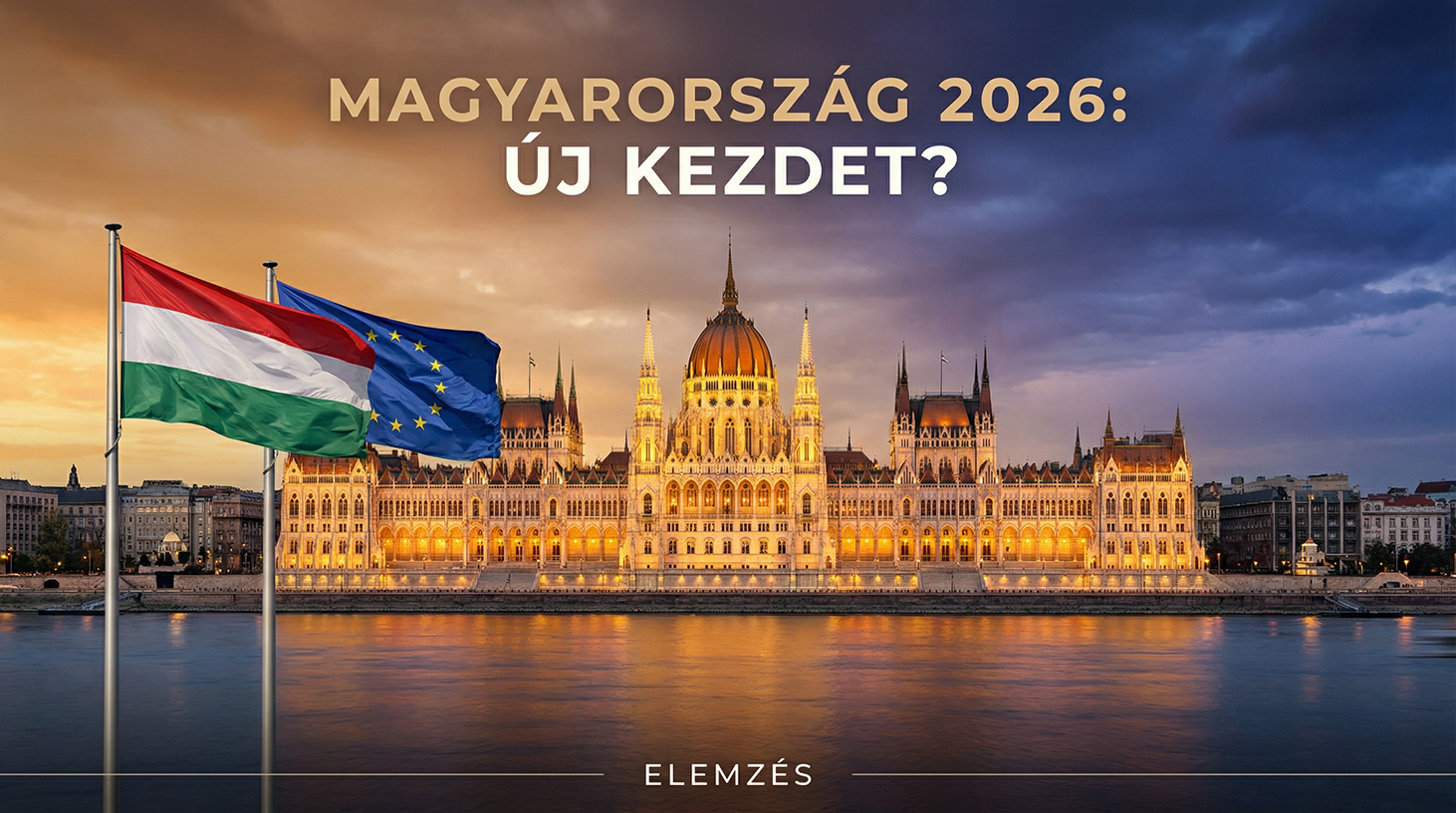
Hungary 2026: A new beginning? An analysis – Image: Xpert.Digital
After 16 years: Orbán admits defeat – This man is now transforming Hungary
Two-thirds majority for Magyar! Why Orbán's election defeat is a relief for the EU
Economic ruin Hungary: The heavy legacy after Viktor Orbán's historic downfall
It is a political earthquake, felt far beyond Hungary's borders: In the 2026 parliamentary elections, Viktor Orbán suffered a historic defeat after 16 years in power. His challenger, Péter Magyar, and his still-young Tisza party secured a two-thirds majority right out of the gate – thus ending an era that had increasingly isolated Hungary and repeatedly paralyzed the European Union. While Brussels and Kyiv breathe a sigh of relief, Vladimir Putin and Donald Trump lose arguably their most important ideological ally on the European continent. But the new beginning is fraught with massive obstacles: Magyar inherits an economically struggling country and a deeply entrenched, autocratic system. A comprehensive analysis of the consequences of the Hungarian change of power for the country, the EU, and global geopolitics.
Related to this:

A small country is shaking up the world of politics
On the evening of April 12, 2026, something happened in Budapest that many political observers had considered virtually impossible just a few years earlier: After sixteen years in power, Viktor Orbán conceded defeat and allowed a challenger to win who, only a few months before, had been a largely unknown figure on the Hungarian political scene. Péter Magyar, 45 years old, a former government insider and ex-husband of a former Minister of Justice, led his Tisza party to a landslide victory that exceeded even the most optimistic predictions. With more than 98 percent of the votes counted, Tisza won 138 of the 199 parliamentary seats, securing a comfortable two-thirds majority—the magic threshold that makes constitutional amendments possible. Orbán himself spoke of a "painful" result, congratulated the winner on election night, and announced his intention to assume the role of the opposition. Voter turnout reached a historic high of around 80 percent in the history of democratic Hungary. What was celebrated as liberation in Budapest resonated far beyond the country's borders – in Brussels, Kyiv, Washington, and Moscow.
From system opposition to system changer
Péter Magyar is not a typical opposition figure. He comes from the Fidesz milieu himself, was married to former Justice Minister Judit Varga, and only emerged publicly in 2024 following a scandal surrounding the pardon of a convicted sex offender from within the government circle. He broke with the Orbán world with an unusual mix of personal credibility, emotional authenticity, and a surprisingly professional campaign team. His Tisza party – named after Hungary's second-largest river – garnered around 30 percent of the vote in the 2024 European Parliament elections, instantly establishing itself as a force to be reckoned with. During the election campaign, Magyar positioned himself as conservative but pro-European, reform-oriented without leftist ideology, and a staunch opponent of Orbán's culture of self-enrichment. On a stage on the Buda side of the Danube – symbolically opposite the illuminated parliament building – he proclaimed to his tens of thousands of supporters that together they had voted out the Orbán regime and liberated Hungary. This was not mere victory rhetoric, but a precise political message.
The two-thirds majority is more than just an arithmetic figure. Orbán himself had ruled with precisely such supermajorities since 2010 and systematically used them to cement his power structure constitutionally: He enacted laws with constitutional status, filled the Constitutional Court, the Public Prosecutor's Office, and the Media Authority with loyal followers, and reshaped the electoral system in such a way that the inequality of opportunity between government and opposition parties was structurally embedded. Magyar has announced his intention to recapture precisely these institutional levers of power. In his election night speech, he called for the resignation of President Tamás Sulyok, Chief Prosecutor Gábor Bálint Nagy, and the heads of the Constitutional Court and the Media Authority. The possibility of filling these positions is the real core of his takeover – and the reason why, without a two-thirds majority, any reform agenda could have failed due to entrenched institutions.
The economic legacy: Disruption as a starting point
Orbán is leaving his successor with a troubled economy. Hungary is in a structurally difficult situation, further burdened by a number of self-inflicted factors. GDP growth for 2024 was estimated by the European Commission at a mere 0.6 percent, and although forecasts for 2026 indicate a moderate recovery of around 2 to 3 percent, these figures fall far short of what Orbán promised his voters. Inflation reached elevated levels again in 2025, between 4.5 and 5.1 percent, and wages failed to keep pace with price increases. The forint, Hungary's national currency, exhibited considerable volatility, further damaging consumer confidence.
Perhaps the most serious economic legacy is the blocked relationship with EU structural funds. Due to systematic violations of the rule of law – lack of judicial independence, corruption in public procurement, conflicts of interest at all levels – the European Commission froze approximately €22 billion in cohesion fund resources. By the end of 2024, over €1 billion had already been irrevocably lost because the Orbán government failed to meet the reform requirements. Furthermore, proceedings before the European Court of Justice regarding whether the approximately €10 billion that had been released in the interim had been disbursed lawfully created new legal uncertainties. During his election campaign, Magyar promised to reopen the doors to the frozen EU billions by restoring the rule of law. Conservative estimates from economists close to Tisza suggest that up to 8 trillion forints could be mobilized for the Hungarian state budget in this way in the medium term.
The economic policy program of Tisza's party combines classic conservative elements with targeted social policy adjustments. Plans include income tax cuts for earners below the median income, a wealth tax of 1 percent annually on assets exceeding one billion forints (approximately 2.6 million euros), a doubling of child benefits, and an inflation adjustment of pensions. Hungary's dilapidated healthcare system—reports indicate that some hospitals lack basic supplies such as toilet paper and soap—is to be revitalized through massive investment programs. Tisza has identified the introduction of the euro as a long-term monetary policy goal and intends to set a "foreseeable and achievable target date." This represents a symbolically significant step away from Orbán's isolationist logic and toward full fiscal integration into the European economic order. Whether and when Hungary can meet the Maastricht criteria for this remains an open question, one that will depend on the new government's fiscal discipline.
Our global industry and economic expertise in business development, sales and marketing

Our global industry and economic expertise in business development, sales and marketing - Image: Xpert.Digital
Industry focus areas: B2B, digitalization (from AI to XR), mechanical engineering, logistics, renewable energies and industry
More information here:
A thematic hub offering insights and expertise:
- Knowledge platform covering global and regional economies, innovation and industry-specific trends
- A collection of analyses, insights, and background information from our key areas of focus
- A place for expertise and information on current developments in business and technology
- A hub for companies seeking information on markets, digitalization, and industry innovations
From illiberalism to NATO cooperation: Washington's new dilemma
The European breakthrough: What Brussels is now gaining
The reactions from European capitals and Brussels were unusually warm. EU Commission President Ursula von der Leyen personally congratulated Magyar on election night, agreed to close cooperation, and wrote: “Hungary has chosen Europe. A country is finding its way back to its European path.” EU Council President António Costa and Parliament President Roberta Metsola echoed these sentiments. Austrian Chancellor Merz congratulated Magyar and looked forward to working together for a “strong, secure, and united Europe.”.
This sigh of relief is understandable given what Orbán's Hungary had demanded of the EU in recent years. Budapest systematically blocked or delayed key EU initiatives: the oil embargo against Russia, financial aid for Ukraine, and negotiating chapters on Ukraine's EU accession. When Hungary held the EU Council Presidency in the second half of 2024, the government provocatively named its slogan "Make Europe Great Again"—a direct reference to Donald Trump—and openly announced that it would not advance Ukraine's accession talks during its presidency. Unanimity among all 27 member states is required for every single step in the enlargement process; a single veto was enough to block Kyiv indefinitely. With Magyar, this calculation changes fundamentally.
Tisza is a member of the European People's Party, the large center-right group in the European Parliament, which also includes the CDU, CSU, and ÖVP. Magyar positions himself not as a fervent pro-European federalist, but as a constructive national conservative who sees the EU not as an enemy of sovereignty, but as its protector. This nuance is important: No euphoric leaps toward integration are to be expected from Budapest, but rather an end to the permanent obstructionist stance. Even a "friendlier tone" and a "constructive relationship," as observers put it, would significantly improve the EU's ability to act on key issues. Specifically, this means: Aid to Ukraine from the EU budget can be released, accession negotiations with Kyiv can move forward, and the EU's sanctions policy against Russia will lose one of its loudest internal critics.
Another geopolitical effect concerns the Central European power structure. The Visegrád Group – consisting of Poland, the Czech Republic, Hungary, and Slovakia – was deeply divided by the war in Ukraine. While Poland and the Czech Republic were among Kyiv's most ardent supporters, Orbán's Hungary and Robert Fico's Slovakia formed a pro-Russian counterweight. With a pro-European Hungary under Magyar, Budapest is once again aligning itself with Poland, which, under Donald Tusk, has become the most powerful EU state on the eastern flank. This new constellation could initiate a reshaping of Central European cooperation – with significant consequences for the balance of power within the EU.
Moscow's strategic loss: An ally abandons them
For Vladimir Putin, the outcome of the Hungarian election is a significant geopolitical setback. For years, Orbán's Hungary was not only an ideological ally, but also a concrete operational lever within the EU and NATO: it blocked arms shipments through Hungarian territory, delayed sanctions, prevented financial aid to Ukraine, and continued to maintain open energy relations with Moscow despite the embargo regime. Just days before the election, the transcript of a telephone conversation was made public in which Orbán offered Putin his unconditional support: "No matter what it is, I am at your service." This document, obtained by the Bloomberg news agency, severely damaged Orbán in the final stretch of the election campaign.
That the Kremlin would not stand idly by after the loss of its Hungarian partner was evident in its unprecedented interference in the election campaign. According to reports from several European intelligence agencies, Russia had dispatched a team of "political technologists" under diplomatic cover to the Russian embassy in Budapest to conduct social media manipulation and disinformation campaigns on behalf of Orbán. The coordinator was named as the Russian political veteran Vadim Titov, who had already carried out similar operations in Moldova. The operation failed. Hungarian voters were not swayed by it.
Besides the political loss, Russia also faces a tangible economic and energy policy disaster in Hungary. The Paks II project – a multi-billion-euro nuclear power plant being built and financed by the Russian state-owned company Rosatom as the general contractor – has been officially under construction since February 2026. Tisza had announced that he would subject this project to a comprehensive review. A potential suspension or renegotiation would mean a severe loss of reputation for Rosatom and damage its model of geopolitical dependency through nuclear exports. Regardless, Tisza stipulated in his election platform that Hungary would gradually end its energy dependence on Russia by 2035 and double the share of renewable energies by 2040. Whether and how quickly this energy transition can succeed under strained financial conditions remains to be seen – but the political direction is clear.
Washington's dilemma: Trump loses his favorite European
Few foreign politicians were as close to Donald Trump as Viktor Orbán. Their ideological affinity was evident: both rejected supranational institutions, espoused Christian nationalism, attacked the media and judiciary as enemies of the people, and pursued a policy of cultural confrontation with the liberal mainstream. Trump repeatedly referred to Orbán as a "great leader" and "friend," and as recently as October 2025, during a personal meeting at Mar-a-Lago, he granted Orbán an exemption to import Russian energy. Shortly before election day, Trump intervened openly: on Truth Social, he promised Hungary the "full economic power" of the United States should Orbán win. This intervention had no effect.
For the Trump administration, Magyar's victory initially means the loss of Europe's model of illiberalism. In MAGA circles, Orbán was not just a friend, but a piece of evidence: living proof that a right-wing nationalist shift in a Western democracy can be lasting and successful. His defeat shakes this narrative, at least in some respects. For practical transatlantic policy, however, the effect is more ambivalent. Magyar has announced plans to strengthen Hungary's position in NATO. A more reliable NATO partner like Hungary could certainly be welcome from Washington's perspective—even for an administration that repeatedly pushes for a greater sharing of the European defense burden. The loss of an ideological ally and the gain of a more reliable ally in terms of defense policy represent a real conflict of objectives that the Trump administration must first resolve internally.
Ukraine: New hope, not a guarantee
For Ukraine, the change of power in Budapest is potentially far-reaching. Orbán's obstructionist stance was one of the main obstacles on the path to EU membership: he prevented the opening of negotiating chapters, voted against Ukrainian membership in referendums, and refused to endorse positive EU assessments of Ukraine's reform progress. The European Commission repeatedly stated that there were "no objective reasons" for the obstruction – and yet a single veto was enough.
Magyar has signaled a less hostile stance towards Ukraine. Tisza is not fundamentally opposed to Ukraine's EU accession – a paradigm shift from Orbán. However, given the deep-rooted skepticism towards Ukraine, systematically sown by Orbán's media, even a Magyar government would not be an unconditional supporter of Kyiv. Given the current domestic political climate, Magyar will likely avoid direct involvement in arms deliveries. The crucial difference from Orbán, however, lies not in enthusiastic support, but in the withdrawal of active obstruction: Magyar is unlikely to prevent EU accession negotiations with Ukraine or block the already agreed-upon EU financial aid for Kyiv. This is less than a decisive breakthrough, but significantly more than the previous zero-sum game.
What remains: Limits and risks of a new beginning
The euphoria of election night should not obscure the fact that Magyar inherits a structurally overwhelming problem: the Orbán system itself. Sixteen years of autocratic rule have left deep institutional scars. Like-minded judges, loyal prosecutors, state-controlled media, a profoundly opaque web of oligarchic networks and party-affiliated economic structures – all of this cannot be undone by an election victory, not even by a two-thirds majority in parliament. The new government will have to reckon with fierce institutional resistance. Moreover, the financing of key campaign promises – the healthcare system, child benefits, pension adjustments, social housing – is not yet conclusively secured. Magyar is banking on the combination of released EU funds and savings from anti-corruption measures creating the necessary fiscal foundation. This is a plausible, but risky, path.
Furthermore, the question remains whether Magyar, as head of government, will maintain the political style that made him strong as opposition leader. Governing is a different craft than mobilizing the population. Building the rule of law, negotiating with the EU about the frozen billions, conducting the Paks II review, and simultaneously delivering social policy results for an exhausted population—this is an administrative and political Herculean task. Hungary has chosen Europe. Whether Europe—and Hungary itself—will benefit sustainably from this depends on whether Magyar can build a functioning state from the legacy of destruction.
Your global marketing and business development partner
☑️ Our business language is English or German
☑️ NEW: Correspondence in your native language!

Konrad Wolfenstein
I and my team are happy to be available to you as your personal advisor.
You can contact me by filling out the contact form here or simply call me at +49 7348 4088 965. My email address is : [email protected]
I'm looking forward to our joint project.
☑️ SME support in strategy, consulting, planning and implementation
☑️ Creation or realignment of the digital strategy and digitization
☑️ Expansion and optimization of international sales processes
☑️ Global & Digital B2B trading platforms
☑️ Pioneer Business Development / Marketing / PR / Trade Fairs
🎯🎯🎯 Data-driven B2B industry hub as a quasi-in-house solution

The quasi-in-house solution: How Xpert.Digital closes operational gaps in B2B marketing and sales – Smart Content-Driven Business - Image: Xpert.Digital
Xpert.Digital is a data-driven B2B industry hub led by Konrad Wolfenstein . The company acts as an external, quasi-in-house solution for industrial partners, closing operational gaps in marketing, content, and sales – without requiring additional resources on the client side.
More information here:










