

From Elco site to logistics hub: Huge high-bay warehouse instead of industrial wasteland: Hörmann's multi-million euro plan for Gütersloh
Xpert Pre-Release

Available in 27 languages 📢
Prefer Xpert.Digital on GoogleⓘPublished on: September 14, 2026 / Updated on: September 14, 2026 – Author: Konrad Wolfenstein
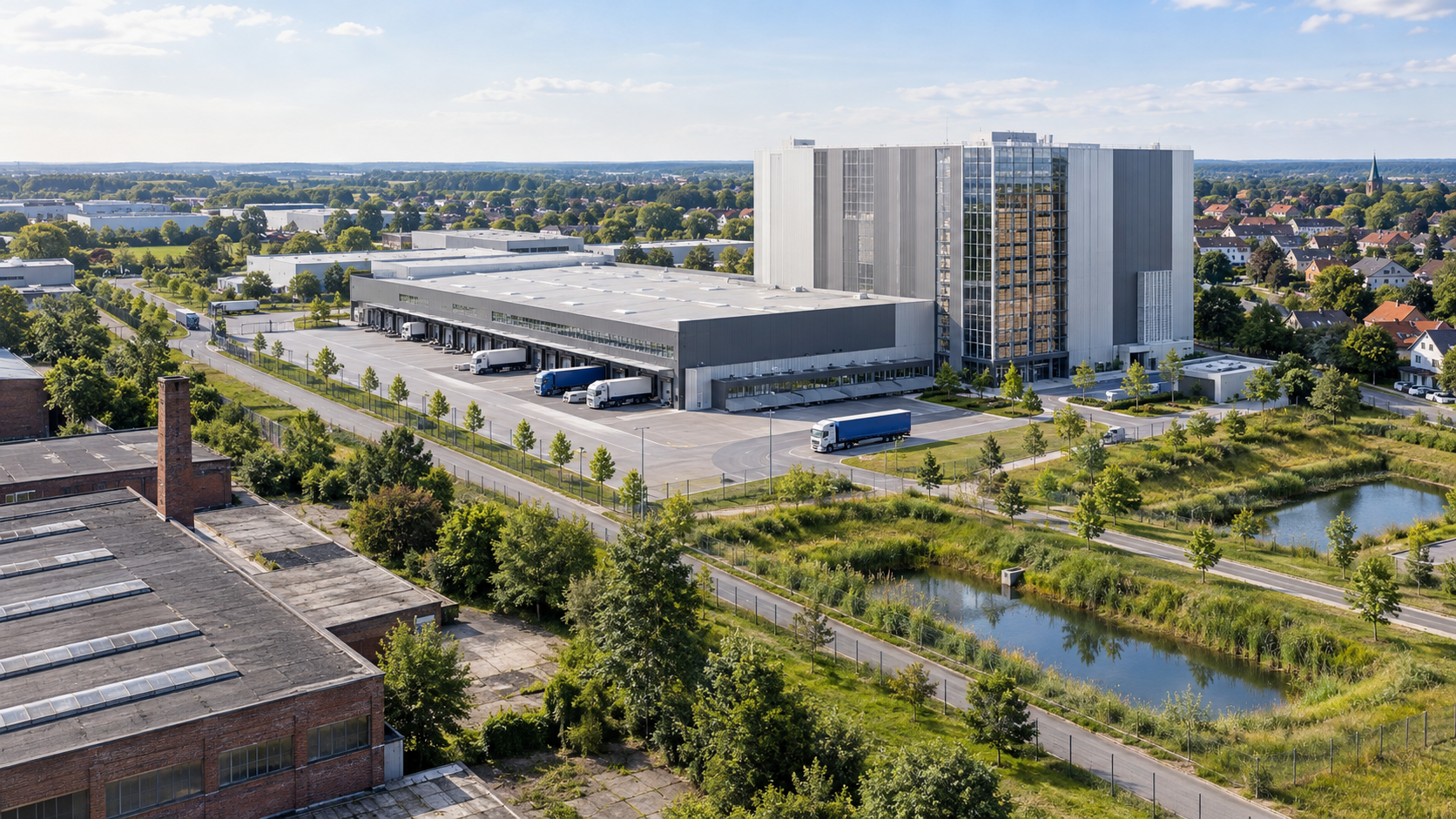
From Elco site to logistics hub: Huge high-bay warehouse instead of industrial wasteland: Hörmann's multi-million euro plan for Gütersloh – Creative image on the topic, with AI: Xpert.Digital
Name error in Gütersloh: Which Hörmann Group is really behind the mega-warehouse?
Logistics offensive with obstacles: Why the new Hörmann tower is more than just a warehouse
A groundbreaking industrial project is about to begin in Gütersloh-Avenwedde: On the former Elco site on Osnabrücker Landstraße, the East Westphalian Hörmann Group plans to build a state-of-the-art logistics center. The centerpiece of the project is a high-bay warehouse for wooden doors, approximately 30 meters high, which will be built in the immediate vicinity of the group's subsidiary, HUGA. Up to 50 new jobs are expected. But this multi-million euro project is far more than just an ordinary site expansion – it is a prime example of the structural transformation of German industry.
While the corporation is focusing on automated efficiency, short distances, and the revitalization of a brownfield site, concerns are growing in the neighborhood. A 30-meter tower, the threat of heavy truck traffic, and noise concerns are putting the local quality of life to the test. However, a purely black-and-white view is insufficient. Whether the project will be an economic Segen for the region depends not only on the building's height or the number of jobs created, but also on intelligent traffic management plans, measurable noise protection, and the ability to reconcile economic benefits with community acceptance.
An industrial building with a symbolic impact: Thirty meters high, up to 50 new jobs – but the value of the project is not determined by the warehouse, but by the traffic in front of its door
The planned construction of a logistics center on the former Elco site in Gütersloh-Avenwedde is far more than an ordinary real estate project. Behind the project lies the strategic question of how an established industrial group can further develop its production and distribution structures in a region where suitable commercial space is scarce and new logistics buildings increasingly encounter resistance. According to the plans made public so far, a logistics center is to be built on the property on Osnabrücker Landstraße, the defining feature of which would be a high-bay warehouse for wooden doors, approximately 30 meters high. Up to 50 additional jobs are anticipated.
From an economic perspective, the project combines three developments that have become typical for Germany as an industrial location. First, manufacturing companies are increasingly investing in automated storage and material flow systems to make supply chains more robust, faster, and more transparent. Second, abandoned industrial sites are increasingly being repurposed because undeveloped commercial land is harder to find and politically contested. Third, the conflict between industrial competitiveness and local quality of life intensifies as soon as tall buildings, truck traffic, noise, and additional land sealing converge on established residential areas.
Precisely for this reason, an assessment that portrays the project as either a pure success story or a mere burden falls short. For Hörmann and its neighboring subsidiary HUGA, the logistics center can be a valuable component for consolidating goods flows. For Gütersloh, it offers the opportunity to keep an already commercially used area productive and to create new jobs. However, for the surrounding area, there are real risks of disruption that cannot be addressed with general promises of growth and modernization. The quality of the project therefore depends less on its sheer size than on its specific integration into traffic, noise protection, the landscape, and operational processes.
Which Hörmann is investing here?
To clarify the company, it's important to first clear up a common misconception. The company in question is the Hörmann Group, headquartered in Steinhagen, East Westphalia, which develops and manufactures gates, doors, frames, operators, access control systems, and storage solutions. This family-owned business employs more than 6,000 people, operates over 40 specialized plants in Europe, North America, and Asia, and generates annual sales of more than one billion euros. It is therefore an internationally active manufacturer of building components with strong regional roots in the Gütersloh district.
This should be distinguished from HÖRMANN Industries GmbH, based near Munich. This second group of companies operates in the automotive, communication, engineering, and intralogistics sectors. It included the former Hörmann Logistik GmbH, which has been operating as HÖRMANN Intralogistics Solutions GmbH since the end of 2023. This company plans and implements, among other things, automated high-bay warehouses, conveyor technology, robotics, and warehouse management systems for its clients. Despite the shared family name and the striking similarity of their business areas, there is no legal corporate identity with the door and gate manufacturer from Steinhagen.
The planned center in Avenwedde is therefore not a new transshipment warehouse for the Munich-based HÖRMANN intralogistics group, nor is it automatically a reference project for this plant engineering company. According to current information, the investor and user is the Steinhagen-based Hörmann Group, a building components company. The logistics here will serve its own industrial business, particularly the storage and distribution of wooden doors. Whether an external plant engineering company from the HÖRMANN Group or another intralogistics provider will supply the technical equipment is not publicly documented. This distinction is crucial because otherwise, the manufacturer, logistics user, and plant engineering company would be incorrectly conflated into a single entity.
The HUGA connection explains the location
The choice of location becomes clear when considering the immediate surroundings. Opposite the former Elco site, at Osnabrücker Landstraße 139, is the HUGA KG factory. HUGA produces wooden interior doors and frames and has been part of the Hörmann Group since the beginning of 2013. The location was therefore not chosen at random, but is directly adjacent to an existing industrial value chain within the group.
HUGA has decades of experience in wood processing and, according to the company, employs around 350 people. In recent years, the site has been technologically modernized and its production capacity expanded. Previously published figures indicated a capacity of approximately 280,000 doors per year; at the same time, investments were made in new halls and largely automated production technology. This demonstrates that Avenwedde is not a peripheral storage location for Hörmann, but a production site of strategic importance.
A high-bay warehouse for wooden doors on the opposite side of the street can therefore be a direct response to the growth and modernization of production. The closer the warehouse, production, and shipping are located, the less need there is for distant external warehouses and repeated intermediate transport. Inventory can be managed more centrally, lead times can be reduced, and the availability of finished doors for dealers, construction sites, or other company units can increase. However, this requires that the internal material flow between the factory and the warehouse is designed to be safe and efficient. If production and warehouse are located close to each other but separated by a busy public road, a new logistical bottleneck can arise if crossings and access routes are not effectively managed.
From plastics factory to logistics hub
The property at Osnabrücker Landstraße 154 was associated with plastics processing for decades. Elco manufactured, among other things, injection-molded parts, thermoformed components, and plastic profiles for industrial customers. The company stated that its site comprised approximately 40,000 square meters. However, this historical figure does not necessarily reflect the exact size of the property acquired by Hörmann or the area subsequently developed. Until complete planning documents are published, it should only be understood as an approximate size of the former industrial site.
Elco ceased operations on June 30, 2025. The reasons given were ongoing losses and a lack of economic prospects. Most recently, the site employed approximately 65 people. With the end of production, the site faced the threat of becoming a typical industrial brownfield: buildings and technical infrastructure rapidly depreciate without reuse, ongoing safety and maintenance costs remain, and potential environmental contamination or decommissioning obligations hinder redevelopment.
The acquisition by Hörmann initially prevents the site from lying fallow indefinitely. From a regional economic perspective, this is significant because it's not just a matter of a property changing hands, but rather an industrially oriented location remaining within the economic cycle. Nevertheless, a structural transformation is taking place. A plastics processing operation with machinery, skilled labor, and diverse manufacturing processes is being replaced by a more automated warehousing function. The new use may be more productive, cleaner, and logistically more efficient, but it doesn't necessarily have to achieve the same depth of local value creation or the same level of employment.
Why a high-bay warehouse can be useful
A high-bay warehouse is primarily a tool for maximizing storage capacity. Instead of distributing goods across a large footprint in low-ceilinged halls, storage capacity is organized vertically. With a planned height of approximately 30 meters, a large storage volume can be created on a comparatively small plot of land. This is particularly attractive from a business perspective for bulky, highly variable products such as doors. Door leaves differ in dimensions, surface finish, function, fire protection rating, sound insulation, design, and customer-specific specifications. A broad product range generates numerous item positions that must be precisely stored, identified, and picked on schedule.
Automated storage and retrieval systems can handle goods movements around the clock with high repeatability. A digital warehouse management system links inventory levels, production orders, and shipping dates. This reduces search times, picking errors, and unnecessary movements. At the same time, inventory can be stored more densely because wide aisles for conventional forklifts are not required on each storage level. The building's height is therefore not merely an architectural expression but an integral part of the efficiency model.
For Hörmann, such a facility can fulfill several economic functions. It can act as a buffer between fluctuating production and demand, reduce the number of decentralized warehouse locations, and improve route planning. It can also enable growth without tying up HUGA's production areas with additional finished goods inventory. In a specialized factory, production space is typically more valuable than storage space because that's where machines, processing steps, and skilled labor directly generate added value. If finished doors are removed from production more quickly, the same location can potentially handle higher output without having to rebuild all production areas.
The economic value of short distances
The close proximity between HUGA and the new warehouse is probably the strongest economic advantage of the project. Every additional kilometer between production, intermediate storage, and shipping incurs transport costs, personnel expenses, lost time, and a risk of damage. For delicate door panels, packaging, safe handling, and the avoidance of unnecessary transshipments also play a crucial role. Consolidation can reduce these inefficiencies.
The benefits, however, don't materialize automatically. The crucial factor is how many of today's external warehouses, shuttle trips, or temporary parking areas are actually replaced. If the new center merely creates additional capacity without consolidating existing traffic, the overall volume will increase. Conversely, if it consolidates several distributed warehouses and optimizes transport capacity, the number of kilometers driven per delivery door can decrease, even though more trucks are visibly present at the site itself. Therefore, an objective assessment requires not only the number of daily truck trips to the new gate, but a before-and-after analysis of the entire logistics system.
From a corporate perspective, the investment can also stabilize delivery capacity. The building materials supply industry is dependent on economic cycles, while retailers, tradespeople, and major customers demand reliable delivery dates. An efficient warehouse partially decouples production from short-term order fluctuations. While this ties up capital in inventory, it reduces the risk of production disruptions or transportation problems immediately impacting customers. The economically optimal solution, therefore, does not lie in the largest possible inventory, but rather in a data-driven balance between availability, capital commitment, and inventory turnover.
Brownfield instead of green meadow
The use of the former Elco site reflects a nationwide trend. The proportion of former industrial and commercial land used for new logistics properties has risen significantly in recent years. A brownfield share of approximately 45 percent of new logistics construction in Germany was projected for 2025; in the first half of the year, it even reached slightly more than half at times. Several million square meters of new logistics space are planned for such sites across Germany in the coming years.
Behind this development lies not only ecological awareness, but also sound land-use economics. Developed commercial properties in well-connected regions are scarce. Municipalities are under pressure to protect agricultural land and open spaces. At the same time, companies need expansion opportunities near their plants. A brownfield site often offers existing access roads, utilities, prior planning permission, and a neighborhood that is at least partially already characterized by commercial activity.
Between 2021 and 2024, Germany continued to acquire an average of approximately 50 hectares of land per day for settlement and transport purposes. The political target for 2030 is less than 30 hectares per day, with the long-term goal being a circular economy of land use with net zero additional consumption. Against this backdrop, the reuse of the Elco site is fundamentally more compelling than developing an equally sized undeveloped area on the city's outskirts. It keeps an already developed area economically active and allows for the continued use of existing infrastructure.
However, brownfield development does not automatically equate to environmentally friendly. Even on a former industrial site, additional sealing of the land, soil disturbance, remediation of contaminated sites, loss of trees, and increased traffic can occur. The ecological benefits must therefore be assessed based on the specific design. Positive aspects would include compact vertical construction, the reuse of suitable building components or materials, photovoltaics on roofs and facades, rainwater retention, the removal of impervious surfaces, and resilient greening. Simply demolishing existing structures and then maximizing the building footprint would only partially realize the potential for genuine revitalization.
Jobs between hope and automation
Up to 50 additional jobs are relevant for a single district, but this should be put into proper economic perspective. The word "up to" refers to an upper limit and not a guaranteed number of employees. Furthermore, in a modern high-bay warehouse, it can be assumed that a significant portion of the physical storage and retrieval processes are automated. New jobs are therefore more likely to be created in control systems, maintenance, shipping, logistics, quality assurance, IT, building technology, and loading, rather than in traditional manual warehouse work.
From a municipal perspective, it's not just the number of jobs that matters, but their quality. Technical and logistics specialists typically earn higher incomes and generate stronger regional demand than those in short-term, low-paying positions. Apprenticeships and ongoing training would further enhance the benefits. Furthermore, if the center is closely integrated with HUGA, it can safeguard existing manufacturing jobs because the entire location becomes more competitive. This indirect safeguarding effect can be more significant for the national economy than the number of newly created positions.
This contrasts with the job losses at Elco, where approximately 65 people were employed most recently. However, comparing 65 previous positions with up to 50 announced job losses would be too simplistic, as qualifications, working hours, wages, and added value differ. Furthermore, Hörmann is not the cause of the previous plant closure but is creating a new use for the site after its market exit. Therefore, the following assessment is realistic: The project can compensate for some of the lost local employment and simultaneously stabilize existing industrial work at HUGA. However, it does not automatically replace the plastics processor's former production structure.
Your intralogistics experts

Consulting, planning and implementation of complete solutions for high-bay warehouses and automated storage systems - Image: Xpert.Digital
More information here:
The unsolved mysteries of the logistics offensive: What remains unclear at the Elco site
What the investment can trigger regionally
A new logistics center generates direct, indirect, and induced effects. Direct effects include construction contracts, technical installations, and subsequent ongoing employment. Indirect effects benefit suppliers, maintenance companies, security services, energy providers, waste disposal companies, and transport partners. Induced effects arise when employees spend a portion of their income in the region. Municipal revenues also contribute, though their precise amount depends on the corporate structure of profits, the allocation of business taxes, and the long-term profitability.
The so-called anchoring effect is particularly relevant. If an internationally operating family business invests in the immediate vicinity of an existing plant, the likelihood increases that further modernizations will also take place in the region. A high-performance logistics component makes the production site less interchangeable because manufacturing, warehousing, personnel, and processes are more closely integrated. This fosters site loyalty, without guaranteeing it. Even a highly automated site remains dependent on the construction industry, demand, energy costs, and the corporation's strategic decisions.
For Avenwedde, the project can strengthen its industrial profile. The Gütersloh district is one of Germany's economically strong, medium-sized business-dominated regions and boasts a well-developed production base. Its proximity to the A2 and A33 motorways connects East Westphalia with the Ruhr area, Hanover, Northern Germany, and the southern economic regions. This location benefits both procurement and distribution. The downside is that many companies utilize the same locational advantages, thereby accumulating the strain on the regional road network.
Traffic determines acceptance
The central point of contention is therefore not the existence of logistics, but its traffic management. Residents fear more trucks, noise, and increased strain on their living environment. Around 100 people are said to have signed a petition. Such objections are neither automatically proof of the project's incompatibility nor merely emotional resistance to economic development. They highlight costs that are not fully reflected in the company's calculations but can be borne by the local community.
For a reliable assessment, concrete traffic data is essential. This includes the number of truck arrivals and departures per day, their temporal distribution, potential nighttime traffic, routes to the main roads, additional car traffic by employees, and the number of internal movements between HUGA and the new warehouse. Equally important are queue lengths, waiting areas, and whether trucks can turn around and wait on the property without blocking public space.
A modern high-bay warehouse can reduce traffic volume per product unit by consolidating shipments, optimizing vehicle utilization, and eliminating external storage. However, it can also concentrate more traffic at the specific location. Both statements can be true simultaneously. Therefore, Hörmann and the city should present a system-wide assessment: Which current trips will be eliminated, which will be added, how many kilometers will be saved overall, and on which roads will the traffic volume change? Only this transparency will allow for a fair economic evaluation.
Practical measures to reduce conflicts would include fixed access routes, a ban on unnecessary through traffic in towns, digital time slots for deliveries, sufficient parking spaces on company premises, and limits on particularly noisy operations at night. A direct or technically secured connection between the opposing sites should also be examined, provided it is legally, logistically, and economically feasible. The benefit of short distances must not be negated by frequent, uncoordinated crossings of Osnabrücker Landstraße.
Height as an economic exchange
The approximately 30-meter-high high-bay warehouse is the most visible and politically sensitive part of the plan. According to the information published so far, the existing development plan envisioned significantly lower buildings. Nevertheless, the city of Gütersloh considers the project fundamentally approvable and has signaled its political commitment to the development. However, this does not mean that all detailed questions regarding the building structure, noise control, fire safety, drainage, traffic, and environmental mitigation measures have yet been answered.
Economically, height is a trade-off. More vertical storage capacity reduces the horizontal space required. A lower building with comparable capacity would need more land, longer transport routes, or additional external storage. From a space-saving perspective, a tall, compact building can therefore be more sensible than several low-rise halls. From the perspective of the neighborhood, however, it significantly alters sightlines, shading, and the character of the local landscape.
The crucial planning question is not only whether a height of 30 meters can be legally permitted, but also how this height is designed. Facade color, articulation, distance to residential buildings, terrain modeling, rows of trees, and the building's position all influence its actual impact. A monolithic, light-colored building can be highly visible from afar when the sun is at an unfavorable angle; a coordinated, matte facade and high-quality landscaping can reduce its dominance. However, a high-bay warehouse of this size cannot be made completely invisible. Therefore, sound planning should not promise visual obscurity, but rather minimize the unavoidable impact as much as possible.
Noise needs measurable limits
Noise at logistics centers isn't solely generated by engines. Reversing alarms, air brakes, starting at ramps, loading bridges, roller doors, maneuvering trailers, and the handling of swap bodies can all trigger short but disruptive noise spikes. Nighttime is particularly critical because permissible noise levels are lower, making individual events more noticeable. Therefore, simply stating the average noise level is insufficient.
An effective concept begins with the layout. Loading gates should ideally face away from residential areas. The tall warehouse structure or lower building sections can act as a shield. Noise barriers, enclosed ramps, low-noise flooring, electric yard tractors, and modern reversing warning systems can complement this. Equally important are operating procedures, such as avoiding idling, horn use, and nighttime maneuvering in particularly sensitive areas.
Continuous monitoring would be beneficial for public acceptance. Noise measurements before commissioning establish a baseline; measurements after ramp-up show whether forecasts and reality align. A clearly defined contact person and a documented complaints procedure enable swift corrections. Such measures incur costs, but are economically rational because they can prevent legal disputes, delays, and reputational damage.
Energy, climate and operating costs
An automated high-bay warehouse requires electricity for storage and retrieval machines, conveyor technology, control systems, lighting, fire protection, and building technology. At the same time, a large, compact structure offers excellent conditions for efficient operation. Automated storage areas often require less heating and lighting than permanently occupied warehouses. Kinetic energy can be partially recovered, and intelligent control systems can limit peak loads.
The use of photovoltaics is a particularly obvious choice. Besides roof surfaces, suitable facade areas can also be attractive for a high-bay warehouse. However, the crucial factor is not just the installed peak capacity, but rather its alignment with the consumption profile. A logistics center with continuous daily operations can directly utilize a high proportion of the generated solar power. Battery storage, charging infrastructure, and an energy management system could improve self-consumption and grid compatibility, but their cost-effectiveness must be demonstrated based on actual load profiles.
Fire protection is paramount in a timber product warehouse. Large quantities of flammable material, high shelves, and automated technology place particular demands on early fire detection, sprinkler systems, water supply, and fire department access. A serious fire would not only have safety consequences but could also disrupt supply chains for months. Investments in redundancy, emergency plans, and spatially sound segmentation are therefore not a regulatory luxury but rather a safeguard for the value of the stored goods and production capacity.
Water and soil as site factors
The revitalization of a former plastics manufacturing site raises questions about the soil and water balance. Before any major earthworks begin, it is essential to determine whether historical uses have left behind any contamination and which areas require remediation or stabilization. The costs can be substantial, but proper remediation will also ensure a lasting increase in the property's value. Without published expert reports, it is impossible to definitively confirm or rule out the presence of contamination on the Elco site.
For the new center, rainwater management should exceed minimum requirements. Large roof and courtyard areas accelerate runoff and increase the strain on the sewer system during heavy rainfall. Retention basins, greened perimeter zones, permeable parking areas, and the use of rainwater for operational purposes can mitigate this effect. Where possible, unsealing improves local evaporation and reduces heat impacts.
Here, too, the advantage of vertical storage becomes apparent. If the same capacity is accommodated on a smaller footprint, more space remains for buffer zones, greenery, and spacing. However, this advantage only exists if the saved area actually remains unsealed or ecologically enhanced. If it is instead used entirely for additional access roads and parking spaces, the vertical argument loses some of its ecological persuasiveness.
Municipal opportunities without embellishment
Gütersloh has a legitimate interest in securing the site. A derelict industrial area creates uncertainty, while a financially strong company offers a concrete plan for its future use. The project can generate business tax revenue, employment, and demand for local service providers. Furthermore, the city avoids the political and financial burden of designating new industrial land elsewhere.
Nevertheless, the municipality should not justify the benefits solely on the basis of company size and job announcements. Additional heavy traffic causes maintenance costs, traffic safety requirements, and potentially investments in intersections, traffic lights, or noise barriers. If these costs are predominantly borne by the public sector, while the operational efficiency gains accrue to the private sector, a distribution problem arises. Agreements based on the principle of causation regarding development, access roads, and protective measures are therefore legitimate.
Equally important is the quality of the process. If the impression arises that political decisions have already been made before traffic data and safety concepts are available in a comprehensible manner, this intensifies resistance. Transparent participation does not necessarily mean that every demand is met or that the project is fundamentally questioned. However, it should demonstrate which options were examined, why certain solutions were ruled out, and which binding conditions apply. Trust is built less through general offers of dialogue than through verifiable commitments.
The real estate value of the area
With this purchase, Hörmann is not only acquiring a plot of land, but also development risks. These include demolition, potential environmental contamination, permitting time, construction costs, and the technical specialization of the future building. A high-bay warehouse for large door formats is not a standard property that can be rented out arbitrarily. Its value depends heavily on its continued use by Hörmann and its connection to the HUGA plant.
This specialization can be economically advantageous. An owner-occupier doesn't value a property solely based on achievable market rent, but rather on the savings and productivity gains it generates across the entire operation. If the warehouse replaces external locations, reduces inventory, improves delivery times, and enables production growth, the internal benefits can significantly outweigh the isolated property value. Conversely, the risk increases if the product mix or demand undergoes structural changes.
Without information on the purchase price, investment amount, capacity, and expected savings, a return on investment calculation is impossible. Any concrete statement about the amortization period or return on capital would therefore be speculative. All that can be stated is that a 30-meter-high automated high-bay warehouse, including land development, building technology, fire protection, and conveyor technology, represents a long-term capital commitment. A family business typically makes such an investment not for a short-term boost in demand, but as infrastructure for many years to come.
The sensitive points of the calculation
The greatest project risk may not lie in the technology itself, but in delays. Changes in construction costs, additional expert opinions, planning law disputes, or subsequent protective measures can all impact costs and the schedule. Furthermore, with closely coordinated production and logistics concepts, opportunity costs arise if the new capacity becomes available later than planned.
A second risk concerns capacity utilization. Highly automated warehouses have relatively high fixed costs and only become economically attractive when a sufficient and stable flow of goods passes through the facility. If the construction industry weakens permanently or demand shifts significantly, capacity utilization decreases. The warehouse may still remain strategically sound, but its calculated amortization period is extended.
A third risk is dependence on technology and IT. If a central storage and retrieval machine, conveyor system, or warehouse management system fails, a large part of the flow of goods can be blocked. Redundant components, spare parts inventory, cybersecurity, and a robust emergency operation plan are therefore crucial. Centralization saves costs but increases the consequences of a single failure. The economically sound solution combines efficiency with sufficient resilience.
A fourth risk lies in social acceptance. Prolonged conflicts can trigger lawsuits, political reassessment, and reputational damage. This factor is particularly relevant for a regionally rooted family business. Hörmann benefits from an image based on quality, long-term commitment, and responsibility. A technically sound project can fail due to communication issues if those affected get the impression that their burdens are being downplayed.
What is not yet reliably known
Despite the more concrete reports now available, key figures remain unclear. In particular, the investment amount, the exact land and warehouse area, the number of parking spaces, the storage capacity, the level of automation, and the planned timeline have not been publicly disclosed. Reliable information is also lacking regarding the expected daily truck movements, operating hours, potential nighttime operations, and the number of external storage facilities that will be eliminated.
It is also unclear which existing buildings will be preserved, which areas will be unsealed, and what proportion of new sealing will occur. The same applies to photovoltaics, heating concepts, battery storage, charging infrastructure, rainwater management, and ecological compensation measures. The announcement of a brownfield project does not replace this detailed assessment.
The status of the approval process must also be precisely defined. Fundamental eligibility for approval and political support are important signals, but they are not equivalent to a fully legally binding building permit including all conditions. Until final documents are available, formulations such as "plans," "should," and "up to" should be retained. This prevents the premature presentation of uncertain information as a final fact.
A meaningful test standard
The project should be measured against five interconnected outcomes. First, it must demonstrably improve the competitiveness of the HUGA and Hörmann sites. Second, the redevelopment should offer a genuine advantage in terms of space and environmental impact compared to development on undeveloped land. Third, new and secure jobs must be commensurate with the public and neighborhood burdens. Fourth, a traffic and noise management solution is needed that is not only approvable but also sustainable in everyday use. Fifth, the design of the tall building should take its unique location at the transition between commercial and residential areas seriously.
This standard avoids two extremes. The project is not good simply because a well-known company is investing and announcing jobs. Nor is it bad simply because a 30-meter-high building is visible and additional traffic is feared. The project is economically sound if the operational efficiency gains outweigh the additional social costs and a fair share of the benefits remains in the local area.
To this end, Hörmann and the city should publish verifiable key figures. These include a net traffic balance, specific operating hours, noise forecasts with peak events, the number of permanently created jobs, the share of renewable energy, the net sealing of surfaces, and the planned compensatory measures. Such data is not merely voluntary image cultivation, but rather the basis for a rational debate about the location.
An investment with conditions
Overall, there are many arguments in favor of repurposing the former Elco site for industrial use. The area is already developed, the HUGA production facility is located directly opposite, and Hörmann, as a long-term oriented manufacturer, has a demonstrable operational need. A vertical high-bay warehouse can save space, consolidate inventory, and stabilize regional value creation. Up to 50 new jobs will further enhance these benefits, although their actual number and quality can only be assessed after the production ramp-up.
The critical points remain substantial. The tall building will permanently alter the surrounding area. Truck traffic and nighttime operational noise can negatively impact the quality of life. An investment in automation does not generate the same employment impact as labor-intensive production. And as long as the investment amount, capacity, traffic volume, and environmental impact assessment are lacking, the overall economic balance cannot be definitively quantified.
The clearly reasoned perspective is therefore: The project is economically plausible and fundamentally justifiable from an urban planning perspective, provided it is planned as an integrated extension of an existing industrial site and not as an isolated logistics property whose subsequent costs are shifted to the surrounding area. The brownfield approach, the proximity to HUGA, and the vertical land use all speak in favor of the project. However, its legitimacy depends on binding traffic management, effective noise protection, good architectural integration, and transparent performance monitoring.
Avenwedde thus serves as a prime example of the new industrial policy on a small scale. Competitive production requires modern logistics, scarce land necessitates densification, and successful investments require social acceptance. Those who focus solely on the number of jobs underestimate the environmental impact. Those who only consider building height misunderstand the economic logic. The project will only become viable if efficiency, land conservation, and the needs of the surrounding community are not pitted against each other, but rather planned together.
Your global marketing and business development partner
☑️ Our business language is English or German
☑️ NEW: Correspondence in your native language!

Konrad Wolfenstein
I and my team are happy to be available to you as your personal advisor.
You can contact me by filling out the contact form here [email protected]:or simply call me at +49 7348 4088 965. My email address is
I'm looking forward to our joint project.










