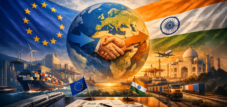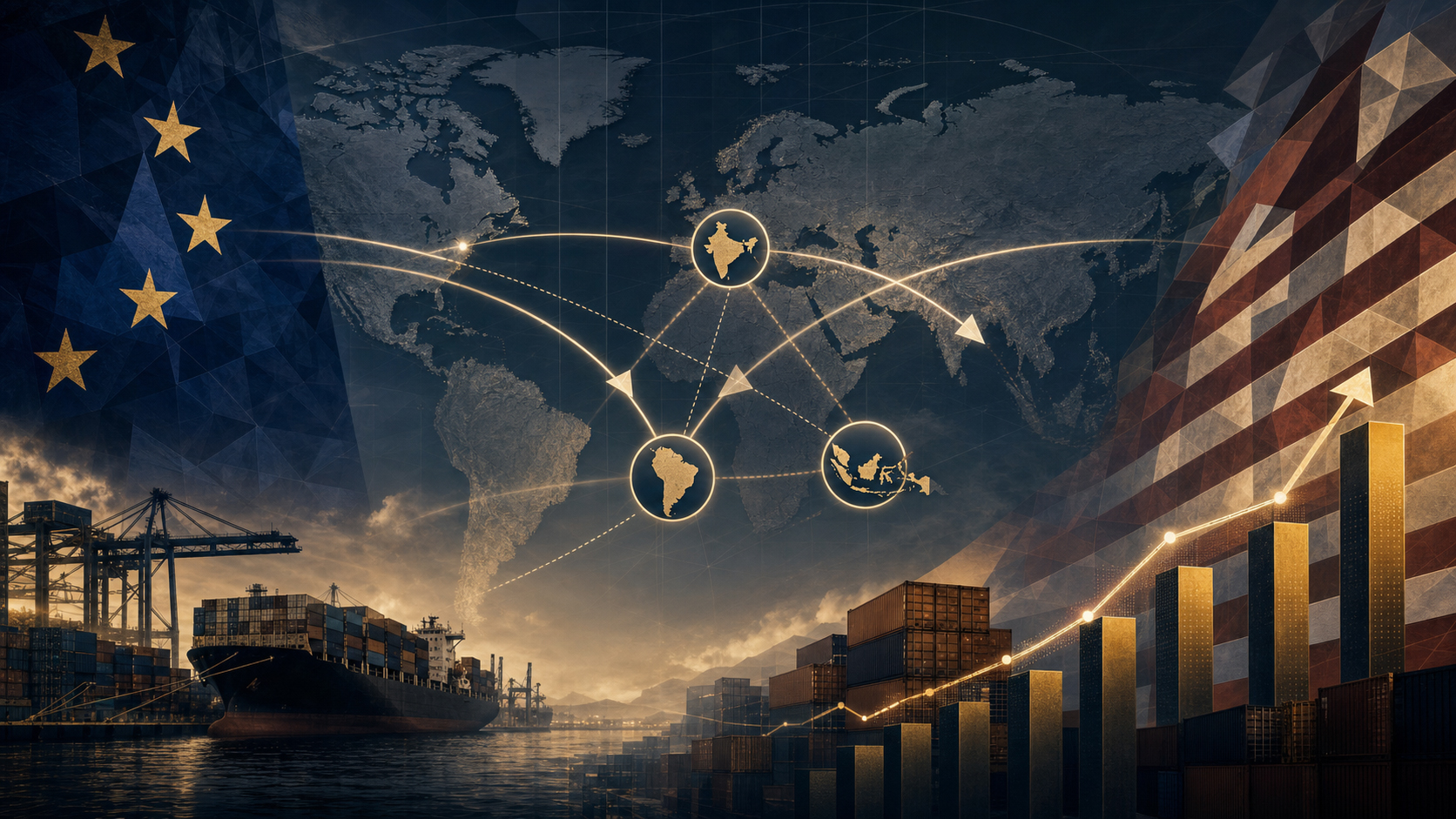
The secret Trump effect: How the EU is suddenly concluding historic mega-deals – Image: Xpert.Digital
How Trump's tariff blackmail is unintentionally transforming Europe into a new trading power
Biggest crisis in 80 years: How Trump's tariff tactics are destroying world trade
Tariffs, threats, ultimatums: Will Europe ultimately benefit from Trump's strategy?
Donald Trump's aggressive tariff policy resembles an unpredictable poker game – yet this very constant pressure from Washington is having a paradoxical effect worldwide. While the US government no longer uses tariffs as an economic protectionist instrument, but rather as a ruthless tool of diplomatic blackmail, the European Union is awakening from its trade policy lethargy. Out of sheer necessity and fear of the massive consequences for domestic, and especially German, export industries, Brussels is suddenly pushing ahead with historic free trade agreements with India, Indonesia, and the Mercosur countries at an absolute record pace. But this so-called "Trump effect" comes at a price. The following analysis reveals why Europe's newfound capacity for action is far more fragile than it initially appears, what irreparable damage the WTO's global trading system has already suffered, and why Europe's newfound dynamism has a dangerously short expiration date.
Tariff poker as a wake-up call: How Trump's threats are reshaping Europe's trade policy
The past two years have disrupted the global trading order more profoundly than any event since World War II. Since taking office, US President Donald Trump has used tariffs not as a last resort in economic policy, but as a daily tool of pressure in international diplomacy. What initially appeared to be a classic trade dispute between two economic blocs has evolved into a global upheaval that extends far beyond tariffs. A striking paradox emerges: the very aggressive and unpredictable tariff policy emanating from Washington has triggered a dynamic of negotiation in Brussels, New Delhi, Jakarta, and Brasília that has brought agreements stalled for decades to fruition within months. This analysis assesses the true resilience of this so-called Trump effect, identifies who is really benefiting, and examines the underlying structural problem that is far more dangerous than any single tariff increase.
A deadline, a phone call, a show of force
The immediate trigger for the latest escalation was an ultimatum issued by the US president to the European Union. If the EU did not fully implement the trade agreement reached last year by July 4th, the 250th anniversary of American independence, tariffs would immediately rise to a significantly higher level, Trump threatened after a phone call with EU Commission President Ursula von der Leyen. Specifically, this involved increasing tariffs on European cars and trucks from 15 to 25 percent, a move that would have severely impacted German manufacturers such as Mercedes-Benz and BMW. This threat was not an isolated incident, but followed a now familiar pattern: announcement, deadline, public pressure, and a last-minute, makeshift agreement. As early as the summer of the previous year, Trump and von der Leyen had reached a framework agreement in Turnberry, Scotland, which set a tariff ceiling of 15 percent for most EU exports, but in return demanded far-reaching concessions from the Europeans, including multibillion-dollar investment commitments in the US and the purchase of $750 billion worth of American energy by 2028. The fact that this so-called Turnberry Agreement was criticized by many MEPs as unbalanced did not change the fact that Brussels, under the pressure of the threat, ultimately agreed to it.
Why the EU always gives in in the end
The agreement reached in May, which ensured the full implementation of the customs agreement, followed the same pattern of blackmail as before. Representatives of the member states and the European Parliament agreed in a late-night negotiating session to eliminate tariffs on US industrial goods and grant American agricultural products better market access in order to avert the threatened increase in car tariffs in time. The corresponding regulations did indeed come into force on July 1st: American industrial goods can now be imported into the EU duty-free, while at the same time the duty-free threshold for small consignments under €150 was eliminated and the import quota for duty-free steel was reduced to less than half its previous volume. The built-in safeguard mechanism is noteworthy: Should the US itself violate the agreement, the EU can suspend its concessions, and the entire set of rules is set to expire automatically on December 31, 2029. This time limit reveals a lot about the European self-image in this regard: They do not expect lasting reliability, but rather negotiate from one extension to the next.
The economic consequences of this ongoing threat are particularly noticeable for Germany. The German Engineering Association (VDMA) estimates that well over half of German machinery exports to the US continue to be subject to high special tariffs on steel and aluminum, an exemption that the US has now extended to 407 product categories. The German Chamber of Industry and Commerce (DIHK) anticipates a decline in German exports to the United States of around eight percent this year, while three-quarters of German companies operating in America report negative business consequences in surveys. For Washington itself, however, the high tariffs mean a surge in government revenue: While just over seven billion dollars in tariffs were levied on EU exports in 2023, ten times that amount is expected this year. A study published in February by the credit insurer Allianz Trade estimates that additional tariffs of ten percent based on a US trade law could cause annual export losses of between 54 and 85 billion dollars, although new trade agreements with other regions of the world could offset some of these losses.
The paradoxical side effect of American blackmail policy
It is precisely at this point that the truly interesting effect of Trump's policies unfolds. While transatlantic relations are under constant strain, the aggressive American tariff strategy has triggered a domino effect on other trade agreements worldwide. Emerging and developing countries, themselves suffering under high American tariffs, are frantically searching for alternative markets, and the European Union is skillfully positioning itself as a more reliable partner. Economist Clemens Fuest of the ifo Institute succinctly summarizes this effect when he states that Trump has unintentionally made it clear to Europe that it needs to focus more on other trading partners, and that his protectionism has effectively awakened Europeans in this regard.
The evidence is impressive. The Mercosur agreement with Argentina, Brazil, Paraguay, and Uruguay, which had been under negotiation for almost 25 years, was finally concluded in December 2024, just one month after Trump's re-election, following decades of stagnation. It is intended to eliminate annual tariffs on EU exports worth over four billion euros and, according to Commission estimates, enable EU exports to the Mercosur countries to grow by 39 percent. Shortly thereafter, the free trade agreement with Indonesia was finalized within a few months of negotiations and will reduce tariffs on European chemicals, machinery, and dairy products by around 600 million euros. However, the biggest coup to date was achieved with India: After almost two decades of interrupted negotiations, Ursula von der Leyen and Indian Prime Minister Narendra Modi signed an agreement in New Delhi that creates a free trade zone for nearly two billion people. More than 90 percent of tariffs are to be reduced or eliminated entirely in the coming years; Indian car tariffs will fall from 110 to 10 percent, and both sides confidently refer to the deal as the mother of all agreements. Modi himself unequivocally justified the new urgency with the pressure from American punitive tariffs of up to 50 percent on Indian goods.
Our global industry and economic expertise in business development, sales and marketing

Our global industry and economic expertise in business development, sales and marketing - Image: Xpert.Digital
Industry focus areas: B2B, digitalization (from AI to XR), mechanical engineering, logistics, renewable energies and industry
More information here:
A thematic hub offering insights and expertise:
- Knowledge platform covering global and regional economies, innovation and industry-specific trends
- A collection of analyses, insights, and background information from our key areas of focus
- A place for expertise and information on current developments in business and technology
- A hub for companies seeking information on markets, digitalization, and industry innovations
Between hardship and new beginnings: Is European trade policy truly sustainable?
A record pace that raises questions about its actual strength
Chancellor Friedrich Merz is now urging the EU to maintain this pace and quickly revise or renegotiate agreements with Australia, Indonesia, and Mexico. The European Union has now concluded trade agreements with more than 76 countries and is even considering joining the CPTPP free trade bloc. At first glance, this development reads like a trade policy triumph for Europe. However, closer examination reveals a structural weakness that is far more worrying than any single tariff: The EU is not acting out of its own strategic strength, but out of necessity, because a single American president, with his unpredictability, has destabilized global trade. A commentary on the Indonesia agreement succinctly illustrates this disparity: While the EU negotiated its agreement with Jakarta for ten years and negotiated 21 chapters on trade, services, investment, and environmental and social standards, Trump needed only a few weeks for a comparable, significantly narrower agreement because his document focuses primarily on tariffs. This speed may be impressive, but it comes at the cost of substance: Indonesian exporters will have to pay 19 percent tariffs in the future and have also been pressured to purchase billions of dollars' worth of American products, including 50 Boeing passenger planes.
Even the European successes are more fragile than they initially appear. Despite being signed, the Mercosur agreement was referred to the European Court of Justice for review by the European Parliament, which could mean a delay of up to two years. Critics from France and Poland fear cheap imports of South American beef that would put European farmers under pressure, while environmental groups warn of further deforestation in the Amazon. The India agreement is also less ambitious than its designation as the mother of all deals suggests: it does not achieve full liberalization in the automotive sector and completely excludes public procurement, energy, raw materials, and industrial investment. Furthermore, before it can be ratified, all EU official languages must be taken into account, a qualified majority of member states must be secured, and the European Parliament must be convinced—a process that, according to Indian estimates, could take another year even in the best-case scenario.
The real problem lies deeper than any customs dispute
Far more serious than the specific tariffs is the gradual erosion of the rules-based global trading system itself. The World Trade Organization, which has been intended to act as an arbiter of international trade disputes since the post-war period, appears virtually powerless in the face of American tariff policy. A Swiss law professor put it bluntly: it seems as if the American president simply wants to demonstrate that he can and will act without any limits, especially without regard for international law. WTO Director-General Ngozi Okonjo-Iweala described the current situation in March as the worst disruptions of the past 80 years and the greatest crisis in global trade since the end of World War II. While she emphasizes that, despite all the disruptions, almost three-quarters of global trade still takes place in accordance with WTO rules, the unilateral American tariff increases are considered a blatant violation of the organization's fundamental principles.
The reason for Trump's systematic circumvention of multilateral institutions is obvious: Bilateral negotiations with individual countries or economic blocs put the US in a significantly stronger negotiating position than a common, universally applicable set of rules ever could. This strategy of deliberately driving wedges between economic blocs and nations ultimately aims to weaken multilateral cohesion as a whole. For the affected states, this means a fundamentally new reality: Those who do not react quickly enough and seek new partners find themselves caught in the crossfire of a system in which pure negotiating power, rather than the rules, determines economic opportunities.
Germany between dependence and realignment
For Germany, an export-oriented economy with particularly close ties to the American market, this new reality has a twofold explosive potential. Firstly, the German economy, due to its traditionally high export dependence, is especially vulnerable to American tariffs, as economists have repeatedly emphasized. Secondly, Washington possesses a whole arsenal of additional leverage beyond traditional tariffs, ranging from export controls on critical technologies to financial sanctions that could exclude European companies and banks from the American financial system, although such measures are currently considered less likely. At the same time, recent surveys by the German-American Chamber of Commerce show that German companies with US plants are increasingly pessimistic about the future and are scaling back their investments in America, after years of above-average business confidence. This uncertainty particularly affects the automotive industry, which has had a strong presence in the US since the 1990s, when BMW and Mercedes-Benz established plants in the American South, followed by Volkswagen about a decade later.
At the same time, the new geopolitical situation also presents opportunities for a long-overdue strategic realignment. Diversifying trade relations, moving away from a one-sided focus on the United States and toward a network of more diverse partnerships with India, South America, Southeast Asia, and other regions, will reduce the long-term vulnerability of the German and European economies to precisely such attempts at blackmail. The crucial question, however, is whether this realignment will happen quickly enough and whether the EU can adapt its notoriously slow internal decision-making processes—which, even after agreements have been fully negotiated, can take years for final ratification—to the current pace of negotiations.
A fragile advantage with an expiration date
The current acceleration of European trade diplomacy is undoubtedly real and significant in its substance. However, it should not be confused with a strategic repositioning of Europe as a self-confident global trading power. Rather, it is a reactive adjustment to an external shock whose origin—the unpredictability of a single political leader—could disappear at any time or shift in a completely new direction. Should relations between Washington and Europe normalize again in the foreseeable future, or should American domestic policy lead to a completely different foreign policy orientation, the pressure for reform on the EU is also likely to subside, with the risk that many of the diversification processes that have only just begun will stall. The real lesson of the past two years, therefore, is not to celebrate the Trump effect as a lucky coincidence, but to permanently institutionalize the resulting momentum, regardless of who governs in the White House in the future. Only a European Union that diversifies its trade relations out of its own strategic conviction and not merely out of acute fear of blackmail will be resilient in the long term against the next tariff attack, regardless of which direction it may come from.
🎯🎯🎯 Data-driven B2B industry hub as a quasi-in-house solution

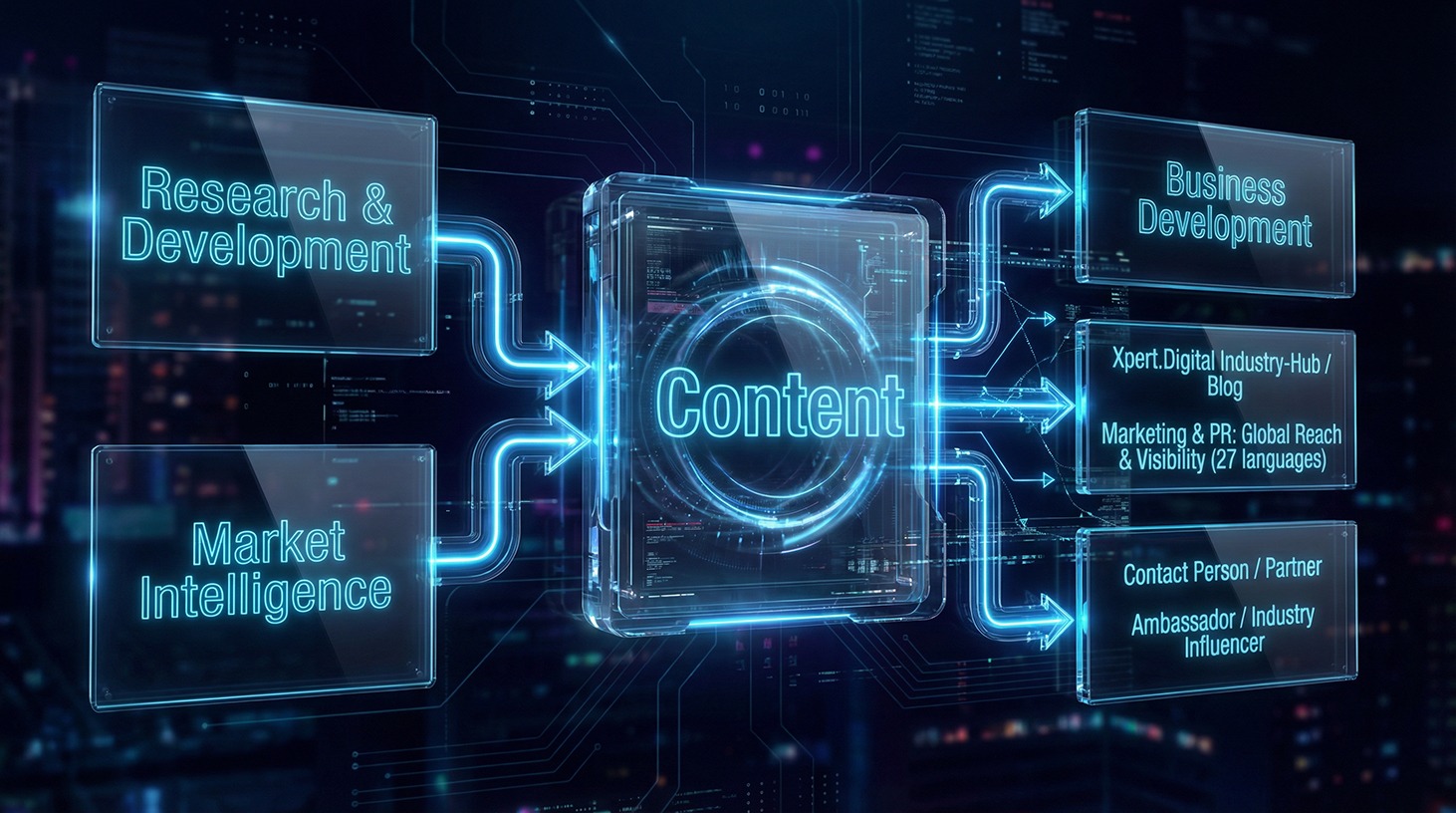
The quasi-in-house solution: How Xpert.Digital closes operational gaps in B2B marketing and sales – Smart Content-Driven Business - Image: Xpert.Digital
Xpert.Digital is a data-driven B2B industry hub led by Konrad Wolfenstein . The company acts as an external, quasi-in-house solution for industrial partners, closing operational gaps in marketing, content, and sales – without requiring additional resources on the client side.
More information here:
Your global marketing and business development partner
☑️ Our business language is English or German
☑️ NEW: Correspondence in your native language!

Konrad Wolfenstein
I and my team are happy to be available to you as your personal advisor.
You can contact me by filling out the contact form here wolfenstein@xpert.digital:or simply call me at +49 7348 4088 965. My email address is
I'm looking forward to our joint project.