
Historic oil earthquake: Why the Emirates are really leaving OPEC – checkmate for China?
Xpert Pre-Release

Available in 27 languages 📢
Prefer Xpert.Digital on GoogleⓘPublished on: April 28, 2026 / Updated on: April 28, 2026 – Author: Konrad Wolfenstein
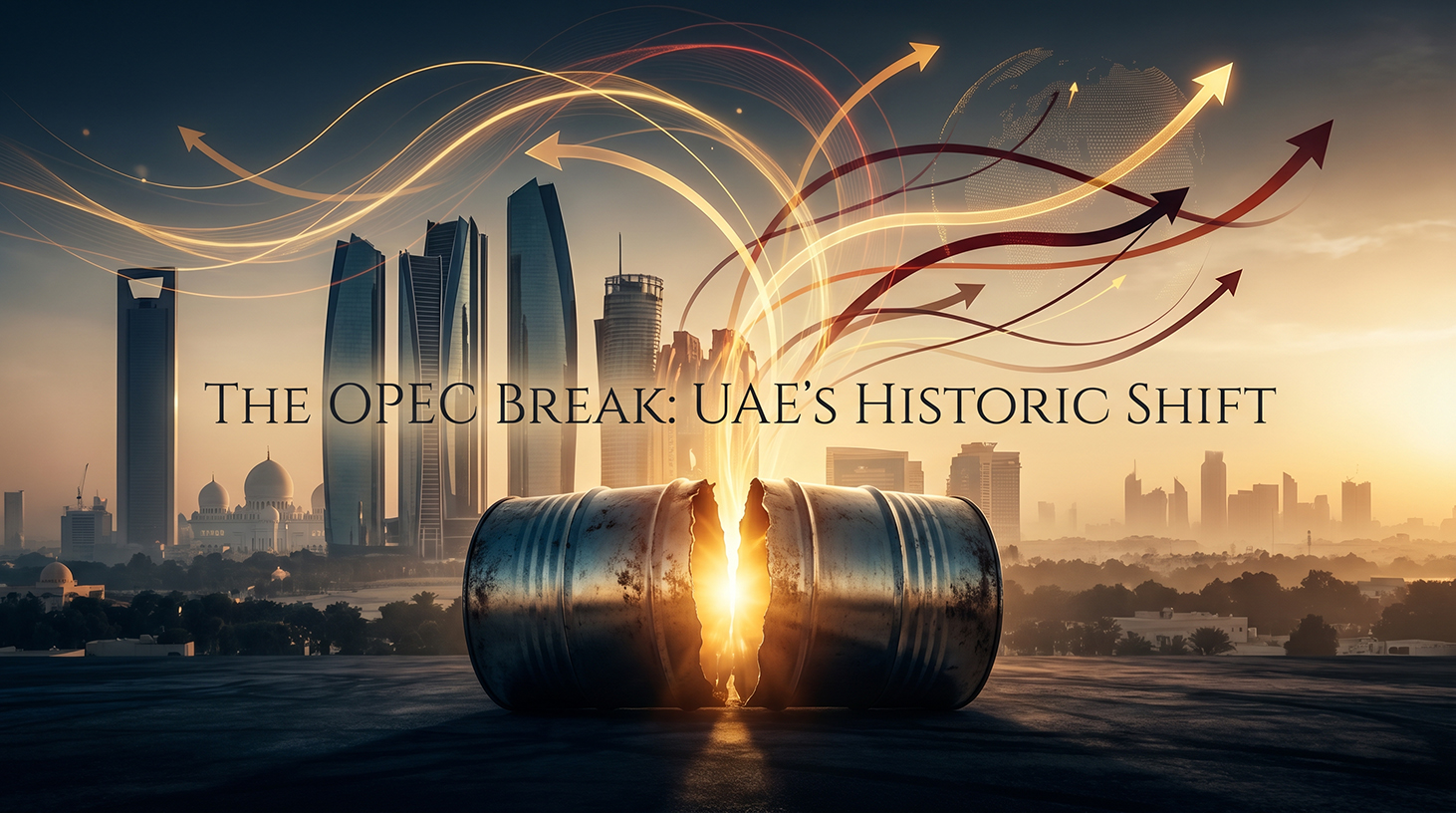
Historic oil quake: Why the Emirates are really leaving OPEC – checkmate for China? – Image: Xpert.Digital
The US window of opportunity: How the OPEC split is slowing China's power ambitions in the Middle East
Escalation in the Persian Gulf: The real reason for the rift between the UAE and Saudi Arabia
The UAE's exit from OPEC: A secret deal that plays into Trump's hands?
A geopolitical earthquake is shaking the global energy order: The announcement came like a bolt of lightning – the United Arab Emirates (UAE) will turn its back on OPEC and the expanded OPEC+ alliance on May 1, 2026. After almost 60 years of membership, one of the cornerstones of the world's most powerful oil cartel is crumbling. Behind the diplomatic platitudes of the official justification lies a very real power struggle: a deep rift with Saudi Arabia, unresolved tensions in the shadow of an escalating conflict with Iran, and Abu Dhabi's unconditional pursuit of economic autonomy. But this move is far more than a regional drama. It is a geopolitical turning point that plays into the hands of US President Donald Trump, opens new strategic doors for China, and, in an extreme scenario, could even shake the foundations of the global petrodollar system. A detailed analysis of how this historic withdrawal will dictate prices, supply chains, and the global economy of tomorrow.
End of OPEC power? UAE exit as a turning point in the global energy order
The news hit global energy markets like an earthquake: The United Arab Emirates (UAE) will leave both OPEC and its expanded alliance OPEC+ on May 1, 2026. The announcement, made via the state news agency WAM, surprised even long-time market observers – not least because the UAE's Energy Minister, Suhail Al Mazroui, explicitly stated that he had not informed the other member states beforehand. This brings to an end a membership that lasted almost 60 years, beginning in 1967 under Abu Dhabi's own name and continuing in 1971 as the United Arab Emirates.
The official justification follows statesmanlike rhetoric: the decision reflects the UAE's long-term strategic and economic vision, including increased investment in domestic energy production, and reaffirms the country's commitment to a responsible and forward-looking role in global energy markets. But behind these well-phrased sentences lies a profound rift: years of tension with Saudi Arabia, an escalating conflict with Iran, and Abu Dhabi's unfulfilled ambition for genuine energy independence.
The immediate background is almost inseparable from the war against Iran. Since US and Israeli forces launched attacks on Iranian territory at the end of February 2026, the entire energy supply of the Persian Gulf has been in a state of emergency. The Strait of Hormuz – through which approximately 20 percent of the world's crude oil and liquefied natural gas shipments normally flow – has been severely disrupted by Iranian attacks and threats against shipping. In this climate of exposed solidarity problems within the Arab world, the UAE leveled serious accusations against other Arab states, claiming they had not acted sufficiently in the Iran crisis.
Added to this was a specific dispute over the Yemen issue: at the end of 2025, Saudi Arabia demanded that the Emirates withdraw their remaining troops from Yemen within 24 hours – a public humiliation in one of the region's most sensitive geopolitical issues. This combination of military disagreements, disappointment over a lack of Arab solidarity, and decades of disputes over production quotas made the OPEC withdrawal an act that was as much a political as an economic one.
The chronicle of a conflict foretold – Saudi Arabia and the UAE
Anyone who sees the UAE's withdrawal as a sudden step underestimates the depth of the structural tensions within the oil cartel. The conflict between Abu Dhabi and Riyadh has a history that extends far beyond current events. In 2021, the Emirates briefly blocked an OPEC agreement to increase production because they considered their baseline production volume—the fundamental figure on which quotas are calculated—too low. The result: OPEC+ agreed in June 2024 to raise the UAE quota to 3.219 million barrels per day—a concession that underscores Abu Dhabi's structural bargaining power vis-à-vis Riyadh.
The deeper conflict lies in the production strategy. Abu Dhabi's state-owned oil company ADNOC has invested billions in capacity expansion in recent years: with an investment volume of US$150 billion between 2023 and 2027, ADNOC is pushing its production capacity toward a target of 5 million barrels per day by 2027 – an increase over the currently officially reported capacity of 4.85 million barrels per day. However, every production cut agreed upon within OPEC+ meant that the Emirates could not fully utilize this expensively acquired capacity. The OPEC model – sacrificing market share to support prices – was structurally less and less suited to an economy that had invested massively in capacity.
Saudi Arabia, for its part, pursued its own agenda in the Iran crisis. As early as February 2026, the Kingdom increased its production by approximately 340,000 barrels per day to 10.34 million barrels per day as part of an emergency plan – despite formal OPEC+ agreements to freeze production in the first quarter. This move served as a safeguard against potential Iranian attacks on the Strait of Hormuz. The news that Riyadh had apparently also failed to fully consult the other OPEC members regarding this strategic maneuver likely had a significant impact in Abu Dhabi. The mutual breach of trust was thus complete.
OPEC in erosion mode – structural weakening of a cartel
The UAE's withdrawal comes at a time when OPEC and OPEC+ are already significantly weakened. In recent years, the organization has increasingly faced a classic dilemma: production cuts to stabilize prices require short-term sacrifices that individual members must make for the benefit of the cartel as a whole – and this willingness is waning. Iraq, Kazakhstan, and Nigeria have repeatedly exceeded their agreed quotas, forcing Saudi Arabia to shoulder disproportionately large cuts.
The extent of the structural weakening is also evident in the reserve capacity figures. The International Energy Agency estimates that Saudi Arabia holds around 2.1 million barrels per day of usable reserve capacity, and the UAE another 0.6 to 1.1 million. Together, these two countries thus represent the overwhelming majority of the world's usable surplus capacity, which is essential for a cartel to exert its market influence. An independent analyst at Reuters put it succinctly: The UAE, along with Saudi Arabia, is one of the few members with genuine reserve capacity – and this capability is precisely the key leverage OPEC uses to exert influence on markets. If the organization loses one of these heavyweights, it also loses the central instrument of its market control.
Added to this is an increasingly competitive external environment. Non-OPEC producers – primarily the USA, Brazil, and Guyana – have consistently increased their production volumes in recent years and are continuously compensating for OPEC+ cuts. The IEA has forecast a global supply surplus of up to 3.84 million barrels per day for 2026. In this environment, an independent UAE producer becomes more attractive as a price-depressing factor – which is likely to further strain the cohesion of the remaining OPEC alliance.
Energy shock from the Iran war – the context of the historical moment
The UAE's withdrawal comes amid a global energy regime fundamentally shaken by the Iran-Iraq War. Since the attacks on Iranian territory in late February 2026, the conflict has culminated in a historic energy shock. The price of Brent crude oil exceeded $100 per barrel for the first time in four years. The Strait of Hormuz – a transit route for approximately 20 percent of the world's oil and gas supplies – was effectively blocked for a time by Iranian attacks on tankers.
For the UAE, this situation presented a particular operational challenge. On the one hand, Abu Dhabi has bypass pipelines to the port of Fujairah, providing an alternative to the Hormuz Passage. On the other hand, analysts reported that these export capacities offer only limited replacement capacity and that both Saudi Arabia and the UAE would reach their storage limits within approximately 20 days if the blockage persisted. ADNOC itself stated that it was actively managing its offshore production while onshore operations continued. In March 2026, UAE production plummeted to 1.89 million barrels per day as a result of these disruptions—a decrease of approximately 1.53 million barrels compared to planned figures.
Despite this environment, OPEC nevertheless forecast demand growth of 1.38 million barrels per day for 2026, reaching a total of 106.53 million barrels per day – and maintained this forecast for seven consecutive monthly reports. This forecast is subject to considerable uncertainty: the Iran crisis has disrupted supply chains to such an extent that no reliable medium-term forecast is possible. The UAE's withdrawal now further exacerbates this uncertainty.
Impact on global commodity trade – markets in reorganization
From the perspective of commodity trading, the UAE's withdrawal is not an isolated political event, but a market-impacting structural change with profound consequences for pricing, supply chains, and trade relations. Outside the OPEC framework, the Emirates are no longer subject to any production limits. ADNOC has set a capacity target of 5 million barrels per day for 2027 – and can now fully utilize this capacity without antitrust restrictions.
The price impact of such a move is significant. Every additional barrel the UAE brings to market compresses the margin within which Saudi Arabia, as the remaining OPEC anchor, can support prices. Market analysts already observed an immediate price drop in 2023 when the first reports of internal UAE discussions about leaving OPEC became public: Brent crude fell by up to 2 percent within a very short time. The lasting effect of an actual withdrawal goes far beyond this initial reaction: A permanently unaffiliated UAE producer with increased capacity is a structurally price-dampening factor for the global market.
For international commodity traders, this means a reassessment of the supply structure. Abu Dhabi's Murban crude oil – officially listed as a standalone benchmark contract on the ADX exchange – will be priced independently of OPEC quota obligations. Even before the formal withdrawal, ADNOC had reportedly made more Murban volume available for April 2026, sending a clear signal. Commodity traders and refinery operators who rely on Murban as a dependable source of supply are likely to try to extend and expand their supply contracts – anticipating stable and growing deliveries in the long term.
At the same time, the withdrawal poses risks to price stability. If Saudi Arabia, as the de facto leader of OPEC, finds itself increasingly isolated by the loss of one of the few members with genuine reserve capacity, the cartel's ability to act as a buffer against market shocks diminishes. This exposes oil importers – from Europe to Asia to America – to a structurally more volatile price regime. For energy-intensive industrial companies, this translates into significantly increased planning effort; hedging costs on the futures markets are likely to rise.
The physical flow of trade will also shift. The UAE operates one of the world's most important oil export terminals in Fujairah – a hub providing access to Asian, European, and American markets. As an OPEC member, this hub was integrated into a coordinated export regime; now it is available for bilateral transactions, regardless of collective production targets. Major Asian buyers in particular – Japan, South Korea, India, and especially China – will seek to strengthen direct, long-term supply contracts with ADNOC, independent of OPEC decisions.
🎯🎯🎯 Global Sourcing & Commodity Trading with integrated logistics

Raw materials, global procurement & trade - Image: Xpert.Digital
State-of-the-art cargo planes, optimized transport routes, and multimodal logistics chains are interchangeable—they can be bought, leased, or outsourced. What money can't buy are direct contacts with producers in Peruvian mines, reliable supply relationships in the CIS countries, and years of built-up trust in markets that are unfamiliar to outsiders. The decisive competitive advantage in global commodity trading lies not in transporting the good from A to B, but in knowing where the good comes from, who produces it, and how to gain access before others even know the market exists. Whoever owns the network sets the price. Everyone else pays it.
More information here:
Between Washington and Beijing: The strategic realignment of the UAE
Trump's strategic win – why Washington is celebrating
For years, US President Donald Trump has described OPEC as an anti-business organization that harms the global community with artificially inflated prices. The UAE's withdrawal represents a success for Trump in several respects. First, a weakened OPEC cartel means structurally lower oil prices – which benefits American consumers, dampens inflation, and strengthens domestic support for Trump's economic agenda.
Secondly, the UAE's withdrawal reinforces the strategic partnership between Washington and Abu Dhabi, which was already sealed in May 2025. During Trump's visit to the Gulf states, the UAE pledged to increase its energy investments in the US to $440 billion by 2035 – an increase from the then-current level of $70 billion. This investment commitment was embedded in an even more ambitious $1.4 trillion package for the entire American economy, encompassing sectors such as artificial intelligence, semiconductors, energy, and manufacturing. Abu Dhabi's simultaneous withdrawal from OPEC is the logical consequence of a foreign policy realignment toward Washington.
Third, an independent UAE producer shifts global energy geopolitics in favor of American interests. The more crude oil the UAE brings to market independently of OPEC quotas, the more difficult it becomes for Saudi Arabia and Russia—the de facto leading powers of OPEC and OPEC+—to maintain their combined pricing power. The US itself has long since become the world's largest oil producer; lower crude oil prices on the world market weaken the financial foundations of both of Washington's geopolitical rivals.
At the same time, it would be naive to interpret Trump's joy as purely altruistic. The political support for the UAE in the Iran crisis—military protection pledges, logistical cooperation, diplomatic backing—is the price Washington is paying for this geopolitical shift. This connection was never implicit; Trump has publicly indicated that he intends to link the US military presence in the region to economic concessions. The UAE's withdrawal from OPEC is thus also evidence of the transactional nature of Trump's foreign policy, which exchanges security guarantees for a willingness to cooperate economically.
China between losses and opportunism – a complex calculation
At first glance, the UAE's withdrawal from OPEC seems to play into Beijing's hands – and indeed, the situation for China is highly complex. On the one hand, China has long been the largest single buyer of Emirati crude oil, and a UAE producer exempt from OPEC quotas can, in principle, supply China with larger volumes at market-determined prices. On the other hand, the Iran-Iraq War has significantly strained China's energy supply: around 40 to 50 percent of China's offshore oil imports pass through the Strait of Hormuz, the navigability of which was recently called into question by the Iran conflict.
China has strategically prepared for precisely this risk scenario in recent years. According to CNBC, the country has built one of the world's largest strategic and commercial crude oil storage facilities – estimated at around 1.2 billion barrels in January 2026, which corresponds to a supply security of three to four months. In addition, there are overland pipelines and a massive expansion of renewable energies and electric vehicles as structural buffers against imported energy shocks. This resilience strategy gives Beijing a temporal buffer that hardly any other major importing country possesses.
For China, the UAE's withdrawal from OPEC has three strategic consequences: First, the possibilities for bilateral energy partnerships intensify. Without OPEC coordination obligations, Abu Dhabi can conclude long-term supply contracts with Beijing that regulate price and quantity directly between the parties. Second, the yuan oil trading infrastructure gains in importance. China has spent years developing alternative settlement systems: yuan swap lines, the mBridge digital currency platform, and bilateral clearing agreements. If the UAE were to actually settle parts of its oil trade in Chinese yuan—as has been indicated internally to Washington—it would be a tectonic blow to the petrodollar system.
This very point, from a US geopolitical perspective, makes the UAE's withdrawal a double-edged sword. According to reports in the Wall Street Journal, the UAE has already warned the Trump administration: if dollar shortages persist in the wake of the Iran war, Abu Dhabi could be forced to settle some of its oil sales in yuan. UAE Central Bank Governor Khaled Mohamed Balama personally conveyed this message to US Treasury Secretary Scott Bessent and Fed representatives – a direct threat to the petrodollar system, which has formed the foundation of American financial hegemony since the establishment of the Saudi-Saudi oil pact in 1974.
This threat is not an empty maneuver. China has already built up volumes for oil transactions denominated in yuan: Yuan settlements accounted for around 20 percent of daily trading volumes on the Brent benchmark in 2024, and by early 2025 this share was approaching 24 percent. Every new crude oil supplier that opens up to yuan settlements strengthens the systemic legitimacy of this infrastructure and increases the pressure on other Gulf states to consider similar steps.
The Petrodollar Dilemma and its Consequences for Washington
Herein lies the central strategic paradox for the US. On the one hand, the UAE's withdrawal from OPEC strengthens Washington's interests in the short term: a weakened oil cartel, lower prices, a closer ally in Abu Dhabi, and economically weakened Russia and Saudi Arabia. On the other hand, the UAE's estrangement from the Arab world and the resulting dependence on Washington opens a door for Beijing: if, in an extreme scenario, the Emirates are dependent on US dollar liquidity, but these dollars become scarce due to the war, the yuan option is not an ideological move, but simply pragmatic contingency planning.
The petrodollar system relies on the agreement that major oil exporters invoice their commodity in US dollars and preferentially recycle the proceeds into US Treasury bonds. This system finances the American federal budget on favorable terms and maintains structurally high global demand for dollars. Any partial withdrawal from the system—even if pursued only as an emergency measure—creates cracks in this system, which has historically proven difficult to reverse. A study published in 2025 by the Asia Society Policy Institute explicitly warned of a gradual erosion of dollar use in global oil trade, triggered by Chinese innovations such as mBridge and the increasing integration of Gulf states into yuan-based settlement systems.
For Washington, this means that the gains from a weakened OPEC cartel must be weighed against the risk of accelerated de-dollarization in energy trading. In the short term, the geopolitical advantage outweighs the risks—especially if the UAE maintains its flow of investment to the US. In the long term, however, the Emirates' estrangement from its Arab neighbors and its increasing need to serve Beijing as a trading partner could undermine the foundations of the petrodollar. It is this dialectic that makes the UAE's withdrawal a geopolitical event of historic significance—and not merely a routine exit from a trading organization.
Geopolitical chain reactions – what other members are now considering
The question of whether the UAE's withdrawal will prompt other OPEC members to take similar steps is currently open – but not purely academic. Iraq, Kuwait, and other smaller producers will be closely watching the reaction of the markets and Saudi Arabia. Those who leave the cartel lose their collective power to support prices; those who remain may have to exercise greater production discipline to maintain their remaining market power.
For Saudi Arabia, the UAE's withdrawal is a strategic shock. As the de facto anchor of OPEC, the kingdom now faces an even more difficult dilemma: supporting prices means ceding even more market share to non-OPEC producers, including the exempted UAE; defending market share means accepting lower oil prices, which put considerable pressure on the Saudi state budget. Saudi Arabia's fiscal break-even price—the price of crude oil at which the state budget is balanced—is estimated to be significantly higher than current market prices at the beginning of 2026. Every additional barrel from Abu Dhabi that enters the market unconstrained increases Riyadh's downward pressure.
At the same time, Iran, as an OPEC member, is effectively marginalized by the ongoing war: Iranian production fell to around 3.06 million barrels per day in March 2026. The organization is thus already weakened even before the UAE's formal withdrawal. The question of whether OPEC as an institution is viable in its current form will become even more urgent after May 1, 2026. Analysts have long pointed out that cartel discipline is being increasingly eroded by quota violations and growing external competition.
Energy policy consequences for Europe and the global economy
Europe faces an ambivalent situation. On the one hand, lower crude oil prices due to more unsecured UAE oil on the markets provide relief for energy-intensive industries and private households that were severely impacted by the Iran-related oil price shock. On the other hand, a structurally more volatile price regime – in which OPEC's role as a stabilizer weakens – significantly increases planning uncertainty for businesses and governments.
European refinery operators and energy suppliers that use Arabian crude oil as a benchmark commodity must reassess their procurement strategies. The removal of the OPEC binding agreement for Murban oil immediately opens up room for negotiation of direct supply contracts with ADNOC on market-based terms – which presents both an opportunity and an additional burden in negotiations.
For the global economy as a whole, the UAE's withdrawal signals a tectonic shift in the energy order, the beginnings of which have been visible for years. The model of the coordinated supply cartel, which controls prices through collective production discipline, is losing its viability. Competition between American shale oil producers, Brazilian deep-sea sources, Guyanese production, and now a fully unleashed Emirati oil giant is increasingly defining the market framework from the supply side – and the OPEC model of price stabilization through quantity control is facing a structural challenge in this environment.
Structural change or episodic event – a sober assessment
It would be analytically dishonest to frame the UAE's withdrawal solely as an epochal turning point without acknowledging the limiting factors. Despite its reserve capacity and strategic weight, the UAE is not a single producer capable of redefining the global oil market. The Strait of Hormuz crisis currently limits the Emiratis' physical export capabilities, regardless of their cartel affiliation. ADNOC itself acknowledged that export capacity will remain restricted until Gulf navigation normalizes.
Furthermore, it remains unclear whether the UAE's exit signifies an orderly rapprochement with Washington or a permanently geopolitically independent positioning towards pragmatic opportunism. The warning to the Trump administration to switch to yuan-denominated settlements if necessary suggests that Abu Dhabi is deliberately keeping its options open – a classic characteristic of Emirati foreign policy, which has been described for years as "multialignment": maintaining good relations with Washington, Beijing, and other powers simultaneously, without committing to a definitive position.
What is clear, however, is that May 1, 2026, does not mark the first crack in OPEC, but it is a particularly deep one. It accelerates the fragmentation of a cartel that is already under considerable pressure. It intensifies the geopolitical tensions between the Arab Gulf states, the US, China, and Iran into a flashpoint that will occupy global energy and currency markets for a long time to come. And it raises a new question about which institutions will structure the global energy order of the 21st century, a question to which neither OPEC nor the IEA nor the major consumer countries yet have clear answers.
The era of the organized oil cartel as a global price setter is drawing to a close – not with a bang, but through continuous erosion from within. The UAE's withdrawal is the clearest symptom of this process to date.
Your contact for raw materials ⛏️ Global sourcing 🚢🌐 & trading 📦

Dmitry Kovalenko
I would be happy to serve as your personal advisor.
Dmitry Kovalenko
Tel: +49 7348 4088 961
Your contact for raw materials ⛏️ Global sourcing 🚢🌐 & trading 📦

Konrad Wolfenstein
I would be happy to serve as your personal advisor.
Konrad Wolfenstein
Email: [email protected]
Our global industry and economic expertise in business development, sales and marketing

Our global industry and economic expertise in business development, sales and marketing - Image: Xpert.Digital
Industry focus areas: B2B, digitalization (from AI to XR), mechanical engineering, logistics, renewable energies and industry
More information here:
A thematic hub offering insights and expertise:
- Knowledge platform covering global and regional economies, innovation and industry-specific trends
- A collection of analyses, insights, and background information from our key areas of focus
- A place for expertise and information on current developments in business and technology
- A hub for companies seeking information on markets, digitalization, and industry innovations





