
Tamil Nadu (India) plans new inland port in Tiruchy – six seaports, big ambitions and a crucial question
Xpert Pre-Release

Available in 27 languages 📢
Prefer Xpert.Digital on GoogleⓘPublished on: November 9, 2026 / Updated on: November 9, 2026 – Author: Konrad Wolfenstein
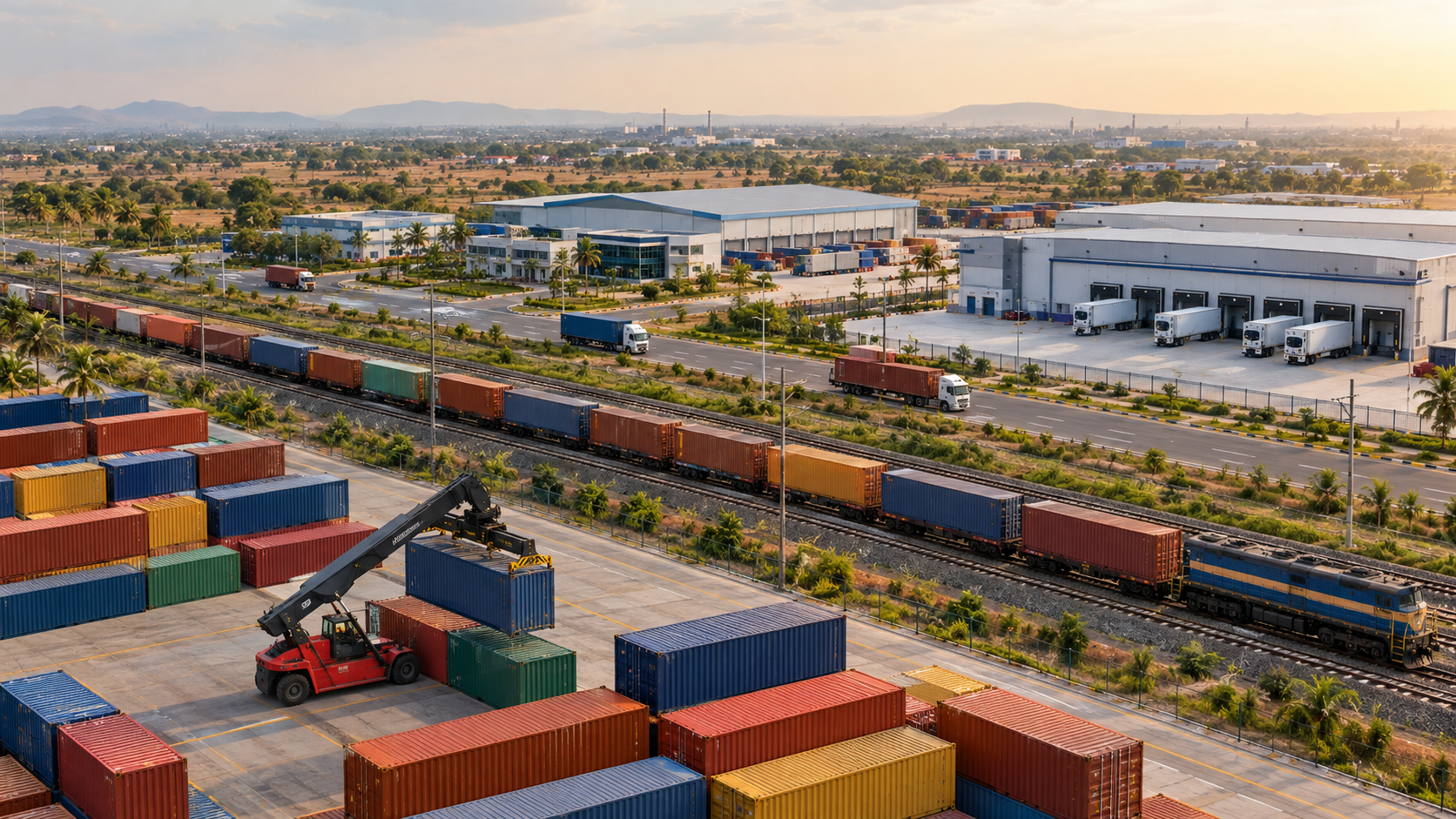
Tamil Nadu (India) plans new inland port in Tiruchy – six seaports, big ambitions and a crucial question – creative image on the topic, with AI: Xpert.Digital
More than containers and tracks: When Tiruchy's inland port becomes a real locational advantage
Focus on smaller companies: Can a logistics center in Tiruchy reduce export costs?
Inland port for South India: What opportunities the project in Tiruchy offers – and what risks remain
Tamil Nadu is one of India's major industrial centers. Now, a logistics hub in the state's interior is intended to boost its export economy: The planned inland port in Tiruchy could provide companies with better access to several seaports and open up new opportunities, especially for smaller businesses. Plans include container handling, warehousing, customs facilities, and a potential connection to the rail network.
However, a large area and modern infrastructure do not automatically make a logistics center profitable. The crucial factor is whether companies can actually transport their goods more cheaply, reliably, and without unnecessary delays to international customers. This requires sufficient freight volumes, functioning connections to seaports, and tangible benefits that offset the additional costs of handling and storage. The following overview outlines what is known about Tiruchy's planned inland port, the opportunities it presents for the region, and the criteria by which the project's success will be measured.
Tiruchy's inland port: The economic touchstone for Tamil Nadu's export economy
An inland port in Tiruchy can improve the competitiveness of the economy in central Tamil Nadu. However, its economic value does not stem solely from container space, warehouses, or a rail connection. The crucial factor is whether companies can transport their goods to international customers more cheaply, reliably, and with less tied-up capital. The planned logistics center must be measured against precisely this criterion: an improved supply chain, not the most impressive infrastructure.
The project has a sound industrial basis. The region combines mechanical engineering, metalworking companies, small and medium-sized suppliers, as well as agricultural and food processing activities. At the same time, its location in the southern Indian state of Tamil Nadu offers multiple access points to seaports on the east and west coasts. This combination has the potential to create a high-performing logistics hub. However, whether this will actually translate into economic benefits is not yet certain. Sufficient freight volumes, suitable services, competitive prices, and functioning connecting transport links are all essential.
A regional industrial project of national importance
Tiruchy, also called Tiruchi or Tiruchirappalli, is located in the central part of Tamil Nadu, and thus in South India. This geographical classification is economically important: The project is not intended to fill a gap in Central India, but rather to better connect the industrial and agricultural base of a comparatively strong South Indian state with international transport networks.
The Tamil Nadu Industrial Development Corporation (TIDCO) is pursuing the concept of a multi-modal logistics hub. This refers to a logistics center that organizationally and spatially integrates different modes of transport and services. As a dry port or inland container depot, it will also take on functions that are otherwise often only performed in the vicinity of a seaport. These include, in particular, container handling and customs procedures.
The project is embedded in the industrial policy framework of the 2026/27 fiscal year. Chief Minister C. Joseph Vijay announced the development of the logistics center in Parliament on August 31, 2026. Local Member of Parliament Durai Vaiko is among the political supporters. The central government has signaled its general willingness to support the project. This political backing improves coordination but does not replace either the site selection or the proof of economic viability.
What an inland port actually provides
A dry port requires neither a river nor its own ship berth. Here, the term refers to an inland logistics terminal with a functional connection to seaports. Goods can be collected, stored, loaded into containers, and cleared through customs there, subject to the applicable regulations. Subsequent transport to the seaport is by road or rail.
The benefit lies in the upstream processing and consolidation of processes. A company no longer needs to coordinate every organizational step directly at the coastal port. Instead, documentation, container preparation, goods inspection, and transport planning can be brought closer to the production sites. This can reduce interfaces and simplify planning.
An additional hub can also incur additional costs. If a shipment is first transported to a hub, transshipped, temporarily stored, and then transported again, new work steps are required. Therefore, an inland port is not automatically more efficient than direct transport from the factory to the seaport. Its viability only arises when the advantages of consolidation and handling outweigh the additional transshipment, storage, and supply costs.
The industrial scale behind the project
Tamil Nadu boasts a broad industrial base. For the 2025/26 financial year, merchandise exports are projected at US$59.93 billion, of which US$19.97 billion are electronics exports. This represents 41 percent of India's total electronics exports. Manufacturing contributes 25.22 percent to Tamil Nadu's gross value added (GV) at constant prices, compared to 17.13 percent for India as a whole.
The operational structure also underscores the importance of industry. For 2023/24, 32,000 active factories with a total of 2.984 million employees are reported. These figures describe the state as a whole, not the immediate catchment area of the planned inland port. This distinction prevents a common planning error: A large export sector is a favorable factor, but not a reliable demand forecast for a single terminal.
For Tiruchy, therefore, the actual achievable flow of goods must be determined. Electronics exports from another part of the country will not automatically pass through the new center simply because they belong to the same state. The decisive factors remain the production location, the target market, existing supply contracts, transport speed, and the competitiveness of existing routes.
Different goods require different solutions
Regional demand is by no means homogeneous. BHEL operates facilities in Tiruchirappalli for the production of high-pressure boilers and steam generators, as well as seamless steel pipes. This creates an industrial environment where, in addition to standardized components, heavy, bulky, or particularly demanding goods may also be relevant. Not every industrial product is suitable for a standard container.
In neighboring Karur, textile production, including exports, plays a significant role. Such goods have different requirements than heavy machine components. Here, dry and clean storage areas, reliable container availability, suitable packaging, and adherence to international delivery windows can be particularly important. Agricultural products from Tiruchy and the surrounding area, on the other hand, sometimes require short turnaround times, sorting, traceability, and temperature-controlled processing.
This has a clear consequence for the logistics center: a large total tonnage is not sufficient as a planning benchmark. Weight, volume, value of goods, seasonality, temperature sensitivity, and technical loading requirements must be considered separately. A ton of steel requires different infrastructure than a ton of textiles or fresh vegetables. Only the specific product profile determines which facilities are economically viable.
At least twelve hectares are not proof of capacity
The center is planned to occupy an area of at least 30 acres, which is approximately twelve hectares. The final location within the Tiruchirappalli district has not yet been determined. The area is also intended to allow for future expansion to accommodate additional logistics services as demand grows.
The minimum size is a spatial requirement, not a predictor of future annual throughput. Internal roads, safety clearances, drainage, administrative areas, parking, and technical facilities are all deducted from the total site area. A potential rail connection requires additional spatial flexibility. The remaining capacity also depends on storage duration, stacking heights, site organization, operating hours, and the performance of the handling equipment.
A high throughput cannot be reliably derived solely from the size of the site. The dwell time is particularly important: containers that remain on the premises for extended periods block space without enabling a correspondingly high volume of new services. For the hub's economic efficiency, rapid handling can be more valuable than maintaining the largest possible inventory. Expansion reserves should therefore be combined with an initial configuration designed for short distances and swift throughput.
The choice of location will determine the outcome for decades
The best location is not necessarily the cheapest. A cost-effective plot of land can become expensive in the long run if trucks have to take detours, access roads are congested, or a rail connection is only possible with considerable effort. Conversely, a higher land price can be justifiable if it permanently allows for shorter access routes and more reliable connections.
Therefore, the proximity to production clusters, the connection to national and state highways, the actual accessibility of the rail network, and the connection to relevant seaports must be evaluated. The airport should also be considered, without automatically implying an integrated air freight service. The geographical proximity of different modes of transport only creates an advantage if their operational processes are compatible.
In addition, contiguous land availability, ownership, electricity supply, water, drainage, and compatibility with neighboring uses must be considered. Areas prone to flooding or poorly drained can cause business interruptions and high subsequent costs. Therefore, the economic site selection must go beyond land prices and include all costs and risks of future operations.
Six seaports create choices
The planned hub is intended to improve connections to Chennai, Kamarajar, Kattupalli, Chidambaranar in Thoothukudi, Cochin, and Vizhinjam. The concept thus targets access points on the east coast as well as ports in western Kerala. Its central location within Tamil Nadu opens up several transport options.
However, this does not mean that all six ports are the same distance away, equally easily accessible, or equally suitable for every type of goods. Actual road and rail connections, port charges, available ship departures, and container capacities differ. For an exporter, what matters is the entire connection to the foreign recipient, not just the shortest route to the nearest port.
A more distant seaport can be economically advantageous if it offers a more suitable direct connection or a more reliable departure. Conversely, inexpensive sea freight can be negated by costly land transport and longer waiting times. The six ports should therefore be seen as a potential portfolio. A good hub mediates between these options, rather than channeling all freight according to a rigid scheme.
New port structures are changing the hinterland
The maritime environment continues to develop. India's ports classified as Major Ports handled a combined 915.17 million tons of cargo in the 2025/26 financial year, representing a 7.06 percent increase over the previous year. This statistical category does not include all Indian ports and should therefore not be equated with total national port throughput.
Vizhinjam is of particular interest for the West Coast option. Commercial operations for the first phase began on December 3, 2024, with a designed capacity of one million standard container units (TEU) per year. Further expansion aims for an annual capacity of up to 5.7 million TEU. TEU is the standardized unit of measurement for container traffic, based on a 20-foot container.
For Tiruchy, this presents a potential additional connection to international shipping networks. However, planned port capacity is neither a realized throughput nor a guarantee of favorable export connections. Likewise, not every container handled by a transshipment port automatically becomes hinterland freight. The economic relevance of Vizhinjam therefore depends on the actual available connections, hinterland costs, and its usability for regional exporters.
Logistics costs require clear reference points
A data-driven analysis should not begin with sweeping statements about supposedly extremely high logistics costs in India. For 2023/24, the study by NCAER and DPIIT estimates total logistics costs at 7.97 percent of gross domestic product. Based on the production value of agriculture, mining, and manufacturing, this equates to 9.09 percent.
These indicators answer different questions. The share of gross domestic product describes a macroeconomic relationship. The reference to the production value of non-service sectors focuses more on the areas where physical goods movements occur. Neither of these values automatically corresponds to the burden on an individual exporter or a specific route.
Historical comparisons also require caution. Different data collection methods and cost definitions can produce significantly different results. A newly calculated lower rate, therefore, does not in itself prove an equally large real efficiency gain. For Tiruchy, the practical question is more crucial: What costs are incurred today for specific shipments, and which of these can the new center actually avoid?
Small businesses could particularly benefit
Company size significantly impacts logistics costs. In the underlying national survey, companies with an annual turnover of up to five crore rupees incur average logistics costs of 16.9 percent of their production value. For companies with an annual turnover exceeding 250 crore rupees, the corresponding figure is 7.6 percent. The turnover thresholds are 50 million and 2.5 billion rupees, respectively.
These differences cannot be entirely attributed to single causes. However, they illustrate the importance of economies of scale and bundling. Small businesses often cannot utilize transport capacities as evenly as large companies. Furthermore, organizational tasks are spread across fewer shipments. A shared hub can therefore be particularly beneficial where individual companies cannot establish their own efficient export logistics.
No specific savings rate for Tiruchy can be derived from this. The difference between the national averages does not represent a short-term savings potential for every small business. The hub can only mitigate certain structural disadvantages. For this to happen, it needs access that handles even small shipments economically, offers transparent tariffs, and is not exclusively tailored to a few large customers.
Bundling is the core of the business model
The most important economic mechanism of the project is consolidation. Several smaller shipments are combined to better utilize transport and handling capacities. This can reduce costs per unit, provided the additional coordination does not take too long and the shipments are compatible in terms of destination and requirements.
Consolidation, however, doesn't work solely in terms of location. It also requires scheduling. If goods from different companies are ready for shipment at completely different times, waiting for a joint shipment can generate new storage and financing costs. Therefore, the optimal shipment isn't necessarily the largest, but rather the one with the lowest overall costs and an acceptable delivery time.
The reverse direction also deserves attention. An export-oriented hub must clarify how containers and means of transport can be made available again. Suitable import or domestic transport can better utilize return journeys and limit empty runs. However, their mere existence is not enough: container type, location, timing, and ownership conditions must be aligned. A balanced transport structure arises from concrete planning, not from a blanket comparison of export and import tonnage.
A rail connection does not yet constitute a rail service
The planned rail component has significant economic potential. The national logistics cost study cites average costs of 3.78 rupees per tonne-kilometer for road transport and 1.96 rupees for rail transport. These figures illustrate the potential cost efficiency of rail. However, they are not directly comparable total prices for every transport chain.
Especially with rail, the first and last road segments are not fully covered by the aforementioned average value. Terminal services, potential shunting operations, waiting times, and organizational requirements must also be considered. Therefore, simply multiplying the lower rail value by the transport distance may underestimate the true cost of a multimodal connection.
For Tiruchy, a functioning rail service must consist of sufficiently frequent departures, guaranteed capacity, and suitable port connections. A siding without reliable use can tie up capital without providing any benefit to exporters. Cooperation with Southern Railway and a technical feasibility study of a terminal connection are therefore necessary, but only the beginning of the economic evaluation. Infrastructure and usable transport capacity are two different things.
LTW Intralogistics Solutions – Intermodal Transport

LTW Intralogistics Solutions – Intermodal Transport – Image: LTW Intralogistics GmbH
LTW offers its customers not individual components, but integrated complete solutions. Consulting, planning, mechanical and electrotechnical components, control and automation technology, as well as software and service – everything is networked and precisely coordinated.
In-house production of key components is particularly advantageous. This allows for optimal control of quality, supply chains, and interfaces.
LTW stands for reliability, transparency, and collaborative partnership. Loyalty and honesty are firmly anchored in the company's philosophy – a handshake still means something here.
Related to this:
How small businesses can benefit from the logistics revolution
The first and last mile are decisive
The distance at which a combination of road and rail becomes more economical depends heavily on the initial and final leg of the journey. The national study, under certain assumptions, yields an economic threshold of approximately 600 kilometers of total distance, assuming 50 kilometers each at the beginning and end of the journey are by road. With 100 kilometers each for initial and final leg, this threshold shifts to approximately 1,000 kilometers.
These figures are guidelines for a specific cost comparison, not universally applicable laws of nature. Direct rail connections, low handling costs, high capacity utilization, or favorable operating concepts can all alter the calculation. Likewise, inconsistent timetables or long detours can impair the competitiveness of rail.
This leads to a sobering perspective for the inland port. Not every connection to one of the six seaports needs to be by rail. On some routes, trucks can remain economically superior. Multimodality, therefore, does not mean shifting as many shipments as possible to rail, regardless of their characteristics. It means organizing the appropriate combination for different freight flows and designing efficient transitions between modes of transport.
The catchment area does not end at the district
The concept envisions examining potential collection and consolidation functions in more distant areas as well. Villupuram, Salem, and Madurai are among the locations mentioned. Such decentralized facilities could receive smaller shipments and forward them in batches to Tiruchy. The central hub would thus become part of a regional network rather than an isolated facility.
Such a system can improve accessibility, but it also creates additional interfaces. A regional collection center requires personnel, space, digital connectivity, and sufficient, regular inbound traffic. If demand is lacking, another cost factor arises. Furthermore, for certain companies, it may remain more cost-effective to go directly to a seaport or another terminal.
The aforementioned locations should therefore not automatically be treated as a fixed catchment area entirely focused on Tiruchy. The economically decisive factor is the achievable market share for each flow of goods. A regional collection point can be beneficial if it improves routes and capacity utilization. It is not beneficial if freight is routed through additional stations solely for organizational reasons. The network should follow demand, not the other way around.
Customs proximity can be more important than kilometers
The ability to relocate customs functions inland is one of the key advantages of a dry port. For companies, the proximity to customs clearance processes can reduce coordination efforts and identify problems earlier. Missing documents or ambiguities then don't have to be addressed at the coastal port immediately before a scheduled ship departure.
A customs area alone does not guarantee rapid clearance. Crucial factors include legal authorization, responsibilities, the availability of the relevant authorities, and coordination with the respective seaport. Additional inspection requirements must also be considered if certain goods require further checks. The planned customs functions should therefore be classified as a target configuration, not as an existing operational state.
The key performance advantage would be reliable processing. For an exporter, a well-planned process can be more valuable than occasionally very fast processing with widely fluctuating durations. Therefore, a suitable business organization should consider not only average processing times but also delays and their causes. The goal is less uncertainty along the entire export chain.
Warehousing should not become an end in itself
The planned range of services includes warehouses, container storage, truck terminals, and supporting facilities. This combination can decouple production and shipping processes and simplify organization. At the same time, a distinction must be made between necessary warehousing and avoidable waiting time. A well-stocked warehouse may be profitable for the operator, but not automatically efficient for the customer.
The capital costs of stored goods are also economically relevant. The longer a product waits for shipment, the longer capital remains tied up. Insurance, damage, and obsolescence risks can also be factored in. Therefore, a lower transport bill can be partially or completely offset by higher inventory levels.
The center should therefore not measure its performance solely by occupied floor space. More important are a reliable flow of goods, demand-driven interim storage, and the reduction of avoidable downtime. This perspective can create a conflict of objectives if the operator particularly benefits from long holding times. A well-designed economic model should therefore reward fast, predictable processing and not rely on the longest possible storage durations.
Cold chains require more than just cold storage facilities
Temperature-controlled services could be particularly beneficial for the region's agricultural sector. Bananas and various vegetables are key components of the region's production. A suitable logistics chain can help maintain quality and improve access to more distant markets. The planned refrigeration and temperature-controlled zones are therefore a technically sound and integral part of the concept.
A cold storage facility at a central location does not automatically solve all the problems associated with perishable goods. If products have been transported unrefrigerated for too long or handled improperly before arrival, the loss of quality cannot simply be reversed. A coordinated chain of processes is required, encompassing harvesting, sorting, appropriate pretreatment, packaging, transport, and storage.
Furthermore, the optimal conditions vary depending on the product. Different temperatures, humidity levels, and ripening processes require appropriate technical and organizational solutions. For economic viability, it's not just the amount of waste avoided that counts, but also the additional sales revenue that can actually be generated and who bears the cooling costs. Without considering these factors, there is a risk of a technically sophisticated but underutilized specialized facility.
Digitalization only creates benefits with data quality
The planned connection to the Unified Logistics Interface Platform, or ULIP for short, is intended to support the digital exchange of logistics information. ULIP enables standardized interfaces between participating systems. For a hub like Tiruchy, this can provide a basis for better integrating status information, vehicle movements, and other relevant data.
This differs from the PM GatiShakti National Master Plan. The latter supports spatially integrated infrastructure planning using geographic data. This allows for the combined consideration of transport networks, economic hubs, and other relevant location information for site selection. ULIP and GatiShakti thus fulfill different, complementary tasks: operational data linking on the one hand and coordinated infrastructure planning on the other.
The digital integration of the planned hub is initially a development goal. An interface alone will not eliminate incorrect master data or delayed reporting. Economic benefits only arise when the information is complete, timely, and usable in daily operations. Therefore, simple access and understandable processes should be a priority for small businesses. A technically complex platform that requires parallel manual data entry could otherwise actually increase the workload.
Competition prevents expensive convenience
Tiruchy would not be built in a completely untapped logistics market. Container terminals, warehouses, and specialized service providers already exist in South India. CONCOR, for example, has operations in Irugur near Coimbatore and in the vicinity of major seaports. Furthermore, direct road transport remains an alternative for many companies.
The relevant question, therefore, is not simply whether freight is available at all. The crucial question is why a company should change its existing supply chain. A new hub must offer a tangible advantage in terms of cost, reliability, service quality, or capacity availability. Political support and modern facilities are not enough.
An overly closed business model can limit regional benefits. If individual transport providers are favored or high switching costs arise, efficiency gains may remain with the operator instead of being passed on to exporting companies. From an economic perspective, there are therefore strong arguments for transparent tariffs, non-discriminatory access, and the ability to integrate different providers. A high-performing hub should enable competition, not replace it with new dependencies.
Not every additional service creates added value
The project also includes value-added logistics services. Depending on demand, these can include packaging, labeling, order picking, quality control, or other goods-related activities. Such functions can enhance the center's profile beyond mere container handling and relieve its customers of organizational work.
However, the economic benefit depends on whether these tasks can actually be performed better at the hub than in the production plant or by existing specialists. Some work steps can be efficiently combined. Others require close ties to manufacturing, specialized expertise, or additional permits. Therefore, a long list of services is not, in itself, a measure of quality.
Spatial requirements must also be considered. Additional processing steps consume space, personnel, and internal transport routes. If they impede core processes, they can reduce the efficiency of the entire site. A phased rollout based on proven customer needs is therefore more convincing than an immediate, full implementation of all conceivable services. The decisive factor remains the added value per unit of capital invested and per unit of occupied space.
Economic efficiency begins with reliable quantities
Actual throughput is the key unknown in financial valuation. It must be considered in terms of tonnage, container units, and service types. A high total volume may be of little economic significance if it consists primarily of goods that would not utilize the intended service.
A sound volume analysis requires information on origin and destination relationships, current seaport utilization, seasonality, modes of transport, and the realistically achievable market share. Particularly important is the distinction between existing freight, which is merely being relocated, and additional traffic that arises only through improved logistics. Both categories can generate revenue for the operator, but have different overall economic significance.
Binding expressions of interest in using the port would be more meaningful than general expressions of support. Companies can support the idea of an inland port and still stick with their existing transport routes if the specific offering isn't convincing. A cautious assessment should therefore also factor in a slower growth in demand. The initial phase of a terminal is particularly vulnerable financially because significant costs are incurred while customer relationships and transport services are still developing.
Distinguish between operator profit and prosperity gain
To finance the project, revenues from container handling, storage, rail services, refrigerated areas, the truck terminal, and supplementary services must cover operating expenses and capital requirements. Relevant factors include personnel costs, energy, maintenance, land costs, digital systems, and the renewal of technical equipment. Financing costs and the timing of investments must also be considered.
From a business perspective, the return on capital, the net present value, the ability to service debt, and the necessary minimum capacity utilization must therefore be examined. A center can show a profit on paper and still experience liquidity problems if payments and ongoing obligations are out of sync. Similarly, an attractive return on equity can be associated with significant risks if high debt levels are involved.
The macroeconomic perspective must be distinguished from this. Fewer empty runs, reduced uncertainty, or improved export opportunities can generate benefits that are not fully reflected in the operator's revenues. Conversely, high operator revenues from additional mandatory fees are not proof of increased regional productivity. A sound evaluation therefore considers the project's cash flows and the additional benefits for businesses and society separately.
Public support needs clear limits
Various institutional models are suitable for development, including joint ventures with private partners, public-private partnerships, or long-term land-use models. TIDCO can support infrastructure development and coordination in this process. The most suitable structure depends on capital requirements, demand, governance options, and risk distribution.
Public support can be objectively justified if significant benefits arise outside the operator or if several stakeholders require shared infrastructure whose development they cannot coordinate individually. However, it is no substitute for a convincing operating concept. If a structurally weak service is permanently subsidized, resources may be tied up that could be of greater benefit elsewhere.
Even publicly contributed land is not free. Even if no immediate purchase price is paid, the land has alternative uses. Its economic value must therefore remain visible. A structure in which private partners profit from favorable developments while the public sector largely absorbs losses in demand or cost increases would be particularly problematic. Good risk distribution is based on who can actually influence and control a risk.
Phased expansion protects against overcapacity
A modular development approach is well-suited to the current uncertainty. Initially, those functions for which reliable demand can be identified can be built. Further storage, cooling, or processing capacities should follow when usage and revenues justify the expansion. This reduces the risk of tying up capital prematurely in underutilized facilities.
A phased approach should not be confused with short-term, minimal planning. Site layout, drainage, energy supply, and potential track connections must be considered from the outset to accommodate future expansions. Otherwise, later construction phases can become expensive or disrupt ongoing operations. The challenge lies in securing the necessary options today without immediately financing all of them in full.
A processing period of 28 weeks is allocated for the technical and economic planning. This does not include additional testing and approval times. This timeframe is neither a construction deadline nor a commissioning date. A reliable completion date, a final investment amount, or a guaranteed annual handling capacity cannot be derived from this period.
Jobs are not created by space alone
A new logistics center can create jobs in handling, warehousing, transport planning, maintenance, security, and digital operations. Furthermore, regional producers can benefit by reaching larger markets or improving their delivery capabilities. This indirect effect, in particular, would be economically attractive because it extends beyond the terminal's operations.
However, concrete employment figures can only be reliably determined with a sufficiently defined plant configuration and a plausible operating model. Furthermore, a distinction must be made between gross and net effects. If activities are merely relocated from an existing site to Tiruchy, jobs will be created there, but not to the same extent in the overall economy.
Equally important is the quality of work. A high-performing company needs trained employees, reliable safety standards, and expertise in handling documentation and digital systems. A qualification approach that involves local businesses and educational institutions would be beneficial for the region. Long-term economic gains for the location arise not only from the number of jobs, but also from increased productivity, improved skills, and additional economic opportunities.
Climate protection requires a complete balance sheet
Multimodal logistics can offer environmental benefits by more efficiently consolidating transport, avoiding empty runs, and shifting suitable freight flows to rail. However, this benefit is not automatically linked to the construction of a hub. Additional access roads, longer detours, and energy-intensive warehousing operations can negate some of the advantages.
For Tiruchy, therefore, a consideration of the entire transport chain would be beneficial. Relevant factors include the mileage before and after the center's use, the actual capacity utilization, the energy supply, and the resulting downtimes. Cold chains, in particular, require a reliable supply and careful technical design. Measures such as suitable building design or on-site power generation can be examined, but should not be treated as fixed project elements.
Climatic risks must also be factored into the economic calculation. Flooding, inadequate drainage, and power outages can damage goods and delay transport. A resilient site therefore protects not only the environmental footprint but also the availability of the entire facility. Operational stability and sustainability are closely intertwined in this respect.
Success must reach the exporter
The evaluation of subsequent operations should be based on a few key performance indicators. These include the total cost per comparable shipment, the transit time from the factory to port handover, its variability, the reliability of departures, and the dwell time at the terminal. Damage, temperature deviations, and suitability for small businesses are also important quality indicators.
A simple before-and-after comparison would not always suffice. Diesel prices, sea freight rates, exchange rates, and international demand can change independently of the hub. For a reliable assessment, comparable trade flows and framework conditions must be considered. Otherwise, general market changes could be wrongly attributed to the project.
The well-founded economic outlook is therefore positive, but conditional. Tiruchy, with its industrial and agricultural environment, possesses a plausible basis for an inland port. Its most compelling purpose lies in providing small and medium-sized enterprises with access to more reliable, consolidated export chains. Whether this succeeds will not depend on political attention or the size of the container area, but on demonstrable benefits for the users. Only when companies are better off overall, despite all the additional fees and travel involved, will an infrastructure location translate into a productivity gain.
Consulting - Planning - Implementation

Konrad Wolfenstein
I would be happy to serve as your personal advisor.
You can contact me at wolfenstein∂xpert.digital or
Just call me on +49 7348 4088 965 .
Your intralogistics experts

Consulting, planning and implementation of complete solutions for high-bay warehouses and automated storage systems - Image: Xpert.Digital
More information here:










