
Louisiana is investing millions in inland ports – and focusing on more industry
Xpert Pre-Release

Available in 27 languages 📢
Prefer Xpert.Digital on GoogleⓘPublished on: October 26, 2026 / Updated on: October 26, 2026 – Author: Konrad Wolfenstein
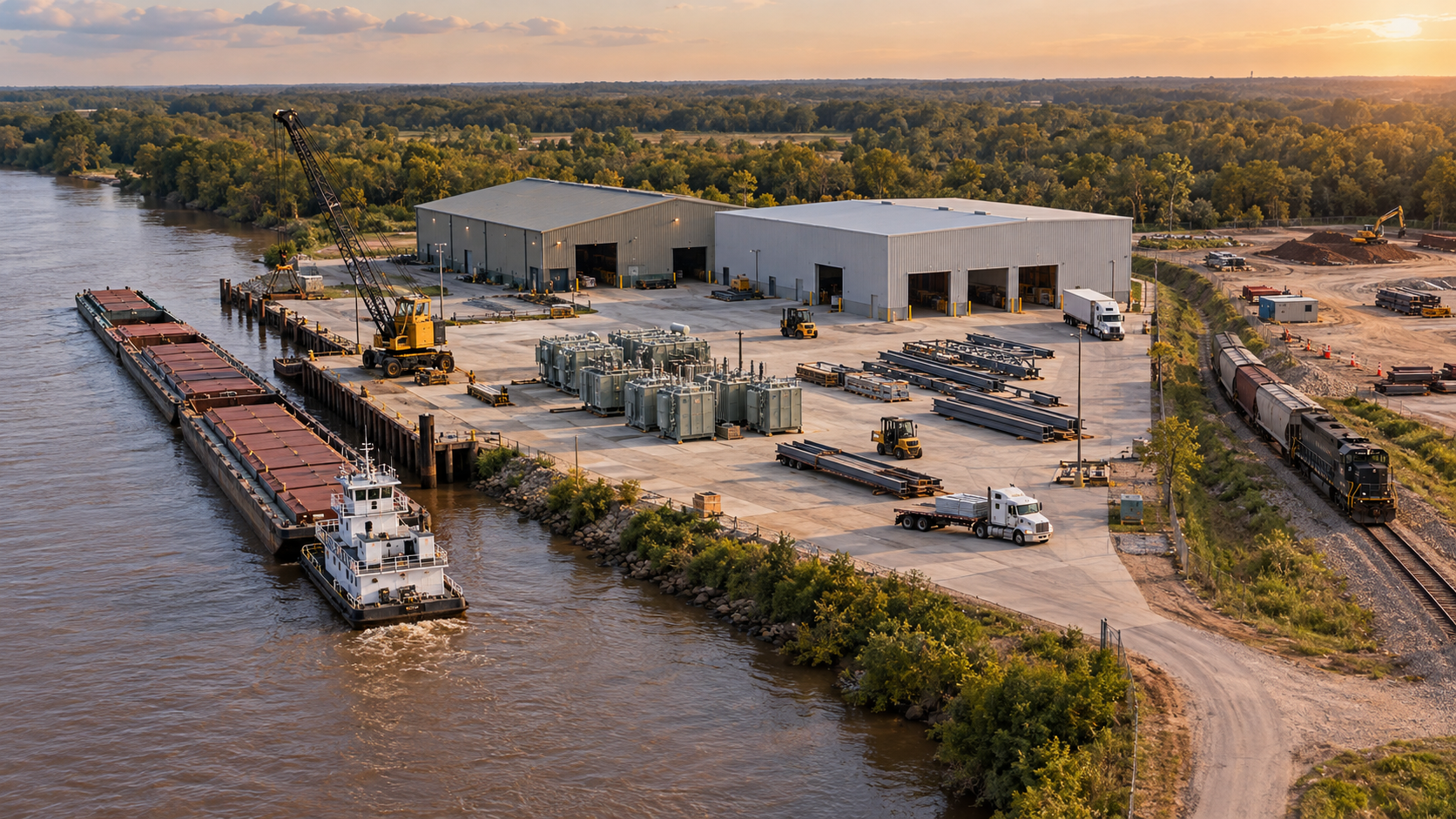
Louisiana invests millions in inland ports – and focuses on more industry – Creative image on the topic, with AI: Xpert.Digital
More storage space, more production? Louisiana's bet on two inland ports
Why new port areas could be crucial for Louisiana's industry
Louisiana is expanding its inland ports: What's behind the multi-million dollar investments?
Louisiana is investing more than $4.5 million in the expansion of two inland ports. In Campti, additional storage space will enhance the utilization of the Natchitoches Parish Port; in Alexandria, a heavy-load area is being built to support the growth of substation manufacturer DisTran Packaged Substations. These projects address an often underestimated bottleneck: a lack of storage and staging areas can slow down industrial operations and delay larger investments.
However, new land alone guarantees neither additional production nor sustainably viable revenue. The crucial factors are whether companies actually use it, whether it aligns with transportation connections and operational requirements, and whether the anticipated economic benefits become measurable. Louisiana is pursuing a location strategy that aims to provide infrastructure early on and recoup the invested public capital later. The two port projects therefore demonstrate not only how industrial development can be prepared, but also how the success of such investments must ultimately be measured.
Louisiana's inland ports: How storage areas enable industrial investment: Without concrete, location policy remains a promise
Louisiana is investing in two inland ports not simply in additional storage space, but in the ability to capitalize on industrial growth opportunities in a timely manner. A total of more than $4.5 million will be invested at Natchitoches Parish Port and Central Louisiana Regional Port to eliminate bottlenecks, support existing businesses, and improve conditions for further development.
What's economically important isn't so much the absolute amount of these sums, but rather their position within industrial value chains. A missing warehouse or an insufficiently robust outdoor area can delay a significantly larger production project. Conversely, concrete alone doesn't create a competitive location. The crucial factor is whether the additional space can be combined with actual demand, suitable transport links, qualified employees, and sustainable revenue.
These two projects therefore demonstrate more than just regional infrastructure maintenance. They represent a location policy that doesn't wait until a company has already made its investment decision before supporting economic development. Louisiana is preparing land so that investments can be made more quickly and with fewer implementation hurdles. This strategy is understandable, but it remains a gamble on land use and solvency. Its success will later have to be measured by production, capacity utilization, and capital return.
Small amounts, big bottleneck
At Natchitoches Parish Port in Campti, $2.55 million is earmarked for site preparation and additional storage capacity. Central Louisiana Regional Port in Alexandria will receive nearly $2 million for a heavy-duty area to support the growth of DisTran Packaged Substations. This funding addresses two distinct objectives in Louisiana: expanding the overall usability of an industrial and logistics site in Campti, and focusing on a specific industrial need in Alexandria.
This distinction is crucial for risk assessment. A site for an already expanding business has a fundamentally different starting point than a warehouse whose future users still need to be acquired. In the first case, demand can be more closely linked to existing production processes. In the second case, success depends more heavily on how well the infrastructure appeals to different companies and how convincingly the location is marketed.
Furthermore, the investment amount should not be confused with the total value of the economic activity enabled. Financing a logistics area is neither the complete expansion of production nor its sole cause. However, it can be a necessary link. If a company wants to build additional production capacity but lacks space for material receiving, intermediate storage, and shipping, a comparatively small infrastructure measure may become the crucial component of the overall project.
This leads to a factually sound perspective: The projects are more interesting as targeted investments to address bottlenecks than as blanket promises of growth. Their quality is measured by which previously blocked processes they actually enable.
Campti expands its industrial reach
Natchitoches Parish Port currently has approximately 62,000 square feet of storage space, equivalent to about 5,760 square meters. The planned expansion is expected to nearly double this capacity. This could bring the total storage area closer to approximately 11,500 square meters; however, an exact doubling of the final area is not guaranteed.
For a regional inland port, such a change is significant. Additional covered space not only increases storage capacity but also allows for the spatial separation of goods flows, the protection of sensitive goods, and the organization of different uses side by side. The planned expansion is therefore intended to facilitate not only storage and logistics but also manufacturing, processing, and cargo handling.
The $2.55 million will cover, among other things, terrain modeling, foundations, the base slab, and additional hall space. However, this does not allow for a reliable, complete construction cost per square meter. For that, the precise additional usable area, the technical equipment, all other financing components, and a final cost breakdown would be required. A supposedly precise economic indicator based on incomplete data would be more misleading than an openly acknowledged data gap.
Construction is expected to begin towards the end of 2026, with completion in 2027. The period between the construction decision and productive use is therefore economically crucial. If the acquisition of suitable tenants only begins after the work is finished, additional downtime will occur. However, if technical requirements and potential leases are coordinated early on, the hall can transition more quickly into a reliable revenue stream.
The value of flexible hall spaces
A warehouse's economic value isn't solely determined by its size. Crucially, it must be able to accommodate a variety of processes and how complex a change of user would be. Therefore, Campti's analytical advantage lies in its versatile design: sufficiently robust floors, suitable access routes, sensibly positioned gates, and utilities that support industrial activities.
This presents a conflict of objectives. A highly specialized hall might be particularly valuable to a specific business, but remain unattractive to other potential tenants. A universally usable hall facilitates re-leasing, but may not meet the requirements of demanding manufacturing processes. Therefore, the right solution does not automatically lie in maximum flexibility, but rather in a logical balance between likely demand and reasonable conversion costs.
Spatial organization also influences yield. If delivery, storage, processing, and shipping can be handled without mutual interference, the same area can deliver greater economic output. An additional hall could also prevent production areas from being used as unplanned temporary storage. The benefit would then be not only more space, but also better utilization of existing facilities.
Such effects are more important for the evaluation than an isolated floor space figure. However, without information on contract durations, rental prices, occupancy intentions, and operating costs, a reliable return on investment cannot yet be calculated for Campti. The almost doubled capacity describes a physical possibility, but not yet a proven economic success.
Alexandria is focusing on heavy industry
A 10-acre heavy-load area is being created at the Central Louisiana Regional Port. This corresponds to approximately 4.05 hectares, or about 40,470 square meters, and not 10 hectares. The difference is significant because confusing the units would greatly exaggerate the actual size of the project.
Such a paved outdoor area must bear heavy loads and enable the orderly movement of heavy materials. Its economic benefit lies in the interplay of load-bearing capacity, drainage, maneuvering capabilities, and connection to production and storage areas. For large-volume industrial components, any unpaved area is not a suitable substitute.
The new area is part of a 71.8-acre (approximately 29-hectare) industrial manufacturing and logistics campus. It will receive raw materials and finished products and prepare them for the next stages of production and transportation. Its purpose is therefore not simply to store goods. It connects material supply, industrial processing, and shipping within a growing production environment.
By mid-August 2026, more than half of the heavy-load area was already completed, and some sections were already in use. The remaining work is scheduled for completion by November 1, 2026. This significantly distinguishes Alexandria from Campti in terms of timing: while the hall expansion there is still pending, some of the additional logistical benefits are already available here. This earlier use can be economically significant because the capital investment does not remain without operational benefit until full completion.
Substations need more than manufacturing
DisTran Packaged Substations develops and supplies high-voltage substations and related system concepts. With factory-prefabricated solutions, key work steps are consolidated in a controlled manufacturing environment before the units are delivered to their installation site. This makes coordination between industrial manufacturing and on-site logistics particularly important.
Upstream manufacturing can shift activities from the final point of use to a more predictable production environment. This requires components to be available on time and finished assemblies to leave the factory in the correct sequence. Additional external areas can support this coordination by decoupling material receipt, intermediate storage, and shipping preparation.
The potential productivity gains, therefore, do not automatically result from higher inventory levels. They arise when there is less search effort, fewer internal transfers, and fewer interruptions. An organized staging area can prevent already manufactured components from hindering the next production step. At the same time, it may allow for the mitigation of uneven delivery dates without immediately halting production.
More storage space can, however, also mask inefficiencies. If materials are ordered too early, poorly allocated, or not processed on time, inventory and tied-up capital increase. In such cases, the new space is used, but not necessarily productively. Therefore, for Alexandria, the focus should not be solely on the occupancy of the heavy-duty storage area. More meaningful metrics would be throughput times, on-time deliveries, and the amount of additional production output associated with the space.
The electricity demand extends all the way to the port
The connection between an inland port and the expansion of electrical infrastructure is closer than it initially appears. Additional data centers and industrial power applications increase the demand for grid infrastructure; consequently, their industrial supply chains also gain in importance. Alexandria is positioning itself within this context by supporting a substation provider, although this does not automatically guarantee a specific increase in sales.
In September 2026, the forecast for US electricity sales was 4,135 billion kilowatt-hours for 2026 and 4,211 billion kilowatt-hours for 2027. Electricity generation was projected to increase by 2.2 percent to 4,368 billion kilowatt-hours in 2026, with a further 1.7 percent growth expected for 2027. Electricity sales and electricity generation are distinct metrics and should not be equated in an analysis.
This development generally creates a favorable demand environment for electrical infrastructure providers. At the same time, supply chains continue to show bottlenecks: For distribution transformers, delivery times increased from three to six months in 2019 to twelve to thirty months in 2023. These historical figures describe the market situation at that time and do not automatically reflect delivery times in October 2026.
This leads to a sober assessment of the port projects. Additional logistics space can support operations, but it doesn't solve the shortage of transformers, skilled workers, or upstream materials. The benefit is greatest when the space actually eliminates a significant bottleneck and doesn't merely shift another bottleneck spatially.
Three transport routes, different tasks
Natchitoches Parish Port connects the Red River to the CPKC railway and road network. This combination is a key locational advantage, as it allows for the organization of different freight flows via various modes of transport. However, it does not automatically make the port the most cost-effective solution for every transport task.
For heavy or bulky goods, waterways can be a viable option. Rail can support longer land-based transport chains, while trucks offer flexible connections to suppliers and customers. However, whether switching between modes of transport is economical depends on distance, quantity, handling effort, and time required. More options are valuable, but not every additional transshipment creates an advantage.
For operational decisions, the total costs up to the point of use are therefore crucial. This includes not only the actual freight but also pre- and post-carriage, intermediate storage, tied-up capital, and the risk of delayed delivery. A transport option that appears inexpensive on paper can become unattractive if unreliable arrival times result in high safety stock levels or production interruptions.
The new storage and staging areas can be particularly beneficial at this interface. They allow for the temporal separation of delivery and further processing. Their economic role then lies less in mere transshipment than in stabilizing industrial processes. However, for this to work, transport connections and internal processes must be effectively coordinated.
The waterway sets limits
The Red River is a developed inland waterway with five locks and weirs. The planned shipping channel is nine feet deep and 200 feet wide, which is approximately 2.74 meters deep and 61 meters wide. These technical dimensions clarify that this is an inland navigation corridor and not a seaport with direct handling of large ocean-going vessels.
The usable transport capacity remains dependent on the functionality of the overall system. An additional warehouse cannot replace a closed lock. Likewise, a new heavy-load area cannot compensate for every restriction on the waterway. Location quality therefore arises from the interaction of local facilities and supra-regional connections.
For companies, multimodal connectivity is particularly valuable when alternative routes are readily available in case of disruptions. A rail connection on the map is insufficient if suitable railcars are not available at short notice. Road transport offers only limited assistance if heavy components cannot be transported without additional technical assessment. Therefore, capacity must be evaluated based on specific goods categories and realistic alternative options.
Potential environmental benefits cannot be quantified in general terms. Without information on transport volumes, capacity utilization, distances, and actual traffic modal shifts, a concrete reduction in emissions cannot be reliably determined. The infrastructure offers possibilities; which of these will be utilized and with what results will have to be shown by subsequent operation.
LTW Intralogistics Solutions

LTW Intralogistics – Engineers of Flow - Image: LTW Intralogistics GmbH
LTW offers its customers not individual components, but integrated complete solutions. Consulting, planning, mechanical and electrotechnical components, control and automation technology, as well as software and service – everything is networked and precisely coordinated.
In-house production of key components is particularly advantageous. This allows for optimal control of quality, supply chains, and interfaces.
LTW stands for reliability, transparency, and collaborative partnership. Loyalty and honesty are firmly anchored in the company's philosophy – a handshake still means something here.
Related to this:
Innovative Port Strategies for Louisiana
Prepared areas sell time
Louisiana's location strategy focuses on making industrial sites more usable before a concrete decision is made to locate there. This stems from an understandable economic problem: companies invest not only money but also time in site preparation. The more technical and legal questions remain unanswered, the greater the uncertainty before production begins.
A prepared site can reduce this uncertainty. For example, once soil conditions, access, and utilities are clarified, a project can be planned more realistically. The crucial point is not to anticipate every possible future requirement. It's about eliminating those uncertainties that affect multiple potential users equally.
Economically, such a location possesses option value. It allows for future investment without committing to it in advance. The state thus finances part of the prerequisites for future decisions. This value can be substantial, but remains more difficult to measure than the size of a warehouse or the length of a railway siding.
This is countered by the risk of premature investment. If construction begins too early and demand fails to materialize, operating costs and tied-up capital are incurred. If investment is delayed, an economic opportunity may be missed. The appropriate strategy, therefore, does not consist of building as much as possible for future use, but rather of phased preparation: removing general obstacles early on and linking user-specific features as closely as possible to reliable demand.
A fund instead of one-off funding
The FastSites program is financed by the Site Investment and Infrastructure Improvement Fund, whose volume has been increased by $50 million to a total of $200 million. This represents a one-third increase compared to the original $150 million. Louisiana is thus not only expanding the capabilities of two ports but also strengthening the financial foundation of a statewide site development strategy.
The key difference from a purely grant-based approach lies in the planned repayment. The partners in the two port projects are expected to fully repay the invested public funds so that the capital can later be used for other infrastructure projects. This means that public financing will repeatedly enable economic advance payments, rather than being permanently depleted after a single disbursement.
FastSites can generally use various forms of financing, including loans and equity investment models. Therefore, it would be inaccurate to describe all program funds indiscriminately as traditional bank loans. However, the full repayment of government capital is planned for both port projects.
This approach has a plausible advantage: a limited capital stock can support multiple site developments over time. However, this does not create unlimited financing flexibility. As long as capital is tied up in ongoing projects, it is not available for further investments. Therefore, the speed, reliability, and actual amount of returns are just as important as the initial size of the fund.
Repayment is not yet a return
A dollar repaid is not necessarily worth the same economic value as a dollar invested today. Time, inflation, and the risk of default lie between disbursement and repayment. Therefore, full nominal repayment should not automatically be equated with an instrument that is cost-free for the government.
In addition, there are administrative costs, technical inspections, and ongoing monitoring. Even if the entire original amount is repaid, such expenses may remain. To assess financial viability, information on interest rates, collateral, payment terms, and the handling of delays would also be necessary. Without this information, the actual subsidy value cannot be reliably determined.
For economic evaluation, two levels should be considered separately. The first concerns the fund: How much capital will be returned, when, and with what risk? The second concerns the regional impact: What additional production, employment, and value creation will be enabled? A project can be convincing on one level and weak on the other.
A full repayment, for example, would be financially welcome, but it doesn't prove that an investment would not have been made without government assistance. Conversely, a project can generate significant regional benefits even if the immediate returns are slow. A sound evaluation must keep these differences visible, rather than summarizing all outcomes in a single, supposedly decisive success metric.
What the investment leverage really means
The program outline states a total volume of approximately US$28.9 million for the industrial expansion at the Central Louisiana Regional Port. This includes a FastSites contribution of roughly US$1.9 million and a port-side contribution of approximately US$27 million. These figures refer to the broader expansion project and not solely to the new heavy-load docking area.
The government's FastSites contribution thus amounts to approximately seven percent of this reported sum. This suggests a significant correlation with other investments. However, this does not yet prove a causal link. Not every dollar spent outside the program was necessarily triggered by the government contribution.
Likewise, the entire remaining amount cannot automatically be treated as private capital. A contribution from the port and other participating entities is not synonymous with purely private-sector financing. The decisive factor is the actual origin of the funds, not their position outside of a specific funding program.
For a reliable impact analysis, it would therefore be necessary to ask which parts would have been implemented unchanged, later, or not at all without FastSites. If the program primarily accelerates the timeline, its benefit lies in the earlier availability of resources. If it closes a critical funding gap, its significance can extend beyond that. Both approaches are possible, but they should not be confused.
Acceleration can be more economical than subsidies
A key benefit of financing can be the ability to implement worthwhile investments sooner. The Central Louisiana Regional Port specifically addresses the time gap between industrial demand and available infrastructure funds. This bridging of the gap is economically significant because a company's production planning cannot wait indefinitely for public funding schedules.
Making areas available earlier can allow for an earlier start to production. This could lead to additional revenue, more stable delivery dates, or avoided alternative costs. However, whether such advantages actually materialize depends on whether the area lies on the critical path of the overall project. If another part of production is already delayed, the earlier concrete pour may offer little additional benefit.
A precise evaluation would therefore need to consider the entire project timeline. Which specific activities are being prioritized? What other prerequisites must be met simultaneously? And will the acceleration result in higher construction costs that offset some of the time saved? Only these questions will reveal whether faster is actually more economical.
The already utilized sections in Alexandria are revealing in this respect because operational use began before the entire sub-project was completed. They demonstrate early utilization, but not yet a quantifiable increase in productivity. This distinction prevents a plausible benefit from being prematurely presented as a fully proven return on investment.
Regional development needs multiple partners
The projects combine state development policy with regional implementation. Louisiana Economic Development, under Susan B. Bourgeois, provides the economic policy framework, while Travis Tyler, as head of the Natchitoches Parish Port, is responsible for local development. Representative Jack McFarland and the North Louisiana Economic Partnership, under Justyn Dixon, are also among the participating regional stakeholders.
This situation is not only relevant from an organizational perspective. A port can develop land, but it cannot, on its own, create all the prerequisites for a successful industrial development. In addition to buildings and transport connections, companies may need suitable employees, reliable utility connections, and competent contacts for day-to-day operations. If responsibilities are fragmented, even a technically well-prepared site can remain difficult to use.
Conversely, a joint approach can facilitate coordination. Port operators are familiar with the operational possibilities of the location, regional economic development agencies can reach out to potential users, and government agencies can support overarching infrastructure issues. The economic added value arises from resolved interface problems, not simply from the number of participating institutions.
Ultimately, companies need to be able to identify who can provide binding information about space, technical equipment, and schedules. Site readiness is therefore also a question of institutional reliability. A prepared building loses value if key decisions remain unresolved between multiple parties.
Jobs are not created from square meters
The expansions are intended to strengthen existing businesses and improve the conditions for additional industrial employment. However, the project description does not specify a reliable number of new permanent jobs created for the specific warehouse project in Campti. Therefore, it would be inadmissible to automatically infer a corresponding increase in employment from the almost doubled warehouse space.
A distinction must also be made between the construction phase and continuous operation. Construction work generates temporary employment. Permanent jobs only arise through the economic use of the new facilities. Their number depends on the activities that actually take place there: Pure storage can have a different employment profile than assembly, manufacturing, or technical processing.
The quality of employment also matters. For a regional economy, stable, skilled jobs with opportunities for further training can be more valuable than a larger number of short-term positions. Conversely, a highly automated company with few employees can generate considerable added value. Therefore, the number of jobs and economic productivity should be considered together.
Particular caution is needed regarding indirect effects. Additional demand may arise among suppliers or in local businesses, but this demand may not remain entirely within the region. Without information on purchasing relationships, commuting patterns, and income expenditure, a concrete assessment of the employment multiplier would be speculative. The projects create opportunities for regional development; the extent of these opportunities must be demonstrated based on actual utilization.
The dangerous difference between growth and displacement
A new business establishing itself at a port does not automatically translate into additional economic gains for the entire state. If a company merely relocates from another location within Louisiana, the local impact may appear positive, while generating only limited additional activity statewide. Therefore, an economic analysis must select the appropriate spatial level of analysis.
For the port community, additional rents, employment, and demand are crucial. For Louisiana, it's also important whether production is maintained, expanded, or established within the state. From a national perspective, it would be necessary to examine again whether the measure creates real capacity or merely shifts regional market shares.
This raises the question of additionality. Public funds are particularly effective when they enable a profitable, socially beneficial investment that would otherwise not be possible, or would only be possible much later, due to a specific infrastructure obstacle. Financing that merely makes a project that would be implemented unchanged anyway cheaper would be less convincing.
This does not mean that supporting existing businesses is worthless from an economic policy perspective. It can prevent relocation or enable expansion at the current location. However, such effects should be described as securing existing businesses or accelerating their growth. A precise description is more meaningful than the blanket statement that every square meter of subsidized space represents entirely new growth.
More storage capacity does not automatically mean resilience
Additional storage space can make supply chains more resilient if it allows for appropriately sized buffers. Material shortages, uneven arrivals, and changing shipping dates can then potentially be better absorbed. The economic question, however, is which inventories are truly necessary and which merely tie up capital.
A large inventory can provide short-term security but also increase costs. In addition to the purchase price, expenses arise for storage, insurance, handling, and administration. For project-specific electrical components, alternative uses may be limited. Therefore, storability is not synonymous with financial flexibility.
A differentiated inventory management concept would be sensible for the new port areas. Critical, difficult-to-replace components could be treated differently than standardized and readily available materials. The additional space should support the appropriate material availability, not simply increase volume indiscriminately.
The same applies to alternative transport routes. Resilience only develops when multiple routes are practically usable and the economic consequences of a detour remain manageable. A high number of possible connections on a location map is merely a starting point. Ultimately, the strength of a logistics location is demonstrated by how reliably it functions under normal conditions and in the event of disruptions.
Where the strategy could fail
The most obvious risk is insufficient utilization. If users stay away or their production grows more slowly than expected, ongoing costs are incurred while planned revenues are lacking. For a revolving model, this would be doubly problematic: the individual site would fall short of expectations, and capital might become available to the fund later than planned.
A second risk lies in specialization. A facility tailored to a few large users may be well-utilized, but its success depends on their business performance. More broadly usable spaces reduce this risk, but may be less efficient for demanding specialized processes. Therefore, a genuine economic tension exists between efficiency and adaptability.
Furthermore, there are technical and financial uncertainties. Construction costs, drainage, load-bearing capacity, maintenance, and utilities must remain manageable during operation. Detailed calculations of all long-term costs and revenues are currently unavailable for a reliable assessment of both port projects. Therefore, neither guaranteed profitability nor a reliable net benefit for public budgets can be asserted.
Finally, there is a portfolio risk. If many funded sites rely on the same economic climate, their revenues can come under pressure simultaneously. A fund does not become robust simply by spreading its resources across multiple projects. The economic interdependencies between these projects must also be taken into account.
What Germany can learn from this
The transferable core of the Louisiana strategy lies not in a specific amount of funding, but in the treatment of infrastructure as a time-critical component of industrial development. The question of which obstacles delay economically viable development and which of these can be overcome jointly is also relevant for European inland ports and industrial sites.
This does not imply a blanket recommendation for additional commercial space. A convincing plan should focus on realistic user groups, functioning transport connections, and demonstrable bottlenecks. A site does not become competitive simply because it is described as strategically important.
Also of interest is the distinction between general infrastructure and user-specific equipment. General access roads, load-bearing surfaces, and basic utility connections can serve multiple companies. Highly specialized manufacturing technology, on the other hand, should remain more closely tied to the respective users and their business risks. This distinction helps to differentiate between the public benefit and individual company advantages.
A repayable financing model can be an option, but it requires reliable sources of income and a clear allocation of risk. It is not automatically suitable for every socially beneficial infrastructure project. Where sufficient returns cannot be generated, a seemingly revolving instrument might only be a disguised subsidy with subsequent financing problems.
From 2027 onwards, the results will count
With $200 million in funding, FastSites has a significantly larger financial foundation than at its initial launch. A further development phase began on October 1, 2026, and runs until December 1; additional investment decisions are expected in early 2027. This also increases the importance of a verifiable success metric.
For Campti, this benchmark should initially encompass the additional space actually completed and usable. After that, occupancy, lease duration, and whether new manufacturing or logistics activities are added are also important. A fully occupied hall is an important indicator, but not yet conclusive proof of additional regional value creation.
In Alexandria, other factors are paramount. Here, it would be necessary to examine whether the heavy-load area improves production processes, stabilizes delivery dates, and supports higher industrial output. The fact that some sections are already operational provides an early starting point for such an analysis. However, the crucial factor is identifying measurable changes compared to the previous processes.
Ultimately, the fund requires tangible results in actual repayments, payment dates, and renewed investments. Only then will it become clear whether a sustainable financing cycle emerges from the capital initially provided. The relevant benchmark for Louisiana's inland ports is therefore not the scale of the political announcement, but rather the reliably usable combination of land area, production, transportation, and economic return.
Consulting - Planning - Implementation

Konrad Wolfenstein
I would be happy to serve as your personal advisor.
You can contact me at wolfenstein∂xpert.digital or
Just call me on +49 7348 4088 965 .
Your container high-bay warehouse and container terminal experts

Container terminal systems for road, rail and sea transport in the dual-use logistics concept of heavy-lift logistics - Creative image: Xpert.Digital
In a world marked by geopolitical upheavals, fragile supply chains, and a new awareness of the vulnerability of critical infrastructure, the concept of national security is undergoing a fundamental reassessment. A state's ability to guarantee its economic prosperity, the provision of essential goods and services to its population, and its military capability increasingly depends on the resilience of its logistical networks. In this context, the concept of "dual-use" is evolving from a niche category of export control to a broader strategic doctrine. This shift is not merely a technical adjustment but a necessary response to the "paradigm shift" that demands a profound integration of civilian and military capabilities.
Related to this: