
Google data center in Belgium shut down: Why water is becoming an investment risk – A halted data center as an economic warning sign
Xpert Pre-Release

Available in 27 languages 📢
Prefer Xpert.Digital on GoogleⓘPublished on: November 29, 2026 / Updated on: November 29, 2026 – Author: Konrad Wolfenstein
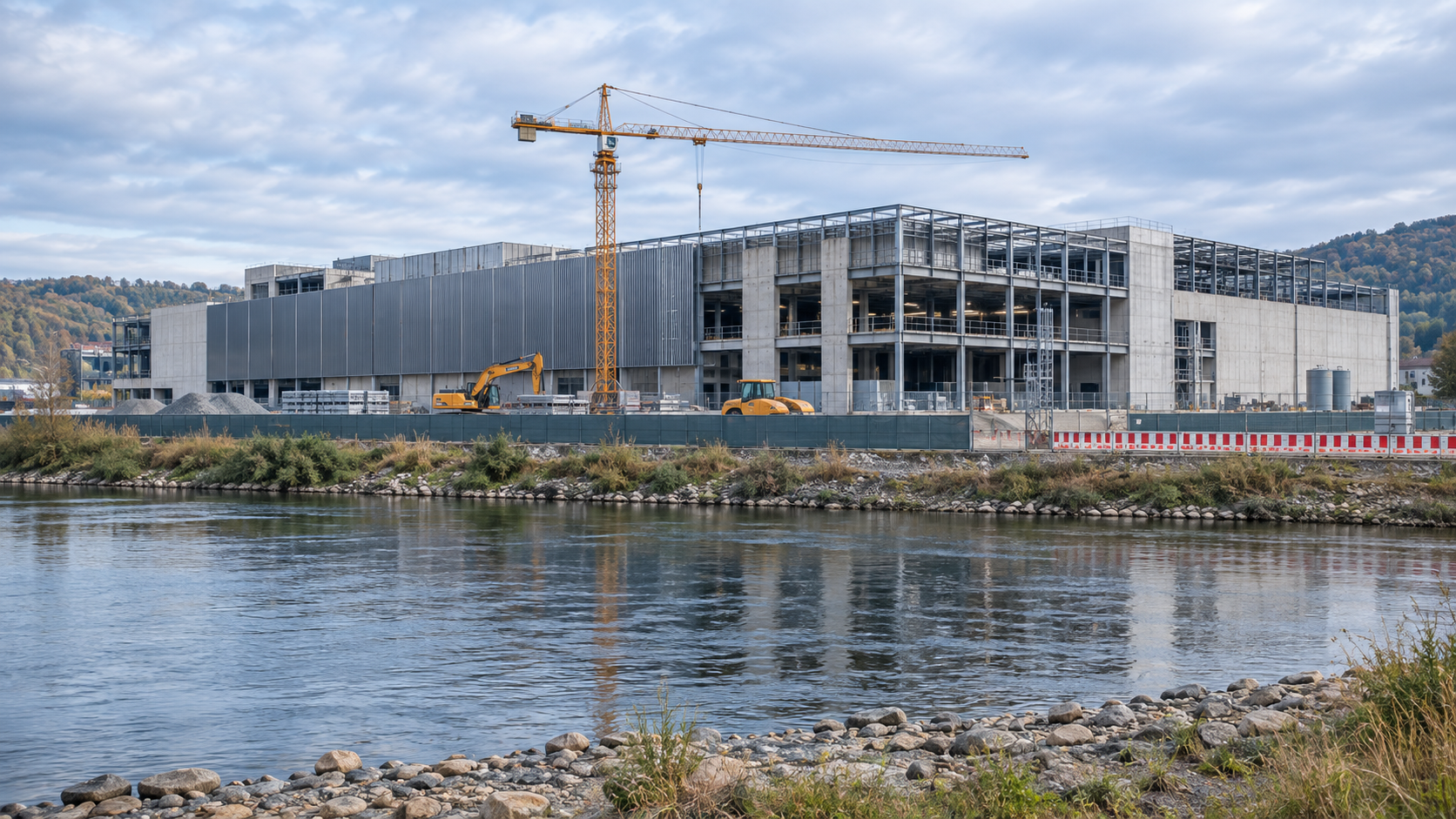
Google data center in Belgium shut down: Why water is becoming an investment risk – A halted data center as an economic warning signal – Creative image on the topic, with AI: Xpert.Digital
The cloud promises limitless growth – but water, building regulations and public acceptance cannot be scaled indefinitely
When the cloud reaches its limits: The economic price of a construction halt
Water, permits, costs: Why Google's data center became a point of contention
The halt to construction of a Google data center near Charleroi, Belgium, is more than just a local dispute over a building permit. It demonstrates how heavily the expansion of digital infrastructure now depends on traditional location factors: available natural resources, reliable permits, public acceptance, and construction planning that integrates technical changes with legal requirements in a timely manner. The economic significance, therefore, lies not only in the interruption of a single project. The crucial question is under what conditions large data centers can be reliably built and operated in the future.
Walloon authorities halted construction on November 26, 2026. Approximately 300 workers were present at the site during the inspection. A building with roughly 30,000 square meters of floor space was already largely completed in its shell construction phase. The dispute concerns a data center campus located near Farciennes, Aiseau-Presles, and Sambreville. A geographical clarification is important: according to the local council, the specific building in question is located within the municipality of Aiseau-Presles, even though the site is often referred to as Farciennes.
Economically, this reveals a fundamental contradiction. Digital services can be offered across national borders, but the necessary infrastructure remains geographically bound. Servers require buildings, power supply, cooling, and reliable operating conditions. Global demand thus clashes with local capacity limits. Those who only clarify these limits during the construction phase transform a technical investment project into a difficult-to-calculate economic risk.
How a change of plans became the central project risk
The project originated from a permit issued in 2024, which allowed for three smaller, air-cooled data centers. In 2025, Google applied for an amendment: two of the planned units were to be combined into one larger data center. At the same time, water from the Sambre River was to be used for cooling. This not only changed the physical structure but also altered the relationship between the project and its natural environment.
The administration initially approved the amendment in April 2026. However, following an objection from the public, the responsible Walloon minister, François Desquesnes, refused to approve this amended version in August. The central issue was water availability and whether the planned withdrawals would be sustainable in the long term, given increasing risks of drought. The application called for the withdrawal of 600 cubic meters of river water per hour.
This sequence of events is crucial for the economic assessment. This is not a case of a site for which no permit existed from the outset. Rather, the conflict lies in determining which works are still covered by the original permit and which belong to the subsequently rejected project modification. Google maintains that the original permit remains valid. The company also justified the continued work by citing the need to secure and preserve the site during the ongoing legal proceedings. The authorities, however, objected to the advanced stage of construction of the modified building.
For investors, this distinction is essential: An existing basic permit does not automatically protect every subsequent technical or structural development.
Why a larger plant is not automatically a better project
Merging two smaller data centers can seem plausible from an operational perspective. Larger units may allow for a greater consolidation of infrastructure, maintenance, security, and technical management. Certain fixed costs can be spread across more usable capacity. At the same time, contiguous space can simplify the planning of large IT installations.
However, these potential advantages do not necessarily mean that the larger variant is economically superior under all conditions. With increased concentration, the demands on individual supply points often rise. A larger unit may require more cooling capacity at a single location and, in the event of a malfunction, affect a larger proportion of the planned capacity. Furthermore, the impact on water resources, the power grid, or the surrounding environment may change.
The decisive benchmark is therefore not solely the construction cost per square meter or per installed unit of power. The entire project must be evaluated, including the likelihood of approval, adaptability, security of supply, and potential delays. A technically more efficient building can perform worse economically if its realization becomes significantly less certain.
The Belgian case thus exposes a classic weakness of major infrastructure decisions: local economies of scale are easily overestimated if the additional dependencies are not taken into account. The consolidation of facilities may reduce internal costs, but could also increase external conflicts. Economic size and economic resilience are not the same thing.
What 600 cubic meters of water per hour actually means
The requested water withdrawal of 600 cubic meters per hour corresponds to 600,000 liters. If this amount were withdrawn evenly throughout an entire day, this would result in 14,400 cubic meters, or 14.4 million liters. With continuous withdrawal over 365 days, this would amount to 5.256 million cubic meters per year.
This projection describes a calculated order of magnitude, not a proven annual consumption. Information on actual capacity utilization, cooling system operation, seasonal fluctuations, and potential withdrawal restrictions is lacking. Furthermore, a distinction must be made between water withdrawal and water consumption. Water that is returned to a body of water after use must be assessed differently than water that evaporates and is therefore no longer immediately available to the local water system.
For a reliable environmental and economic assessment, at least the extraction volumes, return volumes, temperatures, and seasonal operating profiles would be required. The quality of the returned water can also be relevant. A single hourly figure is insufficient to quantify the overall impact.
Nevertheless, the figure is highly significant. It makes clear that cooling a large data center is not a minor building function. It represents an independent resource decision. Especially during dry periods, the deciding factor is not the average annual water availability, but the river's capacity during critical weeks.
The economic value of water increases with its scarcity
Water is often initially recorded in investment calculations as a recurring operating cost. For large industrial users, this perspective is too narrow. What matters is not only the price of a given quantity, but also the reliability of access. An inexpensive resource is of little economic value if it is unavailable during critical operational phases.
In addition, there are the so-called opportunity costs. This refers to the benefit that others must forgo when a resource is used for a specific purpose. Water available to a data center cannot, under scarce conditions, simultaneously serve other industrial, environmental, or societal needs without restriction.
However, a proper assessment should not lead to a blanket preference for individual user groups. Digital infrastructure also generates economic benefits. Companies need computing power for communication, data processing, software, and numerous business applications. The real challenge lies in reconciling different uses under realistic conditions of scarcity.
That's precisely why the mere willingness of a financially strong company to pay is not a sufficient distribution criterion. A higher water price doesn't automatically create additional flow during a drought. Where physical limits are reached, markets need binding usage rules. Prices can create efficiency incentives, but they don't replace robust minimum environmental standards or provisions for supply conflicts.
Cooling is a conflict of objectives and not a simple technical question
The contrast between air and water cooling is often oversimplified. In reality, several technical levels must be considered: the heat absorption directly at the IT components, the transport of this heat within the building, and its final release into the environment. Therefore, a liquid-cooled server installation does not automatically imply high river water consumption. Conversely, a system with air-based heat distribution may utilize water elsewhere.
The entire cold chain is crucial. Evaporative cooling systems can reduce the electricity required for heat dissipation under suitable conditions, but they require water. Methods with low direct water consumption can result in higher electrical consumption. The International Energy Agency explicitly describes such a conflict between water and energy efficiency. Furthermore, some of the water demand for digital infrastructure arises outside the data center, particularly during power generation.
A sound site selection decision must therefore consider several factors together. These include direct water requirements, electricity consumption, the source of the electricity, operational reliability, and local climate conditions. A single favorable metric can create an incomplete picture.
For the Belgian project, this means that the rejection of the requested river water use does not yet answer which technical alternative would be most sensible overall. A comprehensible comparison of options would be necessary, one that also takes hot and dry operating periods into account.
Climate risks change the calculation over the entire operating period
A data center is not only planned for the conditions of its opening year. The building, energy supply, and essential parts of the technical infrastructure should remain economically viable over longer periods. This makes the development of the local climate a variable factor in the investment.
Simultaneous stresses can be particularly problematic. High ambient temperatures increase the demands on cooling. At the same time, low water levels can limit water intake from rivers. A system then has to cope with less favorable cooling conditions, especially during a demanding operating phase.
For investment calculations, this means that average values are insufficient. Crucial factors also include challenging combinations: heat during low water levels, high IT utilization with limited water withdrawals, or maintenance requirements during a strained supply situation. Such scenarios are not forecasts for a specific point in time, but rather assessments of technical and economic resilience.
Additional reserves initially incur costs. However, they can prevent later operational interruptions or costly retrofits. Therefore, a cheaper initial concept is not necessarily the more economical life-cycle solution. The more environmental conditions can change, the more valuable adaptability and multiple technically robust operating options become.
Capital already invested does not create an entitlement to further construction
The advanced stage of construction exacerbates the conflict. A building with approximately 30,000 square meters of floor space already ties up capital, materials, planning services, and labor. The further a project progresses, the greater the pressure to complete it.
Economically, however, expenses that have already been irrevocably incurred are sunk costs. They are important for explaining the project's progress to date, but should not dominate the evaluation of future decisions. The crucial question is which additional solution, starting today, will generate the highest justifiable benefit with acceptable risks.
From a business perspective, continuing construction might seem attractive to Google if it secures a later start of operations. However, for authorities, an institutional problem arises if advanced construction work effectively serves as an argument for retroactive approval. Such a pattern could encourage companies to circumvent legal uncertainties by presenting the existing construction work.
It need not be assumed that this was the intention in the specific case. The differing descriptions of permissible work still need to be examined. Nevertheless, the general principle is clear: The extent of investments already made does not replace either a required permit or a verifiable resource assessment.
A construction halt costs more than wasted working time
The immediate costs of a construction halt are only one part of the potential economic damage. Site setup, security, insurance, and certain contractual obligations may continue. Components already ordered may need to be stored temporarily. Companies cannot always transfer personnel and equipment to other projects without disruption.
Furthermore, the timing of technical trades is intertwined. If one phase is delayed, subsequent installations can also be affected. A later restart requires that skilled workers, deliveries, and testing capacities are once again aligned. Therefore, costs are incurred not only during the shutdown but potentially also during the resumption of work.
The delayed start of operation is also relevant for the operator. A system that goes into operation later will deliver its planned computing capacity later. How significant this is depends on demand, available alternative options, and internal capacity planning.
It is not possible to reliably determine specific damage figures for the Belgian project based on this information. Details regarding investment volume, construction contracts, completion schedule, and economic capacity utilization are lacking. However, the general trend is clear: delays can negatively impact profitability even if a project is ultimately allowed to proceed unchanged.
Our EU and German expertise in business development, sales and marketing

Our EU and German expertise in business development, sales and marketing - Image: Xpert.Digital
Industry focus areas: B2B, digitalization (from AI to XR), mechanical engineering, logistics, renewable energies and industry
More information here:
A thematic hub offering insights and expertise:
- Knowledge platform covering global and regional economies, innovation and industry-specific trends
- A collection of analyses, insights, and background information from our key areas of focus
- A place for expertise and information on current developments in business and technology
- A hub for companies seeking information on markets, digitalization, and industry innovations
Technical flexibility in large infrastructure projects
Certainty of permits is a productive location factor
In location debates, permits are often treated as an additional bureaucratic burden. From a business perspective, however, the speed of the process is not the only decisive factor. The consistency of the decision and the clarity of its scope are at least as important.
A decision issued quickly loses some of its economic value if fundamental conflicts remain unresolved for years afterward. Conversely, a more rigorous procedure can facilitate implementation if it addresses objections early on and establishes legally sound conditions.
For large data centers, regulatory compliance should therefore be considered an integral part of the infrastructure. It fulfills a similar function to a reliable power supply: it makes future operations more predictable. Without this predictability, companies must expect additional reserves, delays, and potential changes to the system design.
The Belgian case also illustrates the importance of clear change processes. If building size and cooling concept change during project development, the consequences must be systematically reassessed. An initial permit can only be reliable for the specific implementation authorized within it.
An investment-friendly state is therefore not necessarily one with the lowest possible requirements. Above all, an investment-friendly state is one that establishes comprehensible rules in a timely manner and then consistently applies them.
What the 300 employees say about the regional benefits
The approximately 300 people working on the construction site demonstrate that a data center project can have significant immediate employment effects. Construction companies, technical equipment suppliers, transport companies, and various service providers can experience additional demand during the construction phase.
However, this figure should not be equated with subsequent permanent employment. The construction and operational phases follow different economic structures. During construction, material- and labor-intensive activities are paramount. During operation, regional employment effects depend more heavily on maintenance, technical support, safety, and the involvement of local service providers.
The number of permanent jobs expected to be created at a specific location cannot be determined from the construction site workforce. Similarly, it is unknown what proportion of the construction work will actually be carried out regionally. A reliable benefit assessment therefore requires separate data on temporary employment, permanent jobs, and local value creation.
This leads to an important requirement for regional policy: A large construction project should not be evaluated solely on the basis of its visible initial effects. What matters is its long-term contribution to the economic structure and the scarce resources it permanently ties up for it.
Digital infrastructure must first enable regional value creation
A data center can be a crucial foundation for economic digitalization. However, this does not automatically mean that the surrounding region will benefit from increased productivity to the same extent. Several intermediate steps lie between the physical presence of servers and the economic success of local businesses.
Regional businesses need to be able to use digital applications effectively. This requires suitable software, expertise, organizational changes, and often support with data management and security. A nearby data center alone cannot solve these problems.
The regional economic impact of a project increases when it is linked to skills development, local supplier relationships, and application-oriented collaboration. Partnerships with technical educational institutions or the development of specialized maintenance and infrastructure expertise would be conceivable examples.
A distinction must be made between potential and promised effects. For the controversial building, such additional regional effects cannot be quantified based on the available project data.
The economic policy conclusion remains important: the establishment of large-scale digital infrastructure is no substitute for a broader innovation strategy. It can be a building block if companies, workers, and public institutions can actually utilize the resulting opportunities.
Why economic power does not determine local distribution
For a global technology company, investment decisions are embedded in an international context. A location is assessed based on its contribution to the overall strategy. For a municipality or region, the calculation is different: it bears some of the local impacts and receives a share of the economic benefits.
These perspectives can diverge. A project might be highly profitable for the corporation, while the regional impact is less clear. Conversely, socially beneficial investments can only become economically attractive for an individual company under certain conditions.
Therefore, burdens and benefits must be assessed separately. Who gains jobs, contracts, or additional revenue? Who bears resource risks, infrastructure adaptation costs, or potential restrictions on other uses? If these questions are not answered transparently, even an economically significant project can lose public support.
An objective assessment avoids both extremes: A large investment is not automatically a societal benefit, nor is high resource demand automatically evidence of economic folly. What matters is the additional value created in relation to the actual costs and risks incurred.
Citizen participation can delay conflicts or defuse them at an early stage
Public objections and the intervention of Greenpeace were crucial elements in this development. Following the dispute over the amended permit, the environmental organization initiated an urgent inspection of the construction site. This inspection resulted in the authorities halting construction.
For companies, such participation often initially appears as an additional source of uncertainty. However, from an economic perspective, it can also be understood as an information mechanism. Residents and community organizations can point out burdens that are not adequately considered in a purely internal corporate analysis.
This does not mean that every objection is technically valid or every demand reasonable. Participation requires transparent procedures and verifiable arguments. Likewise, authorities must be able to make decisions without leaving every controversy indefinitely unresolved.
However, the alternative to early involvement does not automatically guarantee a conflict-free project. If contentious issues only become apparent during advanced stages of construction, costs increase for all parties. Therefore, an open discussion about water requirements, technical options, and operational limits can be more economically advantageous than later legal and administrative escalation.
Social acceptance does not replace approval. However, it can significantly support its practical viability.
The legal dispute will not yet decide the final outcome of the project
On October 17, 2026, Google filed an appeal with the Belgian Council of State against the rejection of its amended permit. A public hearing is scheduled for January 7, 2027. Greenpeace and several private individuals also intend to submit their arguments to the proceedings. Therefore, the further legal course of the case remains open at this time.
The construction halt therefore does not automatically mean that the entire data center project must be permanently abandoned. Likewise, the ongoing legal appeal does not imply that the modified design will ultimately be permissible.
For an objective economic analysis, these levels must be distinguished. The current standstill is a real burden on the project. The final scope of possible adjustments, however, remains uncertain. The question of which work already undertaken is covered by existing permits also falls under the legal and regulatory clarification process.
This interim phase is particularly relevant from an economic perspective. Companies must make decisions even though the final outcome is not yet known. In such situations, the value of reversible measures increases: steps that ensure necessary security without creating additional, difficult-to-reverse commitments.
Technical flexibility is becoming an economic asset
Adaptable planning can be extremely valuable in large-scale projects. This includes the ability to combine different cooling methods, separate construction phases, or commission capacities gradually. Such options may initially seem more complex than a concept tailored entirely to a single operating mode.
Their benefits become apparent, however, when assumptions prove incorrect. If water withdrawal is restricted, an alternative heat dissipation method can be crucial. If a sub-project is delayed, an independent initial expansion phase may still be usable. If demand changes, the expansion can be adjusted accordingly.
Flexibility, however, comes at a price and is not always beneficial. Additional systems require space, capital, and maintenance. The economic challenge lies in comparing their cost with the risk avoided.
Without detailed technical planning, it's impossible to say which alternatives would actually be feasible for the Belgian site. The general conclusion remains: a plant optimized for minimal initial costs can be at an economic disadvantage compared to a slightly more expensive, adaptable solution as soon as permitting or resource conditions become uncertain.
Waste heat can create benefits, but it cannot resolve water disputes
The use of waste heat is frequently cited as a way to better integrate data centers into regional economic cycles. In principle, heat that would otherwise be released unused into the environment can be given an additional purpose.
Whether this results in a viable business model depends on specific conditions. Suitable customers, an appropriate distance, technically usable temperature levels, and sufficiently reliable demand are required. Furthermore, pipelines, potential heat pumps, and contractual safeguards must be economically feasible.
The timing is particularly important. A data center generates heat even when surrounding buildings require little heating energy. Therefore, a calculated annual potential says little about the actually usable amount.
For the Belgian project, there is insufficient information available to determine a specific contribution. Waste heat utilization should therefore be treated as a supplement to be examined, not as an existing advantage.
Above all, it does not replace an independent assessment of water withdrawal. Additional regional benefits can improve the overall balance, but they do not eliminate the physical limits of a river's capacity.
Three economic development paths remain conceivable
Several scenarios can be distinguished for further developments, without assigning a specific probability of occurrence to each. One path would be a legally confirmed implementation of the amended version, possibly under additional conditions. Economically, the consequences of the delay and any potential requirements would then be the most significant.
A second option would be a technical or structural redesign. This could involve adapting parts of the project to alter resource requirements or other impacts. Whether this would be feasible and economically viable would depend on the existing structure and the technical requirements.
A third option would be a more comprehensive reorganization of the expansion plan. This could include a revised timeline or different capacity decisions. Again, this is not a prediction, but a fundamental course of action in the event of major infrastructure conflicts.
For all scenarios, the later fundamental planning assumptions are changed, the higher the adjustment costs may be. At the same time, it would be wrong to cling to a permanently unsuitable solution simply because of costs already incurred. The most economically viable continuation must take future conditions into account, not just the expenses incurred so far.
Europe's business location quality depends on robust rules
This case is also relevant to the European debate on economic competitiveness. Digital infrastructure is intended to support economic performance. For this, Europe needs investment, technical expertise, and sufficient computing capacity. However, these goals are not separate from existing land, energy, and water management.
A competition based on the lowest possible requirements would therefore be short-sighted. It could attract projects whose true burdens only become apparent later. Equally problematic would be unpredictable regulation where companies cannot reliably identify fundamental requirements even after extensive planning.
A convincing location policy combines both: clear ecological and legal boundaries as well as a reliable path to implementing suitable projects. This includes early availability of information about resources, coordinated responsibilities, and robust evaluation criteria for technical options.
For large international investors in particular, this reliability can be more important than an initially very generous commitment. A location is attractive in the long term if it not only allows for construction but also for stable business operations over many years.
The crucial lesson: Growth must be fully calculated
The construction halt at Charleroi is neither proof that Europe fundamentally hinders digital investments, nor sufficient evidence of the ultimate failure of the Google project. Rather, it demonstrates how costly an incompletely coordinated combination of technology, resources, and permits can become.
The sound economic perspective is therefore that data centers should not be evaluated solely on construction costs, capacity, and energy efficiency. Water availability, climate resilience, legal compliance, and actual regional benefits are equally important. These factors are not retrospective adjustments to an otherwise complete investment calculation; they belong at its core.
For Google, the challenge lies in achieving a technically sound and legally viable solution. For the authorities, it's about managing resources proactively while simultaneously ensuring transparent investment conditions. For the region, the crucial question is whether the project will ultimately result in more than just a large construction site with significant utility needs.
The digital economy can enable enormous additional services. However, its physical infrastructure remains scarce and geographically bound. Therefore, sustainable competitiveness will not be achieved by ignoring this limitation the longest, but by translating it into economically sound decisions early on.
🎯🎯🎯 Data-driven B2B industry hub as a quasi-in-house solution

The quasi-in-house solution: How Xpert.Digital closes operational gaps in B2B marketing and sales – Smart Content-Driven Business - Image: Xpert.Digital
Xpert.Digital is a data-driven B2B industry hub led by Konrad Wolfenstein . The company acts as an external, quasi-in-house solution for industrial partners, closing operational gaps in marketing, content, and sales – without requiring additional resources on the client side.
More information here:
Your global marketing and business development partner
☑️ Our business language is English or German
☑️ NEW: Correspondence in your native language!

Konrad Wolfenstein
I and my team are happy to be available to you as your personal advisor.
You can contact me by filling out the contact form here [email protected]:or simply call me at +49 7348 4088 965. My email address is
I'm looking forward to our joint project.