
Deutsche Telekom is launching a huge AI data center in Munich – what does this mean for digital sovereignty?
Xpert Pre-Release

Available in 27 languages 📢
Prefer Xpert.Digital on GoogleⓘPublished on: February 8, 2026 / Updated on: February 8, 2026 – Author: Konrad Wolfenstein
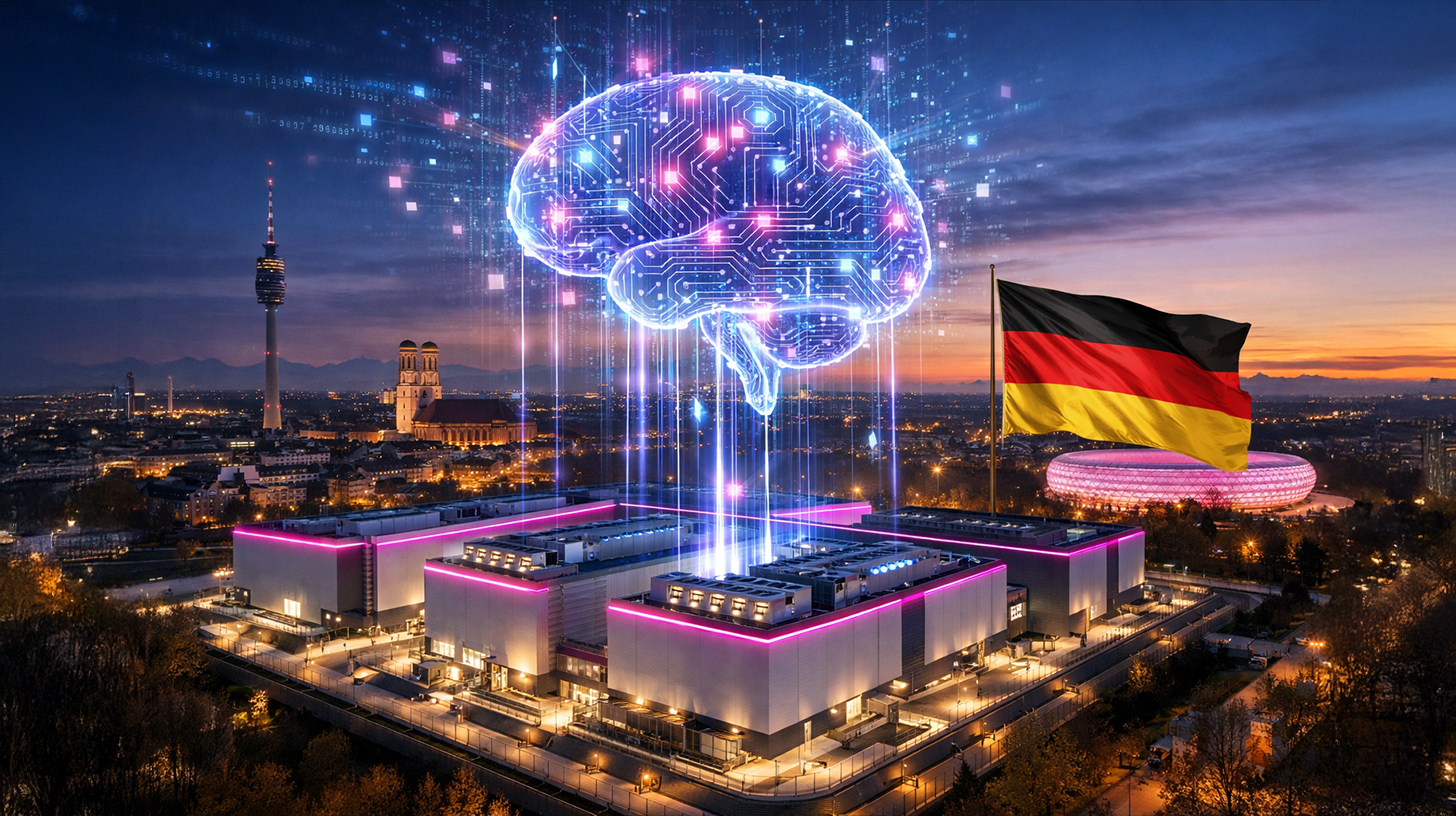
Deutsche Telekom launches huge AI data center in Munich – what does this mean for digital sovereignty? – Creative image: Xpert.Digital
Half-truths instead of sovereignty: What politicians and telecommunications companies are concealing at the AI launch
Digital sovereignty or dependence? The risky game with the new super data center
The 10,000 GPU bluff: Why German hardware doesn't protect against the US CLOUD Act
It's being hailed as a breakthrough for German digital policy: Deutsche Telekom has launched a gigantic AI data center in Munich, equipped with 10,000 graphics processors, which is intended to kick-start Europe's technological catch-up. But behind the jubilant headlines about "digital sovereignty" and "data storage in Germany" lies a complex reality that politicians and business leaders are reluctant to discuss.
While the Munich location suggests physical security and adherence to German data protection standards, the technical and legal infrastructure remains deeply rooted in US dependencies. From chip architecture and cloud stacks to maintenance contracts, US corporations dictate the rules – and, through the "CLOUD Act," bring direct access for American authorities to Bavaria. Critics accuse those responsible of operating with half-truths and mistaking physical security for independence. The following article examines why the concept of "digital sovereignty" in this prestigious project is more marketing than reality and why the true dependencies are often deliberately concealed.
Related to this:

German data centers, American law: Why politics and business operate with half-truths
Deutsche Telekom has launched a new, extremely powerful AI data center in Munich. According to recent reports, around 10,000 graphics processing units (GPUs) will work together there to train and run AI models. The data center is considered one of the largest in Germany and is being celebrated as a milestone for German digital sovereignty and AI strategy. Politicians and business leaders are presenting the project as a symbol of technological maturity, industrial strength, and future-oriented economic development. But behind the media hype lie complex questions: How "sovereign" is a data center really if, despite its German location, it is heavily dependent on US technology and US law? Can the construction of high-performance data centers be responsibly promoted with the buzzword "digital sovereignty"—or does this very portrayal mask existing dependencies?
What is Telekom's new AI data center in Munich?
Deutsche Telekom's new AI data center in Munich is an extremely scalable, high-performance cluster specifically designed to meet the demands of AI training and services. It is based on thousands of tightly coupled graphics processing units (GPUs) to process massive amounts of data and learn complex models. The infrastructure is designed to operate cloud-based AI services intended for use by both businesses and public sector clients. Deutsche Telekom positions the center as a key component of its cloud and AI strategy, emphasizing that data remains in Germany and operations comply with national data protection standards.
At the same time, the project is being marketed as a contribution to the German and European AI initiative: more computing power at domestic locations, less dependence on foreign cloud providers, and greater control over sensitive data. The political message is clear: Germany now has its own high-performance AI infrastructure.
More show than substance: What's really behind the facade of German cloud computing
Despite the emphasis on Germany as a location, it is often overlooked that the infrastructure itself remains heavily influenced by US technology and law. Data centers operated by Deutsche Telekom and many other providers rely on US hardware, US software, US cloud platforms, and US service providers. These entities bring their own legal systems with them – regardless of whether the servers are located in Munich, Frankfurt, or Dublin. Consequently, politicians and businesses often operate with half-truths when presenting data centers as a "German" or "European" solution.
The message is easy to communicate: here in Germany, here in Europe, therefore safe and sovereign. The technical and legal reality is more complex. The public is often presented with simplified symbols, while the actual dependencies are taboo. This happens because an honest explanation of the role of US cloud providers, chip manufacturers, and software licensing models would weaken the political narrative. Instead, the focus is placed on concrete, energy consumption, and cooling technology, while the crucial pitfalls lie in software, firmware, and cloud law.
What does digital sovereignty mean in the data center sector?
Digital sovereignty in the data center context means that a state, public institution, or company can actually control its data, its infrastructure, and the services running on it. This includes the physical location, but not only that. Equally important are the legal framework, the technologies used, the ownership structures, and the access rights. Whoever controls the chips, the software, the cloud platforms, and the legal guarantors of data processing ultimately controls sovereignty.
When data centers in Germany or Europe are celebrated, it is often suggested that location alone guarantees control and independence. In reality, however, location is only one component – albeit a visible one. What is crucial is whether the technology, architecture, and legal contracts are actually under German or European control. If these elements remain subject to US manufacturers and cloud providers, sovereignty remains limited – regardless of where the servers are located.
Why is a German data center alone not enough for sovereignty?
A German data center provides concrete, electricity, cooling, and German regulatory authorities. It is subject to German and European data protection regulations and is overseen by German supervisory bodies. Technically speaking, however, there is often little that is truly "German" about the infrastructure: The chips come from US manufacturers, the servers from US or US-dominated corporations, and the software that controls the data center comes from US companies. As soon as this US technology is integrated, the infrastructure can legally fall under US law.
This is not a theoretical scenario, but a real legal situation. The US CLOUD Act allows US authorities to compel US companies to hand over data – even if that data is physically stored outside the US. Therefore, a German data center based on US software, US cloud platforms, or US service providers is insufficient for true digital sovereignty. Sovereignty doesn't end at the property line, but where foreign legal systems and dependencies come into play. Politics and business are therefore doing society a disservice when they present location as automatic proof of independence.
A new dimension of digital transformation with 'Managed AI' (Artificial Intelligence) - Platform & B2B solution | Xpert Consulting

A new dimension of digital transformation with 'Managed AI' (Artificial Intelligence) – Platform & B2B solution | Xpert Consulting - Image: Xpert.Digital
Here you will learn how your company can implement customized AI solutions quickly, securely and without high entry barriers.
A managed AI platform is your all-inclusive, worry-free solution for artificial intelligence. Instead of dealing with complex technology, expensive infrastructure, and lengthy development processes, you receive a ready-made solution tailored to your needs from a specialized partner – often within just a few days.
The key advantages at a glance:
⚡ Rapid implementation: From idea to ready-to-use application in days, not months. We deliver practical solutions that create immediate added value.
🔒 Maximum data security: Your sensitive data stays with you. We guarantee secure and compliant processing without sharing data with third parties.
💸 No financial risk: You only pay for results. High upfront investments in hardware, software, or personnel are completely eliminated.
🎯 Focus on your core business: Concentrate on what you do best. We take care of the entire technical implementation, operation, and maintenance of your AI solution.
📈 Future-proof & scalable: Your AI grows with you. We ensure continuous optimization and scalability, and flexibly adapt the models to new requirements.
More information here:
The data center trap: Why your data isn't really safe in Germany
What role does the US CLOUD Act play?
The US CLOUD Act (Clarifying Lawful Overseas Use of Data Act) is a key instrument that allows the US to access data located outside the United States. The law permits US authorities to compel US companies—such as cloud providers, software manufacturers, or hardware service providers—to provide data, even if that data is physically stored in Germany, the EU, or another country. The decisive factor is not so much the physical location of the data, but rather the legal domicile of the service provider.
If a US cloud provider interferes with the infrastructure, if US software provides access, or if US companies are responsible for maintenance and management, US authorities can demand access. This doesn't change the location of the data center, but only the legal status of the service providers and their tools. A newly opened AI data center in Munich can be legally entirely subject to US law, even though it is geographically located on German soil. Politicians and the companies involved are aware of this – but rarely discuss it openly.
Related to this:

Why do telecommunications companies and politicians still celebrate such data centers?
Telecommunications companies and politicians often present new data centers as a sign of digital sovereignty, a success of industrial location policy, or a contribution to security. For companies, this is a marketing advantage; for politicians, a symbol of decisive action. It demonstrates that Germany and Europe are investing, modernizing, and making the location "digitally sovereign." The public is presented with an image of security and control.
At the same time, however, it is often overlooked that the underlying technology and legal framework remain heavily dominated by the USA. The portrayal of a German data center as automatically guaranteeing control and independence serves to quell political and societal skepticism without resolving the underlying dependency. This creates an impression of security that, in some cases, does not correspond to the technical and legal reality. The celebration of these data centers is therefore less a demonstration of genuine sovereignty and more a staged event serving political and economic interests.
Which dependencies remain?
The data centers of Deutsche Telekom and many other providers rely on US software, US firmware, US chips, US cloud stacks, and US service providers. These dependencies extend to fundamental components such as processors, network devices, storage solutions, virtualization software, management tools, and security solutions. Even if the data center is located in Germany, US companies can have access to data, control software updates, or possess maintenance rights.
The infrastructure is thus technically and legally shaped by US influence, even if it is politically marketed as "German" or "European." These dependencies are deeply embedded in the layers of the technology: in the firmware of the chips, in the hypervisors, in the network stacks, and in the cloud platforms. Anyone who fails to make clear decisions here—such as developing their own platforms, chips, or software—remains structurally dependent. In this sense, the newly opened AI data centers are not the end of the line, but merely another link in a chain of dependencies that is not being addressed.
Why is the excuse "This is too complicated for the public" problematic?
The claim that IT and cloud law is too complicated to explain to the public is a standard argument used by politicians and business representatives. In reality, however, the issue is less about complexity and more about the willingness to openly acknowledge dependencies. Cloud infrastructure, data processing, and jurisdiction are indeed complex, but not incomprehensible. The public has a legitimate interest in knowing under which law their data is actually subject, who has access to it, and which legal mechanisms apply.
When actors dismiss these questions as "too complicated," they relinquish some of their democratic responsibility. They create space for misinterpretations and prevent political decisions from being critically examined. Furthermore, this suggests that laypeople are too unintelligent to understand these issues—a discriminatory attitude. Complexity is not an argument against transparency, but rather all the more reason to make it understandable. Avoiding this transparency is not only politically convenient, but also dangerous.
Why is the claim "We are now more independent" dangerous?
The claim that new data centers have now led to greater independence is either too simplistic or deliberately misleading. True digital sovereignty requires investment in domestic technologies, domestic legal frameworks, and a strategic diversification of supply chains. As long as companies continue to rely on US software, US hardware, and US cloud platforms, de facto dependency persists. The portrayal of greater independence often serves to deflect criticism without altering the underlying structures.
This is dangerous because it suggests seemingly solved problems that, in reality, persist or even worsen. Society and the economy believe they are better protected, while dependencies continue to grow beneath the surface. In military, security, or economic conflicts, this can lead to existential vulnerabilities because the supposed control over infrastructure does not reflect reality. In this context, the phrase "Now we are more independent" is a political buzzword that replaces clear accountability.
Why is the “data centers as a new industrial policy” argument insufficient?
The notion that building data centers is simultaneously a new form of industrial policy overstates the importance of purely physical infrastructure. Setting up a few server rooms may make economic sense, but it doesn't replace a strategic plan. What's crucial is who operates the infrastructure, which standards and technologies are used, which legal frameworks apply, and which actors control the data and systems.
If data centers are built primarily as marketing or symbolic gestures, without a clear strategy for technological and legal independence, they essentially remain empty buildings that contribute nothing to sovereignty. Infrastructure is only the beginning, not the solution. Indian policy requires its own technologies, its own platforms, its own software, and its own legal culture. Without these elements, the infrastructure remains dependent—and with it, sovereignty.
Why is the statement "The details are not important" misleading?
The claim that details about hardware, firmware, or legal dependencies are unimportant ignores precisely the points at which sovereignty is actually lost. Anyone who doesn't control the infrastructure, who doesn't know which US companies have access rights or which legal mechanisms apply, can no longer be considered "master in their own house." This is exactly where the pitfalls lie: in firmware, in software updates, in maintenance contracts, in cloud service designs.
Those who omit these details reduce the discussion to symbolic politics. The infrastructure is celebrated as an integral part of the national digital landscape, while the actual dependencies remain taboo. This is not only misleading but also politically negligent. It means that responsibility for digital sovereignty is not discussed transparently but remains hidden behind a facade of technical elegance. It is precisely these "details" that determine security, control, and sovereignty.
What happens when you avoid responsibility?
The repeated use of excuses like "too complicated," "we're more independent now," "data centers are industrial policy," and "details don't matter" leads to a failure to identify responsibility for digital sovereignty and security. Instead of clearly defining which actors are exploiting which dependencies, what legal frameworks apply, and what alternatives exist, there is silence or oversimplification. The result is expensive data centers that are celebrated as a national success, even though the technical and legal control mechanisms remain in the hands of US actors.
The result is expensive but not truly controllable infrastructure. This is not only inefficient but can also lead to existential dependencies in military, security, or economic conflicts
Your global marketing and business development partner
☑️ Our business language is English or German
☑️ NEW: Correspondence in your native language!

Konrad Wolfenstein
I and my team are happy to be available to you as your personal advisor.
You can contact me by filling out the contact form here or simply call me at +49 7348 4088 965. My email address is: [email protected]
I'm looking forward to our joint project.









