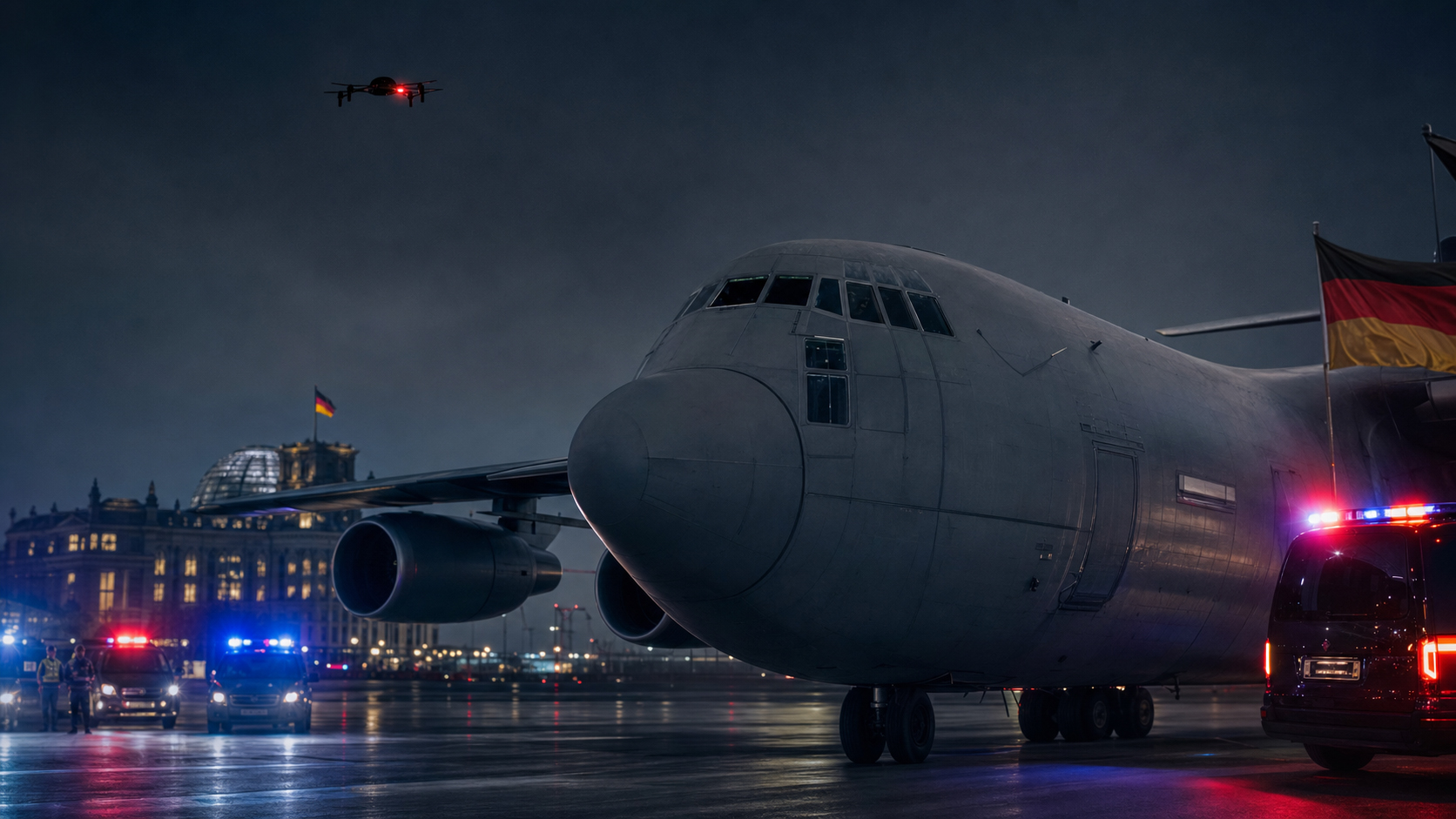
Crisis of trust: Russia's credibility problem and Germany's path to war – Creative image on the topic, with AI: Xpert.Digital
When lies become a strategy and Berlin remains silent
Explosive device at Leipzig Airport: Is Germany already engaged in hybrid warfare?
Drone terror and chancellor fake: Putin's dangerous new front against Germany
The first week of August 2026 marks a dramatic turning point for German security policy. The discovery of a drone equipped with military explosives at Leipzig/Halle Airport, simultaneous attacks on merchant ships in the Black Sea, and a highly professional disinformation campaign against the incumbent Chancellor demonstrate a new and alarming level of threat. Germany, which has long since become one of the most important logistical hubs for military support of Ukraine, increasingly finds itself in the direct crosshairs of hybrid warfare. While the German government tries to walk the fine line between necessary de-escalation and overdue decisive action, one question becomes ever more pressing: Is the existing security architecture still sufficient to protect critical infrastructure and society from sabotage and targeted disinformation? The following article contextualizes these explosive incidents, examines Russia's completely eroded credibility, and analyzes the far-reaching constitutional and geopolitical consequences for the Federal Republic of Germany.
A nation without credibility
Few states have squandered their international credibility as systematically in recent years as Russia. Anyone examining the events surrounding Leipzig/Halle Airport in the first week of August 2026 will recognize a pattern that has been repeating itself for years: First, Moscow reflexively denies any responsibility, then the Russian embassy in Berlin offers a counter-narrative that shifts the blame to the West itself. This is precisely what happened in this case, when the embassy spoke of a "hastily cobbled-together provocation" that supposedly only served the "Kyiv regime" and the "militaristic wing of the European political establishment." This rhetorical knee-jerk reaction has become so predictable that it no longer convinces even conservative security policy experts. CDU politician Marc Henrichmann, chairman of the Bundestag's intelligence oversight committee, summed it up perfectly when he stated that Russia had long since forfeited its credibility, given the situation in Ukraine, where the number of attacks violating international law is almost unmanageable. The core problem of Russian foreign communication today no longer lies in individual misrepresentations, but in the fact that the sheer accumulation of lies, diversionary tactics and hybrid provocations makes every single statement a priori unbelievable, even if it should happen to be true in a particular case.
This erosion of credibility is by no means without economic and geopolitical consequences. A state that no one trusts anymore loses not only diplomatic room for maneuver but also the ability to de-escalate crises, because its assurances are generally interpreted as manipulation. This very deficit of trust makes it considerably more difficult for Western governments to respond to genuine Russian communication efforts, because any reaction could immediately be interpreted as weakness or naivety. At the same time, however, Russia's lack of credibility also opens up a dangerous area for interpretation: If no one believes official Russian statements anyway, it becomes easier to hastily attribute every unexplained incident to Moscow, even if solid evidence is still lacking. The current debate about the drone discovery in Leipzig is situated precisely within this tension between justified mistrust and preemptive blame.
An explosive device between cargo planes
On the night of August 5, 2026, a drone equipped with an explosive device and a detonator was discovered on the grounds of Leipzig/Halle Airport. An airport employee noticed the aircraft hovering between two cargo planes belonging to the Ukrainian airline Antonov Airlines and brought it down, apparently with a daring kick that later became the oft-cited anecdote of the "bus driver" who brought the drone down. Specialists from the Federal Police defused the explosive device, finding that the detonator had already broken off, which apparently only by chance prevented an explosion. Chemical analyses, according to research by NDR, WDR, and the Süddeutsche Zeitung, revealed that the devices were the highly explosive substances PETN and Semtex, both of which are also used in the military. At the same time, a cargo plane belonging to the logistics company DHL collided with an unknown object during a go-around and had to make an emergency landing in Hanover with damage, although it remained unclear whether it was also a drone and whether this incident was related to the first one.
Given the particular significance of the case, the Federal Prosecutor's Office took over the investigation and classified the incident as a "serious attack on the transport and logistics infrastructure in Germany," capable of impairing the external and internal security of the Federal Republic. Federal Interior Minister Alexander Dobrindt cut short his vacation, traveled to Leipzig, and spoke of a "hybrid attack scenario" and a "new level of threat," explicitly not ruling out the involvement of "foreign powers." Initially, there were conflicting reports regarding whether one of the Ukrainian Antonov aircraft was actually loaded with ammunition that had allegedly arrived from France. While NDR, WDR, and the Süddeutsche Zeitung, citing a confidential police report, reported on a cargo of ammunition, both the Federal Ministry of the Interior in a meeting of parliamentary committee members, as well as Saxony's Interior Minister Armin Schuster and Mitteldeutsche Flughafen AG, explicitly denied that any weapons or ammunition had been on board. These contradictions show how unclear even the basic facts remain in such a crisis situation and how cautiously public attributions should be treated before forensic investigation results are actually available.
A cluster of cases that raises eyebrows
The discovery of drones in Leipzig is by no means an isolated incident, but rather part of a series of events that occurred within just a few days and, taken together, paint a disturbing picture. Shortly afterward, on August 5, Russian drones attacked the freighter "Emil" in the Black Sea. Sailing under the Liberian flag, but owned by the Hamburg-based shipping company Johann MK Blumenthal, the ship was hit multiple times, caught fire, and was temporarily disabled about 21 nautical miles off Odessa. During the evacuation of the eleven-member crew, another drone attack apparently occurred. Russia's Ministry of Defense confirmed the attack on two cargo ships, justifying it with the unproven claim that the ships were transporting military equipment for Ukraine. Moscow presented no public evidence for this claim. Almost simultaneously, a professionally produced fake video, bearing the Deutsche Welle logo, circulated, announcing the imminent resignation of German Chancellor Friedrich Merz, citing an alleged, but nonexistent, Handelsblatt document. German security authorities believe this video is highly likely to have originated from the Storm-1516 network, which is attributed to the Russian military intelligence service GRU and was already held responsible for disinformation campaigns during the 2025 German federal election.
Related to this:

This accumulation of different forms of attack—physical sabotage, maritime violence, and digital disinformation—within such a short period corresponds exactly to the pattern that security experts have been describing for years as hybrid warfare. Security expert Nico Lange described the Leipzig incident as a typical example of Russian hybrid attacks against Germany. Historian and Russia expert Matthias Uhl also considers Russian involvement likely, but at the same time points to methodological doubts: The procurement and preparation of explosives and detonators requires specialized expertise possessed only by trained experts, while Russian agents in the West are under increased surveillance, which makes complex remotely controlled operations more difficult. In this context, Uhl recalled earlier cases, such as two explosions at a Czech munitions depot in 2014, for which GRU agents were held responsible, and also pointed to the possible alternative of a false flag operation, in which traces are deliberately planted to point to Russia, without Moscow actually being the perpetrator. This nuance is important because it shows that even renowned experts on Russia remain cautious about making clear accusations as long as reliable forensic evidence is lacking.
Germany as a secret belligerent
Regardless of the ultimately unresolved question of who was responsible for the Leipzig drone attack, the incident raises a more fundamental question that extends far beyond the investigation into this specific case: What role does Germany actually play in this war if Ukrainian transport planes, loaded with Western arms shipments, are regularly handled via German airports? Leipzig/Halle Airport has been a central hub for military aid deliveries to Ukraine for years, and the Antonov cargo planes used are among the largest transport aircraft in the world, though their production has now ceased. Therefore, the breakdown of even a single aircraft could significantly disrupt Ukrainian logistics. Every arms shipment that passes through German territory and enables Ukraine to attack Russian territory gradually shifts Germany's de facto involvement in the conflict from a purely supportive role toward that of an actual party to the conflict, even if, under international law, it is still formally considered a non-belligerent nation.
The principle of peace enshrined in the Basic Law, particularly Article 26, declares unconstitutional any actions that are likely to disrupt, and are intended to disrupt, the peaceful coexistence of nations. Weapons intended for warfare may only be manufactured, transported, and distributed with the authorization of the Federal Government. Critics of current arms export policies argue that the systematic logistical support of attacks on Russian territory increasingly contradicts this constitutional principle, even if the deliveries are formally declared as assistance to a country that, under international law, is in a defensive situation against an illegal war of aggression. The political and legal assessment of this issue remains highly complex because international law generally grants the attacked state the right to self-defense, and third-party states may supply weapons without automatically becoming a party to the conflict themselves. Nevertheless, with each new escalation, such as the authorization of attacks on the Russian heartland using Western weapons systems, the question becomes more pressing as to at what point such support effectively crosses the line into direct participation in the war.
Security authorities caught between alarm and restraint
What's interesting about the German government's public reaction is the striking caution with which official bodies operate, even when virtually all the evidence points in a certain direction. While Interior Minister Dobrindt spoke immediately after the discovery of the weapon of a hybrid attack scenario and a new level of threat, he avoided explicitly naming Russia and only vaguely referred to the possibility of involvement by "foreign powers." This reticence was explicitly addressed in commentaries, for example in Der Spiegel: While everyone knows that Russia is the most likely culprit behind the attempted attack, Dobrindt's refusal to openly voice this suspicion suggests political calculation rather than a lack of conviction. This calculated approach can be interpreted as an attempt to both raise public awareness of the real threat and, at the same time, avoid an open diplomatic escalation with Moscow until legally admissible evidence is available.
Chancellor Friedrich Merz himself made hardly any public appearances in the immediate aftermath of the incident. From his vacation, he merely chaired a telephone meeting of the National Security Council, through which government spokesman Stefan Kornelius announced that the Chancellor was in constant contact with Interior Minister Dobrindt and other cabinet members. However, there was no public policy speech, no clear political assessment, and no direct address to the public. This reticence can be interpreted in different ways. On the one hand, it may be an expression of a deliberate de-escalation strategy intended to prevent sharpened public rhetoric from further narrowing the already fragile diplomatic space or stoking domestic anxieties that could be exploited by both the far right and far left for fear-mongering campaigns. On the other hand, such conspicuous silence from the head of government in a situation that security authorities themselves classify as a historically unprecedented threat can also be interpreted as a leadership deficit, reinforcing the impression of an overwhelmed or evasive federal government. Significantly, even during this period of silence, a fake video was deliberately spread that exploited this perception gap and claimed an allegedly imminent resignation by Merz, demonstrating how precisely Russian disinformation actors attempt to exploit domestic political weaknesses and communication gaps.
Hub for Security and Defense - Advice and Information


Hub for Security and Defense - Image: Xpert.Digital
The Security and Defence Hub offers expert advice and up-to-date information to effectively support companies and organizations in strengthening their role in European security and defence policy. Working closely with the SME Connect Defence Working Group, it particularly promotes small and medium-sized enterprises (SMEs) that wish to further develop their innovative capacity and competitiveness in the defence sector. As a central point of contact, the Hub thus creates a crucial bridge between SMEs and European defence strategy.
Related to this:
Targeted disinformation and logistics attacks: Why Germany's security architecture is now under pressure
Disinformation as a weapon against the administration
The fake video claiming Chancellor Merz would resign deserves special attention because it exemplifies the sophisticated nature of modern Russian disinformation operations. The clip mimicked the look and feel of Deutsche Welle and, citing a fabricated Handelsblatt document, asserted that Merz would resign on August 10 due to persistently weak poll numbers, naming North Rhine-Westphalia's Minister-President Hendrik Wüst as his most likely successor. Both Handelsblatt and Deutsche Welle immediately clarified that the video was a complete fabrication, based neither on actual editorial content nor on genuine CDU internal correspondence. Furthermore, the video contained factual errors, such as the reference to supposed federal elections in September, which are not actually taking place. This suggests a certain degree of technical carelessness on the part of the creators, without diminishing the fundamental effectiveness of such campaigns.
German security authorities attributed the operation with a high degree of probability to the Storm-1516 network, which, according to the French anti-disinformation agency Viginum, was responsible for at least 77 disinformation operations against Western states between the end of 2023 and March 2025 and is directly controlled by the Russian military intelligence service GRU. During the 2025 federal election campaign, which Merz won, the German government had already held this network responsible for targeted disinformation campaigns. The timing of this campaign is noteworthy: it coincided exactly with the upcoming state elections in eastern Germany, in which the CDU was expected to perform poorly according to polls, and deliberately linked itself to a real internal party debate about a possible successor to Wüst in order to lend the fabrication an air of plausibility. This strategy of seizing upon real political tensions and condensing them with invented details into a seemingly credible story is considered particularly effective in disinformation research because it caters to existing perception patterns and prejudices of the target group, instead of inventing completely new narratives.
Between defensive capability and fear of escalation
The spate of incidents in Leipzig, the Black Sea, and the digital sphere has triggered a noticeable shift within German security policy. CDU domestic policy expert Detlef Seif and Green Party defense policy expert Konstantin von Notz independently suggested that a plausible scenario involving Russian intelligence services could be behind the attacks, while the AfD parliamentary group in Saxony requested a special session of its internal affairs committee, demonstrating that the incident resonated across party lines domestically. It is also noteworthy that, in light of the series of incidents, a defense policy expert even publicly raised the possibility of invoking Article 4 of the NATO Treaty, which provides for consultations between alliance partners in the event of a threat to the territorial integrity or security of a member state. Such considerations mark a significant rhetorical escalation compared to Germany's previous reticence and signal that parts of the political establishment believe the threshold for an open security policy confrontation with Russia has already been crossed.
At the same time, the German government remains committed to projecting a public image of a measured, non-escalating response. This tension between the perceived need to demonstrate toughness and resolve, and the simultaneous concern about potentially contributing to the escalation of the conflict through excessive rhetoric, characterizes the German response to hybrid threats in general. Furthermore, this case reveals significant structural deficiencies in Germany's security architecture. Matthias Uhl explicitly pointed out that, given the conflict has already lasted several years, it is astonishing that Ukrainian transport aircraft carrying out important arms shipments from Germany are apparently not adequately guarded. This criticism hits a nerve: If Germany has de facto become a central logistical hub for arms deliveries to Ukraine, then, logically, the physical security of this infrastructure must also be raised to a level commensurate with its actual strategic importance and the associated threat level. The fact that a drone equipped with military explosives was apparently able to operate undetected in the immediate vicinity of critical infrastructure for an extended period of time suggests significant gaps in the airspace surveillance of both civilian and military airports.
Economic and geopolitical consequences
The economic implications of these developments extend far beyond the immediate material damage of individual incidents. An attack on key logistics infrastructure such as Leipzig/Halle Airport, which provides significant civilian freight capacity for companies like DHL in addition to military capacity, could, if repeated, severely disrupt the entire German export industry, as Leipzig is one of Europe's most important freight hubs. The same applies to attacks on civilian merchant ships in the Black Sea, which effectively erode international trade freedom on one of the world's most important grain and commodity routes and, in the medium term, lead to higher insurance premiums, detours, and thus increased freight costs for global agricultural trade. The repeated attacks on freighters flying various flags already demonstrate that Russia is effectively pursuing a policy of blockade against any form of merchant shipping that can be even remotely linked to Ukrainian ports, regardless of the actual cargo.
For German companies with international supply chains, a topic of central importance to the logistics and export sectors, this development means an increasing need to systematically integrate risk scenarios for hybrid threats into their own security and business continuity planning. The debate surrounding critical infrastructure as a whole—from energy supply and data cables to transportation hubs—also gains new relevance through such incidents, as they illustrate that hybrid warfare targets not only military but increasingly also civilian and economic objectives. The political debate about increased investment in defense and security infrastructure, which has been ongoing in Germany since the so-called "turning point" in history, receives additional impetus from such events, while simultaneously raising the question of whether the existing budgetary resources and institutional capacities of the security authorities are truly sufficient to adequately address the growing threat landscape.
A country caught between awakening and repression
The statement by a well-connected Norwegian contact, that Germany is naive and doesn't even notice the ongoing hybrid war, touches a raw nerve in the public debate. For years, warnings from security experts about Russian sabotage and disinformation activities in Germany were treated more as abstract threat scenarios, while concrete social and political awareness was only truly sharpened by a series of visible, physically tangible incidents such as the discovery of a drone in Leipzig. Dobrindt himself spoke in this context of a turning point, at which Germany's threat assessment shifted from an abstract to a concretely high level of danger. This assessment may be accurate, but it also raises the uncomfortable question of why it took a near-successful bombing at one of Germany's most important cargo airports for this insight to actually be articulated at the highest political level.
The coming months will show whether Germany actually draws structural consequences from this cluster of incidents, such as a significant increase in airspace surveillance at critical transport hubs, closer coordination between federal and state authorities in combating hybrid threats, or more transparent public communication from the federal government regarding actual responsibilities as soon as forensic evidence allows. It also remains to be seen how the fundamental debate about Germany's de facto role as a logistical hub for arms deliveries to Ukraine develops, particularly in light of the constitutional questions surrounding the Basic Law's commitment to peace. What is already clear is that the events of the first week of August 2026 are likely to go down in German security history as a symbolic turning point, regardless of whether the Russian origin of the Leipzig drone attack can ultimately be proven beyond doubt. What is crucial, however, is that a new normality has established itself in public and political perception, in which hybrid threats are no longer treated as a hypothetical future scenario, but as an immediate reality of German security policy.
Consulting - Planning - Implementation

Markus Becker
I would be happy to serve as your personal advisor.
Head of Business Development
Chairman SME Connect Defense Working Group
Consulting - Planning - Implementation
Konrad Wolfenstein
I would be happy to serve as your personal advisor.
You can contact me at wolfenstein∂xpert.digital or
Just call me on +49 7348 4088 965 .