Germany's next economic powerhouse? These 20 companies could change the country
Xpert Pre-Release

Available in 27 languages 📢
Prefer Xpert.Digital on GoogleⓘPublished on: November 17, 2026 / Updated on: November 17, 2026 – Author: Konrad Wolfenstein
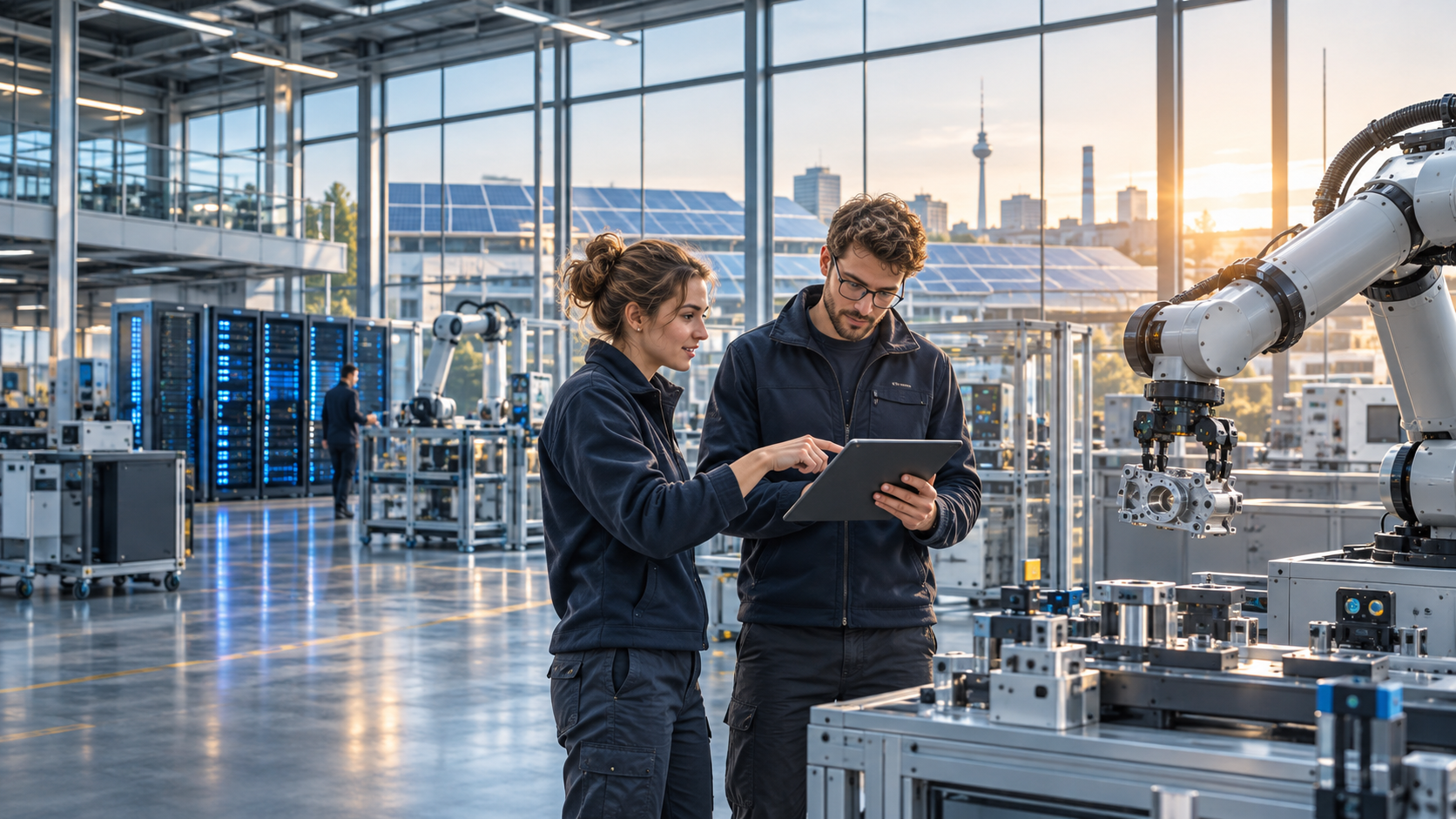
Germany's next economic powerhouse? These 20 companies could change the country – a creative image on the topic, created with AI: Xpert.Digital
While Germany talks about decline, these companies are building for the next upswing
From AI to space travel: 20 German companies with great future potential
These 20 companies could revitalize Germany's economy
Germany's economic future is not solely decided at the factory gates of its major car manufacturers, chemical companies, and mechanical engineering firms. It is also being shaped in software labs, robotics centers, digital banks, and companies working on new energy and aerospace technologies. There, a generation of companies is emerging that isn't waiting for the old engines of growth to restart – but is instead trying to build new ones.
However, this doesn't guarantee a new German economic miracle. High company valuations don't automatically create prosperity, and a large funding round is no substitute for a viable market or a profitable business model. Even a technically impressive product only transforms the economy when it is widely adopted, reduces costs, generates new demand, or lessens dependencies.
Nevertheless, it would be wrong to measure Germany's capacity for innovation solely by the difficulties faced by its established industries. Companies like Celonis, DeepL, Enpal, and Flix have already built customer bases and business volumes that extend far beyond the experimental startup phase. Others, including Proxima Fusion and Isar Aerospace, represent long-term technological bets. In between lies a broad field of young, growing companies whose significance cannot be measured solely by a ranking based on company value.
The following selection of 20 companies takes into account economic substance, technological independence, international scalability, and potential benefits for Germany as a business location. It is an analytical classification, not a mathematically calculated ranking. Companies with German roots or a significant development base in Germany are considered – including established growth companies and German-European business models.
The central thesis: A new German economic upswing will hardly come from a single wonder industry. It could emerge where young companies combine the country's industrial strengths with software, artificial intelligence, new financing opportunities, and international sales.
While Germany is discussing relegation, others are already building their next ascent
Germany's economic future is not solely decided at the factory gates of its major car manufacturers, chemical companies, and mechanical engineering firms. It is also being shaped in software labs, robotics centers, digital banks, and companies working on new energy and aerospace technologies. There, a generation of companies is emerging that isn't waiting for the old engines of growth to restart; it's trying to build new ones.
The idea of an imminent economic miracle should nevertheless be treated with caution. High company valuations do not automatically create overall economic prosperity. A funding round is no substitute for a viable market or a profitable business model. And a technically impressive product only transforms an economy when it is deployed on a larger scale, reduces costs, unlocks new demand, or lessens existing dependencies.
Nevertheless, it would be equally wrong to judge Germany's capacity for innovation solely based on the difficulties faced by its established industries. Companies like Celonis, DeepL, Enpal, and Flix have already built customer bases and business volumes that extend far beyond the experimental startup phase. Others, including Proxima Fusion and Isar Aerospace, represent longer-term technological bets. Between these two groups lies a broad spectrum of young, growing companies whose significance cannot be captured by a single ranking based on company value.
The following top 20 list therefore combines economic substance, technological independence, international scalability, and potential benefits for Germany as a business location. Its ranking is an analytical classification and not a mathematically calculated ranking. Companies with German roots or a significant German development base are considered. This includes established growth companies and German-European business models.
The central thesis is: A new German economic upswing will not come from a single wonder industry. It could emerge where young companies combine existing industrial skills with software, artificial intelligence, new financing options, and international sales.
Why billions in financing don't automatically create an economic miracle
The German startup market is once again showing considerable investment activity, albeit with a striking concentration. An analysis for the first nine months of 2026 puts the equity capital raised by German technology startups at around €8.95 billion. At the same time, the number of recorded financing rounds fell from 335 to 270 compared to the same period of the previous year. Six particularly large rounds accounted for approximately 59 percent of the total volume. More capital, therefore, does not automatically mean that the entire startup landscape benefits equally.
This distinction is economically crucial. If a few defense, robotics, or energy companies raise exceptionally large sums, this can significantly boost the overall market, while smaller companies continue to struggle for follow-on financing. However, a vibrant innovation system needs both: large companies capable of becoming internationally competitive and a broad base of new providers.
Furthermore, the different key performance indicators (KPIs) have varying degrees of significance. Revenue is not profit. Recurring contract revenue is not the same as the annual revenue already realized. Customer assets on a financial platform do not belong to the platform operator. An order backlog can extend over several years and be subject to conditions. Company valuations, in turn, reflect the expectations and contractual terms of a financing arrangement, not the achievable sale price of the entire company at any given time.
The macroeconomic impact also differs. A digital bank can improve competition without creating a particularly large number of jobs. A robotics company can increase the productivity of numerous industrial enterprises. A space company can develop strategic capabilities, but this may require long timeframes and significant upfront investments. These very differences must be considered when evaluating the following companies.
1. Celonis: The productivity lever lies in the processes
Celonis is one of the most compelling examples of how internationally relevant business software can originate in Germany. The company analyzes digital footprints from business systems and reveals how processes actually unfold. This includes areas such as purchasing, invoice processing, production, logistics, and receivables management. Celonis boasts more than 1,000 customers and over 3,000 employees.
The economic value lies not in another user interface, but in identifying operational inefficiencies. Late payments, multiple processing of orders, or unnecessarily high inventory levels tie up capital and working time. Improved process control can therefore simultaneously reduce costs and increase a company's financial flexibility.
With the increasing use of artificial intelligence, this data foundation gains additional importance. An AI system can only act reliably if it understands the operational context. Celonis aims to provide precisely this context: Which order belongs to which customer, which exception is business-critical, and which action improves the overall result?
The limit lies in implementation. Identified weaknesses don't disappear automatically. Companies must change responsibilities and actually adapt processes. Furthermore, public financial transparency is limited; customer reach and valuation alone don't provide a reliable indication of current net profitability.
2. DeepL: Language barriers become a solvable cost problem
DeepL demonstrates how a specialized European AI provider can establish a globally relevant market position. The company boasts more than 200,000 business customers. A $300 million funding round announced in 2024 saw the company valued at $2 billion. Its offerings now include text translation, writing assistance, and speech translation.
Economically, DeepL reduces the costs of cross-border communication. This benefits not only large corporations but also medium-sized manufacturers, enabling them to provide multilingual documentation, sales materials, and customer communications more quickly. The lower these language-related fixed costs, the easier it is to tap into additional markets.
The strategic advantage lies in specializing in a specific, frequently recurring business need. For companies, linguistic elegance is not the only factor; technical terminology, consistent wording, confidentiality, and integration into existing workflows are also crucial.
At the same time, competitive pressure is considerable. General AI models are increasingly integrating translation functions into more comprehensive software offerings. DeepL must therefore continually justify why an additional specialized solution is worth its price. Reliable quality, industry-specific adaptations, and productive integration will be crucial. DeepL is particularly attractive from a business perspective where translation is not used as an isolated task, but rather as part of an international value chain.
3. Personio: The unspectacular digitization with a broad impact
Personio addresses an area that is rarely perceived as a future-oriented industry, but affects almost every company: human resources management. The platform connects employee data, recruiting, and payroll processes, among other things. In the fall of 2025, the company reported more than 15,000 customers and around 1,500 employees.
The economic significance lies in its widespread impact. Many medium-sized companies manage their human resources using a mix of spreadsheets, emails, and separate applications. This leads to redundant data entry, media breaks, and unnecessary coordination. An integrated platform can reduce these ongoing administrative costs.
The business model also possesses an important structural characteristic: once master data, authorizations, and processes are set up, the software becomes a central business system. This can foster long-term customer relationships. Additional modules create the opportunity to increase revenue with existing customers.
However, these advantages don't come without a price. Implementation, data migration, customer support, and adaptation to different national regulations all require effort. At the same time, Personio competes with both specialized providers and large software companies.
The next stage of development involves not only mapping administrative processes electronically, but actually automating workflows. The benefit is measured by whether HR departments spend less time on routine tasks and gain more capacity for employee development and filling critical positions.
4. Trade Republic: The attack on the cost structure of investing
Trade Republic is an example of how a digital financial platform can now reach considerable operational scale. In the 2024/25 financial year, which ended in September 2025, the company generated revenue of €754 million. Commission income amounted to approximately €733 million, more than doubling compared to the previous year.
The core economic advantage lies in a low cost structure per additional customer and simplified digital usage. Securities trading and savings plans become accessible to customer groups who perceive traditional banking services as too expensive or too complicated.
However, from an economic perspective, this only creates a sustainable advantage if lower barriers to entry contribute to better long-term investment. More frequent trading alone does not generate additional wealth. Costs, risk perception, and the suitability of the products used are crucial.
For Trade Republic itself, the central challenge shifts with its growing size. Customer acquisition is no longer the sole focus; reliable operation, accessible service, and regulatory resilience are becoming crucial competitive factors.
The company thus represents a general maturation process for digital financial providers: Ease of use opens the door. However, a lasting market position only emerges when the underlying organization functions reliably even under high pressure.
5. N26: A digital bank needs to be more than just a good app
N26 pursues a broader approach than a pure trading platform. At its core is the digital banking relationship in everyday life. For 2025, the company reported gross revenues of €501.6 million, gross profit of €350.5 million, and, for the first time, profitability on a full-year basis. Preliminary figures for the first quarter of 2026 show a net profit of €9.8 million and gross revenues of €130 million.
This development is interesting because it touches on a central question of digital banking: Can a technically attractive application be developed into a permanently profitable institution?
The answer depends largely on the intensity of use. A rarely used secondary account has a different economic value than an active primary bank account with regular incoming payments and multiple services used. Therefore, the number of accounts opened is not the only decisive factor.
N26 can benefit from automated processes and the absence of a traditional branch network. At the same time, identity verification, fraud prevention, data protection, and reliable customer service remain essential cost factors.
For Germany as a business location, the significance lies in the fact that even a highly regulated business model can be digitally reorganized. However, long-term success will be measured less by growth announcements than by stable earnings, customer satisfaction, and organizational reliability.
6. Scalable Capital: The goal is to transform the broker into an asset management platform
Scalable Capital combines digital securities access with the ambition of building a more comprehensive investment platform. In June 2025, the company raised €155 million. At that time, more than one million customers had a combined total of over €30 billion on the platform.
This figure illustrates the potential, but it shouldn't be misinterpreted. The 30 billion euros represent customer assets, not revenue or the company's freely available capital. Economic success depends on the sustainable revenue that can be generated and the associated costs for support, technology, and regulation.
The strategic appeal lies in building long-term customer relationships. A customer who invests regularly over several years can be more economically valuable to a platform than a trader who is only active in the short term. Additional offerings can further strengthen this relationship.
Scalable also represents the increasing competition between digital financial ecosystems. The competition is no longer solely about individual order fees, but about usability, product selection, reliability, and the bundling of financial needs.
The announced European expansion opens up additional sales markets. However, it also brings with it differing customer preferences and greater organizational complexity. Sustainable success therefore requires mastering both growth and operational discipline simultaneously.
7. Enpal: The energy transition is being sold as a complete product
Enpal combines photovoltaics, storage, heat pumps, and energy-related services into an integrated offering. For 2025, the company reported revenues of more than €1.1 billion in its operating subgroup, representing growth of 25 percent. At the same time, this subgroup reported positive free cash flow for the first time over an entire fiscal year. The customer base served comprised more than 115,000 households in Germany and Italy.
The core entrepreneurial approach lies in reducing technical and organizational complexity. A household typically doesn't want to coordinate multiple providers, compare financing models, and integrate different control systems. Enpal aims to create a standardized, integrated product from this.
Economically, this shifts the value creation from the individual solar module to sales, installation, financing, control, and long-term customer support. This is precisely where recurring revenues and closer customer relationships can be generated.
The risks lie in the practical implementation. Installation and service remain labor-intensive. Financing costs affect the attractiveness of the offers. Furthermore, the benefits of the overall system must outweigh the costs of its complexity.
It is important to define the key figures: Positive free cash flow in the operating subgroup is progress, but not automatic proof of identical profitability in all companies and financing structures.
8. Flix: The platform concept has long since reached long-distance travel
Flix is no longer a fledgling experiment, but an internationally established transportation company with a digital core. In 2025, the group generated revenues of €2.283 billion, compared to €2.235 billion the previous year. Adjusted operating profit before interest, taxes, depreciation, and amortization (EBITDA) was €144.6 million. However, net profit amounted to only €4.2 million.
This difference is particularly revealing. It shows why high sales and a positive adjusted operating result should not be equated with high net profitability.
The business model combines branding, booking, network planning, and demand management, whereas in the long-distance bus business, a significant portion of the transport service is provided through partners. This allows for the organization of a large network without having to finance and operate all the vehicles oneself.
The strength lies in the combination of digital demand aggregation and physical service. With increasing network density, additional connections can become more attractive because more transfer options become available.
However, the limitations remain those of the transport market: personnel, energy, infrastructure, and capacity utilization all determine profitability. Flix, therefore, demonstrates less about overcoming traditional industry logic than about organizing it more intelligently. This is an important model for Germany because it integrates existing medium-sized service providers into an internationally scalable system.
9. Helsing: Software is becoming an industrial safety factor
Helsing is one of the most prominent companies in European defense technology. As early as 2025, the company raised €600 million in a funding round. It represents an approach in which artificial intelligence and software become central components of military capabilities.
The economic significance extends beyond the individual supplier. As the performance of technical systems increasingly depends on data processing, sensor fusion, and software updates, the distribution of industrial value creation changes. Alongside traditional manufacturing, software architecture and continuous development gain in importance.
This could create additional technological capabilities for Europe. However, this should not be equated with complete independence. Even software-oriented defense systems require hardware, semiconductors, communication infrastructure, and robust supply chains.
Helsing's opportunities are therefore subject to special requirements. Technical effectiveness must be demonstrated under real-world conditions. Safety-critical systems require different testing standards than ordinary business applications.
At the same time, the growth of this market is not simply an increase in prosperity in the usual sense. Defense spending serves to safeguard security and political capacity. However, it ties up resources that would otherwise be available for civilian investments. A dispassionate assessment must consider strategic benefits and economic opportunity costs together.
Our EU and German expertise in business development, sales and marketing

Our EU and German expertise in business development, sales and marketing - Image: Xpert.Digital
Industry focus areas: B2B, digitalization (from AI to XR), mechanical engineering, logistics, renewable energies and industry
More information here:
A thematic hub offering insights and expertise:
- Knowledge platform covering global and regional economies, innovation and industry-specific trends
- A collection of analyses, insights, and background information from our key areas of focus
- A place for expertise and information on current developments in business and technology
- A hub for companies seeking information on markets, digitalization, and industry innovations
Isar Aerospace: The path to independent access to space
10. Quantum Systems: Airborne data becomes a key resource
Quantum Systems develops unmanned aerial systems and is one of the companies where German engineering expertise combines with software and data-driven analysis. In 2025, the company received €160 million in funding. Investors included financial investors as well as companies from the aerospace and defense sectors.
The economic benefit of such systems lies not solely in the aircraft itself. Crucially, they enable the reliable acquisition of usable information. A technical system only creates significant customer value when robust decisions can be quickly derived from image and sensor data.
This creates a value chain comprising flight platform, sensors, communication, analysis, and integration. Providers who master several of these levels can shape a larger portion of the customer value themselves.
However, the business model differs significantly from pure software. Manufacturing capacities, quality control, spare parts, and service must grow accordingly. Furthermore, every international expansion requires organizational and legal adjustments.
Quantum Systems is therefore particularly interesting for Germany: The company does not represent a departure from industrial production, but rather its expansion with digital capabilities. Whether this results in sustainably high added value depends significantly on how well technical performance can be translated into standardized, reliably deliverable products.
11. Neura Robotics: Intelligent machines must prove their worth in everyday life
Neura Robotics, based in Metzingen, Germany, is working on cognitive and humanoid robot systems. In January 2025, the company announced a €120 million funding round. At that time, it reported having more than 300 employees and an order backlog of €1 billion. These figures reflect a development stage at that time and should not be confused with actual annual revenues.
The market potential is considerable because flexible automation could bridge the gap between rigid production facilities and human labor. Many tasks can currently only be automated with significant programming effort. Systems that better perceive their environment and react to changes could lower the economic threshold for their adoption.
However, what matters is not how human-like a robot looks. Decisive factors are cost per productive hour, availability, safety, maintenance requirements, and integration effort.
For Neura, the opportunity lies in combining several technical levels: mechanics, sensors, control systems, and AI. However, this very breadth also increases the capital requirements and development risks.
The German location offers industrial proximity and sophisticated application possibilities. This creates an advantage when customer problems are incorporated into the development process early on. Conversely, an impressive demonstration has little economic value as long as sustained operation fails to demonstrate a reliable benefit.
12. Parloa: Customer service becomes the testing ground for economic AI
Parloa develops AI systems for customer communication. At the end of 2025, the company reported more than $50 million in annual recurring revenue on a projected contract basis. This was complemented by a net revenue retention rate of 150 percent. In simpler terms, this means that the existing customer base significantly increased its contract revenue after both new sign-ups and churns.
These metrics are interesting because they go beyond mere user numbers. They indicate that customers are using additional services. However, projected recurring revenue is not the same as reported annual revenue.
The economic approach is clear: Recurring requests should be processed more quickly, while human employees handle more complex cases. This can result in shorter waiting times and lower processing costs.
The central challenge is quality. An automated dialogue that misunderstands requests or keeps customers in loops can cause follow-up costs and a loss of trust. Therefore, handoffs to humans, access rights, and connections to internal systems must function reliably.
Parloa thus represents a significant shift in the AI market. Companies are no longer buying a technological innovation on a permanent basis, but rather a measurable operational impact. Consequently, competition is decided by solved problems and reliable results, not solely by the naturalness of an artificial voice.
13. Sereact: The intelligent reach into the shelf becomes a business model
Sereact develops AI software for robots, particularly for warehousing and logistics applications. In January 2025, the Stuttgart-based company raised €25 million in funding. Its models are designed to enable various robot systems to perceive their environment and flexibly handle changing objects. Among the users mentioned are Daimler Truck, Bol, and Active Ants.
The economic relevance lies in the diversity of real-world goods flows. Uniform parts can be handled relatively easily using automation. It becomes more difficult when packaging, shapes, and positions are constantly changing. It is precisely in these situations that manual labor often remains indispensable.
If software can significantly reduce the adaptation effort, the cost-effectiveness of existing robot hardware improves. This opens up a scalable model where not every new application needs to be completely developed from scratch.
However, practical operation is what matters. Mistakes, damaged goods, or frequent interruptions can quickly negate any theoretical advantages. Therefore, success rates, cycle times, and restart behavior under everyday conditions are crucial.
Sereact is an example of a particularly promising German collaboration: AI is not offered in isolation, but rather applied to a specific industrial bottleneck. The potential productivity effect arises where software makes physical work more reliable and flexible.
14. Isar Aerospace: Access to space is becoming an industrial issue
Isar Aerospace develops launch vehicles, representing one of the most capital-intensive technologies in this selection. In 2025, funding of up to €150 million from Eldridge Industries was announced. At that time, the company's valuation reached the order of one billion US dollars.
The economic rationale is the importance of independent access to space. Satellite-based applications require not only high-quality payloads but also suitable launch facilities. Availability, scheduling, and technical requirements can be just as important as the launch price itself.
For a young rocket company, the biggest challenge is combining technical reliability with industrial repeatability. A successful flight would be a significant milestone, but not yet proof of a commercially viable mass production business.
Furthermore, significant upfront costs are involved. Development, testing, and production facilities must be financed before regular revenues can be generated. Delays therefore have a direct impact on capital requirements.
Isar Aerospace is included in this selection because the company is targeting a strategically important bottleneck. However, the risk remains higher than with established software models. The potential return lies not only in business success, but also in additional technical expertise, qualified supply chains, and European opportunities for action.
15. The Exploration Company: Space exploration needs more than new rockets
The Exploration Company is pursuing a different approach than a traditional launch provider with its reusable Nyx space capsule. The Franco-German company is working on transport capabilities for space and the return of payloads. In September 2026, it announced a $450 million funding round, which was still subject to regulatory approvals.
The economic logic is similar to building a new logistics chain. A functioning space market requires not only transport to the top, but also reliable supply, suitable interfaces, and, if necessary, the return of materials.
Reusability can improve the cost structure. However, it only generates an economic advantage if maintenance, reprocessing, and reuse are organized efficiently enough. The mere return of a capsule, therefore, does not prove the overall system's cost-effectiveness.
The company also needs a market that extends beyond individual development missions. Regular demand and reliable deployment planning are crucial to transforming technical capability into a sustainable business model.
For Germany and Europe, the significance lies in complementing existing space expertise. At the same time, the company demonstrates that new champions do not necessarily have to emerge in national isolation. Cross-border industrial cooperation can itself be a key competitive advantage.
16. Proxima Fusion: The greatest impact still lies behind the greatest risk
Proxima Fusion is working on fusion power plants based on the stellarator concept. Founded in Munich in 2023, the company represents an attempt to translate cutting-edge scientific expertise into an industrial energy application. A €130 million funding round was announced as early as 2025.
The potential economic impact would be exceptionally large. A commercially viable new energy source could fundamentally change industrial location conditions in the long term. Precisely for this reason, there is a risk of confusing scientific potential with foreseeable commercial availability.
Numerous challenges lie between a convincing technical concept and a competitive power plant. These include material stress, maintenance, fuel cycles, plant availability, and the integration of all components into a permanently functioning system.
For an economic evaluation, physical milestones alone are therefore insufficient. Ultimately, construction costs, operating life, financing, and the cost of the energy generated would be decisive. A technically functioning power plant is not automatically competitive with other energy supply solutions.
Proxima Fusion is therefore not a short-term economic driver, but a long-term industrial option. The site's benefits could materialize sooner through research, specialized components, and skilled employment. However, the long-term investment thesis remains subject to considerable technical and temporal uncertainties.
17. Anvil: Reliable expertise becomes digital infrastructure
Amboss combines medical knowledge transfer, learning opportunities, and support in everyday clinical practice. In 2025, a €240 million funding round was announced. At that time, more than one million people worldwide were using the platform. The company employed over 400 physicians, scientists, and software developers.
The economic value arises from a recurring problem: medical knowledge is growing, while time for research remains limited. A well-structured and readily accessible knowledge base can improve learning processes and reduce the effort required to search for information.
This is what distinguishes Amboss from any other digital reference work. Crucial factors are up-to-date expertise, editorial quality, and the connection to concrete application scenarios. Trust is not just a brand value here, but a prerequisite for continued use.
AI creates additional opportunities to make information more accessible in a targeted manner. At the same time, the demands on traceability and error control increase. Linguistically convincing but factually unreliable answers would be particularly problematic in this environment.
For Germany, Amboss represents the export of specialized knowledge. The company demonstrates how in-depth expertise can lead to the development of an international digital product. However, scaling remains challenging because medical practices, training, and institutional requirements vary between countries.
18. Osapiens: Supply chain transparency becomes an operational tool
Osapiens develops software for supply chain transparency, sustainability information, and regulatory compliance. As of November 2026, the company reported approximately 2,800 customers and 550 employees. A $100 million funding round had raised the company's valuation above the billion-dollar mark by 2026.
The market arises from a fundamental information problem. Large companies need to consolidate data from numerous subsidiaries, locations, and supplier relationships. Without suitable systems, this quickly becomes a labor-intensive, disparate process of spreadsheets, emails, and manual checks.
The immediate benefit may lie in more efficient fulfillment of obligations. However, the use of the same data for business decisions is more interesting in the long term: Where do dependencies exist, what information is missing, and which parts of a supply chain require special attention?
The business model also carries a political risk. If the scope or timing of regulatory requirements changes, purchasing decisions may be delayed. Therefore, a provider should offer more than simply digitally mapping individual reporting requirements.
Osapiens is particularly compelling from a business perspective when compliance and operational improvement converge. Reliable data can not only reduce documentation efforts but also enhance the understanding of complex value chains. However, the extent to which this translates into sustainably profitable customer relationships remains difficult to assess due to a lack of comprehensive publicly available financial data.
19. Sennder: The digital freight forwarder must prove its economies of scale
Sennder is aiming to organize European road freight transport more efficiently via a shared digital platform. Following the integration of CH Robinson's European land transport business, the company projected annual revenue of around one billion euros for 2026. In November 2026, a financing package of 228 million euros was also announced. This fell short of the earlier expectation of 1.4 billion euros in combined revenue; the reasons given included divested or discontinued business units.
This very development makes Sennder analytically interesting. Size through acquisitions is not the same as organic growth. And a large volume of brokered transport does not guarantee a high margin.
The economic benefit lies in better capacity utilization, more efficient scheduling, and less administrative friction. When clients and carriers can connect more easily, search and coordination costs can decrease.
At the same time, the fundamental conditions of the market remain unchanged. Transportation is highly competitive, dependent on economic cycles, and characterized by real capacity costs. Software can make these conditions more manageable, but it cannot eliminate them.
For Sennder, success therefore hinges on integration: Will different business units actually become more productive on a shared technical and organizational foundation? Only then will size translate into a sustainable competitive advantage.
20. Stark Defence: Series production determines technological sophistication
Stark Defence is one of the youngest companies in this selection. Founded in 2024, the company focuses on military drone systems. In 2026, it reportedly received approximately €500 million in funding at a valuation of over €3.2 billion.
The rapid raising of capital demonstrates the strong interest in new defense technologies. However, it should not be interpreted as proof of a correspondingly high level of industrial capacity.
Economically, Stark faces a challenging task: development speed must be combined with manufacturing quality, reliable delivery capability, and continuous technical adaptation. A functioning prototype and a reproducibly manufactured product are two distinct stages of development.
In such systems, the relationship between effectiveness, unit costs, and production capacity is also crucial. A technically sophisticated solution can reach its economic and strategic limits if it is too expensive or not available quickly enough.
Stark thus exemplifies a new type of industrial startup that aims to combine software speed and hardware production. Whether this ambition succeeds will be determined not by its valuation, but by its industrial implementation and long-term usability.
The common denominator is not technology, but an expensive customer problem
The 20 companies serve very different markets. Nevertheless, they are united by an economic pattern: they are trying to eliminate costly bottlenecks.
Celonis addresses inefficient business processes. DeepL reduces language-related friction. Personio simplifies HR management. Digital financial providers lower barriers to entry and transform sales structures. Enpal consolidates a complex energy decision. Sereact and Neura are working on more flexible automation. Sennder organizes transport capacities. Amboss structures expertise.
This perspective is more useful than simply categorizing companies according to buzzwords. A company isn't attractive simply because it uses AI. It becomes attractive when its solution offers a relevant advantage and the provider can capture a reasonable share of that advantage as revenue.
This also leads to an important distinction between technological and economic progress. An application can be impressive without customers being willing to pay enough for it. Conversely, a technically unremarkable improvement can be very profitable if it occurs frequently and reliably reduces costs.
The strongest companies will therefore not necessarily be those that generate the most attention. They will be those whose products become permanently integrated into indispensable workflows.
Germany's opportunity lies in combining factory floor and software
The selection suggests a location perspective that is neither nostalgic nor purely digital. Germany does not have to choose between industry and technology. The combination of both sectors appears particularly promising.
Industrial experience makes it easier to identify complex customer problems. Software can transform these into scalable solutions. Research provides the technical foundation. International marketability determines whether this foundation reaches a large market.
The bottleneck often lies between these stages. A scientific discovery is not yet a mass-produced product. A good product does not yet have a reliable distribution network. And strong growth does not automatically create a stable organization.
This leads to a different perspective on economic renewal. It is not enough to establish as many companies as possible. What is crucial is how many of them successfully navigate the transitions between research, market entry, growth, and industrial maturity.
Equally important is the dissemination of solutions. If a few leading companies adopt cutting-edge technology while a large part of the economy remains stuck with fragmented processes, the overall economic productivity effect will be limited. A new upswing will only emerge when innovation is not only developed but also widely applied.
Capital is necessary, but its origin and use are what count
Large financing rounds open up new possibilities. They enable research, production setup, and international expansion. At the same time, they demonstrate how heavily young German companies depend on international capital networks. Foreign investors play a key role in numerous companies in this selection, such as DeepL, Enpal, Scalable Capital, and The Exploration Company.
This is not necessarily a disadvantage. International capital can bring experience, market access, and additional business contacts. A problematic situation would arise if Germany supported research and early development but only captured a small portion of subsequent entrepreneurial value creation.
The discussion should not be reduced to the nationality of individual shareholders. Research locations, skilled employment, business decision-making centers, and the integration of domestic suppliers are also crucial factors.
Equally important is the use of capital. Growth expenditures only create sustainable value if they lead to repeatable revenues, better products, or structural cost advantages. Conversely, persistently high spending on customer acquisition without strong customer retention can mask a weakness.
The decisive factor is therefore not how much money a company has raised. What matters is the resulting economic performance.
What truly turns promising talents into new champions
A sustainable economic rise for these companies would be evidenced by several developments. Revenues would not only have to grow, but increasingly stem from repeatable demand. The costs for additional customers or product units would have to remain manageable. Technological advantages would have to be defensible against the competition.
For software companies, customer loyalty, usage intensity, and the cost-effectiveness of support are paramount. For hardware companies, production yield, delivery reliability, maintenance, and the costs of mass production are key. For long-term research companies, verifiable technical milestones and financing that reflects the actual development timelines are crucial.
Trust also becomes more important with increasing size. Small companies can temporarily compensate for operational weaknesses through personal commitment. Large providers need robust systems, clear responsibilities, and transparent communication.
The top 20 are therefore not a list of guaranteed winners. Some companies will expand their market position, while others will have to realign themselves. Mergers, setbacks, and possibly even failure are all part of such a development.
The rationale remains constructive: Germany has companies that address real problems with internationally marketable solutions. This is more than just an optimistic narrative; it's an economic foundation. Whether this leads to a new upswing depends on how consistently technical expertise translates into productive application, growth into stable profitability, and individual successes into broader industrial renewal.
🎯🎯🎯 Data-driven B2B industry hub as a quasi-in-house solution

The quasi-in-house solution: How Xpert.Digital closes operational gaps in B2B marketing and sales – Smart Content-Driven Business - Image: Xpert.Digital
Xpert.Digital is a data-driven B2B industry hub led by Konrad Wolfenstein . The company acts as an external, quasi-in-house solution for industrial partners, closing operational gaps in marketing, content, and sales – without requiring additional resources on the client side.
More information here:
Your global marketing and business development partner
☑️ Our business language is English or German
☑️ NEW: Correspondence in your native language!

Konrad Wolfenstein
I and my team are happy to be available to you as your personal advisor.
You can contact me by filling out the contact form here [email protected]:or simply call me at +49 7348 4088 965. My email address is
I'm looking forward to our joint project.